A recent Clinique CX launch has placed recombinant PDRN into the spotlight. For skincare brands, OEM/ODM manufacturers, formulators, and ingredient buyers, the real question is not only whether PDRN is trending. The more important question is how PDRN sourcing, quality control, documentation, and formulation strategy are changing.
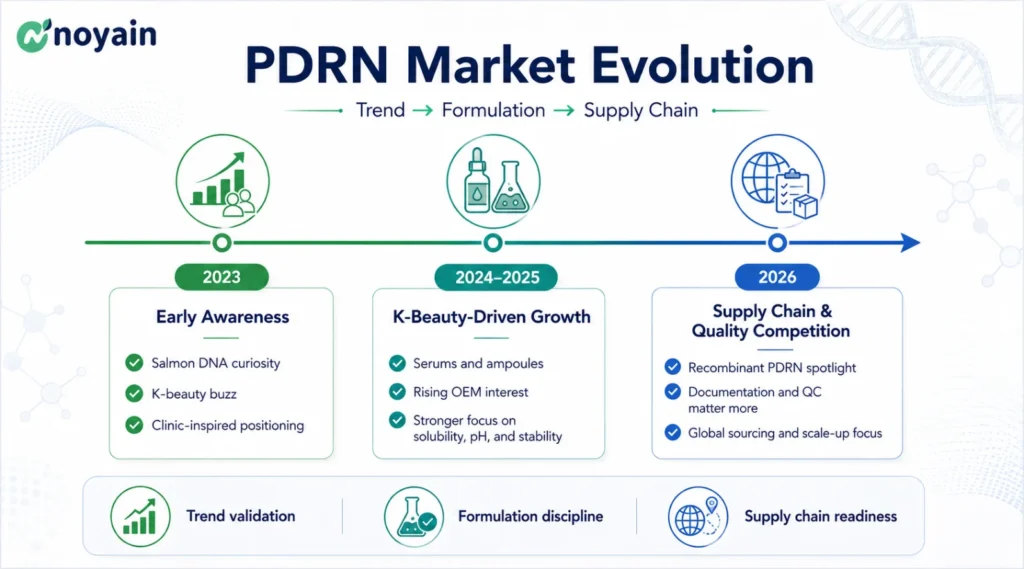
PDRN has moved through several stages in skincare.
It first gained visibility through Korean medical-aesthetic culture and skin booster concepts. Then it entered K-beauty serums, ampoules, creams, and sheet masks. Now, with recombinant PDRN being discussed in connection with a major global beauty group, PDRN is becoming a more serious raw-material and supply-chain topic.
According to public Chinese media reports, Clinique, a brand under The Estée Lauder Companies, launched a new CX repair-focused product series in China using recombinant PDRN as a core ingredient. The original industry discussion is important because it does not only describe a product launch. It points to a larger shift: global beauty brands are paying closer attention to biotechnology-based active ingredients, local supply-chain innovation, and higher technical standards for PDRN sourcing.
At Noyain, we view this as a practical signal for brands and OEM/ODM manufacturers.
The question is no longer simply:
“Should we use PDRN because it is trending?”
A better question is:
“Which PDRN material fits our source story, formula system, target market, quality standard, claim direction, regulatory dossier, and commercial supply plan?”
This article explains what the recombinant PDRN news means for brands, OEM/ODM factories, formulators, and buyers evaluating high purity Sodium DNA for skincare formulation and global market scale-up.
Key Takeaways
- Clinique’s recombinant PDRN launch suggests that PDRN is moving from K-beauty buzz into global-brand supply-chain validation.
- The industry shift is not only “PDRN is popular,” but “PDRN sourcing is becoming more technical.”
- Recombinant PDRN is attracting attention because it may support source control, batch consistency, molecular-weight design, scalable production, and animal-free positioning.
- Marine-sourced or salmon-derived Sodium DNA / PDRN remains commercially important because it has a mature application history, cost-performance advantages, and established use in medical-aesthetic-inspired skincare concepts.
- Buyers should compare PDRN materials by source, assay, molecular weight distribution, hyperchromicity, endotoxin, solubility, documentation, and formulation behavior.
- Topical PDRN is not the same as injectable PDRN. Cosmetic products need their own formulation validation and compliant claim language.
- At Noyain, we support global partners evaluating high purity Sodium DNA for skincare formulation, cosmetic-grade PDRN sourcing, technical dossier review, sample testing, formulation compatibility discussion, and bulk raw material supply planning.
What Happened: Clinique CX and Recombinant PDRN
According to Jiefang Daily / Shangguan News, Clinique launched a new CX product series in China on July 3, with recombinant PDRN as a core ingredient. The report described the launch as a result of Estée Lauder Companies’ local innovation work in China and stated that the recombinant PDRN material came from a domestic biotechnology company that had won an Estée Lauder Companies China innovation competition.
Sina Shanghai also reported that the Clinique CX series focuses on anti-aging and skin repair positioning, placing the launch within Estée Lauder Companies’ broader scientific skincare and medical-research collaboration strategy in China.
Separately, Clinique’s official U.S. website lists a Smart Clinical Repair™ Collagen + PDRN Cream, positioned around anti-aging, firming, hydration, collagen, PDRN, and peptides. This does not necessarily refer to the same recombinant PDRN supply chain, but it does show that PDRN has entered a major dermatologist-guided skincare brand’s visible consumer product language.
For ingredient buyers, this is the useful signal:
PDRN is no longer only discussed by niche K-beauty brands or clinic-inspired skincare startups. It is becoming a serious ingredient category watched by multinational beauty groups.
Why This News Matters for the PDRN Market
The most important part of this news is not the word “PDRN” itself.
Many brands already use PDRN, salmon DNA, Sodium DNA, or DNA-derived ingredient concepts in serums, masks, creams, ampoules, and post-care cosmetic products.
The more important signal is that production route, supplier quality, and documentation are becoming part of the ingredient story.
| Signal | What It Means for the Industry | Why Buyers Should Care |
|---|---|---|
| Global brand adoption | PDRN is moving beyond niche K-beauty visibility | Brands need more serious sourcing and documentation |
| Recombinant biotechnology | Production route becomes part of the product story | Source, process, purity, scalability, and claim direction matter |
| Local biotech supply chain | Chinese biotechnology suppliers may enter global beauty innovation pipelines | Buyers may see more PDRN sourcing options |
| Medical-aesthetic positioning | PDRN is linked to repair, post-care, and skin longevity narratives | Claims must remain cosmetic and evidence-controlled |
| Supplier evaluation | COA, assay, molecular weight distribution, hyperchromicity, and endotoxin become more important | Procurement decisions become more technical |
For B2B buyers, this changes the supplier conversation.
A strong PDRN project is not built by asking only:
- Is PDRN trending?
- What is the lowest price?
- Can you send a sample?
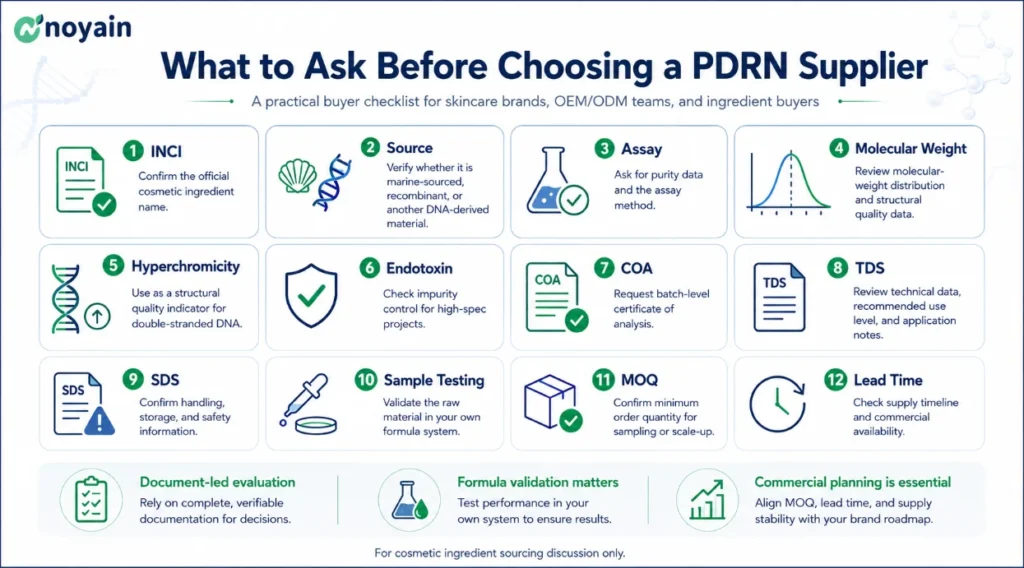
A more professional sourcing discussion should ask:
- What is the source?
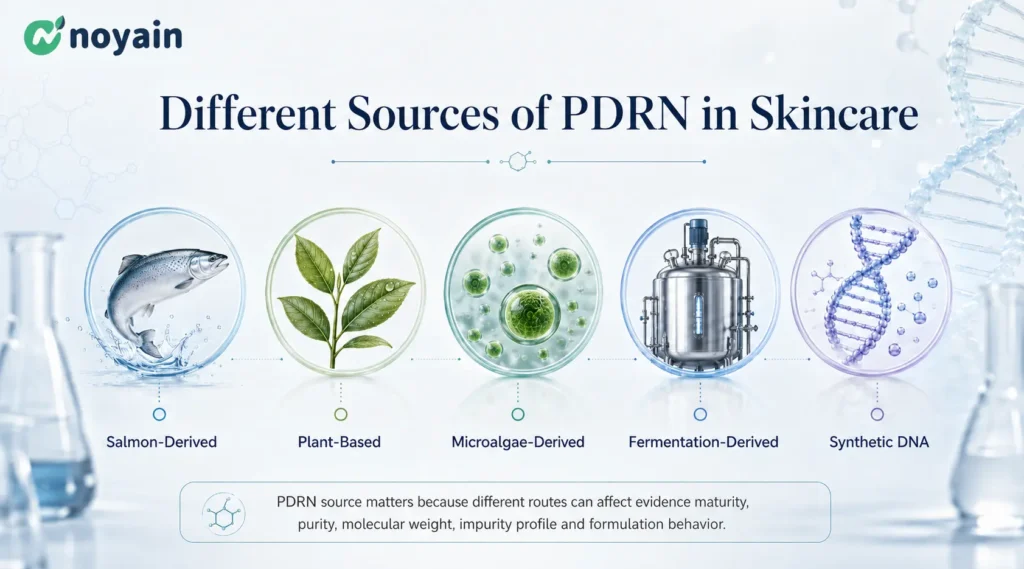
- Is it marine-sourced, salmon-derived, recombinant, or another DNA-derived material?
- What is the production route?
- What does the COA show?
- What is the assay method?
- What is the molecular weight distribution?
- Is PDRN hyperchromicity used as a quality indicator in the supplier’s current QC setup?
- Is endotoxin controlled?
- Is the material water-soluble?
- Can the supplier support formulation testing before scale-up?
- Can the brand make compliant cosmetic claims in the target market?
From K-Beauty Trend to Supply Chain Competition
PDRN first gained strong skincare visibility through Korean dermatology, skin booster culture, and K-beauty products. This early stage was driven by consumer curiosity, clinic-inspired positioning, and the appeal of “salmon DNA” in anti-aging and repair-focused skincare.
But the market is changing.
Stage 1: PDRN as a K-Beauty Trend
In the trend stage, consumers and brands focused on:
- salmon DNA
- PDRN ampoules
- glass-skin serums
- clinic-inspired skincare
- post-care repair concepts
- anti-aging and skin renewal stories
This helped create awareness. However, trend awareness alone does not build a stable product line.
For more background on this stage, see our article: PDRN Has Quickly Taken Over K-Beauty: What Formulators Need to Know.
Stage 2: PDRN as a Formulation Challenge
Once brands move from concept to product development, PDRN becomes a formulation question.
Formulators need to evaluate:
- water solubility
- pH environment
- processing temperature
- molecular weight distribution
- ionic compatibility
- preservative system
- viscosity and clarity
- packaging stability
- assay retention in the finished formula
A PDRN material that looks attractive in a marketing presentation may still behave differently in a serum, ampoule, toner, cream, or sheet mask essence.
For step-by-step raw material behavior, dosage screening, and product-format logic, check our PDRN formulation guide for serums, creams, masks, toners and ampoules.
Stage 3: PDRN as Supplier-Quality Competition
The next stage is supplier-quality competition.
Buyers are starting to compare:
- salmon-derived PDRN vs recombinant PDRN
- Sodium DNA vs broader DNA-derived materials
- UV assay or HPLC assay method
- molecular weight distribution
- endotoxin result
- protein content
- hyperchromicity
- batch consistency
- technical dossier
- source declaration
- regulatory support
- formulation compatibility support
This is the stage where ingredient suppliers, not only finished-product brands, become important.
Quick Answer: What Is Changing in the PDRN Market?
The PDRN market is moving from marketing-led growth to quality-led competition. Buyers are no longer only asking whether PDRN is popular. They are asking how it is produced, how it is tested, how stable it is in formulation, and whether the supplier can provide reliable documentation before scale-up.
Recombinant PDRN vs Marine-Sourced Sodium DNA: Not a Replacement Story
It is tempting to frame recombinant PDRN as the “new” option and salmon-derived PDRN as the “old” option.
That is too simple.
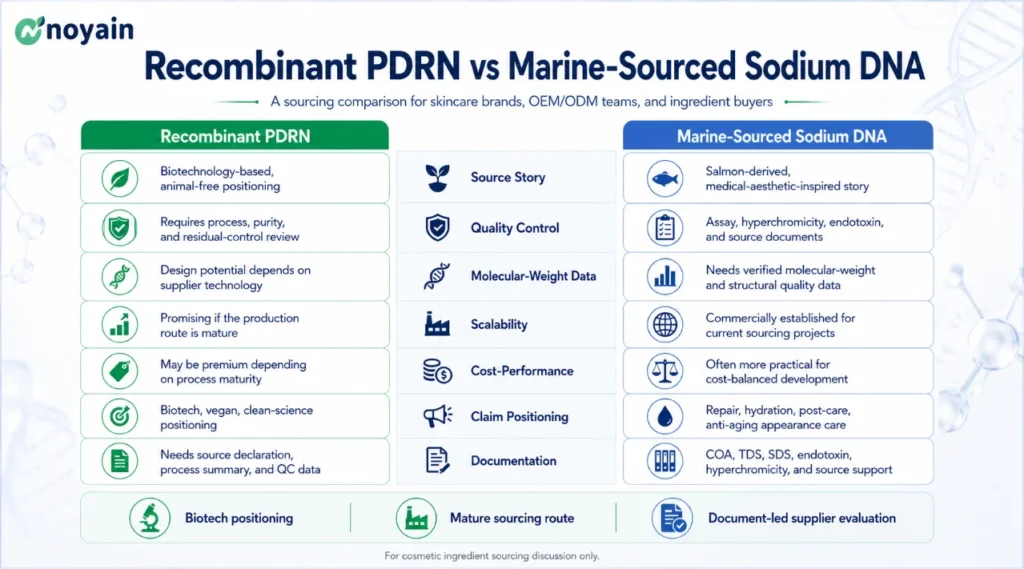
The more accurate view is that the PDRN market is moving toward two parallel supply routes, each with different strengths and different brand applications.
| Dimension | Recombinant / Biotechnology-Based PDRN | Marine-Sourced / Salmon-Derived Sodium DNA / PDRN | Buyer Interpretation |
|---|---|---|---|
| Best-fit positioning | Vegan, animal-free, biotechnology beauty, clean science | Medical-aesthetic-inspired skincare, repair serums, premium ampoules, cost-balanced active systems | Choose based on brand positioning, not trend pressure alone |
| Source story | May support animal-free or recombinant biotechnology narratives if verified | Familiar “salmon DNA” and PDRN story with strong consumer recognition | Both need clear source declarations |
| Supply maturity | Potentially scalable if the process is mature | More commercially established in many current PDRN sourcing projects | Ask for commercial capacity and batch consistency |
| Quality evaluation | Requires assay, molecular-weight data, residual-control data, and process documentation | Requires assay, molecular-weight data, hyperchromicity, endotoxin, protein content, and source documents | Do not accept either route based only on marketing wording |
| Cost structure | May be premium or limited depending on technology maturity | Often more practical for bulk PDRN powder wholesale and OEM/ODM development | Evaluate cost-performance and launch timeline |
| Claim direction | Biotech, vegan, animal-free, clean science | Post-care, skin comfort, hydration, anti-aging appearance care, premium repair concept | Claims must remain cosmetic and market-specific |
| Formula readiness | Must be validated in the target formula | Often easier to place into water-rich skincare systems if solubility and documentation are clear | Finished-formula testing is still required |
This is not a replacement story.
It is a strategic choice.
Recombinant PDRN may be attractive for brands that prioritize vegan, animal-free, or biotechnology beauty positioning. Marine-sourced Sodium DNA / PDRN remains a highly established route for brands that want a mature, ready-to-formulate, cost-effective, and medical-aesthetic-inspired active story.
While recombinant biotechnology represents an exciting direction for vegan-focused positioning, marine-sourced Sodium DNA remains a practical benchmark for repair-positioned and clinic-inspired skincare development. At Noyain, our high-purity salmon-derived Sodium DNA / PDRN, supported by 99.8% assay and 47.7% hyperchromicity in current commercial batch data, offers a mature sourcing option for brands that need immediate formulation testing, stable documentation, and cost-balanced product development.
For many brands, the best commercial choice is not always the newest source route. It is the source route that fits the formula, price target, launch calendar, regulatory dossier, claim direction, and target market.
Why Recombinant PDRN Is Getting Attention
Recombinant PDRN is not only a scientific phrase. For brands and OEM manufacturers, it can influence product positioning, documentation, and supply-chain strategy.
1. More Controllable Source Story
Traditional PDRN is commonly associated with salmon-derived DNA. This gives brands a familiar “salmon DNA” story, especially in K-beauty and medical-aesthetic-inspired skincare.
Recombinant PDRN may offer a different source story. If properly documented, it may support biotechnology beauty, animal-free beauty, or clean science positioning. This can be attractive for brands that want to move away from animal-derived ingredient narratives.
However, brands should not rely on supplier wording alone. They should request source declarations, production-route summaries, and market-specific compliance review.
2. Potential Batch Consistency
A mature recombinant or fermentation-based process may support more controlled batch-to-batch consistency. That is commercially important because PDRN projects often require repeated production, stable sensory performance, and reliable documentation.
But “potential consistency” is not the same as proven consistency.
Buyers should request:
- multiple batch COAs
- assay method
- molecular weight distribution data
- impurity control data
- endotoxin result
- microbiology data
- stability-related information
- production capacity information
3. Molecular-Weight Design Possibility
PDRN molecular weight matters because it affects formula behavior and may influence how brands discuss the material’s technical profile.
For recombinant PDRN, molecular-weight design may become a future differentiation point. But it must be supported by analytical data, not only marketing language.
For cosmetic sourcing, buyers should ask whether the supplier can provide molecular weight distribution data and explain how the test method supports the material’s intended application.
4. Scalable Supply Chain
If a recombinant production route is mature, it may reduce dependence on animal-derived biological raw materials. This could become important when brands plan larger product lines, global launches, or repeated OEM production.
For buyers, the key question is not only whether a supplier can provide a sample. The key question is whether the supplier can support:
- pilot testing
- scale-up batch planning
- repeatable specifications
- export documentation
- lead-time control
- long-term commercial supply
5. Stronger Biotechnology Story
Global beauty brands need ingredients that can support a long-term product narrative. PDRN is attractive because it connects with several current beauty themes:
- skin longevity
- repair-focused skincare
- post-care cosmetic routines
- dermatology-inspired product design
- biotechnology beauty
- DNA-derived active ingredients
- premium anti-aging appearance care
This is why the Clinique case matters. It shows that PDRN is not only a social-media-friendly ingredient name. It is becoming part of a broader scientific skincare and supply-chain conversation.
Why High Purity Sodium DNA for Skincare Still Matters
For brands that do not specifically require a vegan or recombinant source story, high purity Sodium DNA for skincare remains highly relevant.
At Noyain, our current focus is premium cosmetic-grade, marine-sourced Sodium DNA / PDRN for skincare formulation, OEM/ODM development, and bulk raw material sourcing. This grade is especially suitable for distributors, skincare brands, and OEM/ODM factories looking for reliable bulk PDRN powder wholesale solutions with technical document support.
Our QC testing and current commercial batch data support a high-specification sourcing profile, including:
| Parameter | Current Noyain Sodium DNA / PDRN Data |
|---|---|
| INCI name | Sodium DNA |
| CAS No. | 100403-24-5 |
| Purity / assay | 99.8% |
| Hyperchromicity | 47.7% |
| Solubility | Soluble in water |
| Source support | Salmon-source documentation available |
| Documentation support | COA, SPEC/TDS, MSDS/SDS, Halal declaration, endotoxin data |
| Application direction | Serums, ampoules, creams, masks, toners, eye-care products, and post-care cosmetic concepts |
This type of material can be useful when brands need:
- high purity Sodium DNA for skincare
- cosmetic-grade Sodium DNA supplier support
- bulk PDRN powder wholesale planning
- a cost-balanced PDRN raw material for OEM/ODM projects
- technical dossier support before sample testing
- formulation compatibility discussion before scale-up
For brands inspired by recombinant PDRN news but limited by project budget, supply timeline, or market readiness, a high-purity marine-sourced Sodium DNA / PDRN grade can be a practical drop-in sourcing alternative for repair-positioned, hydration-focused, and anti-aging appearance skincare concepts.
This does not mean every marine-sourced PDRN is automatically suitable. It means the supplier must be able to support the material with clear documents, analytical data, and formulation communication.
Regulatory and Documentation Considerations for Global Buyers
PDRN sourcing is not only a technical issue. It is also a regulatory and documentation issue.
Whether a brand chooses recombinant PDRN, salmon-derived PDRN, or another DNA-derived material, the buyer should confirm the ingredient status and documentation requirements in the target market.
United States: MoCRA and Safety Substantiation
For products marketed in the United States, brands and responsible persons should pay attention to the Modernization of Cosmetics Regulation Act of 2022 (MoCRA).
MoCRA increases the importance of:
- product listing
- ingredient records
- safety substantiation
- adverse event reporting
- facility registration
- documentation control
For PDRN or Sodium DNA projects, this means buyers should not only request a sample. They should request a complete raw-material documentation package for internal safety and regulatory review.
At Noyain, we provide technical dossiers, COA, SDS, source information, assay data, and quality-control documents to help your regulatory team organize raw-material information for MoCRA-related safety substantiation review.
European Union: INCI and CosIng Review
For EU-oriented projects, buyers should review ingredient naming and regulatory context through the European Commission CosIng database.
CosIng lists Sodium DNA/RNA as the sodium salt of DNA and RNA. However, CosIng review alone does not replace finished-product safety assessment, claim review, or compliance with Regulation (EC) No 1223/2009.
Brands should confirm:
- INCI name
- composition statement
- source declaration
- impurity profile
- safety data
- use level
- finished-product claim language
For EU-oriented projects, we help customers prepare ingredient-level documents such as INCI confirmation, composition information, source declaration, COA, SDS, and technical data for internal review before final cosmetic safety assessment.
China: NMPA / IECIC Review
For China-oriented projects, buyers should check the current NMPA ingredient inventory system and related updates. The NMPA announcement on IECIC management states that the Inventory of Existing Cosmetic Ingredients is managed through a dynamic adjustment mechanism and future updates are disclosed through the official NMPA website.
For PDRN, Sodium DNA, recombinant DNA-derived materials, or new source routes, brands should confirm whether the specific ingredient, naming, source, and use scenario meet the required regulatory pathway.
For China-oriented projects, we can assist customers by providing available raw-material safety information, source documents, technical data, and supplier information required for regulatory communication. If a project requires ingredient submission codes or additional local compliance documents, our team can coordinate the available documentation according to the actual supply status.
What Buyers Should Ask Us For
At Noyain, we help customers prepare ingredient-level documentation for target-market review. Depending on the project, this may include:
- COA
- SPEC / TDS
- MSDS / SDS
- source declaration
- CAS / INCI confirmation
- assay and test method information
- molecular weight discussion
- hyperchromicity data
- endotoxin data
- protein content
- heavy metals
- microbial limits
- recommended use level
- storage and handling guidance
- MOQ, lead time, packaging, and export documents
Final formula compliance, safety assessment, product registration, and claim approval must still be reviewed by the customer’s regulatory team or appointed local regulatory consultant.
But PDRN Still Has Formulation Limits
A serious PDRN article should also state what brands should not assume.
PDRN has a strong research background in dermatology, regenerative medicine, and wound-related studies. Published reviews discuss mechanisms such as adenosine A2A receptor involvement, fibroblast activity, extracellular matrix remodeling, collagen-related pathways, angiogenesis, and tissue-repair research.
However, much of the strongest evidence comes from medical, injectable, preclinical, or clinical dermatology contexts.
That evidence should not be copied directly into topical cosmetic claims.
Brands Should Not Assume
- PDRN in a topical serum works the same way as injectable PDRN.
- Higher dosage always means better performance.
- Recombinant PDRN automatically performs better than marine-sourced Sodium DNA.
- A topical cosmetic product can directly borrow wound-healing or injection evidence.
- Supplier purity data can replace finished-product efficacy testing.
- PDRN alone can support a complete anti-aging claim without formula design and substantiation.
Brands Should Evaluate
- molecular weight distribution
- water solubility
- pH window
- heat exposure during processing
- ionic compatibility
- thickener compatibility
- preservative compatibility
- packaging and storage
- assay retention
- microbial quality
- finished-product stability
- claim substantiation
For topical skincare, formula architecture matters. PDRN is usually more commercially convincing when paired with a thoughtful support system, such as:
- hyaluronic acid for hydration and plump-looking skin
- panthenol for comfort and barrier-support positioning
- beta-glucan for soothing-focused formulas
- ectoin for stress-care and comfort concepts
- niacinamide for tone and barrier-support positioning
- ceramides and squalane for cream-based repair concepts
- peptides for premium anti-aging appearance care
This is why PDRN should not be treated as a simple “drop-in trend active.” It needs formulation discipline.
For more practical formulation logic, read our PDRN formulation guide for serums, creams, masks, toners and ampoules.
What This Means for Skincare Brands
For skincare brands, the recombinant PDRN news is useful because it shows where the market is moving.
PDRN is no longer only a novelty ingredient. It can support a premium product story when the brand can explain the source, quality, formula logic, and claim direction.
| Brand Goal | How PDRN Can Support the Concept | What Must Be Controlled |
|---|---|---|
| Premium repair serum | High-value active story with hydration, comfort, and smoother-looking skin positioning | Claim language, supplier documents, formula stability |
| Post-care cosmetic line | Comfort, hydration, and barrier-support positioning after cosmetic procedures | Avoid medical treatment claims |
| Anti-aging appearance care | Plumper-looking, firmer-looking, and smoother-looking skin concepts | Finished-product evidence and delivery system |
| Sensitive skin product | Gentle comfort and repair-support story | Irritation testing and formula compatibility |
| Vegan or biotech concept | Recombinant PDRN may fit if source is verified | Written source declaration and compliance review |
| K-beauty-inspired ampoule | Strong market recognition and premium active positioning | Viscosity, clarity, pH, preservative system, and packaging |
For brand teams, the main opportunity is not to say “we use PDRN” in a generic way.
The stronger approach is to explain:
- why this PDRN source was selected
- what quality data supports the raw material
- why the formula format fits PDRN
- what cosmetic claims are being made
- what claims are deliberately avoided
- how the finished formula was tested
A disciplined brand story is more credible than a louder claim.
What This Means for OEM/ODM Manufacturers
For OEM/ODM manufacturers, PDRN creates both an opportunity and a responsibility.
Many brand customers may ask for PDRN because they see market demand. But they may not fully understand the differences between PDRN, Sodium DNA, salmon DNA, recombinant PDRN, polynucleotides, hydrolyzed DNA, or broader DNA-derived materials.
OEM/ODM teams can create value by turning a trend request into a development framework.
OEM/ODM Teams Should Prepare
- A PDRN source comparison table
- COA and specification review
- Molecular weight distribution and assay comparison
- Hyperchromicity and structural quality discussion
- Endotoxin and protein-content review
- Prototype formula screening
- pH, viscosity, clarity, odor, color, and stability records
- Preservative challenge test plan
- Claim-language options
- Customer-facing technical explanation sheet
For example, if a brand asks for a “high-PDRN ampoule,” the OEM should not only increase the active level.
The better process is:
- confirm the PDRN grade and documents
- screen several addition levels
- check solubility and clarity
- monitor pH and viscosity drift
- check preservative compatibility
- test packaging stability
- review cosmetic claims before marketing approval
This turns PDRN from a trend ingredient into a real product-development project.
PDRN Supplier Evaluation Checklist
For buyers, the supplier discussion should be document-led.
When evaluating a PDRN raw material manufacturer, distributor, or technical supplier, the key question is not only whether the material is called PDRN. Buyers should verify what the material is, how it is tested, how it behaves in formulation, and whether the supplier can support regulatory and procurement review.
| Buyer Question | Why It Matters | Document or Data to Request |
|---|---|---|
| What is the INCI name? | Supports labeling and regulatory review | INCI / composition statement |
| Is it Sodium DNA, PDRN, PN, or another DNA-derived material? | Prevents terminology confusion | Product specification |
| What is the source? | Affects animal-derived, marine-sourced, recombinant, vegan, or clean beauty claims | Source declaration |
| What is the production route? | Extraction, fermentation, recombinant, or hydrolysis route affects impurity and claim direction | Process summary or flow chart |
| What is the assay? | Supports purity comparison | COA and test method |
| Is the assay by UV, HPLC, or another method? | Different methods may answer different quality questions | Method statement |
| What is the molecular weight distribution? | Affects material profile and formulation behavior | MWD data |
| Is hyperchromicity tested? | Helps assess DNA structural quality | Hyperchromicity result and method |
| Is endotoxin controlled? | Important quality indicator for high-spec projects | Endotoxin test report |
| Is protein content tested? | Supports impurity and sensitivity review | COA |
| Is the material water-soluble? | Critical for serums, ampoules, masks, and toners | Solubility data |
| What is the recommended use level? | Helps guide prototype design | TDS / application notes |
| Can the supplier support formulation discussion? | Reduces scale-up risk | Application notes and technical communication |
| Can the supplier support bulk PDRN powder wholesale projects? | Important for distributors, OEM factories, and global brand launches | MOQ, lead time, packaging, and export documents |
This checklist is especially useful when comparing marine-sourced PDRN and recombinant PDRN. Both may be valuable. Both require evidence. Neither should be accepted based only on marketing wording.
Noyain: Your Technical Cosmetic-Grade Sodium DNA Supplier
To clarify, we are not part of the Clinique or Estée Lauder supply chain.
Our role as a technical cosmetic-grade Sodium DNA supplier is different: we help skincare brands, OEM/ODM manufacturers, distributors, and formulation teams evaluate Sodium DNA / PDRN for their own product development projects.
As a cosmetic ingredient supplier focused on PDRN raw material sourcing, we support customers with:
- sample request
- COA support
- TDS / specification sheet
- MSDS / SDS
- source declaration
- endotoxin data
- hyperchromicity data
- molecular weight discussion
- recommended use level
- formulation compatibility discussion
- quotation, MOQ, lead time, and export support
- technical dossier support for internal R&D and procurement review
Our current commercial batch data shows 99.8% assay, 47.7% hyperchromicity, water solubility, salmon-source documentation, and low-endotoxin QC data for formulation and procurement review.
For brands evaluating recombinant PDRN, marine-sourced Sodium DNA, or different DNA-derived materials, the practical first step is not to decide based on trend language. The first step is to compare documents, test samples, and validate the material in the intended formula.
If your project specifically requires recombinant, vegan, or plant-positioned PDRN, our team can also help evaluate customized sourcing options, technical feasibility, and documentation requirements.
Technical Documents Available Upon Request
| COA | TDS / SPEC | SDS / MSDS | QC Data |
|---|---|---|---|
| Assay, appearance, solubility, batch information | INCI, CAS, recommended use level, application direction | Handling, storage, safety information | Hyperchromicity, endotoxin, source support and other project-specific data |
Request a Sample and Technical Data Package
For your next PDRN serum, ampoule, cream, mask, toner, or OEM/ODM project, you can request a sample and technical data package from our team.
Related Technical Resources from Noyain
To support your R&D, procurement, and regulatory teams, we have compiled our technical resources around PDRN sourcing, formulation behavior, quality indicators, and supplier evaluation.
- For product specifications and sample requests, visit our Cosmetic-Grade Sodium DNA / PDRN Product Page.
- For supplier questions from Korean buyers, read How to Choose a PDRN Supplier: Noyain Answers at the 2026 Korea Cosmetics Show.
- For structural quality evaluation, read PDRN Hyperchromicity as a Key Quality Indicator for Double-Stranded DNA.
- For formula architecture, read our PDRN Serum, Cream, Mask, Toner and Ampoule Formulation Guide.
- For the market background, read PDRN Has Quickly Taken Over K-Beauty: What Formulators Need to Know.
- For topical and injectable claim boundaries, read PDRN Injection vs Topical: Efficacy and Safety Guide.
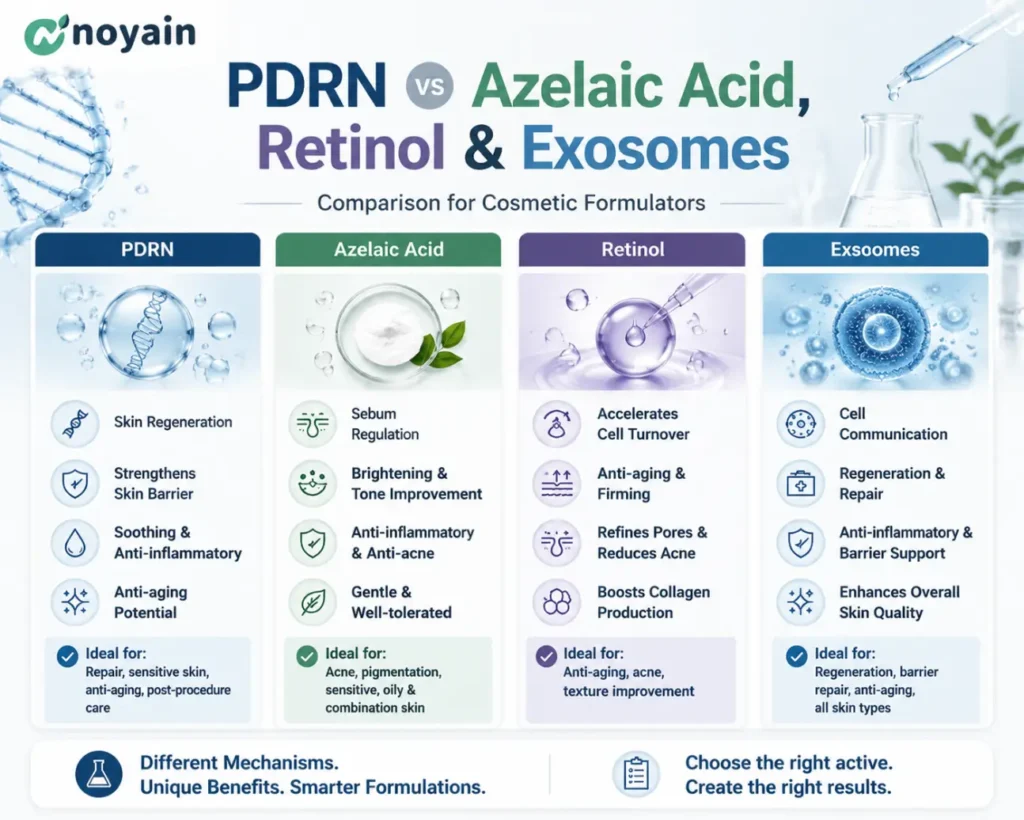
- For active ingredient positioning, read PDRN vs Azelaic Acid, Retinol & Exosomes: Comparison for Cosmetic Formulators and Distributors.
Final View: PDRN Is Moving from Hype to Quality Competition
The Clinique recombinant PDRN news should not be read only as a single product launch. It is a sign of a broader industry shift.
PDRN is moving into a more serious phase.
In the early trend stage, brands asked whether PDRN was popular. In the next stage, buyers will ask whether the PDRN material is well documented, stable, scalable, and suitable for the target formula.
For skincare brands, this means PDRN can support premium repair, hydration, post-care, and anti-aging appearance concepts when claims are controlled and evidence is respected.
For OEM/ODM manufacturers, this means PDRN should be handled as a technical development project, not only a marketing request.
For ingredient buyers, this means supplier selection should focus on source, assay, molecular weight distribution, hyperchromicity, endotoxin, solubility, formulation behavior, regulatory dossier, and document support.
The future of PDRN skincare will not be decided only by which brand uses the loudest claim. It will be decided by which companies can combine market timing, formulation discipline, compliant storytelling, and reliable raw-material supply.
FAQ
What Is Recombinant PDRN in Skincare?
Recombinant PDRN is a DNA-derived cosmetic ingredient produced through a biotechnology-based route rather than direct extraction from animal-derived biological raw materials.
The exact production method may vary by supplier, so buyers should request source declarations, production-route information, COA, assay data, molecular weight distribution data, and regulatory support before using the material in a cosmetic formula.
Is Recombinant PDRN Better Than Salmon-Derived PDRN for Skincare?
Not automatically. Recombinant PDRN may offer advantages in animal-free positioning, source control, scalability, or molecular-weight design if the supplier has mature technology and proper documentation.
Marine-sourced or salmon-derived Sodium DNA / PDRN remains commercially important because it can offer a mature supply route, strong cost-performance, familiar market positioning, and practical formula compatibility. Buyers should compare actual documents and formula performance rather than relying on the source story alone.
What Is the Difference Between Sodium DNA and PDRN in Cosmetic Sourcing?
Sodium DNA is commonly used as the cosmetic INCI name for PDRN-related DNA materials.
However, buyers should still confirm the exact material type, source, molecular weight distribution, assay, hyperchromicity, and test methods because PDRN, PN, salmon DNA, recombinant PDRN, hydrolyzed DNA, and other DNA-derived terms may be used differently in marketing and sourcing conversations.
Why Did Clinique’s Recombinant PDRN Launch Attract Industry Attention?
It attracted attention because it suggests that PDRN is moving from a K-beauty trend into the supply-chain strategy of global beauty groups.
The news also highlights how biotechnology, local innovation platforms, and raw-material process control are becoming more important in premium skincare development.
Can Topical PDRN Replace Injectable PDRN?
No. Topical PDRN should not be treated as equivalent to injectable PDRN.
Many PDRN studies come from medical, injectable, preclinical, or dermatology contexts. A topical cosmetic product needs its own formulation design, stability testing, skin compatibility review, and compliant cosmetic claim substantiation.
What Should Brands Ask Before Choosing a PDRN Raw Material Supplier?
Brands should first verify source, INCI, assay, molecular weight distribution, hyperchromicity, endotoxin, solubility, documentation, and formulation support.
For high-spec projects, buyers should request COA, TDS/SPEC, SDS/MSDS, source declaration, assay method, molecular weight data, hyperchromicity result, endotoxin result, microbial limits, recommended use level, MOQ, lead time, and sample testing support.
How Do We Evaluate High Purity Sodium DNA for Skincare Formulation?
High purity Sodium DNA should be evaluated through a combination of assay, molecular weight distribution, hyperchromicity, endotoxin, protein content, microbial limits, solubility, batch consistency, and finished-formula stability.
A high assay result alone does not prove finished-product efficacy. It should be reviewed together with structural indicators and formulation performance.
Does Noyain Supply Recombinant PDRN or Only Marine-Sourced Sodium DNA?
At Noyain, we currently focus on premium cosmetic-grade, marine-sourced Sodium DNA / PDRN for skincare formulation, OEM/ODM development, and bulk raw material sourcing.
If your project specifically requires recombinant, vegan, or plant-positioned PDRN, our team can help evaluate customized sourcing options, technical feasibility, documentation requirements, and formulation compatibility before you move into sampling or scale-up.
What Product Formats Are Suitable for PDRN Skincare?
PDRN is commonly evaluated in water-rich cosmetic formats such as serums, ampoules, masks, toners, essences, light creams, and eye-care products.
Final suitability depends on solubility, pH, processing temperature, preservative system, packaging, and finished-formula stability.
What Claims Are Safer for Topical PDRN Cosmetics?
Safer cosmetic claim directions include hydration support, skin comfort, smoother-looking skin, plump-looking skin, barrier-support positioning, visibly healthier-looking skin, and anti-aging appearance care.
Brands should avoid medical treatment, wound-healing, injectable-equivalent, or disease-related claims unless the target market’s regulatory framework and evidence package support them.
References & Sources
- Jiefang Daily / Shangguan News.
- Sina Shanghai.
- Clinique Official. “Clinique Smart Clinical Repair™ Collagen + PDRN Cream.”
- The Estée Lauder Companies. “The Estée Lauder Companies Showcases New Research at the Chinese Dermatology Association (CDA) 2025 Annual Meeting.”
- European Commission CosIng. “Sodium DNA/RNA.”
- U.S. FDA. “Modernization of Cosmetics Regulation Act of 2022 (MoCRA).”
- National Medical Products Administration. “Announcement on Matters Related to the Administration of the Inventory of Existing Cosmetic Ingredients (IECIC).”
- Akaberi SM, Sharma K, Ahmadi-Ashtiani HR, Hedayati M. “Polydeoxyribonucleotide in Skincare and Cosmetics: Mechanisms, Therapeutic Applications, and Advancements Beyond Wound Healing and Anti-aging.” Journal of Skin Stem Cell, 2025.
- Veronesi F, et al. “Polydeoxyribonucleotides from Skin to Musculoskeletal Tissue Regeneration via Adenosine A2A Receptor Involvement.” PubMed.
- Colangelo MT, et al. “The Effects of Polydeoxyribonucleotide on Wound Healing and Tissue Regeneration: A Systematic Review.” PubMed.