
Cosmetic Active System
Sodium DNA (PDRN)
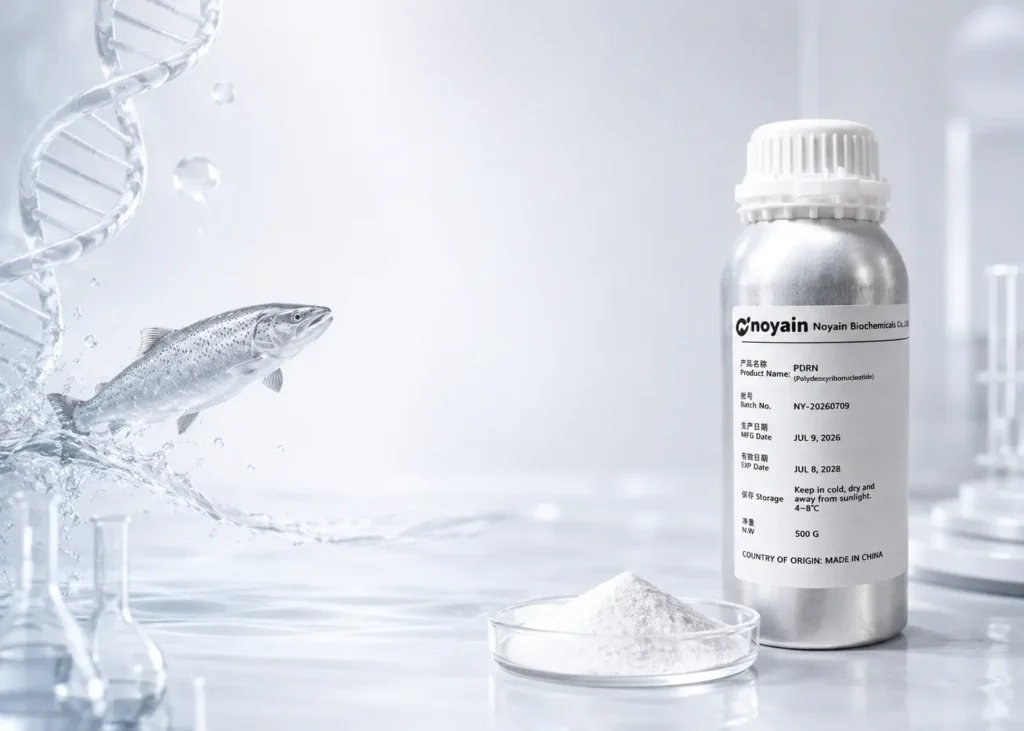
Cosmetic-grade Sodium DNA / PDRN powder/liquid for skincare formulation, OEM/ODM development, and bulk raw material sourcing.
Sodium DNA (PDRN) is a cosmetic raw material used in serums, ampoules, creams, masks, toners, and post-care skincare concepts. Our current batch data supports a high-specification sourcing story with 99.8% assay by UV, 47.7% hyperchromicity, water solubility, salmon-source documentation, and low-endotoxin QC data for formulation and procurement review.
Sodium DNA active for advanced skincare concepts
47.7% hyperchromicity in current COA
COA, SPEC, MSDS, Halal and endotoxin data available
INCI
Sodium DNA
CAS
100403-24-5
Function
Skin conditioning; anti-aging appearance care; hydration and skin comfort positioning
Recommended Dosage
0.02-1%; water cream reference 0.05-0.3%; water-based formula reference 0.2-0.3%
Shelf Life
24 Months
Product Overview
Sodium DNA (PDRN) for Advanced Anti-Aging and Skin Comfort Formulations
Sodium DNA (PDRN) is a cosmetic active raw material used in formulations designed for anti-aging appearance care, hydrated and plump-looking skin, smoother texture, skin comfort, and post-care cosmetic positioning. For skincare brands, formulators, manufacturers, and distributors, it helps build product concepts around salmon DNA, PDRN quality control, and high-value cosmetic active storytelling.
In formulation development, Sodium DNA (PDRN) is especially suitable for water-rich leave-on systems where hydration, comfort, texture, and active positioning are central to the product concept. It can be used in serums, ampoules, creams, sheet mask essences, toners, and eye-care products. Final use level, pH, preservative compatibility, processing temperature, and finished-product claims should be validated in the final formula.
For sourcing and commercial evaluation, buyers should confirm INCI, CAS statement, source declaration, assay, hyperchromicity, molecular-weight range, endotoxin, protein content, solubility, appearance, recommended use level, COA, TDS/SPEC, SDS/MSDS, Halal declaration, MOQ, lead time, packaging, and batch consistency before sample testing or bulk order approval.
01
Match Your Required Spec
Tell us your target assay, hyperchromicity expectation, endotoxin requirement, source documentation, use level, and application scenario. We help you confirm whether our Sodium DNA (PDRN) specification matches your formulation or sourcing project.
02
Test It in Your Formula
We support sample evaluation for PDRN serums, ampoules, creams, mask essences, toners, eye care, and post-care cosmetic concepts. Compatibility, pH, temperature, viscosity, preservative system, and stability should be checked in the finished formula.
03
Prepare for Commercial Order
For bulk purchasing, we help confirm COA, TDS/SPEC, MSDS, endotoxin data, Halal declaration, source statement, MOQ, lead time, packaging, shipping documents, and batch consistency before commercial approval.
Core Advantages
Why Formulators Choose Sodium DNA
01
Skin Repair Support
Helps improve the appearance of damaged or stressed skin by supporting natural skin renewal processes.
02
Anti-Aging Performance
Assists in reducing visible signs of aging, including fine lines, loss of elasticity, and uneven skin texture.
03
Barrier Enhancement
Supports skin barrier function and helps maintain healthier, more resilient skin.
04
Deep Hydration Synergy
Works synergistically with moisturizing ingredients to improve skin hydration and comfort.
Market Applications
Recommended Applications for Sodium DNA (PDRN)
Serum
PDRN Anti-Aging Serum
In anti-aging serum formulas, Sodium DNA (PDRN) can be used as a featured cosmetic active to support hydration, smoother-looking texture, plump-looking skin, and premium active positioning. It can be combined with glycerin, betaine, sodium hyaluronate, niacinamide, panthenol, peptides, or ectoin. Final use level, pH, preservative compatibility, and assay retention should be verified in the finished formula.
Ampoule
Intensive PDRN Ampoule
In ampoule systems, Sodium DNA (PDRN) supports concentrated skincare concepts focused on comfort, hydration, and visibly healthier-looking skin. It is suitable for water-rich formulas paired with humectants, soothing agents, and barrier-support ingredients. Processing temperature and viscosity should be controlled to avoid unnecessary stress on the ingredient.
Cream
PDRN Barrier-Support Cream
In cream and emulsion systems, Sodium DNA (PDRN) can help create a skin-comfort and anti-aging appearance story when paired with panthenol, ceramides, squalane, niacinamide, betaine, and mild emulsifier systems. Compatibility with cationic ingredients, electrolytes, preservatives, and pH adjusters should be checked before scale-up.
Sheet Mask
PDRN Recovery-Positioned Mask Essence
In sheet mask essence formulas, Sodium DNA (PDRN) can be used for hydration, skin comfort, and post-use smoothness concepts. It can be combined with sodium hyaluronate, glycerin, allantoin, panthenol, ectoin, and soothing botanical systems. Preservative challenge testing and microbial quality are especially important for water-rich mask systems.
Toner
PDRN Water Essence
In toner and essence formats, Sodium DNA (PDRN) supports lightweight hydration and active-layering concepts. Formulators should confirm complete dissolution, clarity, pH, preservative compatibility, and packaging stability, especially in formulas containing acids, electrolytes, metal ions, or strong botanical extracts.
Eye Care
PDRN Eye Serum or Cream
In eye-area skincare, Sodium DNA (PDRN) can be positioned for hydrated, smoother-looking, and tired-looking skin concepts. It may be paired with peptides, sodium hyaluronate, panthenol, niacinamide, and gentle emollients. Eye-area safety, use level, and irritation potential must be verified in the finished formula.
why choose us
Our high-quality PDRN ingredients
Built on Long-Term DNA Research and Process Development
Our PDRN is developed on the basis of long-term DNA research and continuous process optimization, with a focus on DNA extraction, purification, molecular-weight control, and quality consistency. This research-driven approach supports the development of well-characterized salmon-derived PDRN for premium cosmetic formulations.
Premium Wild Pacific Salmon Source
Derived exclusively from wild-caught Pacific salmon from the Russian Far East, free from antibiotics, artificial feed, and aquaculture contaminants. With approximately 98% DNA homology to human DNA, it offers outstanding biocompatibility and biological activity.
Exceptional Purity and Quality Consistency
During extraction, the highly purified DNA forms visible crystal-like precipitates, indicating efficient DNA recovery and purification. Combined with 99.8% purity, a Hyperchromicity value of 47.7%, and endotoxin strictly controlled at ≤0.01 EU/mL, it demonstrates a high level of purity, double-stranded DNA integrity, and quality control consistency.
Clinically Demonstrated Anti-Aging and Repair Benefits
Efficacy has been evaluated through in vitro, in vivo, and human testing. In a 33-subject human study, the tested formulation showed improvements in key cosmetic skin parameters after 28 days, including stratum corneum hydration +45.48%, skin elasticity +11.86%, firmness +26.86%, crow's-feet volume -6.58%, and crow's-feet area -8.99%. Skin density was also evaluated using ultrasound-based instrumental measurement.
Backed by a More Established Research History
Salmon-derived PDRN has decades of research across biological mechanisms, tissue repair, and clinical applications. Plant-derived alternatives are emerging, particularly for vegan positioning, but their evidence base remains comparatively recent and limited.
Explore the differences between PDRN sources →Advanced Solvent-Free Extraction & Membrane Purification Technology
Our PDRN is produced using an inorganic-salt-based extraction process combined with pressure-driven membrane separation and purification.
Rather than defining purification quality by a fixed number of repeated filtration cycles, the process is designed to separate target DNA fractions while efficiently reducing residual proteins, polysaccharides, and other non-target impurities.
The purification process can be performed under controlled mild-temperature conditions to minimize unnecessary thermal stress on the DNA material. Combined with 99.8% assay and a Hyperchromicity value of 47.7%, this process supports consistent production of high-quality PDRN for premium cosmetic active applications.
Formulation Guide
How to Use Sodium DNA (PDRN) in Formulations
Use our Sodium DNA (PDRN) as a water-compatible cosmetic active for advanced skincare formulas. Our application guidance recommends 0.02-1% for general use, 0.05-0.3% for water cream concepts, and 0.2-0.3% for water-based formulas. We support formulation discussion for processing, compatibility, and claim direction.
Get Formulation GuideUse Level
Our application guidance recommends 0.02-1% as a general use range. For water cream concepts, we recommend 0.05-0.3%; for water-based formulas, we recommend 0.2-0.3%. Contact us for formulation support based on your product format, target claim, pH, preservative system, and stability plan.
Solubility
Our current COA states that Sodium DNA (PDRN) is soluble in water. Our application notes indicate that a 50 degrees C water bath can speed dissolution, while excessive temperature may affect molecular weight. Contact us for TDS and dissolution guidance before scale-up.
Addition Phase
We recommend water-phase pre-dissolution or cool-down addition depending on formula temperature and process. Avoid unnecessary high heat and prolonged high shear after Sodium DNA (PDRN) addition. Monitor clarity, dispersion, viscosity, and assay retention during pilot testing.
Compatible Actives
Our Sodium DNA (PDRN) can be developed with glycerin, betaine, sodium hyaluronate, panthenol, ectoin, niacinamide, peptides, ceramides, squalane, allantoin, and soothing agents. We recommend careful testing with acids, strong oxidizers, cationic salts, metal ions, and high-electrolyte systems.
Stability Check
We recommend monitoring pH, color, odor, viscosity, precipitation, microbial quality, preservative compatibility, endotoxin-related documentation, and assay retention under accelerated and real-time stability conditions. For PDRN systems, our application notes support pH design around 5.8-6.2.
Packaging Suggestion
Use clean, well-sealed packaging that protects the finished formula from contamination, light, and moisture. For advanced water-rich formulas, airless or low-contamination packaging may be considered. We provide batch COA/TDS and MSDS guidance for raw-material storage and handling.
Technical Specifications
Product Technical Parameters
Parameter | Specification |
|---|---|
Trade Name | PDRN |
INCI Name | Sodium DNA |
CAS No. | 100403-24-5 |
Approximate molecular weight | <1000kDa |
Hyperchromicity | 47.7% |
Purity | 99.8% |
Appearance | White, off-white, or light-yellow powder |
Recommended Dosage | 0.02-1%; water cream reference 0.05-0.3%; water-based formula reference 0.2-0.3% |
Solubility | Soluble in water |
Function | Skin conditioning; anti-aging appearance care; hydration and skin comfort positioning |
Application | Creams, serums, facial oils, eye care, masks, and emulsions |
Storage Condition | Keep tightly sealed, protected from light and moisture; MSDS recommends cool, dark, dry storage and -20 degrees C for long-term storage |
Shelf Life | 24 months under recommended storage conditions |
Why Choose NOYAIN®
Supply Support for Sodium DNA (PDRN) Projects
- Batch-specific COA support for assay, hyperchromicity, pH, loss on drying, protein content, endotoxin, molecular weight, heavy metals, and microbial limits.
- SPEC/TDS and MSDS support for formulation review, storage, handling, documentation, and procurement approval.
- Endotoxin test report support for low-endotoxin PDRN sourcing conversations and buyer quality review.
- Halal declaration available for Sodium DNA / PDRN-related grade; contact us to match the document to your target market and product claim.
- Sample support for lab screening in serums, ampoules, creams, masks, toners, eye care, and OEM/ODM product development.
- Technical communication for source declaration, CAS confirmation, use level, pH design, dissolution, preservative compatibility, and batch consistency.
- Quotation, MOQ, lead time, packaging, shipping documents, and commercial-order support for pilot and bulk procurement.
Kind Tips
Formulation Precautions
Temperature Control
Our application notes state that moderate water-bath heating can speed dissolution, while excessive temperature may affect molecular weight. We recommend avoiding unnecessary high heat and checking assay retention in the final process.
pH and Buffer Design
Our application notes mention a PDRN compounding solution pH around 5.8-6.2 and phosphate buffer support. We can help discuss pH adjustment, buffer selection, and long-term formula behavior before scale-up.
Compatibility Screening
Carefully test Sodium DNA (PDRN) with strong oxidizers, strong acids, strong alkalis, cationic salts, high-electrolyte systems, metal ions, and highly reactive actives. Monitor precipitation, viscosity shift, discoloration, and odor.
Preservative and Microbial Control
Water-rich PDRN formulas require robust preservative design and challenge testing. Our application notes mention compound preservative systems with polyols, and our team can support preservative-system discussion during prototype development.
related products
Other related products
Related Documents
Technical Documents
COA Document
Get For FreeTDS (Technical Data Sheet)
Get For FreeMSDS (Material Safety Data Sheet)
Get For FreeFormulation Guide
Get For FreeRelated Topics
PDRN Product Solutions
related products
Product-related articles
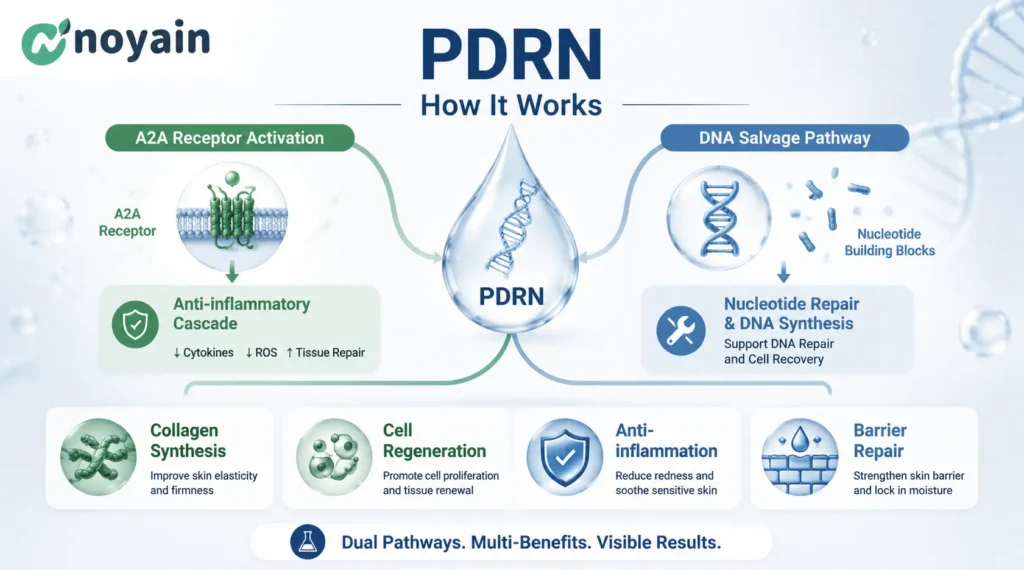
What is PDRN? A Complete Guide to Salmon DNA in Skincare (2026)
PDRN has moved quickly from regenerative-medicine research into K-beauty marketing, cosmetic formulation and global ingredient sourcing. That popularity has also created confusion.Some pages describe PDRN as…
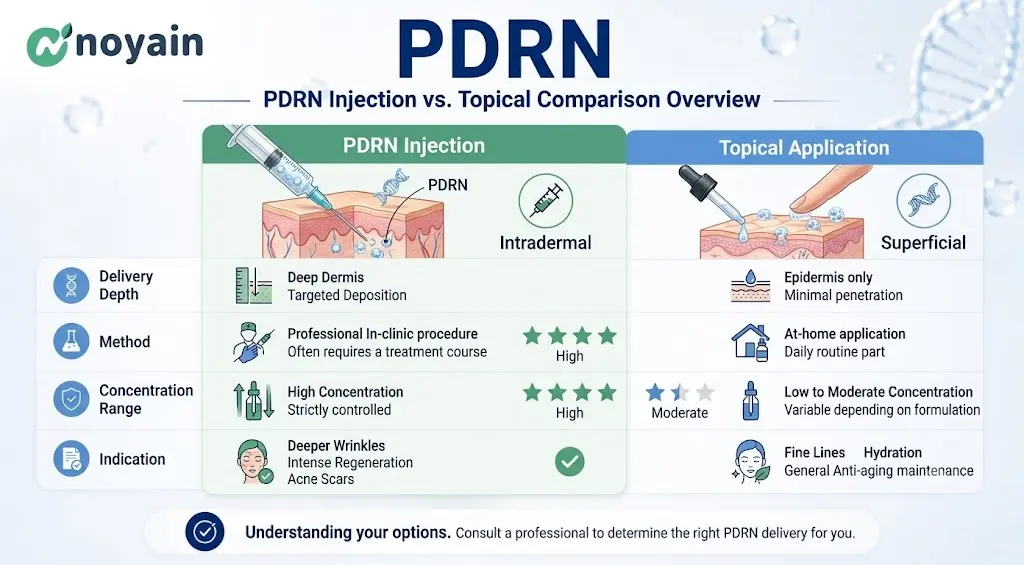
PDRN Injection vs Topical PDRN: Which Works Better?
Cosmetic claim note: This article compares professional injectable PDRN or polynucleotide treatments with topical PDRN skincare for educational purposes. Injectable products and procedures are regulated differently…

How Is PDRN Extracted? From Salmon DNA to a High-Specification Raw Material
PDRN is usually introduced as “salmon DNA”, which makes it sound like something you simply take out of a fish. Turning it into a Sodium DNA…
Ready to Source Sodium DNA (PDRN) for Advanced Skincare?
Contact us to request a sample, quotation, COA, SPEC/TDS, MSDS, endotoxin report, Halal declaration, and formulation support for your PDRN serum, ampoule, cream, mask, or OEM/ODM project.
Frequently Asked Questions
Questions from Formulators and Buyers
- What is Sodium DNA in cosmetics?
Sodium DNA is a biotechnology-derived active ingredient composed of nucleic acid fragments that support skin repair, hydration, and anti-aging cosmetic applications.
- Is Sodium DNA the same as PDRN?
Sodium DNA and PDRN are closely related nucleotide-based materials used in cosmetic formulations. Both are valued for their skin-regenerating and repair-supporting properties.
- What are the benefits of Sodium DNA for skincare?
Sodium DNA helps support skin renewal, improve hydration, enhance skin barrier function, and reduce visible signs of aging.
- Can Sodium DNA be used in sensitive skin formulations?
Yes. Sodium DNA is commonly incorporated into formulations designed for sensitive, damaged, or stressed skin due to its skin-conditioning properties.
- What is the recommended dosage of Sodium DNA?
Typical usage levels range from 0.02–1%, depending on formulation goals and product type.
- What does 47.7% hyperchromicity mean for PDRN sourcing?
Hyperchromicity is a structure-related UV indicator used in PDRN quality evaluation. It is commonly used to assess double-stranded DNA behavior and can help buyers compare batch quality together with other technical parameters.
Our current COA reports 47.7% hyperchromicity, while the specification threshold is ≥30.0%. This higher result can support a stronger quality-control and sourcing differentiation story compared with materials that only meet the minimum threshold.
However, hyperchromicity should not be used as a standalone efficacy claim. For professional sourcing review, it should be evaluated together with assay, molecular-weight range, endotoxin level, protein content, microbial limits, heavy metals, solubility, batch consistency, and finished-formula testing.