At in-cosmetics Korea 2026, the PDRN conversations we had with Korean cosmetic buyers were not only about whether PDRN is popular.
Many visitors already knew the PDRN story. What they wanted to understand was more practical: What is the sodium level? What does the latest COA show? What is the molecular weight range? Is hyperchromicity tested? Is endotoxin controlled? Can this material work in higher-addition ampoules, transparent serums, masks, or creams?
Those questions gave us a clear signal. Korean brands are moving from trend interest to supplier evaluation. For PDRN projects in Korea, buyers are no longer only asking “Is PDRN popular?” They are asking “Which PDRN supplier can support a stable, clean, well-documented formula?”
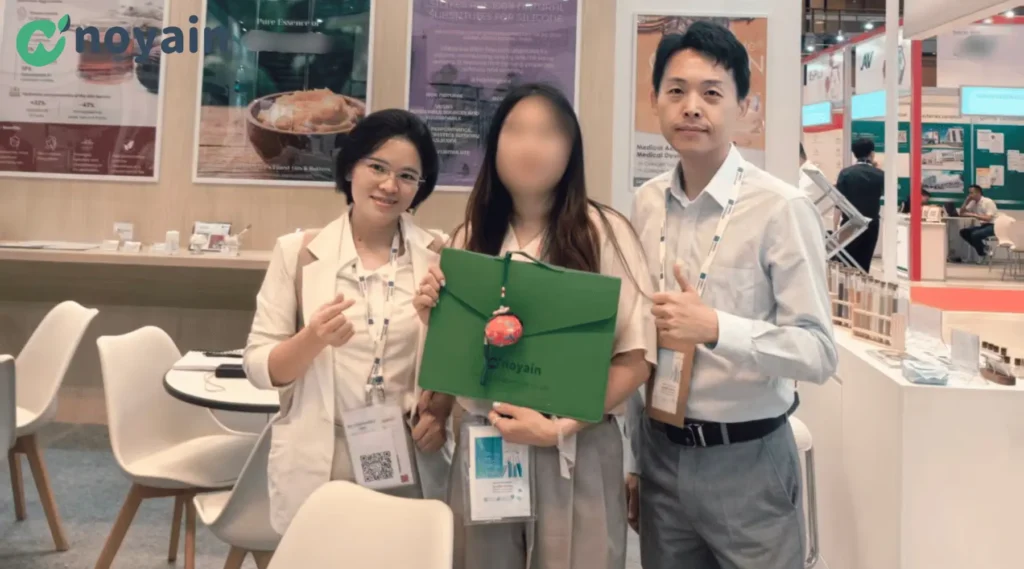
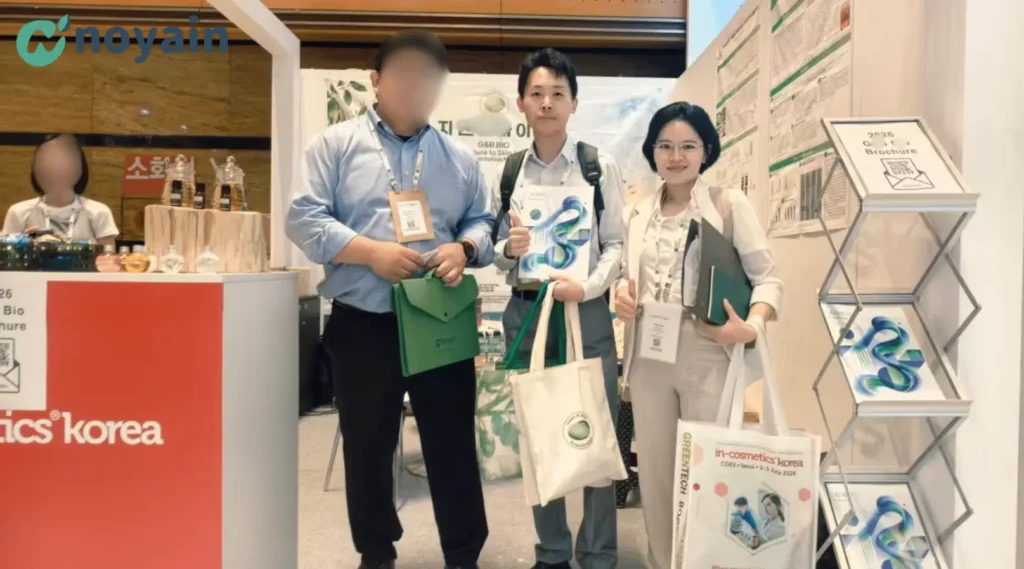
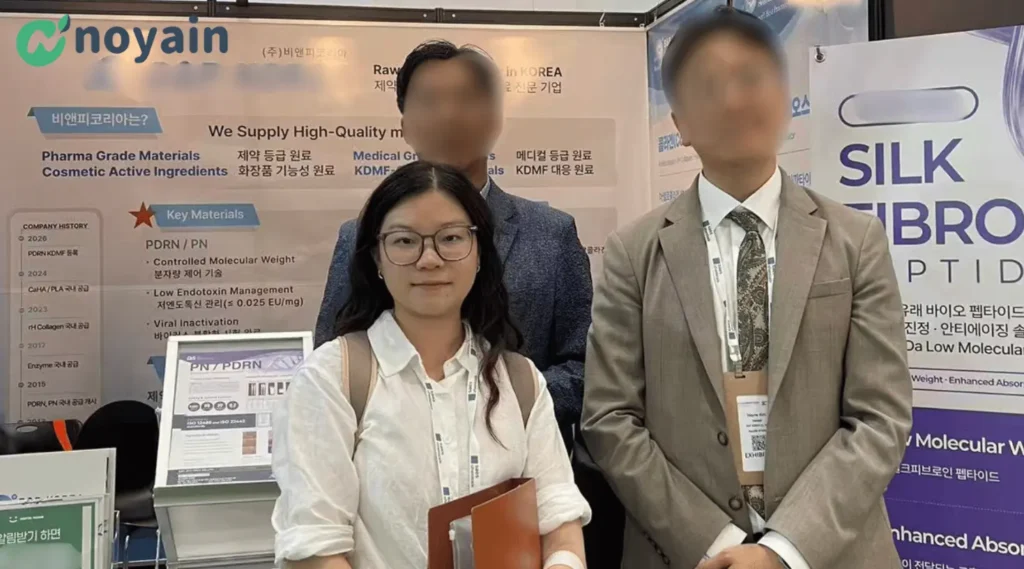
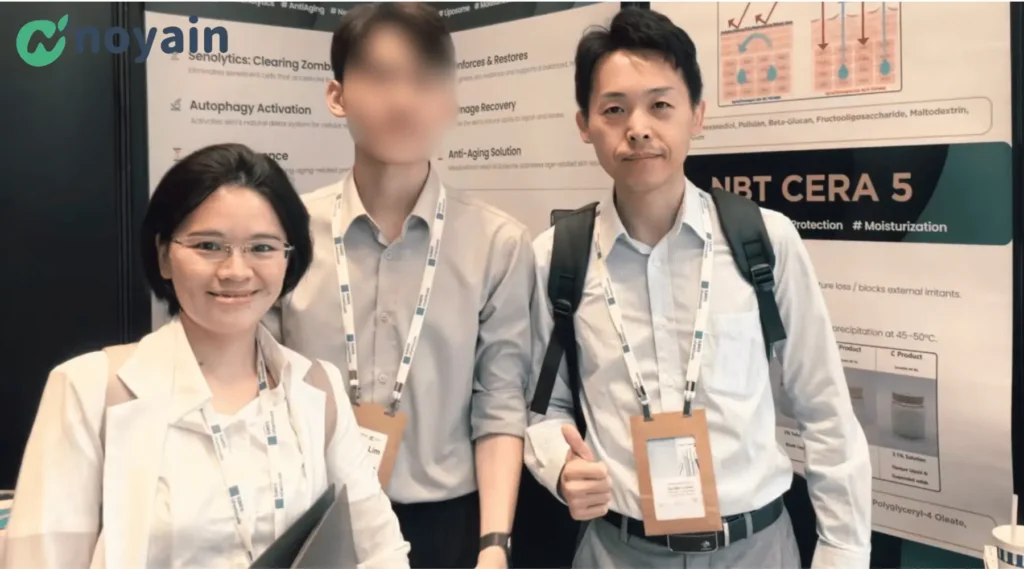
in-cosmetics Korea 2026 is held from 1-3 July 2026 at COEX, Seoul. The official event page describes it as Korea’s dedicated exhibition for personal care ingredients, formulation sourcing, trend exchange, and face-to-face supplier discussions. Although Noyain did not exhibit with a booth, our team attended the show, met Korean cosmetic customers on site, and collected direct feedback on how buyers are evaluating PDRN quality in 2026.
Key Takeaways
- Korean buyers are moving from PDRN trend interest to technical supplier review.
- The most repeated questions focused on sodium level, COA, molecular weight, hyperchromicity, endotoxin control, and formulation behavior.
- A lower sodium profile may be useful for higher-addition PDRN ampoules and serums, but it should be discussed with batch-specific data and formula testing.
- Noyain PDRN is positioned as cosmetic-grade Sodium DNA with 99.8% UV assay, 47.7% hyperchromicity, controlled protein and endotoxin levels, and average molecular weight below 1000 kDa in the latest COA.
- For Korea-market projects, the strongest supplier conversation is not only “Do you have PDRN?” but “Can you provide the data, samples, and formulation support needed before scale-up?”
What Korean Buyers Asked Us About PDRN
During our conversations at COEX, several Korean formulators and sourcing teams did not start with marketing questions. They first asked for documents, quality indicators, and formulation behavior.
The most repeated questions were:
- What is the sodium level?
- Can the material support higher-addition ampoule or serum concepts?
- What does the latest COA show?
- What is the molecular weight range?
- What is the assay, and how is purity measured?
- Is hyperchromicity available as a structural quality indicator?
- Is endotoxin controlled?
- Can the material be used in transparent water-based serums, masks, creams, or ampoules?
- How should this material be compared with PDRN from different origins?
- Can Noyain provide samples, documentation, and formulation discussion after the show?
This is why the article is not just an exhibition recap. It is a buyer-led PDRN supplier selection guide based on the questions Korean customers actually raised during the event.
Why These Questions Matter
PDRN has strong recognition in Korean dermatology, skin booster culture, and clinic-inspired skincare. For cosmetic brands, that makes it attractive for premium ampoules, serums, masks, creams, and post-treatment-inspired comfort care concepts.
Korea, however, is not a beginner market. Buyers, formulators, and distributors know that “PDRN” can mean different things in practice: Sodium DNA, polydeoxyribonucleotide, polynucleotide, salmon DNA, or broader DNA-derived material. A recent review, From Polydeoxyribonucleotides (PDRNs) to Polynucleotides (PNs), explains why structure and terminology matter when comparing DNA-derived polymers.
Published PDRN literature also helps explain why the ingredient has medical-aesthetic familiarity. For example, one review discusses adenosine A2A receptor involvement in PDRN-related tissue research, while preclinical research has examined polydeoxyribonucleotide in angiogenesis and wound models. These sources provide scientific background only. Finished cosmetic products still require their own formulation validation and compliant claim review.
For readers who need the ingredient background before reviewing supplier quality, our complete guide to PDRN in skincare explains the basic definition, INCI relationship with Sodium DNA, and cosmetic application context.
For sourcing teams, the practical supplier questions are more direct:
- What is the exact INCI name and grade?
- What is the source material and production process?
- What does the latest batch COA show?
- What are the assay method, sodium profile, molecular weight, and hyperchromicity result?
- Are protein, endotoxin, and microbiology controlled?
- Can the supplier support formulation trials, not only sample delivery?
Why Sodium Level Became a Formulation Question
Sodium level matters because PDRN for cosmetics is commonly supplied under the INCI name Sodium DNA. Sodium-containing materials can contribute to the ionic environment of a formula. At low use levels, this may not be obvious. At higher PDRN addition levels, ionic load can influence thickener behavior, viscosity, clarity, sensory profile, and compatibility with charged polymers or salts.
Several Korean buyers raised sodium content as a comparison point when evaluating different PDRN sources, especially for ampoule and serum concepts. This does not mean sodium is automatically a problem, and it should not be used as an unsupported competitor claim. It means sodium should be measured, disclosed, and considered during formulation design.
For brands developing PDRN ampoules, gel serums, masks, or clinic-inspired creams, a lower sodium profile can be commercially meaningful when supported by data. It may help formulators:
- reduce ionic interference in gel or serum systems
- maintain better clarity in water-based formats
- reduce viscosity drift risk with sensitive thickeners
- create more room for electrolytes, buffers, peptides, and other actives
- test higher PDRN addition levels with fewer formulation compromises
For Noyain PDRN, we recommend discussing sodium profile together with batch-specific testing data, COA review, and formulation trials. Any final marketing claim should be based on verified batch data rather than a generic supplier statement.
How Noyain PDRN Answers These Buyer Questions
Noyain PDRN is positioned for Korean projects because it combines a recognizable PDRN story with quality indicators that sourcing teams can review. Based on the latest product documents, Noyain PDRN is supplied as cosmetic-grade Sodium DNA, derived from salmon-based raw material, and presented as a white to off-white water-soluble powder.
The June 2026 COA for batch Z-2-20260610A reports:
| Quality Item | Result / Positioning | Why Korean Buyers Care |
|---|---|---|
| INCI name | Sodium DNA | Matches cosmetic ingredient labeling needs |
| Grade | Cosmetic grade | Supports skincare formulation use |
| Assay by UV | 99.8% | Helps support purity-based supplier comparison |
| A260/A280 identification | 1.85 | Indicates a nucleic-acid UV profile within the specified range |
| pH, 1% aqueous solution | 6.92 | Useful for water-based serum and ampoule development |
| Hyperchromicity | 47.7% | Supports discussion of retained double-stranded DNA structure |
| Protein content | 0.05% | Important impurity and sensitivity screening signal |
| Bacterial endotoxin | <0.01 EU/mL | Useful for strict impurity-control expectations |
| Average molecular weight | <1000 kDa | Helps formulators compare topical suitability and material profile |
| Microbiology | TAMC 140 CFU/g; molds and yeasts <10 CFU/g; specified pathogens not detected | Supports quality documentation review |
These parameters do not replace finished-product efficacy testing. They do, however, answer the type of questions buyers asked at the exhibition: What is the material? How clean is it? What does the COA show? Is there a structural quality indicator? Can it be tested in high-value formulas?
Buyers comparing PDRN quality often ask how to interpret structural indicators such as hyperchromicity. Our technical guide explains how PDRN hyperchromicity can support quality review.
Documentation Buyers Should Request
Technical teams asked about process because supplier quality needs to be repeatable, not just attractive on one sales sheet. DNA-derived cosmetic ingredients can be sensitive to harsh extraction, residual impurities, degradation, and inconsistent molecular profiles.
For PDRN sourcing, the strongest supplier conversation is document-led. Buyers should request:
- COA for the selected batch
- product specification sheet
- SDS / MSDS
- composition statement
- production flow chart
- source material information
- sodium content test data when relevant
- purity, assay, and hyperchromicity test methods
- endotoxin and microbiological data
- recommended use level and formulation notes
- halal or other market-specific declarations where relevant
This approach is especially important in Korea because buyers are often comparing multiple origins and suppliers at the same time. A supplier that can explain the process, provide methods, and support formulation testing has a stronger sourcing position than one that only promotes “high purity.”
Formulation Notes for Korean Brands
PDRN formulation is influenced by water solubility, pH environment, temperature exposure, ionic compatibility, molecular weight, and the structure of the finished dosage form. It is not just a marketing active that can be dropped into every base without screening.
Based on Noyain application notes, a practical starting range is:
| Formula Type | Practical PDRN Screening Range | Notes |
|---|---|---|
| Water cream | 0.05-0.3% | Start low and check viscosity, clarity, and skin feel |
| Water-based serum / ampoule | 0.2-0.3% | Good format for PDRN concept products |
| Broader development range | 0.02-1% | Higher levels require stronger compatibility and stability checks |
Noyain application notes also suggest that PDRN dissolves faster at about 50 deg C, but excessive heat may damage molecular weight. For pH, a 5.8-6.2 compounded solution can use a phosphate buffer system, while strong oxidizers, highly active substances, and cationic salts deserve extra compatibility testing.
For Korean brands, a practical development path is:
- Start with a water-based essence, ampoule, mask liquid, or light gel cream.
- Screen PDRN at 0.05%, 0.1%, 0.2%, and 0.3%.
- Track pH, viscosity, clarity, odor, color, and sensory feel at 0, 4, 8, and 12 weeks.
- Compare sodium profile and ionic-load behavior if using high PDRN addition levels.
- Avoid aggressive heating, strong oxidizers, and untested cationic systems.
- Request COA, SDS, composition, and sodium-related test data before scale-up.
This article is based on ingredient document review, exhibition feedback, and lab-scale formulation considerations. It does not make medical or clinical treatment claims. Final performance should be validated in the finished cosmetic formulation.
Buyer Checklist: What to Ask a PDRN Supplier
Buyers can use PDRN sourcing questions as a practical decision framework rather than a generic supplier interview. The goal is to connect every technical question with a document, test result, or support action.
| Buyer Question | Why It Matters | What Noyain Can Provide |
|---|---|---|
| What is the INCI name? | Labeling and regulatory review | Sodium DNA documentation |
| What is the product grade? | Cosmetic suitability review | Cosmetic-grade product documents |
| What is the assay? | Purity comparison | Latest COA with UV assay |
| What is the sodium level? | Higher-addition formulation risk | Batch-specific sodium testing discussion upon request |
| What is the molecular weight? | Material profile and formula behavior | Average molecular weight data |
| Is hyperchromicity available? | Structural quality review | Hyperchromicity result and test method |
| Is endotoxin controlled? | Impurity and quality screening | Endotoxin test result |
| Can we test samples? | Formula validation before scale-up | Sample support and technical discussion |
For premium PDRN skincare, the supplier discussion should happen before finalizing the formula architecture. This is especially important if the target product uses a higher PDRN addition level, a transparent serum base, a delicate polymer system, or a multi-active positioning with peptides, hyaluronic acid, panthenol, exosomes, or barrier-support ingredients.
Why Noyain for Korea-Market PDRN Projects
For Korean cosmetic brands, PDRN is no longer only a trend ingredient. It is becoming a supplier-selection test. The brands that move fastest will still need strong marketing, but the brands that build long-term PDRN lines will need stronger raw material control.
Noyain PDRN is worth discussing for Korea-market projects because it brings together:
- cosmetic-grade Sodium DNA positioning
- latest COA with 99.8% UV assay result
- 47.7% hyperchromicity result
- <0.01 EU/mL bacterial endotoxin result
- low protein content
- average molecular weight below 1000 kDa
- document support for sourcing review
- sample and formulation discussion support
For customers specifically concerned about sodium level, our team recommends evaluating batch-specific sodium data together with formulation trials at the intended addition level.
Sourcing Support
If you are developing a PDRN ampoule, serum, mask, or cream for the Korean market, Noyain can support your sourcing review with cosmetic-grade Sodium DNA (PDRN) samples, the latest COA, specification documents, SDS, molecular weight information, hyperchromicity data, endotoxin results, and formulation discussion.
For projects that require higher PDRN addition levels or transparent water-based systems, our team can also discuss sodium-related formulation concerns, pH range, viscosity risk, and compatibility before scale-up.
To compare PDRN samples or request COA, sodium-related data, samples, and formulation discussion for a Korea-market project, contact our technical team.
FAQ
Why is PDRN popular in Korea?
PDRN is popular in Korea because it connects with K-beauty comfort care, clinic-inspired anti-aging concepts, and consumer familiarity with salmon DNA and skin booster language. It also gives brands a premium active story for ampoules, masks, creams, and serums.
Is PDRN the same as Sodium DNA?
In cosmetic ingredient labeling, Sodium DNA is commonly used as the INCI name for PDRN-related cosmetic materials. However, buyers should still confirm the material type, molecular weight, purity, and test methods because PDRN, PN, and salmon DNA terms are sometimes used loosely in marketing.
Why do Korean buyers care about sodium content in PDRN?
Sodium content can affect the ionic environment of a formula. At higher PDRN addition levels, this may influence clarity, viscosity, polymer compatibility, and stability. Lower sodium content can be an advantage when supported by batch-specific data and formulation testing.
What documents should PDRN buyers request?
Buyers should request COA, product specification, SDS / MSDS, composition statement, flow chart, source information, assay method, sodium-related test data where relevant, molecular weight information, microbiology, endotoxin data, and recommended application notes.
What is hyperchromicity in PDRN quality control?
Hyperchromicity measures the increase in UV absorbance after DNA strands are denatured. In PDRN quality review, it can help indicate retained double-stranded structure. It is useful as a structural quality signal, but it should not be used alone as a finished-product efficacy claim.
Can PDRN be used at high levels in cosmetics?
PDRN can be screened across a broad cosmetic development range, but higher levels require careful compatibility testing. Noyain application notes suggest 0.05-0.3% for water creams and 0.2-0.3% for water-based formulas as practical starting points.
Does Noyain claim its PDRN is clinically proven to treat skin conditions?
No. Noyain positions PDRN as a cosmetic-grade active ingredient for skincare formulation support. Medical treatment claims should not be made for cosmetic products. Finished-product efficacy and claim language must be validated according to the target market’s cosmetic regulations.
How can Korean brands start evaluating Noyain PDRN?
Korean brands can start by requesting a sample, latest COA, specification sheet, SDS, molecular weight information, hyperchromicity data, and sodium-related discussion. For higher-addition ampoule or serum concepts, Noyain can also support formulation compatibility review before scale-up.
References & Sources
- in-cosmetics Korea official event page
- Polydeoxyribonucleotides (PDRNs) from skin to musculoskeletal tissue regeneration via adenosine A2A receptor involvement – PubMed
- Polydeoxyribonucleotide stimulates angiogenesis and wound healing in the genetically diabetic mouse – PubMed
- From Polydeoxyribonucleotides (PDRNs) to Polynucleotides (PNs) – PMC
- Noyain PDRN COA, batch Z-2-20260610A, report date 2026-06-18 – Internal product documentation
- Noyain PDRN product specification sheet and application notes, extracted from latest product documents, June 2026 – Internal product documentation