
Cosmetic Active System
VC-IP (Ascorbyl Tetraisopalmitate)
An oil-soluble vitamin C derivative for brightening, antioxidant, and anti-aging skincare formulations.
We supply VC-IP as a colorless to pale-yellow liquid with an HPLC purity specification of at least 98.5%. Its oil solubility, skin affinity, and ingredient-level brightening and antioxidant data make it suitable for oil serums, facial oils, emulsions, creams, and other leave-on skincare projects.
HPLC purity specification >=98.5%
Soluble in common cosmetic oils
Halal-certified grade; certificate available
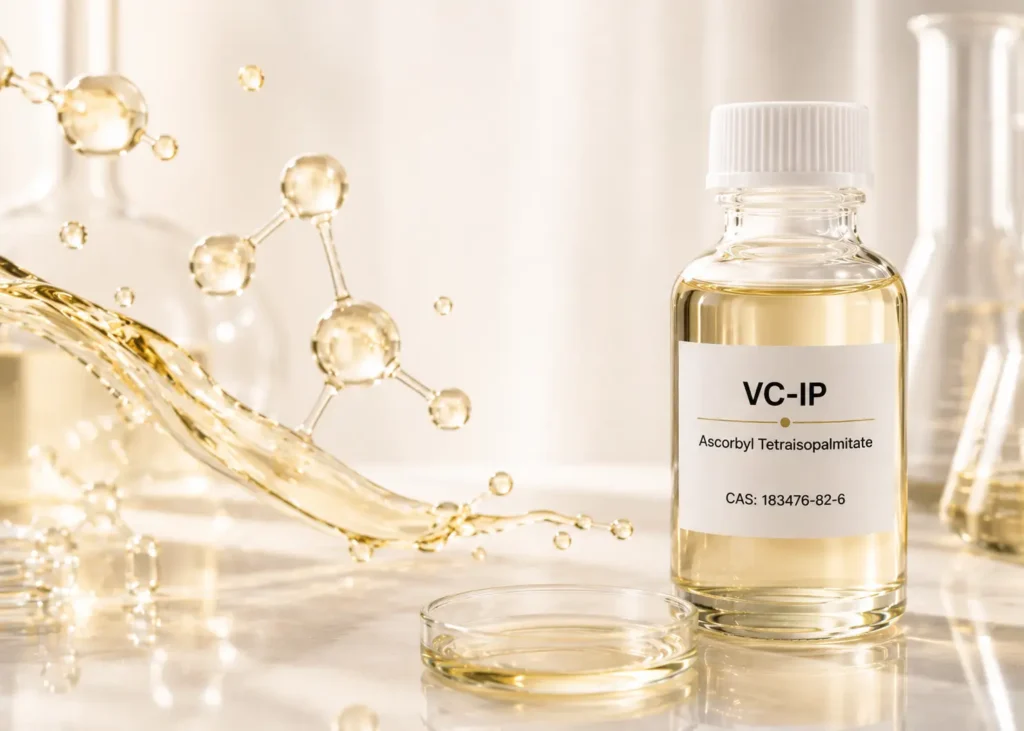
INCI
Ascorbyl Tetraisopalmitate
CAS
183476-82-6
Function
Skin conditioning; brightening, antioxidant, and anti-aging formulation support
Recommended Dosage
Our verified whitening serum model used 3.0%. Determine the final level through finished-formula testing.
Shelf Life
Confirm against the current batch COA before order approval.
Product Overview
An Oil-Soluble Vitamin C Derivative for Brightening and Antioxidant Skincare
VC-IP is our oil-soluble vitamin C derivative for cosmetic formulas targeting visible radiance, more even-looking tone, antioxidant care, and signs of photoaging. Ascorbyl Tetraisopalmitate is also known as Tetrahexyldecyl Ascorbate, Tetra-isopalmitoyl Ascorbic Acid, IPAA, VC-IP, and Vitamin C-isopalmityl tetraester. It is suitable for both anhydrous oils and properly designed emulsion systems.
Our technical presentation reports ingredient-level results across melanin-related, singlet-oxygen, lipid-oxidation, UV-stress, collagen-related, and skin-penetration models. These results support brightening, antioxidant, and anti-aging product concepts. Finished-product performance, safety, and claim wording must still be verified in the final formulation and target market.
For sourcing evaluation, we can help buyers confirm the current batch identity, HPLC purity, appearance, density, refractive index, composition, handling information, Halal certification documents, sample availability, MOQ, lead time, packaging, and supporting documents before pilot or commercial approval.
01
Match Your Required Spec
**01 Match Your Required Spec** - Tell us your target purity, physical-property range, document requirements, and application. We will confirm whether our current VC-IP batch matches your sourcing specification.
02
Test It in Your Formula
We support sample evaluation for oil serums, facial oils, emulsion serums, creams, lotions, and eye-care products. Compatibility, color, pH, processing conditions, and stability must be checked in the final system.
03
03 Prepare for Commercial Order
Before bulk approval, we can confirm the batch COA, MSDS, composition statement, Halal certificate, quotation, MOQ, lead time, packaging, shipping documents, and batch-consistency requirements.
Buyer decision path
Key Benefits of VC-IP
01
Even-Tone Positioning
Our technical presentation reports dose-dependent melanin-related results and intracellular tyrosinase-activity inhibition in cell models, supporting cosmetic concepts for radiance and more even-looking tone.
02
Antioxidant Support
In the singlet-oxygen assay reported in our presentation, VC-IP showed 80% scavenging, compared with 78% for L-ascorbic acid under the stated test conditions.
03
Skin-Affinity Delivery
The human-skin section model included in our presentation reports epidermal penetration, while a fibroblast uptake model reports conversion to ascorbic acid after cellular uptake.
04
Photo-Stress Care
The ingredient-level cell models included in our presentation report reductions in selected UV-induced oxidative and DNA-damage markers. VC-IP is not a sunscreen filter and does not replace UV filters.
Formula concepts
Recommended Applications for VC-IP
Oil Serum
Brightening Vitamin C Oil Serum
In anhydrous oil serums, VC-IP can serve as the featured vitamin C derivative for visible radiance, antioxidant care, and more even-looking skin tone. Its solubility in common cosmetic oils supports clear or translucent oil-format concepts after compatibility testing.
VC-IP can be evaluated with squalane, selected ester oils, and tocopherol. Confirm clarity, color, odor, assay retention, and package compatibility at the intended use level.
Emulsion Serum
Daily Even-Tone Serum
Our 48 degrees C, 35-day formulation screen used 3.0% VC-IP in an emulsion serum and showed less color change at pH 4.5-5.0 than at pH 6.0-6.5. This format is suitable for daily brightening and antioxidant positioning.
The tested base included an ester emollient, tocopheryl acetate, EDTA, humectants, polymers, and allantoin. Revalidate the complete emulsifier, active, preservative, and packaging system in your own formula.
Cream or Lotion
Brightening Anti-Aging Emulsion
In creams and lotions, VC-IP can support radiance, antioxidant, and smoother-looking skin concepts while fitting an oil-phase delivery strategy. Our presentation includes a 3.3% VC-IP cream stability screen at 45 degrees C for three months across pH 4.21-5.72.
Consider glyceryl stearate or another validated emulsifier, tocopherol, a chelating agent, and a balanced oil phase. Confirm interfacial stability, discoloration, viscosity, and assay retention.
Facial Oil
Antioxidant Skin-Conditioning Oil
VC-IP is suitable for facial oils and oil concentrates where brands want a vitamin C derivative without a water-based delivery system. It can support glow, soft skin feel, and antioxidant product positioning.
Non-polar oils such as squalane can help manage oil-phase polarity. Avoid assuming universal solubility at every concentration; verify low-temperature clarity, oxidation stability, and packaging interaction.
Eye Care
Radiance and Fine-Line Appearance Emulsion
In eye creams and emulsion serums, VC-IP can support antioxidant care, dullness-focused positioning, and the appearance of smoother skin. Pairing it with emollients, humectants, allantoin, or other soothing ingredients can support a comfort-focused concept.
The final use level, migration risk, eye-area tolerance, stability, and claims must be evaluated in the finished eye-care product.
Day Care
Antioxidant and Photoaging-Appearance Support
VC-IP can be used in day creams and antioxidant emulsions designed around environmental-stress and photoaging-appearance narratives. Our ingredient-level data support this positioning, but VC-IP is not an approved sunscreen filter.
For products making UV-protection claims, use approved filters at compliant levels and complete the required finished-product testing for the target market.
Formulation notes
How to Use VC-IP in Formulations
Use VC-IP as an oil-soluble active in anhydrous or emulsified skincare systems. Our formulation work supports a practical starting point, but final dosage, phase addition, compatibility, and claim performance must be established in the finished formula.
Get VC-IP Formulation SupportUse Level
Our whitening serum verification used 3.0% VC-IP, and our cream stability presentation used 3.3%. Other concentrations in efficacy models are test conditions, not universal dosage recommendations. Establish the commercial use level through lab screening, stability, safety, and claim-support testing.
Solubility
VC-IP is soluble in many common polar and non-polar cosmetic oils. Our solubility table reports compatibility with ester oils, castor oil, olive oil, and mineral oil, while glycerin, propylene glycol, and 1,3-butylene glycol were insoluble under the stated conditions.
Addition Phase
Add VC-IP through a compatible oil phase or a validated cool-down process. Although our presentation describes good heat stability, it also advises against prolonged heating. Confirm dissolution, emulsion uniformity, and assay retention for the selected manufacturing process.
Compatible Actives
Our documents support evaluation with tocopherol, chelating agents such as EDTA, diglucosyl gallic acid, carnosine, humectants, and allantoin. Do not assume compatibility with every brightening active; our accelerated screen found noticeable browning with tranexamic acid in the tested system.
Stability Check
Our general formulation guidance uses pH 4.0-6.0. In the tested whitening serum, pH 4.5-5.0 produced less color change than pH 6.0-6.5 after 35 days at 48 degrees C. Monitor color, odor, pH, viscosity, phase stability, and assay retention.
Packaging Suggestion
Keep the raw material sealed in a cool, dry place away from direct sunlight and temperature extremes. For finished products, evaluate packaging that limits light and air exposure, then confirm package compatibility during accelerated and real-time stability testing.
Technical Specifications
Product Technical Parameters
Parameter | Specification |
|---|---|
Trade Name | VC-IP |
INCI Name | Ascorbyl Tetraisopalmitate |
Synonyms | Tetra-isopalmitoyl Ascorbic Acid; IPAA; Tetrahexyldecyl Ascorbate; VC-IP; Vitamin C-isopalmityl tetraester |
CAS No. | 183476-82-6 |
Function | Skin conditioning; brightening, antioxidant, and anti-aging formulation support |
Appearance | Colorless to pale-yellow liquid; composition statement describes a transparent liquid |
Composition / Active Content | Ascorbyl Tetraisopalmitate >=98.5% |
Formulation pH | General design guidance pH 4.0-6.0; pH 4.5-5.0 showed less color change in our tested serum system |
Recommended Dosage | 3.0% in our whitening serum verification model; determine the final level in the finished formula |
Storage | Keep closed; store in a cool, dry place away from direct sunlight, temperature extremes, strong acids, strong bases, and strong oxidizers |
Shelf Life | Confirm on the current batch COA before purchase approval |
Document support
Supply Support for VC-IP Projects
- We provide a batch-specific COA for identity, appearance, density, refractive index, and HPLC purity review.
- We can provide our MSDS, composition statement, Halal certificate, Halal Declaration, product presentation, and formulation verification document.
- We support sample and quotation requests for laboratory screening, OEM/ODM development, distributor evaluation, and commercial sourcing.
- We can discuss oil-phase design, use-level screening, pH, discoloration, active compatibility, and accelerated stability observations.
- We help buyers confirm the current batch, MOQ, lead time, packaging, shipping documents, and supply terms before commercial approval.
- We can align document naming, product identity, and batch specifications with the requirements of your quality, regulatory, and purchasing teams.
Formulation
Formulation Precautions
Control Finished-Formula pH
Use pH 4.0-6.0 as our general design range. In our 48 degrees C, 35-day serum screen, pH 4.5-5.0 showed less color change than pH 6.0-6.5.
Manage Oxidation and Heat
Our guidance recommends chelating agents and tocopherol to help limit discoloration. Avoid unnecessary prolonged heating, and test color, odor, and assay retention throughout the proposed manufacturing process.
Balance Oil-Phase Polarity
An overly polar VC-IP oil phase may promote precipitation at the oil-water interface. Our guidance recommends adjusting polarity with non-polar oils such as squalane and strengthening interfacial stability.
Validate Active Combinations
In our accelerated serum screen, diglucosyl gallic acid reduced color change, while tranexamic acid caused noticeable brown discoloration. Carnosine performed better than the tested amino-acid-based brightening option. Recheck every combination in the final base.
related products
Other related products
Related Documents
Technical Support Materials
COA Document
Request COATDS (Technical Data Sheet)
Request TDSSDS / MSDS
Request SDS / MSDSFormulation Guide
Get For FreeRelated Topics
Product-related articles
Ready to Evaluate VC-IP for Your Next Vitamin C Formula?
Contact us for a VC-IP sample, quotation, current batch COA, MSDS, composition statement, Halal certificate, and formulation support for oil serums, emulsions, creams, and OEM/ODM projects.
Frequently Asked Questions
Questions from Formulators and Buyers
- What is VC-IP (Ascorbyl Tetraisopalmitate)?VC-IP is our oil-soluble vitamin C derivative for cosmetic formulas. Its INCI name is Ascorbyl Tetraisopalmitate, CAS No. 183476-82-6. Synonyms include Tetra-isopalmitoyl Ascorbic Acid, IPAA, Tetrahexyldecyl Ascorbate, VC-IP, and Vitamin C-isopalmityl tetraester. We supply it as a colorless to pale-yellow liquid with an HPLC purity specification of at least 98.5%.
- What skincare positioning can VC-IP support?Our technical presentation includes ingredient-level data related to melanin pathways, singlet oxygen, lipid oxidation, UV-stress markers, collagen-related activity, and skin penetration. These data support cosmetic concepts for visible radiance, more even-looking tone, antioxidant care, and signs of photoaging. Final claims must be verified in the finished product and reviewed for the target market.
- What is the recommended use level for VC-IP?Our verified whitening serum model used 3.0% VC-IP, while our cream stability presentation used 3.3%. These are formulation examples rather than a universal dosage range. We recommend confirming the final level through compatibility, accelerated and real-time stability, safety assessment, claim-support testing, and cost-in-use evaluation for the intended product format.
- Is VC-IP oil soluble?Yes. Our solubility table reports that VC-IP is soluble in many common cosmetic oils, including tested ester oils, castor oil, olive oil, and mineral oil. It was insoluble in glycerin, propylene glycol, and 1,3-butylene glycol under the stated conditions. Confirm solubility at your exact concentration, temperature, and oil-phase composition before scale-up.
- What pH is recommended for formulas containing VC-IP?Our general formulation guidance recommends a finished-formula pH of 4.0-6.0. In our 48 degrees C, 35-day whitening serum screen, pH 4.5-5.0 showed less color change than pH 6.0-6.5. The best target still depends on the emulsifier, oil phase, antioxidants, chelating system, other actives, preservative system, and packaging.
- Can VC-IP be combined with tranexamic acid or other brightening actives?Compatibility is formula dependent. In our accelerated serum screen, the tested VC-IP and tranexamic acid combination developed noticeable brown discoloration, so we do not recommend assuming compatibility without reformulation and stability work. Diglucosyl gallic acid reduced color change in the tested model, and the carnosine combination performed better than the tested amino-acid-based brightening option.
- Does VC-IP replace sunscreen filters?No. Our ingredient-level presentation includes UV-stress and oxidative-damage models, but VC-IP is not an approved sunscreen filter and should not be presented as a replacement for UV filters. Any product making UV-protection or SPF claims must use compliant filters and complete the required finished-product efficacy, safety, stability, and regulatory testing for the target market.
- What documents can we provide for VC-IP sourcing?We can provide our current batch COA, MSDS, composition statement, Halal certificate, Halal Declaration, VC-IP product presentation, and formulation verification document. Contact us to confirm sample availability, quotation, MOQ, lead time, packaging, shipping documents, and whether any additional identity or regulatory statements are available for your quality and market-entry review.