
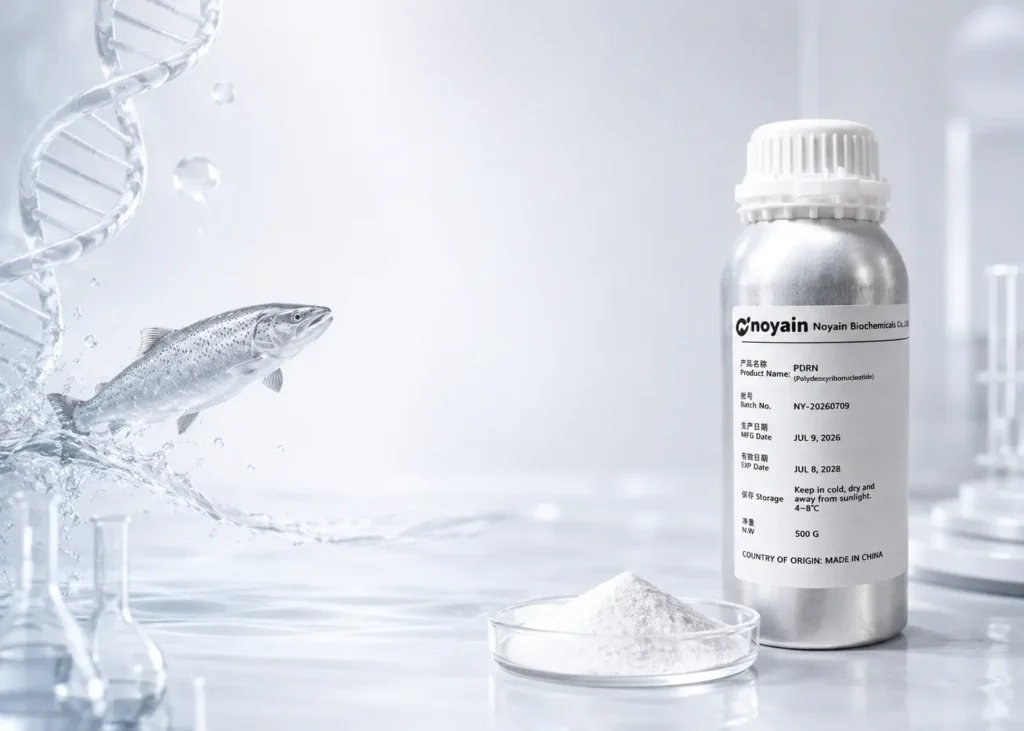
PDRN Quality Guide

PDRN Quality Guide

How do you know whether a PDRN raw material is worth further evaluation?
Purity is often the first number buyers look at. But once you move into supplier screening and formulation development, you also need to understand molecular characteristics, hyperchromicity, source, extraction and purification, impurity control, and batch-to-batch consistency.

This guide explains how to read each quality indicator first, then uses current Noyain data only where an example helps make the evaluation method clearer.
PDRN (polydeoxyribonucleotide)
01 · Quick Check

Start with These 6 Quality Checks

You do not need to decode every line of a PDRN COA at once. Start with these six areas to build a clear first-pass assessment:
01
Assay
Does the current batch meet its defined specification?
02

Molecular Characteristics
What is reported: molecular weight, fragment size, and which test method?
03
Hyperchromicity
What does the result indicate about DNA structure under the stated test conditions?
04
Source & Process
Where does the raw material come from, and how is it extracted and purified?
05
Impurity Control
How are protein, endotoxin, and microbiological parameters controlled?
06
Batch Consistency
Do released batches continue to meet the same product specification?
02 · Core Quality Data

Assay & Molecular Characteristics

How to Evaluate

Assay: What Should You Check First?

Confirm what the assay measures and which method is used. Then compare the current batch result with the supplier's stated product specification. Cross-supplier comparisons are meaningful only when the test item and method are aligned.
Noyain Example
Assay (UV)
99.8%
Noyain Product Spec
≥90.0%
How to Evaluate

Molecular Characteristics: What Does the Report Actually Show?

Identify whether the report provides average molecular weight, a molecular-weight range or distribution, or fragment size. Then confirm the test method and units. These measurements describe different aspects of the sample and should not be treated as interchangeable.
Noyain COA Example
Average Molecular Weight
<1000 kDa
Noyain Product Spec
≤1000 kDa
pdrn-200bp-fragment-size-gel-electrophoresis
The Noyain PDRN samples underwent an independent agarose gel electrophoresis test.
Independent Test — Noyain Sample
Fragment Size: Approx. 200 bp
An independent test reported an approximate fragment size of 200 bp for the evaluated PDRN sample. Method: agarose gel electrophoresis using a 50 bp DNA ladder.
Related Reading
Explore PDRN molecular weight and chain length in more detail:
Does PDRN Molecular Weight Matter? Chain Length Guide
03 · Hyperchromicity

Hyperchromicity: How Should You Read It?

How to Evaluate
Think of hyperchromicity as a structure-related check: it looks at how UV absorbance changes when DNA denatures.
Under the same test conditions, a more pronounced hyperchromic effect generally indicates that the DNA retained more ordered base stacking before denaturation, making it a useful structure-related quality signal.

In supplier evaluation, check whether a defined hyperchromicity specification is provided and whether the current batch result meets that requirement.
Related Reading
Learn how hyperchromicity is used as a PDRN quality indicator:
PDRN Hyperchromicity: A Quality Indicator for Double-Stranded DNA
Diagram illustrating DNA denaturation and enhanced ultraviolet absorption
DNA denaturation reduces base stacking, resulting in higher UV absorbance.
Noyain Example
Current Batch
47.7%
Noyain Product Spec
≥30.0%
04 · Source & Process

Source & Process: What Should You Verify?

How to Evaluate
Source information helps verify biological origin, species, and traceability. Process information helps you understand how DNA is recovered and purified from the starting material.

Rather than comparing suppliers by the number of purification steps alone, evaluate source and process information together with final, verifiable quality data such as assay, molecular characteristics, hyperchromicity, and impurity-control results.
Related Reading
Explore PDRN source differences and extraction methods in more detail:
Different Sources of PDRNHow Is PDRN Extracted? From Source to Purified Raw Material
PDRN sources evidence maturity spectrum
Evidence maturity spectrum of the five PDRN sources. Currently, the evidence base for salmon-derived PDRN is the most robust.
05 · Impurity & Routine QC

Impurity Control: What Should You Check?

How to Evaluate
For a biologically derived raw material such as PDRN, quality evaluation should include more than DNA-related parameters. Protein content, bacterial endotoxin, and microbiological results help show whether impurity control and routine release testing are clearly defined.

For an initial supplier review, focus on representative impurity indicators such as protein content, bacterial endotoxin, and microbiological control. The full COA can then be used to review the complete routine QC profile.

See the representative batch table below for microbiological, pH, and other routine QC results.
Salmon PDRN Extraction Process
Routine QC helps verify protein, endotoxin, and microbiological control before batch release.
Noyain Example
Protein Content
0.05%
Bacterial Endotoxin
<0.01 EU/mL
06 · Batch Consistency

How Should You Assess Batch-to-Batch Consistency?

How to Evaluate
A single COA represents one production batch. For long-term sourcing, review: Product Specification + Batch Result + Representative Batch COAs.

Numerical results can vary normally from batch to batch. What matters is that each released batch continues to comply with the same current product specification.

One batch shows a result. Multiple batches show consistency.
Noyain Current Batch Example

Representative Batch Quality Data

Batch Z-2-20260610A
Parameter Noyain Product Specification Current Batch Result
A260/A280 Ratio 1.5–2.0 1.85
pH (1% Aqueous Solution) 5.0–9.0 6.92
Assay (UV) ≥90.0% 99.8%
Hyperchromicity ≥30.0% 47.7%
Protein Content <2.0% 0.05%
Bacterial Endotoxin <0.1 EU/mL <0.01 EU/mL
Average Molecular Weight ≤1000 kDa <1000 kDa
Aerobic Bacterial Count ≤1000 CFU/g 140 CFU/g
Molds & Yeasts ≤100 CFU/g <10 CFU/g

This table shows one current Noyain production batch as a practical example. To assess batch-to-batch consistency, review representative COAs from multiple production batches.

This table shows one current Noyain production batch as a practical example.To assess batch-to-batch consistency, review representative COAs from multiple production batches.
Practical Check

How to Read a PDRN COA in 4 Steps

Use these four steps to review a PDRN COA efficiently, from product identity to batch-to-batch consistency.
01
Verify the Product
Product Name · INCI · Source · Grade
02
Review Core Quality Data
Assay · Molecular Characteristics · Hyperchromicity
03
Review Impurity Control
Protein · Endotoxin · Heavy Metals · Microbiology
04
Compare Batches
Product Specification → Batch Result → Representative Batch COAs
Compare Before You Decide

We Welcome Side-by-Side Comparison

If you are evaluating PDRN suppliers, we can provide a free sample so you can test Noyain PDRN alongside your current material or samples from other suppliers under the same evaluation conditions.

  • Compare formulation performance in your own system
  • Review COAs, specifications, and third-party test documentation side by side
  • Complete your internal sample evaluation before making a purchasing decision

Review the data. Test the sample. Then decide.

Frequently Asked Questions

Questions from Formulators and Buyers

We’ll get in touch with you within 24 hours. Please check your email and WhatsApp messages.

Enter your Phone & business email to download our 2026 Catalog & Technical Dossier
Please fill out the form to receive the file for free
联系我们