Quick Answer
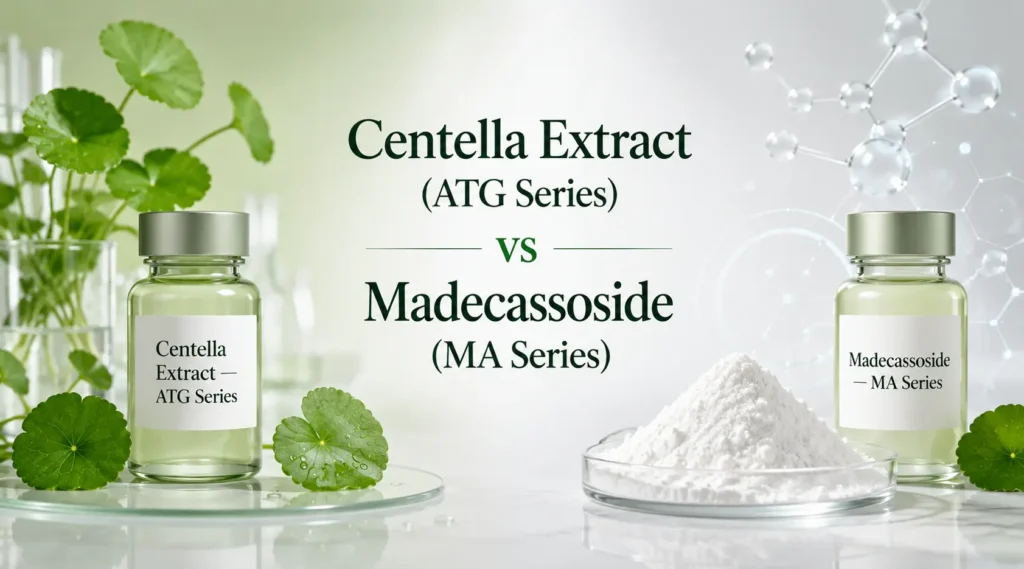
When comparing Madecassoside vs Centella Asiatica Extract skincare benefits, the key point is that both ingredients come from Centella asiatica, but they do not serve the same role in cosmetic formulation.
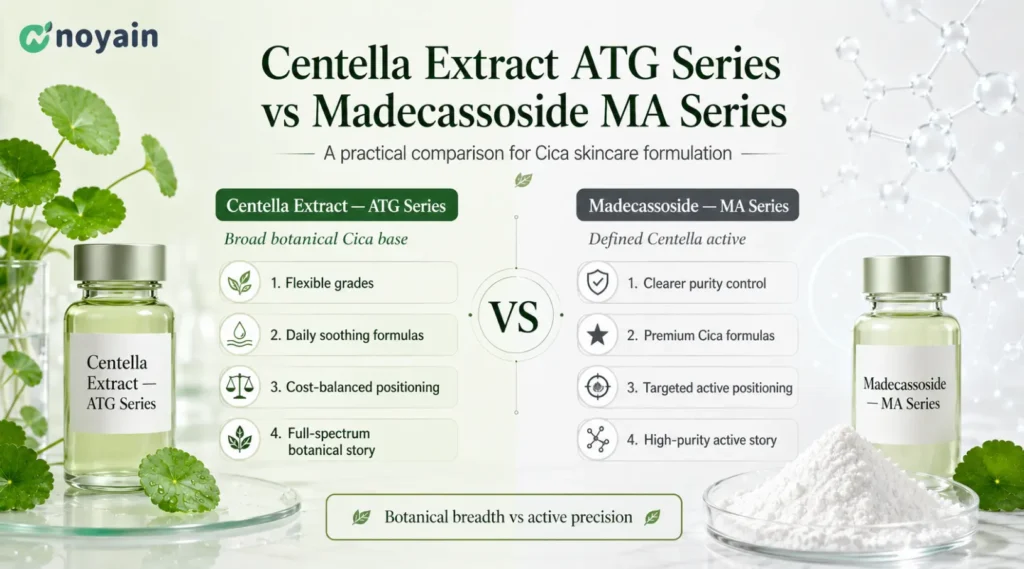
Centella Asiatica Extract is a broader botanical Cica ingredient. It is usually better for full-spectrum Cica positioning, daily soothing formulas, botanical skincare stories, and cost-flexible product lines.
Madecassoside is a more defined Centella-derived active compound. It is usually better when a formula needs premium Cica positioning, clearer active-content communication, stronger grade selection logic, and more precise sensitive-skin product storytelling.
From a B2B formulation perspective, Madecassoside vs Centella Asiatica Extract benefits should not be judged only by which one sounds stronger. The right choice depends on product type, active grade, dosage strategy, target claim, cost structure, documentation, solubility, crystallization screening, and finished formula stability.
In practical formulation terms:
- Choose Centella Asiatica Extract when you need a broader botanical Cica story and flexible cost structure.
- Choose Madecassoside when you need a defined active ingredient for premium Cica or sensitive-skin formulations.
- Use both when you want full-spectrum botanical positioning plus a more precise Centella-derived active story.
What Is Centella Asiatica Extract?
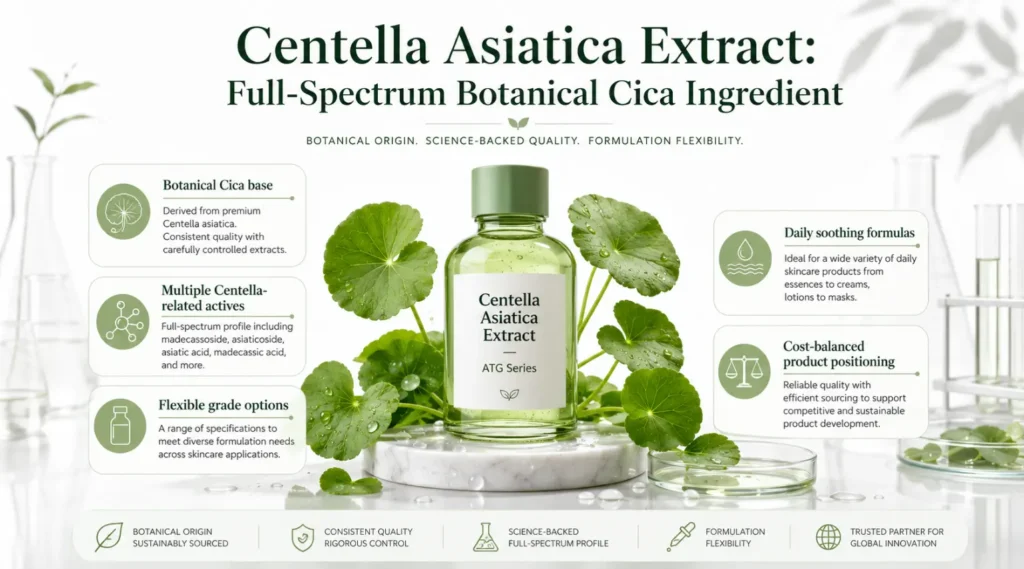
Centella Asiatica Extract is a botanical extract derived from Centella asiatica, a plant widely used in Cica skincare concepts. In cosmetic ingredient listings, Centella-derived extracts may appear in several forms, such as Centella Asiatica Extract, Centella Asiatica Root Extract, or Centella Asiatica Leaf/Stem Extract, depending on plant part, extraction process, and supplier documentation.
From a skincare formulation perspective, Centella Asiatica Extract is not a single purified molecule. It is usually positioned as a broader botanical ingredient that may contain multiple Centella-related components, including madecassoside, asiaticoside, asiatic acid, and madecassic acid.
For B2B buyers, the key question is not simply whether a formula contains “Centella Asiatica Extract.” The more important questions are:
- Is the extract standardized?
- What marker compounds are controlled?
- What grade is being supplied?
- What is the assay method?
- Is the extract suitable for the target formula type?
- Can the supplier provide COA, TDS, SDS/MSDS, and specification documents?
- Does the grade match the product’s positioning and cost structure?
Centella Asiatica Extract is often a strong choice for brands that want a broad Cica botanical story, daily soothing-positioned products, sensitive-skin concepts, or cost-balanced formulas.
What Is Madecassoside?
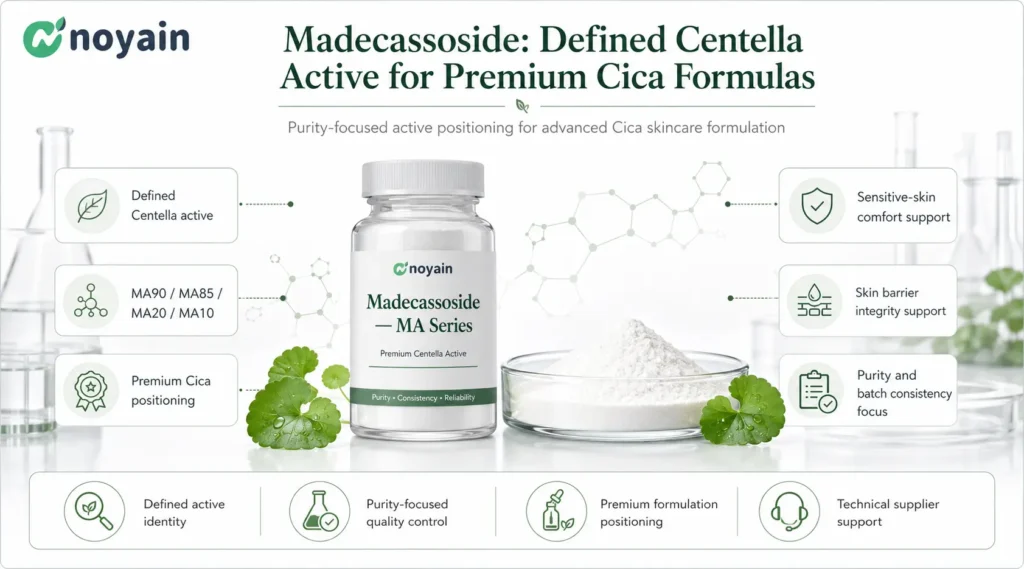
Madecassoside is a defined Centella-derived active compound. It is one of the key triterpenoid saponins associated with Centella asiatica and is widely used in premium Cica, sensitive-skin, redness appearance care, and skin barrier integrity support formulas.
In product development, Madecassoside is not simply “stronger Centella.” A better way to understand it is:
Madecassoside is a more defined Centella-derived active that helps formulators build a clearer Cica active story.
This matters for premium skincare because many brands do not only want a botanical extract on the ingredient list. They want a recognizable, specific active ingredient that supports:
- Premium Cica serum positioning
- Sensitive-skin comfort-support products
- Redness appearance care concepts
- Skin barrier integrity support formulas
- Recovery-focused cosmetic care
- Retinol companion formulas
- Post-active routine products
As a technical cosmetic ingredient supplier with capabilities across botanical extraction, purification control, biosynthesis-oriented active development, and advanced encapsulation solutions, Noyain positions high-purity Madecassoside grades such as MA90 for buyers who need controlled purity, crystal stability screening, and batch-to-batch consistency in water-based Cica formulas.
This is especially relevant for formulators working on high-transparency serums, ampoules, gels, and sensitive-skin products where appearance, clarity, and stability can strongly affect final product acceptance.
Madecassoside vs Centella Asiatica Extract Skincare Benefits: What Buyers Should Know
For cosmetic brands and OEM/ODM formulators, the skincare benefits of Madecassoside and Centella Asiatica Extract overlap in Cica positioning, sensitive-skin comfort, redness appearance care, and skin barrier integrity support. However, the commercial value of each ingredient is different.
Centella Asiatica Extract is usually selected when the formula needs a broader botanical story and a full-spectrum Cica positioning. It helps brands communicate a recognizable plant-based Cica concept, especially in toners, lotions, sheet masks, creams, and daily soothing skincare lines.
Madecassoside is usually selected when the formula needs a more defined active ingredient, clearer purity communication, and a premium Cica claim structure. It is especially useful in serums, ampoules, barrier-support creams, and targeted sensitive-skin formulas.
This is why the comparison of Madecassoside vs Centella Asiatica Extract benefits should include not only skin benefits, but also formulation behavior, grade selection, documentation, stability screening, and supplier reliability.
For B2B buyers, a practical comparison should answer four questions:
- Which ingredient fits the product concept?
- Which grade supports the target claim?
- Which material is easier to formulate in the desired product type?
- Which supplier can provide reliable documentation, sample support, and technical guidance?
Madecassoside vs Centella Asiatica Extract: Key Differences
| Comparison Point | Centella Asiatica Extract | Madecassoside |
|---|---|---|
| Ingredient type | Botanical extract or standardized Centella fraction | Defined Centella-derived active compound |
| Noyain grade system | ATG Series | MA Series |
| Composition | Broader mixture of Centella-related components | More specific active identity |
| Main formulation role | Botanical Cica base, hero or supporting active depending on grade | Hero active or key supporting active |
| Best positioning | Natural Cica, botanical soothing, daily comfort care | Premium Cica, defined active, sensitive-skin support |
| Cost flexibility | Usually more flexible by grade | Depends strongly on purity and grade |
| Claim communication | Broad Cica botanical story | More precise active ingredient story |
| Common product types | Toner, lotion, mask, cream, botanical gel | Serum, ampoule, cream, targeted gel |
| Buyer focus | Standardization, marker compounds, color, solubility, documentation | Purity, assay, grade, solubility, stability, documentation |
| Best use case | When a full botanical Centella story matters | When a clear Centella-derived active story matters |
The real difference is not only “extract vs compound.” The real B2B difference is how each ingredient supports product positioning, formulation cost, active-content communication, technical feasibility, and buyer confidence.
Skincare Benefits Comparison: Madecassoside vs Centella Asiatica Extract
Both Centella Asiatica Extract and Madecassoside are widely used in Cica skincare concepts. However, for a B2B cosmetic ingredient supplier, benefits should be described with cosmetic, appearance-focused language rather than medical claims.
| Benefit Area | Centella Asiatica Extract | Madecassoside | Cosmetic Claim Direction |
|---|---|---|---|
| Sensitive-skin comfort | Strong fit | Strong fit | Comfort-support, sensitive-skin friendly positioning |
| Soothing-positioned skincare | Strong fit | Strong fit | Helps support calmer-looking skin |
| Redness appearance care | Good fit | Strong targeted fit | Supports a less stressed-looking complexion |
| Skin barrier integrity support | Good fit | Good fit as part of complete formula architecture | Barrier-support skincare concepts |
| Cica product story | Strong botanical story | Strong active story | Cica care, recovery-focused cosmetic care |
| Antioxidant support | Depends on extract quality | CosIng lists antioxidant function | Antioxidant-positioned cosmetic support |
| Premium active positioning | Moderate to strong depending on grade | Strong | Defined active story for high-end Cica formulas |
| Cost-flexible product lines | Strong fit | Depends on grade | Better for mass-market Cica concepts when lower grades are selected |
| High-purity active communication | Moderate | Strong | Better for premium active-focused Cica products |
Recommended Cosmetic Wording
Use:
- skin-conditioning
- soothing-positioned
- comfort-support
- redness appearance care
- skin barrier integrity support
- stressed-looking skin
- sensitive-skin formula
- recovery-focused cosmetic concept
- Cica active positioning
Avoid:
- treats inflammation
- heals wounds
- treats acne
- cures redness
- repairs damaged skin in a medical sense
- medical recovery
- therapeutic treatment
Why Standardization Matters More Than the Ingredient Name
A common mistake in Cica ingredient selection is assuming that all “Centella Asiatica Extract” materials are equivalent. They are not.
For a finished formula, the name on the ingredient list does not tell the full story. Two Centella extracts may have the same INCI name but differ in:
- plant part
- extraction method
- marker compound profile
- active triterpene level
- color
- odor
- solubility
- clarity in water systems
- batch-to-batch consistency
- recommended dosage
- documentation completeness
This is why B2B buyers should ask for more than a product name. They should review the COA, specification, assay method, TDS, SDS/MSDS, recommended dosage, and application guidance before sampling or bulk purchase.
For Madecassoside, the same principle applies. A high-purity Madecassoside grade and a lower standardized grade may both support a Cica claim, but they will not serve the same product positioning, cost structure, active-story depth, or stability screening requirement.
Grade Selection: Centella Extract ATG Series vs Madecassoside MA Series
Grade selection is where many Cica ingredient comparisons become commercially useful.
For B2B skincare development, the question is not only:
Which ingredient is better?
The better question is:
Which grade fits the product type, target claim, cost structure, technical requirement, and customer expectation?
Centella Asiatica Extract ATG Series
| Grade Direction | Best Fit | Commercial Logic |
|---|---|---|
| ATG70 | Premium Cica serum, sensitive-skin ampoule, skin barrier integrity support cream | Use when Centella is a hero botanical active and stronger Cica positioning is needed |
| ATG20 | Toner, lotion, sheet mask, daily soothing cream | Use when Centella is important but not the only hero active |
| ATG10 | Entry-level or high-volume formulas | Use for cost-sensitive projects after confirming specification, COA, and formula performance |
Madecassoside MA Series
| Grade Direction | Best Fit | Commercial Logic |
|---|---|---|
| MA90 | Premium high-purity Cica active | Best for hero active positioning, premium serum, ampoule, and targeted Cica concepts |
| MA85 | High-purity balanced grade | Suitable for premium formulas with more commercial flexibility |
| MA20 | Practical standardized grade | Suitable for toners, lotions, masks, and OEM/ODM projects |
| MA10 | Cost-efficient supporting grade | Suitable for entry-level or high-volume Cica positioning |
Application Matrix by Product Type
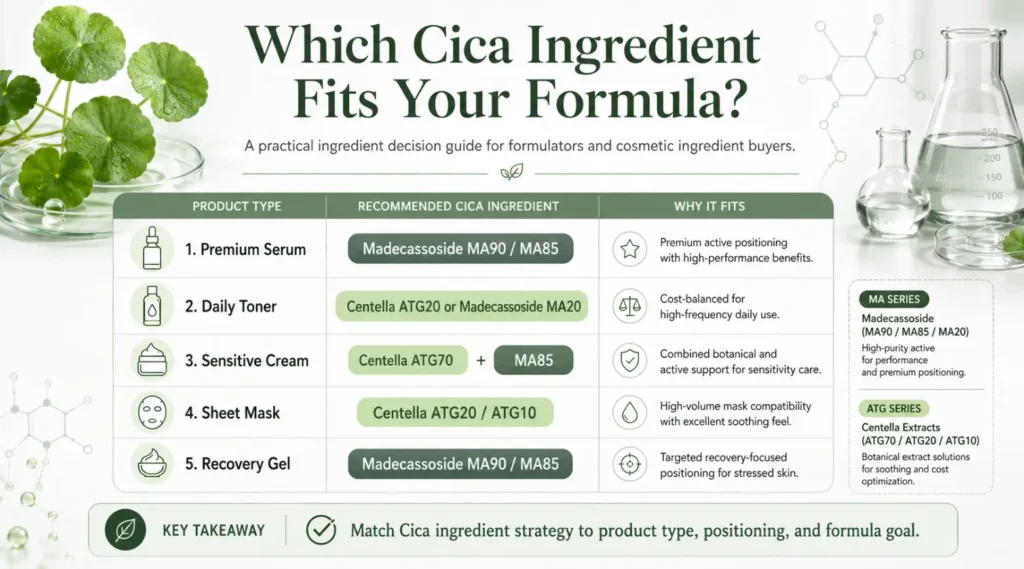
| Product Type | Recommended Ingredient Strategy | Why It Makes Sense |
|---|---|---|
| Premium Cica Serum | Madecassoside MA90 / MA85 | Clear active story, premium positioning, sensitive-skin comfort |
| Daily Soothing Toner | Centella ATG20 or Madecassoside MA20 / MA10 | Cost-balanced and suitable for daily Cica positioning |
| Sensitive-Skin Cream | Centella ATG70 + Madecassoside MA85 / MA20 | Combines botanical Cica story with defined active support |
| Sheet Mask Essence | Centella ATG20 / ATG10 or Madecassoside MA20 | Suitable for high-volume OEM/ODM projects |
| Recovery-Focused Gel | Madecassoside MA90 / MA85 | Stronger defined active positioning |
| Retinol Companion Cream | Madecassoside MA85 / MA20 + skin barrier integrity support ingredients | Supports comfort-focused active routine products |
| After-Sun Cosmetic Care | Centella ATG20 / ATG70 | Use cosmetic wording; avoid sunburn treatment claims |
| Botanical Cica Lotion | Centella ATG20 | Flexible, botanical, and cost-effective for mass skincare lines |
| Premium Barrier-Support Cream | Centella ATG70 + Madecassoside MA85 | Stronger story for sensitive-skin and skin barrier integrity support positioning |
Can You Use Madecassoside and Centella Asiatica Extract Together?
Yes. In many Cica formulas, Centella Asiatica Extract and Madecassoside can be used together when the brand wants both a botanical full-spectrum story and a more defined active ingredient story.
This combination is especially useful when the product needs:
- botanical Cica positioning
- clearer active-content communication
- premium sensitive-skin concept
- stronger product story for brand marketing
- practical formula differentiation
- skin barrier integrity support positioning
- better support for OEM/ODM sales materials
Combination Strategy
| Ingredient | Role in the Formula |
|---|---|
| Centella Asiatica Extract ATG Series | Broad Cica botanical base |
| Madecassoside MA Series | Defined active reinforcement |
| Panthenol | Comfort and skin barrier integrity support |
| Beta-glucan | Soothing-support and hydration |
| Ectoin | Stress-protection positioning |
| Sodium Hyaluronate | Hydration and skin feel |
| Ceramides / Cholesterol / Fatty Acids | Skin barrier integrity support architecture |
| Allantoin | Comfort-support in sensitive-skin formulas |
| Niacinamide | Tone-evening and barrier-support positioning, depending on formula concept |
Example Concept: Premium Cica Barrier Serum
| Phase / Ingredient Type | Suggested Role |
|---|---|
| Centella Asiatica Extract ATG70 | Botanical Cica base |
| Madecassoside MA85 or MA90 | Defined Cica active |
| Panthenol | Comfort and barrier-support |
| Beta-glucan | Soothing-support and hydration |
| Sodium Hyaluronate | Hydration |
| Ectoin | Stress-support positioning |
| Mild preservative system | Sensitive-skin formula compatibility |
| Low-tack humectant system | Better sensory feel |
Formulation Notes for R&D Teams
1. Confirm the Grade Before Setting Dosage
Centella Asiatica Extract and Madecassoside should not be treated as one-size-fits-all ingredients. Grade selection affects:
- active level
- formula cost
- product positioning
- recommended dosage
- claim strength
- batch documentation
- clarity expectation
- final formula testing requirements
For high-purity Madecassoside grades, formulators can evaluate around 0.05–0.2% depending on grade, product type, and finished-product testing. For Centella Asiatica Extract, dosage should be confirmed according to the supplier’s specification, active marker content, formula type, and claim direction.
2. Check Solubility, Clarity, and Crystallization Risk
Solubility is especially important in:
- toners
- essences
- clear gels
- sheet mask essences
- ampoules
- low-viscosity serums
- water-based sensitive-skin formulas
A material that looks acceptable in an emulsion may not be suitable for a clear toner or transparent gel. Before scale-up, R&D teams should evaluate:
- clarity
- sedimentation
- crystallization
- color shift
- odor change
- pH drift
- viscosity change
- preservative compatibility
- packaging compatibility
Anti-Crystallization Tip:
High-purity Madecassoside grades such as MA90 may need additional solubility and crystallization screening in pure water systems, especially under low-temperature storage. R&D teams can screen polyols such as glycerin or butylene glycol as pre-mix solvents and evaluate a final formula pH range around 5.5–6.5 as a practical starting point for aqueous Cica systems. Final stability should always be confirmed in the finished formula.
3. Use a Pre-Mix for Better Dispersion
For powders or concentrated active materials, direct addition into a high-viscosity cream or gel base may cause poor dispersion. A water or water/humectant pre-mix can help improve processing consistency.
Suggested screening points:
- pre-mix solvent system
- mixing temperature
- mixing time
- addition stage
- batch pH
- compatibility with polymers
- compatibility with electrolytes
- stability under accelerated conditions
4. Monitor Color Shift in Botanical Systems
Centella Asiatica Extract may bring a stronger botanical color or natural odor depending on grade, extraction process, and active content. Madecassoside grades may be visually cleaner, but finished formula appearance still depends on the full system.
R&D teams should monitor:
- initial color
- color change after heat exposure
- color change under light exposure
- interaction with metal ions
- interaction with botanical extracts
- interaction with high-electrolyte systems
- packaging compatibility
For premium transparent or light-colored formulas, clarity and color stability should be screened early.
5. Validate Claims in the Finished Formula
Ingredient data does not automatically equal finished product performance. Final claims should be supported by:
- finished formula stability testing
- compatibility testing
- packaging testing
- preservative challenge test when required
- sensory evaluation
- consumer or instrumental testing when relevant
- regulatory review for the target market
For international skincare brands, claim wording should remain cosmetic and appearance-focused.
Supplier Evaluation Checklist for Cosmetic Ingredient Buyers
Before buying Centella Asiatica Extract or Madecassoside, use this checklist.
| Question | Why It Matters |
|---|---|
| What is the exact INCI name? | Confirms correct ingredient declaration |
| What is the CAS number? | Supports QA and regulatory review |
| Is it a botanical extract or purified Madecassoside? | Avoids ingredient identity confusion |
| Is it ATG Series or MA Series? | Helps match grade with product strategy |
| What grade is available? | Impacts cost, positioning, and active level |
| What is the assay method? | Supports quality verification |
| What marker compounds are reported? | Important for standardized Centella extracts |
| Is COA available? | Batch quality verification |
| Is TDS available? | R&D and marketing communication |
| Is SDS/MSDS available? | Safety and handling |
| What is the recommended dosage? | Formula planning |
| What is the solubility profile? | Toner, serum, gel, and mask feasibility |
| What is the appearance and color? | Important for formula aesthetics |
| Is low-temperature stability data available? | Important for high-purity Madecassoside screening |
| What is the MOQ? | Commercial feasibility |
| What is the lead time? | Launch planning |
| Can the supplier support sample testing? | Reduces formulation risk |
| Can the supplier provide claim language support? | Helps avoid medical claims |
| Is export documentation available? | Important for international buyers |
Common Mistakes When Comparing Madecassoside and Centella Extract
Mistake 1: Assuming All Centella Extracts Are the Same
Two materials may share the same INCI name but differ significantly in active marker content, color, solubility, and batch consistency. Buyers should not evaluate Centella Extract by ingredient name alone.
Mistake 2: Assuming Madecassoside Is Always Better
Madecassoside is better for defined active positioning, but it is not automatically the best commercial choice for every formula. For high-volume toner, lotion, or sheet mask projects, a standardized Centella Asiatica Extract or a lower Madecassoside grade may be more practical.
Mistake 3: Ignoring Cost-Positioning Fit
A premium active grade may not fit every product price point. Ingredient selection should match:
- formula cost
- brand positioning
- target market
- expected retail price
- claim direction
- dosage strategy
- documentation requirement
Mistake 4: Ignoring Crystallization and Color Shift During Development
A high-purity active may require more careful solubility and crystallization screening, especially in low-viscosity water-based formulas. A botanical extract may bring stronger color or odor variation depending on grade and source.
For R&D teams, this means ingredient selection should consider not only marketing story but also:
- clarity
- low-temperature stability
- pH compatibility
- polyol system
- packaging
- final formula appearance
- batch consistency
Mistake 5: Using Medical Claim Language
Centella and Madecassoside are often discussed in research contexts related to skin repair or wound healing, but cosmetic marketing must avoid medical or therapeutic claims unless properly substantiated and legally permitted in the target market.
For cosmetic product communication, use appearance-focused terms such as:
- supports skin comfort
- helps improve the look of stressed skin
- supports skin barrier integrity
- suitable for soothing-positioned formulas
- helps support a calmer-looking complexion
Mistake 6: Skipping Finished Formula Validation
Even if the raw material has strong documentation, the finished formula still needs testing. Formula performance depends on the whole system, including emulsifiers, polymers, pH, preservatives, packaging, and processing conditions.
Final Recommendation: Which Ingredient Fits Your Formula?
Choose Centella Asiatica Extract If:
- You need a broader botanical Cica story.
- You are developing daily soothing skincare.
- You need grade flexibility for toner, lotion, mask, or cream.
- Cost structure matters.
- You want a full-spectrum Centella positioning.
- Your formula needs a natural botanical ingredient story.
- You are building a broad sensitive-skin or Cica product line.
Choose Madecassoside If:
- You need a more defined active ingredient.
- You are developing premium Cica or sensitive-skin formulas.
- You need stronger active-content communication.
- You want clearer grade selection.
- Your product positioning depends on a specific Centella-derived active.
- You are developing a serum, ampoule, premium cream, or targeted Cica gel.
- You need a stronger story around skin barrier integrity support and sensitive-skin comfort.
Use Both If:
- You want botanical full-spectrum positioning plus a defined active story.
- You are developing premium Cica serum, barrier-support cream, or recovery-focused cosmetic care.
- Your brand wants both natural origin communication and active-grade credibility.
- You want a stronger product story for OEM/ODM presentation.
- You need both broad botanical recognition and precise active reinforcement.
FAQ
What are the main Madecassoside vs Centella Asiatica Extract skincare benefits?
The main overlapping skincare benefits include Cica positioning, sensitive-skin comfort, soothing-positioned skincare, redness appearance care, and skin barrier integrity support. Centella Asiatica Extract provides a broader botanical story, while Madecassoside provides a more defined active ingredient story.
How should brands compare Madecassoside vs Centella Asiatica Extract benefits?
Brands should compare Madecassoside vs Centella Asiatica Extract benefits by looking at product positioning, target formula type, active grade, recommended dosage, solubility, crystallization risk, color stability, COA/TDS/SDS documentation, and supplier support.
Is Madecassoside the same as Centella Asiatica Extract?
No. Madecassoside is a defined Centella-derived active compound, while Centella Asiatica Extract is a broader botanical extract or standardized Centella fraction containing multiple Centella-related components.
Which is better for skincare, Madecassoside or Centella Asiatica Extract?
It depends on the product goal. Centella Asiatica Extract is usually better for broad Cica botanical positioning, while Madecassoside is usually better for defined active positioning and premium sensitive-skin formulas.
Can Madecassoside and Centella Asiatica Extract be used together?
Yes. They can be used together when a formula needs both a botanical Centella story and a more defined active ingredient story.
Which one is better for sensitive-skin formulas?
Both can be used in sensitive-skin formulas. Madecassoside is usually more suitable for premium targeted sensitive-skin concepts, while Centella Asiatica Extract is suitable for broader daily soothing products.
What documents should buyers request before purchasing?
Buyers should request COA, TDS, SDS/MSDS, specification, assay method, recommended dosage, storage condition, grade information, and sample testing support.
What is the CAS number of Madecassoside?
Madecassoside is commonly referenced with CAS number 34540-22-2.
What is the CAS number of Centella Asiatica Extract?
Centella Asiatica Leaf/Stem Extract is commonly referenced in CosIng with the generic CAS number 84696-21-9.
What are common product types for Centella Asiatica Extract?
Centella Asiatica Extract is commonly suitable for Cica toner, lotion, sheet mask essence, sensitive-skin cream, botanical soothing gel, and daily skin barrier integrity support skincare.
What are common product types for Madecassoside?
Madecassoside is commonly suitable for premium Cica serum, sensitive-skin ampoule, barrier-support cream, redness appearance care gel, recovery-focused cosmetic gel, and retinol companion cream.
Does high-purity Madecassoside require special formulation screening?
Yes. High-purity Madecassoside grades such as MA90 should be screened for solubility, crystallization, clarity, pH compatibility, and low-temperature stability in the finished formula.
How should a brand choose between them?
Choose by product type, target claim, active grade, formula cost, desired ingredient story, documentation requirement, technical feasibility, and final formula testing results.
References
- PubChem. Madecassoside | C48H78O20 | CID 24825675. Used for Madecassoside CAS number, molecular formula, and ingredient identity reference.
- European Commission CosIng. MADECASSOSIDE. Used for cosmetic function reference, including antioxidant and skin-conditioning functions.
- European Commission CosIng. CENTELLA ASIATICA LEAF/STEM EXTRACT. Used for ingredient description and generic CAS number reference.
- Bylka W, Znajdek-Awiżeń P, Studzińska-Sroka E, et al. Centella asiatica in cosmetology. Used for Centella triterpene component background, including asiaticoside, madecassoside, asiatic acid, and madecassic acid.
- Cosmetic Ingredient Review / Expert Panel for Cosmetic Ingredient Safety. Safety Assessment of Centella asiatica-Derived Ingredients as Used in Cosmetics. Used for cosmetic safety and skin-conditioning context.