Cosmetic claim note:
This article compares professional injectable PDRN or polynucleotide treatments with topical PDRN skincare for educational purposes. Injectable products and procedures are regulated differently across markets and should only be administered by appropriately qualified professionals. Noyain supplies cosmetic-grade Sodium DNA for topical cosmetic formulation, not injectable treatments.
PDRN injection and topical PDRN are not interchangeable delivery methods.
An injection bypasses the outer skin barrier and places a PDRN- or polynucleotide-based product directly into the targeted tissue. A topical serum, cream or mask remains subject to the stratum corneum and is better suited to non-invasive hydration, skin conditioning and daily cosmetic care.
The difference is not simply that one route contains “more PDRN.” Delivery depth, molecular-weight distribution, product composition, regulatory status and the quality of supporting evidence all affect the expected result.
This guide compares PDRN injection and topical PDRN by efficacy, safety, delivery depth and realistic skincare use. For a basic ingredient overview, read our
guide to PDRN and salmon-derived Sodium DNA in skincare.
Key Takeaways
-
PDRN injection provides deeper and more direct delivery,
but it is an invasive professional procedure with product-specific evidence and procedure-related risks. -
Topical PDRN does not reproduce injection-level delivery
across intact skin and should not be marketed as an injection substitute. -
Topical products may still provide cosmetic value
through hydration, film formation, skin conditioning and properly substantiated appearance benefits. -
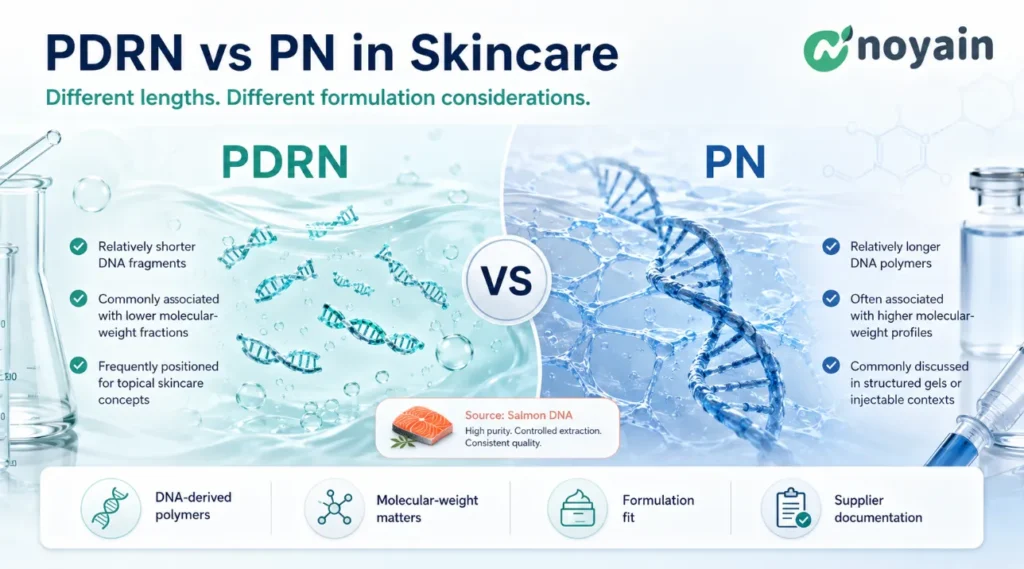
PDRN and PN are often used interchangeably in marketing,
although their molecular characteristics and finished-product classifications may differ. -
For cosmetic brands, the relevant development route is topical Sodium DNA
supported by traceable raw material, stable formulation and final-product testing.
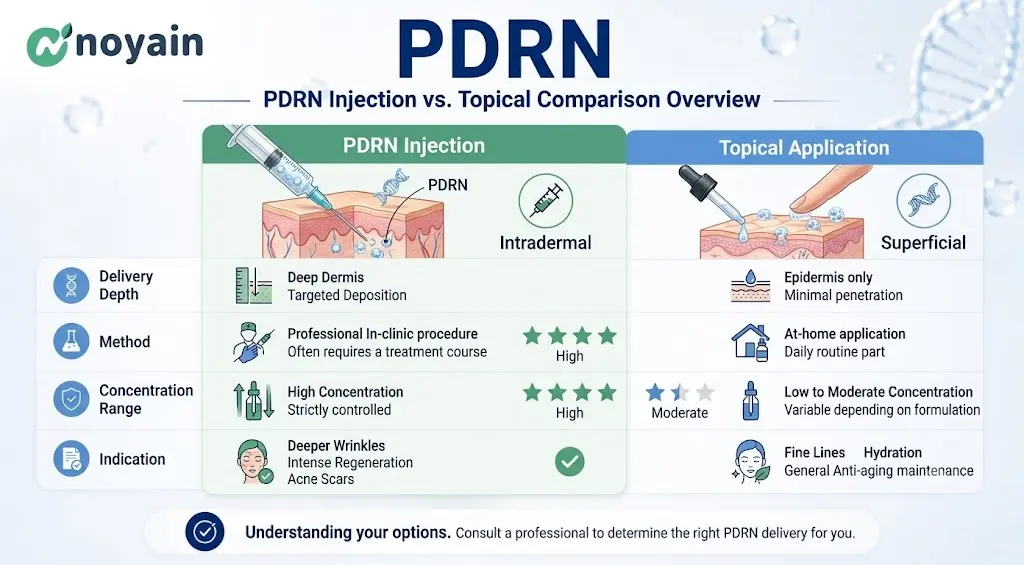
PDRN Injection vs Topical PDRN: Quick Comparison
| Comparison Point | PDRN Injection | Topical PDRN |
|---|---|---|
| Delivery route | Injected into or beneath the skin by a qualified professional | Applied to the external skin surface |
| Skin barrier | Bypasses the stratum corneum | Remains limited by the stratum corneum |
| Expected delivery depth | Direct local delivery into deeper tissue | Primarily surface and epidermal exposure unless supported by a validated delivery system |
| Evidence base | Includes injectable PDRN and PN studies, wound-healing research and aesthetic-treatment studies | Smaller evidence base including formulation, laboratory and limited human topical studies |
| Main positioning | Professional aesthetic or medical use depending on the product and market | Hydration, skin conditioning, smoother-looking skin and daily cosmetic maintenance |
| Safety considerations | May involve redness, swelling, bruising, tenderness or other procedure-related complications | No needle-related downtime, but formula irritation and compatibility still require evaluation |
| Suitable channel | Professional clinics and regulated treatment channels | Consumer skincare, beauty brands, OEM/ODM and retail cosmetic channels |
Why Injection and Topical PDRN Produce Different Results
The stratum corneum is the primary physical difference between the two delivery routes. An injection mechanically bypasses this barrier. A conventional topical product does not.
PDRN consists of DNA-derived polymers that are substantially larger than conventional small-molecule cosmetic ingredients. The widely cited
500 Dalton rule for passive skin penetration
proposes that compounds above approximately 500 Da generally have difficulty passing through intact stratum corneum by passive diffusion.
Published literature describes PDRN and related polynucleotides across a broad molecular-weight range. A
review of PDRN and PN terminology
also highlights continuing inconsistency in how the two terms are defined and used.
Evidence boundary:
Many popular injectable “PDRN” treatments are described in published research as polynucleotide or PN products. Evidence from a specific PN injectable should not automatically be transferred to every PDRN raw material, and injectable evidence should not be used as direct proof for an ordinary topical cosmetic.
How Effective Is PDRN Injection?
Injectable PDRN or PN products have a clear delivery advantage because the material is placed directly into the treatment area. This makes the route more relevant when the intended target lies below the skin surface.
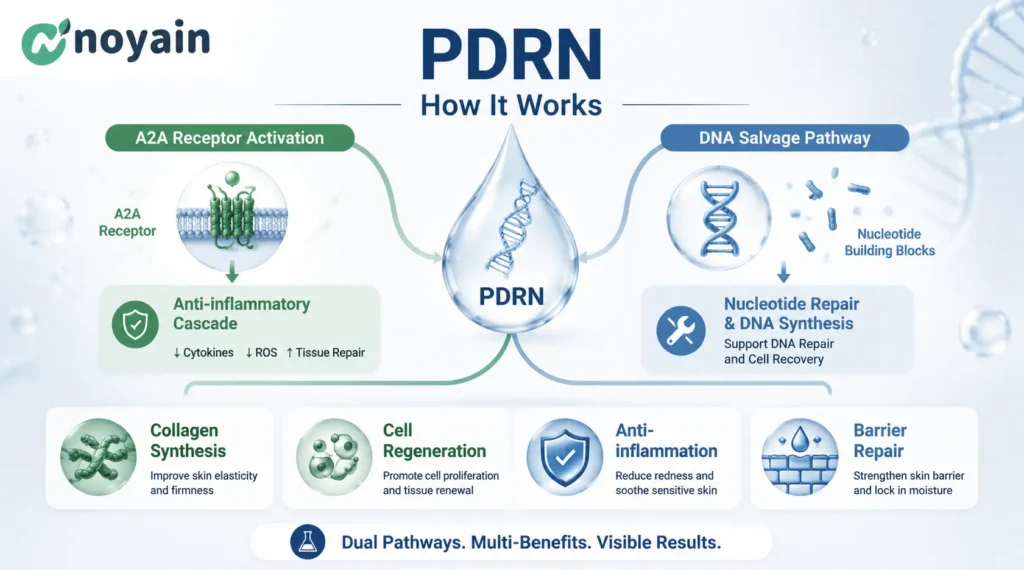
PDRN has been investigated through adenosine A2A receptor-related signaling and nucleotide salvage pathways. A
peer-reviewed pharmacological review of PDRN
summarizes research involving tissue repair, inflammation and wound-healing models.
In aesthetic medicine, published clinical results are promising but not uniform. A
systematic review of injectable polynucleotides in aesthetic medicine
reported potential improvements in wrinkles, skin texture and elasticity. However, differences in products, treatment protocols, assessment methods and study quality make it difficult to assign one universal efficacy level to every PDRN injection.
Human research has also examined more specific clinical outcomes. For example, a
randomized controlled study of postoperative PDRN injections
evaluated their effect on scar outcomes. Such findings are relevant to injectable clinical use, but they do not demonstrate that a topical cosmetic will produce the same result.
Commonly Evaluated Outcomes
- Wrinkle and fine-line appearance
- Skin texture and elasticity
- Periorbital skin quality
- Scar appearance
- Investigator- or patient-reported improvement
- Recovery after selected professional procedures
These outcomes should not be grouped together as one general “PDRN injection benefit.” An improvement in skin texture is not equivalent to scar treatment, and evidence from wound-healing research is not automatically proof of facial anti-aging performance.
PDRN Injection Safety and Limitations
The safety profile of a PDRN injection depends on the exact formulation, manufacturing standard, administration technique, treatment site, patient characteristics and local regulatory status.
Potential procedure-related effects may include:
- Temporary redness or swelling
- Bruising or tenderness
- Visible papules or small injection-site bumps
- Itching or irritation
- Infection if aseptic practice is inadequate
- Hypersensitivity or product-specific reactions
- Uneven results or prolonged inflammation
Treatment frequency, recovery time and duration of results vary by product and protocol. Universal statements such as “all PDRN injections last six months” or “four sessions are always required” are therefore unreliable.
Consumers considering an injectable treatment should verify the exact product, its regulatory status, the practitioner’s qualifications and the evidence supporting the proposed indication.
Does Topical PDRN Work Without Injection?
Topical PDRN should not be judged only by whether the entire DNA polymer reaches the dermis. A cosmetic formula may still improve skin appearance through effects occurring at or near the skin surface.
Potential contributors to topical performance include:
- Hydration and film formation: the finished formula may reduce the appearance of dryness and improve skin feel.
- Prolonged surface contact: leave-on serums, creams and masks maintain contact longer than rinse-off products.
- Fragment-size distribution: lower-molecular-weight fractions may behave differently from longer DNA polymers.
- Formulation vehicle: emulsions, gels, liposomal systems and other carriers influence deposition and stability.
- Supporting ingredients: glycerin, panthenol, hyaluronic acid and other components contribute to the final measured effect.
- Skin condition: hydration level and barrier condition affect how a topical formulation interacts with the skin.
The more useful question is:
What benefit does the tested finished formulation provide, under what conditions, and which part of that benefit can reasonably be attributed to PDRN?
What Does Human Evidence for Topical PDRN Show?
Direct human evidence for topical PDRN remains limited compared with injectable and wound-healing research.
A recent study evaluated a cream containing low-molecular-weight, peony-derived PDRN in a small group of participants. The study reported changes in periorbital elasticity and transepidermal water loss after several weeks of use.
However, the
authors of the topical PDRN study
also identified important limitations: the participant group was small, the treatment period was short, there was no active comparator and skin penetration was not directly measured.
The tested material was also plant-derived and low in molecular weight. Its results should not automatically be transferred to every salmon-derived Sodium DNA ingredient or finished product.
Practical conclusion for cosmetic brands:
Current topical evidence supports further product development and finished-formula testing. It does not support describing a standard PDRN serum as equivalent to an injectable treatment.
Developing a Topical PDRN Product?
Request a cosmetic-grade Sodium DNA sample, TDS, COA and formulation information for a serum, cream, gel, ampoule, mask or OEM/ODM project.
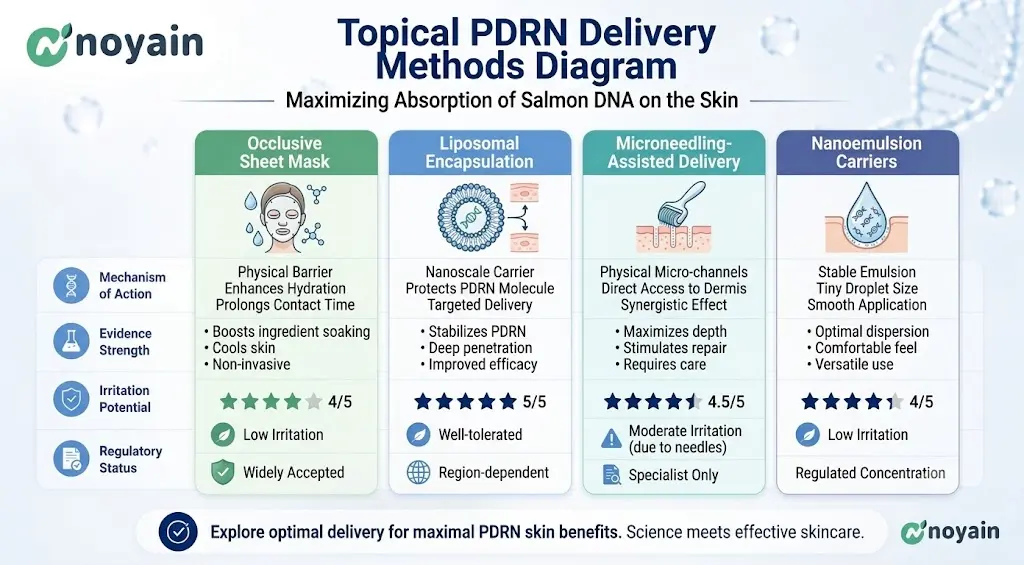
Microneedling With PDRN Is a Separate Delivery Route
Microneedling is frequently grouped with topical PDRN because a liquid or serum may be placed on the skin during the procedure. Scientifically and regulatorily, however, it should be treated as a separate device-assisted route.
Microneedling creates temporary channels and changes both exposure and risk. An ordinary cosmetic serum is not automatically sterile, suitable for delivery below the skin surface or approved for use with a microneedling device.
The
U.S. FDA guidance on microneedling devices
states that authorized devices have not been approved for delivering cosmetics, topical medications, vitamin solutions, drugs or blood products into the skin.
Cosmetic brands should therefore avoid suggesting that a standard Sodium DNA serum is suitable for microneedling, mesotherapy or injection unless the exact product has been developed, manufactured and legally assessed for that intended use.
PDRN Injection vs Topical: Which Route Fits Which Goal?
| Primary Goal | More Relevant Route | Reason |
|---|---|---|
| Professional treatment targeting deeper tissue | PDRN or PN injection | Direct placement below the skin barrier |
| Daily hydration and smoother-looking skin | Topical PDRN | Non-invasive and suitable for routine cosmetic use |
| Retail serum, cream or mask development | Topical Sodium DNA | Compatible with a conventional cosmetic development and distribution model |
| Scar or wound treatment | Medical evaluation | These are not standard cosmetic indications |
| Use with microneedling | Professionally assessed protocol | The device and applied product require separate safety and regulatory consideration |
| Maintenance between professional treatments | Topical skincare | May support hydration and cosmetic skin condition without claiming to reproduce the treatment |
Realistic Claims for Topical PDRN Skincare
Cosmetic claims must reflect the finished formula, supporting data and target-market requirements. Brands should not take mechanisms demonstrated in injected, animal or cell-based studies and present them as proven consumer outcomes for a topical serum.
More Defensible Cosmetic Directions
- Helps hydrate the skin
- Supports smoother-looking skin
- Helps improve the appearance of dryness and roughness
- Supports a more supple skin appearance
- Helps maintain skin in good condition
- Suitable for a barrier-support skincare routine
- Designed for daily cosmetic maintenance
Claims Requiring Stronger Evidence or a Different Regulatory Pathway
- Repairs human DNA
- Regenerates dermal tissue
- Heals wounds
- Treats acne scars
- Stimulates angiogenesis in human skin
- Reverses biological skin aging
- Delivers PDRN directly into the dermis
- Replaces injectable PDRN
The
FDA guidance on cosmetic labeling claims
explains that claims involving treatment or prevention of disease, or effects on the structure or function of the body, may cause a product to be regulated as a drug rather than solely as a cosmetic.
For a deeper review of cosmetic benefits and evidence, read our
PDRN benefits and skin science guide.
Formulation Considerations for Topical Sodium DNA
A topical PDRN product should be evaluated as a complete formulation. The percentage displayed in marketing materials is not enough to predict finished-product performance.
Key variables include:
- Actual Sodium DNA or DNA content of the supplied raw material
- Molecular-weight or fragment-size distribution
- Solubility and dispersion quality
- Processing temperature
- Final formulation pH
- Ionic strength and charged-ingredient interactions
- Preservative compatibility
- Packaging and storage stability
- Finished-product contact time
- Supporting ingredients and vehicle type
Sodium DNA is a negatively charged polynucleotide material. Strongly cationic ingredients may interact with its phosphate backbone and potentially cause turbidity, flocculation, precipitation or viscosity changes.
The actual risk depends on the complete formulation and should be assessed through laboratory and stability testing.
For guidance by serum, cream, mask, toner and ampoule format, see our
PDRN formulation guide.
Recommended Finished-Product Testing
| Target Claim or Risk | Relevant Evaluation |
|---|---|
| Skin hydration | Corneometer or equivalent instrumental measurement |
| Barrier-support positioning | Transepidermal water loss measurement |
| Smoother-looking skin | Instrumental roughness measurement or standardized image analysis |
| Elasticity appearance | Cutometer or equivalent assessment |
| Consumer tolerance | Patch testing and supervised use testing where appropriate |
| Physical stability | Accelerated, freeze-thaw and real-time stability testing |
| Microbiological robustness | Microbiological limits and preservative challenge testing |
| Packaging suitability | Formula-packaging compatibility and storage evaluation |
What Cosmetic Brands Should Check Before Choosing PDRN
For a topical cosmetic project, raw-material evaluation should focus on identity, source, analytical characterization, formulation suitability and documentation—not on unqualified injectable claims.
Confirm the Cosmetic Ingredient Identity
Ask the supplier to distinguish clearly between the marketing term PDRN and the applicable cosmetic ingredient declaration.
The European Commission
CosIng entry for Sodium DNA/RNA
identifies the ingredient as the sodium salt of DNA and RNA.
Verify the Source
Determine whether the DNA is derived from salmon, another marine source, plant material, microalgae, fermentation or another manufacturing route.
Source affects traceability, documentation, allergen review, vegan positioning and commercial communication. See our comparison of
salmon, vegan, bioengineered and synthetic PDRN routes.
Request Molecular-Weight Information
Ask whether the supplier provides an average value, a molecular-weight range or a full distribution. A single number may not adequately describe a heterogeneous DNA-fragment material.
Review Identity and Purity Data
Relevant tests may include:
- Identity or DNA-specific analysis
- Assay or DNA content
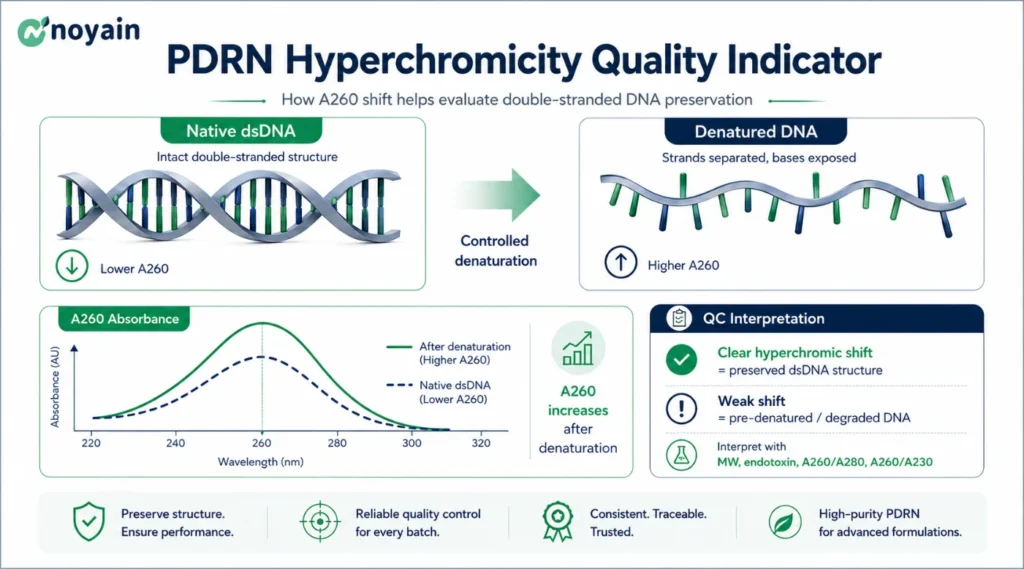
- UV absorbance ratios
- Hyperchromicity where applicable
- Residual protein
- Moisture and ash
- Heavy metals
- Microbiological limits
- Appearance, odor and solubility
No single test proves overall PDRN quality. For example,
PDRN hyperchromicity
may provide information about DNA structure, but it should be assessed together with identity, purity, molecular weight and batch consistency.
Confirm the Intended Use
Cosmetic-grade Sodium DNA should not automatically be promoted for injection, mesotherapy or delivery through professional devices. High assay or low endotoxin data alone does not establish sterility, injectable safety or medical-product compliance.
Request a Complete Technical Package
- Certificate of Analysis
- Technical Data Sheet
- Safety Data Sheet
- Product specification
- Source and country-of-origin information
- Animal-origin or BSE/TSE statements where relevant
- Recommended processing guidance
- Available stability and compatibility information
Need PDRN TDS, COA or a Lab Sample?
Tell us your product format, target market and formulation requirements. Our team can provide cosmetic-grade Sodium DNA documentation and sample support for formulation evaluation.
Frequently Asked Questions
Is PDRN injection more effective than topical PDRN?
Injection provides deeper and more direct delivery, so it has an advantage when the intended target is below the skin surface. Topical PDRN is more suitable for non-invasive hydration, skin conditioning and cosmetic appearance care.
Can a topical PDRN serum replace PDRN injections?
No. A topical serum does not bypass the stratum corneum and should not be presented as an injection substitute. It may be useful as part of a daily cosmetic routine, but its claims should be supported by testing of the finished product.
Can topical PDRN penetrate intact skin?
Passive penetration of conventional PDRN polymers is expected to be limited because their molecular size substantially exceeds the range normally associated with passive skin diffusion.
Fragment size, vehicle, contact time and skin condition may influence topical performance, but dermal delivery should not be claimed without direct evidence.
Is every injectable salmon DNA product PDRN?
Not necessarily. Commercial and scientific literature frequently use PDRN and PN interchangeably, while some researchers differentiate the materials by polymer length and molecular weight.
Is PDRN injection FDA-approved?
Regulatory authorization is product- and indication-specific. There is no blanket FDA approval covering every product marketed as PDRN, PN, salmon DNA or a skin booster.
Can an ordinary PDRN serum be used with microneedling?
It should not be assumed to be suitable. A standard cosmetic serum may not be sterile or assessed for delivery through skin channels. The device, product and combined protocol require separate professional and regulatory evaluation.
What is the best concentration of topical PDRN?
There is no universal percentage that applies to every raw material or formulation. The appropriate level depends on raw-material assay, molecular-weight profile, supplier guidance, formulation stability, product type and intended claims.
What documents should a PDRN supplier provide?
Cosmetic brands and OEM/ODM formulators should request a COA, TDS, SDS, product specification, source information, relevant animal-origin declarations and formulation guidance. Molecular-weight and structural-quality information should also be requested when available.
Conclusion
PDRN injection and topical PDRN serve different purposes.
Injection bypasses the skin barrier and provides more direct tissue exposure, but it is an invasive professional route whose efficacy and safety depend on the exact product, protocol and practitioner.
Topical PDRN is more accessible and appropriate for cosmetic skincare, but it should not be positioned as an injection in a bottle. Its commercial value lies in properly supported hydration, skin-conditioning and appearance benefits delivered through a stable finished formula.
For cosmetic brands and formulators, the strongest development strategy combines:
- A clearly identified cosmetic-grade Sodium DNA raw material
- Transparent source and batch documentation
- Appropriate molecular-weight characterization
- Compatible formulation design
- Finished-product stability and efficacy testing
- Claims consistent with cosmetic regulations
Explore our
PDRN article library
for additional guidance on PDRN sources, quality, formulation and sourcing.
References & Sources
- Squadrito F, et al. Pharmacological Activity and Clinical Use of PDRN. Frontiers in Pharmacology. 2017.
- Bos JD, Meinardi MMHM. The 500 Dalton Rule for the Skin Penetration of Chemical Compounds and Drugs. Experimental Dermatology. 2000.
- From Polydeoxyribonucleotides to Polynucleotides: Scientific Definitions, Molecular Insights and Clinical Applications. Biomolecules. 2025.
- The Effectiveness of Polynucleotides in Esthetic Medicine: A Systematic Review.
- Early Postoperative Injections of Polydeoxyribonucleotide to Prevent Hypertrophic Scars: A Randomized Controlled Trial.
- Anti-Aging Efficacy of Low-Molecular-Weight Polydeoxyribonucleotide Derived from Paeonia lactiflora. International Journal of Molecular Sciences.
- U.S. Food and Drug Administration. Microneedling Devices: Benefits, Risks and Regulatory Considerations.
- U.S. Food and Drug Administration. Cosmetics Labeling Claims.
- European Commission CosIng. Sodium DNA/RNA Cosmetic Ingredient Entry.