
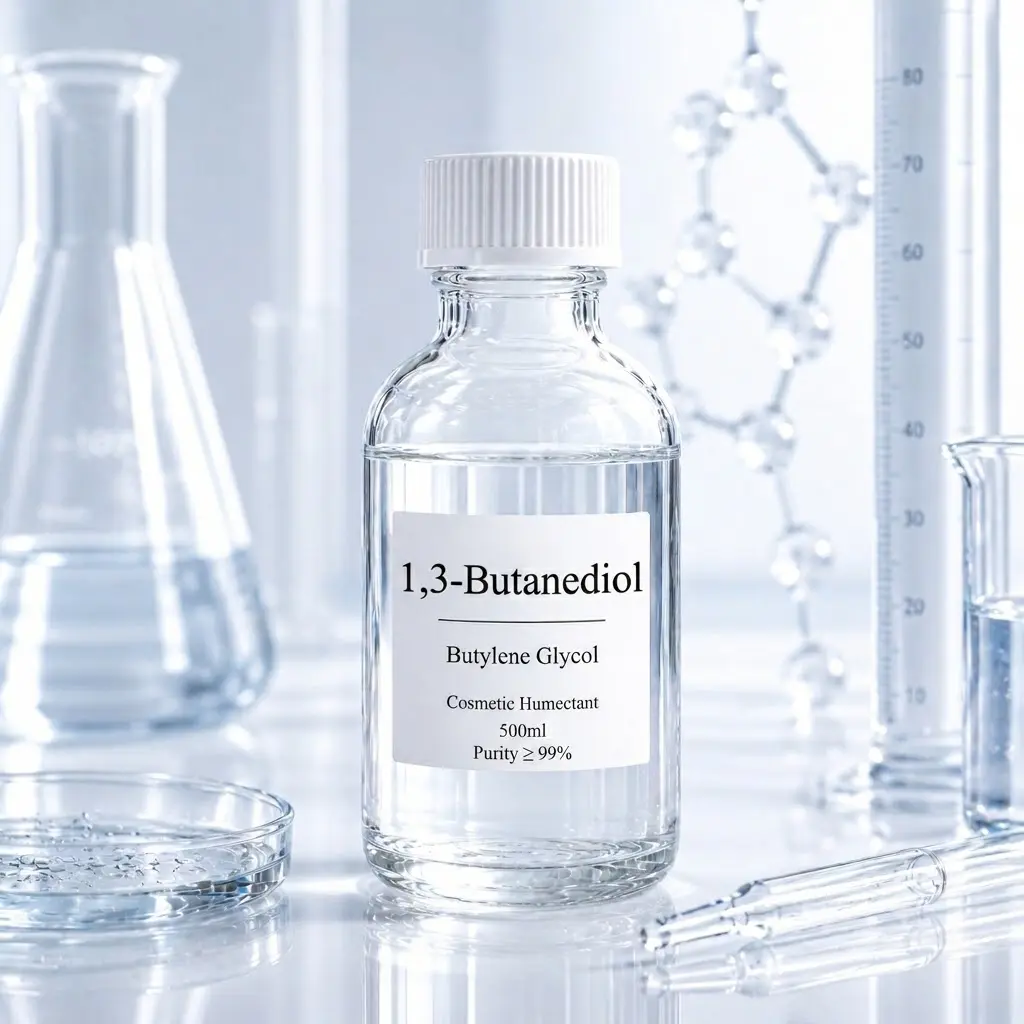
Cosmetic Active System
Butylene Glycol (1,3-Butanediol)
Butylene Glycol (1,3-Butanediol) is a clear, practically odorless multifunctional cosmetic ingredient that serves as a humectant, solvent, viscosity modifier, and preservative support agent in a single molecule. With an EWG safety rating of 1 (Low Hazard) and a non-comedogenic profile, it is one of the most widely used glycols in modern skincare — particularly in K-beauty formulations, vitamin C serums, sheet masks, and lightweight moisturizers where superior hydration, silky feel, and clean-label compatibility are required.
INCI
Butylene Glycol
CAS
107-88-0
Function
Humectant, solvent, texture enhancer, viscosity modifier, preservative booster
Shelf Life
24 months
Product Overview
The Trusted Multifunctional Glycol for Hydration, Solvency and Sensorial Excellence
Butylene Glycol is one of the most frequently encountered ingredients on cosmetic INCI labels — and for good reason. Its two hydroxyl (–OH) groups provide the chemical foundation for three essential formulation functions: moisture retention through hydrogen bonding with water molecules, broad-spectrum solvency for dissolving both hydrophilic and lipophilic active ingredients, and viscosity modulation that transforms tacky, high-glycerin formulas into elegantly spreadable, non-sticky textures.
Unlike propylene glycol, which carries a higher irritation profile (EWG 3) and comedogenicity concern, Butylene Glycol is consistently rated EWG 1 (Low Hazard) with a comedogenicity score of 0–1. This safety profile, combined with its multifunctional versatility, explains why it is a staple ingredient in Korean beauty formulations — appearing in the top five ingredients of most hydrating toners, essences, and sheet masks on the market. Butylene Glycol is produced under controlled conditions with ≥ 99% purity, ensuring batch-to-batch consistency, neutral odor profile, and full compliance with global cosmetic ingredient regulations.Butylene Glycol (1,3-Butanediol) is widely adopted across Asia, Europe, and North America as the preferred humectant-solvent for clean beauty and sensitive skin formulations.
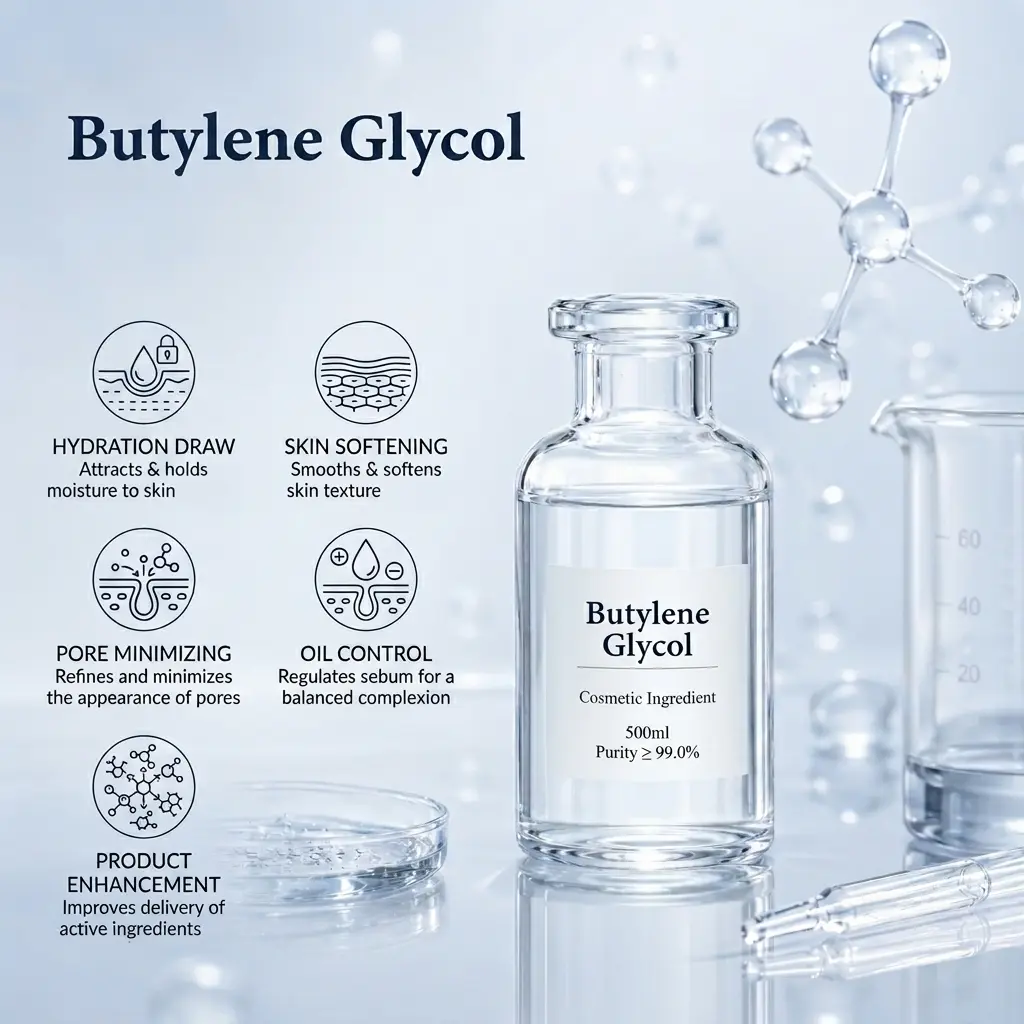
Core Advantages
Moisturization Benefits
Water Retention
Butylene Glycol acts as a powerful humectant by drawing and binding atmospheric moisture to the skin barrier. Its low molecular weight (90.12 g/mol) enables rapid penetration into the upper epidermis, where it helps maintain optimal water content and reduce transepidermal water loss (TEWL). Unlike glycerin, which can feel heavy or tacky at higher concentrations, Butylene Glycol delivers sustained hydration with a lightweight, quick-absorbing finish.
Barrier Support
Adequate hydration is a prerequisite for healthy skin barrier function. By maintaining optimal moisture levels in the stratum corneum, Butylene Glycol supports the enzymatic activity required for proper desquamation and barrier maintenance. Well-hydrated skin is more resilient to environmental stressors and less prone to sensitivity reactions.
Skin Softness
Regular use of Butylene Glycol in leave-on formulations visibly improves skin smoothness and suppleness. The humectant effect plumps the skin surface, reducing the appearance of fine dehydration lines and creating a soft, healthy-looking texture that does not rely on occlusive or film-forming agents.
Synergistic Effects
Butylene Glycol pairs exceptionally well with other moisturizing agents. When combined with glycerin, it reduces the characteristic tackiness while boosting total hydration. With hyaluronic acid, it improves serum clarity and dispersion. With ceramides, it supports the overall moisturization system by ensuring that barrier lipids remain in a well-hydrated environment.
Suitable for the following applications
Recommended Applications
Hydrating Toners & Essences
The primary application format. Butylene Glycol at 2–4% provides lightweight, rapid-absorbing hydration that primes the skin for subsequent active ingredients.
Vitamin C Serums
Essential solvent for L-ascorbic acid at 3–5%. Prevents crystallization and maintains serum clarity and stability over shelf life.
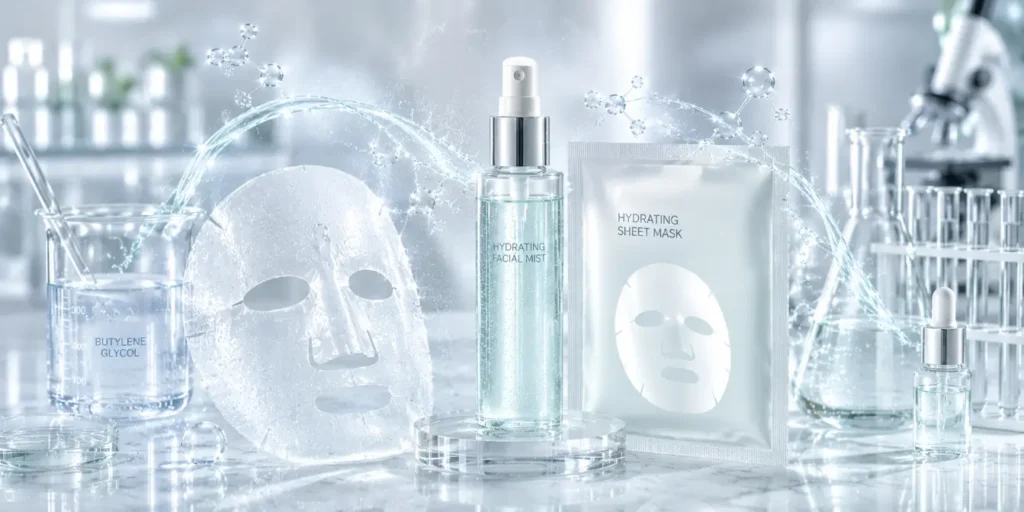
Sheet Masks & Facial Mists
Short-contact systems at 2–4%. Delivers hydration without tackiness, compatible with multi-layer packaging and repeated application.
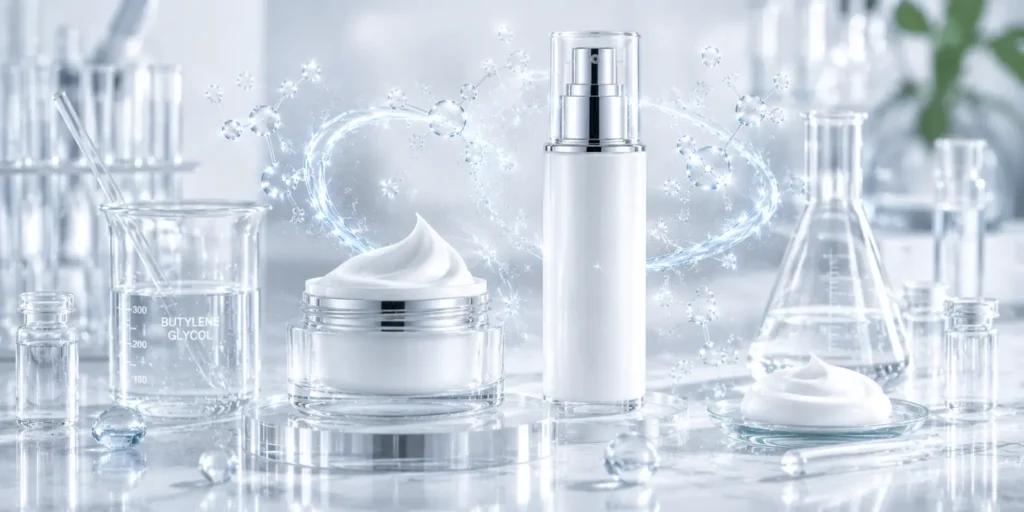
Moisturizers & Emulsions
Leave-on cream/lotion at 1–3%. Reduces glycerin stickiness and improves overall sensory profile.
Core Advantages
Why Formulators Choose Butylene Glycol
Multifunctional Versatility
A single ingredient that serves as humectant, solvent, viscosity modifier, and preservative support agent, reducing the number of raw materials needed and simplifying formulation workflows.
Exceptional Safety Profile
EWG Rating 1 (Low Hazard) with a comedogenicity score of 0–1. Significantly milder than propylene glycol (EWG 3) at equivalent use levels. Non-irritating and non-sensitizing in standard HRIPT assays.
Superior Skin Feel
Transforms the heavy, tacky texture of high-glycerin formulations into a silky, rapid-absorbing finish. The low molecular weight enables quick epidermal penetration without leaving a sticky residue.
Excellent Solvent Capacity
Dissolves a wide range of hydrophilic and lipophilic actives, including L-ascorbic acid, niacinamide, salicylic acid, and fragrance compounds. Prevents precipitation and crystallization in finished formulations.
Preservative System Support
At concentrations of 3–5%, lowers water activity (Aw) in formulations, enhancing the efficacy of traditional preservatives and enabling reduced total preservative load.
K-Beauty Industry Standard
The most commonly used humectant-solvent in Korean skincare, appearing in over 50% of hydrating toners, essences, and sheet masks globally. Formulated by leading brands worldwide for its reliability and multifunctional performance.
why choose us
Our high-quality Butylene Glycol ingredients
Cold-process compatible
Fully miscible with water at room temperature; no heating required for incorporation.
Broad pH tolerance
Stable across pH 3.0–10.0, compatible with virtually all cosmetic formulation types.
Heat-stable
Withstands standard production heating cycles up to 80°C without degradation.
Non-viscosity altering at low use
Minimal thickening effect at typical usage levels; formula viscosity remains manageable.
Transparent system compatible
Does not cloud or haze clear aqueous formulations.
Practically odorless
No competing scent profile; compatible with fragrance-sensitive and fine-fragrance applications.
Technical Specifications
Product Technical Parameters
Parameter | Specification |
|---|---|
INCI Name | Butylene Glycol |
Appearance | Clear, colorless, viscous liquid |
Purity | ≥ 99.0% |
Recommended Dosage | 1.0% – 5.0% |
Solubility | Readily soluble in water |
pH Stability | 5.0 – 7.0 |
Application | Toners, serums, vitamin C formulations, sheet masks, moisturizers, sunscreens, cleansers, hair care |
Shelf Life | 24 months |
related products
Other related products
Related Documents
Technical Support Materials
COA Document
Get For FreeTDS (Technical Data Sheet)
Get For FreeMSDS (Material Safety Data Sheet)
Get For FreeFormulation Guide
Get For FreeRelated Topics
Product-related articles
No related articles available yet. Stay tuned for more insights and updates.
Frequently Asked Questions
- What is Butylene Glycol and what is its primary function in cosmetic formulations?Butylene Glycol (1,3-Butanediol, CAS 107-88-0) is a multifunctional cosmetic ingredient that serves primarily as a humectant and solvent. Its two hydroxyl groups attract and bind atmospheric moisture to the skin barrier, providing lightweight hydration, while its solvent properties effectively dissolve active ingredients for uniform dispersion. It also functions as a viscosity modifier and preservative support agent at higher concentrations.
- What is the recommended dosage range for Butylene Glycol?For humectant and solvent functions, the recommended dosage is 1.0% to 5.0%. For preservation support — where Butylene Glycol lowers water activity (Aw) to enhance preservative efficacy — a higher range of 3.0% to 5.0% is recommended. Most leave-on formulations use 2–4%.
- Is Butylene Glycol safe for sensitive skin formulations?Yes. Butylene Glycol carries an EWG safety rating of 1 (Low Hazard), a comedogenicity score of 0–1 (non-comedogenic), and is classified as non-irritating and non-sensitizing in standard HRIPT assays at typical use levels. It is significantly milder than propylene glycol (EWG 3), making it the preferred glycol choice for sensitive skin formulations.
- How does Butylene Glycol differ from Propylene Glycol?Butylene Glycol (C4, 1,3-diol) has a lower EWG score (1 vs 3), lower comedogenicity (0–1 vs 0–3), and lower irritation potential compared to Propylene Glycol (C3, 1,2-diol). While both function as humectants and solvents, Butylene Glycol offers a superior safety profile that makes it the preferred choice in clean beauty, sensitive skin, and K-beauty formulations.
- What is the solubility profile of Butylene Glycol?Butylene Glycol is completely miscible with water, ethanol, and acetone. It can be incorporated into the water phase of any emulsion system without heating, making it compatible with both cold-process and hot-process manufacturing. It also dissolves a wide range of active ingredients, including L-ascorbic acid, niacinamide, salicylic acid, and fragrance compounds.
- Can Butylene Glycol be used as a preservative?Butylene Glycol is not a standalone preservative, but it functions as a preservative support agent. At concentrations of 3–5%, it reduces water activity (Aw) in formulations, creating a less favorable environment for microbial growth. It synergizes with traditional preservatives such as phenoxyethanol and ethylhexylglycerin, allowing formulators to reduce the total preservative load while maintaining antimicrobial efficacy.