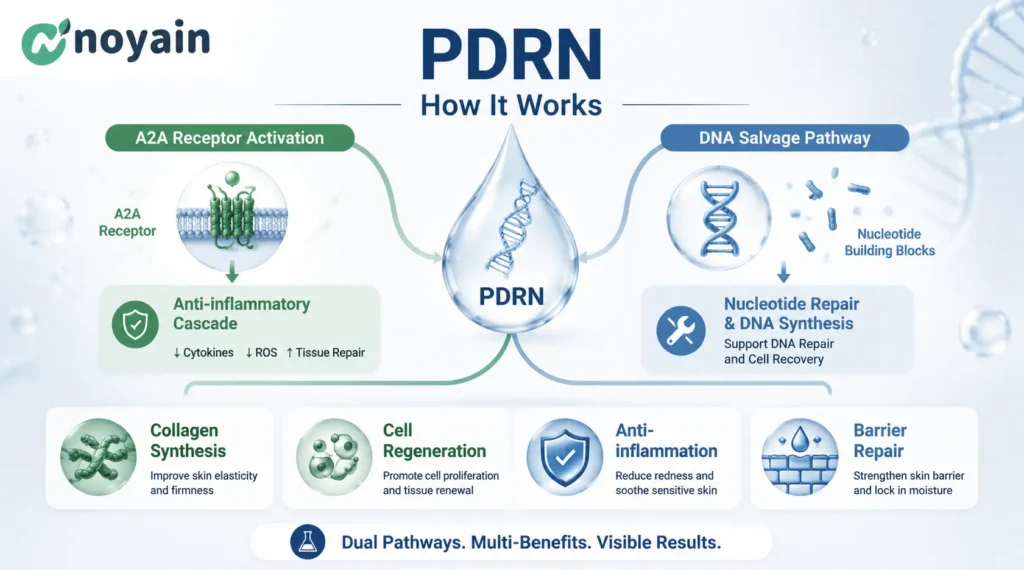
Four little letters—PDRN—have taken over the skin-care industry. Once a niche ingredient known mainly to K-beauty insiders, salmon-derived PDRN is now appearing in serums, creams, masks, and ampoules from Seoul to New York. This article breaks down why it is trending, what the evidence actually says, and what product developers should know before jumping on the bandwagon.
For the clinical evidence behind PDRN’s skin benefits, see our PDRN Benefits for Skin article. To understand how PDRN compares with established actives like retinol and azelaic acid, read our PDRN vs Retinol, Azelaic Acid & Exosomes Comparison.
Key Takeaways
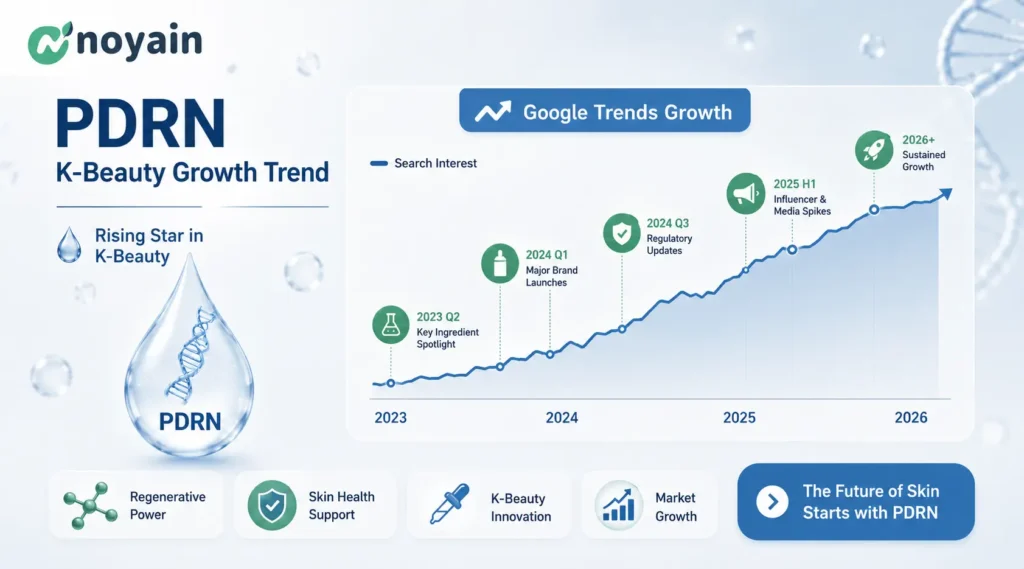
- PDRN (polydeoxyribonucleotide) is the fastest-growing active ingredient in K-beauty, with global search interest rising more than 400% since 2023
- The trend is driven by three converging forces: K-beauty global influence, the rise of post-procedure skincare, and consumer demand for biotech regenerative ingredients
- Evidence is strongest for wound healing and post-procedure recovery; anti-aging data is promising but still emerging
- For formulators, the window of opportunity is open but narrowing
What is PDRN?
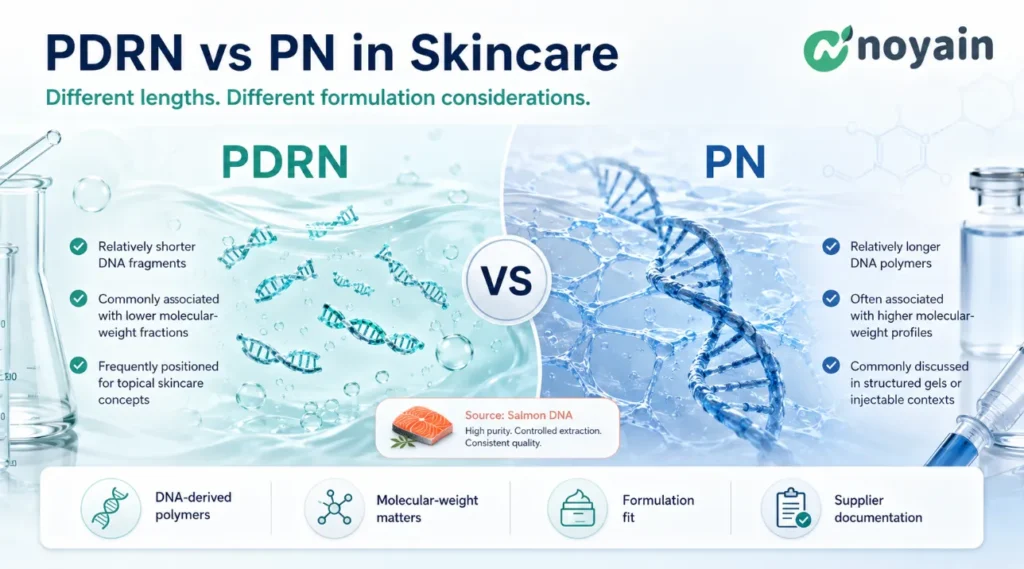
PDRN (polydeoxyribonucleotide) is a DNA-derived ingredient sourced from salmon sperm cells. It consists of DNA fragments typically in the 50-300 kDa molecular weight range for cosmetic applications. Its INCI name is Sodium DNA.
For a comprehensive technical overview, see our companion article: What is PDRN? A Complete Guide to Salmon DNA in Skincare (2026).
This article focuses specifically on the market trend and strategic implications for formulators, procurement professionals, and brand owners.
Why is PDRN Trending Now?
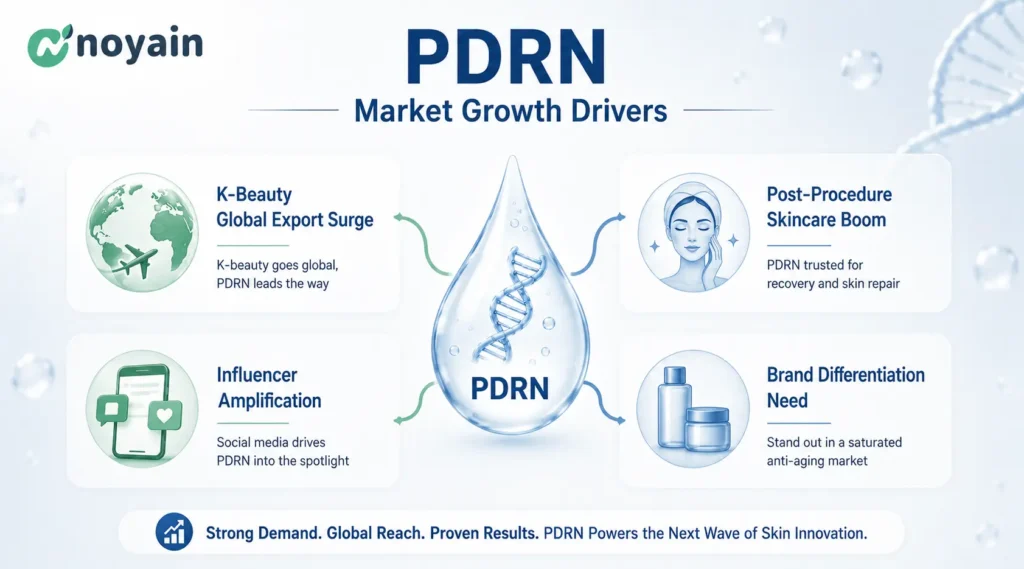
PDRN rise from a niche K-beauty ingredient to a global phenomenon is not accidental. Three structural shifts in the beauty industry have converged to create this moment.
| Driver | What is Happening | Why It Matters for B2B |
|---|---|---|
| K-beauty global influence | Korean beauty trends reach Western markets within months | PDRN is table stakes for K-beauty brands |
| Rise of post-procedure skincare | The recovery model is reshaping product development | PDRN products command 2-3x premium |
| Demand for regenerative ingredients | Consumers seek biotech ingredients that work with your body | Biotech-derived actives support premium B2B positioning |
| Social media amplification | TikTok and Instagram create feedback loops | Speed-to-market is critical |
Expert Insight
“PDRN occupies the intersection of clinically recognized tissue repair and premium cosmetic positioning. No other regenerative skincare ingredient bridges that gap with the same regulatory clarity.”
The Numbers Tell the Story
- Google Trends: Global search interest increased approximately 400% between Q1 2023 and Q2 2026 (Source: Google Trends, accessed May 2026)
- Product launches: More than 1,200 new PDRN-containing products launched globally in 2025 (Source: Mintel GNPD, accessed May 2026)
- Price positioning: Average PDRN serum retails at $48-$120, well above the average serum price of $25-$45
- Geographic spread: South Korea ~45% of launches; US and EU growing fastest at 65% and 52% YoY
Who Should Formulate with PDRN?
| Brand Profile | Why PDRN Fits | Recommended Product Form |
|---|---|---|
| Post-procedure skincare brands | Strongest clinical evidence; highest premiums (2-3x) | Recovery ampoules, post-treatment sheet masks |
| Medical spa private labels | Aligns with clinical credibility | Professional-strength serums, procedure kits |
| Premium anti-aging lines | Supports regenerative biotech narrative | Anti-aging serums, eye creams |
| Recovery-focused mask brands | Single-use allows higher unit pricing | PDRN-infused sheet masks, single-dose ampoules |
| Clean-beauty and vegan lines | Fermentation-derived PDRN eliminates animal concerns | Plant-based PDRN formulas |
From K-Beauty to Global Phenomenon: Key Market Signals
The TikTok Effect
In 2025, #PDRN accumulated over 280 million views on TikTok. Categories included before-and-after comparisons, ingredient education, product reviews, and esthetician commentary. Several PDRN suppliers reported inbound inquiries increased 3-5x in 2025.
Competitor Landscape
- First-generation: Small Korean biotech firms for domestic aesthetic medicine
- Scale-up: Mid-sized manufacturers expanding from hyaluronic acid into PDRN
- New entrants: Large Chinese and Indian fermentation companies
Key differentiators: molecular weight consistency, regulatory documentation, and BSE/TSE-free certification.
Does PDRN Actually Work?
| Claim | Evidence Level | Notes |
|---|---|---|
| Wound healing | Strong | Multiple clinical studies |
| Post-procedure recovery | Moderate-strong | Reduced erythema, faster barrier recovery |
| Collagen stimulation | Moderate | In vitro plus small clinical trials |
| Anti-aging | Moderate | Promising but limited to small cohorts |
| Skin barrier improvement | Moderate | Improved barrier function metrics |
What this means: Evidence is strongest in wound healing and post-procedure recovery. For anti-aging claims, data is directionally positive but not as robust as retinoids or vitamin C.
PDRN vs. Other Repair Actives
| Ingredient | Best-Fit Application | B2B Premium |
|---|---|---|
| PDRN | Post-procedure, barrier recovery | Very high (2-3x) |
| Centella Asiatica (Cica) | General soothing, sensitive skin | Low-moderate |
| Copper Tripeptide-1 | Anti-aging, scar improvement | Moderate-high |
| Exosomes | Advanced regenerative repair | Very high (emerging) |
Key takeaway: PDRN occupies a unique niche—medically validated wound healing with clean regulatory status and premium pricing.
What the Industry Is Saying
Dr. Park, a Seoul-based formulation scientist: “PDRN is not a replacement for retinoids or vitamin C. But for the post-procedure and barrier repair market, nothing else works quite the same way.”
Formulation Rules of Thumb for PDRN
Optimal pH Range
Maintain final formulation pH between 5.5 and 7.0. Outside this range hydrolytic degradation accelerates.
Charge Compatibility (Critical)
- Avoid: Cationic surfactants, cationic polymers (Polyquaternium), divalent metal ions (Zn2+, Cu2+, Ca2+)
- Preferred: Nonionic surfactants, anionic surfactants, amphoteric surfactants at low concentrations
- Preservative caution: Avoid cationic preservatives; phenoxyethanol is generally compatible
Thickener System Selection
| Thickener | Compatibility | Notes |
|---|---|---|
| Xanthan gum | Excellent | Cold-process; add PDRN after hydration |
| Sodium hyaluronate | Excellent | Synergistic barrier benefits |
| HEC | Excellent | Neutral polymer, no charge interaction |
| Carbomer | Good | Hydrate then add PDRN then neutralize |
| Cationic thickeners | Not recommended | Risk of precipitation |
Common Formulation Mistakes to Avoid
| Mistake | Result | Solution |
|---|---|---|
| Using cationic conditioners | Precipitation or haziness | Use nonionic or anionic only |
| Formulating below pH 4.5 | DNA degradation | Maintain pH 5.5-7.0; use buffer systems |
| Adding PDRN before thickener hydration | Uneven dispersion, clumping | Hydrate thickener fully first |
Regulatory Landscape at a Glance
| Market | Status | Key Consideration |
|---|---|---|
| South Korea | Approved cosmetic ingredient | Longest history of safe use |
| China | Listed in IECIC (2021) as Sodium DNA | Compliant for import registration |
| European Union | Listed in CosIng | BSE/TSE-free certification required |
| United States | Cosmetic use permitted | No FDA monograph |
| Japan | Approved with documentation | Source origin documentation needed |
Strategic Recommendations
- Position for post-procedure, not just anti-aging: Highest evidence and price premiums are in recovery
- Invest in formulation quality: Novelty advantage fades within 12-18 months
- Build regulatory documentation now: Complete COA, BSE/TSE, stability data
- Consider product forms beyond serum: Sheet masks, eye creams, sunscreen combinations, body lotions
- Watch the next wave: Fermentation-derived PDRN (vegan), liposomal PDRN, PDRN-peptide composites
Choosing a Reliable PDRN Supplier
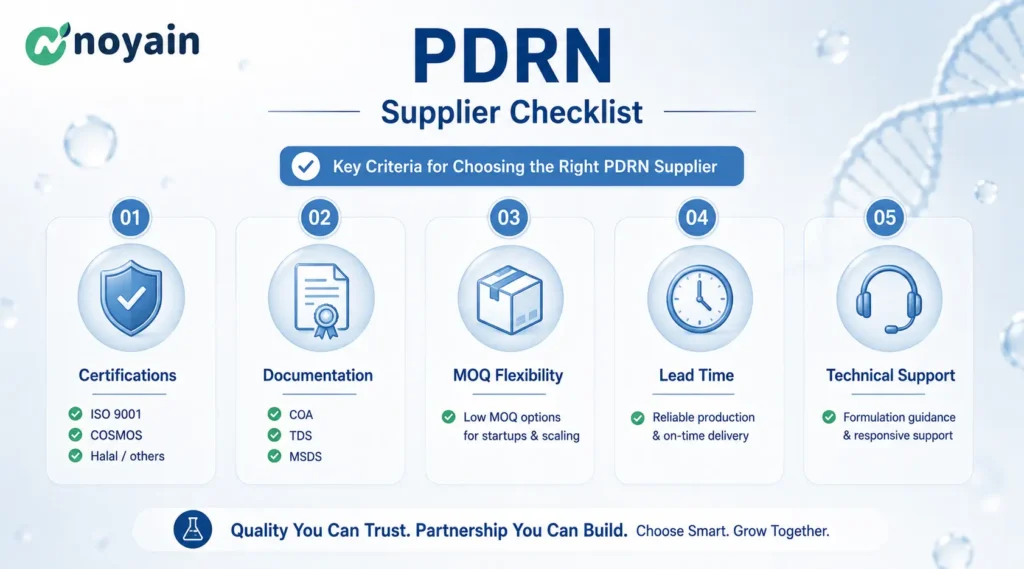
| Criterion | Why It Matters |
|---|---|
| Molecular weight consistency | Request HPLC profiles with every COA |
| Manufacturing capacity | Our capacity: 500 kg/month, expandable to 2,000 kg/month |
| ISO/GMP certifications | ISO 22716, ISO 9001 |
| BSE/TSE-free certification | Mandatory for EU and US |
| Lot traceability | Full traceability from reception to release |
| Lead time | Powder: 15-20 days. Solution: 20-25 days |
| MOQ | Powder: 1 kg trial, 25 kg production |
FAQ
Q1: Is PDRN just marketing hype?
A: Evidence is strongest for post-procedure recovery and barrier repair. Positioned correctly, it delivers real value.
Q2: How long will the trend last?
A: 3-5 years of strong market presence ahead, based on comparable ingredient trends.
Q3: Cosmetic vs. medical grade?
A: Medical: 1000-1500 kDa for injectable. Cosmetic: 50-300 kDa for topical. Not interchangeable.
Q4: Can PDRN be combined with hyaluronic acid?
A: Yes. Fully compatible with sodium hyaluronate, niacinamide, panthenol. See Hyaluronic Acid Guide.
Q5: Where can I source PDRN?
A: We supply cosmetic-grade PDRN. See our PDRN Powder and PDRN Solution pages.
Explore Our PDRN Products
| Product | Trial Size | Production Size | Lead Time |
|---|---|---|---|
| PDRN Powder (99%+, MW 50-300 kDa) | 1 kg | 25 kg | 15-20 days |
| PDRN Solution (1%) | 5 kg | 50 kg | 20-25 days |
| Liposomal PDRN | Custom | Custom | Upon request |
Certifications: ISO 22716 | ISO 9001 | BSE/TSE-free | Full lot traceability | COA with HPLC MW profile
B2B Inquiry
To request a sample, download documentation, or discuss your formulation needs, please contact us through our inquiry form:→ Contact Us
Or reach us directly at [email protected]
Noyain Biochemicals
Room 3a05, 4th Floor, No. 6, Ketai Second Road, Baiyun District, Guangzhou City, China
Related Articles
- Pillar: What is PDRN? Complete Guide
- Related: Hyaluronic Acid Guide | Copper Peptides Guide | Centella Asiatica Guide
- Products: PDRN
References
- Kim, S.K., 2023. Polydeoxyribonucleotide: Mechanisms and Clinical Applications. Journal of Cosmetic Dermatology.
- Mintel GNPD. PDRN product launches 2022-2025. Accessed May 2026.
- Google Trends. PDRN Skincare 2023-2026. Accessed May 2026.
- Noh, T.K., et al., 2020. PDRN vs. HA for Skin Rejuvenation. Dermatologic Surgery.
- Kwon, T.R., et al., 2021. PDRN in Tissue Regeneration. Molecules.
- Allure. PDRN Is the Viral K-Beauty Ingredient. 2025.
- CosIng Database – Sodium DNA. European Commission.
- China NMPA. IECIC 2021 – Sodium DNA.