
- Optimal pH range: 5.0–6.5 for maximum stability and efficacy.
- Avoid strong acids (AHAs/BHAs), as low pH (< 4.0) can destabilize the copper-peptide complex.
- Avoid high-concentration Vitamin C (L-ascorbic acid), as the reducing environment may displace the copper ion from the peptide complex.
- Avoid EDTA and other strong chelating agents, which may compete for copper binding.
- Add during the cool-down phase (< 40 °C) when using hot-process manufacturing.
- Use opaque or UV-protective packaging to help prevent photodegradation.
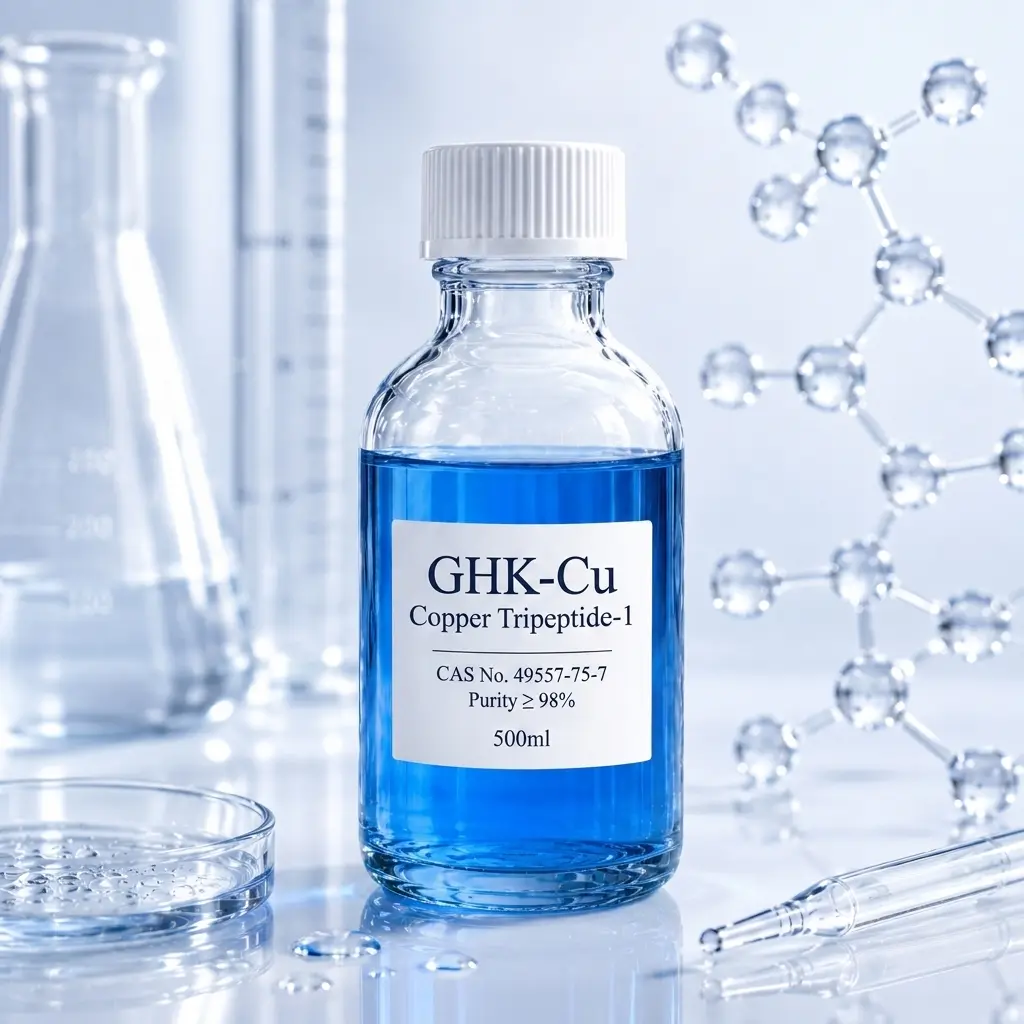
Cosmetic Active System
Copper Tripeptide-1
Copper Tripeptide-1 is a copper-complexed tripeptide
used as a cosmetic skin-conditioning ingredient.
It is suitable for formulations designed around
appearance-focused aging care, smoother-looking texture,
skin comfort, and premium peptide positioning.
Copper Tripeptide-1 can be incorporated into serums, creams,
eye-area products, masks, and scalp-care cosmetic formulations.
Its use level, pH compatibility, stability, safety, and
finished-product claims should be verified in the complete formula.
INCI
Copper Tripeptide-1
CAS
89030-95-5
Function
Skin conditioning; appearance-focused aging care;
firmness appearance; skin comfort; cosmetic scalp-care positioning
Shelf Life
24 months
Product Overview
Copper Tripeptide-1 for Cosmetic Formulation and Appearance-Focused Skincare
Copper Tripeptide-1 is a proteolytic fragment generated naturally during tissue injury, where it serves as a molecular signal that orchestrates the skin's repair response. First identified by Dr. Loren Pickart in 1973, Copper Tripeptide-1 is found in human blood plasma at concentrations of approximately 200 ng/mL in young adults — levels that decline steadily with age to around 80 ng/mL by age 60. This decline correlates with reduced skin repair capacity, slower wound healing, and visible signs of aging, making topical Copper Tripeptide-1 replenishment a scientifically grounded strategy for maintaining youthful skin function.
What distinguishes Copper Tripeptide-1 from other peptide actives is its multifunctional mechanism. The copper ion serves as an essential cofactor for lysyl oxidase — the enzyme that cross-links newly synthesized collagen and elastin into a functional extracellular matrix — while also mimicking the activity of superoxide dismutase (SOD), one of the body's most important endogenous antioxidant enzymes. The GHK tripeptide, meanwhile, acts as a signaling molecule that upregulates collagen Type I synthesis by up to 70%, stimulates glycosaminoglycan production for deep hydration, and modulates the inflammatory response through NF-κB pathway suppression. This dual peptide-metal synergy makes Copper Tripeptide-1 a uniquely versatile active for anti-aging, repair, and soothing applications.
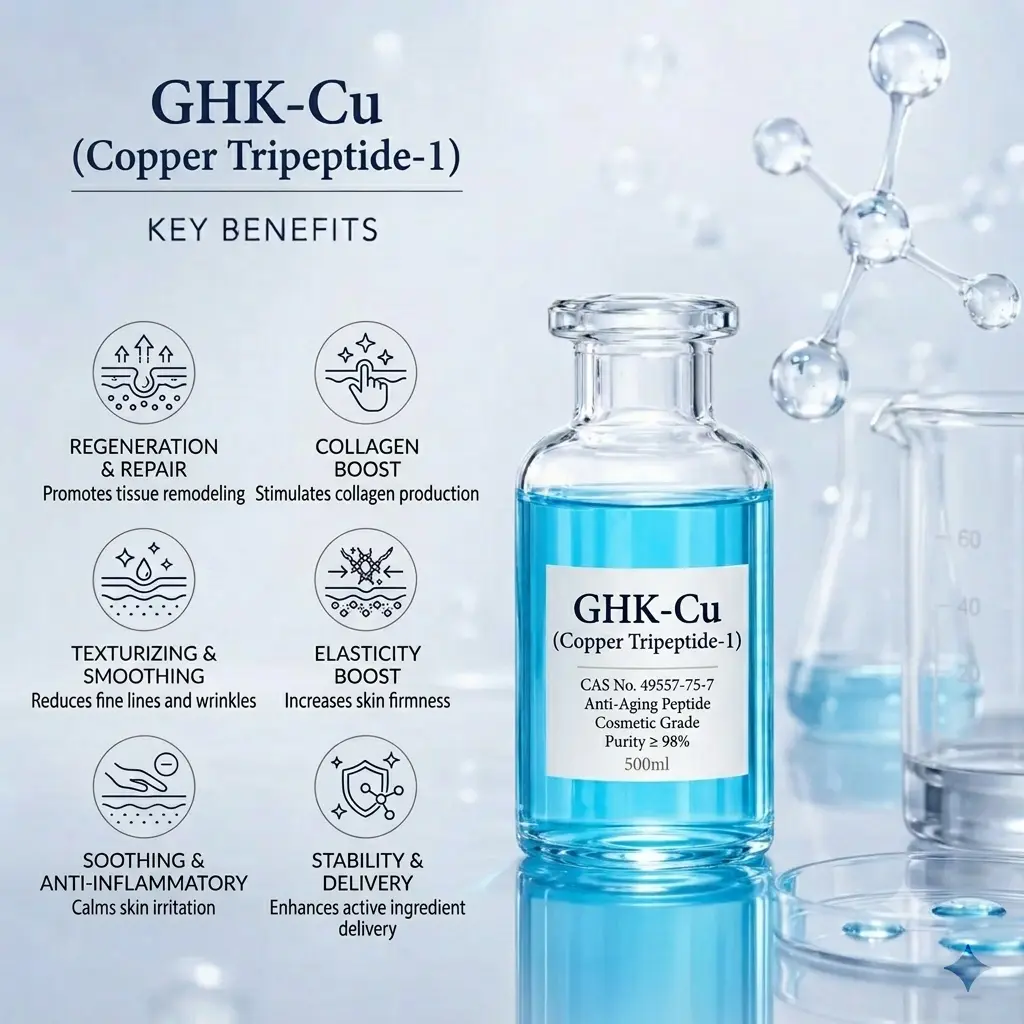
Core Advantages
Cosmetic Formulation Positioning
Firmness Appearance Positioning
Copper Tripeptide-1 directly signals dermal fibroblasts to upregulate collagen Type I, III, and VII production. In vitro studies demonstrate up to a 70% increase in collagen synthesis in treated fibroblast cultures compared to untreated controls. The copper ion acts as an essential cofactor for lysyl oxidase, the enzyme responsible for cross-linking collagen and elastin fibers into a functional, resilient extracellular matrix. This dual mechanism — stimulating production while ensuring proper cross-linking — translates to measurable improvements in skin firmness, density, and wrinkle reduction.
Elasticity Appearance Care
Beyond collagen, Copper Tripeptide-1 stimulates elastin synthesis in dermal fibroblasts, improving skin elasticity and recoil. The copper-dependent lysyl oxidase pathway also cross-links tropoelastin into mature elastin fibers, maintaining the skin structural network that resists sagging and laxity.
Cellular Renewal
Copper Tripeptide-1 promotes wound healing and tissue regeneration through multiple pathways: it enhances keratinocyte migration and proliferation for faster re-epithelialization, stimulates angiogenesis (new blood vessel formation) to improve oxygen and nutrient delivery to damaged tissue, and modulates matrix metalloproteinases (MMPs) to balance extracellular matrix remodeling. These effects accelerate the skin's natural repair cycle, making it valuable for both anti-aging and post-procedure recovery.
Skin Barrier Improvement
By stimulating fibroblast production of glycosaminoglycans — including hyaluronic acid — Copper Tripeptide-1 contributes to deep dermal hydration and plumping. It also supports proteoglycan synthesis (such as decorin), which organizes the extracellular matrix and maintains barrier integrity. The anti-inflammatory effect through NF-κB suppression further supports barrier recovery by reducing cytokine-mediated barrier disruption.
Suitable for the following applications
Recommended Applications
Anti-Aging Serum
The primary delivery platform. Copper Tripeptide-1 at 0.1–0.5% in an aqueous or lightweight serum base provides daily collagen support and firming benefits. Pairs well with hyaluronic acid and other peptides for comprehensive anti-aging.
Eye Cream
Targeted firming treatment at 0.1–0.3% for the delicate periorbital area. The peptide collagen signaling effect is particularly beneficial for improving skin density and reducing fine lines around the eyes.
Firming Cream
Leave-on emulsion at 0.1–0.5% for overall face and neck firming. The combination of collagen synthesis stimulation and glycosaminoglycan hydration provides measurable skin tightening over 4–8 weeks of regular use.
Post-Procedure Ampoule
High-concentration treatment at 0.3–0.5% for use after microneedling, laser, or chemical peel procedures. Accelerates wound healing, reduces redness, and supports organized tissue remodeling.
Core Advantages
Why Formulators Choose Copper Tripeptide-1
Clinically Validated Collagen Synthesis
Up to 70% increase in collagen Type I production in fibroblast cultures, with supporting evidence from multiple independent studies spanning over four decades of research since its discovery in 1973.
Multi-Target Mechanism
A single active that addresses collagen synthesis, antioxidant protection (SOD-mimetic), anti-inflammatory signaling (NF-κB suppression), wound healing, and glycosaminoglycan stimulation — reducing the number of actives needed in a formulation.
Unique SOD-Mimetic Antioxidant Activity
The copper ion in Copper Tripeptide-1 catalytically dismutates superoxide radicals, functioning as a true enzymomimetic antioxidant. This is fundamentally different from stoichiometric antioxidants (like Vitamin C or Vitamin E) that are consumed during radical neutralization.
Low Use Level, High Impact
Clinically active at concentrations as low as 0.05%, enabling cost-effective formulation and minimizing formulation load.
Dual Anti-Aging and Repair Positioning
Unlike pure anti-aging actives or pure soothing actives, Copper Tripeptide-1 bridges both categories — making it suitable for anti-aging serums, post-procedure recovery, and sensitive skin formulations alike.
Vertical Application Versatility
Effective across anti-aging skincare, post-procedure clinical care, hair and scalp treatments, and acne scar management — offering broad product line extension potential.
why choose us
Our high-quality Copper Tripeptide-1 ingredients
Cold-process compatible
Fully miscible with water at room temperature; no heating required for incorporation.
Broad pH tolerance
Stable across pH 3.0–10.0, compatible with virtually all cosmetic formulation types.
Heat-stable
Withstands standard production heating cycles up to 80°C without degradation.
Non-viscosity altering at low use
Minimal thickening effect at typical usage levels; formula viscosity remains manageable.
Transparent system compatible
Does not cloud or haze clear aqueous formulations.
Practically odorless
No competing scent profile; compatible with fragrance-sensitive and fine-fragrance applications.
Technical Specifications
Product Technical Parameters
Parameter | Specification |
|---|---|
INCI Name | Copper Tripeptide-1 |
Appearance | Blue to bluish-purple powder |
Purity | ≥ 98% |
Recommended Dosage | 1.0% – 5.0% |
Solubility | Readily soluble in water; characteristic blue solution |
pH Stability | 5.0 – 6.5 |
Application | Anti-aging, collagen synthesis, wound healing, antioxidant, anti-inflammatory, firming, hair growth support |
Shelf Life | 24 months |
Kind tips
Formulation Precautions
related products
Other related products
Related Documents
Technical Support Materials
COA Document
Get For FreeTDS (Technical Data Sheet)
Get For FreeMSDS (Material Safety Data Sheet)
Get For FreeFormulation Guide
Get For FreeRelated Topics
Product-related articles
Frequently Asked Questions
- What is the primary function of Copper Tripeptide-1 in cosmetic formulations?Copper Tripeptide-1 is primarily used as an anti-aging and skin repair active. It stimulates collagen and elastin synthesis, accelerates wound healing, provides antioxidant protection through SOD-mimetic activity, and reduces inflammation. It is one of the most well-researched peptide actives in cosmetic science, with clinical data supporting its efficacy in improving skin firmness, reducing wrinkles, and promoting tissue repair.
- What is the recommended dosage range for Copper Tripeptide-1?The recommended dosage ranges from 0.05% to 0.5% for leave-on products such as serums and creams. For concentrated treatments such as professional ampoules and post-procedure products, levels up to 1.0% may be used. The optimal pH range for maximum stability and efficacy is 5.0 to 6.5.
- Is Copper Tripeptide-1 the same as Copper Tripeptide-1?Yes. Copper Tripeptide-1 is the INCI name for Copper Tripeptide-1. Copper Tripeptide-1 is the copper chelate of the tripeptide GHK (Glycyl-L-Histidyl-L-Lysine). The terms are used interchangeably in the cosmetic industry, with Copper Tripeptide-1 being the common abbreviation and Copper Tripeptide-1 being the official INCI designation.
- Does Copper Tripeptide-1 help with acne scarring?Yes. Copper Tripeptide-1 promotes organized tissue remodeling during wound healing through modulation of matrix metalloproteinases (MMPs) and stimulation of collagen reorganization. Clinical evidence supports its use in reducing the appearance of atrophic acne scars over 8–12 weeks of regular application. It is most effective when used in combination with professional treatments such as microneedling.
- What gives Copper Tripeptide-1 its blue color?The characteristic blue color of Copper Tripeptide-1 is due to the copper ion (Cu²⁺) coordinated within the peptide complex. This color is a natural and expected property of copper-peptide complexes and serves as a useful visual indicator of product quality and concentration. In finished formulations at typical use levels (0.05–0.3%), the blue tint is subtle or can be easily masked.
- How does Copper Tripeptide-1 compare to other anti-aging peptides?Copper Tripeptide-1 is unique among cosmetic peptides because of its copper ion, which provides additional SOD-mimetic antioxidant activity and serves as a cofactor for lysyl oxidase (collagen cross-linking). Most other cosmetic peptides (such as Matrixyl or Argireline) are purely signaling peptides without metal cofactor activity. This makes Copper Tripeptide-1 the most multifunctional peptide active in the cosmetic ingredient palette.