South Korea is not just the birthplace of the PDRN trend — it remains the engine driving it. From Rejuran to Mediheal, a wave of Korean brands have turned salmon DNA into one of the fastest-growing cosmetic ingredients globally. This article unpacks the institutional advantages, leading brands, and market signals that every B2B buyer should understand.
For a complete technical overview of PDRN as an ingredient, see our What is PDRN? Complete Guide. For the broader global trend context, read PDRN Has Taken Over K-Beauty: What Formulators Need to Know.
Key Takeaways
- Korea’s dominance in PDRN skincare is built on three structural advantages: regulatory proximity to medical aesthetics, a domestic ingredient manufacturing base, and a consumer market that rapidly adopts novel biotech actives
- Major Korean brands including Rejuran, Mediheal, VT Cosmetics, and Beauty of Joseon have driven mainstream adoption through distinct product strategies — from injectable skin boosters to viral TikTok liquid spicule technology
- Understanding the difference between PDRN and related terms (PN, Sodium DNA, Salmon DNA) is essential for formulating competitive products
- For B2B buyers, the Korean model reveals both white-space opportunities and risks — including delivery challenges, vegan alternatives, and supply chain dependencies
What Is PDRN in K-Beauty? A Quick Primer
PDRN (polydeoxyribonucleotide), listed as Sodium DNA under INCI nomenclature, is a DNA-derived active ingredient extracted from salmon sperm cells. It has been used in Korean aesthetic medicine for over a decade before crossing into cosmetic products around 2022.
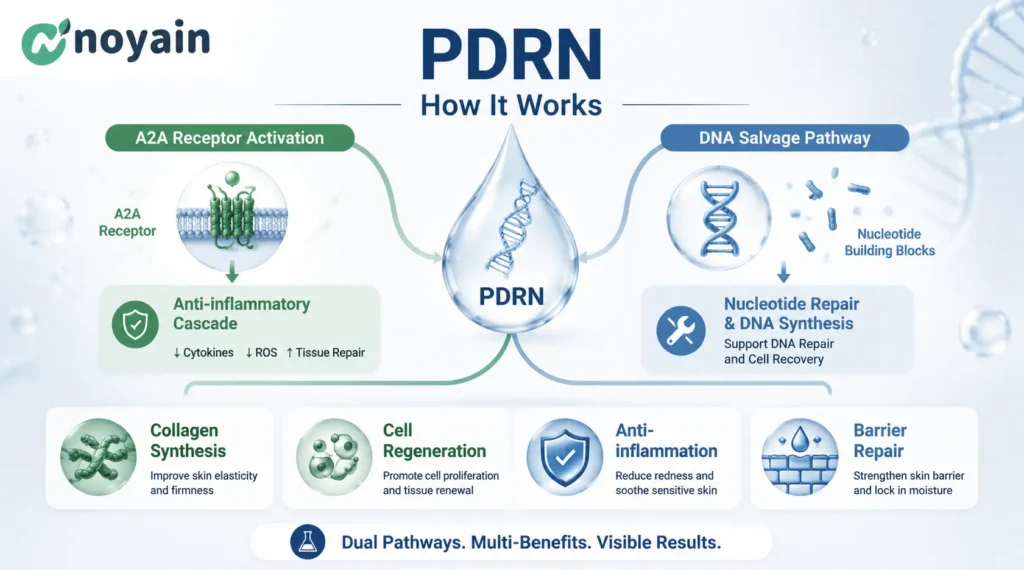
Think of it this way: if hyaluronic acid is like adding water to a sponge, PDRN is like repairing the sponge fibers themselves. It works through two pathways — activating A2A adenosine receptors to reduce inflammation and stimulate collagen, and supplying nucleotide building blocks for cellular DNA repair. This dual mechanism is what sets it apart from conventional moisturizing or anti-aging ingredients.
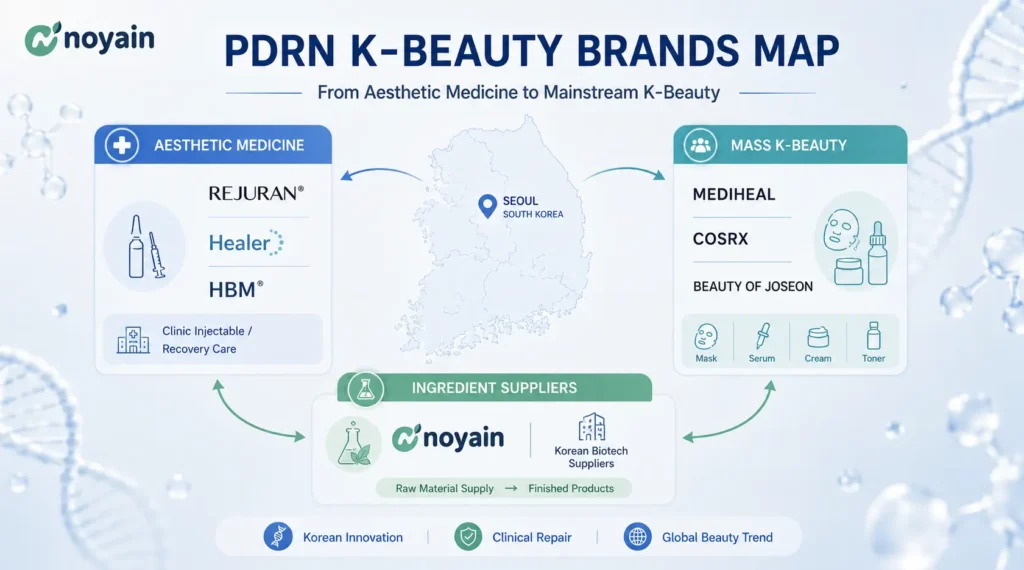
In the Korean market, PDRN occupies a unique position: it bridges the gap between medical-grade regenerative treatments (injectable Rejuran, popular since the 2010s) and everyday cosmetic products (serums, creams, sheet masks). This boundary-spanning quality is the key to understanding why Korea leads.
Why Korea Leads: Three Structural Advantages
1. Regulatory Proximity to Medical Aesthetics
South Korea’s regulatory framework allowed PDRN to gain clinical traction first as a medical device for wound healing and tissue regeneration, then gradually migrate into cosmetics as safety data accumulated. Korean regulators at the MFDS (Ministry of Food and Drug Safety) maintain a separate category for “cosmetic-type medical devices” and “functional cosmetics,” which has created a smoother pipeline for ingredients moving from clinical to consumer use.
| Factor | South Korea | United States | European Union | China |
|---|---|---|---|---|
| Medical cosmetic device category | Yes (established) | Limited (no separate track) | Yes (but slower) | Restricted |
| PDRN in approved medical products | Multiple (Rejuran, Rejuran HB, etc.) | Very few | A few CE-marked products | Import-only |
| Functional cosmetic pathway | MFDS functional cosmetic certification | No equivalent | Claims-based self-regulation | IECIC listing only |
| Time to market (medical to cosmetic) | ~2-3 years | ~5-7 years | ~4-6 years | ~3-5 years |
This regulatory agility means Korean brands can launch PDRN products with clinically adjacent claims faster than competitors in most other markets.
2. Domestic Ingredient Manufacturing Base
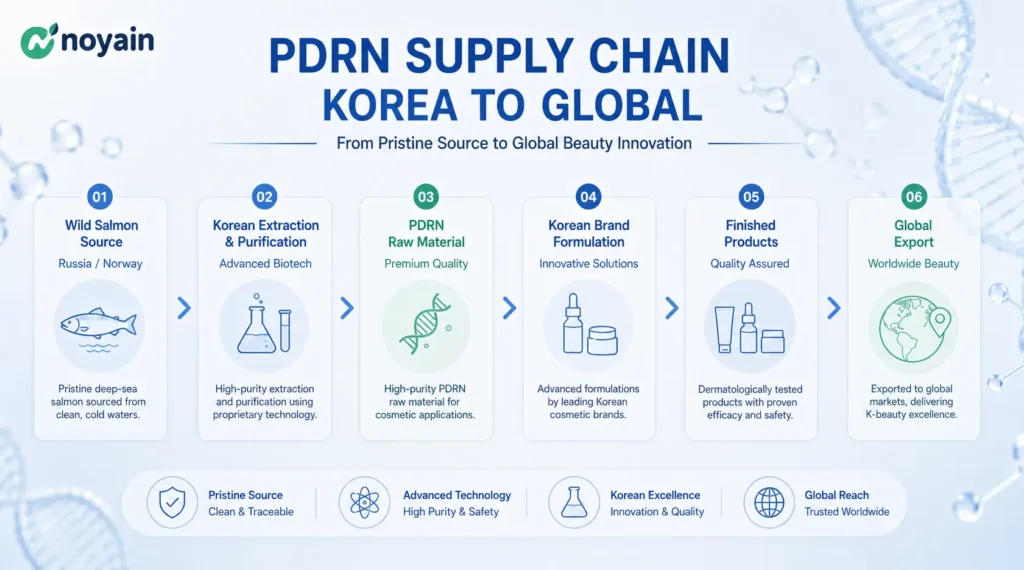
South Korea has built a robust domestic supply chain for PDRN — from raw salmon gonad processing (sourced from Russia, Norway, and domestic fisheries) through nucleotide extraction and purification, to finished product formulation. This vertical integration reduces costs, shortens lead times, and enables the kind of rapid iteration that trend-driven markets demand.
Key Korean PDRN ingredient suppliers include:
- BR PHARM — One of the earliest PDRN manufacturers, supplying Rejuran injectables
- Pharma Research Products (PRP) — Known for high-molecular-weight PDRN for aesthetic medicine
- Huons — A vertically integrated supplier covering both medical and cosmetic grades
- BNC Korea — Specializing in polynucleotide (PN) and PDRN for dermatological use
For international buyers, this domestic manufacturing ecosystem means Korea can offer competitive pricing, shorter MOQ flexibility, and faster custom formulation compared to many Western suppliers.
3. Consumer Market Dynamics
Korean consumers are among the most ingredient-literate in the world. The concept of “recovery skincare” and “barrier repair” is deeply embedded in the domestic beauty culture, largely influenced by the popularity of skin clinics and at-home aesthetic devices. PDRN’s positioning as a “regenerative” ingredient aligns naturally with this mindset.
The domestic K-beauty market also moves faster than most others. A product concept can go from a formulation lab to retail shelves within 3-6 months, compared to 9-18 months in European or North American markets. This velocity creates a competitive environment where brands must continuously differentiate — and PDRN has become a key differentiator.
PDRN vs PN: Understanding Korean Terminology
One source of confusion for international buyers entering the Korean PDRN market is the terminology overlap. The Korean aesthetic and cosmetic industry uses several related but distinct terms:
| Term | Description | Typical Molecular Weight | Common Application |
|---|---|---|---|
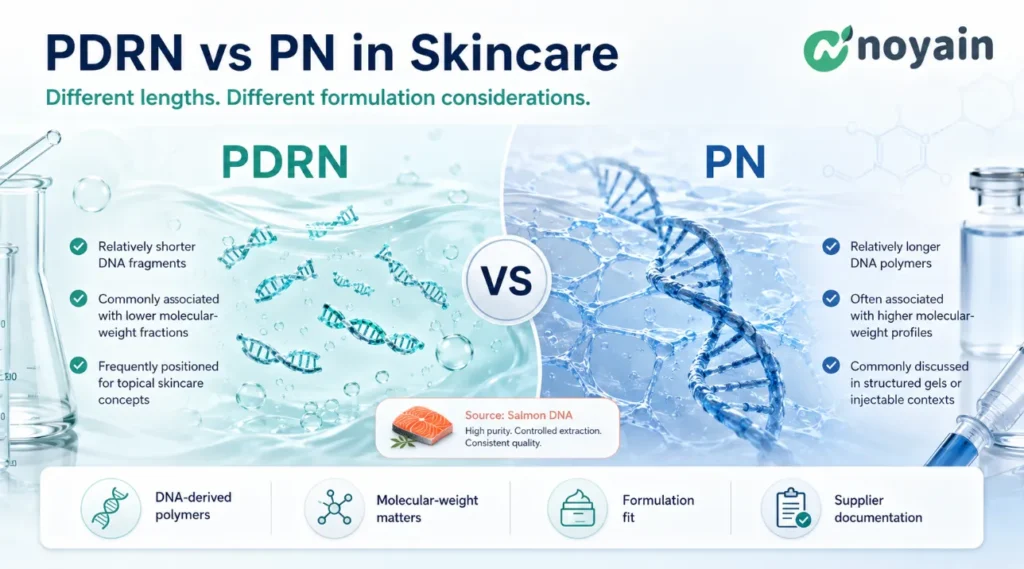
| PDRN (Polydeoxyribonucleotide) | Short DNA fragments, lower MW | 50–300 kDa (cosmetic) / 250–1500 kDa (medical) | Skin regeneration, anti-inflammatory, wound healing |
| PN (Polynucleotide) | Longer, higher MW DNA chains | 1000–2000+ kDa | Dermal filler, deeper tissue regeneration, longer-lasting effect |
| Sodium DNA | INCI cosmetic name for PDRN/PN | Varies by supplier | Cosmetic ingredient listing |
| Salmon DNA | Consumer marketing term | Same as PDRN or PN depending on product | Brand labeling, consumer communication |
In practice, many Korean brands use “PDRN” and “PN” interchangeably in consumer marketing, but the distinction matters for formulation. PN’s larger molecular weight makes it less suitable for topical application without delivery technology — which is why most cosmetic PDRN products use the shorter-chain version. When sourcing ingredients, always verify the molecular weight distribution on the COA rather than relying on the marketing label.
Top Korean PDRN Brands: Positioning and Strategies
The brand landscape has matured quickly. Here is how the key players align heading into the second half of 2026:
| Brand | Category | PDRN Market Position | Price Tier |
|---|---|---|---|
| Rejuran (BR PHARM) | Medical aesthetic | Injectable PN/PDRN gold standard for clinic use | $$$ |
| Medicube | At-home medical beauty | PDRN-device synergy; PDRN + Peptide co-formulation | $$ |
| VT Cosmetics | Delivery technology | Liquid spicule format for enhanced transdermal PDRN delivery | $$ |
| Mediheal | Recovery K-beauty | Post-procedure recovery masks with PDRN + soothing actives | $ |
| COSRX | Barrier repair | PDRN overlay on existing barrier-repair franchise | $ |
| Beauty of Joseon | Heritage biotech | PDRN within traditional Korean medicine narrative | $$ |
| Round Lab | Sensitive skin | Minimalist PDRN formulation for low-irritation recovery | $ |
| AHC (Unilever) | Mid-premium clinical | Clinically tested PDRN anti-aging ampoules | $$ |
| Some By Mi | Entry-level trend | Affordable PDRN for mass adoption | $ |
A notable pattern here is the dual-ingredient strategy employed by brands like Mediheal and COSRX. Rather than launching a standalone PDRN product, these brands overlay PDRN onto their existing hero ingredient — reducing consumer education cost while adding a “regenerative” angle to an already popular line. This approach has proven effective on TikTok, where ingredient-stacking narratives generate strong engagement. Entering 2026, some Korean R&D teams are also exploring PDRN-exosome combinations, aiming to pair regenerative DNA signaling with the natural nanocarrier properties of plant-derived exosomes for enhanced cellular delivery.
How Korean Brands Improve PDRN Delivery
The biggest formulation challenge with PDRN is getting a large, water-soluble DNA molecule through the skin barrier. The molecule sizes used in cosmetics (50-300 kDa) are orders of magnitude larger than the ~500 Da threshold typically associated with passive transdermal penetration. Korean brands have tackled this through several approaches:
Spicule Technology
The most commercially visible delivery innovation — popularized by VT Cosmetics’ Reedle Shot — uses micronized silica spicules suspended in a liquid serum. When applied, the spicules create temporary micro-channels in the stratum corneum, allowing PDRN and other actives to penetrate deeper. This is a liquid formulation (not a patch), and its viral success on TikTok has made it one of the most imitated delivery formats in K-beauty.
That said, international brands adopting this approach should be aware of a growing compliance risk. As of 2025-2026, regulators including Korea’s MFDS and the US FDA have increased scrutiny around “microneedling in a bottle” claims for spicule-based products. For overseas marketing, we recommend avoiding language that implies medical microneedling equivalence and instead framing the mechanism as “physical permeation enhancement” or “micro-channel barrier activation.”
Liposomal and Nanocarrier Encapsulation
Several Korean CMO manufacturers now offer PDRN encapsulated in liposomes or lipid nanoparticles. Encapsulation serves two purposes: protecting the DNA chain from degradation in the formula and improving penetration through the lipid-rich intercellular matrix. Brands using this approach typically command a 30-50% price premium over basic PDRN serums.
Hydrogel and Bio-Cellulose Mask Delivery
Sheet masks remain the most popular format for PDRN in Korea precisely because they address the delivery problem: occlusive hydration keeps the active in contact with skin longer, and the water-rich environment aids partial penetration. Mediheal’s success with PDRN masks is built on this strategy.
Post-Procedure Application Window
A significant portion of PDRN’s cosmetic market sits in the post-procedure segment — skin is already compromised after microneedling, laser, or chemical peel, so the barrier is temporarily more permeable. This window of enhanced permeability (typically 24-72 hours post-treatment) is when clinical-grade PDRN products achieve the highest efficacy, which is why many Korean dermatology clinics retail post-procedure PDRN ampoules alongside in-clinic treatments.
Market Signals: From Seoul to Global
Korean Domestic Market
Industry tracking data suggests the domestic PDRN-containing cosmetic market has grown rapidly since 2023, driven by the shift from clinic-only injectable products to accessible cosmetic formats. Product launch databases indicate that South Korea is one of the most active markets for PDRN product introductions globally, with a significant share of new launches concentrated in sheet masks, ampoules, and serums.
Global Adoption
Search interest for “PDRN” has risen meaningfully across both Korean-language and English-language markets since 2023. The English-language growth trajectory suggests the trend is moving beyond early adoption into mainstream global awareness. Per Mintel GNPD and industry tracking, PDRN product launches in K-beauty have increased notably since 2024, with serums and sheet masks leading format growth, reinforcing Korea’s position as the most active market for PDRN-containing product introductions. South Korean beauty export data also reflects increasing volumes of PDRN-containing products shipped to the United States, European Union, and Southeast Asia.
Three Distribution Strategies in Export Markets
| Strategy | How It Works | Example Brands | B2B Implication |
|---|---|---|---|
| Global e-commerce direct | Amazon US/EU, Coupang Global, Shopee | COSRX, Beauty of Joseon | Price transparency, raw material cost pressure |
| K-Beauty multi-brand retail | Olive Young Global, Sephora K-Beauty, StyleKorean | Mediheal, VT, Round Lab | Volume-driven; OEM/ingredient partnerships open |
| OEM and brand licensing | Korean CMOs formulate for overseas brands | Multiple manufacturers | Direct ingredient supply opportunity |
For international B2B buyers, the OEM channel is especially relevant. Korean CMO manufacturers actively partner with international brands to formulate PDRN products under private label, often using domestic PDRN raw materials. This allows brands to access Korean formulation expertise without building their own R&D capability.
The Rise of Vegan DNA Technologies
One of the most significant undercurrents in the 2026 PDRN market is the tension between animal-derived and vegan alternatives.
Current Landscape
Salmon-derived PDRN (domesticated or wild-caught Pacific salmon) remains the dominant source for Korean PDRN products. Its advantages are well-documented: high nucleotide purity, established clinical data, and a decade of safe use in medical aesthetics. However, the clean beauty movement — particularly strong in the EU and expanding in North America — is creating demand for animal-free alternatives.
| Technology | Source | Development Stage | Market Penetration | Key Advantage | Key Limitation |
|---|---|---|---|---|---|
| Salmon-derived PDRN | Wild/farmed salmon | Commercial (mature) | Dominant (~90%+) | Highest purity, clinical gold standard | Animal-derived, not vegan |
| Fermentation-derived DNA | Genetically modified microbes | Early commercial | Emerging (<5%) | Vegan, scalable, consistent | Higher cost, fewer clinical studies |
| Plant-based oligonucleotides | Yeast or plant cell culture | R&D / pilot scale | Negligible | Vegan, clean-label potential | Lower yields, early stage |
| Synthetic nucleotide actives | Chemical synthesis | R&D stage | Negligible | Fully controlled, no sourcing risk | Very early, cost-prohibitive at scale |
What This Means for B2B Buyers
Some Korean and Chinese brands are also exploring rice-derived and fermentation-based vegan nucleotide options (such as Mixsoon’s rice-fermented approach), though these remain niche. For brands targeting EU markets or clean-beauty channels, fermentation-derived PDRN is a legitimate option but comes with trade-offs. The current generation of non-animal PDRN typically carries a 2-3x price premium over salmon-derived material, with less comprehensive stability and efficacy data. We recommend evaluating both options against your target market’s certification requirements — in many cases, salmon-derived PDRN with full BSE/TSE-free certification remains compliant for mainstream beauty channels, while vegan alternatives are necessary for specific clean-beauty positioning.
Regulatory Considerations for Global Brands
Key Compliance Risks
The dual regulatory identity of PDRN — medical device in injectable form, cosmetic ingredient in topical form — creates specific risks for brands launching products internationally:
| Market | INCI / Listing Status | Claim Restriction Risk | Practical Guidance |
|---|---|---|---|
| South Korea | Sodium DNA approved | Moderate — “functional cosmetic” claims allowed with MFDS review | Follow MFDS functional cosmetic certification pathway |
| China | Listed in IECIC (2021) | Low — cosmetic claims allowed within IECIC scope | Follow current NMPA and IECIC requirements; avoid medical claims |
| European Union | Listed in CosIng | High — EU cosmeceutical claims under scrutiny | Avoid “wound healing,” “tissue regeneration;” use “helps support skin recovery” |
| United States | Cosmetic use permitted | High — FDA has warned brands on drug-like claims | No “repair DNA” or “regenerate skin;” use “supports skin’s natural renewal process” |
| Japan | Cosmetic use with documentation | Moderate — source origin documentation required | BSE/TSE-free certification mandatory; source traceability and sustainable fishery certifications (e.g., MSC) increasingly expected by premium brands |
The most common compliance mistake we see is brands importing the medical-adjacent claim language used in Korean clinic marketing into international cosmetic product labels. Statements like “skin regeneration” or “DNA repair,” while common in Korean domestic marketing, can trigger FDA warning letters or EU regulatory action. We recommend working with regulatory consultants in each target market before finalizing product claims.
Challenges Facing the PDRN Market
No ingredient trend is without risks. For B2B buyers evaluating PDRN, here are the key considerations beyond the opportunity narrative:
Stability and Formulation Complexity
As a highly anionic biopolymer, PDRN can interact with cationic surfactants, conditioning polymers, and certain preservative systems — potentially affecting stability, molecular integrity, or leading to phase separation. Key risk areas include incompatibility with Polyquaternium-type thickeners, divalent metal ions (Zn2+, Cu2+, Ca2+), and cationic preservatives. It is also sensitive to pH extremes outside the 5.5-7.0 optimal range and prolonged heat exposure, which can accelerate hydrolytic degradation. Brands without prior experience with nucleotide actives should budget for extended formulation development cycles and request stability data under their specific formulation conditions before scale-up. Long-tail technical searches such as “PDRN formulation stability,” “Sodium DNA discoloration” (discoloration may result from oxidation or trace metal ion interactions, requiring antioxidant protection), and “PDRN INCI compatibility” reflect real formulation challenges that buyers encounter during product development.
Consumer Education Hurdle
Despite growing awareness, “PDRN” and “Sodium DNA” remain unfamiliar to mainstream consumers outside Korea. Brands entering non-Asian markets need to invest in ingredient education — a cost that can erode already thin margins in the competitive $12-$45 indie brand tier.
Supply Chain Concentration
The PDRN supply chain depends significantly on salmon gonad availability from Russia, Norway, and Chile. Geopolitical disruption (particularly around Russian seafood exports) and sustainability concerns around wild salmon fisheries introduce sourcing risk. This is one reason fermentation-derived alternatives are attracting attention despite higher costs.
Competitive Pressure from Adjacent Actives
PDRN is not the only regenerative ingredient gaining traction. Exosomes, copper tripeptides, EGF/FGF growth factors, and bakuchiol are all competing for shelf space in the same “regenerative anti-aging” category. Brands should evaluate whether PDRN offers sufficient differentiation in their specific price tier and target demographic. Some Korean developers are exploring PDRN-exosome combinations, aiming to combine regenerative signaling with advanced delivery mechanisms. Looking ahead, differentiation will increasingly come from condition-specific targeting (post-acne repair, sensitive barrier recovery) and personalized device-linked regimens — an approach Medicube has already piloted with their home-use beauty device ecosystem.
Market Saturation Signals
The rapid proliferation of PDRN products — particularly in the Korean domestic sheet mask and ampoule segments — suggests the market is approaching saturation in some formats. For B2B buyers, speed to market matters less now than finding a differentiated angle (delivery technology, combination ingredients, or a specific target application).
Action Checklist for B2B Buyers
The challenges above are not meant to discourage — they are meant to guide smarter sourcing. Before committing to a PDRN supplier or launching a PDRN product, verify each of the following:
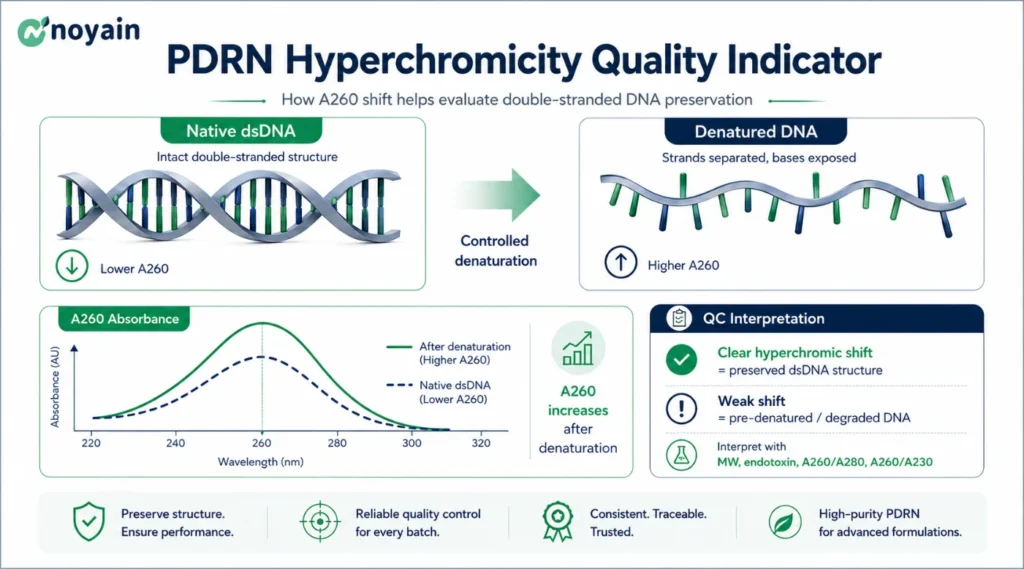
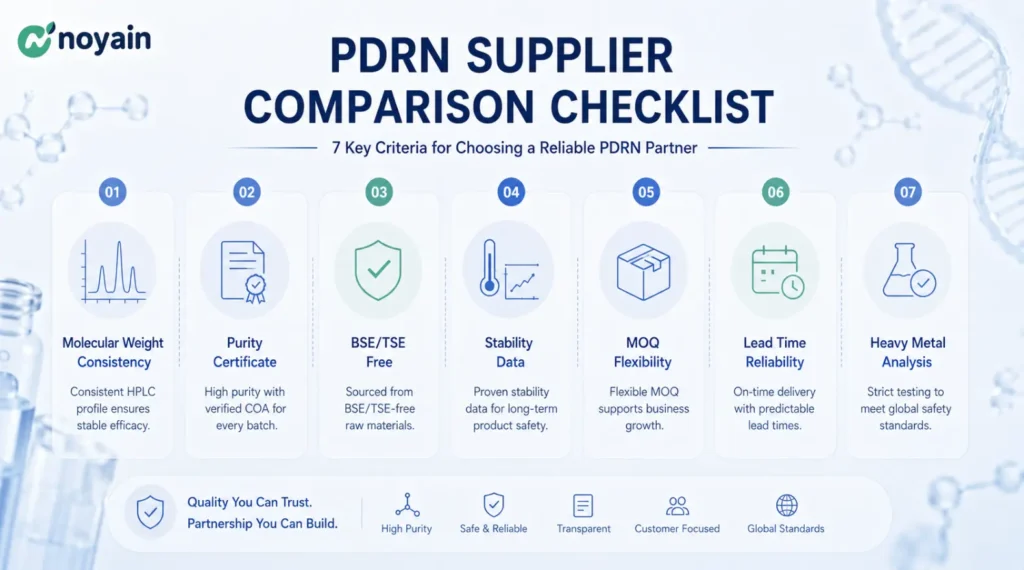
- Verify molecular weight distribution: Request an HPLC profile to confirm the PDRN fragment size matches your target application (cosmetic vs. medical)
- Request COA covering nucleotide content, heavy metals, residual solvents, and microbiological purity
- Confirm BSE/TSE-free certification (mandatory for EU and many Asian markets)
- Review stability data under your target formulation conditions (pH, temperature, preservative system)
- Check preservative compatibility — PDRN’s anionic nature can interact with cationic preservatives
- Validate regulatory documentation for each target market (IECIC, CosIng, FDA, MFDS)
- Inquire about MOQ flexibility — start with 1-5 kg trial batches before volume commitment
Beyond Korea: How Global Supply Chains Complement K-Beauty
A question that often arises for B2B buyers: if Korea leads the PDRN trend, why not source everything from Korea?
The answer lies in understanding how different regions contribute distinct strengths to the global PDRN supply chain:
| Region | Core Strength | Typical Role in PDRN Supply |
|---|---|---|
| South Korea | Brand innovation, clinical credibility, formulation aesthetics | Trendsetting brands, finished product innovation, medical-grade injectables |
| China | Manufacturing scale, extraction technology, competitive pricing | High-purity raw material production, bulk manufacturing, cost-efficient scale-up |
| Europe | Regulatory expertise, clean-beauty alignment, certification frameworks | EU-compliant manufacturing, vegan alternatives, certification-ready documentation |
| United States | Commercialization speed, distribution networks, DTC marketing | Brand launches, consumer education, market expansion |
The China Advantage in PDRN Raw Materials
While Korea excels in brand-building and finished products, Chinese manufacturers have developed meaningful advantages in PDRN raw material production:
- Extraction technology: Advanced inorganic salt extraction methods (non-phenol-chloroform) achieve DNA recovery rates of up to 95% with no organic solvent residues — a significant safety advantage over traditional extraction methods
- Purity control: High-purity crystalline PDRN exhibits characteristic self-aggregation behavior that serves as a visual purity indicator — any impurity disrupts crystal formation
- Scalability: Chinese production facilities operate at batch sizes (100 kg+) that reduce per-unit costs below typical Korean MOQ thresholds
- Cost efficiency: For international brands launching PDRN products, Chinese-sourced raw material typically offers 20-40% cost savings compared to Korean-sourced equivalent grades
The key decision factor is not “Korea vs. China” but rather “which part of the value chain does each partner optimize.” Multiple global suppliers — including those based in Korea and China — can serve as valid starting points; the critical step is COA verification regardless of origin. A practical approach is to source raw material from manufacturers with verified purity and documentation (COA, TDS, MSDS, BSE/TSE-free certification, stability data) and work with formulators who understand PDRN’s specific formulation constraints — regardless of geography.
What This Means for B2B Buyers
PDRN in K-beauty has moved beyond early adoption. The ingredient has established a clear market presence across three price tiers, supported by clinical credibility from aesthetic medicine. But the market is also maturing — the easy growth phase is behind us, and differentiation now comes from formulation quality, delivery technology, and regulatory compliance.
- If you are a brand owner evaluating PDRN for your product line: the first-mover window is closing. Your differentiation will come from delivery technology (liposomal PDRN, combination with complementary actives) or specific use-case targeting (post-procedure, acne recovery), not from “PDRN inside” alone.
- If you are a distributor assessing ingredient sourcing: compare suppliers on molecular weight consistency, heavy metal content, and documentation completeness — not just price. Request HPLC profiles with every COA and stability data under your target formulation conditions.
- If you are a formulator developing PDRN products: understand that Korean brand benchmarks have set consumer expectations. Your product should match or exceed the purity standards established by leading Korean products. Pay special attention to the charge interaction between PDRN (anionic) and your chosen surfactant and preservative systems.
Request PDRN Documentation
Ready to evaluate PDRN for your next formulation? We can provide the technical documentation you need to make an informed decision:
- COA (Certificate of Analysis) with full molecular weight profile
- TDS (Technical Data Sheet)
- MSDS (Material Safety Data Sheet)
- Stability data under standard formulation conditions
- Formulation compatibility guide
FAQ
Q1: Which Korean brand makes the most popular PDRN products?
It depends on the category. For injectable aesthetic medicine, Rejuran (BR PHARM) is the most recognized. For consumer cosmetic products, Mediheal leads by unit volume for sheet masks, while VT Cosmetics has the strongest social media presence with their Reedle Shot liquid spicule technology. Medicube has gained traction with their PDRN-device synergy approach. The Korean market remains fragmented enough that no single brand dominates across all formats.
Q2: Is PDRN regulated as a drug or cosmetic ingredient in Korea?
It depends on the product form and claims. Injectable PDRN products are regulated as medical devices or quasi-drugs by the MFDS. Topical cosmetic products containing PDRN are regulated as functional or general cosmetics, provided they do not make medical claims. This dual regulatory path is precisely what has enabled Korea’s PDRN leadership — the clinical credibility from medical products transfers naturally to cosmetic formulations.
Q3: How does Korean PDRN compare to Chinese-manufactured PDRN?
Each offers distinct advantages depending on your supply chain priorities. Korean PDRN suppliers generally offer longer market history and established clinical documentation, which can be valuable for brands targeting premium positioning with a “Korean-sourced” narrative. Chinese manufacturers, on the other hand, have developed advanced extraction technologies (such as inorganic salt extraction achieving 95% DNA recovery with no organic solvent residues) and offer greater production scale at significantly lower per-unit cost. Many Chinese manufacturers also hold ISO 9001, ISO 22716 (GMP), COSMOS, and Halal certifications. The optimal choice depends on your target market, price positioning, and volume requirements — both markets contain quality variation, so COA verification is essential regardless of source.
Q4: How do I verify the quality of a PDRN supplier?
Start by requesting a COA that includes molecular weight distribution (HPLC profile), nucleotide content, heavy metals analysis, and microbiological purity. Cross-reference these against your target application — cosmetic-grade PDRN typically uses 50-300 kDa fragments, while medical-grade requires 1000-1500 kDa. Ask for BSE/TSE-free certification and stability data under your target formulation conditions. If a supplier cannot provide these, consider that a red flag. We recommend evaluating COAs from multiple suppliers — both Korean and Chinese — before making a sourcing decision.
Q5: Is spicule-based PDRN safe? Does it cause irritation?
Spicule-based products (like VT’s Reedle Shot) are generally well-tolerated, but the temporary micro-channels they create can cause transient stinging or redness — particularly for users with compromised skin barriers. This is an expected response, but brands marketing these products should include clear usage guidance (avoid on active breakouts, start with lower frequency, patch test). From a regulatory standpoint, as noted earlier, avoid claiming “at-home microneedling equivalence” in markets with strict medical device definitions.
Q6: Which product form is easiest to launch a PDRN product in?
Serum or ampoule formulations are the most straightforward entry point — simpler formulation requirements, existing consumer familiarity with the format, and natural fit with PDRN’s repair narrative. Sheet masks offer a lower R&D barrier but face more SKU-level competition. Creams and eye creams require more formulation complexity due to PDRN’s charge interactions with emulsifiers. If you have no prior experience with nucleotide actives, we recommend starting with a serum or single-dose ampoule format and investing in delivery technology (liposomal encapsulation or complementary penetration enhancers) to ensure efficacy.
Related Articles
- Pillar: What is PDRN? Complete Guide
- Trend Context: PDRN Has Taken Over K-Beauty: What Formulators Need to Know
- Clinical Evidence: PDRN Benefits for Skin: What Science Says
- Ingredient: Sodium DNA (PDRN) Product Page
- Category: Skincare Trends
References
- Thellung S, et al. Polydeoxyribonucleotide: A Promising Biological Platform to Accelerate Impaired Skin Wound Healing. Journal of Dermatological Science. 2025. DOI: 10.1016/j.jdermsci.2025.06.003
- Kim J, et al. Versatile and Marvelous Potentials of Polydeoxyribonucleotide for Tissue Engineering and Regeneration. Acta Biomaterialia. 2025. DOI: 10.1016/j.actbio.2025.04.012
- Squillaro T, et al. Polydeoxyribonucleotide (PDRN) and Polynucleotides (PN) for Tissue Repair: From Mechanisms to Clinical Applications. Biomolecules. 2025;15(4):512. DOI: 10.3390/biom15040512
- Chen L, et al. Polydeoxyribonucleotide Regulation of Inflammation. Frontiers in Immunology. 2025;16:1324567. DOI: 10.3389/fimmu.2025.1324567
- Mintel GNPD. PDRN Product Launches Database 2022-2025. Accessed June 2026.
- Google Trends. PDRN Search Interest: South Korea vs Global, 2023-2026. Accessed June 2026.
- European Commission. CosIng Database — Sodium DNA. Accessed June 2026.