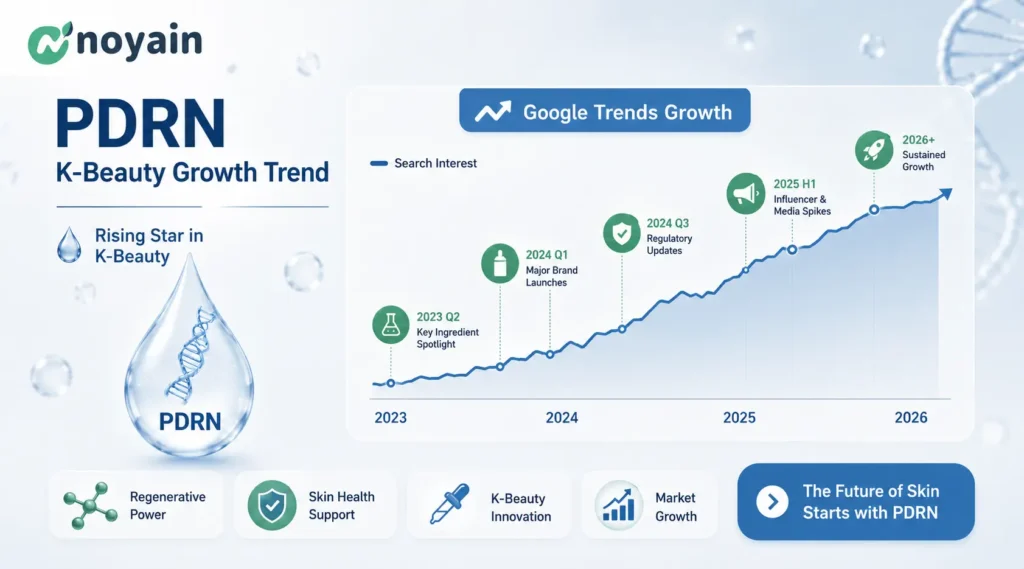
PDRN has moved quickly from regenerative-medicine research into K-beauty marketing, cosmetic formulation and global ingredient sourcing.
That popularity has also created confusion.Some pages describe PDRN as one fixed molecule. Others treat PDRN, PN, Sodium DNA, salmon DNA, low-molecular-weight PDRN and nano PDRN as interchangeable terms. Supplier claims may also combine data from injections, wound models, raw-material tests and ordinary cosmetic serums without explaining the differences.
For a skincare brand, OEM/ODM manufacturer, formulator or ingredient buyer, the useful question is not simply:
What is PDRN?
It is:
What does the available evidence show, what can a cosmetic product reasonably claim, and which raw-material data should be checked before formulation or procurement approval?
This guide explains PDRN from that practical B2B perspective.
Quick Answer: What Is PDRN?
PDRN, short for polydeoxyribonucleotide, describes mixtures of DNA-derived fragments rather than one uniform molecule with one fixed molecular weight.
Established pharmaceutical PDRN preparations have commonly been produced from purified reproductive tissue of salmonid fish. In cosmetics, related DNA-derived raw materials are commonly labelled under the INCI name Sodium DNA.
PDRN has been studied in pharmacological, wound-healing, tissue-regeneration, animal and cell models. These studies are relevant to understanding its scientific background, but they do not automatically prove that an ordinary cosmetic serum or cream can reproduce the effects of an injected medicine or a medical treatment.
For cosmetic use, the most defensible positioning focuses on:
- Skin conditioning
- Hydration and skin comfort
- Smoother- and plumper-looking skin
- Support for stressed-looking skin
- Premium active-ingredient storytelling
- Finished-product performance verified by appropriate testing
Key Takeaways
- PDRN is a mixture of DNA fragments, not one fixed-size molecule.
- Sodium DNA is the INCI name commonly used for related cosmetic raw materials, but the INCI name alone does not prove source, purity, molecular weight or biological performance.
- Most established PDRN mechanisms come from pharmaceutical, preclinical or medical research; topical cosmetic evidence must be evaluated separately.
- Molecular weight may affect delivery potential, degradation and formulation behavior, but lower molecular weight does not automatically mean better penetration or higher activity.
- Current Noyain application guidance recommends 0.02–1% for general use, with product-format reference ranges that should be validated in the finished formula.
- CosIng inclusion, IECIC status or US cosmetic listing requirements should not be described as global ingredient approval.
- Buyers should review source, assay, molecular-weight information, hyperchromicity, residual protein, endotoxin, microbiology, solubility, formulation compatibility and batch documents together.
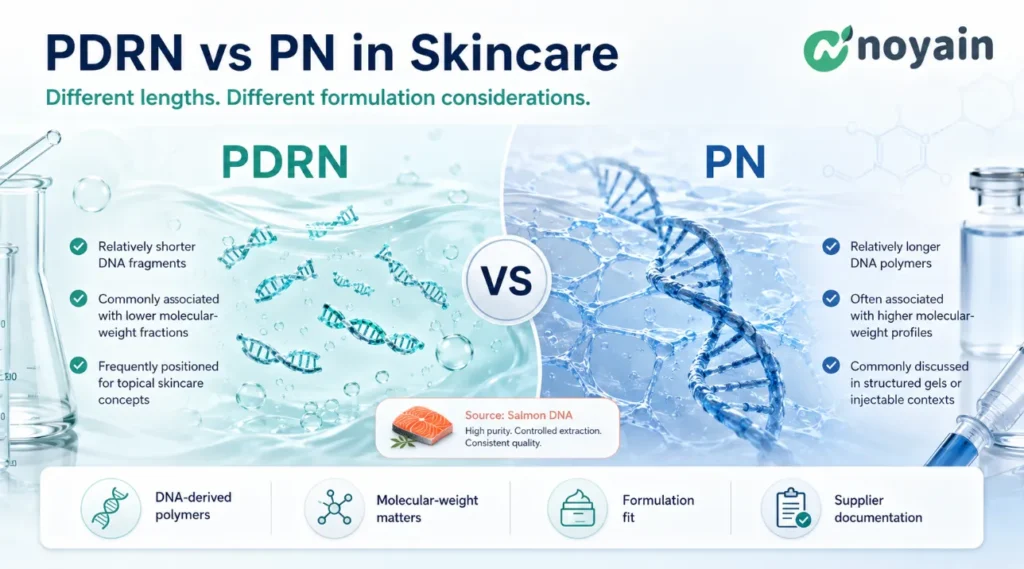
PDRN, Sodium DNA and PN: Are They the Same?
These terms are related, but they are not perfect synonyms.
| Term | Practical meaning | What it does not establish |
|---|---|---|
| PDRN | A scientific and commercial term for mixtures of relatively shorter DNA fragments | Exact INCI, source, purity or chain-length distribution |
| Sodium DNA | A cosmetic ingredient name used for the sodium salt of DNA-derived material | Whether the material meets a specific pharmaceutical definition of PDRN |
| Salmon DNA | A source-based marketing term | Molecular weight, assay, purity or finished-product efficacy |
| PN | Polynucleotide, generally discussed as longer DNA polymers than PDRN | A globally harmonized legal cutoff |
| Low-MW PDRN | A molecular-weight positioning term | Better penetration unless a range, method and finished-product test are supplied |
| Nano PDRN | Often a delivery-system or marketing term | Whether “nano” refers to DNA chains, liposomes, particles or another structure |
A cosmetic label may use Sodium DNA while the product is marketed as containing PDRN. However, two Sodium DNA raw materials can differ in:
- Biological source
- Manufacturing and purification process
- DNA assay
- Chain-length distribution
- Average molecular weight
- Protein residue
- Endotoxin level
- Hyperchromicity
- Formulation behavior
- Batch consistency
This is why an INCI match is only the starting point for supplier comparison.
For a detailed terminology and molecular-weight comparison, read PDRN vs PN: Molecular Weight and Skincare Differences.
Where Does PDRN Come From?
Established PDRN research has frequently used material purified from salmonid reproductive tissue, including trout and chum salmon.
The wider cosmetic market now also discusses:
- Other marine or animal DNA sources
- Plant-derived DNA fragments
- Microalgae-derived materials
- Fermentation or microbial routes
- Recombinant or bioengineered routes
- Synthetic DNA fragments
- Encapsulated or assembled PDRN systems
Source matters because it may affect:
- Vegan or animal-origin positioning
- Traceability requirements
- Protein and allergen review
- Impurity profile
- Manufacturing documentation
- Sustainability claims
- Market-specific documentation
Source alone does not determine quality.
A salmon-derived material is not automatically purer or more effective than every alternative. A plant-, fermentation- or synthetic-route material is not automatically inferior or equivalent. Each grade must be assessed through its actual specification, analytical method, safety data and finished-formula performance.
For a full sourcing comparison, see Different Sources of PDRN: Salmon, Vegan, Fermentation and Synthetic Routes.
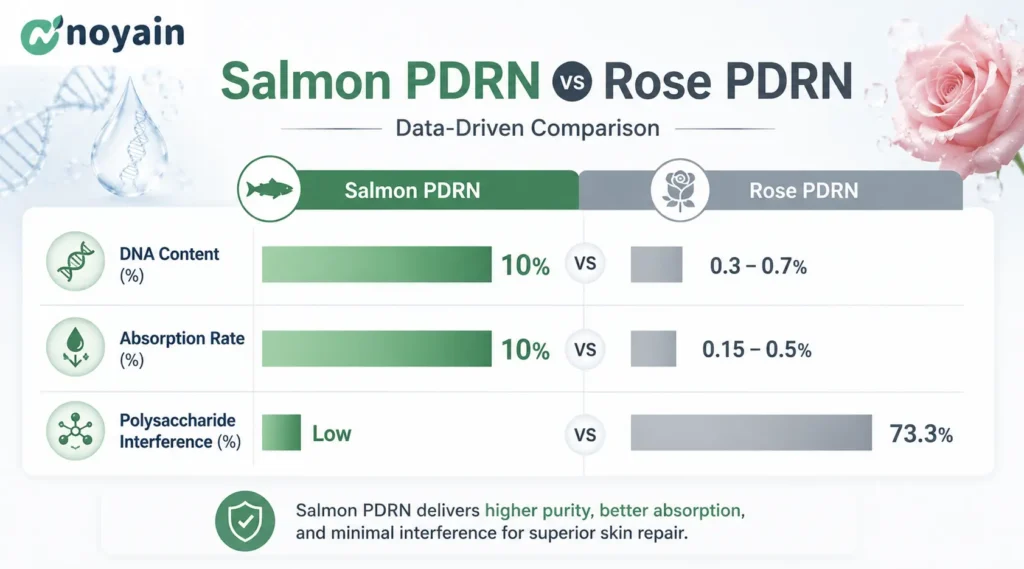
PDRN sources should be compared through verified specifications and documentation rather than source-based assumptions alone.
How Is PDRN Studied?
PDRN evidence comes from several different research categories.
They should not be treated as equivalent.
| Evidence type | What it can help explain | Main limitation for cosmetics |
|---|---|---|
| Pharmaceutical and injection studies | Pharmacological mechanisms, local tissue response and medical use | Does not establish passive delivery from a cosmetic serum |
| Wound and tissue-regeneration studies | Biological pathways and repair models | Wound-healing claims may fall outside cosmetic scope |
| Animal studies | Mechanistic and comparative evidence | Results may not translate directly to humans |
| Cell studies | Molecular pathways and screening signals | Does not reproduce the skin barrier or consumer use |
| PN or PN-HA studies | Behavior of longer DNA polymers and combined systems | PN is not automatically interchangeable with PDRN |
| Finished-product cosmetic tests | Hydration, appearance, comfort and consumer-relevant outcomes | Results apply to the tested formula, not every PDRN ingredient |
A systematic review of PDRN in wound healing and tissue regeneration identified evidence across in-vitro, in-vivo and clinical studies. This supports the scientific importance of PDRN, but much of that evidence concerns therapeutic or regenerative settings rather than conventional cosmetics.
A 2025 review comparing PDRN and PN in dermatology also emphasizes differences in polymer length, molecular weight and clinical use. It should not be read as proof that every cosmetic Sodium DNA raw material produces the same outcome.
Evidence boundary: Medical and preclinical research can explain why PDRN is scientifically interesting. Cosmetic claims still need to be supported by the finished product, intended use and applicable regulatory framework.
How Does PDRN Work?
Defined pharmaceutical PDRN preparations are commonly discussed through two related mechanisms.
Adenosine A2A receptor-related signaling
PDRN research has associated certain preparations with adenosine A2A receptor activation and downstream anti-inflammatory, angiogenic and tissue-repair signaling.
A review of PDRN and adenosine A2A receptor involvement summarized studies across skin and musculoskeletal tissue regeneration.
However, this mechanism should be described carefully in a cosmetic article.
It does not prove that:
- Every Sodium DNA grade has identical receptor activity
- A cosmetic use level produces a pharmaceutical response
- Ordinary topical application reaches the same tissue compartment as injection
- A finished cosmetic can claim to treat inflammation or heal wounds
Nucleotide salvage pathway
PDRN can be degraded into smaller nucleotide-related components. In pharmacological research, these components are discussed as supporting nucleotide availability through salvage pathways.
This mechanism helps explain why PDRN has been studied in metabolically stressed tissue models. It does not mean an ordinary cosmetic formula should claim direct cellular regeneration.
A suitable cosmetic interpretation is:
PDRN is a DNA-derived active concept with a scientific background in nucleotide-related and adenosine-associated pathways. Finished-product claims should remain within cosmetic scope and be verified in the final formula.
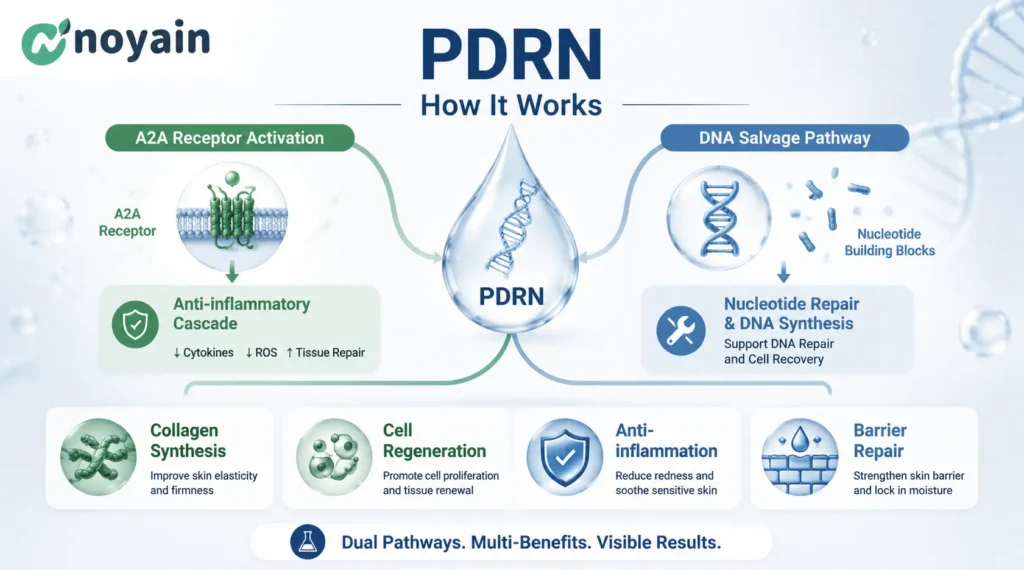
The established PDRN mechanism literature is primarily pharmacological and should be separated from finished cosmetic claim substantiation.
For a deeper review of reported skin-related outcomes and evidence quality, read PDRN Benefits for Skin: What Science Says About Salmon DNA.
What Can PDRN Do in a Cosmetic Formula?
For cosmetic brands and formulators, PDRN is best treated as a skin-conditioning active whose final value depends on the formula, use level, delivery system and supporting tests.
Hydration and skin comfort positioning
Sodium DNA can be incorporated into water-rich skincare concepts alongside humectants and barrier-supporting ingredients.
Possible product positioning includes:
- Hydrated and plump-looking skin
- Improved skin comfort
- Smoother-looking texture
- Support for dry or stressed-looking skin
- Premium serum and ampoule concepts
Hydration claims should be verified by the finished product through suitable instrumental or consumer testing.
Anti-aging appearance care
PDRN’s regenerative-medicine background creates strong consumer interest in anti-aging products.
For cosmetic positioning, use appearance-based language such as:
- Helps improve the look of fine lines
- Supports smoother-looking skin
- Helps improve the appearance of elasticity and firmness
- Supports a more refreshed skin appearance
Avoid presenting pharmaceutical collagen, angiogenesis or wound-model findings as direct proof for an untested cosmetic.
Skin-conditioning and soothing concepts
PDRN may be considered for formulations designed around:
- Skin comfort
- Stressed-looking skin
- Dryness-related sensitivity concepts
- Post-care cosmetic routines for intact skin
- Barrier-support ingredient combinations
Claims such as treating inflammation, accelerating wound healing or shortening medical-procedure downtime require a different evidence and regulatory framework.
Brightening concepts
Some cell studies discuss melanin-related pathways, but strong human topical evidence remains limited.
PDRN should not be used as the only basis for a strong whitening or pigmentation-treatment claim. In a brightening product, it may be positioned as a supporting skin-conditioning ingredient alongside ingredients with more established cosmetic evidence.
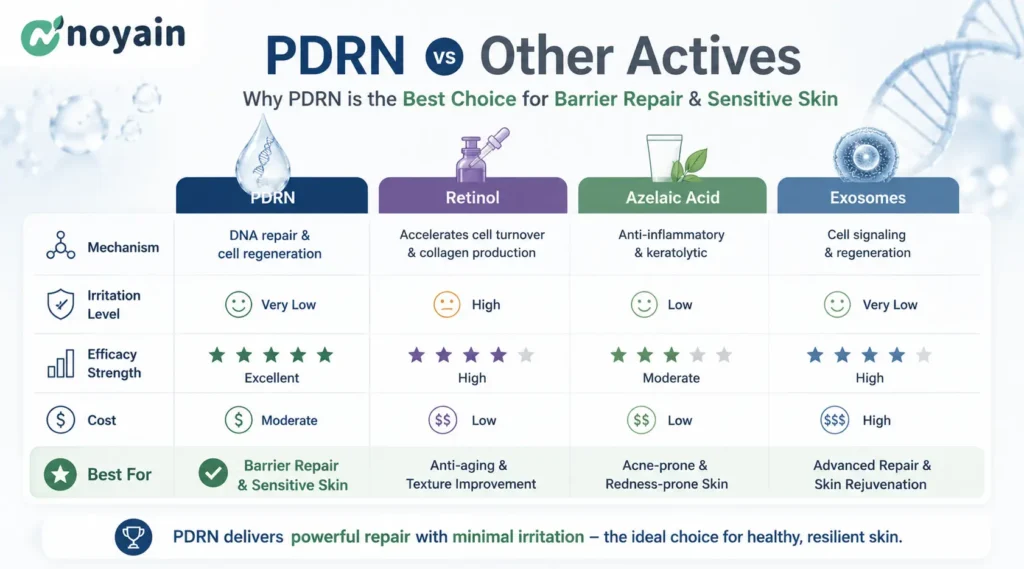
PDRN should be compared with other cosmetic actives by product objective, evidence type, formulation role and claim boundary—not by a single universal ranking.
For a formulation-focused comparison, read PDRN vs Azelaic Acid, Retinol and Exosomes.
Does PDRN Molecular Weight Matter?
Yes, but molecular weight is not a simple “lower is better” specification.
PDRN is a mixture of DNA fragments. Chain length and molecular-weight distribution may influence:
- Topical delivery potential
- Enzymatic degradation
- Local residence
- Solution viscosity
- Polymer entanglement
- Hydrogel behavior
- Filtration
- Processing stability
- Batch consistency
Lower molecular weight may improve formulation mobility and topical permeation potential, but it does not independently prove penetration through intact skin.
A statement such as:
Smaller PDRN penetrates deeply into the dermis.
requires evidence from the finished product, such as appropriate permeation, deposition or imaging studies.
Noyain’s current batch COA reports an average molecular weight below 1,000 kDa. This is a useful batch-release parameter, but it is not a complete base-pair or molecular-weight distribution.
It does not establish:
- Exact chain length in bp
- Minimum and maximum fragment sizes
- Main peak
- Distribution width
- Percentage of low-molecular-weight fragments
- Narrow distribution
- Improved skin penetration
For the complete explanation, read Does PDRN Molecular Weight Matter? How Chain Length Affects Skin Delivery, Formulation and Raw Material Selection.
PDRN and PN Are Not Automatically Interchangeable
A 2025 scientific review proposed a practical classification in which relatively shorter material is described as PDRN and material at or above approximately 1,500 kDa is described as PN.
That cutoff is useful for technical discussion, but it is not a globally harmonized legal definition.
Longer PN materials are more often associated with:
- Higher viscosity
- Greater viscoelasticity
- Water association
- Hydrogel or scaffold behavior
- Injectable aesthetic applications
Relatively shorter PDRN is more often discussed as:
- A more fluid DNA-fragment mixture
- A pharmaceutical active
- A water-compatible cosmetic ingredient
- A candidate for topical delivery-system development
Product format, concentration, carrier system and analytical evidence remain essential.
Formulation Basics for Sodium DNA
The following guidance reflects current Noyain supplier documentation and should be validated in the finished product.
Recommended use level
Current application guidance recommends:
| Application reference | Suggested screening range |
|---|---|
| General use | 0.02–1% |
| Water-cream concepts | 0.05–0.3% |
| Water-based formulas | 0.2–0.3% |
These are formulation-screening references, not universal legally authorized limits or guaranteed optimum levels.
The correct use level depends on:
- Raw-material concentration and assay
- Product format
- Target market
- Claim direction
- Formula pH
- Preservative system
- Stability
- Cost target
- Finished-product testing
Solubility and addition
The current COA states that Sodium DNA is soluble in water.
Current application notes indicate that a water bath around 50°C may help accelerate dissolution, while excessive or prolonged heat may affect molecular-weight-related properties.
A practical development approach is to:
- Confirm the exact raw-material concentration and batch documents.
- Pre-dissolve in the water phase or use a suitable cool-down addition process.
- Avoid unnecessary prolonged high heat.
- Avoid unnecessary prolonged high shear after addition.
- Monitor clarity, viscosity, odor, color and precipitation.
- Confirm assay retention and stability during scale-up where relevant.
Do not assume a fixed glycol pre-dispersion ratio is required for every formula unless it has been tested with the current batch and formulation system.
pH
Current application guidance discusses a PDRN compounding-solution pH around 5.8–6.2 and the possible use of an appropriate buffer system.
The final pH should still be selected according to:
- Complete formula
- Preservative efficacy
- Packaging
- Other active ingredients
- Skin compatibility
- Stability results
Compatibility screening
Sodium DNA is a polyanionic polymer. Formulators should carefully screen:
- Cationic surfactants
- Cationic polymers
- Cationic salts
- Strong oxidizers
- Strong acids and alkalis
- High-electrolyte systems
- Metal-ion-containing formulas
- Highly reactive actives
Possible warning signs include:
- Turbidity
- Flocculation
- Precipitation
- Viscosity loss
- Color change
- Odor change
- Assay loss
Do not assume that every cationic ingredient or metal-containing active will fail. The result depends on concentration, pH, addition order and the complete formula.
Thickeners and sodium hyaluronate
PDRN may be formulated with systems containing xanthan gum, hydroxyethylcellulose, carbomer or sodium hyaluronate, but compatibility must be confirmed.
In a PDRN and sodium hyaluronate formula, distinguish:
- PDRN molecular weight
- Sodium hyaluronate molecular weight
- Concentration of each polymer
- Total electrolyte level
- Final rheology
A high finished-product viscosity does not prove that the PDRN itself has a high molecular weight.
Preservative system
Water-rich PDRN products require a suitable preservative strategy and preservative-efficacy testing.
Do not describe phenoxyethanol, ethylhexylglycerin, sodium benzoate or another system as universally compatible without testing the actual formula.
Packaging and stability
Consider packaging that protects the product from:
- Contamination
- Excessive light
- Moisture exchange
- Repeated consumer contact
Airless or low-contamination packaging may be useful for some water-rich formulations, but packaging compatibility should be confirmed through finished-product testing.
A stability plan should monitor:
- Appearance
- Color
- Odor
- pH
- Viscosity
- Precipitation
- Microbiological quality
- Preservative efficacy
- Assay retention
- Packaging interaction
Post-Care and Professional-Treatment Positioning
PDRN is frequently promoted in products associated with aesthetic-treatment routines.
This category requires careful wording.
A normal cosmetic can be positioned for:
- Skin comfort
- Hydration
- Smoother-looking skin
- Cosmetic post-care on intact skin
- Support for dry or stressed-looking skin
A normal cosmetic should not automatically be recommended:
- On open wounds
- On unhealed skin
- Immediately after barrier-disrupting procedures
- As a treatment for procedure complications
- To accelerate wound closure
- To reduce medical downtime
Use after microneedling, laser resurfacing, chemical peeling or another professional procedure depends on the finished product’s legal category, sterility or microbial controls, instructions, safety assessment and professional guidance.
For a route-specific evidence review, read PDRN Injection vs Topical PDRN.
Regulatory and Documentation Considerations by Market
PDRN should not be presented as “approved worldwide.”
Market access depends on:
- Exact ingredient identity
- Source and composition
- Manufacturing process
- Intended use
- Use level
- Finished-product category
- Claims
- Safety assessment
- Local notification or registration requirements
| Market | More accurate interpretation | What brands and manufacturers should verify |
|---|---|---|
| United States | Cosmetic ingredients generally do not receive FDA premarket approval, except for applicable color additives. GRAS is a food-ingredient concept, not a medical-device or cosmetic approval. | Finished-product safety substantiation, MoCRA obligations where applicable, facility/product requirements, labeling and cosmetic-versus-drug claims |
| European Union | CosIng is an informational database and ingredient-name resource. Inclusion does not mean the ingredient is approved for cosmetic use. | Regulation (EC) No 1223/2009, CPSR, responsible person, CPNP notification, source documentation, claims and applicable restrictions |
| China | Inclusion in the Inventory of Existing Cosmetic Ingredients may mean a material is not managed as a new cosmetic ingredient, but it does not guarantee finished-product filing acceptance. | Exact Chinese/INCI correspondence, current IECIC query, source, composition, use level, safety assessment, product category and claim scope |
| Korea, Japan and other markets | Do not rely on a general statement such as “approved cosmetic ingredient.” | Current local inventory, labeling, animal-source documents, importer requirements and finished-product compliance |
Official references:
- FDA: Does the FDA approve cosmetics before they go on the market?
- FDA: Registration and Listing of Cosmetic Product Facilities and Products
- FDA: Generally Recognized as Safe (GRAS)
- European Commission: CosIng Cosmetic Ingredient Database
- NMPA: Inventory of Existing Cosmetic Ingredients administration, 2025
- NMPA: Cosmetic New Ingredient Filing Guidance
Important: Ingredient-database inclusion, facility registration, product listing or document availability should not be marketed as government approval.
Halal, ISO, COSMOS and Other Documentation
Different document types must be named accurately.
Halal declaration
Noyain currently has a Halal declaration for a relevant Sodium DNA/PDRN grade.
A company declaration is not the same as:
- JAKIM certification
- A certificate from an accredited Halal certification body
- Market acceptance in every Muslim-majority country
Use the wording:
Halal declaration available; confirm document applicability for the target market.
Do not use:
JAKIM-certified PDRN
unless a valid certificate supports that exact product, production site and claim.
ISO certification
ISO certification should be tied to:
- The legal certificate holder
- The audited site
- The scope of certification
- Certificate validity
Do not imply that ISO 9001 certifies product efficacy or regulatory approval.
COSMOS documentation
COSMOS certification, approval or acceptability must be matched to the exact:
- Product
- Supplier
- Certificate or database entry
- Scope
- Validity period
Do not list “COSMOS Certification” for PDRN unless the exact current grade is covered.
How to Evaluate a PDRN Supplier
A professional supplier comparison should move beyond purity headlines and source stories.
1. Confirm identity and source
Ask for:
- Trade name
- INCI name
- CAS statement
- Biological or synthetic source
- Source declaration
- Country or region of origin
- Animal-origin documents where relevant
2. Review assay and purity-related data
Check:
- Assay method
- A260/A280
- Residual protein
- Loss on drying
- Heavy metals
- Microbiological limits
- Endotoxin where relevant
- Residual-solvent information where relevant
A high UV assay alone does not prove:
- Narrow chain-length distribution
- Strong topical delivery
- Absence of all impurities
- Finished-product efficacy
3. Review molecular-weight information
Ask:
- Is the result an average, range or peak?
- Is it expressed in bp or kDa?
- What analytical method was used?
- Is a distribution curve available?
- Does the report correspond to the current batch?
- Are multiple batches comparable?
For the complete buyer framework, read Does PDRN Molecular Weight Matter?.
4. Review structural-quality indicators
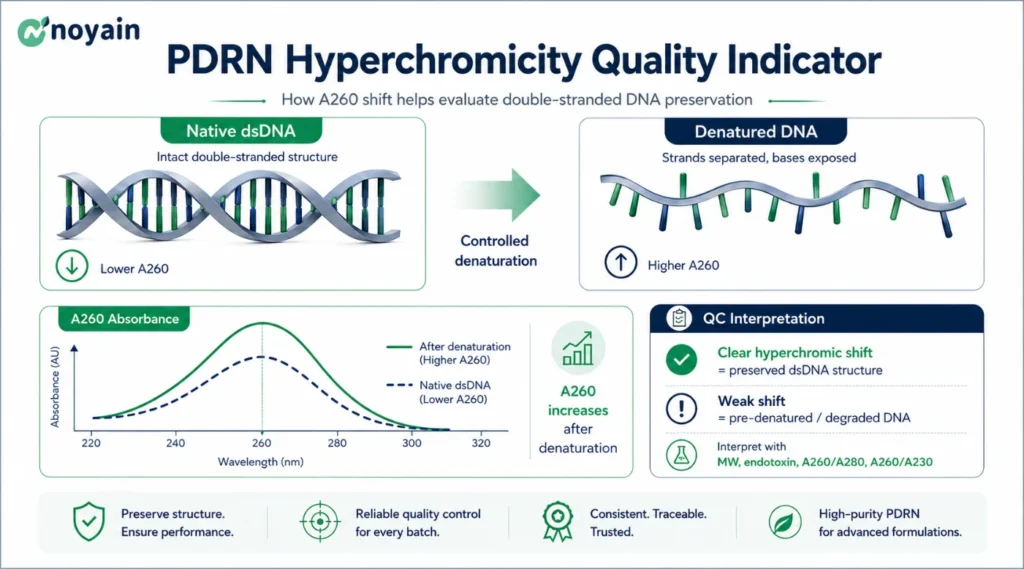
Hyperchromicity is a structure-related UV parameter based on the change in absorbance when DNA strands separate under heating.
It should be reviewed together with:
- Assay
- Molecular-weight information
- Residual protein
- Endotoxin
- Microbiology
- Batch consistency
It should not be used as a standalone efficacy claim.
Read PDRN Hyperchromicity: A Key Quality Indicator for Double-Stranded DNA.
5. Test the current sample in the intended formula
Evaluate:
- Dissolution
- Clarity
- pH
- Viscosity
- Precipitation
- Heat and shear exposure
- Preservative compatibility
- Accelerated stability
- Real-time stability
- Packaging
- Finished-product claims
6. Match documents to the commercial batch
Before bulk approval, confirm that:
- The COA matches the supplied batch
- The product specification has not changed
- The sample and commercial material use the same grade
- Source and process documents remain valid
- Certification or declaration wording is current
- Packaging, MOQ, lead time and shelf life are confirmed
Current Noyain Sodium DNA Data
The current Noyain batch documentation supports the following information:
| Parameter | Current documented information |
|---|---|
| Trade name | PDRN |
| INCI name | Sodium DNA |
| Grade | Cosmetic grade |
| Source statement | Male salmon |
| Appearance | White, off-white or light-yellow powder |
| Solubility | Soluble in water |
| A260/A280 | 1.85 |
| Assay by UV | 99.8% |
| Hyperchromicity | 47.7% |
| Residual protein | 0.05% |
| Average molecular weight | Below 1,000 kDa |
| General formulation reference | 0.02–1% |
| Water-cream reference | 0.05–0.3% |
| Water-based formula reference | 0.2–0.3% |
These are batch and application-document data points.
They do not by themselves prove:
- A 50–300 kDa molecular-weight distribution
- A specific bp range
- Narrow distribution
- Deep dermal penetration
- A universal optimal use level
- Pharmaceutical or injectable suitability
- Finished-product efficacy
Available support may include:
- Batch COA
- Product specification or TDS
- SDS/MSDS
- Endotoxin-related report
- Halal declaration
- Source documentation
- Application guidance
- Sample support
Document availability should be confirmed for the exact grade and target market.
Frequently Asked Questions
What is PDRN in skincare?
PDRN is a term used for mixtures of DNA-derived fragments. In cosmetics, related raw materials are commonly labelled as Sodium DNA and used in serums, creams, masks, ampoules, toners and eye-care concepts.
The finished formula should be positioned and tested as a cosmetic rather than relying directly on injectable or wound-healing evidence.
Is Sodium DNA the same as PDRN?
They are closely related terms but not automatically identical specifications.
Sodium DNA is an ingredient name. PDRN describes a type of DNA-fragment material used in scientific and commercial contexts. Buyers should verify source, assay, molecular weight and other quality parameters.
What are the cosmetic benefits of PDRN?
The most defensible cosmetic positioning includes skin conditioning, hydration, skin comfort, smoother-looking texture, plumper-looking skin and anti-aging appearance care.
Medical claims such as wound healing, tissue regeneration or treatment of inflammation require different evidence and regulatory consideration.
What is the recommended use level?
Current Noyain application guidance recommends 0.02–1% for general formulation screening, with 0.05–0.3% for water-cream concepts and 0.2–0.3% for water-based formulas.
The correct use level must be confirmed in the final formula.
Is low-molecular-weight PDRN better for topical skincare?
Not automatically.
Lower molecular weight may improve formulation mobility and delivery potential. It does not prove penetration through intact skin or stronger activity without a defined range, analytical method and finished-product testing.
Can PDRN be combined with sodium hyaluronate?
It can be screened in sodium-hyaluronate systems, but formulators should distinguish the molecular weight and concentration of each polymer.
Monitor clarity, viscosity, pH, precipitation, preservative compatibility and stability.
Can PDRN be combined with cationic ingredients or metal ions?
Sodium DNA is polyanionic, so cationic materials, high-electrolyte systems and metal-ion-containing formulas require careful compatibility testing.
Do not assume universal incompatibility. Test the exact concentration, addition order and complete formula.
Is PDRN approved in the United States?
Cosmetic ingredients generally do not receive FDA premarket approval, except for applicable color additives.
GRAS is a food-ingredient concept and should not be used as a cosmetic or medical-device approval claim. Finished-product companies remain responsible for safety, labeling, MoCRA obligations and claim compliance.
Does CosIng listing mean PDRN is approved in the European Union?
No.
The European Commission states that CosIng is an informational database with no legal value. Inclusion does not itself authorize cosmetic use. The finished product must comply with Regulation (EC) No 1223/2009 and undergo the appropriate safety assessment.
Is Sodium DNA automatically compliant for cosmetic filing in China?
No blanket statement should be made without checking the current official inventory and the exact material.
Even when an ingredient is included in the Inventory of Existing Cosmetic Ingredients, the registrant or filing party must confirm identity, source, use level, safety assessment, product category and claims.
Is Noyain PDRN Halal certified?
The current available document is a Halal declaration, not a confirmed JAKIM certificate.
The document should be reviewed against the target market and exact commercial grade.
Where can I source cosmetic-grade Sodium DNA?
Noyain supplies cosmetic-grade Sodium DNA/PDRN for B2B formulation, OEM/ODM development and bulk sourcing.
Review the Sodium DNA product page or contact Noyain for the current batch COA, product specification, sample and quotation.
Related PDRN Resources
- PDRN Benefits for Skin: What Science Says About Salmon DNA
- Does PDRN Molecular Weight Matter? Chain Length, Formulation and Sourcing
- PDRN vs PN: Molecular Weight and Skincare Differences
- Different Sources of PDRN: Salmon, Vegan, Fermentation and Synthetic
- PDRN Injection vs Topical PDRN
- PDRN Hyperchromicity and Double-Stranded DNA Quality
- All PDRN Articles
Conclusion
PDRN is scientifically interesting because it sits at the intersection of DNA-derived biomaterials, regenerative-medicine research and modern cosmetic active development.
That does not mean every PDRN claim applies equally to every product.
For cosmetic brands, OEM/ODM manufacturers and ingredient buyers, a responsible evaluation should separate:
- PDRN from PN
- Sodium DNA naming from actual specification
- Raw-material data from finished-product efficacy
- Medical evidence from cosmetic evidence
- Average molecular weight from full chain-length distribution
- Declarations from third-party certifications
- Ingredient-database inclusion from regulatory approval
The strongest PDRN sourcing decision is not based on the most aggressive marketing language.
It is based on:
- A clearly identified material
- Current batch documents
- Appropriate quality-control data
- Transparent evidence boundaries
- Successful formulation testing
- Finished-product safety and claim substantiation
References
- Marques C, Porcello A, Cerrano M, et al. From Polydeoxyribonucleotides (PDRNs) to Polynucleotides (PNs): Bridging the Gap Between Scientific Definitions, Molecular Insights, and Clinical Applications of Multifunctional Biomolecules. Biomolecules. 2025;15(1):148.
- Kim ST. Comparison of Polynucleotide and Polydeoxyribonucleotide in Dermatology: Molecular Mechanisms and Clinical Perspectives. Pharmaceutics. 2025;17(8):1024.
- Colangelo MT, Galli C, Guizzardi S. The Effects of Polydeoxyribonucleotide on Wound Healing and Tissue Regeneration: A Systematic Review of the Literature. Regenerative Medicine. 2020.
- Veronesi F, Dallari D, Sabbioni G, et al. Polydeoxyribonucleotides From Skin to Musculoskeletal Tissue Regeneration via Adenosine A2A Receptor Involvement. Journal of Cellular Physiology. 2017;232(9):2299–2307.
- Ha YJ, Tak KH, Jung JM, et al. The Effect of Polynucleotide-Hyaluronic Acid Hydrogel in the Recovery After Mechanical Skin Barrier Disruption. Skin Research and Technology. 2024;30(9):e70068.
- European Commission. Cosmetic Ingredient Database — CosIng.
- U.S. Food and Drug Administration. Does the FDA Approve Cosmetics Before They Go on the Market?.
- U.S. Food and Drug Administration. Registration and Listing of Cosmetic Product Facilities and Products.
- U.S. Food and Drug Administration. Generally Recognized as Safe.
- National Medical Products Administration. Announcement on Matters Related to the Administration of the Inventory of Existing Cosmetic Ingredients, No. 61 of 2025.
- National Medical Products Administration. Cosmetic New Ingredient Filing Guidance.
- T/SHRH 077—2025. General Requirements for Detection of Polydeoxyribonucleotide (PDRN) Cosmetic Raw Materials.