PDRN and polynucleotide, usually shortened to PN, are often presented as two names for the same salmon DNA ingredient. That is an oversimplification.
Both are DNA-derived polymers, and both may come from salmonid sources. However, they can differ in polymer length, molecular-weight distribution, processing, formulation behavior, intended application and supplier specification. The terminology is also not fully standardized across research papers, aesthetic products and cosmetic raw-material suppliers.
For skincare brands, OEM/ODM manufacturers, formulators and ingredient buyers, the useful question is not simply:
Is PN or PDRN better?
The commercially relevant question is:
Which documented DNA-derived raw material has the identity, molecular-weight distribution, purity, formulation behavior and evidence package required for the intended product?
This guide compares PDRN vs PN from a cosmetic ingredient supplier’s perspective. It explains the molecular-weight issue, the relationship between salmon DNA source and final quality, topical versus injectable applications, and the information buyers should review before approving a supplier.
Cosmetic claim and naming note: This article compares ingredient identity, molecular characteristics, supplier specifications and cosmetic formulation considerations. PDRN and PN are not universal INCI names, and medical, injectable or wound-treatment findings must not be transferred directly into claims for ordinary topical skincare products. In markets such as China, cosmetic labels and advertising must not explicitly or implicitly claim medical effects, and efficacy claims require appropriate substantiation. Avoid injection imagery and expressions such as “wound healing,” “tissue regeneration” or “cell regeneration” in ordinary cosmetic positioning. Use the ingredient name accepted for the exact material and target market, and support finished-product claims such as moisturizing, soothing, firming, anti-wrinkle or repair with the required evidence.
Quick Answer: What Is the Difference Between PDRN and PN?
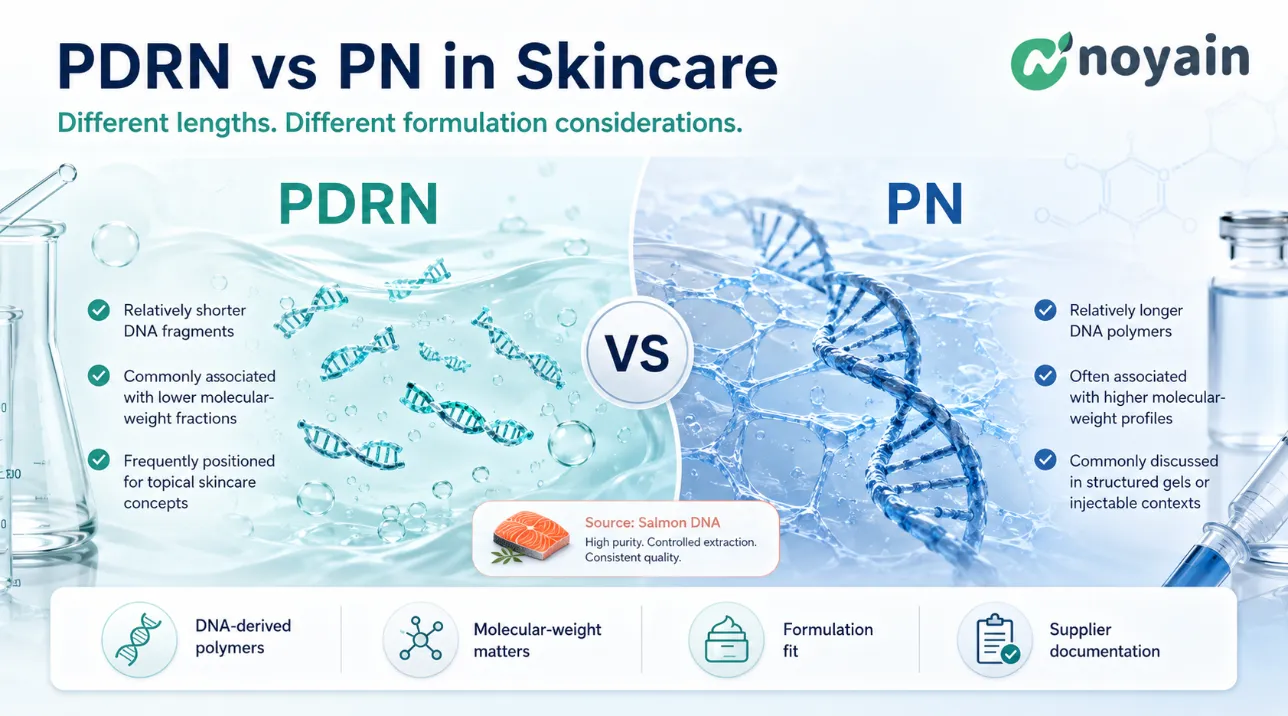
PDRN and PN are related DNA-derived polymers, but they should not automatically be treated as identical or interchangeable raw materials.
In current scientific and commercial usage, PN is generally associated with longer DNA polymers or a relatively higher-molecular-weight profile, while PDRN is generally associated with relatively shorter, purified or fractionated DNA fragments. The distinction is useful, but it is not applied consistently by every paper, brand or supplier.
A 2025 nomenclature review discussed the overlap between PDRN and PN and proposed a molecular-weight-based framework, including a possible 1,500 kDa dividing point. This proposal helps organize the terminology, but it is not a universally adopted cosmetic naming rule.
For B2B sourcing, buyers should evaluate the actual:
- INCI name
- Biological source
- DNA assay
- Molecular-weight range and distribution
- Analytical method
- Residual protein and impurity controls
- Color, odor, solubility and clarity
- Finished-formula stability
- COA, TDS/SPEC and SDS/MSDS
- Intended route and regulatory category
Practical conclusion: PDRN is not automatically better because it is described as smaller, and PN is not automatically better because it is described as larger. The better material is the grade whose verified specification and formulation performance match the intended skincare product.
Key Takeaways for Cosmetic Buyers
- PDRN and PN are related but not automatically interchangeable. Commercial names must be supported by measurable specifications.
- PN is generally associated with relatively longer DNA polymers, while PDRN is generally associated with relatively shorter or fractionated DNA fragments. Their molecular-weight distributions may overlap.
- The 1,500 kDa Marques Polynucleotide Cutoff is a proposed nomenclature framework, not a universally enforced cosmetic or pharmaceutical standard.
- Lower molecular weight does not automatically prove better topical penetration. Vehicle design, concentration, polymer structure and the skin barrier remain critical.
- Higher molecular weight does not automatically prove longer-lasting cosmetic performance. Rheology and residence behavior depend on the complete formulation and route of use.
- Salmon origin does not guarantee purity, low odor or batch consistency. Buyers should review residual protein, molecular-weight distribution, assay, color, clarity and source traceability.
- The best material is the best-characterized grade for the intended product. Compare INCI identity, analytical methods, formulation compatibility, batch documents and sample performance—not the acronym alone.
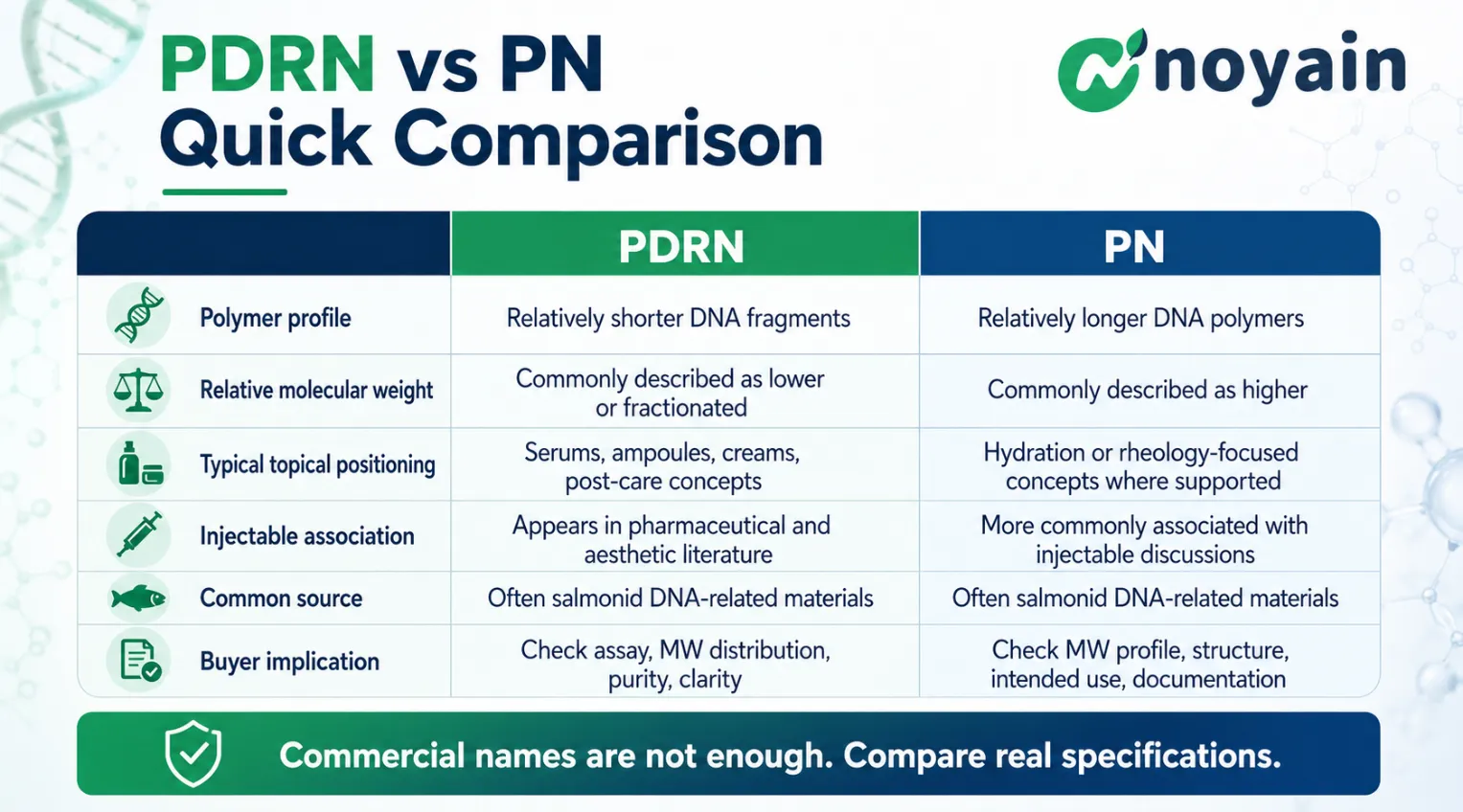
PDRN vs PN at a Glance
| Comparison Point | PDRN | Polynucleotide (PN) | Buyer Implication |
|---|---|---|---|
| Full name | Polydeoxyribonucleotide | Polynucleotide | Confirm how the supplier defines the term |
| General polymer profile | Relatively shorter DNA fragments | Relatively longer DNA polymers | Request measured data rather than relying on the name |
| Molecular weight | Commonly described as lower or fractionated | Commonly described as higher | Distributions may overlap |
| Product structure | Mixture of fragment lengths | Mixture of polymer lengths | Neither is normally one uniform molecule |
| Common source | Salmon trout, chum salmon or other documented sources | Often salmonid reproductive tissue | The same source does not produce the same final grade |
| Cosmetic naming | Frequently marketed as PDRN and documented as Sodium DNA | May use PN commercially and a DNA-related INCI in documentation | Commercial name and INCI must both be checked |
| Typical topical positioning | Serum, ampoule, cream, mask and post-care concepts | Higher-MW DNA, hydration or rheology concepts where supported | Application depends on the exact grade |
| Typical injectable positioning | Appears in pharmaceutical and aesthetic literature | Commonly associated with aesthetic injection products | Injectable use is a separate regulatory pathway |
| Main supplier risk | Undefined assay, MW or purity basis | Unsupported “high-MW PN” claim | Compare complete specifications and samples |
The most important point is that PDRN and PN are category or commercial descriptions, not complete technical specifications.
What Is PDRN?
PDRN stands for polydeoxyribonucleotide. It describes a mixture of DNA-derived polymer fragments rather than one single molecule with one fixed molecular weight.
Classic pharmaceutical literature describes a defined salmonid-derived PDRN preparation with a molecular-weight distribution of approximately 50–1,500 kDa, with a substantial fraction around 80–200 kDa. Earlier analytical work also characterized PDRN through a distribution of fragment lengths rather than one uniform chain.
These values are useful scientific background, but they should not be copied automatically into every cosmetic PDRN specification. Modern materials may differ in source, extraction, fragmentation, purification, DNA content, double-stranded structure, molecular-weight profile and formulation behavior.
In cosmetic documentation, PDRN is commonly used as a technical or commercial term, while the regulatory ingredient identity may be declared as Sodium DNA or another supported DNA-related INCI, depending on the exact material and target market.
For the broader ingredient background, read What Is PDRN? A Complete Guide to Salmon DNA in Skincare.
What Is Polynucleotide (PN)?
In the broad chemical sense, a polynucleotide is a polymer composed of nucleotide units.
In aesthetic medicine and commercial DNA-material discussions, PN is commonly used more narrowly for longer-chain or relatively higher-molecular-weight DNA polymers. These longer chains may influence viscosity, water binding or three-dimensional polymer behavior, depending on concentration and processing.
However, the term PN alone does not tell a buyer:
- The exact molecular-weight distribution
- Whether the material is highly purified
- Whether it is suitable for topical cosmetics
- Whether it is sterile or suitable for injection
- Which INCI name should be used
- Whether it will dissolve clearly in a serum
- Whether different batches are equivalent
Important: “PN” is not an injectable-grade guarantee, an efficacy guarantee or a complete regulatory identity. The commercial name must be supported by the actual specification and intended-use documentation.
Are PDRN and PN the Same Ingredient?
They are closely related, but they should not be assumed to be exactly the same.
The terms are frequently confused because both materials consist of nucleotide-based polymers, may be derived from salmon or trout DNA, and may have overlapping molecular-weight distributions. Consumer marketing also uses broad descriptions such as “salmon DNA,” while suppliers may define PN and PDRN according to internal product categories.
From a broad chemical perspective, PDRN belongs to the wider family of deoxyribonucleotide polymers. In current dermatology and commercial practice, however, PDRN and PN are often treated as separate categories based on relative chain length, molecular weight, processing and intended application.
The safest B2B interpretation is:
PDRN and PN are related and may overlap, but commercial equivalence must be demonstrated rather than assumed.
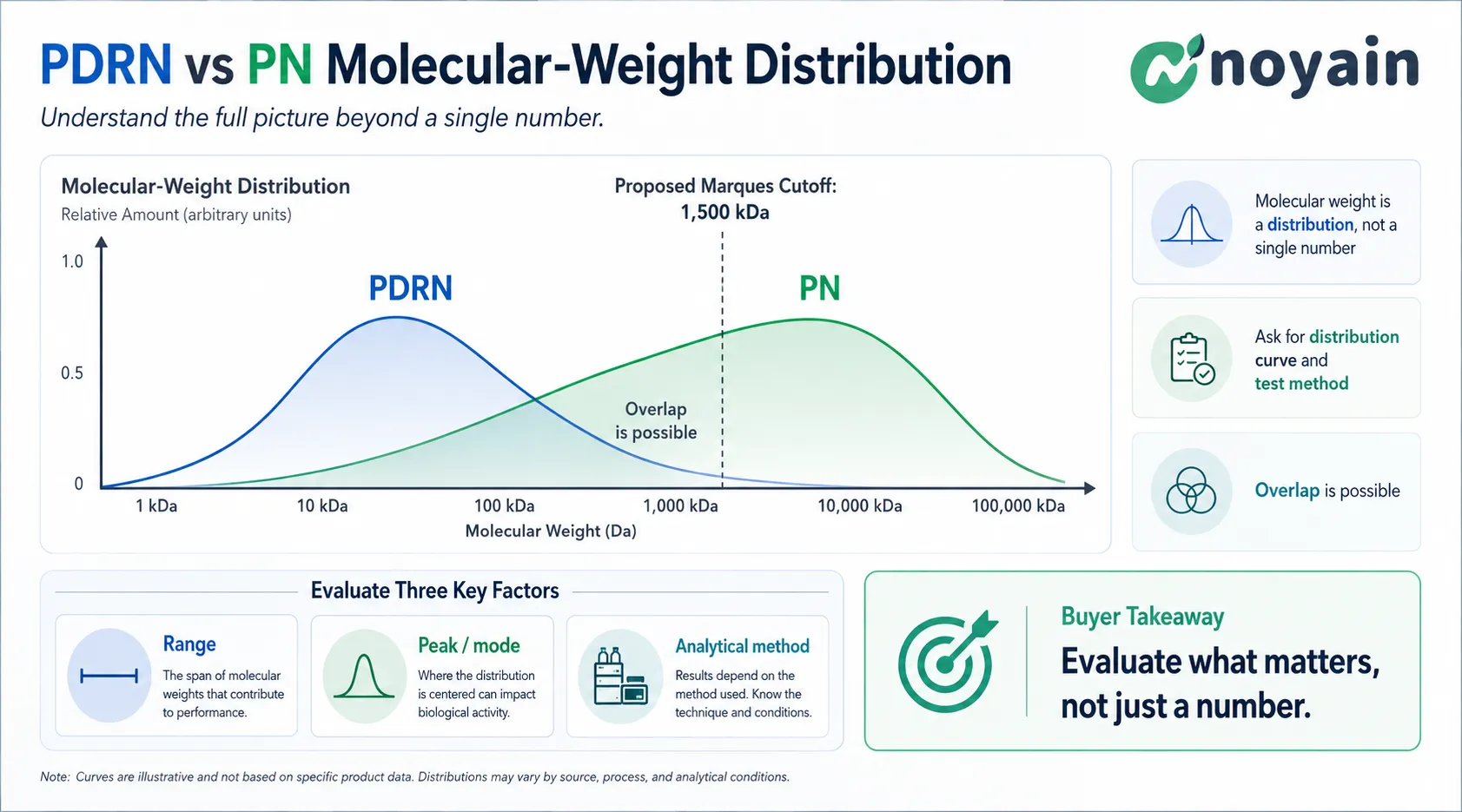
PDRN vs PN Molecular Weight and the Marques Cutoff
The Proposed 1,500 kDa Boundary
A 2025 review proposed a clearer nomenclature framework and discussed 1,500 kDa as a possible boundary between PDRN and higher-molecular-weight PN.
This is a proposed classification, not a universal cosmetic regulation. Not every supplier follows it, broad distributions may cross the proposed threshold, and different analytical methods may not produce directly comparable results.
A supplier should therefore not use “PN above 1,500 kDa” or “PDRN below 1,500 kDa” as a substitute for a complete molecular-weight report.
Molecular weight is often presented as the main difference between PN and PDRN. It is important, but it must be interpreted correctly.
Molecular Weight Is a Distribution, Not One Number
DNA-derived raw materials are generally polydisperse. A batch contains polymer chains of different lengths rather than one perfectly uniform molecule.
A COA reporting only one average value may hide:
- A broad distribution
- A high-molecular-weight tail
- A small low-molecular-weight fraction
- Batch-to-batch shifts
- Degradation during processing or storage
- Aggregation or incomplete dissolution
Buyers should request the molecular-weight range, dominant fraction, distribution curve, analytical method and batch comparison where available.
How to Read a Molecular-Weight Distribution
Formulators should not search for one “magic” molecular-weight number. They should review a distribution generated with a validated method, such as SEC/GPC with suitable detection, and ask whether the method is appropriate for the sample’s concentration, ionic environment and polymer size. Orthogonal methods may be useful when one method cannot adequately characterize a broad or difficult distribution.
The often-cited 80–200 kDa fraction comes from the characterization of a particular classical PDRN preparation. It should not be presented as a universal target or as the proven “optimal” range for topical skin-barrier formulas. A cosmetic supplier must demonstrate how its own grade behaves rather than borrowing a range from a different pharmaceutical preparation.
A 2026 analytical study used complementary methods to characterize PDRN and highlighted the difficulty of measuring a biological macromolecule with a broad distribution. The practical lesson is that a molecular-weight number should always be interpreted together with its method and sample conditions.
Do Not Compare Base Pairs and kDa Without Context
Some suppliers describe fragment size in base pairs, while others report molecular weight in kDa. These measurements are related, but they are not interchangeable labels.
When comparing reports, ask:
- Was the result measured directly or converted?
- Was the material evaluated as single- or double-stranded DNA?
- Which analytical method was used?
- Does the report show a distribution or only one selected value?
- Were samples prepared under comparable conditions?
How Molecular Weight Can Affect Formulation
Molecular-weight distribution may influence:
- Dissolution time
- Viscosity and rheology
- Clarity and filtration
- Film formation and sensory feel
- Interaction with electrolytes or cationic ingredients
- Precipitation risk
- Stability during heating, mixing and storage
Higher molecular weight does not automatically mean better performance. It may support a viscous gel or hydration-focused concept, but it may also create slower dissolution or haze.
Lower molecular weight does not automatically prove better skin penetration. Topical delivery depends on the whole system, including polymer structure, vehicle, concentration, delivery technology, skin condition and finished-product stability.
| Molecular-Weight Issue | Why It Matters | What Buyers Should Request |
|---|---|---|
| Only one average is reported | It may hide a broad distribution | Range, peak and distribution curve |
| Very broad distribution | Formula behavior may vary | Batch comparison |
| High-MW fraction | May affect viscosity, clarity and filtration | Solubility and rheology data |
| Low-MW fraction | May reflect fractionation or degradation | Identity and process-stability data |
| Test method is missing | Results may not be comparable | Method and sample conditions |
| “Low MW” is only a marketing claim | It does not establish quality or delivery | Numeric report and analytical basis |
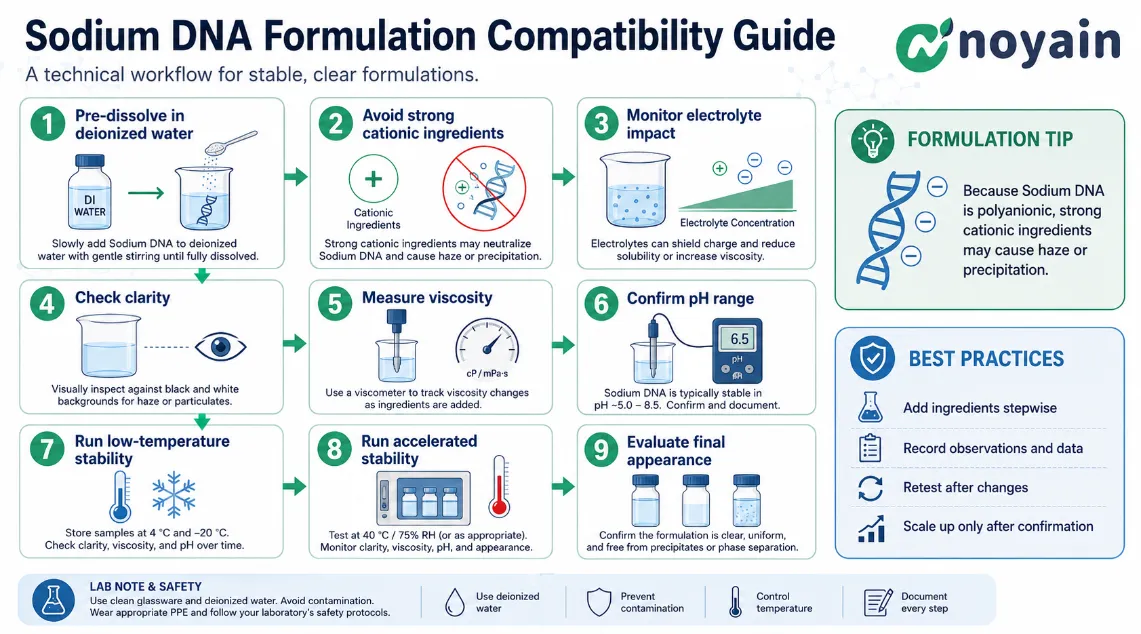
Formulation compatibility note: Sodium DNA is a polyanionic polymer. Strong cationic surfactants, quaternary ammonium compounds and cationic conditioning polymers can form electrostatic complexes with DNA, potentially causing condensation, haze or precipitation. Electrolytes can also change chain conformation and rheology, although this does not make every electrolyte-containing formula incompatible. Pre-dissolve the material in deionized water, control the order of addition, avoid prolonged heat, and screen the exact formula for clarity, viscosity, pH and assay retention under room-temperature, accelerated, low-temperature and freeze–thaw conditions.
For high-electrolyte brightening or anti-aging systems, run a compatibility matrix rather than relying on a generic “water-soluble” statement. Include the intended salts, cationic ingredients, preservative system and packaging in the test.
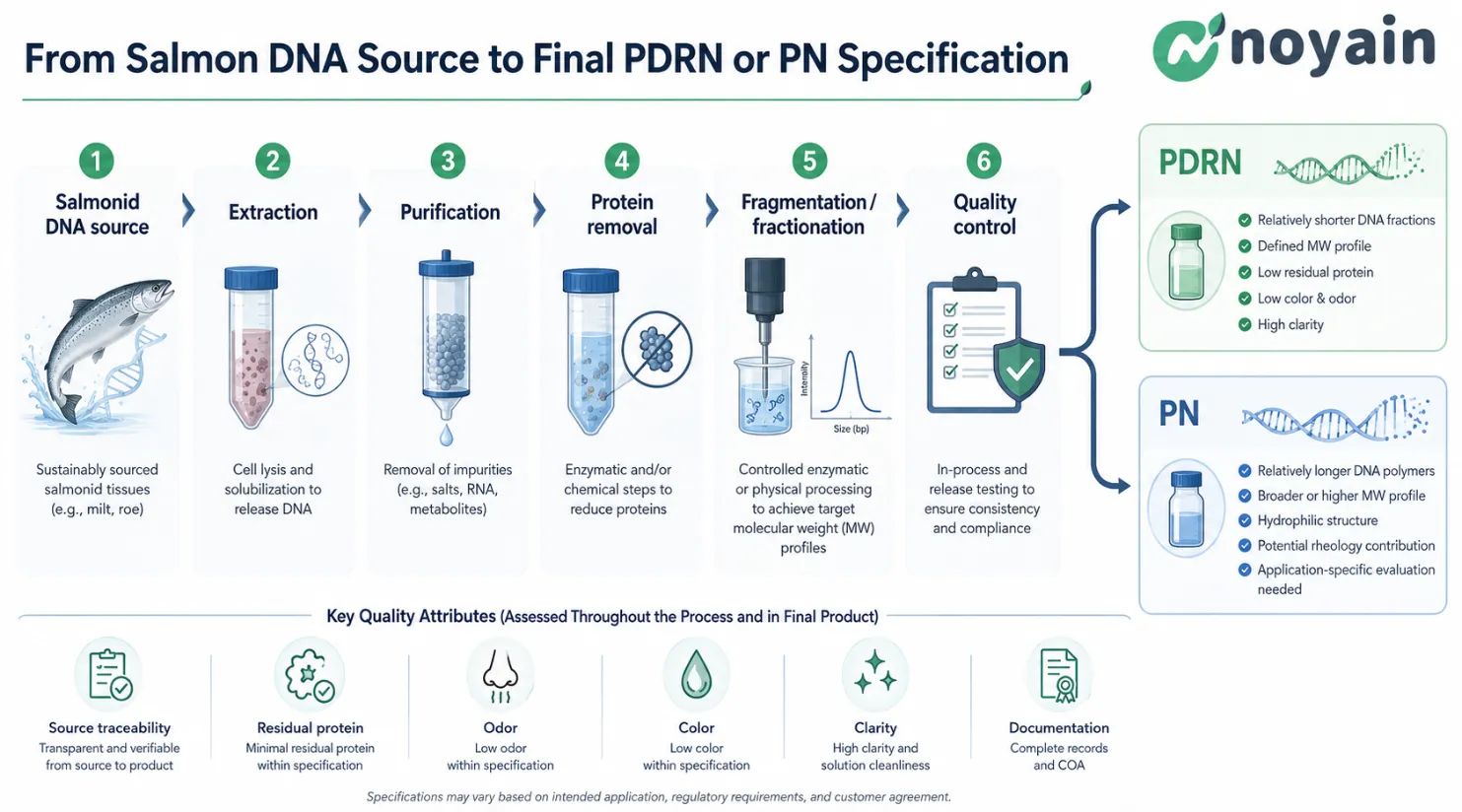
PDRN vs PN From Salmon DNA: Same Source, Different Raw Materials
Many PN and PDRN materials are associated with salmonid DNA. However, salmon origin explains where the nucleic acid came from; it does not define the final molecular weight, purity, structure or application grade.
Even when two suppliers begin with salmon DNA, the final materials may differ because of:
- Species and tissue source
- Raw-material traceability
- Extraction and purification
- Protein removal
- Fragmentation or depolymerization
- Molecular-weight fractionation
- Salt conversion
- Drying process
- Microbial control
- Batch-release limits
Low Immunogenicity Depends on Purification, Not a Simple DNA-Similarity Claim
Salmonid DNA is often described as biocompatible, but a B2B supplier should avoid reducing this to a vague statement that salmon DNA is “similar to human DNA.” The more defensible quality argument is that a defined purification process removes proteins, peptides and other source-related impurities that could increase odor, color, immunological or stability risk.
For procurement purposes, buyers should therefore request residual-protein limits, source controls, impurity data and batch-specific release results rather than relying on a general biocompatibility slogan.
For a broader source comparison, read Different Sources of PDRN Explained.
Sustainability and Traceability Are Separate From “Vegan”
Sustainable sourcing can strengthen a salmon-derived ingredient’s procurement profile, but it should not be confused with vegan positioning. A salmon-derived PDRN or PN remains animal-derived even when the fishery is well managed or the raw material is obtained from a processing by-product.
For sustainability due diligence, buyers can request:
- Species and geographic origin
- Wild-caught or aquaculture status
- Evidence that the species is not endangered
- Legal-catch and anti-IUU documentation where relevant
- Chain-of-custody or traceability records
- By-product utilization information
- Third-party fishery or chain-of-custody certification, if available
Programs such as Friend of the Sea provide audited fishery and chain-of-custody frameworks. However, a supplier should mention a certification only when the exact source, product or supply chain is covered by a valid certificate. A general statement that the material is “FOS-friendly” is not equivalent to certification.
Why Purification Matters
Poorly controlled material may show fish-related odor, yellow color, residual protein, haze, visible particles or inconsistent assay. These issues can make a material unsuitable for a clear serum, toner or premium ampoule even when the source story is attractive.
For animal-derived DNA materials, deodorization and decolorization are relevant process objectives, but buyers should not accept the process name as proof of performance. Odor, color, residual protein and solution clarity should be controlled through batch-release specifications and verified in the finished formula at the intended use level. A supplier should not promise fragrance-free suitability or high-dose odor neutrality without sample and formula data.
Double-Stranded DNA and Hyperchromicity
Hyperchromicity describes the increase in UV absorbance around 260 nm when double-stranded DNA is denatured and base stacking is disrupted.
It can provide structure-related information, but it should not be treated as a standalone purity result, efficacy measurement or proof of skin penetration. It should be interpreted together with DNA assay, molecular-weight distribution, residual protein, spectral purity indicators and batch consistency.
Read PDRN Hyperchromicity: A Key Quality Indicator for Double-Stranded DNA for the detailed analytical explanation.
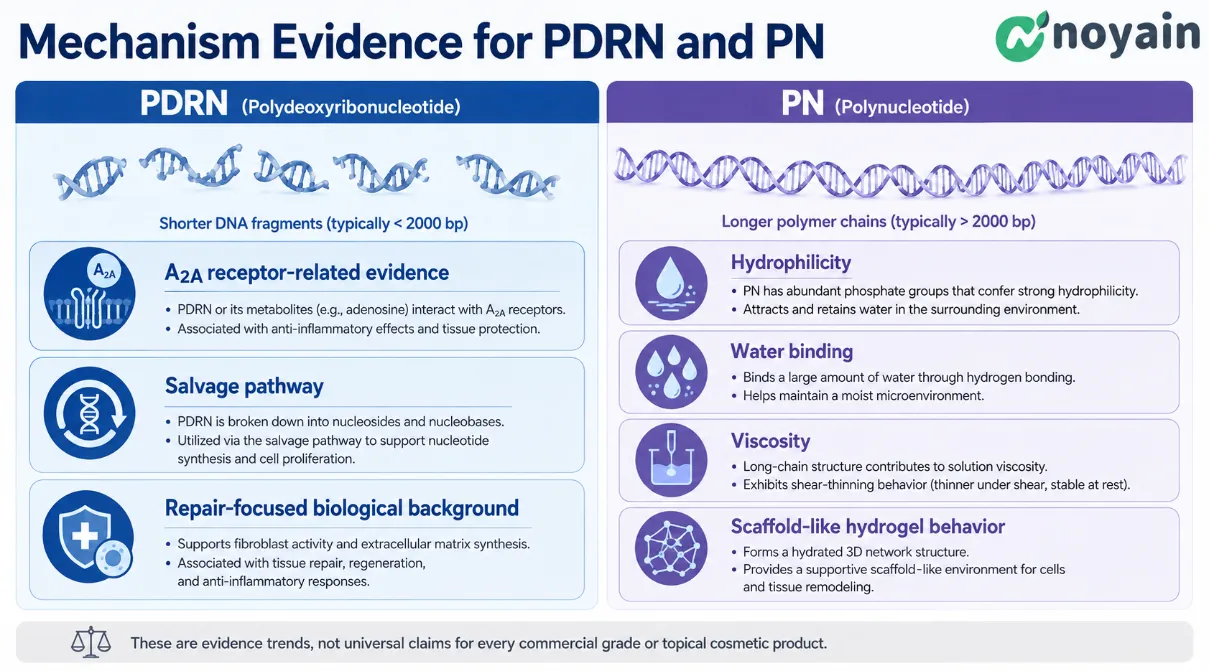
Mechanism Evidence: What PDRN and PN Studies Actually Show
Mechanism discussions are useful only when the tested material, molecular-weight profile, delivery route and study model are clearly identified. PDRN and PN should not be assigned universal biological functions solely from their commercial names.
PDRN: A2A Receptor and Salvage-Pathway Evidence
Classic pharmacological studies on defined PDRN preparations support two frequently discussed pathways:
- Engagement of adenosine A2A receptor-related signaling
- Provision of nucleosides and nucleotides for the cellular salvage pathway after enzymatic degradation
These mechanisms come mainly from pharmaceutical, cellular, animal and injected-use research. They provide biological background, but they do not prove that every cosmetic-grade Sodium DNA material—or every finished topical serum—will produce the same response. The mechanism can depend on DNA origin, molecular-weight distribution, manufacturing process, concentration and delivery route.
PN: Hydrophilicity and Scaffold-Like Behavior
Higher-molecular-weight PN is polyanionic and hydrophilic. In concentrated hydrogel or injectable systems, long chains can contribute to water binding, viscosity, polymer entanglement and scaffold-like structures. This helps explain why PN is frequently associated with structural or rheological positioning in aesthetic products.
However, buyers should not assume that every PN powder or dilute topical formula forms a clinically meaningful scaffold. Scaffold formation and residence time depend on polymer length, concentration, formulation architecture, crosslinking or association with other polymers, and the route of administration.
| Evidence Statement | Appropriate Interpretation | What It Does Not Prove |
|---|---|---|
| PDRN can engage A2A-related signaling | Supported for defined experimental or pharmaceutical preparations | Equivalent activity from every topical cosmetic grade |
| PDRN can contribute to the salvage pathway | Enzymatic degradation can supply nucleotide components | Guaranteed finished-product efficacy |
| High-MW PN can form scaffold-like hydrogels | Relevant to concentrated or structured PN systems | That all PN materials act as dermal scaffolds |
| PN may degrade more slowly in a hydrogel | Plausible for a specific long-chain formulation | Universal longer duration across all products |
| Lower-MW material may be easier to formulate or deliver | Must be demonstrated in the exact vehicle | Automatic penetration through intact skin |
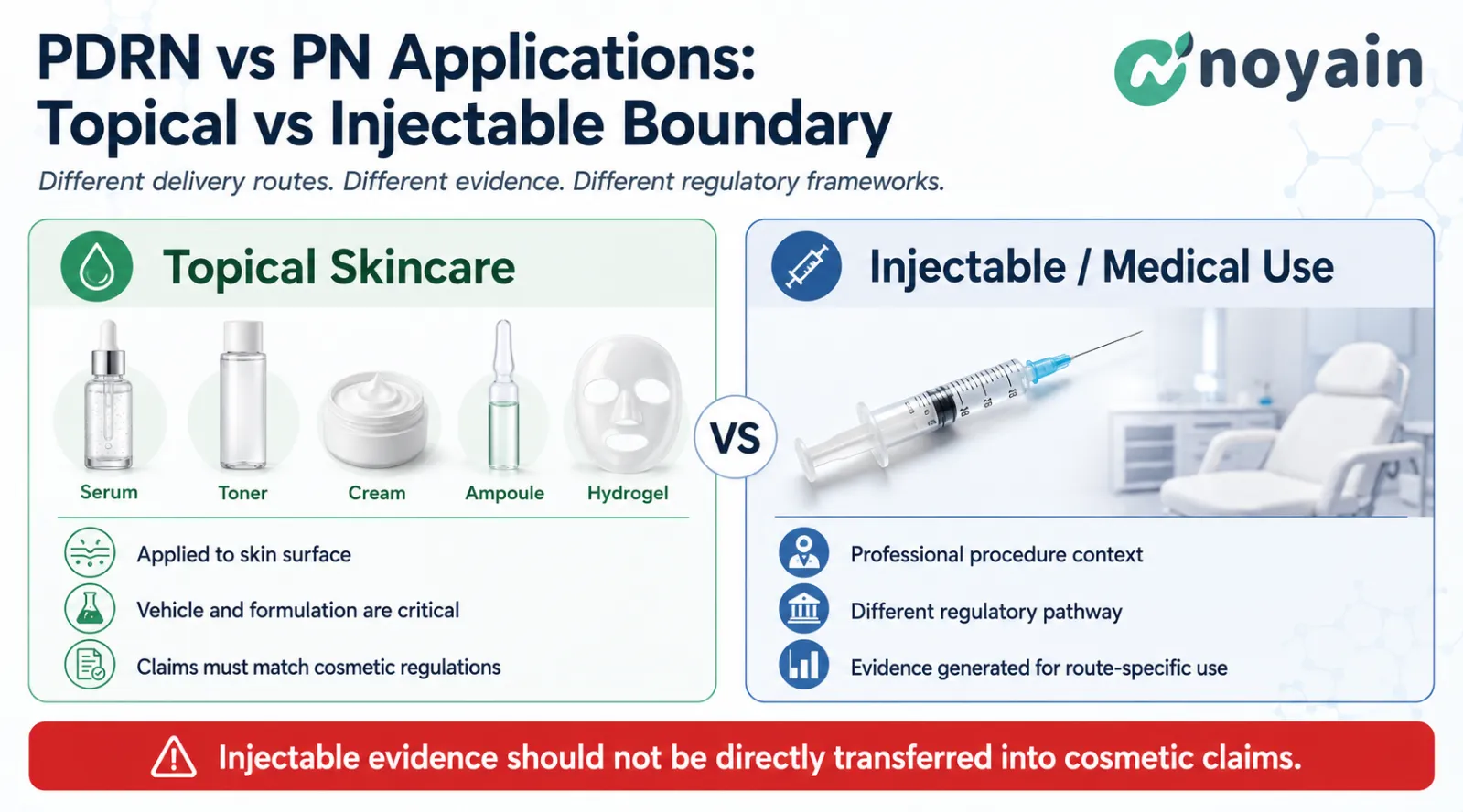
PDRN vs PN Applications: Topical Skincare Is Not Injectable Use
Search results for PN vs PDRN are heavily influenced by aesthetic-injection content. Cosmetic buyers should not transfer conclusions from injected products directly into topical skincare.
PN does not automatically mean injectable, and PDRN does not automatically mean topical. The application route depends on product grade, regulatory category, manufacturing quality, sterility, impurity limits, intended use and supporting evidence.
| Application Direction | Common Market Term | Main Evaluation Focus |
|---|---|---|
| Topical serum, ampoule, toner or cream | PDRN, Sodium DNA, salmon DNA | INCI, assay, solubility, purity, stability and cosmetic claims |
| Hydrogel or polymer-rich system | PN or higher-MW DNA polymer | Rheology, hydration, clarity and compatibility |
| Injectable aesthetic product | PN or PDRN | Route-specific regulation, sterility, endotoxin and clinical specifications |
| Post-care cosmetic concept | PDRN skincare | Barrier-compatible formulation and cosmetic claim boundaries |
| Biomedical or research material | PN/PDRN | Exact polymer identity and study protocol |
Injection bypasses the stratum corneum and places material directly into tissue. A serum or cream remains subject to the skin barrier, vehicle performance and surface-application conditions.
Clinical literature on injected PN or pharmaceutical PDRN can help explain biological plausibility, but it does not prove equivalent results from an ordinary topical cosmetic.
Topical Delivery: Smaller Does Not Mean Readily Absorbed
PDRN is smaller than high-molecular-weight PN in relative terms, but both remain macromolecular DNA materials. A lower molecular weight may improve dissolution, diffusion or delivery-system design, yet it does not by itself demonstrate meaningful passage through intact stratum corneum.
Delivery technologies such as liposomes, nanocarriers, film-forming systems or procedure-assisted application may alter deposition or permeation. Their results are formulation-specific and should not be transferred to an untested powder, stock solution or conventional serum. For topical product development, the supplier and formulator should distinguish among:
- Raw-material solubility
- Deposition on the skin surface
- Penetration into the stratum corneum
- Delivery into deeper viable skin layers
- Biological effect from the finished formulation
These are different endpoints and require different test methods.
For a detailed route comparison, read PDRN Injection vs Topical PDRN.
Regulatory Naming and Claim Positioning
A commercial story and a regulatory ingredient name are not the same thing. A brand may discuss a “PDRN skincare concept” in educational content, while the finished-product ingredient list must use the name accepted for the exact raw material and target market.
For China, the current regulatory framework requires cosmetic claims to have sufficient scientific support and prohibits labels and advertising from explicitly or implicitly presenting cosmetics as having medical effects. The term PDRN itself is not automatically a prohibited word, but the surrounding context can create risk—particularly injection imagery, references to medical procedures, or claims such as cellular regeneration, wound healing and tissue repair.
China-specific ingredient naming also requires case-by-case verification. The 2021 Inventory of Existing Cosmetic Ingredients in China includes DNA (脱氧核糖核酸) and Hydrolyzed DNA (水解 DNA). This does not mean that every commercial Sodium DNA material can automatically be filed under either entry. The registrant or responsible person should compare the exact salt form, composition, manufacturing process and supporting use history against the latest NMPA requirements.
In the European Commission CosIng database, SODIUM DNA/RNA is described as the sodium salt of DNA and RNA. CosIng is useful for nomenclature research, but buyers still need to confirm the exact supplied material, target-market requirements and finished-product safety assessment.
| Buyer Question | Practical Requirement |
|---|---|
| Can we call the ingredient PDRN on the front label? | Review the full claim context, target market and substantiation |
| Which name belongs in the ingredient list? | Use the accepted name for the exact supplied material and market |
| Can injectable studies support the finished cosmetic? | Use them only as background; substantiate the topical finished product separately |
| Can we claim repair, firming or anti-wrinkle benefits? | Use only claims permitted in the target market and supported by the required evidence |
| Is “clinical skincare” safe wording? | Avoid language or visuals that imply a drug, medical device or therapeutic procedure |
Formulation Compatibility: What Actually Matters in Topical Skincare?
For topical formulation, the following factors usually matter more than the acronym on the product label:
- Correct INCI identity
- DNA assay and calculation basis
- Molecular-weight distribution
- Source traceability
- Residual protein and impurity control
- Solubility and clarity
- pH and processing compatibility
- Preservative compatibility
- Finished-formula stability
- Evidence on the exact grade
| Formulation Requirement | Supplier Evidence to Request |
|---|---|
| Clear serum or ampoule | Dissolution method, clarity and precipitation test |
| Transparent toner | Color, optical clarity and low-temperature stability |
| Hydrogel | Viscosity profile and polymer compatibility |
| Sensitive-skin positioning | Finished-product tolerance and safety substantiation |
| Premium salmon DNA concept | Source, assay, MW and batch consistency |
| Export formulation | INCI, SDS, specification and market documentation |
| OEM/ODM scale-up | Process temperature, mixing order and stability data |
Which Material Should a Formulator Evaluate First?
Neither PN nor PDRN is universally better for skincare. The first material to evaluate should be selected according to product architecture, regulatory route, sensory target and the quality data available for the exact grade.
| Product Development Goal | Material to Evaluate First | Why |
|---|---|---|
| Clear serum or ampoule | Cosmetic-grade Sodium DNA/PDRN | Current PDRN skincare recognition and practical fit for transparent formats |
| Transparent toner | Well-characterized, readily soluble DNA grade | Clarity, color and precipitation control matter more than the PN/PDRN label |
| Structured hydrogel | Defined higher-MW PN | Polymer entanglement and rheology may be relevant when demonstrated in the exact system |
| Fragrance-free sensitive-skin product | Low-odor, low-color grade with residual-protein controls | Purification quality is critical for animal-derived materials |
| High-electrolyte brightening or anti-aging formula | Grade with formulation compatibility data | Charge interaction, viscosity change and precipitation must be screened |
| Premium salmon DNA concept | Traceable salmon-derived material | Source documentation and batch consistency strengthen the ingredient story |
| Evidence-led premium cosmetic | Best-characterized grade | Grade-specific data matters more than the commercial category name |
| Vegan product | Verified non-animal DNA route | Salmon-derived PN and PDRN do not meet vegan positioning |
| Injectable product | Separate regulated medical-grade product | Cosmetic-grade Sodium DNA is not an injectable substitute |
Answer to “PDRN vs PN—which is better?”: Select the grade whose molecular-weight profile, identity, purity, formulation behavior, documentation and regulatory route match the finished product. Do not select PN or PDRN solely from a generalized benefit list.
Supplier Differences: Why Two PN or PDRN Materials May Not Be Equivalent
Two suppliers can both offer “salmon PDRN” or “high-MW PN” while supplying materially different products.
| Marketing-Only Statement | Better Supplier Evidence |
|---|---|
| “High-purity PDRN” | Batch-specific DNA assay with method |
| “Low molecular weight” | Numeric range, dominant fraction and test method |
| “High-MW PN” | Molecular-weight distribution report |
| “Premium salmon DNA” | Species, source and traceability documents |
| “Water-soluble” | Concentration, dissolution time and clarity result |
| “99% purity” | Explanation of what the percentage represents |
| “Injectable quality” | Route-specific documentation rather than a marketing phrase |
| Generic COA | Batch-specific COA linked to the sample |
| Strong clinical evidence | Clear connection between study material and supplied grade |
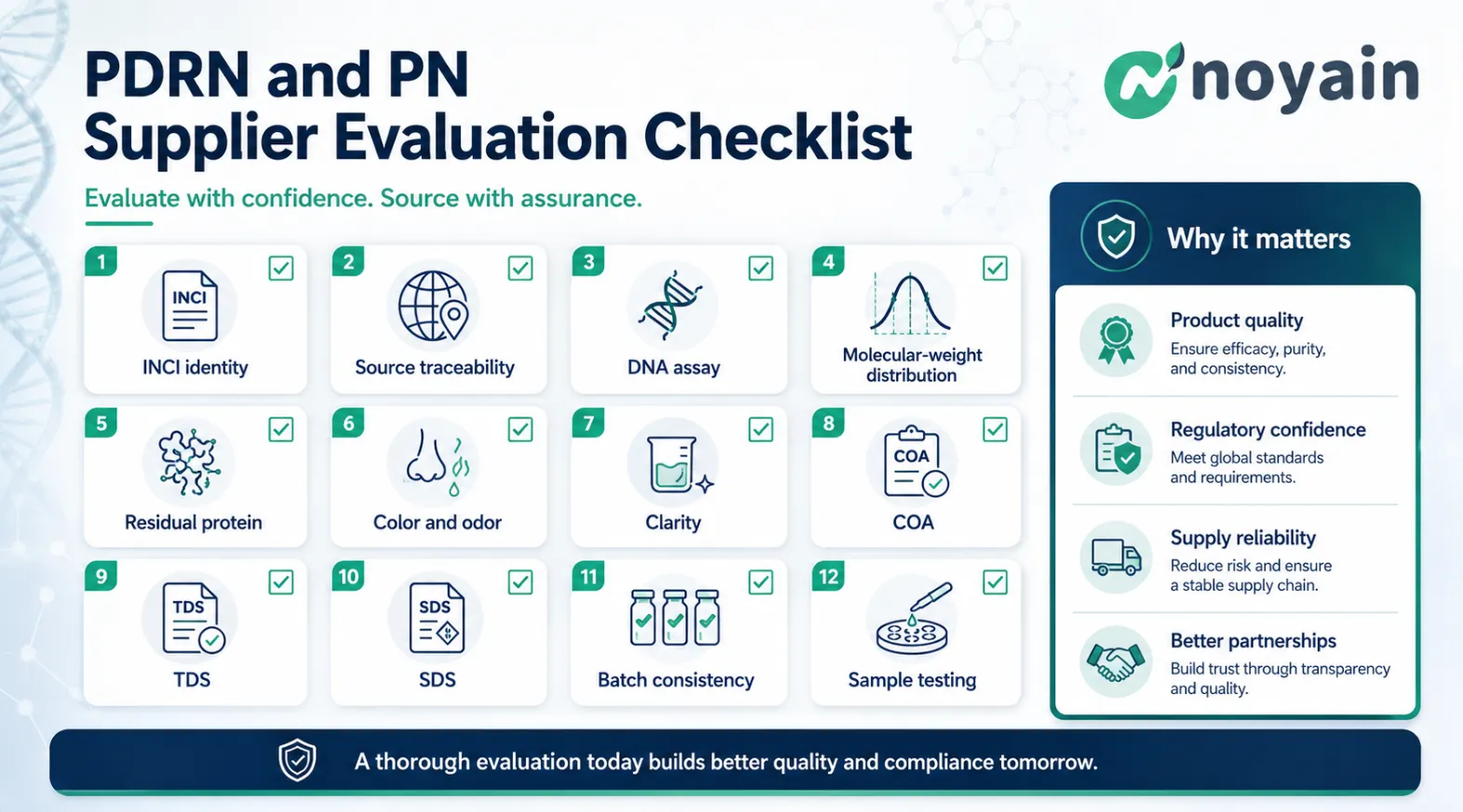
A professional supplier qualification should cover:
- Trade name and INCI
- Biological source and species
- Manufacturing and purification description
- DNA assay and method
- Molecular-weight distribution and method
- Hyperchromicity or other structural data where relevant
- Residual protein
- Microbial limits and heavy metals
- Relevant endotoxin information
- Appearance, odor, solubility and clarity
- COA, TDS/SPEC and SDS/MSDS
- Storage, shelf life and batch consistency
- Sample and formulation support
Why “99% Purity” May Be Misleading
A supplier’s “99%” may refer to DNA assay on a dry basis, total UV-absorbing nucleic-acid content, a selected fraction or a supplier-defined calculation.
It does not automatically mean:
- 99% intact double-stranded DNA
- No RNA, protein, salts or water
- A narrow molecular-weight distribution
- Proven biological activity
- Injectable suitability
The correct procurement question is:
What exactly does the purity percentage measure, which method is used, and what substances are included or excluded?
How to Compare PDRN and PN Supplier Samples
Document review should be followed by practical sample testing.
- Review the batch COA, TDS/SPEC and SDS/MSDS.
- Confirm the trade name, INCI and biological source.
- Check whether assay and MW data apply to the supplied batch.
- Compare powder or concentrate color and odor.
- Prepare equal-concentration solutions under controlled conditions.
- Record dissolution time, clarity, pH and viscosity.
- Test the material in the intended formula base.
- Run room-temperature, accelerated and low-temperature screening.
- Monitor precipitation, crystallization, color, odor and viscosity.
- Compare more than one batch before commercial approval.
| Test | What to Record | Possible Risk |
|---|---|---|
| Appearance | White, off-white, yellow or inconsistent | Purification or batch variation |
| Odor | None, mild or strong fish-related odor | Residual source material |
| Dissolution | Time, temperature and mixing | Manufacturing difficulty |
| Clarity | Clear, hazy or precipitated | Premium appearance and stability risk |
| pH and viscosity | Initial result and storage drift | Formula compatibility risk |
| Low-temperature storage | Precipitation, crystallization and recovery | Logistics and shelf-life risk |
| Batch comparison | Analytical and visual consistency | Supply reliability risk |
Supplier experience point: Complaints about odor, yellow color, haze or batch inconsistency cannot be solved by repeating a high-purity claim. The supplier must connect each issue to a measurable specification, corrective action and repeatable batch result.
Common PDRN vs PN Sourcing Myths
Myth 1: PDRN and PN are simply two names for the same raw material
Reality: They are related DNA-derived material categories, but suppliers may provide substantially different molecular-weight distributions, purity profiles, processing histories and intended-use specifications.
Myth 2: Any material below 1,500 kDa is officially PDRN
Reality: The 1,500 kDa cutoff is a proposed scientific nomenclature framework. It is not a globally enforced cosmetic regulation, pharmacopoeial standard or automatic product classification.
Myth 3: Lower molecular weight always means better skin penetration
Reality: Molecular weight may affect dissolution and diffusion, but topical delivery also depends on charge, polymer structure, concentration, vehicle design, delivery technology and skin-barrier conditions.
Myth 4: Higher-molecular-weight PN always lasts longer
Reality: Residence time and structural behavior depend on concentration, rheology, formulation architecture, degradation conditions and route of administration—not molecular weight alone.
Myth 5: Salmon source guarantees high purity and low immunogenic risk
Reality: Source identity does not prove low residual protein, low odor, low color, narrow molecular-weight distribution or microbial quality. Purification and batch-release controls remain essential.
Myth 6: A 99% purity claim means two suppliers offer equivalent products
Reality: The percentage may refer to different assays, calculation bases or dry-weight conditions. Buyers must compare test methods, molecular-weight data, impurities and sample performance.
Myth 7: PN automatically means injectable grade
Reality: PN is a polymer category or commercial description. Injectable suitability requires separate evidence for sterility, endotoxin, manufacturing quality, clinical use and regulatory authorization.
Myth 8: PDRN works only through receptors, while PN works only as a scaffold
Reality: Defined PDRN preparations have established A2A-related pharmacological literature, and high-MW PN can influence hydrogel structure. These are not mutually exclusive or universal mechanisms for every commercial grade.
Myth 9: The most expensive material is the best material
Reality: Price can include branding, distribution and market positioning. Batch-specific documentation, formula compatibility and supply consistency are more reliable quality indicators.
How Noyain Positions Salmon-Derived Sodium DNA
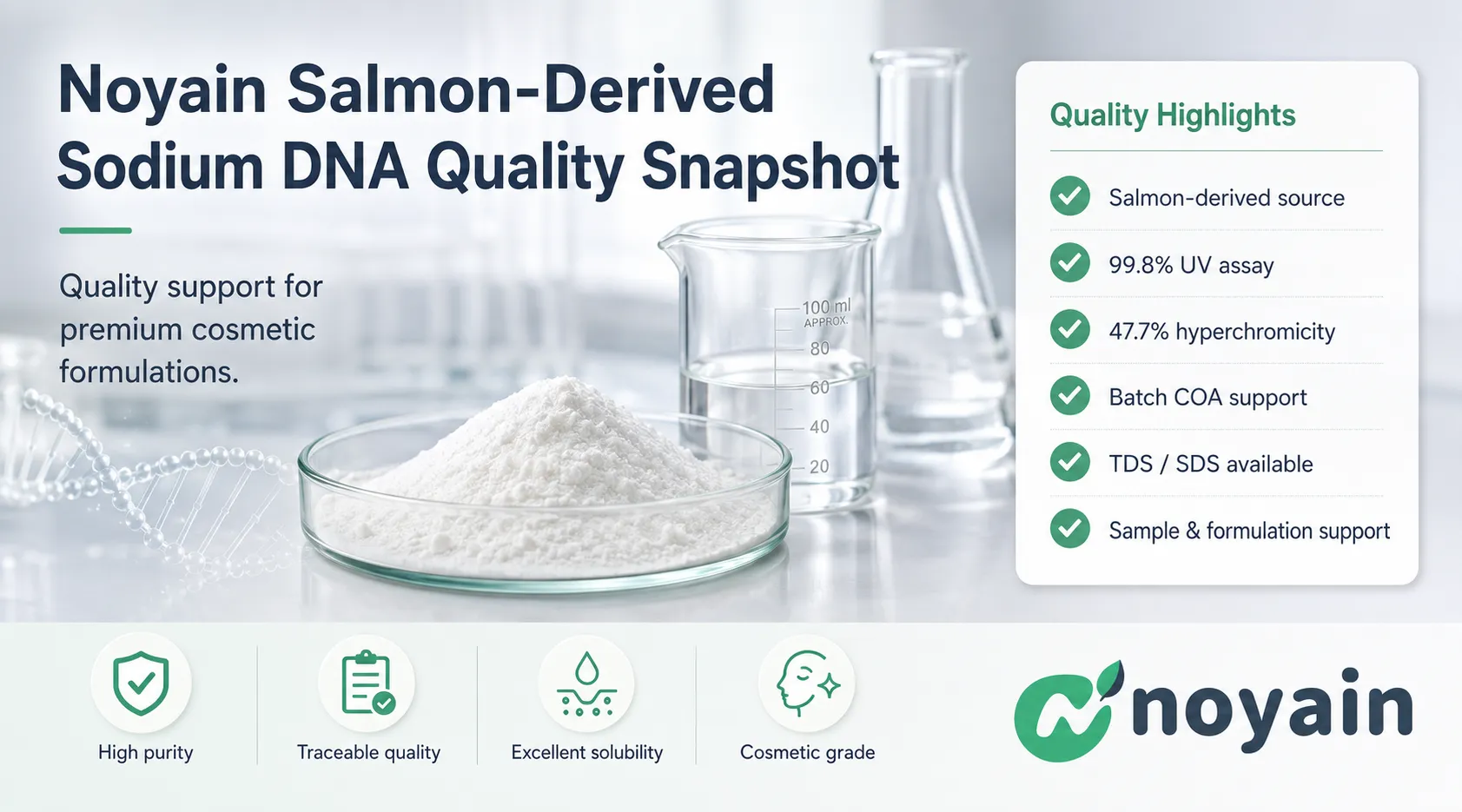
Noyain supplies salmon-derived Sodium DNA for B2B cosmetic formulation evaluation, including serum, ampoule, cream, mask, toner and OEM/ODM development projects.
Our current product documentation uses:
- Trade name: PDRN
- INCI name: Sodium DNA
- Water-soluble cosmetic raw-material format
- Batch-specific COA support
- DNA assay and hyperchromicity data
- Molecular-weight, protein, endotoxin, heavy-metal and microbial review support
- TDS/SPEC and SDS/MSDS
- Sample, formulation and commercial-order support
Current batch information published on our product page includes a 99.8% UV assay and 47.7% hyperchromicity. For B2B buyers, these provide two separate qualification checkpoints:
- The UV assay characterizes nucleic-acid content according to the stated test method.
- Hyperchromicity provides structure-related information about the denaturation response of the DNA sample.
Together, they are more decision-useful than an unexplained “99% purity” marketing claim. They do not, by themselves, prove maximum molecular integrity, minimal process degradation, topical penetration, clinical efficacy or predictable finished-formula performance. Those conclusions require molecular-weight data, spectral purity, residual-protein controls, odor and color assessment, stability testing and evidence on the exact finished product.
For transparent or fragrance-free serum projects, buyers should request a sample and evaluate odor, color, dissolution, clarity and long-term stability at the intended dosage. For high-electrolyte or cationic systems, request a compatibility discussion before scale-up.
Brands, OEM/ODM manufacturers, distributors and formulation laboratories can review the Noyain Sodium DNA product details and request the relevant batch documents before bulk approval.
For related content, visit the PDRN Ingredient Article Hub.
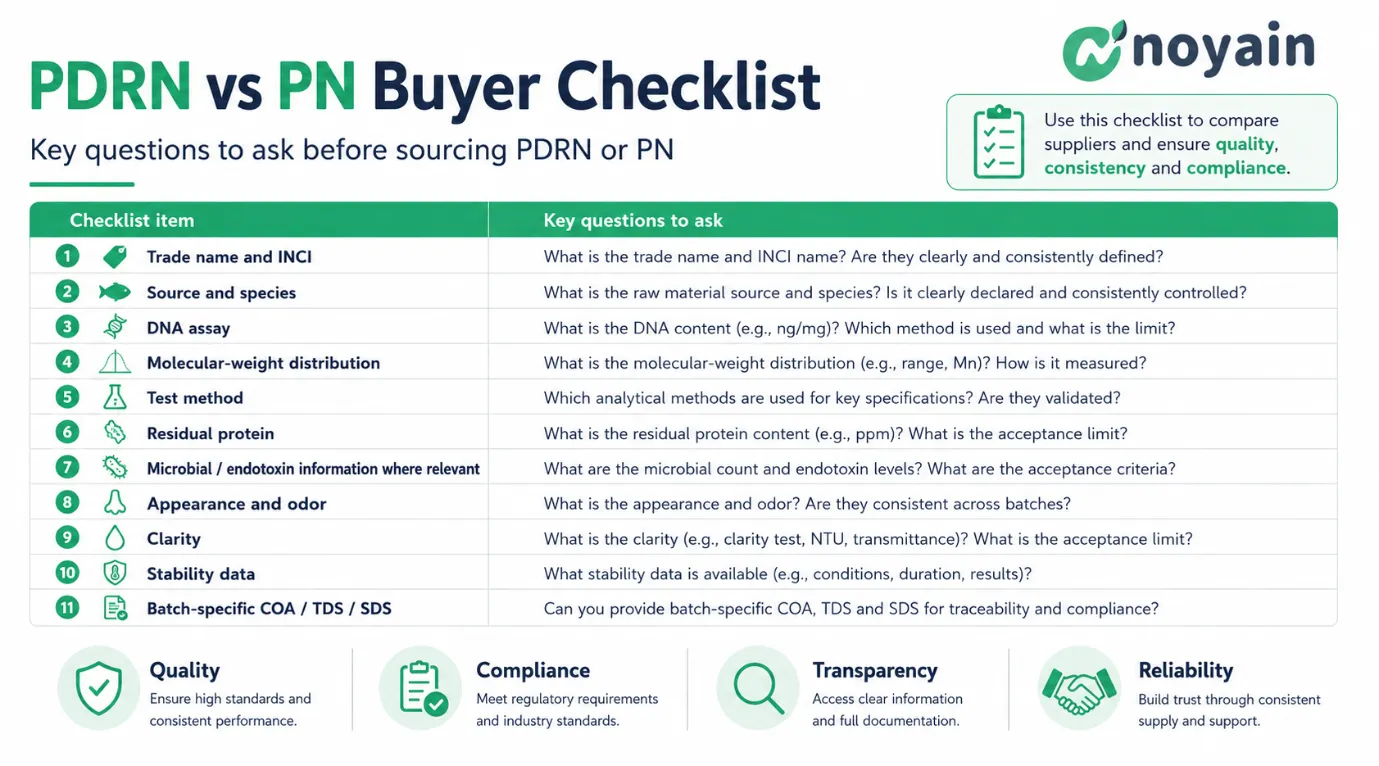
PDRN vs PN Buyer Checklist
Before approving a supplier, ask:
- ☐ What is the trade name and INCI?
- ☐ Is that ingredient name accepted for the exact material and target market?
- ☐ How does the supplier define PN or PDRN?
- ☐ What is the biological source and species?
- ☐ What is the DNA assay and calculation basis?
- ☐ What molecular-weight range and distribution are reported?
- ☐ Which analytical method is used?
- ☐ Is structure-related information available?
- ☐ What are the residual-protein, microbial and heavy-metal limits?
- ☐ Is relevant endotoxin information available?
- ☐ Does the material have visible color or odor?
- ☐ Does it dissolve clearly at the intended use level?
- ☐ Has compatibility with cationic ingredients and the intended electrolyte level been screened?
- ☐ What pH and processing-temperature limits apply?
- ☐ Has it been tested in the intended finished formula?
- ☐ Does the evidence apply to this exact grade?
- ☐ Are batch-specific COA, TDS/SPEC and SDS/MSDS available?
- ☐ Can the supplier demonstrate batch consistency?
- ☐ Are species, origin and chain-of-custody records available?
- ☐ Are any sustainability certifications valid for this exact supply chain?
Final Conclusion: Specification Matters More Than the Name
PDRN and PN are related DNA-derived materials, but they should not be treated as automatically identical.
PN is generally used for relatively longer or higher-molecular-weight polymers, while PDRN is generally used for relatively shorter or fractionated DNA-derived polymers. However, terminology remains inconsistent and distributions may overlap.
For cosmetic buyers, the most reliable comparison is not simply PN vs PDRN. It is:
One documented raw-material specification versus another, tested in the intended finished formula.
Frequently Asked Questions
What is the main difference between PDRN and PN?
PN is generally associated with longer DNA polymers or a relatively higher-molecular-weight profile. PDRN is generally associated with relatively shorter or fractionated DNA fragments. Because terminology is not globally standardized, buyers should compare the actual molecular-weight distribution and specification.
Is PDRN the same as polynucleotide?
PDRN belongs to the broader family of deoxyribonucleotide polymers, but PDRN and PN are often treated as separate commercial categories. They may overlap, so equivalence should be demonstrated rather than assumed.
Which has a higher molecular weight, PN or PDRN?
PN is generally described as having longer chains or a higher molecular-weight profile. This is not guaranteed for every product. The supplier should provide the measured range, distribution and method.
Is PDRN better than PN for skincare?
Neither is universally better. Cosmetic-grade PDRN/Sodium DNA may be practical for serums and ampoules. Higher-MW PN may be relevant when polymer structure or rheology is part of the concept. Direct head-to-head evidence is limited, so formula testing and grade-specific documentation are required in both cases.
Are both PDRN and PN derived from salmon DNA?
Many established products are derived from salmonid DNA, but plant, microalgae, microbial and synthetic routes also exist. Source identity must be verified from supplier documentation.
Can PN be used in topical skincare?
Potentially, but the name PN is not enough to approve the material. Buyers must confirm INCI, source, purity, molecular weight, safety documentation and suitability for the intended topical formula.
Does lower molecular weight mean better skin penetration?
Not automatically. Molecular weight may influence diffusion and formulation behavior, but topical delivery also depends on polymer structure, vehicle, concentration, delivery system, skin condition and formula stability.
What is the INCI name for PDRN or PN?
PDRN and PN are commercial or technical terms rather than universal cosmetic INCI names. Suppliers may use Sodium DNA or another supported DNA-related name. The European Commission CosIng database includes SODIUM DNA/RNA, described as the sodium salt of DNA and RNA. Confirm the exact identity for the supplied grade and target market.
Should a brand use “Sodium DNA” instead of “PDRN” when filing a cosmetic in China?
Do not make that substitution automatically. PDRN is a commercial or technical descriptor, while the filed ingredient name must match the exact material and current Chinese requirements. The 2021 IECIC includes DNA and Hydrolyzed DNA, but the responsible person should verify whether the supplied salt form, composition and process fit an existing entry or require another regulatory route.
Is sustainably sourced salmon PDRN vegan?
No. Sustainable fishery management, by-product utilization and traceability can improve the sourcing profile, but salmon-derived PDRN remains animal-derived and should not be marketed as vegan.
How can a buyer verify whether a material is properly characterized PDRN?
A supplier should provide more than a trade name. Request the supported INCI identity, biological source and species, DNA assay and method, molecular-weight distribution, residual protein, appearance and odor limits, solubility and clarity data, batch-specific COA, TDS/SPEC, SDS/MSDS and finished-formula stability guidance. Two grades should not be treated as equivalent only because both are marketed as PDRN.
What documents should a supplier provide?
Request a batch-specific COA, TDS/SPEC, SDS/MSDS, source declaration, DNA assay, molecular-weight data, residual-protein result, relevant microbial and endotoxin information, solubility guidance, stability information and market-specific naming support.
Does PDRN activate the A2A receptor in topical skincare?
A2A receptor-related activity is supported for defined PDRN preparations in pharmacological and experimental research. That does not automatically prove equivalent receptor activity from every cosmetic-grade material or finished topical product. The exact grade, concentration, delivery and test model matter.
Does PN act as a scaffold in the skin?
High-molecular-weight PN can contribute to scaffold-like hydrogel structures in concentrated or injectable formulations. This should not be generalized to every PN raw material or dilute topical formula without rheological and structural evidence on the exact product.
Can injectable PN research support topical cosmetic claims?
It may provide biological background, but it is not direct proof of equivalent topical performance. Injectable and topical products differ in route, grade, regulation, exposure depth and study endpoints. Topical claims should be supported by the exact finished cosmetic formula.
References & Sources
- Kim S.T. Comparison of Polynucleotide and Polydeoxyribonucleotide in Dermatology. 2025.
- Marques C. et al. From Polydeoxyribonucleotides (PDRNs) to Polynucleotides (PNs). Biomolecules, 2025.
- Squadrito F. et al. Pharmacological Activity and Clinical Use of PDRN. Frontiers in Pharmacology, 2017.
- Chen S. et al. Orthogonal Molecular Weight Analysis of PDRN Using MALS and Mass Photometry. Biomacromolecules, 2026.
- Thellung S. et al. Polydeoxyribonucleotides Enhance the Proliferation of Human Skin Fibroblasts: Involvement of A2 Purinergic Receptor Subtypes. Life Sciences, 1999.
- Ainalem M.L. et al. DNA Compaction Induced by a Cationic Polymer or Surfactant. 2014.
- National Medical Products Administration. Cosmetics Supervision and Administration Regulation and Inventory of Existing Cosmetic Ingredients in China, 2021.
- European Commission CosIng. SODIUM DNA/RNA.