Ectoin is commonly promoted for hydration, skin-barrier support, sensitive-skin comfort, and protection-oriented skincare. For cosmetic product developers, however, the useful question is not simply whether Ectoin has benefits for skin. It is which benefit is relevant to the intended product, what evidence supports it, and what still needs to be confirmed in the finished formulation.
This guide translates Ectoin benefit claims into practical product-development language. It focuses on hydration, barrier-related positioning, sensitive or stressed skin, environmental exposure, suitable product formats, and the evidence required to support a finished-product story.
For the ingredient’s identity, production route, specification, and sourcing checks, read What Is Ectoin in Skincare?.
Quick answer: The main Ectoin benefits for skin are associated with hydration, barrier-focused skincare, skin comfort, and environmental-stress positioning. These properties can make Ectoin relevant to serums, moisturizers, sensitive-skin products, sunscreens, and after-sun formulas. However, the evidence is not equally strong for every benefit. Hydration has direct human and stratum-corneum research, while many environmental-stress claims rely on cell models, ingredient combinations, or proprietary finished formulations. Claim strength therefore depends on the Ectoin grade, concentration, formula, study design, and target market.
Review the current Noyain Ectoin product information before selecting a grade for formulation evaluation.
What Are the Main Benefits of Ectoin for Skin?
Ectoin is a small compatible solute used in cosmetic formulations as part of a broader hydration and protection strategy. It does not replace every familiar moisturizing or barrier ingredient. Its value is that it can give a formula a distinct active-ingredient role while complementing humectants, emollients, lipids, UV filters, and other skincare actives.
The benefit directions should be separated before product claims are written.
| Benefit direction | What the evidence currently supports | Practical evidence strength |
|---|---|---|
| Hydration | Human testing of a 2% Ectoin formulation and laboratory research on stratum-corneum hydration | Moderate and directly relevant, but formulation-specific |
| Barrier-focused skincare | Moisture- and barrier-related findings in specific topical formulations and reviews | Moderate, but “barrier repair” requires stronger finished-product evidence |
| Skin comfort | Supplier patch screening and clinical literature on Ectoin-containing topical products | Supportive, but not proof that every formula is suitable for sensitive skin |
| Environmental stress | UVA, UVB, visible-light, oxidative-stress, and combination-formula research | Emerging; much of the evidence is preclinical or combination-specific |
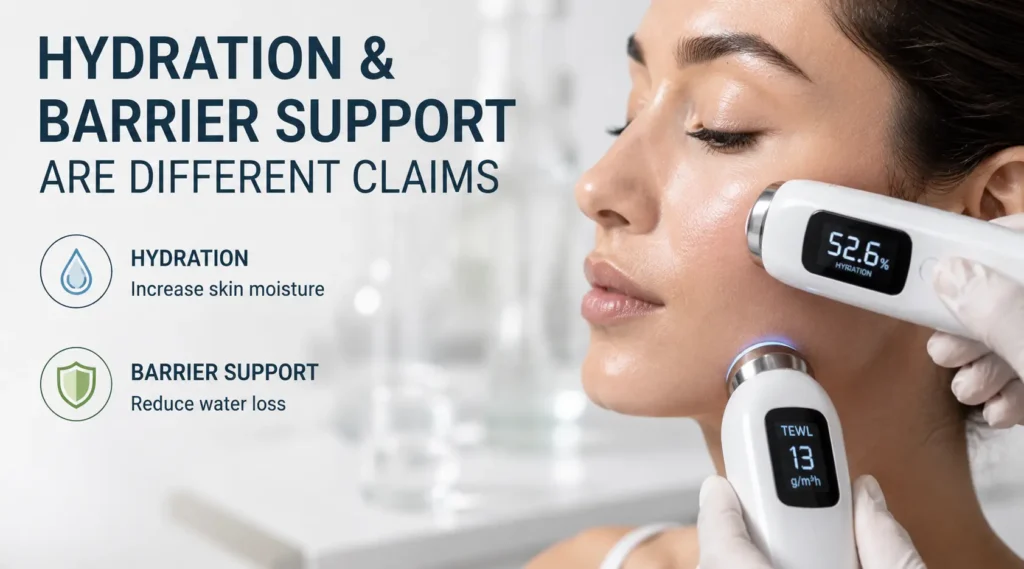
This distinction matters because hydration, reduced TEWL, skin comfort, barrier repair, antioxidant activity, and photoprotection are different endpoints. One result should not be rewritten as another claim.
Ectoin and Skin Hydration
Hydration is the most directly supported and commercially understandable Ectoin benefit. It is also easy to oversimplify.
A moisturizing product may work by attracting water, reducing evaporation, improving the flexibility of the stratum corneum, adding barrier lipids, or changing how dry and tight the skin feels. Ectoin should therefore be evaluated as one component of a complete hydration system rather than as a replacement for glycerin, hyaluronic acid, panthenol, emollients, or occlusive materials.
What published studies suggest
A randomized, double-blind, vehicle-controlled study evaluated a formulation containing 2% Ectoin in 104 healthy female volunteers. Moisturization and other skin-surface parameters were compared with a vehicle emulsion and an untreated control. The study supports the relevance of Ectoin-containing formulations to moisturization-focused skincare, but the findings apply to the tested formula and conditions rather than every Ectoin product. See the 2007 clinical study.
A laboratory study on human stratum corneum reported that Ectoin affected keratin organization and hydration kinetics. This provides useful mechanistic support, but it should not be converted into a consumer-facing duration claim such as “72-hour hydration” without finished-product testing. See the 2021 stratum-corneum study.
A 2026 review also concluded that topical Ectoin research supports moisturizing and barrier-related potential. However, the review covers pharmaceutical and dermatological applications as well as cosmetics, so its conclusions should not be copied directly into general cosmetic claims. See the 2026 review of Ectoin applications.
Where Ectoin may fit in a hydration system
| Existing formula component | Main role | Possible Ectoin contribution |
|---|---|---|
| Glycerin | Conventional humectancy | Adds a distinct osmolyte-based active story |
| Hyaluronic acid | Hydration and film-forming positioning | Adds a different small-molecule role |
| Emollients | Softness, flexibility, and sensory improvement | Complements rather than replaces emolliency |
| Occlusive materials | Reduction of surface water loss | Adds an active-positioning layer |
| Ceramides and other lipids | Barrier-lipid architecture | Complements rather than replaces the lipid system |
Ectoin can therefore be evaluated in hydrating serums, gel creams, daily moisturizers, barrier creams, overnight masks, sunscreen formulas with added skincare benefits, after-sun lotions, and scalp-hydration serums.
The detailed question of whether Ectoin or hyaluronic acid better fits a project belongs in a separate comparison article. This page should remain focused on the benefit evidence.
Ectoin and Barrier-Focused Skincare
Barrier-focused skincare now appears in serums, lightweight moisturizers, sunscreens, gentle cleansers, and sensitive-skin routines—not only in rich creams.
Before selecting an ingredient, product developers should define what “barrier support” means in the brief. It may refer to:
- increased stratum-corneum hydration;
- reduced transepidermal water loss;
- improved softness or surface texture;
- reduced perception of dryness or tightness;
- better comfort after exposure to dry air, cleansing, heat, or other stressors;
- support for a formula containing humectants, emollients, and barrier lipids.
These outcomes are related, but they are not identical. A higher corneometry reading demonstrates a hydration result. It does not automatically prove that the product rebuilds the skin barrier.
How Ectoin may fit a barrier formula
Ectoin may complement glycerin, emollients, ceramides, cholesterol, fatty acids, panthenol, beta-glucan, and mild emulsifier systems. This does not establish automatic compatibility or synergy. The final formulation still needs solubility, pH, viscosity, preservative-efficacy, packaging-compatibility, and stability testing.
Match the wording to the evidence
| More conservative cosmetic positioning | Wording requiring stronger evidence and regulatory review |
|---|---|
| Helps improve skin hydration | Repairs damaged skin |
| Helps reduce the feeling of dryness or tightness | Heals a compromised skin barrier |
| Suitable for barrier-focused skincare | Treats barrier dysfunction |
| Helps maintain comfort after environmental exposure | Treats inflammation |
| Supports a moisturization system | Regenerates skin cells |
The European Union’s cosmetic claim criteria state that an ingredient property must not be presented as a finished-product property without adequate and verifiable evidence. The regulation also requires the evidence to be relevant to the product and the claimed benefit. See Commission Regulation (EU) No 655/2013.
In the United States, claims to treat or prevent disease or to affect the body’s structure or function may cause a product to be regulated as a drug rather than only as a cosmetic. See the FDA’s current guidance on cosmetics labeling claims.
Ectoin for Sensitive or Stressed Skin
Ectoin is often considered for sensitive-skin formulas because hydration, barrier-related positioning, and comfort are central to this category. Adding Ectoin, however, does not automatically make a complete product suitable for sensitive skin.
Finished-formula tolerability also depends on fragrance, surfactants, solvents, preservatives, pH, emulsifiers, active combinations, packaging, application frequency, and the target population.
The supplier evidence package for the Ectoin grade supplied by Noyain includes human patch-test screening at several concentrations. In that test, the 0.3% and 2% samples produced negative reactions in all 30 subjects, while one suspected mild reaction was recorded at 5%. This is useful for preliminary raw-material review, but it does not justify describing every Ectoin formula as hypoallergenic or suitable for every sensitive-skin consumer.
Potential product directions include:
- daily comfort moisturizers;
- minimalist hydrating serums;
- barrier-focused creams;
- after-sun lotions;
- post-cleansing comfort products;
- fragrance-free sensitive-skin formulas;
- dry-air or climate-stress skincare.
Avoid converting this positioning into claims such as “treats eczema,” “reduces rosacea,” “treats dermatitis,” or “anti-allergy treatment.” Clinical literature involving dermatological conditions can inform scientific understanding, but evidence from a specific medical population or proprietary formulation cannot automatically substantiate a general cosmetic product.
Ectoin and Environmental-Stress Positioning
Environmental-stress skincare is commercially useful because it connects ingredient science with modern product concepts. It is also a category where broad claims often exceed the actual evidence.
“Environmental stress” may refer to dry air, temperature changes, surfactant exposure, urban particles, visible light, UV-associated models, post-sun dryness, or oxidative conditions. Evidence from one exposure model should not be used to imply protection against every environmental factor.
What standalone and formulation-specific evidence can show
A published cell-culture study used a UVA stress model and reported effects on several cellular endpoints associated with UVA-induced stress. This supports further evaluation of Ectoin for environmental-exposure skincare, but it does not establish SPF, UVA protection, or sunscreen efficacy. See the foundational UVA study.
A 2024 in vivo publication evaluated Ectoin and mannitol together with UV filters. The study supports the tested combination, not Ectoin alone. See the 2024 photoprotection-combination study.
The supplier package for the Noyain grade also includes laboratory-model data involving UV exposure, visible-light exposure, inflammatory mediators, and oxidative stress. These results may guide product-development directions, but they should be treated as preclinical or raw-material evidence rather than automatic finished-product claims.
What newer 2024–2026 research adds
Recent Ectoin research increasingly evaluates engineered systems, combinations, and derivatives rather than only standalone Ectoin. This is scientifically useful but creates an important claim boundary.
| Recent research | What it adds | What it does not prove for standard Ectoin powder |
|---|---|---|
| 2024 supramolecular hyaluronic acid–Ectoin system | Reported higher permeability and cell-level hydration, inflammatory, and oxidative-stress outcomes for the assembled HA–ECT system | The result cannot be assigned to Ectoin alone or to a simple HA + Ectoin blend |
| 2024 Ectoin + mannitol + UV-filter formulation | Provides in vivo evidence for a specific photoprotection combination | It does not show that Ectoin is a UV filter or independently raises SPF |
| 2025 Ectoin–Thermus thermophilus cofermentation product | Evaluated antioxidant and anti-UVB activity of a composite fermentation product | The result does not establish identical performance for purified Ectoin |
| 2026 topical-application review | Provides the latest broad synthesis of moisturizing, barrier, and inflammatory-skin research | Much of the clinical evidence involves medical or condition-specific formulations |
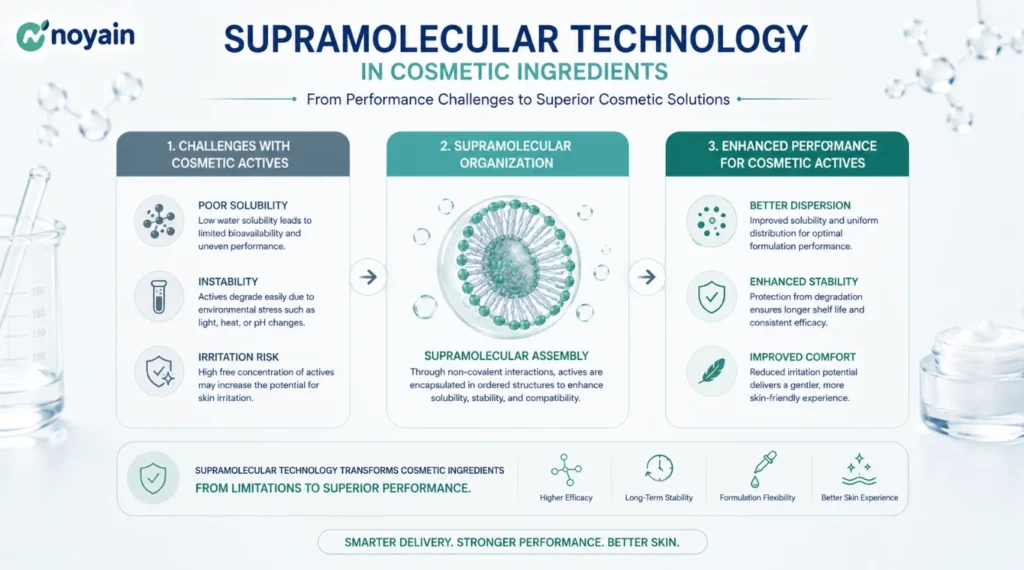
Relevant sources include the 2024 supramolecular HA–Ectoin paper, the 2025 cofermentation-product study, and the 2026 multifunctional Ectoin review.
This distinction is one of the most important lessons for B2B buyers: a result from an Ectoin-containing system is not automatically a result for every Ectoin raw material.
Environmental-stress claim questions
| Marketing direction | What must be clarified? |
|---|---|
| Anti-pollution | Which pollutant, particle, or exposure model was tested? |
| Sun-care support | Was the endpoint SPF, UVA protection, hydration, comfort, or another measure? |
| Visible-light positioning | Was visible-light exposure actually included? |
| Climate-adaptive skincare | What heat, cold, humidity, or dryness condition supports the story? |
| Antioxidant positioning | Was direct radical scavenging measured, or was protection inferred from a stress model? |
| Post-sun comfort | Was the finished formula tested after exposure, and what endpoint was recorded? |
Ectoin is not a UV filter. It does not replace approved filters, SPF and UVA testing, photostability assessment, or market-specific sunscreen requirements.
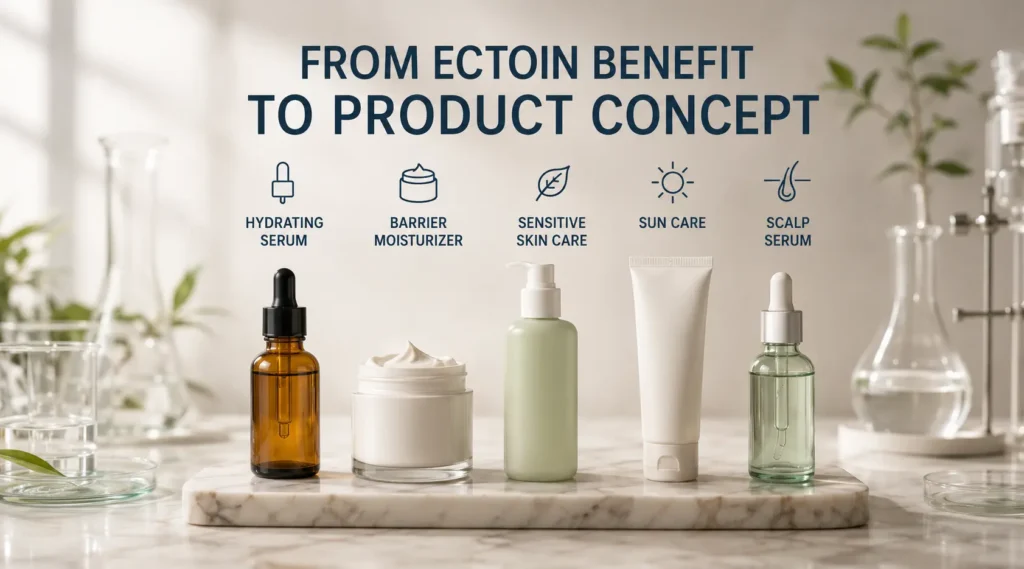
Which Cosmetic Products Can Use These Ectoin Benefits?
The same Ectoin benefit should not be communicated identically across every product format.
| Product concept | Ectoin’s possible role | What must be validated |
|---|---|---|
| Hydrating serum | Osmolyte-based hydration in a lightweight format | Moisture measurement, clarity, viscosity, and stability |
| Barrier moisturizer | Moisture retention and comfort-focused positioning | Hydration, TEWL, tolerability, and emulsion stability |
| Sensitive-skin cream | Minimalist hydration and comfort positioning | Patch or tolerability testing and preservative review |
| Sunscreen | Added skincare benefits within a tested UV-filter system | Filter compatibility, SPF/UVA testing, and photostability |
| After-sun product | Post-exposure moisturization and comfort | Finished-product hydration and consumer-comfort testing |
| Urban skincare | Environmental-stress or resilience narrative | A relevant pollutant, light, dryness, or stress model |
| Scalp serum | Lightweight hydration and scalp-comfort positioning | Scalp compatibility, residue, stability, and user testing |
The strongest concept is normally the one in which Ectoin has a defined role rather than being one more active added to a long ingredient list.
How Strong Is the Evidence Behind an Ectoin Benefit Claim?
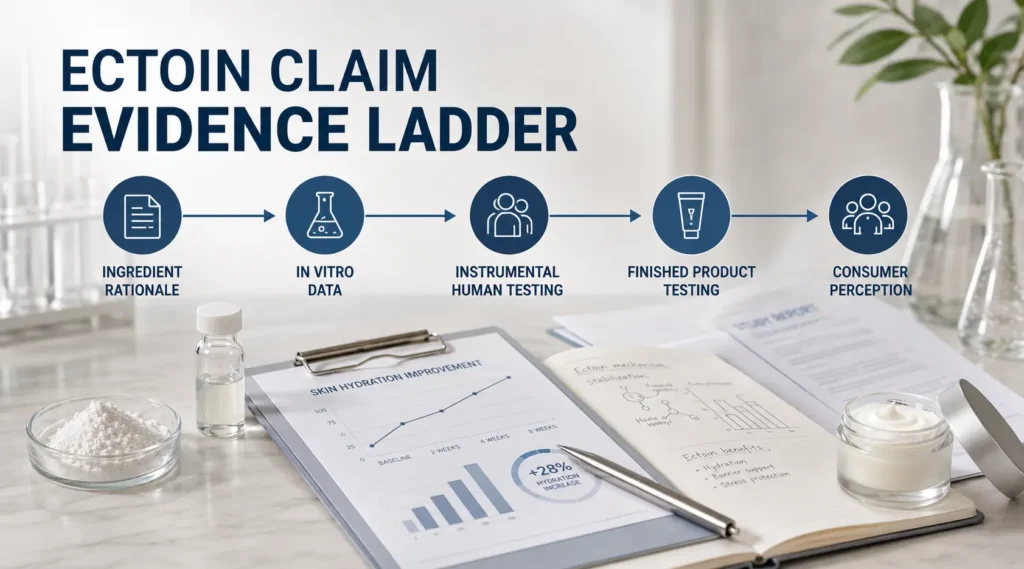
Not all evidence answers the same question.
| Evidence level | What it can support | Main limitation |
|---|---|---|
| Scientific rationale | Explains why Ectoin is worth evaluating | Does not prove a cosmetic result |
| In vitro, ex vivo, or laboratory model | Supports mechanisms and early claim directions | Is not equivalent to human use |
| Raw-material tolerability screening | Supports preliminary ingredient approval | Does not prove finished-formula tolerability |
| Instrumental human testing | Supports measured hydration, TEWL, elasticity, or redness endpoints | Applies to the tested formula and conditions |
| Finished-product testing | Provides the strongest support for a brand’s specific claim | Must match the marketed formula and target population |
| Consumer perception | Supports statements such as “skin feels moisturized” | Does not replace instrumental evidence |
A Claim-Validation Checklist for Product Developers
Before translating Ectoin benefits into marketing copy, ask:
| Question | Why it matters |
|---|---|
| Was the raw ingredient or finished product tested? | Determines how directly the result applies |
| What Ectoin concentration was used? | Prevents one result from being applied to every use level |
| What formula type was tested? | A serum, cream, sunscreen, and rinse-off product behave differently |
| Was there a vehicle or untreated control? | Helps separate the Ectoin contribution from the base formula |
| What endpoint was measured? | Hydration, TEWL, comfort, redness, and antioxidant activity are different claims |
| How long was the test? | Immediate and long-term claims require different evidence |
| Were the subjects healthy or condition-specific? | Determines relevance to a general cosmetic population |
| Was Ectoin tested alone or in a combination? | Prevents assigning a combination result to one ingredient |
| Does the target market require more substantiation? | Claim rules differ between markets |
What Ectoin Benefits Should Not Be Overstated?
Ectoin should not be presented as:
- a UV filter;
- a replacement for SPF or UVA testing;
- a preservative;
- a complete barrier-lipid system;
- automatic proof that a formula is hypoallergenic;
- a treatment for eczema, rosacea, dermatitis, or another disease;
- a guaranteed direct antioxidant in every test system;
- proof that every finished product reduces TEWL;
- evidence for one universal effective percentage;
- proof of synergy with every paired ingredient.
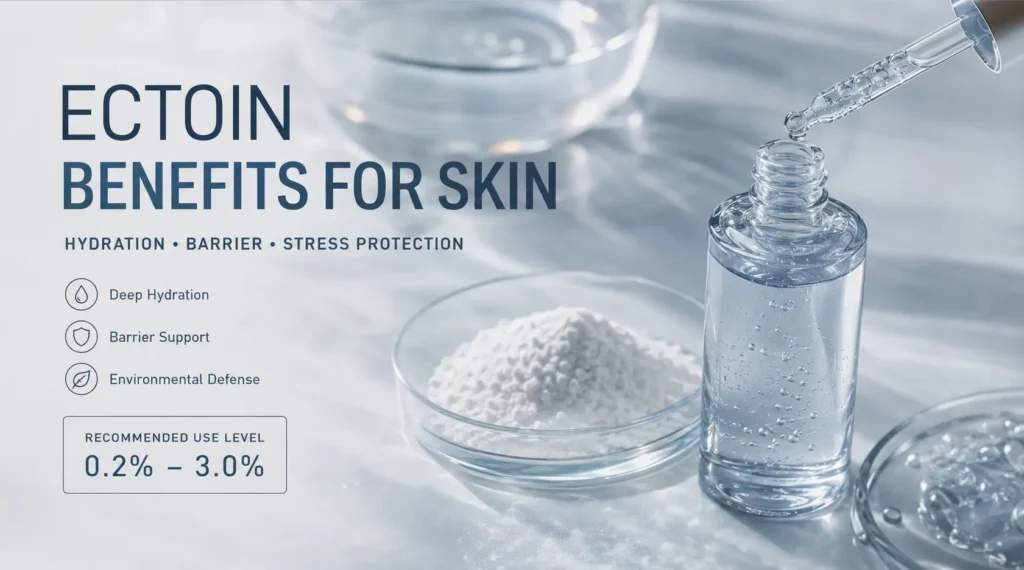
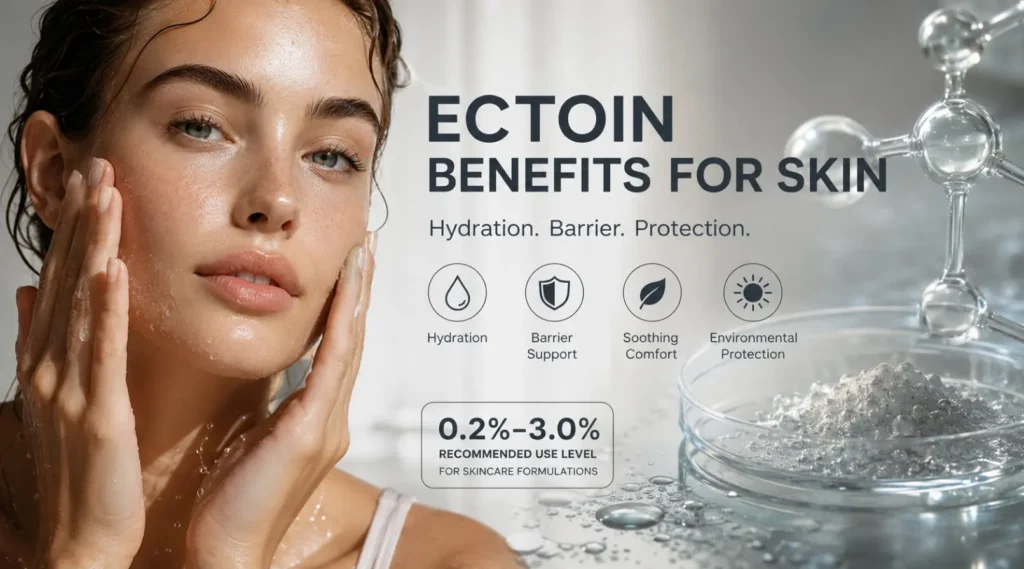
For the Ectoin grade supplied by Noyain, the current supplier guidance recommends evaluating 0.2%–3.0%. This is a formulation starting range, not a universal efficacy threshold. The final use level should reflect the product format, target claim, evidence package, stability results, cost target, and finished-product validation.
Frequently Asked Questions
What does Ectoin do for skin?
Ectoin is mainly evaluated for hydration, barrier-focused skincare, skin comfort, and environmental-stress positioning. The finished-product benefit depends on its concentration, the complete formulation, supporting ingredients, and the validation method.
Is Ectoin good for dry skin?
Ectoin can form part of a moisturizing system for dry or dehydrated skin. It does not replace the humectants, emollients, occlusives, or barrier lipids needed for a complete formula.
Does Ectoin repair the skin barrier?
Published studies support moisture- and barrier-related product development, but “repairs the skin barrier” is a stronger finished-product claim. Hydration, moisture-retention, or barrier-focused wording is more defensible unless the marketed formula has relevant finished-product evidence.
Is Ectoin suitable for sensitive skin?
Ectoin can be evaluated for sensitive-skin formulations, and supplier patch data can support preliminary raw-material review. Final suitability depends on the complete formulation and appropriate tolerability and safety testing.
Is Ectoin a humectant?
Ectoin is associated with hydration and water organization, but describing it only as a conventional humectant is incomplete. It is a compatible solute with a different molecular role from polymeric humectants such as hyaluronic acid.
Is Ectoin an antioxidant?
Ectoin has been studied in oxidative- and environmental-stress models, but it should not automatically be described as a conventional direct antioxidant. The correct claim depends on whether direct radical scavenging, cellular protection, or another endpoint was measured.
Can Ectoin be used in sunscreen?
Ectoin can be included as a supporting skincare active in sunscreen. It is not a UV filter and cannot independently provide SPF or UVA protection.
What percentage of Ectoin is used in skincare?
The supplier guidance for the Noyain grade recommends evaluating 0.2%–3.0%. The final percentage should be selected according to the product format, claim direction, compatibility, stability, evidence, and cost.
Can Ectoin be combined with hyaluronic acid, ceramides, or panthenol?
Potentially, yes. These ingredients can have complementary roles, but compatibility and performance must be confirmed in the complete formulation. Do not claim synergy unless a relevant study supports that conclusion.
Turning Ectoin Benefits into a Supportable Product Story
Ectoin can contribute to hydration, barrier-focused skincare, sensitive-skin comfort, and environmental-stress concepts. Its commercial value does not come from attaching every possible benefit to one ingredient.
A stronger product-development process is to:
- define the benefit the product actually needs;
- identify evidence that supports that benefit;
- select a suitable Ectoin grade and evaluation range;
- confirm compatibility in the intended formulation;
- validate the finished product with a test that matches the claim.
The strongest Ectoin product story is not the one with the longest claim list. It is the one in which Ectoin has a clear role, the evidence matches the wording, and the finished formula has been appropriately evaluated.
Noyain supplies Ectoin for international B2B cosmetic projects. Buyers can review the Ectoin product information or contact Noyain to discuss available technical data, declarations, samples, packaging, MOQ, lead time, and current commercial conditions.
References
- Heinrich U, Garbe B, Tronnier H. In vivo assessment of Ectoin: a randomized, vehicle-controlled clinical trial. Skin Pharmacology and Physiology. 2007.
- Bow JR, Sonoki Y, Uchiyama M, Dauskardt RH. Ectoine disperses keratin and alters hydration kinetics in stratum corneum. Biochemistry and Biophysics Reports. 2021.
- Buenger J, Driller H. Ectoin: an effective natural substance to prevent UVA-induced premature photoaging. Skin Pharmacology and Physiology. 2004.
- Fontbonne A, et al. Positive and ecobiological contribution in skin photoprotection of Ectoin and mannitol combined in vivo with UV filters. Journal of Cosmetic Dermatology. 2024.
- Lu B, et al. Anti-inflammatory and antioxidant effects on skin based on supramolecular hyaluronic acid–Ectoin. Journal of Materials Chemistry B. 2024.
- Wang Y, et al. The Reduction of Skin Photodamage by the Ectoine–Thermus thermophilus Cofermentation Products. Journal of Cosmetic Dermatology. 2025.
- Ferreira P, et al. Ectoine as a multifunctional molecule: biotechnological production and pharmaceutical applications. Drug Delivery and Translational Research. 2026.
- Commission Regulation (EU) No 655/2013: Common criteria for the justification of claims used in relation to cosmetic products.
- US Food and Drug Administration: Cosmetics Labeling Claims.