Ectoin is increasingly used in serums, moisturizers, sensitive-skin products, sunscreens, and other skincare formulas. However, seeing Ectoin on an ingredient list does not immediately explain what it is, why a product developer might select it, or what a buyer should verify before approving the raw material.
This guide introduces Ectoin from a cosmetic ingredient and product-development perspective. It focuses on ingredient identity, production, common project roles, and sourcing evaluation. Detailed skin benefits, mechanisms, formulation methods, recommended use levels, and ingredient comparisons are intentionally reserved for separate guides.
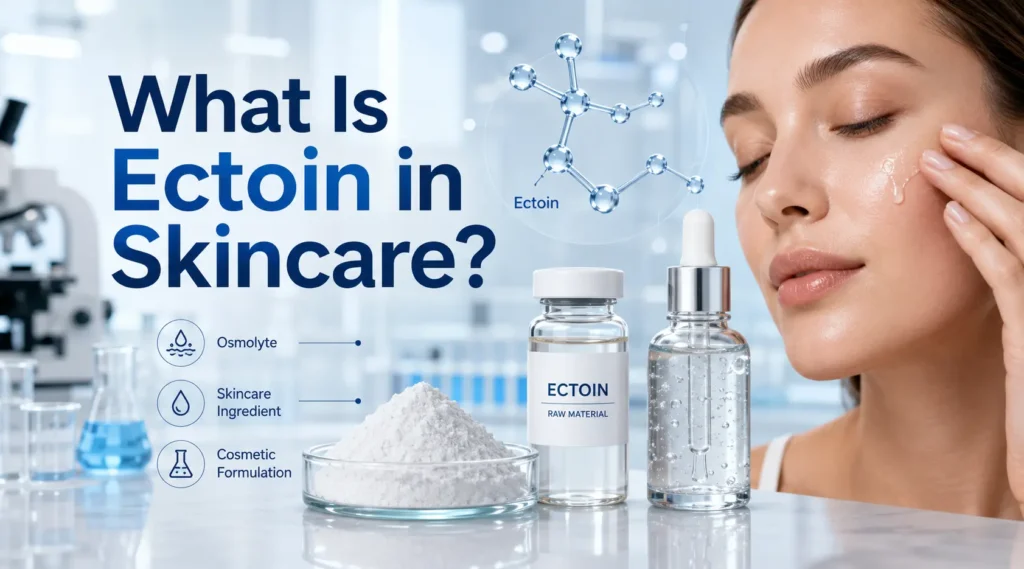
Quick answer: Ectoin is a small, water-soluble organic molecule known as a compatible solute or osmolyte. In skincare, it is used as a cosmetic active in projects positioned around hydration, skin-barrier support, sensitive-skin comfort, and environmental stress. Its INCI name is Ectoin, and its CAS number is 96702-03-3.
What Is Ectoin?
Ectoin is a naturally occurring molecule produced by certain microorganisms that live under demanding environmental conditions, including high salinity, dryness, and temperature stress.
These microorganisms accumulate small organic compounds known as compatible solutes. Compatible solutes help them maintain water balance and protect normal cellular functions without significantly interfering with essential biochemical processes.
Ectoin is frequently described as an extremolyte. This term refers to compatible solutes associated with microorganisms adapted to extreme environments. It describes the molecule’s biological background; it is not a separate INCI category or a finished-product efficacy claim.
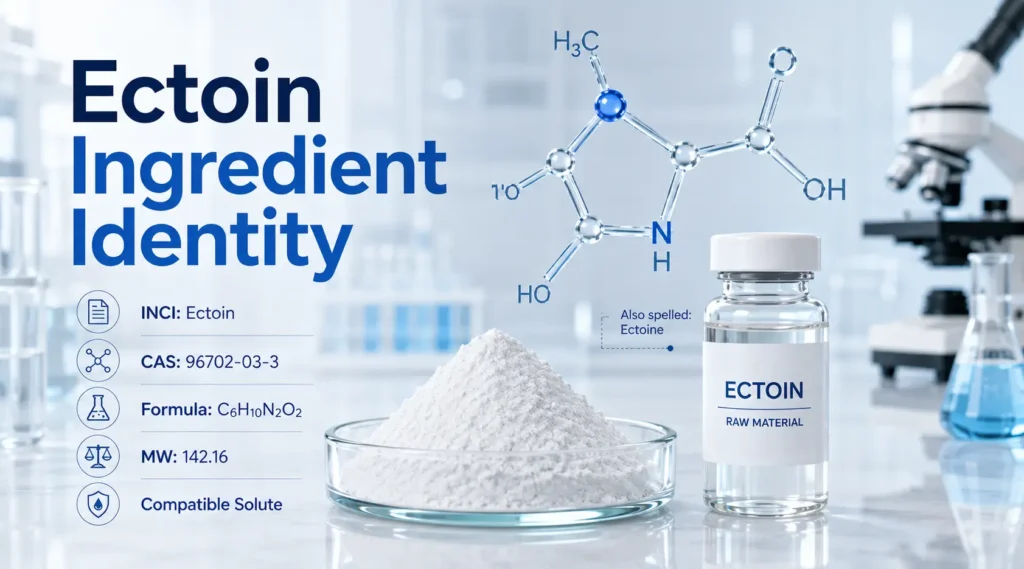
| Identity item | Ectoin information |
|---|---|
| INCI name | Ectoin |
| Common spelling variant | Ectoine |
| CAS number | 96702-03-3 |
| Molecular formula | C6H10N2O2 |
| Molecular weight | 142.16 g/mol |
| Molecule type | Cyclic amino-acid derivative and compatible solute |
The chemical name and the INCI name should not be treated as interchangeable fields. For cosmetic labelling and supplier documentation, the relevant ingredient name is Ectoin.
How Is Cosmetic-Grade Ectoin Produced?
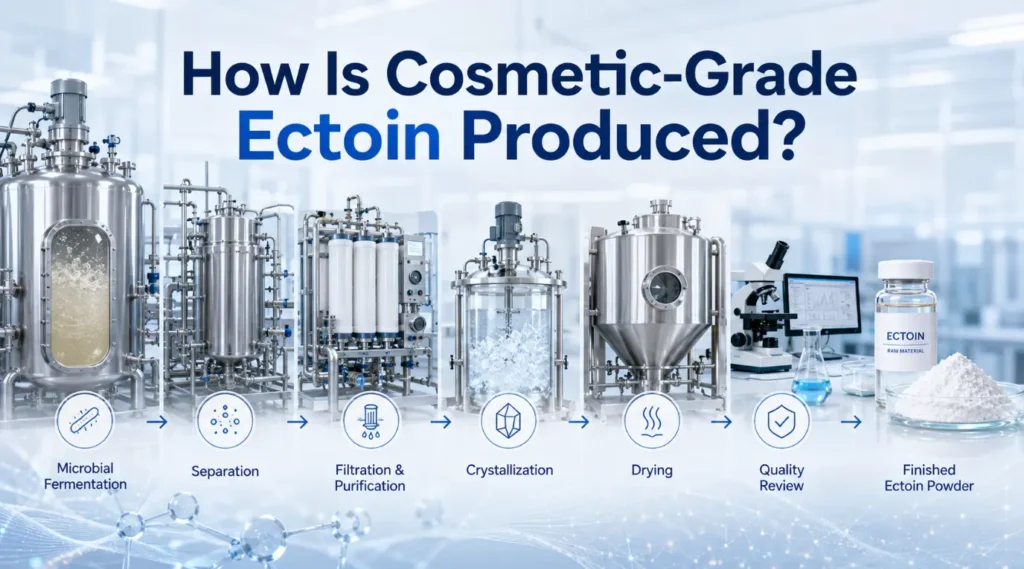
Ectoin occurs naturally in microorganisms, but commercial cosmetic-grade material is generally obtained through controlled biotechnological production rather than by directly harvesting microorganisms from natural salt lakes.
According to the production information available for the Ectoin grade supplied by Noyan, the material is produced through microbial fermentation using non-animal-origin fermentation materials. Downstream processing includes separation and purification steps followed by crystallization and drying to obtain the finished powder.
This distinction matters for buyers. The fact that Ectoin occurs naturally does not automatically mean that every commercial Ectoin grade meets a particular natural-cosmetics standard. Brands requiring COSMOS, ISO 16128, vegan, GMO, or other declarations should request the relevant documents for the specific grade.
A Halal declaration is available for the supplied grade. It should be described as a supplier declaration unless a current third-party Halal certificate is separately provided.
What Role Does Ectoin Play in Skincare?
Ectoin is normally selected as part of a broader formulation system rather than as a complete skincare solution by itself. Product developers commonly evaluate it for four general directions:
- Hydration-focused formulas: Ectoin provides a differentiated osmolyte-based ingredient story alongside conventional humectants.
- Skin-barrier projects: It may complement humectants, emollients, and barrier lipids in products positioned around barrier support.
- Sensitive-skin concepts: It can be considered in formulas designed around comfort, hydration, and simplified ingredient positioning.
- Environmental-stress concepts: Its biological origin provides a relevant story for urban skincare, sun-care support, and climate-stress positioning.
These are product-development directions, not automatic finished-product claims. The final claim depends on the use level, complete formulation, supporting evidence, target market, and finished-product testing.
This article does not expand the benefit evidence or mechanism because those topics should be covered independently in:
- Ectoin Benefits for Skin
- How Does Ectoin Work?
What Ectoin Does Not Replace
A clear ingredient brief should also define what Ectoin is not.
Ectoin is not a UV filter
Ectoin may be included as a supporting skincare active in sunscreen and after-sun formulas, but it does not replace authorised organic or inorganic UV filters. It cannot independently establish SPF or UVA protection.
Ectoin is not a preservative
Ectoin should not be expected to control microbial contamination. The finished product still requires an appropriate preservation strategy, manufacturing controls, and preservative efficacy testing.
Ectoin is not a complete barrier system
A barrier-focused formula may also require humectants, emollients, occlusive materials, ceramides, or other lipids. Ectoin can complement these components but does not replace their structural or sensory functions.
Ectoin is not automatic proof of a finished-product claim
Raw-material studies help explain why Ectoin is selected. They do not prove that every serum, cream, or sunscreen containing Ectoin will deliver the same result.
Where Can Product Developers Consider Ectoin?
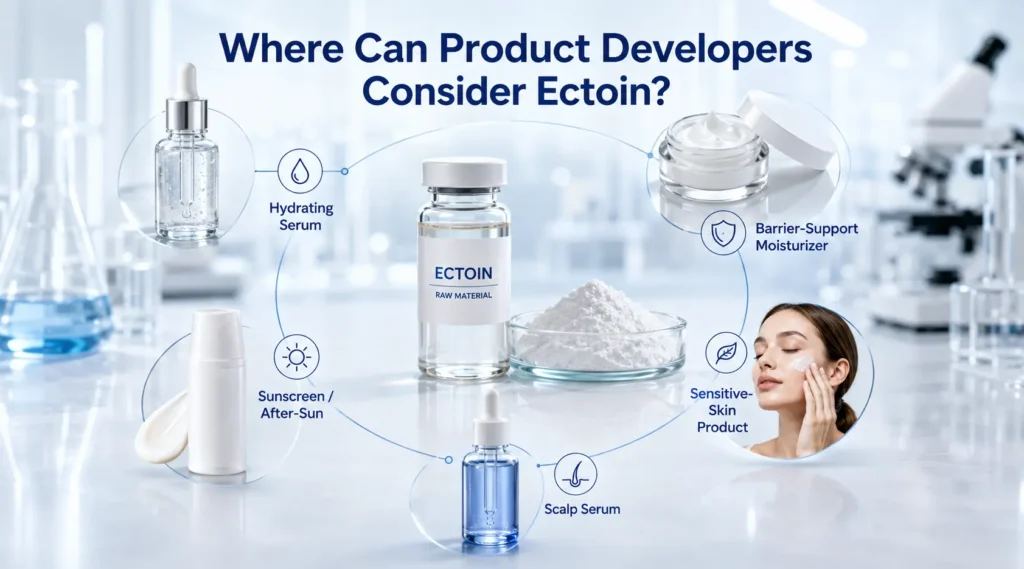
Ectoin can be evaluated in several cosmetic formats. The following table is an initial project-screening overview rather than a formulation recommendation.
| Product format | Why Ectoin may be considered | What still requires validation |
|---|---|---|
| Hydrating serum | Osmolyte-based hydration and premium active positioning | Use level, clarity, viscosity, and active compatibility |
| Barrier-support moisturizer | Complements humectants, emollients, and barrier lipids | Emulsion stability, moisturization, and finished-product claims |
| Sensitive-skin product | Supports a comfort- and barrier-oriented ingredient strategy | Complete formula tolerability and preservative system |
| Sunscreen or after-sun product | Adds supporting skincare and environmental-stress positioning | UV-filter compatibility, SPF testing, and compliant claim wording |
| Scalp serum | Provides a possible hydration and scalp-comfort direction | Project-specific evidence, compatibility, and finished-formula testing |
Noyan Ectoin Grade at a Glance
The following information is based on the product specification, safety information, and application guidance currently available for the Ectoin grade supplied by Noyan.
| Item | Current product information |
|---|---|
| INCI | Ectoin |
| CAS | 96702-03-3 |
| Physical form | White to off-white crystals or crystalline powder |
| Assay | ≥98.0% by HPLC |
| Solubility | Water-soluble; supplier information also indicates solubility in polyols such as glycerin and butylene glycol |
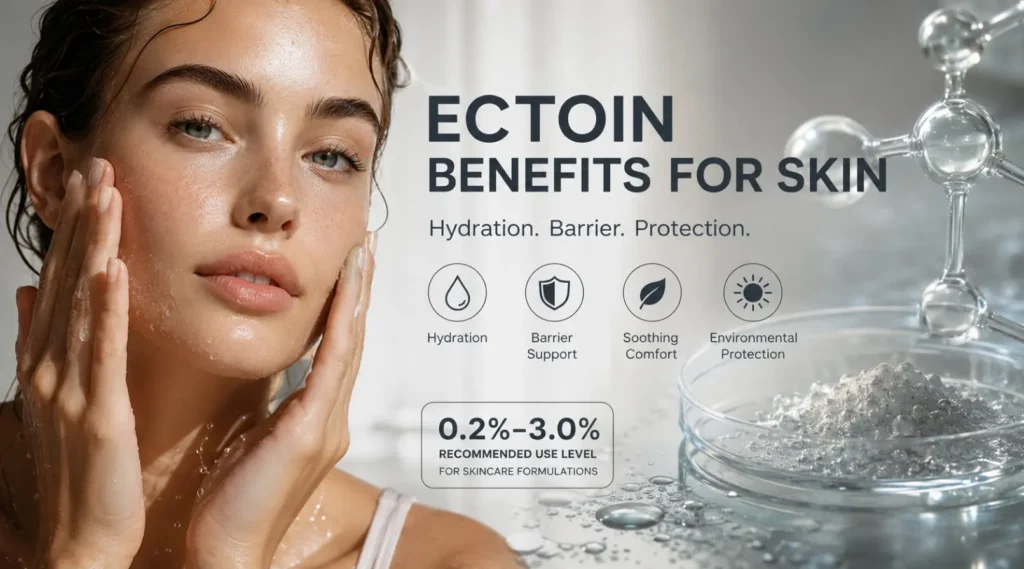
| Supplier-recommended evaluation range | 0.2%–3.0% |
| Formulation preview | Add to the water phase and mix until dissolved; supplier information indicates compatibility with normal hot-process creams |
| Formulation pH guidance | Supplier product information indicates tolerance across pH 1–9; final-formula compatibility must be confirmed |
| Thickening consideration | Ectoin has a slight ionic character, so ion-sensitive thickening systems should be screened |
| Storage | Keep the container sealed and store under cool, dry, and well-ventilated conditions away from heat and humidity; follow the current SDS |
| Available documents | Product information, specification, latest available batch COA, SDS, and available declarations on request |
| Halal information | Halal declaration available on request |
| Packaging, MOQ, and lead time | Confirmed according to the current quotation, stock position, and supply plan |
Product-specific note: The 0.2%–3.0% range is supplier guidance for formulation evaluation, not a universal effective percentage. The final use level should be selected according to the product format, claim direction, formula compatibility, cost target, and validation plan.
For current specifications, sample availability, and procurement information, visit the Noyan Ectoin product page.
What Should Buyers Check Before Sourcing Ectoin?
For a cosmetic buyer, identifying the ingredient as Ectoin is only the beginning. A commercially useful evaluation should determine whether the offered grade is suitable for the intended project and whether the supplier can support technical approval and repeat purchasing.
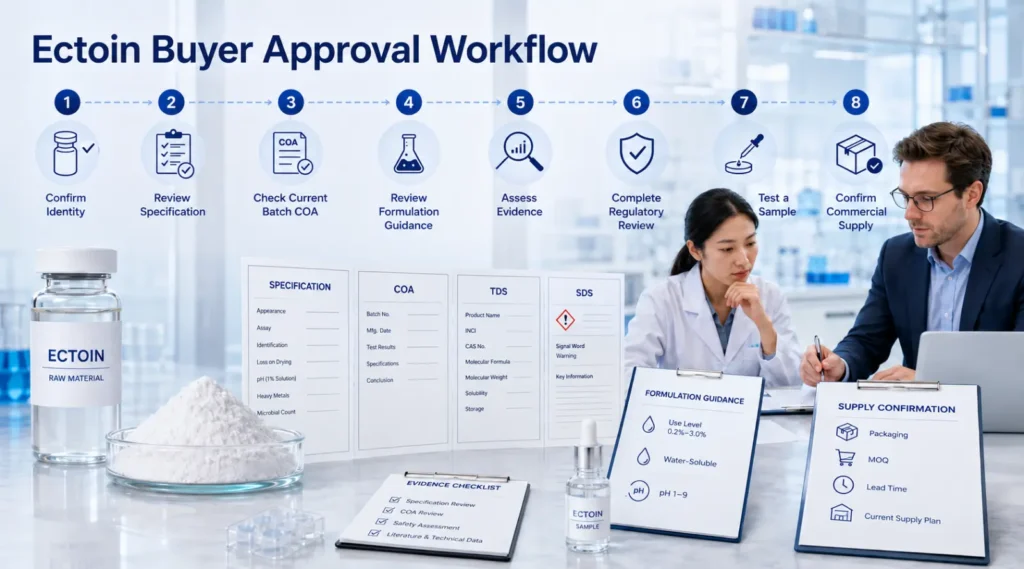
1. Confirm the identity and composition
Check the INCI name, CAS number, physical form, and composition. Confirm whether the offered material is pure Ectoin powder or an Ectoin-containing solution or blend.
2. Review a current batch COA
A product specification defines the acceptable limits. A batch COA should show the actual results for the batch offered for sampling or commercial supply.
Do not treat an undated specification table, an expired COA, or a generic product brochure as a substitute for current batch data.
3. Separate purity from overall quality
Assay is important, but it is not the only purchasing criterion. Depending on the specification, buyers may also need to review appearance, identification, moisture, residue on ignition, chloride, heavy metals, and microbiological limits.
4. Confirm the formulation guidance for the offered grade
Request information covering solubility, suggested use range, addition phase, pH guidance, temperature considerations, and known compatibility issues.
These parameters should come from the specific grade being purchased. Technical guidance from another Ectoin brand should not automatically be applied to a different source.
5. Check what the evidence actually demonstrates
Ask whether the evidence package contains in vitro data, instrumental testing, human patch testing, finished-formula studies, or published literature. Review the tested concentration, sample type, control group, and test conditions before using the data to support marketing claims.
6. Review regulatory and declaration documents
Document requirements vary by customer and market. A typical preliminary review may include:
- Current batch COA
- Product specification or TDS
- SDS
- INCI and composition statement
- Country-of-origin information
- Production-process information
- Animal-origin, vegan, or Halal declarations where relevant
- GMO information where required
- Regional inventory or regulatory information
- Available quality-system certificates
7. Confirm the commercial supply conditions
Technical suitability does not guarantee commercial suitability. Before approval, confirm the sample size, MOQ, packaging, price basis, lead time, current batch availability, and repeat-supply plan.
How Should Buyers Interpret Ectoin Evidence?
The supplier information available for this grade includes formulation guidance, laboratory-model data, and safety-related screening information. These materials can support preliminary raw-material evaluation, but they should not be converted directly into unrestricted finished-product claims.
Published literature also includes studies of Ectoin-containing topical products. However, these studies may use different Ectoin grades, concentrations, formulations, and target populations. Evidence for a particular finished cream cannot automatically prove that a different serum or sunscreen will produce the same result.
A practical evidence review should ask:
- Was the tested material the raw ingredient or a finished formulation?
- What concentration was tested?
- Was the study conducted in vitro, ex vivo, or on human subjects?
- What was the control?
- Was the result statistically significant?
- Does the proposed marketing claim match the endpoint that was tested?
- Is additional finished-product testing required in the target market?
This article does not reproduce the full efficacy data because Ectoin benefits and mechanisms require separate evidence-based reviews.
Is Ectoin the Same as Hyaluronic Acid, Ceramides, or Panthenol?
No. Ectoin is frequently compared with other hydration and barrier-related ingredients, but they do not perform identical formulation roles.
- Hyaluronic acid is a polymeric humectant commonly used for hydration and film-forming positioning.
- Ceramides are lipids used as components of barrier-lipid systems.
- Panthenol is widely used in moisturizing and comfort-focused formulas.
- Niacinamide is a multifunctional active used across several skin-appearance and barrier-related projects.
- Ectoin is a small compatible solute selected for osmolyte-based hydration, barrier-support, and environmental-stress positioning.
In many projects, the decision is not whether Ectoin should replace these ingredients. The more useful question is whether each ingredient has a distinct and supportable role in the complete formula.
The detailed differences should be covered in separate comparison articles rather than expanded here.
Frequently Asked Questions
What is Ectoin used for in skincare?
Ectoin is commonly evaluated for skincare products positioned around hydration, skin-barrier support, sensitive-skin comfort, and environmental stress. The final claim depends on the complete formulation and supporting evidence.
What is the INCI name of Ectoin?
The INCI name is Ectoin. “Ectoine” is a common spelling variant found in scientific and commercial documents, but cosmetic documentation should use the confirmed INCI name consistently.
Is Ectoin a natural ingredient?
Ectoin occurs naturally in certain microorganisms. The grade supplied by Noyan is biotechnology-derived through microbial fermentation. Whether it qualifies under a particular natural-cosmetics standard must be verified against the relevant standard and product documentation.
Is Ectoin a humectant?
Ectoin is associated with hydration and water balance, but describing it only as a conventional humectant oversimplifies its role as a compatible solute. Its hydration mechanism should be addressed in a dedicated technical article.
What percentage of Ectoin should formulators use?
The supplier guidance for the grade supplied by Noyan recommends evaluating 0.2%–3.0%. This is not a universal effective percentage. The final level depends on the formula, product positioning, evidence, stability, and cost target.
Can Ectoin be used in sunscreen?
Ectoin can be considered as a supporting skincare active in sunscreen formulations, but it is not a UV filter and cannot independently provide SPF or UVA protection.
Can Ectoin be combined with hyaluronic acid or niacinamide?
Potentially, yes. The ingredients may have complementary roles, but compatibility and stability must be confirmed in the complete formula.
How should buyers choose an Ectoin supplier?
Compare ingredient identity, current batch quality, formulation guidance, evidence, regulatory documents, sample availability, packaging, MOQ, lead time, and repeat-supply capability rather than comparing price or headline purity alone.
Evaluating Ectoin for a Cosmetic Project
Ectoin has a distinctive biological background and can support several relevant skincare directions. Its commercial value, however, does not come simply from adding a trending INCI name to a formula.
A sound evaluation should begin by defining the product objective, reviewing the current raw-material documents, and testing a representative sample in the intended formulation.
Noyan supplies Ectoin for international B2B cosmetic projects. We can provide available supplier technical information, coordinate requests for the latest available batch documents, and arrange samples for qualified formulation evaluation. Commercial packaging, MOQ, lead time, and pricing are confirmed according to the current supply plan.
References
- PubChem: Ectoine compound and chemical identity
- European Commission: CosIng cosmetic ingredient database
- Advances in the microbial production of the compatible solute ectoine: a review
- Topical Ectoine Application in Children and Adults: A Systematic Review
Scientific references provide general background on Ectoin. Product specifications, formulation guidance, regulatory status, and commercial claims must be reviewed against the current documentation for the specific grade and the intended finished product.