A skincare brand asks whether formula uses low-molecular-weight PDRN.One supplier reports less than 1,000 kDa. Another claims 50–300 kDa. A third promotes “nano PDRN” without explaining whether the number refers to DNA molecular weight, base-pair length, hydrodynamic size or a delivery particle.
Which material is actually more suitable for a serum, mask, cream or hydrogel?The answer cannot be determined from one marketing number.
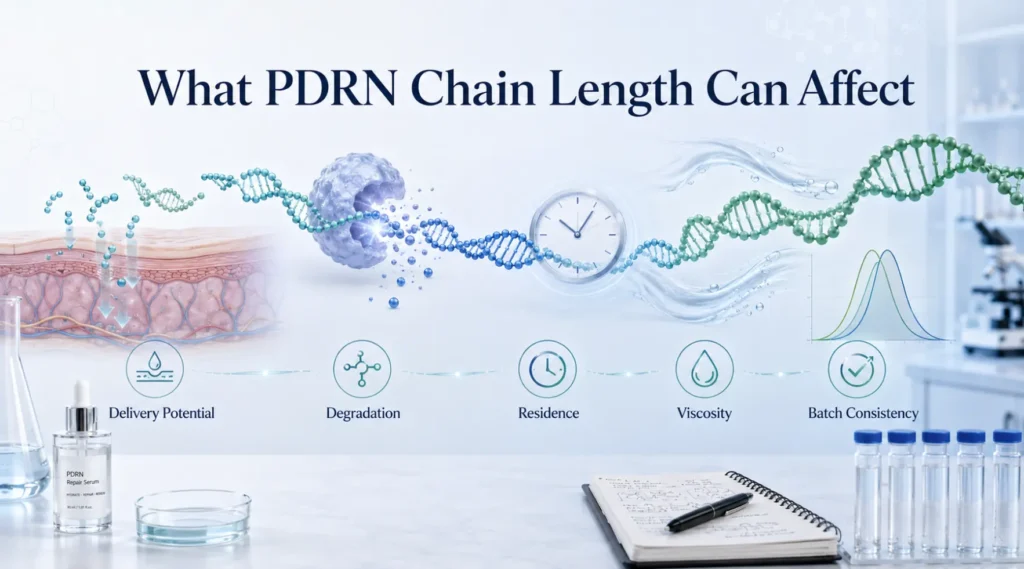
PDRN is not one uniform molecule. It is a mixture of DNA fragments with different chain lengths. Chain length may influence topical delivery potential, enzymatic degradation, local residence, viscosity, hydrogel behavior and batch consistency. However, shorter does not automatically mean better, and current evidence does not establish one fixed molecular-weight range as universally optimal for every application.
For cosmetic brands, OEM/ODM manufacturers and ingredient buyers, the practical question is:
Does the documented PDRN molecular-weight profile match the intended product format, formulation system, claim direction and quality requirements?
This guide explains how to answer that question and what to request before choosing a PDRN raw-material supplier.
Cosmetic evidence note: PDRN research includes pharmaceutical preparations, injections, wound models, cell studies, patents and emerging topical formulas. Evidence from an injected or medical product should not be transferred directly to an ordinary cosmetic serum, cream or mask.

Quick Answer: Why Does PDRN Chain Length Matter?
PDRN chain length can influence five practical areas:
- Topical delivery potential — shorter fragments may have greater mobility, but molecular weight alone does not prove penetration through intact skin.
- Enzymatic degradation — shorter fragments may be broken down and dispersed more quickly, while longer chains may require more time for complete degradation.
- Local residence and duration — longer chains or structured hydrogel systems may remain locally for longer, although formulation architecture is often as important as chain length.
- Formulation properties — chain length can affect dissolution, viscosity, polymer entanglement, clarity, filtration and hydrogel behavior.
- Material classification and batch consistency — molecular-weight distribution helps distinguish PDRN from longer-chain PN and helps identify process or batch variation.
The main limitation is equally important:
No single PDRN chain length has been proven best for every serum, cream, mask, ampoule, hydrogel or other application.
The correct choice depends on the finished product—not on the lowest or highest number in a supplier presentation.
Why Brands and OEM/ODM Manufacturers Ask About PDRN Molecular Weight
Brands rarely request chain-length data for academic interest. They usually need the information to make a product or sourcing decision.
A brand wants a defensible “small-molecule PDRN” story
Marketing teams may ask:
- Is this low-molecular-weight PDRN?
- Is it easier to absorb than conventional PDRN?
- Can we claim “small molecule,” “nano PDRN” or “deep delivery”?
- How is it different from the PDRN used by another brand?
- What evidence supports the molecular-weight claim?
An OEM/ODM manufacturer needs to know whether the supplier has provided a measured range, an average, a main peak or only a marketing description.
The formulator needs to match the ingredient to the product format
A clear serum, sheet-mask essence and polymer-rich hydrogel do not have the same technical requirements.
The formulator may need to evaluate:
- Dissolution speed
- Solution clarity
- Viscosity
- Compatibility with sodium hyaluronate
- Sensitivity to heat and shear
- Precipitation risk
- Storage stability
- Delivery-system requirements
- Claim substantiation
Procurement needs to compare suppliers on the same basis
PDRN suppliers may report:
- Base pairs
- kDa
- An upper limit
- An average value
- A range
- A peak
- Particle size in nanometres
- “Low MW” without a number
These values cannot be compared until the buyer confirms what was measured and how.
Quality teams need to control batch variation
A stable average molecular weight does not guarantee a stable distribution. One batch may contain a narrow central population, while another may contain a mixture of very short and very long fragments that produces the same average.
For B2B approval, the data must help answer:
Will this material behave consistently in our formula and remain consistent from sample approval to commercial production?
PDRN Is a Fragment Mixture, Not One Fixed Molecule
PDRN stands for polydeoxyribonucleotide. It consists of DNA-derived polymer fragments rather than one molecule with one fixed molecular weight.
Each DNA fragment may contain a different number of base pairs. A PDRN batch therefore represents a population of molecules rather than a single molecular species.
A 1996 analytical study characterized a specific placenta-derived PDRN preparation as a mixture of DNA fragments and reported an approximate 50–2,000 bp range by gel electrophoresis. That finding is useful historical evidence for the fragment-mixture concept, but it should not be copied as a universal specification for every modern PDRN raw material.
Different materials may have different profiles because of:
- Biological source
- Initial DNA quality
- Extraction conditions
- Enzymatic or mechanical fragmentation
- Purification and ultrafiltration
- Molecular-weight fractionation
- Drying
- Storage
- Heat exposure
- High shear
- Repeated freeze–thaw cycles
For source-related differences, see Different Sources of PDRN: Salmon, Vegan, Fermentation and Synthetic Routes.
Chain Length, Base Pairs, Molecular Weight and Particle Size Are Not the Same
| Term | Common unit | What it describes | What it does not prove |
|---|---|---|---|
| Chain length | bp or nt | Length of the DNA chain | The proportion of that chain length in the batch |
| Molecular weight | Da or kDa | Approximate mass of a DNA fragment | Skin penetration or biological performance |
| Molecular-weight distribution | kDa range or curve | How different molecular weights are distributed | Finished-formula efficacy |
| Hydrodynamic size | nm | Apparent molecular size in solution | Exact base-pair length |
| Particle size | nm or μm | Size of a liposome, microsphere or assembled particle | Molecular weight of each DNA chain |
Base pairs describe DNA length
A base pair, abbreviated bp, is a length unit for double-stranded DNA.
A 100 bp fragment contains approximately 100 paired nucleotide positions. A 1,000 bp fragment is substantially longer and heavier.
However, reporting one fragment at 1,000 bp does not reveal whether most of the raw material is near that length.
kDa describes molecular weight
A dalton is a molecular-mass unit. One kilodalton equals 1,000 daltons.
A reported kDa value may be:
- A specification ceiling
- A minimum-to-maximum range
- A main peak
- A number-average molecular weight
- A weight-average molecular weight
- A calculated estimate
A buyer should not assume these values are interchangeable.
Particle size describes a delivery structure
A PDRN-loaded liposome or microsphere may contain many DNA chains. Its particle size does not describe the chain length of each PDRN molecule.
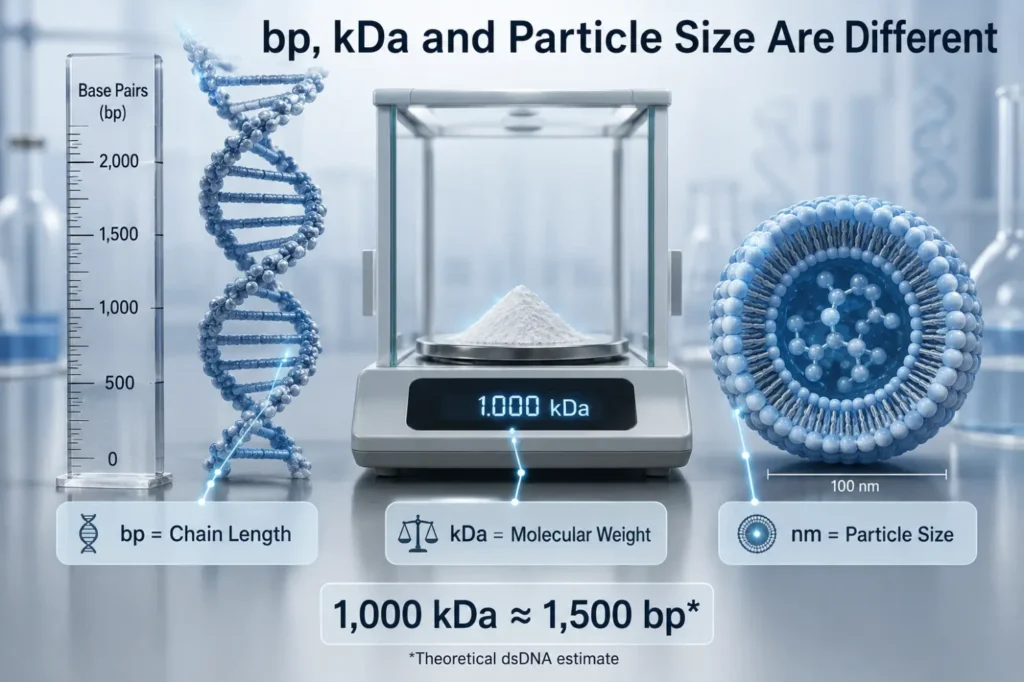
The Chinese group standard T/SHRH 077—2025 separately describes cosmetic PDRN as a DNA-fragment mixture not exceeding 1,500 kDa and sets a particle-size requirement for certain non-covalently modified PDRN systems. The molecular-weight limit and particle-size limit refer to different properties.
How to Convert Base Pairs to kDa
For double-stranded DNA, molecular weight can be estimated from the number of base pairs.
New England Biolabs provides the following practical approximation:
Approximate dsDNA molecular weight = number of base pairs × 650 DaSource: NEB Nucleic Acid Data
Other references commonly use approximately 660 Da per base pair. Either value is an estimate rather than a PDRN test result.
| DNA chain length | Approximate molecular weight |
|---|---|
| 50 bp | 33 kDa |
| 100 bp | 66 kDa |
| 200 bp | 132 kDa |
| 500 bp | 330 kDa |
| 1,000 bp | 660 kDa |
| 1,500 bp | 990 kDa |
| 2,000 bp | 1,320 kDa |
Using the 660 Da approximation:
1,000 kDa ÷ 0.66 kDa per bp ≈ 1,515 bpThis means a single double-stranded DNA fragment with a molecular weight of approximately 1,000 kDa would correspond theoretically to about 1,500 bp.
It does not mean that a PDRN raw material with an average molecular weight below 1,000 kDa contains only fragments below 1,500 bp.
A bp-to-kDa conversion is a theoretical estimate, not a measured fragment-size distribution.
What Does PDRN Chain Length Affect?
1. Topical Delivery Potential
Longer DNA chains generally have higher molecular weights. Large polymers face a greater barrier to passive movement through intact stratum corneum than conventional small molecules.
This creates a reasonable formulation hypothesis:
Lower molecular weight may improve formulation mobility and topical permeation potential.
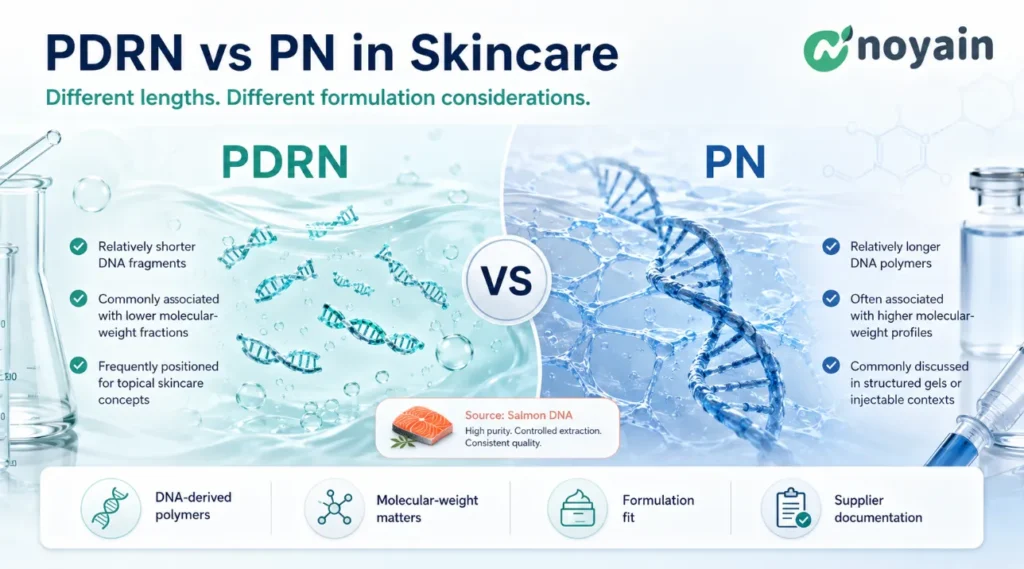
A 2025 review of PDRN and PN molecular-weight terminology associates low-molecular-weight PDRN with topical creams and gels, while medium-weight PDRN and longer-chain PN are more often discussed in relation to hydrogels and dermbooster-type systems.
The review also cites patents involving:
- PDRN below 50 kDa for skin or tissue permeation
- DNA fragments around 1 kDa or less for improved topical permeation
- Particle-condensation strategies intended to deliver longer DNA chains
These examples are useful for formulation research, but they do not establish that every low-molecular-weight PDRN powder will penetrate intact skin.
The actual result also depends on:
- Finished-formula vehicle
- DNA concentration
- Charge and ionic environment
- Encapsulation or delivery technology
- Contact time
- Skin hydration
- Barrier condition
- Rinse-off or leave-on use
A claim such as:
“Smaller PDRN penetrates deeply into the dermis.”
requires direct evidence from the finished product, such as:
- Franz diffusion-cell testing
- Excised-skin permeation testing
- Tape stripping
- Confocal imaging
- Validated chemical or imaging analysis
- Appropriate human testing
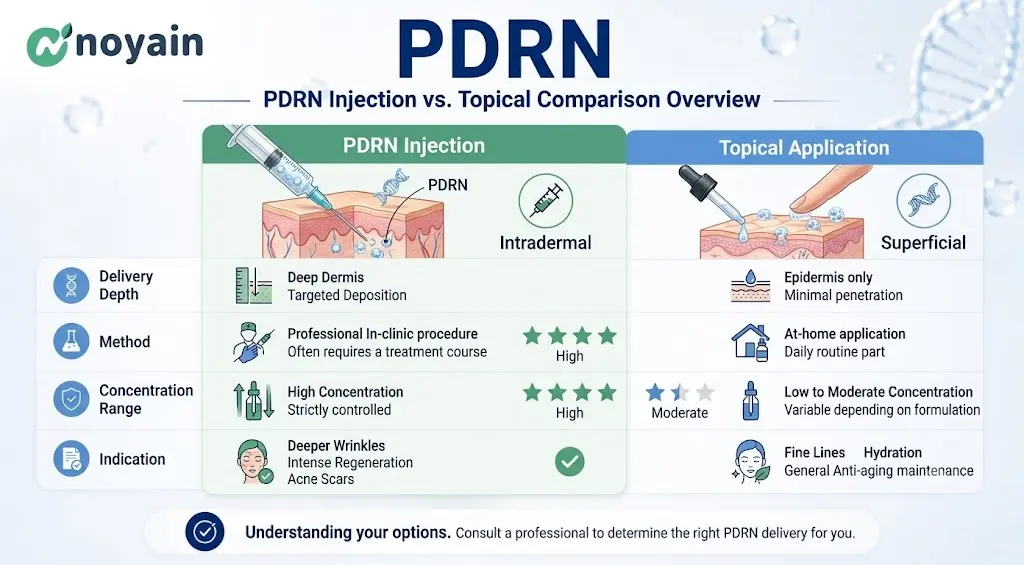
For a detailed route comparison, read PDRN Injection vs Topical PDRN.
Evidence boundary: Molecular weight may influence delivery potential, but it does not independently prove passage through intact skin or delivery into the dermis.
2. Enzymatic Degradation Rate
PDRN can be degraded by nucleases into smaller oligonucleotides, nucleotides and nucleosides.
A pharmacological review of PDRN discusses adenosine A2A receptor-related signaling and nucleotide salvage as major mechanisms associated with defined pharmaceutical PDRN preparations.
Chain length may affect how quickly a polymer is broken down, but the direction should be described as a general tendency rather than an absolute rule.
| Material characteristic | General tendency |
|---|---|
| Shorter PDRN fragments | May disperse and undergo further degradation more quickly |
| Longer DNA chains | Complete degradation may require more time |
| Concentrated polymer system | Diffusion and enzyme access may be slower |
| Structured hydrogel | Release and degradation may be further delayed |
Degradation also depends on:
- DNA conformation
- Double-stranded structure
- Concentration
- Surface area
- Enzyme environment
- Carrier system
- Route of use
- Interactions with other polymers
Faster degradation does not automatically mean stronger biological activity. It may mean faster release of smaller components, but overall performance still depends on the material, dose, formulation and test model.
3. Local Residence and Duration
Shorter and more fluid fragments may disperse more readily. Longer chains may diffuse more slowly and remain associated within a polymer-rich system for longer.
Longer-chain PN is frequently associated with hydrogel structures and higher viscoelasticity. A 2025 dermatology review comparing PN and PDRN describes PN as having relatively higher molecular weight, water content, viscoelasticity and hydrogel-forming behavior, while PDRN is described as more fluid.
However, chain length must not be confused with the behavior of the complete formulation.
A hydrogel may remain locally for longer because of:
- Polymer concentration
- Chain entanglement
- Crosslinking
- Swelling
- Network density
- Encapsulation
- Interaction with hyaluronic acid
- Route of administration
A defensible conclusion is:
Longer DNA chains and structured hydrogel systems may support slower degradation and longer local residence, but duration is determined by the complete formulation and route of use—not chain length alone.
4. Viscosity, Hydration and Hydrogel Behavior
Long polymer chains are more likely to overlap and become physically entangled when their concentration is sufficiently high.
This can contribute to:
- Higher solution viscosity
- Greater resistance to flow
- More apparent viscoelasticity
- Stronger water association
- Network formation
- Slower diffusion
- More structured hydrogel behavior
This does not support a simple rule that longer DNA always provides better hydration.
Final rheology and hydration depend on:
- Polymer concentration
- Salt concentration
- pH
- Solvent composition
- Temperature
- Chain conformation
- Other polymers
- Processing conditions
For clear serums and ampoules
Evaluate:
- Dissolution time
- Optical clarity
- Viscosity
- Filtration
- Precipitation
- Heat exposure
- Shear exposure
- Long-term stability
For creams and mask essences
Evaluate:
- Water-phase compatibility
- Emulsifier system
- Electrolyte level
- Preservative compatibility
- Polymer interactions
- Storage stability
- Claim substantiation in the finished product
For hydrogels and semi-finished systems
Evaluate molecular weight together with:
- PDRN or PN concentration
- Flow curve
- Apparent viscosity
- Storage modulus
- Loss modulus
- Swelling
- Network stability
- Degradation
- Release profile
For PDRN combined with sodium hyaluronate
A viscous finished product does not prove that the PDRN itself has a high molecular weight.
The formulator must separate:
- PDRN molecular weight
- Sodium hyaluronate molecular weight
- Concentration of each polymer
- Total polymer content
- Ionic interactions
- Rheology of the final system
For product-format guidance, see the PDRN Serum, Cream, Mask, Toner and Ampoule Formulation Guide.
5. Material Classification and Batch Consistency
Chain length influences how PDRN and PN are described
The 2025 PDRN/PN review proposes the following structure-based classification:
| Molecular-weight range | Proposed description |
|---|---|
| Below 50 kDa | Low-molecular-weight PDRN |
| 50–1,500 kDa | Medium-molecular-weight or “classic” PDRN |
| At or above 1,500 kDa | PN |
The proposed 1,500 kDa boundary is called the Marques Polynucleotide Cutoff.
It is useful as:
- A scientific terminology framework
- A supplier-comparison reference
- A way to discuss shorter and longer DNA polymers
It is not:
- A globally harmonized legal definition
- A universal efficacy threshold
- A topical-versus-injectable dividing line
- Proof that one material is superior
The Chinese group standard T/SHRH 077—2025 takes a similar approach by defining cosmetic PDRN raw material as a polydeoxyribonucleotide mixture not exceeding 1,500 kDa.
For the broader terminology issue, read PDRN vs PN: Molecular Weight and Skincare Differences.
Distribution matters for batch consistency
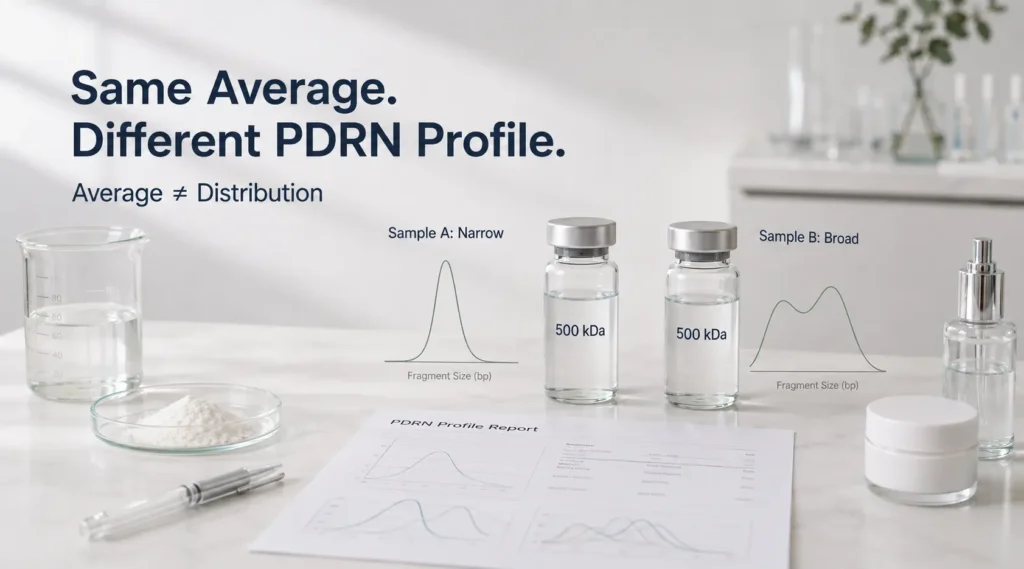
Two samples may report the same average molecular weight while having very different underlying profiles.
| Parameter | Sample A | Sample B |
|---|---|---|
| Average molecular weight | 500 kDa | 500 kDa |
| Main distribution | 400–600 kDa | 50–950 kDa |
| Main peak | Near 500 kDa | Two possible peaks |
| Distribution width | Relatively narrow | Broad |
| Short-fragment fraction | Limited | Higher |
| Long-fragment tail | Limited | More pronounced |
These samples may differ in:
- Dissolution
- Viscosity
- Filtration
- Enzymatic degradation
- Heat and shear sensitivity
- Storage behavior
- Batch predictability
Useful consistency questions include:
- Does the main peak remain in the same position?
- Is the distribution width comparable?
- Has the short-fragment fraction increased?
- Is there evidence of process degradation?
- Has a high-molecular-weight tail appeared?
- Does processing change the profile?
The T/SHRH 077—2025 standard includes an agarose-gel comparison of the main-band molecular-weight distribution before and after nuclease treatment for certain modified PDRN materials. Its scope is specific, but the principle is relevant: a distribution profile can reveal changes that one average value cannot.
Does Chain Length Directly Determine PDRN Activity?
No.
Chain length can influence material behavior, but molecular weight alone does not determine total biological performance.
A 2018 study comparing low-, medium- and high-molecular-weight PDRN evaluated:
- Low molecular weight: below 50 kDa
- Medium or classic PDRN: 50–1,500 kDa
- High molecular weight: above 1,500 kDa
In a mouse wound model, apparent surface wound closure was not significantly different among the molecular-weight groups. The medium-weight group showed differences in collagen composition, lipid accumulation and fibroblast migration.
This study is relevant to the question of molecular-weight effects, but it does not prove that 50–1,500 kDa is the best range for every cosmetic application because:
- The study used animal and in-vitro models.
- It was not a passive topical penetration study.
- It did not compare commercial cosmetic serums or creams.
- It did not establish one range for every route or product format.
The following claims should therefore be avoided:
- Lower molecular weight always means higher activity.
- Shorter chains activate A2A receptors more strongly.
- Below 1,000 kDa is the universal optimal range.
- Low-molecular-weight PDRN automatically enters the dermis.
- Longer chains always provide better repair.
- One molecular-weight range is ideal for every cosmetic product.
A more accurate statement is:
Chain length can influence physicochemical behavior, degradation kinetics, formulation suitability and delivery potential. However, molecular weight alone does not determine the overall biological performance of a PDRN ingredient.
Is Low-Molecular-Weight PDRN Better for Skincare?
Not automatically.
Low-molecular-weight PDRN may be easier to disperse and may offer more flexibility for topical delivery-system design. That makes it relevant for serums, creams and gels.
But a buyer still needs to ask:
- How low is “low molecular weight”?
- Is the value an average, range or main peak?
- Was it measured directly?
- What method was used?
- Is the material still predominantly double-stranded?
- Is the distribution the result of controlled fractionation or uncontrolled degradation?
- Does the finished formula show improved deposition or penetration?
- Is the formula stable after processing and storage?
A very low number is not automatically a quality advantage. Excessive fragmentation may alter:
- Polymer behavior
- Structural characteristics
- Degradation profile
- Viscosity
- Batch consistency
The correct question is not:
“Which supplier has the lowest molecular weight?”
It is:
“Which verified molecular-weight profile works best in the intended formula and is supported by appropriate analytical and finished-product data?”
How Should Different Product Formats Be Evaluated?
There is no responsible table that assigns one universal kDa range to every cosmetic format. Instead, evaluate the variables that matter for the product architecture.
| Product format | Main technical questions | Useful supplier information |
|---|---|---|
| Clear serum | Will it dissolve clearly and remain stable? | MW basis, solubility, clarity, pH and stability information |
| Ampoule | Can the system support a concentrated active story without precipitation? | Assay, concentration basis, MW profile, preservative and packaging compatibility |
| Sheet-mask essence | Will the water-rich system remain clear and microbiologically robust? | Solubility, use-level guidance, preservative compatibility and challenge-test plan |
| Cream or gel | Does PDRN remain compatible with the emulsion, thickeners and electrolytes? | Processing guidance, pH, heat and shear sensitivity |
| PDRN + HA | Which polymer controls viscosity and network behavior? | MW and concentration of both polymers |
| Hydrogel or semi-finished base | Does the material produce the required rheology, degradation and release? | Distribution, concentration, rheology and degradation data |
| Premium claim-led product | Can the ingredient story be substantiated? | Batch documents, source data, analytical method and finished-product testing |
Practical formulation principle: Select the grade according to the product format and evidence package—not according to a standalone “small molecule” or “high molecular weight” claim.
Why Average Molecular Weight Is Not Enough
Average molecular weight compresses the complete fragment population into one number.
It cannot show:
- Where most fragments are located
- How wide the distribution is
- Whether the material has one peak or multiple peaks
- The proportion of very short fragments
- The presence of a long-chain tail
- Changes caused by processing
- Batch-to-batch shifts
Which average is being reported?
Polymer reports may use different molecular-weight metrics:
| Term | Meaning |
|---|---|
| Mn | Number-average molecular weight |
| Mw | Weight-average molecular weight |
| Mz | Z-average molecular weight |
| Mp | Molecular weight at the main peak |
| PDI or dispersity | Breadth of the distribution |
A COA that reports only “average molecular weight” without identifying the method or calculation basis provides limited information for supplier comparison.
Two suppliers may report the same number using:
- Different test methods
- Different standards
- Different calibration ranges
- Different averages
- Different sample preparation
- Different reporting limits
What should a useful distribution report show?
Where available, request:
- Analytical method
- Sample type
- Sample preparation
- Validated measurement range
- bp or kDa range
- Main peak
- Main distribution interval
- Relative area by selected size range
- Mn and Mw
- Dispersity
- Calibration standard
- Distribution curve or electropherogram
- Batch number
- Replicates
- Multi-batch comparison
Why PDRN Chain Length Is Difficult to Measure
The fragment range may be broad
A method optimized for very short fragments may not resolve long chains. A method intended for higher-molecular-weight DNA may not separate small fragments well.
The laboratory must match the method to the expected distribution.
The sample matrix may interfere
PDRN may be tested as:
- Purified powder
- Aqueous solution
- Diluted active blend
- PDRN–hyaluronic acid complex
- Semi-finished serum base
- Finished cosmetic formula
Hyaluronic acid, thickeners, salts, proteins, surfactants and preservatives may affect:
- DNA recovery
- Electrophoretic migration
- UV absorbance
- Staining
- Chromatographic separation
- Apparent size
- Sample viscosity
Raw-material testing and finished-formula testing are not automatically interchangeable.
Detecting DNA is not the same as measuring distribution
A test may confirm nucleic acid without reporting:
- Main fragment range
- Main peak
- Relative abundance
- Distribution width
- Short-fragment proportion
- Batch similarity
Sample preparation can change the result
DNA may be affected by:
- Excessive heat
- Strong acid or alkali
- Nuclease contamination
- High shear
- Aggressive sonication
- Repeated freeze–thaw cycles
- Unsuitable storage
How Is PDRN Chain Length Measured?
No single method is automatically best for every PDRN sample.
Agarose gel electrophoresis
Agarose gel electrophoresis separates DNA fragments primarily by size and compares migration with a DNA ladder.
It can help show:
- Approximate bp range
- Main bands
- Smearing
- Degradation
- Differences before and after treatment
- Batch-to-batch profile changes
Its limitations include:
- Mainly semi-quantitative output
- Limited resolution for very short fragments
- Broad distributions appearing as smears
- Dependence on gel concentration and DNA ladder
Polyacrylamide gel electrophoresis
PAGE may provide higher resolution for relatively short fragments. It can be useful when conventional agarose gels cannot separate small size differences.
Its working range is more limited, and wide PDRN distributions may require more than one analytical condition.
Capillary electrophoresis and fragment analyzers
Automated electrophoresis can provide:
- Fragment-size profiles
- Electropherograms
- Main peaks
- Smear analysis
- Relative area by size interval
- Digital batch comparison
Agilent offers different Fragment Analyzer DNA kits for different size ranges. This illustrates an important point: the selected assay must cover the expected PDRN distribution.
Size-exclusion chromatography
SEC separates macromolecules according to effective size in solution and can provide molecular-weight averages and distribution information when configured appropriately.
Reports may include:
- Mn
- Mw
- Mz
- Dispersity
- Distribution by elution region
Agilent describes GPC/SEC as a technique for generating polymer parameters including Mn, Mw, Mz and dispersity.
However:
“Tested by HPLC” does not automatically mean that a complete PDRN molecular-weight distribution was measured.
The report should identify:
- Chromatographic mode
- Column
- Mobile phase
- Detector
- Calibration standard
- Calibration range
- Data-processing method
- Sample preparation
SEC-MALS
SEC combined with multi-angle light scattering can provide more direct molar-mass and size information for macromolecules than conventional calibration alone.
The method still depends on:
- Adequate separation
- Sample purity
- Concentration measurement
- Aggregation control
- Detector sensitivity
- Correct analytical parameters
Orthogonal methods answer different questions
| Method | Main question |
|---|---|
| Agarose gel or PAGE | What approximate bp range and degradation pattern are present? |
| Capillary electrophoresis | What is the detailed fragment-size profile within the assay range? |
| SEC | How is the material distributed by effective size? |
| SEC-MALS | What are the molar-mass and size distributions in solution? |
| UV A260 | How much nucleic-acid material is present under the selected method? |
| A260/A280 | What does the UV ratio indicate about nucleic-acid and protein-related purity? |
| Hyperchromicity | How does UV absorbance change during heat-induced strand separation? |
For the structural-quality distinction, read PDRN Hyperchromicity: A Key Quality Indicator for Double-Stranded DNA.
How to Compare PDRN Supplier Data
| Report item | What to check | Warning sign |
|---|---|---|
| Test method | Gel, CE, SEC or SEC-MALS | Only “HPLC” is stated |
| Unit | bp, kDa or nm | Units are treated as identical |
| Measurement range | Validated lower and upper limits | No method range |
| Main peak | Peak or main interval | Only an average |
| Distribution | Relative amount by range | No curve or fraction data |
| Calibration | DNA ladder or suitable standard | Calibration is not identified |
| Sample type | Powder, solution or complex | Matrix is not stated |
| Batch number | Matches the sample and COA | Generic report |
| Replicates | Repeatability or variation | One unexplained result |
| Batch comparison | Multiple production batches | No evidence of consistency |
Questions to ask before approving a supplier
- Was the result measured directly or theoretically converted?
- Is it expressed in bp, kDa or particle size?
- Was double-stranded or single-stranded DNA evaluated?
- Is the reported value an average, range or peak?
- Which type of average is reported?
- Is the complete distribution available?
- Does the sample contain hyaluronic acid or another polymer?
- What standard or ladder was used?
- Does the report correspond to the current batch?
- Have multiple batches been analyzed using the same method?
- Does the supplier distinguish raw-material characterization from finished-formula performance?
- Are topical-delivery claims supported by the finished product?
How Noyain Supports PDRN Product Development
Noyain supplies cosmetic-grade Sodium DNA for skincare formulation and B2B sourcing. Our role is to help customers interpret the available raw-material data and evaluate whether the grade fits the intended project.
Current support can include:
- Batch-specific COA review
- Product specification and SDS/MSDS
- Source documentation
- Current molecular-weight release information
- Assay and hyperchromicity information
- Residual-protein and endotoxin-related data
- Recommended use-level and processing guidance
- Sample support for formula screening
- Discussion of product format, pH, temperature and compatibility
- Bulk-order and documentation coordination
For a new project, tell us:
- Product format
- Target market
- Target claim
- Expected use level
- Formula pH
- Key polymers and electrolytes
- Preservative system
- Required documentation
- Expected annual quantity
This allows the discussion to move from “Is lower molecular weight better?” to:
“Does this Sodium DNA grade match the product we intend to develop?”
PDRN Buyer Checklist
Identity and composition
- INCI name
- Commercial product name
- Biological source
- Country or region of origin
- Raw-material concentration
- Assay method
- Batch number
Molecular characteristics
- Molecular-weight specification
- Test method
- bp or kDa range
- Main peak
- Distribution curve
- Mn and Mw, where applicable
- Dispersity, where applicable
- Multi-batch comparison
Structural and purity indicators
- UV identification
- A260/A280
- Hyperchromicity
- Residual protein
- Loss on drying
- Heavy metals
- Endotoxin
- Microbiological limits
Formulation evaluation
- Solubility
- Dissolution process
- pH compatibility
- Temperature sensitivity
- Shear sensitivity
- Electrolyte compatibility
- Cationic-ingredient compatibility
- Preservative compatibility
- Clarity
- Accelerated and real-time stability
- Finished-product claim testing
A PDRN raw material should not be approved or rejected using one molecular-weight number alone.

Frequently Asked Questions
What is the typical chain length of PDRN?
There is no universally applicable base-pair range for every PDRN material.
Historical literature has described specific PDRN preparations using ranges such as approximately 50–2,000 bp, while more recent reviews commonly discuss PDRN within a broad molecular-weight range below 1,500 kDa. The exact chain-length distribution must be confirmed for the specific material.
How many base pairs are in PDRN?
PDRN does not contain one fixed number of base pairs. It is a mixture of DNA fragments.
A valid answer requires a fragment-size analysis of the exact product or batch.
What is the molecular weight of PDRN?
Scientific literature frequently describes “classic” PDRN within approximately 50–1,500 kDa. A 2025 review proposes reserving PDRN for material below 1,500 kDa and PN for material at or above 1,500 kDa.
This is a proposed scientific classification, not a globally harmonized regulatory rule.
Is 1,000 kDa equal to approximately 1,500 bp?
For one double-stranded DNA fragment, 1,000 kDa corresponds theoretically to approximately 1,500 bp.
This is an estimate. It does not describe the complete distribution of a PDRN mixture.
Is low-molecular-weight PDRN better for topical skincare?
Not automatically.
Lower molecular weight may improve mobility and delivery-system design potential. Actual penetration and cosmetic performance depend on the finished formula and require appropriate testing.
Does shorter-chain PDRN penetrate the dermis?
Molecular weight alone cannot prove dermal penetration.
The claim requires testing of the final product using an appropriate skin-permeation or distribution method.
Does longer-chain PDRN last longer?
Longer chains or structured hydrogel systems may degrade and disperse more slowly. Local residence also depends on concentration, network structure, carrier system, enzyme exposure and route of use.
Does chain length determine PDRN activity?
No.
Molecular weight may influence some biological and physicochemical outcomes, but current evidence does not show that shorter or longer chains are universally more effective.
Is average molecular weight enough to approve a supplier?
No.
Average molecular weight should be reviewed together with the test method, molecular-weight range, main peak, distribution, batch consistency, assay, structural-quality data, impurity controls and formula performance.
Is PDRN particle size the same as PDRN molecular weight?
No.
Particle size describes a delivery particle, liposome, microcapsule, microsphere or assembled structure. Molecular weight describes the mass of the DNA polymer.
Conclusion
PDRN molecular weight matters because chain length can influence:
- Topical delivery potential
- Enzymatic degradation
- Local residence
- Viscosity and hydrogel behavior
- Material classification
- Batch consistency
But the correct conclusion is not that lower is always better or that longer is always more effective.
For an OEM/ODM manufacturer or skincare brand, the correct molecular-weight profile depends on:
- Product format
- Formula architecture
- Processing conditions
- Required clarity and viscosity
- Target claims
- Delivery strategy
- Finished-product testing
- Supplier documentation
The strongest sourcing decision is based on a verified specification and successful formula evaluation.
Do not treat average molecular weight as a complete description of PDRN. Review the method, range, main peak, distribution and batch consistency—and interpret those data together with purity, structural quality and finished-formula performance.
Explore more technical PDRN resources in the Noyain PDRN Article Library.
External References
- Marques C, et al. From Polydeoxyribonucleotides (PDRNs) to Polynucleotides (PNs): Bridging the Gap Between Scientific Definitions, Molecular Insights, and Clinical Applications of Multifunctional Biomolecules. Biomolecules. 2025.
- Hwang KH, et al. The effect of molecular weight of polydeoxyribonucleotide on wound healing. Molecular Medicine Reports. 2018.
- Squadrito F, et al. Pharmacological Activity and Clinical Use of PDRN. Frontiers in Pharmacology. 2017.
- Tonello G, et al. Characterization and quantitation of the active polynucleotide fraction (PDRN) from human placenta. Journal of Pharmaceutical and Biomedical Analysis. 1996.
- Lee YJ. Comparison of Polynucleotide and Polydeoxyribonucleotide in Dermatology: Molecular Mechanisms and Clinical Perspectives. 2025.
- New England Biolabs. Nucleic Acid Data.
- Thermo Fisher Scientific. Agarose Gel Electrophoresis.
- Agilent Technologies. Fragment Analyzer Qualitative DNA Kits.
- Agilent Technologies. GPC/SEC Columns and Standards.
- T/SHRH 077—2025. General Requirements for Detection of Polydeoxyribonucleotide (PDRN) Cosmetic Raw Materials.