Key takeaway
- Squalane’s widely quoted comedogenic rating of 0 could not be traced to a primary published study, and the 0–5 scale it belongs to was built on rabbit ear skin at concentrations no cosmetic product uses.
- The comedogenic species documented in the literature is oxidised squalene, not squalane. Squalane is fully saturated and cannot form it.
- “Non-comedogenic” has no regulatory definition and no standard test. A brand substantiates it on its own finished product, not from an ingredient rating or a supplier document.
- What a supplier can contribute is composition: what the non-squalane fraction of the grade actually is.
The question arrives from two directions. A brand needs to answer it for customers, and a brand may want to put “non-comedogenic” on a label. Those look like the same question and they are not.
The short answer to the first is that squalane is widely used in products positioned for oily and blemish-prone skin, and there is a coherent chemical reason for that. The answer to the second is that no ingredient rating — squalane’s or anything else’s — substantiates a claim about a finished product.
This article covers where the 0-to-5 comedogenic scale came from, why the people who built it stopped trusting it, what actually predicts how a product behaves on skin, and what a raw material supplier can and cannot tell you. For the material’s identity and specification, start with What Is Squalane?
A note on the data in this article. Where a figure could not be traced to a primary study, this article says so rather than repeating it. Where a statement comes from NOYAIN documentation, it is labelled as such.
Quick Answer
Three things, in order of how much weight they can carry.
Squalane is commonly quoted as a comedogenic rating of 0. That figure circulates very widely. In preparing this article it could not be traced to a primary published study on squalane, and the scale it belongs to has known and acknowledged limitations. Treat it as a widely repeated number, not as evidence.
There is a real chemical argument, and it concerns squalene rather than squalane. The comedogenic species documented in the literature are squalene’s oxidation products, not squalene itself. Squalane is fully saturated and does not form them. That is a meaningful mechanistic point and it is not the same thing as a claim.
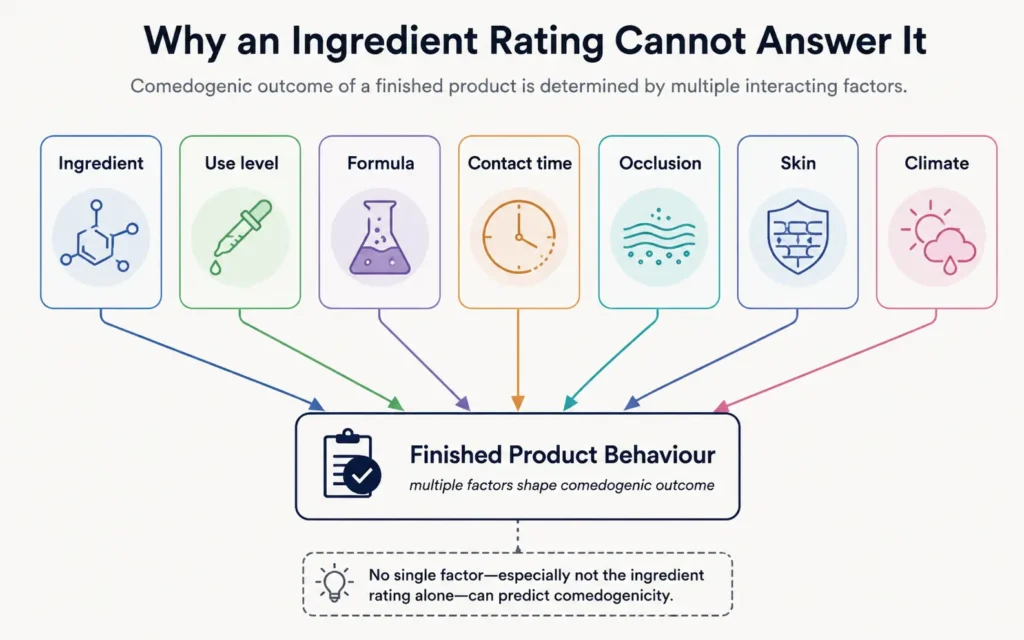
Whether a product causes comedones is a property of the product. Concentration, the rest of the formula, contact time, occlusion, the user’s skin and climate all change the answer. This is not a hedge; it is the settled position in the comedogenicity literature.
Where the 0-to-5 Scale Came From
The ratings circulating on ingredient charts have a specific origin, and knowing it changes how much weight they deserve.
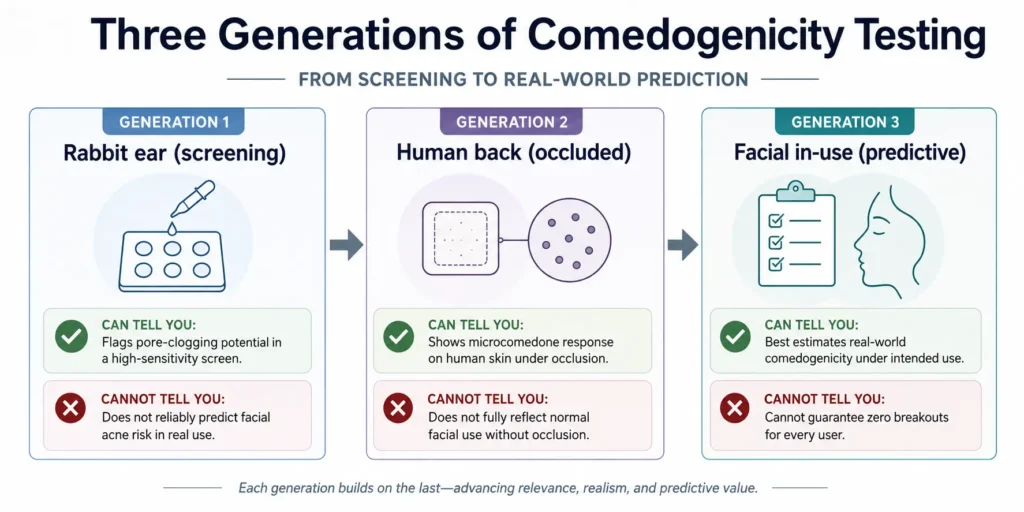
After Kligman and Mills reported on acne cosmetica in 1972, researchers developed animal models to screen ingredients for comedogenic potential, and the rabbit ear assay became the most widely adopted. In that model a test substance is applied to the inner ear of albino rabbits, once or several times weekly for two to four weeks, frequently under occlusion to drive follicular penetration, after which the skin is examined visually and histologically for comedone formation.
Two features of that protocol matter for anyone reading a rating today. The material is applied at high concentration — commonly neat or close to it — and it is applied under conditions designed to maximise the response. Neither resembles how an ingredient sits in a finished cosmetic at a few percent.
The specific 0-to-5 charts that circulate most widely trace largely to Fulton’s 1989 survey of commonly used skincare ingredients in the Journal of the Society of Cosmetic Chemists. Most online rating tables descend from that work, usually without the methods section attached.
Why the Scale Does Not Transfer to Products
This is not a fringe criticism. It came from the people who built the model.
Kligman and Mills followed the rabbit work with a human study in 1982, applying substances under occlusion to the upper back and assessing microcomedone formation by cyanoacrylate biopsy. Several substances that behaved as potent comedogens in rabbits produced little or no comedone formation in humans. The rabbit model, they concluded, was overly sensitive and not consistently predictive of acne risk in people, and they proposed that a substance would need to score above 3 in the rabbit assay before the result indicated meaningful risk in humans.
Kligman returned to the question later still, in a critical reappraisal of the rabbit ear assay built around petrolatum, and made the point that matters most for formulation: substances that are strongly comedogenic when tested neat or at high concentration become non-comedogenic at sufficient dilution. Testing the finished product, rather than the raw ingredient, is far more predictive of what will actually happen.
A recent review of comedogenicity in cosmeceuticals draws the conclusion together: because of these limitations, the comedogenicity of a finished product has to be established by clinical observation of that product. An ingredient list and a set of ratings do not add up to an answer.
What Actually Predicts Product Behaviour
Three models exist, and they are not interchangeable.
| Model | What it establishes |
|---|---|
| Rabbit ear assay | A screening signal on the raw material at high concentration. Prone to false positives relative to human skin |
| Human back, occluded, cyanoacrylate biopsy | Microcomedone formation in humans, but under occlusion and at concentrations that do not mimic normal use, on skin that differs from facial skin |
| Facial in-use study | The closest available prediction of how the actual product behaves on the actual application site |
The facial in-use study is generally the preferred approach for exactly that reason. It is also the only one of the three that tests the thing being sold.
For a brand, the practical consequence is a sequence rather than a lookup. Ingredient selection is informed by screening data and by chemistry. Product behaviour is established on the product.
Where Squalane Specifically Sits
An honest inventory, in three parts.
The circulating rating. Squalane is very widely listed at 0. That number could not be traced to a primary published study on squalane during the preparation of this article, and even a genuine rabbit-assay zero would carry the limitations described above. It is reasonable to note that the figure exists and unreasonable to build a claim on it.
The chemistry, stated precisely. The comedogenic species documented in the peer-reviewed literature is oxidised squalene, not squalene itself. Squalene monohydroperoxide produced a comedogenic response in the rabbit ear model exceeding that of ingredients already recognised as comedogenic, while squalene itself and the corresponding reduced hydroxide produced weaker responses — a finding recorded in the Cosmetic Ingredient Review documentation for squalane and squalene and reinforced in later work describing squalene oxides as potent comedogens in contrast to pure squalene.
Squalane is the fully saturated material. It has no carbon-carbon double bonds, and therefore cannot form the monohydroperoxides that the literature associates with comedogenesis. That is set out in Squalane vs Squalene.
The boundary, because the previous paragraph is easy to over-read. “Squalane cannot form squalene peroxides” is a statement about one mechanism. It is not a statement that squalane is non-comedogenic, that a squalane-containing product will not cause breakouts, or that squalane helps with acne. Comedones form for several reasons and this addresses one of them. Anyone converting the mechanism into a benefit claim has skipped every step in between.
Use in practice. Squalane appears extensively in products positioned for oily, combination and blemish-prone skin, which tells you the industry finds it workable in those formats. Industry practice is evidence of feasibility, not substantiation of a claim.
What NOYAIN Does and Does Not Hold on This Question
Worth stating plainly, because suppliers are usually vague about it.
NOYAIN does not hold comedogenicity testing on this grade, and does not commission it. That is a deliberate position rather than a gap: a comedogenicity result generated on neat raw material, under occlusion, at a concentration no product uses, would not transfer to a customer’s formula. Supplying such a report would give a buyer a document that looks like substantiation and is not one.
What is available is the material documentation — specification, current batch certificate of analysis, safety data sheet, source statement, and the composition of the non-squalane fraction. On this particular question the composition line is the useful one, because it describes what actually enters the formula alongside the squalane.
If a claim is required, the study belongs on the finished product, and the brand commissions it.
Substantiating a Non-Comedogenic Position: What Is Needed
| Requirement | Who provides it | Notes |
|---|---|---|
| Ingredient identity and specification | Supplier | INCI, CAS, assay, appearance, odour |
| Composition of the non-squalane fraction | Supplier | Rarely published; ask for it explicitly |
| Batch conformity | Supplier | Current COA against the approved specification |
| Safety data | Supplier | SDS for the material as supplied |
| Finished-product comedogenicity study | Brand | Facial in-use study is the most predictive design |
| Claim wording review per market | Brand | No regulatory definition exists; wording is market-specific |
| Records retained for challenge | Brand | Retailer and marketplace challenges request the study, not the ingredient list |
The split is the whole point. A supplier substantiates the material. Nothing a supplier provides substantiates a claim about skin.
Grade Parameters Relevant to This Question
Not every specification line matters here. These do, because they describe what actually enters the formula.
| Parameter | NOYAIN vegetable squalane |
|---|---|
| INCI name | Squalane |
| CAS number | 111-01-3 |
| Squalane content | ≥92% (typically 92–94%) |
| Non-squalane fraction | Cyclosqualane 2–5%, iso-squalane 0–1%, other alkanes 0–2% — all saturated |
| Appearance | Clear, colourless oily liquid |
| Odour | Odourless; assessed per batch |
| Source | Soybean oil, vegetable route |
| Shelf life | 24 months, sealed, room temperature, ventilated and dry |
The composition line is the one that matters most for this question, and it is the line most suppliers in this category do not publish. Full specification and current batch documents are available on the squalane grade page.
“Non-Comedogenic” as a Label Claim
There is no regulatory definition of “non-comedogenic” in the major cosmetic markets, and no standardised test that a product must pass to use the term. That absence cuts both ways: the claim is easy to make and, in a challenge, hard to defend on anything other than the brand’s own data.
What a brand needs in order to hold the position is a study on its own finished product, on an appropriate application site, under conditions defensible as representative of normal use. What it cannot use is an ingredient rating table, a supplier’s raw-material data, or a mechanistic argument of the kind set out above.
The same logic runs through Squalane Benefits in Skincare: a supplier substantiates the material, and a brand substantiates what the product does on skin.
What a Supplier Can and Cannot Provide
A raw material supplier can reasonably provide the specification, the current batch certificate of analysis, safety data, source documentation, and the composition of the grade. On the comedogenicity question specifically, the useful contribution is narrower than it looks and worth being clear about.
Composition is relevant, because the non-squalane fraction of a commercial grade is part of what a formulator is putting into the product. The NOYAIN squalane grade is specified at ≥92% squalane, with the remaining fraction published as cyclosqualane, iso-squalane and other saturated alkanes — the detail is in Squalane vs Squalene. A supplier that cannot describe its non-squalane fraction is asking you to test a partially unknown input.
What a supplier should not offer is a comedogenicity result for your product. It does not have your formula.
Frequently Asked Questions
Is squalane comedogenic?
Squalane is widely used in products for oily and blemish-prone skin, and being fully saturated it cannot form the oxidation products that the literature links to comedogenesis. That is not the same as a finding that squalane is non-comedogenic, and it says nothing about a specific finished product, which is where the question is actually settled.
What is squalane’s comedogenic rating?
It is commonly quoted as 0. That figure could not be traced to a primary published study during the preparation of this article, and the rating system it belongs to was developed on rabbit ear skin at high concentrations and is not reliably predictive for humans. Use it as background, not as evidence.
Does squalane clog pores?
There is no basis for saying it does as a raw material, and no basis for guaranteeing that a product containing it will not. Contact time, use level, the rest of the formula and the individual user all contribute. A leave-on facial oil and a rinse-off cleanser containing the same percentage are not the same exposure.
Are comedogenic ratings reliable?
Not as a pass or fail. They came from a screening model applied at high concentration, and the researchers who developed it later showed that substances comedogenic in rabbits were often not comedogenic in humans, and that high dilution removes the effect. They are a starting filter for ingredient selection, nothing more.
Can a brand claim its squalane product is non-comedogenic?
Only on the strength of testing its own finished product. There is no regulatory definition of the term and no standard test a product must pass, so the claim rests entirely on the data the brand holds.
What documents should a buyer request on this topic?
Specification, current batch COA, SDS, source statement, and — specifically for this question — the composition of the non-squalane fraction. What a supplier cannot provide is a comedogenicity result for your formula, because the formula is yours.
Does squalane help with acne?
That is a therapeutic claim and it is not supportable from raw-material data. Squalane can be part of a product positioned around lightweight moisturisation for oily or combination skin, which is a cosmetic claim in a different category.
Conclusion
The comedogenic rating attached to squalane is better understood than trusted. The scale behind it was built as a screening tool, tested at concentrations no product uses, and reconsidered by its own authors. The chemistry that does hold up — that a saturated hydrocarbon cannot form the oxidation products the literature associates with comedogenesis — is worth knowing and is not a claim. The claim, if a brand wants one, is earned on the finished product.
Read next
If the wider question is which claims a raw material can support at all, Squalane Benefits in Skincare sorts what is established at ingredient level from what needs finished-product testing.
References
- Comedogenicity in cosmeceuticals: a review of clinical relevance, regulatory gaps, and future directions. JAAD Reviews. 2025. — the anchor reference for the history and the testing hierarchy; confirm volume, pages and DOI.
- Kligman AM, Mills OH. Acne cosmetica. Archives of Dermatology. 1972. — verify full citation.
- Kligman AM, Mills OH. Human model comedogenicity study. 1982. — verify authors, journal, year and design before publishing.
- Fulton JE. Comedogenicity and irritancy of commonly used ingredients in skin care products. Journal of the Society of Cosmetic Chemists. 1989;40:321–333. — verify, and check whether squalane appears in the tested ingredient list.
- Kligman AM. Petrolatum is not comedogenic in rabbits or humans: a critical reappraisal of the rabbit ear assay and the concept of acne cosmetica. Journal of the Society of Cosmetic Chemists. 1996;47:41–48. — verify.
- Chiba K, et al. Comedogenicity of squalene monohydroperoxide in the skin after topical application. Journal of Toxicological Sciences. 2000;25(2):77–83. PMID:10845185.
- Pham DM, et al. Oxidization of squalene, a human skin lipid. International Journal of Cosmetic Science. 2015. doi:10.1111/ics.12208.
- Cosmetic Ingredient Review. Safety assessment of squalane and squalene as used in cosmetics.
- National Center for Biotechnology Information. Squalane — PubChem Compound Summary, CID 8089.