Evidence note: This article reviews a third-party finished-product study. The research was not conducted by Noyain, and the tested product is not a Noyain product.
Can a topical PDRN serum support skin after a laser procedure?
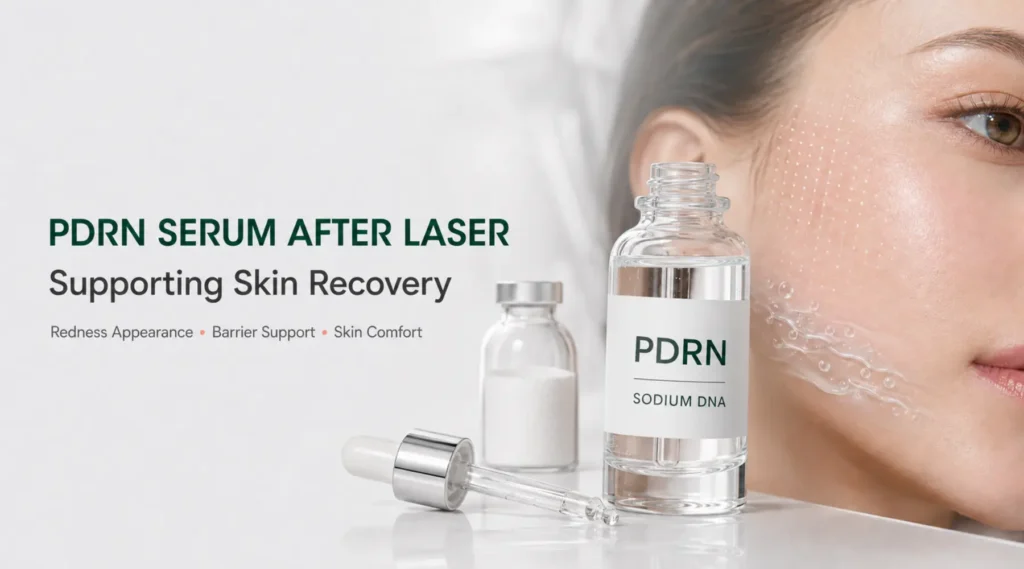
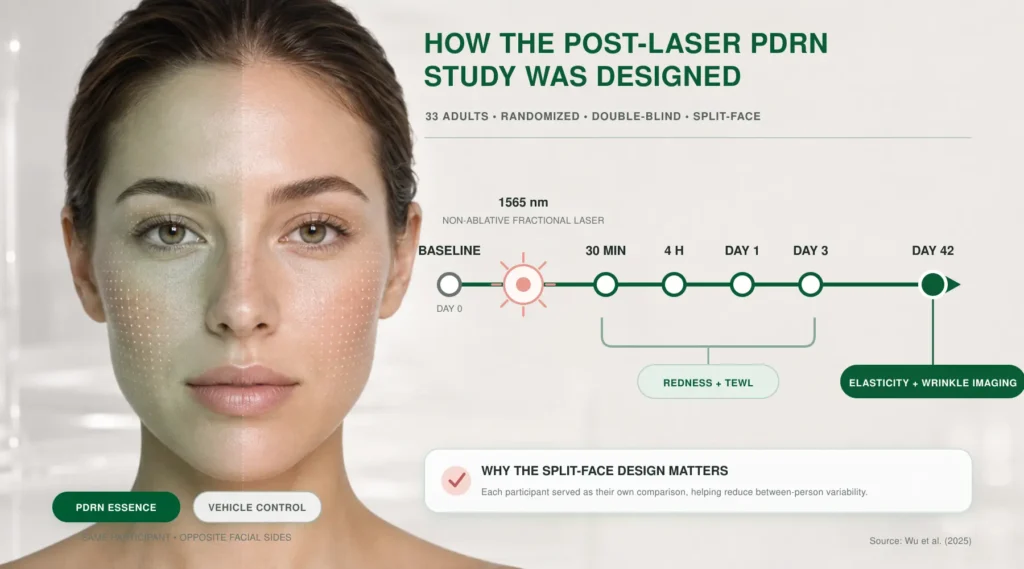
In a 2025 split-face study, 33 adults received a 1565 nm non-ablative fractional laser treatment. Each participant then applied a PDRN essence to one side of the face and a placebo/vehicle control to the other. By Day 3, the PDRN side showed a more favorable redness and water-loss pattern. By Day 42, it showed stronger elasticity and wrinkle-related measurements.
The findings are encouraging. They also belong to one specific finished formula — not to every serum sold as PDRN, and not automatically to every Sodium DNA raw material on the market.
This article covers what the study measured, what the numbers actually support, and how a brand or OEM/ODM can turn that into a claim it can defend.
Quick Answer: What Are the Main PDRN Serum Benefits After Laser?
- Days 0–3 — redness and moisture retention. The PDRN side showed a larger drop in instrumental redness readings and lower transepidermal water loss than the control side.
- Day 42 — elasticity and wrinkles. All four Cutometer elasticity parameters and all five Antera 3D crow’s-feet measurements moved further on the PDRN side.
- Laboratory support. A UVA-stressed 3D skin model showed lower inflammatory markers and higher barrier-protein and collagen staining, which helps explain why the human results are biologically plausible.
Important Evidence Boundary
This was a 33-person study of one finished PDRN essence, after one laser protocol, over 42 days. The source describes the tested essence as using a “special PDRN technology” with a reported average particle size of approximately 122–125 nm; the system is not fully disclosed. These results do not establish that every PDRN serum, or every Sodium DNA raw material, will perform the same way. Treat this as a testing model for your own product, not as a transferable result.
A note on search intent: consumers often search for “PDRN laser treatment.” PDRN is not a laser treatment. The study evaluated a topical essence used as aftercare following a professional laser procedure.
Study at a Glance
| Element | What was reported |
|---|---|
| Participants | 33 Chinese adults; mean age 46.55 ± 10.37; crow’s-feet grade 3–6 |
| Design | Randomized, double-blind, split-face — each participant used both formulas, one on each side of their own face |
| Procedure | 1565 nm non-ablative fractional laser; 40 mJ; 150–200 spots/cm² |
| Test product | A PDRN essence described as using a “special PDRN technology,” with a reported average particle size of ~122–125 nm |
| Control | Placebo/vehicle control as reported by the study. The supplied materials do not fully disclose whether the comparator was identical in every respect except for the PDRN component. |
| Short-term timing | 30 minutes, 4 hours, Day 1, Day 3 |
| Long-term timing | Through Day 42 |
| Instruments | VISIA imaging, Cutometer MPA 580, Antera 3D |
Terms used in this article
- Vehicle / placebo control — the comparison formula applied to the opposite side of the face.
- TEWL — transepidermal water loss, or how much water escapes through the skin surface. Lower generally indicates better moisture retention.
- Split-face — each participant serves as their own control, which removes differences in age, skin type and laser response between people.
- Cutometer — a suction device that measures how skin stretches and recoils.
- Antera 3D — an imaging system that measures wrinkle length, width, depth and count.
- 3D skin model — reconstructed skin tissue tested in a laboratory. Not a human participant.
Post-procedure skin behaves differently from intact skin. A temporarily altered barrier changes how a product interacts with the surface and how well it is tolerated — which is why laser type, skin condition, complete formula and the treating professional’s aftercare instructions all matter, regardless of what any single study reports.
Days 0–3: Redness and Water Loss
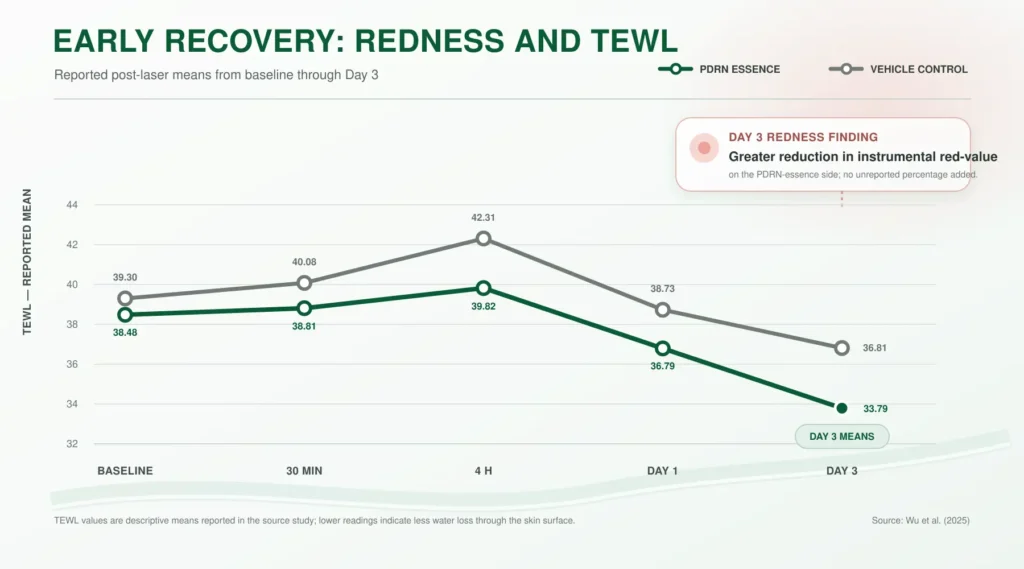
In short: TEWL rose for the first few hours on both sides, then fell — and by Day 3 the PDRN side was lower.
The early rise is expected when the barrier is temporarily disrupted by the procedure. What matters is the recovery slope after that.
| TEWL (g/m²/h) | PDRN side | Control side |
|---|---|---|
| Baseline | 38.48 ± 3.11 | 39.30 ± 3.08 |
| 4 hours | 39.82 ± 2.96 | 42.31 ± 2.83 |
| Day 3 | 33.79 ± 2.42 | 36.81 ± 2.51 |
Instrumental red-value readings followed the same direction, with a larger reduction on the PDRN side by Day 3.
What this supports commercially: wording along the lines of “helps reduce the look of temporary redness” and “helps support moisture retention” — subject to testing your own finished formula. It does not support any claim about treating inflammation or managing laser complications.
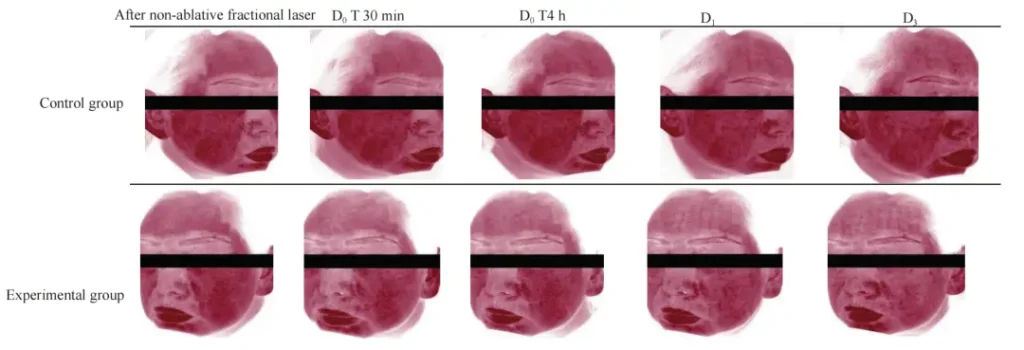
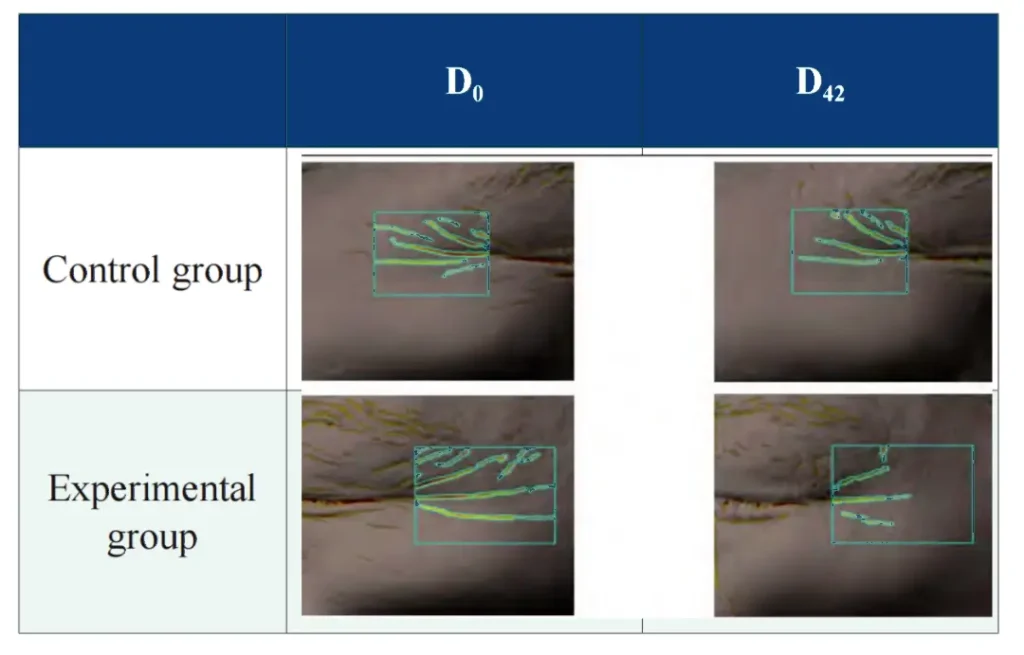
About the source-study images below These figures are reproduced from Wu et al. (2025). In each set, the control condition received the placebo/vehicle formula and the experimental condition received the PDRN essence. They are representative examples selected by the study authors, not all 33 participants, and they are not testing performed by Noyain.
Day 42: Elasticity and Wrinkle Appearance
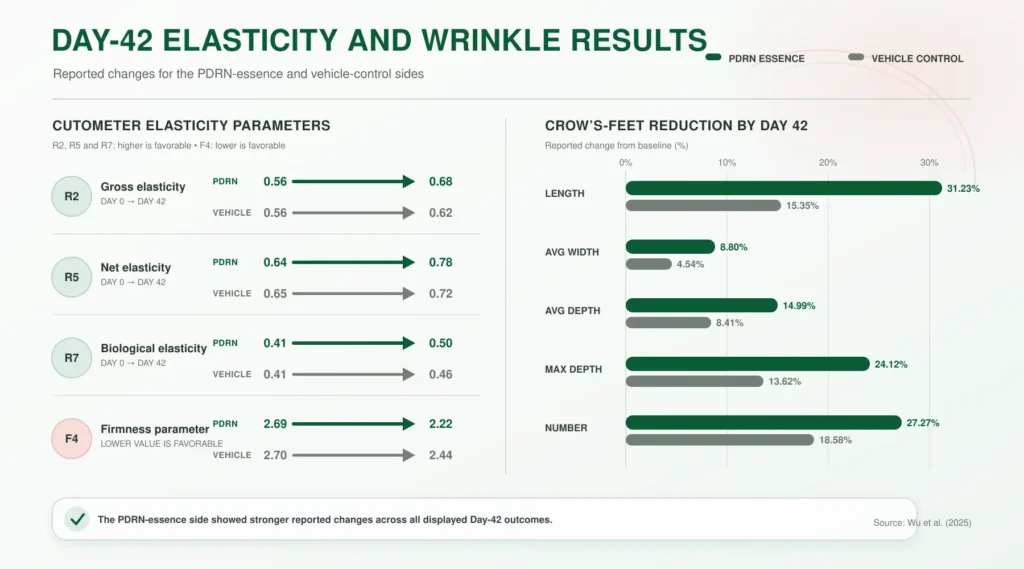
In short: all four elasticity parameters and all five crow’s-feet metrics moved further on the PDRN side, with the source reporting P < 0.001 for each elasticity comparison.
| Cutometer parameter | PDRN side | Control side |
|---|---|---|
| R2 — gross elasticity (higher is better) | 0.56 → 0.68 | 0.56 → 0.62 |
| R5 — net elasticity (higher is better) | 0.64 → 0.78 | 0.65 → 0.72 |
| R7 — biological elasticity (higher is better) | 0.41 → 0.50 | 0.41 → 0.46 |
| F4 — firmness indicator (lower is better) | 2.69 → 2.22 | 2.70 → 2.44 |
Antera 3D crow’s-feet measurements moved in the same direction. The gap was widest on wrinkle length and maximum depth.
| Crow’s-feet metric | PDRN side reduction | Control side reduction |
|---|---|---|
| Length | 31.23% | 15.35% |
| Average width | 8.80% | 4.54% |
| Average depth | 14.99% | 8.41% |
| Maximum depth | 24.12% | 13.62% |
| Number | 27.27% | 18.58% |
These are appearance endpoints measured over 42 days of continued use. They do not establish a permanent effect, a universal timeline, or the same performance from a different formula.
Developing a post-procedure or recovery-focused serum?
Request a cosmetic-grade Sodium DNA sample, current-batch COA and available technical documents for your serum, ampoule or mask project.
What the 3D Skin Model Adds
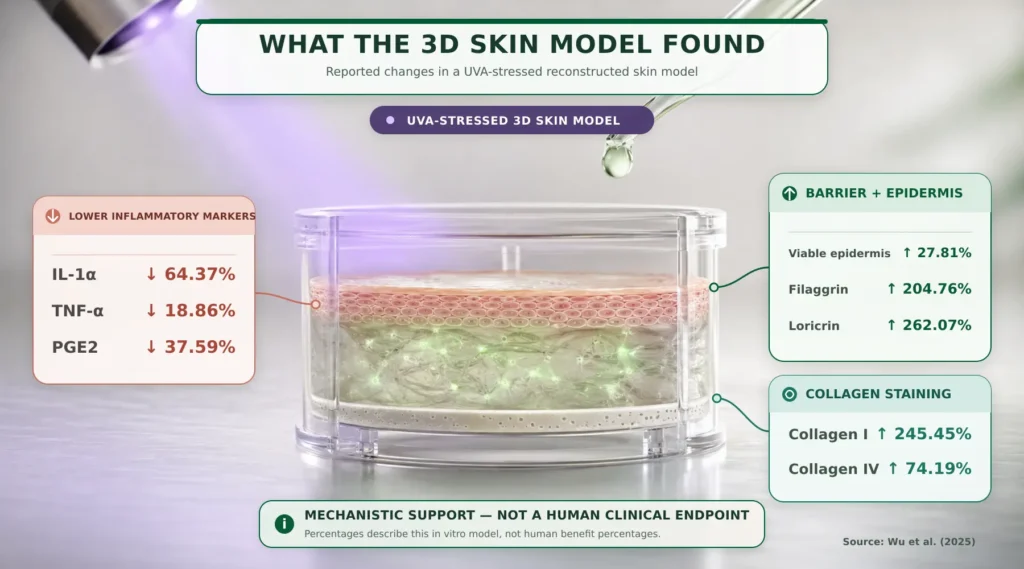
Alongside the human study, the same essence was tested on reconstructed skin tissue exposed to UVA stress. In plain terms, the model pointed in three directions:
- Lower inflammatory signaling — IL-1α, TNF-α and PGE2 were all reduced.
- Stronger barrier structure — filaggrin and loricrin staining increased, as did viable epidermal thickness.
- More collagen staining — both collagen I and collagen IV.
This layer is useful because it offers a plausible biological explanation for the human redness, TEWL and elasticity signals. It is not clinical evidence, and the percentage changes it produced are laboratory measurements on reconstructed tissue — they should never be printed on a cosmetic product or used as consumer-facing benefit figures.
Detailed 3D Model Measurements
The figures below are from the source study and are laboratory measurements on reconstructed tissue, not clinical results.
| Marker | Reported change |
|---|---|
| Viable epidermal thickness | +27.81% |
| Filaggrin staining | +204.76% |
| Loricrin staining | +262.07% |
| Collagen I staining | +245.45% |
| Collagen IV staining | +74.19% |
| IL-1α, TNF-α, PGE2 | Reduced |
These are staining-intensity measurements from one in-vitro model. They are not clinical efficacy figures and must not be transferred to product marketing.
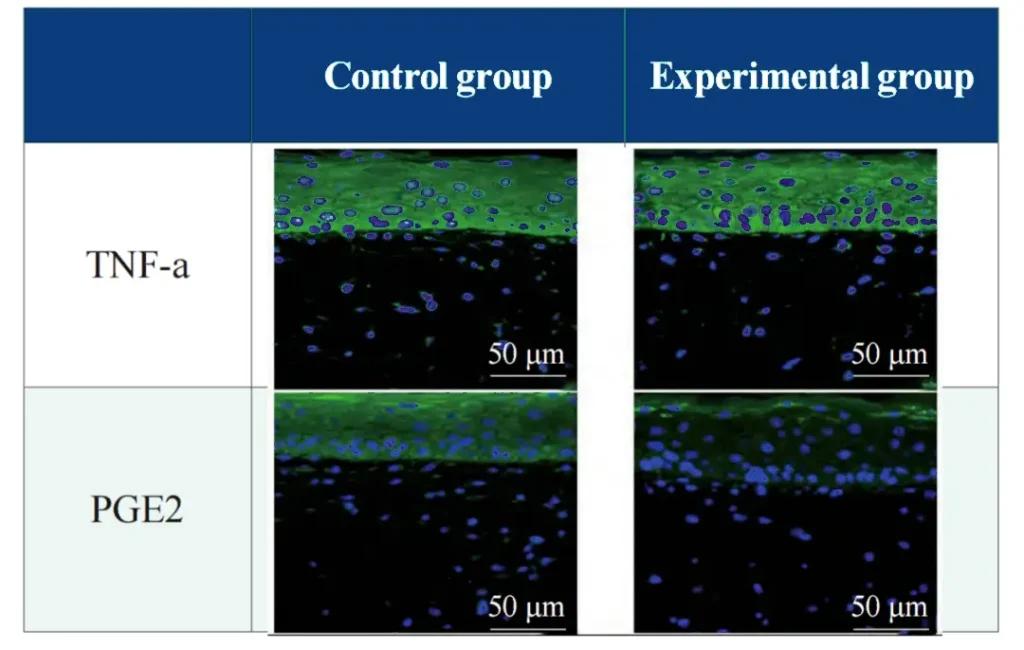
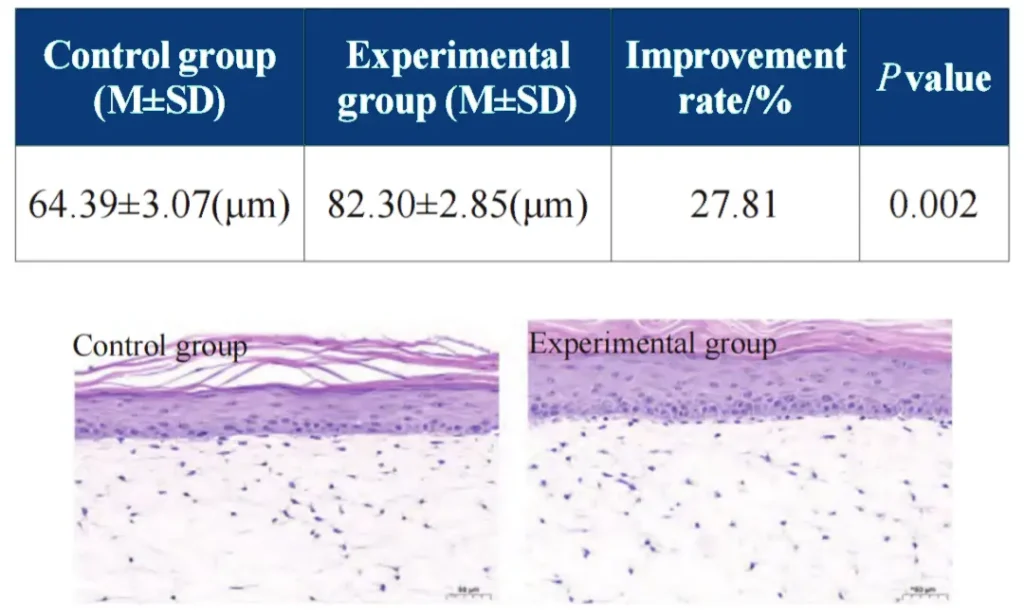
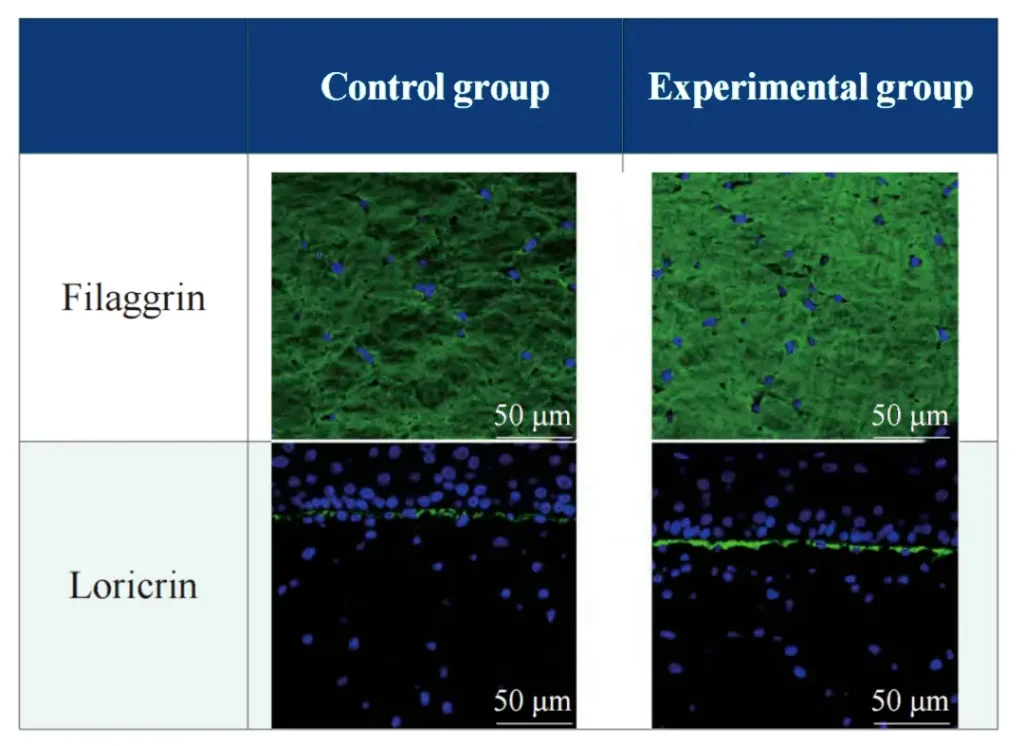
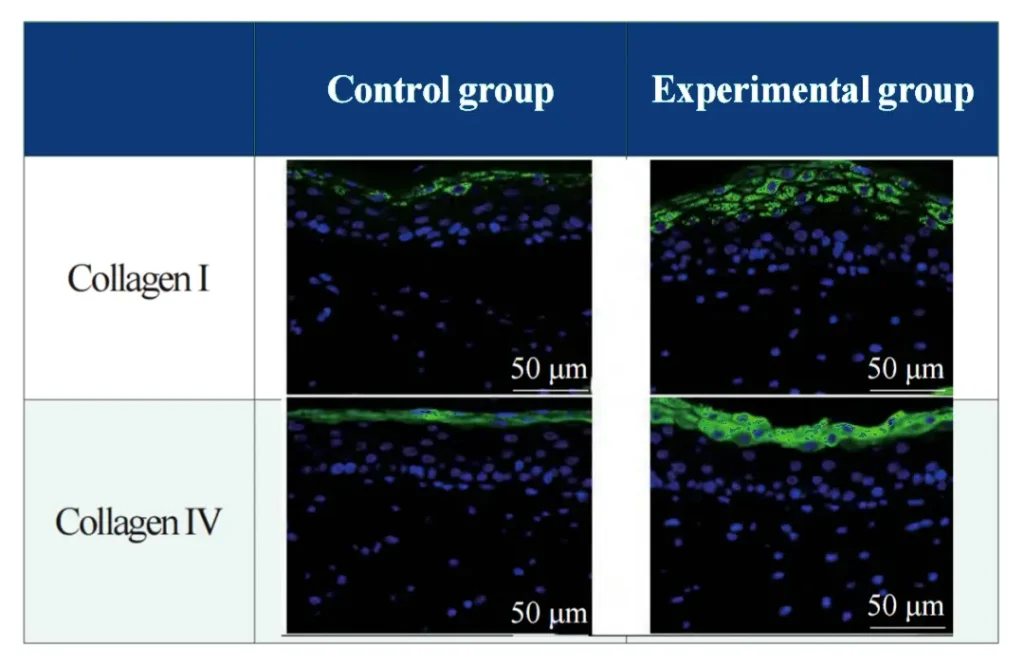
All figures reproduced from Wu et al. (2025), China Detergent & Cosmetics. Control = placebo/vehicle; experimental = PDRN essence. </details>
What This Study Does and Does Not Establish
Where it is strong
The randomized, double-blind split-face design reduces between-person variability and strengthens the comparison. Each participant serves as their own control, so differences in age, baseline skin condition and individual laser response do not confound the result. This is a meaningfully better structure than the uncontrolled before-and-after series that most ingredient marketing relies on.
However, the supplied materials do not fully disclose the complete composition of the comparator formula. The study should therefore be described as a controlled finished-product comparison — not as definitive isolation of the PDRN molecule on its own.
Where it stops
The source describes the tested essence as using a “special PDRN technology” with a reported average particle size of approximately 122–125 nm. What that technology consists of is not fully disclosed, and the reported particle size cannot be assumed to describe the raw material, the carrier or the complete system. It should not be treated as equivalent to other PDRN formats.
Three further constraints apply:
- Scale. 33 participants, 42 days, one laser protocol, one formula.
- Independence. The authors were affiliated with an enterprise team, and the paper appeared in a regional trade journal rather than a large dermatology publication. Independent replication would raise confidence.
- Transferability. No optimal raw-material concentration was established, and no equivalence with other PDRN grades was demonstrated.
None of this makes the findings unusable. It means they should be described as promising, formula-specific evidence — which is exactly how a well-run brand should describe its own data too.
Evidence hierarchy for cosmetic claims Finished-product human data is the most relevant layer. 3D-model, cell, animal and injectable studies can explain plausibility, but they cannot be merged into a single undifferentiated proof claim. This distinction is the difference between a claim that survives regulatory review and one that does not.
Because formats are not interchangeable across grades, molecular size and chain distribution remain live sourcing questions. See Does PDRN Molecular Weight Matter? for the raw-material discussion, and PDRN Injection vs Topical PDRN for the delivery-route comparison.
What This Means for Your Product
The commercial value of this study is not its percentages. It is the testing model — it shows which endpoints a post-procedure claim can be built on, and how to structure the evidence so the claim holds up.
Claim language you can defend
| Study signal | Defensible cosmetic direction | Avoid without route-specific evidence |
|---|---|---|
| Lower red-value readings | Helps reduce the look of temporary redness; supports calmer-looking skin | Treats inflammation, rosacea or laser complications |
| Lower Day-3 TEWL | Helps support moisture retention; helps maintain a healthy-looking barrier | Repairs laser damage; restores a compromised barrier |
| Improved Cutometer parameters | Helps improve the appearance of elasticity and firmness | Regenerates dermal tissue; rebuilds elastin |
| Improved Antera 3D metrics | Helps soften the appearance of fine lines with continued use | Erases wrinkles; delivers procedure-equivalent results |
| 3D-model protein staining | Supports a barrier- and matrix-focused mechanism narrative | Proves human clinical efficacy of the raw material |
Claim language is market-specific. A phrase that is acceptable in one jurisdiction may be treated as drug-like in another. Your evidence dossier should connect each final claim to the tested product, endpoint, population, protocol and duration.
Formulation priorities
- Use a simple, low-irritancy aqueous chassis appropriate to the post-care context.
- Screen humectants and soothing co-actives — glycerin, panthenol, ectoin, allantoin, selected barrier-support ingredients — without making the system tacky.
- Confirm pH, clarity, viscosity, preservation and PDRN compatibility in the complete formula, not in a water solution.
- Decide explicitly whether the product is intended for intact skin only, and align directions with the procedure provider’s aftercare instructions.
- Validate the finished product against the endpoints your claim depends on: TEWL, corneometry, colorimetry, elasticity, imaging, tolerability.
For format-by-format guidance across serums, creams, masks, toners and ampoules, see the PDRN Formulation Guide.
What to verify with any PDRN supplier
- Identity — INCI, source, DNA assay, molecular-weight distribution, residual protein, microbial quality, traceability.
- Structural quality — hyperchromicity and related indicators, read alongside identity and purity rather than in isolation.
- Format — whether the material is a conventionally dissolved Sodium DNA or a specialized system, since published evidence does not automatically transfer between formats.
- Formula readiness — processing conditions, preservative compatibility, stability, packaging.
- Documentation — current-batch COA, specification/TDS, SDS/MSDS, source and quality statements.
Request PDRN documentation
Tell us your product format, target market and intended claim. We can supply cosmetic-grade Sodium DNA specifications, current-batch COA and sample support for formulation evaluation.
Frequently Asked Questions
What are the main PDRN serum benefits after laser?
In this 33-person study, the tested PDRN essence showed a stronger short-term redness reduction, lower Day-3 TEWL, and better Day-42 elasticity and wrinkle measurements than its control. These are findings for that specific finished formula, not guaranteed benefits of every PDRN serum.
Can PDRN be used after a laser procedure?
One PDRN essence has been studied after one non-ablative fractional-laser protocol. That does not make every serum suitable immediately after every procedure. Formula tolerability, skin integrity, procedure type and the treating professional’s instructions determine use.
Does PDRN help with redness?
The study reported a larger reduction in instrumental red-value readings on the PDRN side by Day 3. A suitable cosmetic claim addresses the look of temporary redness — not treatment of inflammatory disease.
Does PDRN repair the skin barrier?
The study offers barrier-support signals: TEWL in humans, and filaggrin, loricrin and epidermal thickness in a 3D model. For cosmetic communication, “supports moisture retention” or “helps maintain a healthy-looking barrier” is far more defensible than a repair claim.
Does the format of the PDRN matter?
It is an important formulation and sourcing question. The essence in this study is described as using a “special PDRN technology” with a reported average particle size of approximately 122–125 nm, and the system is not fully disclosed. Its results should not be assumed to apply to conventionally dissolved Sodium DNA, or vice versa. Ask any supplier to state clearly which format they are quoting.
Is every PDRN serum suitable for post-procedure use?
No. PDRN content alone does not determine suitability. Fragrance, alcohol, acids, preservative system, pH, contamination control, packaging and stability all affect post-care tolerability.
Final Takeaway
This study fills a real gap between broad PDRN mechanism claims and a concrete topical application. It indicates that a specific PDRN essence supported short-term redness and moisture endpoints after laser, followed by measurable elasticity and wrinkle-appearance improvements over 42 days.
Use it as a development model rather than a promise. It tells you which endpoints to test, what claim language those endpoints will support, and which sourcing questions to ask before you commit to a raw material.
For a broader review of the ingredient’s evidence base, see PDRN Benefits for Skin: What Science Says About Salmon DNA, or browse the full PDRN article library.
References
- Wu L, Wen Y, Wu T, Zhang T, Zhao L. Efficacy Study of PDRN Essence after Non-ablative Fractional Laser on Facial Rejuvenation. China Detergent & Cosmetics. 2025(03). CNKI record (subscription access required)
- Squadrito F, Bitto A, Irrera N, et al. Pharmacological Activity and Clinical Use of PDRN. Frontiers in Pharmacology. 2017;8:224. doi:10.3389/fphar.2017.00224
- Yu M, Lee JY. Polydeoxyribonucleotide improves wound healing of fractional laser resurfacing in rat model. Journal of Cosmetic and Laser Therapy. 2017;19(1):43–48. doi:10.1080/14764172.2016.1247966
- Angra K, Lipp MB, Sekhon S, Wu DC, Goldman MP. Review of Post-laser-resurfacing Topical Agents for Improved Healing and Cosmesis. Journal of Clinical and Aesthetic Dermatology. 2021;14(10):24–32. PMC
- Castellini G, Belletti S, Govoni P, Guizzardi S. Anti-Inflammatory Property of PDRN — An in Vitro Study on Cultured Macrophages. Advances in Bioscience and Biotechnology. 2017;8:13–26. doi:10.4236/abb.2017.81002