Squalane is widely recognized as a skincare ingredient, but evaluating it as a cosmetic raw material requires more than knowing that it leaves skin feeling moisturized.
For cosmetic brands, OEM/ODM manufacturers, formulators, distributors, and purchasing teams, several additional questions matter:
- Where does the squalane come from?
- What function does it perform in a formula?
- Is every material sold under the INCI name Squalane equivalent?
- Which specification parameters should be checked before approval?
- What documents should a supplier provide?
This guide covers the basic identity, cosmetic functions, commercial source routes, applications, and the core quality checks buyers should run. NOYAIN currently supplies a soybean-derived vegetable squalane, and that grade is used throughout as a worked example.
A note on the data in this article. Where a statement comes from NOYAIN specifications, product documentation, or internal screening, it is labelled as such. Supplier-level information describes the raw material as supplied; it does not predict how a finished formula will perform, and it is not a substitute for testing in the intended product. Third-party sources are listed in the references.
Quick Answer: What Is Squalane?
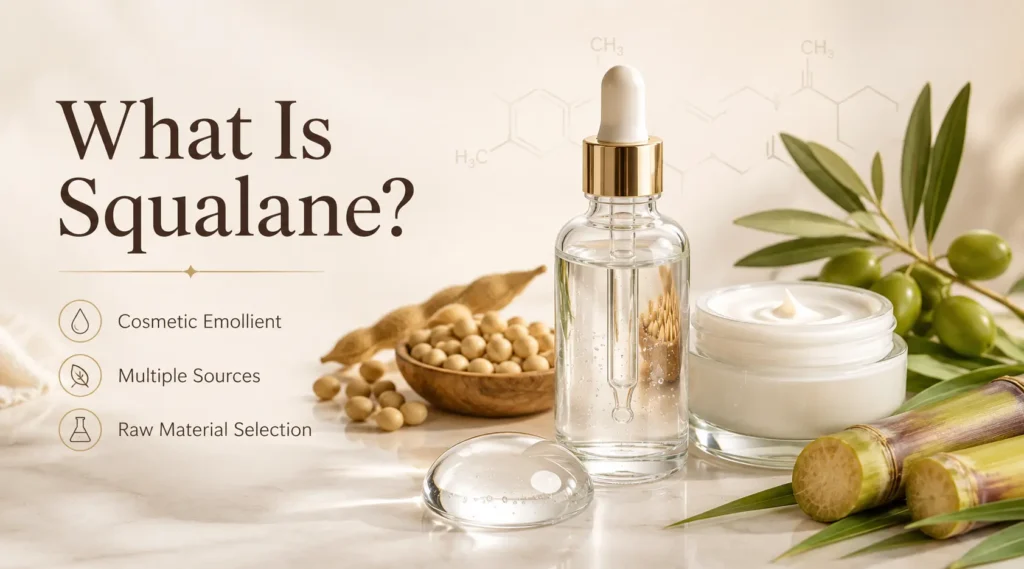
Squalane is a stable, saturated hydrocarbon used primarily as an emollient and sensory modifier in skincare, color cosmetics, sun care, body care, and hair care products.
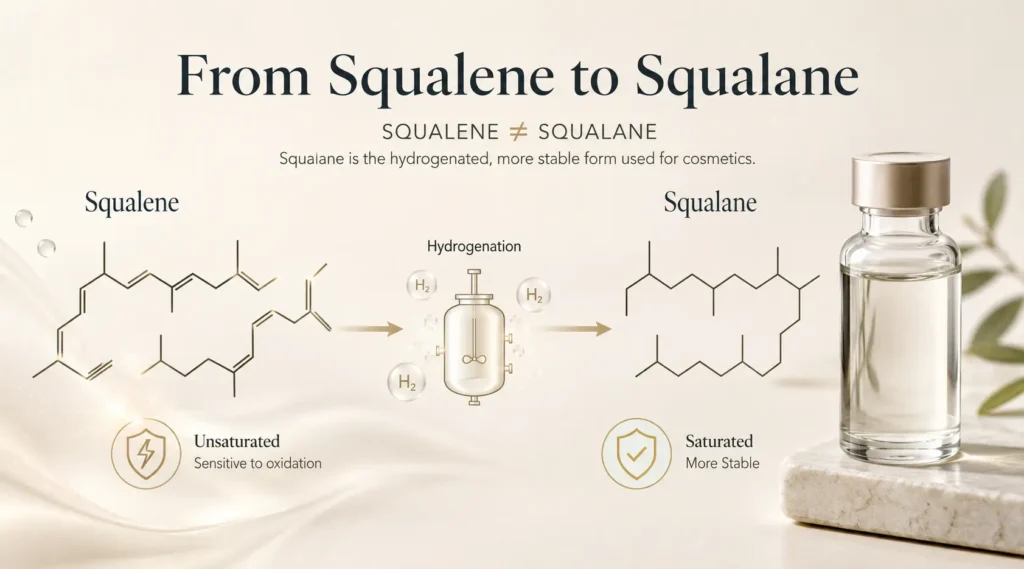
It is commonly produced by hydrogenating squalene, an unsaturated precursor that may be obtained from animal, plant, or fermentation-related sources. Hydrogenation removes the double bonds and produces a material that is more stable toward oxidation.
In formulations, squalane can improve softness, spreadability, slip, and the overall after-feel of a finished product. However, the INCI name alone does not identify the source, squalane content, odor profile, low-temperature clarity, or batch consistency of a commercial grade.
| Parameter | Information |
|---|---|
| INCI name | Squalane |
| CAS number | 111-01-3 |
| Molecular formula | C30H62 |
| Primary cosmetic role | Emollient and sensory modifier |
| Typical appearance | Clear, colorless oily liquid |
The chemical identity and molecular formula can be verified through PubChem’s Squalane record. The European Chemicals Agency also identifies squalane as 2,6,10,15,19,23-hexamethyltetracosane with CAS 111-01-3 and molecular formula C30H62.
Buyers evaluating a commercial grade can review the cosmetic grade squalane specification and request current batch documents before approval.
Squalane’s Role in a Cosmetic Formula
Squalane is an oil-soluble cosmetic ingredient valued for its emollient performance, skin compatibility, spreadability, and relatively lightweight sensory profile.
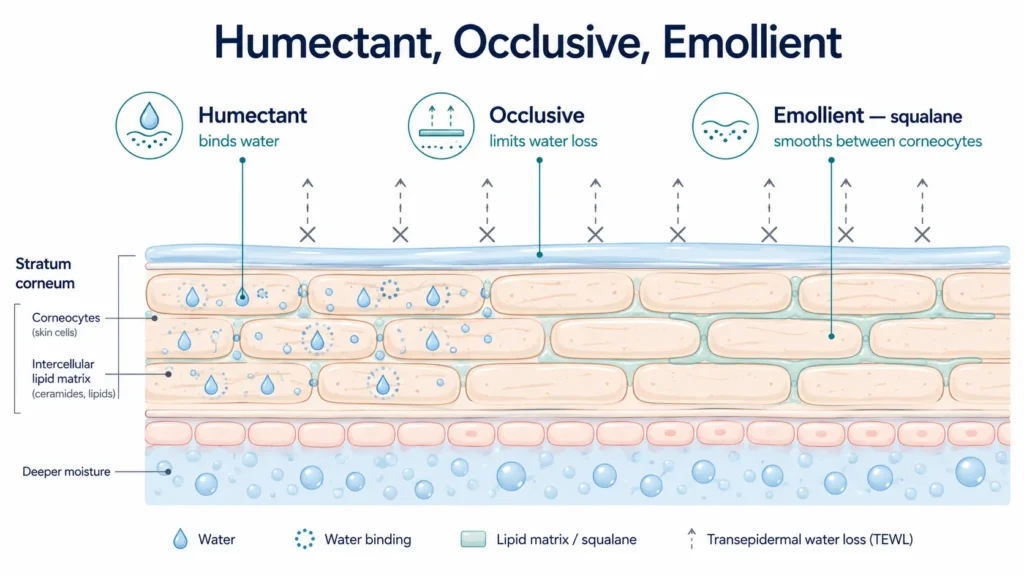
An emollient helps improve the smoothness and softness of the skin surface. In a cosmetic formula, this does not necessarily mean squalane is the principal active ingredient. Its role is often to improve the way a formula spreads, feels during application, and finishes on the skin.
That makes it useful when a product has to balance two objectives: delivering a nourished, moisturized after-feel, while avoiding an excessively greasy, sticky, or heavy sensory profile.
Because squalane is a clear oily liquid used in facial oils, serums, and creams, it is often described commercially as “squalane oil.” The cosmetic ingredient name remains Squalane; “squalane oil” is a product description rather than a separate INCI name.
Squalane as a cosmetic emollient
Squalane can contribute to several formulation characteristics:
- Skin softness and smoothness
- Improved spreading over the skin or hair
- Better slip during application
- A refined, less sticky after-feel
- Oil-phase flexibility in emulsions and anhydrous products
- Barrier-care and moisturization-oriented product positioning
These are primarily formulation and sensory functions. Finished-product performance still depends on the complete formula, use level, packaging, stability, application method, and supporting product tests.
Is Squalane the Same as Squalene?
Squalane and squalene are related, but they are not interchangeable.
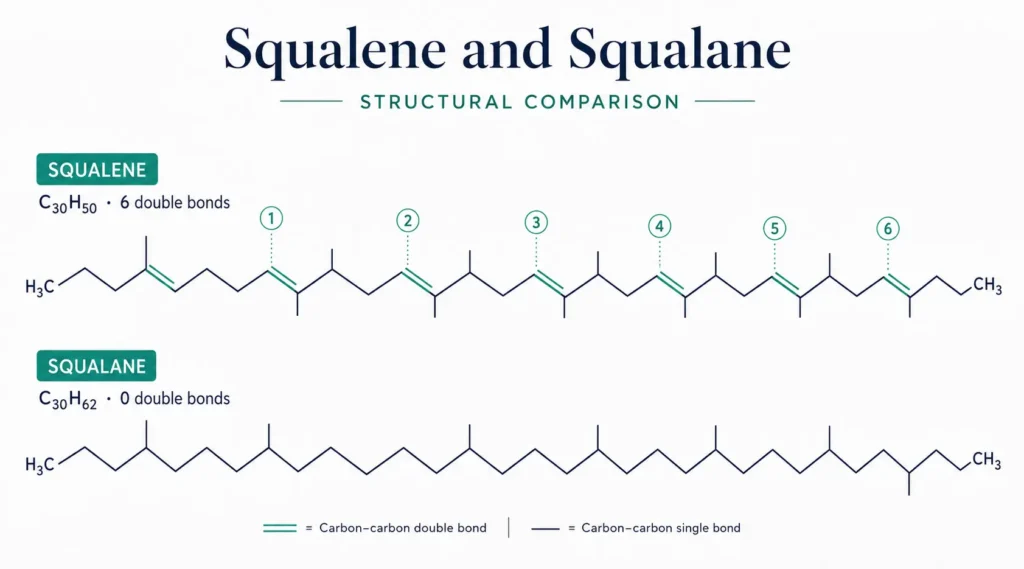
Squalene is an unsaturated compound. Squalane is the saturated material generally obtained by hydrogenating squalene. This difference affects oxidation stability and helps explain why squalane, rather than squalene, is the material normally used in finished cosmetic formulations.
| Squalene | Squalane |
|---|---|
| Unsaturated precursor | Saturated derivative |
| Contains multiple carbon–carbon double bonds | Double bonds have been hydrogenated |
| More susceptible to oxidation | More stable toward air and oxygen |
| Source material or biological lipid | Common cosmetic emollient |
Both compounds occur in human skin lipids
Neither compound is foreign to skin. The Cosmetic Ingredient Review safety assessment documentation describes squalane as a normal constituent of human sebum, present at up to approximately 2.6%, and as the most common hydrocarbon in those lipids after squalene. Kim and Karadeniz likewise report squalene as one of the major constituents of human sebum.
This is a compositional observation, not a performance claim. Natural occurrence in skin lipids does not by itself substantiate any finished-product effect.
The Cosmetic Ingredient Review safety assessment for Squalane and Squalene provides an external reference for cosmetic use and safety evaluation. Chemistry, oxidation behaviour, and the formulation consequences of the difference are covered in Squalane vs Squalene: Stability, Source and Cosmetic Formulation Differences.
Where Does Cosmetic Squalane Come From?
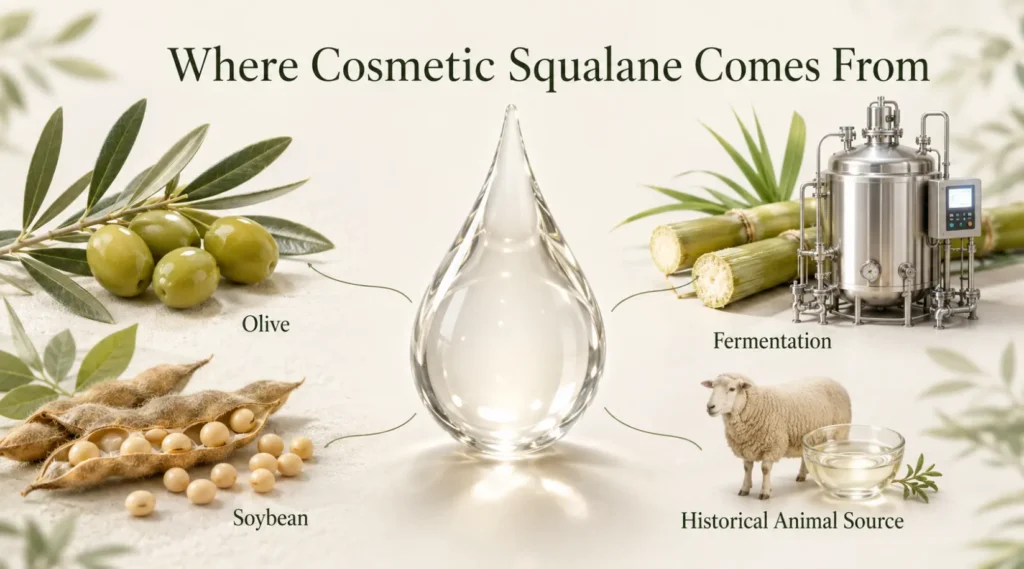
The INCI name Squalane does not reveal the original feedstock. Commercial squalane may be associated with several source routes:
- Shark liver oil
- Olive oil or olive-oil by-products
- Soybean oil
- Sugarcane-derived fermentation routes
- Other vegetable-oil feedstocks
Historically, shark liver oil was an important source. Plant and fermentation routes have become increasingly relevant for companies seeking non-animal sourcing, traceability, supply diversity, or sustainability-oriented positioning; the shift toward fermentation-derived and microbial routes has been documented in the review literature.
Source alone does not determine final quality
Source is an important procurement question, but it should not be the only approval criterion. Two materials sharing the same INCI name and the same broad source category can still differ in squalane content, residual related hydrocarbons, color, odor, acid and iodine values, low-temperature clarity, purification route, batch-to-batch consistency, and available traceability documents.
Buyers should therefore avoid assuming that every olive-derived, soybean-derived, or fermentation-derived grade will produce the same sensory and visual result.
Example: a soybean-oil route
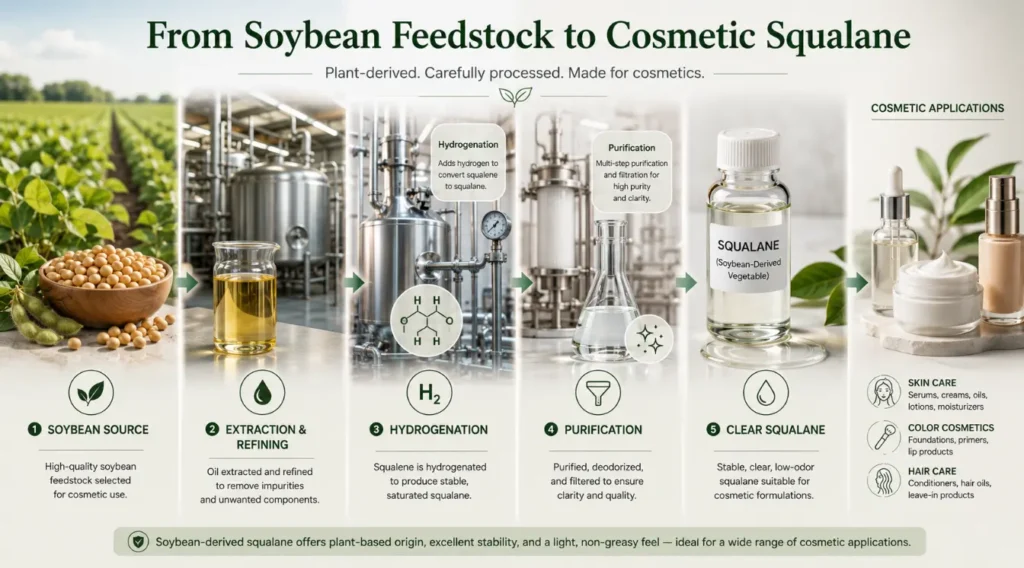
The current NOYAIN grade is vegetable squalane derived from soybean oil. The supplier process information begins with deodorized distillates of soybean oil and includes esterification, dynamic crystallization, coupled distillation, hydrogenation, further distillation, inspection, and packing.
That process description supports the source claim for this specific grade. It should not be read as the only possible route for all soybean-derived squalane.
Source-route comparison, sustainability positioning, and the documents that support a plant-origin claim are covered in What Is Squalane Made From? Olive, Sugarcane and Other Source Routes and Plant-Derived Squalane for Cosmetics: What Buyers Should Verify.
What Does Squalane Do in Cosmetic Formulations?
Squalane is principally useful because of how it affects the skin feel and application properties of a finished formula. It should not be treated only as a consumer-facing hero ingredient; for formulators and product developers its functional contribution matters just as much.
1. Emolliency and skin softness
Squalane helps create a smoother, softer surface feel, which suits products designed for dry-skin care, daily moisturization, barrier-oriented positioning, and premium sensory performance.
Its contribution differs from that of a humectant such as glycerin or hyaluronic acid. Humectants primarily help attract or retain water; squalane contributes oil-soluble emolliency and supports softness, flexibility, and reduced roughness. The two ingredient types are complementary rather than interchangeable.
2. Spreadability and slip
Squalane can improve how a formula spreads across the skin. This is relevant in facial oils that should distribute evenly, creams that should not drag, sunscreens that require uniform spreading, foundations and primers that need smooth glide, and hair oils that should coat without excessive weight.
Improved slip can influence perceived product quality, particularly in premium skincare and color cosmetics. Instrumental and sensory research on cosmetic emollients, including squalane, has evaluated attributes such as spreading, residue, stickiness, slipperiness, softness, and oiliness.
3. Sensory modification
A formula may contain effective emollients and still feel too waxy, sticky, thick, or greasy. Squalane can be used to adjust that profile, adding smoothness and lubrication without the heavy feel associated with some richer oils.
NOYAIN product information describes a soft, smooth, non-greasy, non-sticky sensory profile — a supplier-level sensory description rather than a standardized clinical outcome.
4. Support for barrier-care positioning
Squalane is frequently selected for products positioned around dryness, skin comfort, softness, moisturized appearance, barrier-oriented skincare, and gentle or sensitive-skin concepts.
The wording should remain cosmetic. Claims such as treating dermatitis, healing damaged tissue, reducing allergic reactions, or modifying inflammation require a different level of evidence and may create regulatory concerns.
Where Is Squalane Used?
| Application | Typical formulation role |
|---|---|
| Facial oils | Main emollient or part of an anhydrous oil base |
| Serums | Improves softness, spreading, and after-feel |
| Creams and lotions | Supports emolliency and moisturized skin feel |
| Sunscreens | Improves glide and helps balance oily sensory perception |
| After-sun products | Supports comfort and softness positioning |
| Foundations and primers | Improves slip, spreadability, and finish |
| Lip products | Contributes lubrication and smooth application |
| Hair oils | Helps improve smoothness and shine |
| Conditioners | Supports coating, softness, and reduced heavy feel |
Application-specific formulation guidance is handled on dedicated pages:
- Squalane for lightweight facial oils and serums
- Squalane for moisturizer and barrier-care formulations
- Squalane for hair and scalp care formulations
- Squalane for cleansers and cleansing oils
- Squalane for lip and body care formulations
On use level: supplier documentation for the NOYAIN grade gives a broad material-level range rather than a single recommended figure, and CIR safety assessment documentation similarly reports cosmetic use of squalane spanning from below 0.1% to above 50% depending on product type. Neither should be read as a formulation recommendation. The working level depends on product format, target sensory profile, total oil phase, other emollients, the emulsifier system, packaging, stability requirements, and cost target.
What Should Buyers Check in Cosmetic-Grade Squalane?
Approval should go beyond confirming the INCI name. Five checks separate grades in practice.
1. Source and traceability
Ask the supplier: what is the original feedstock; is the material animal-, plant-, or fermentation-derived; is a source statement available; and is the source consistent between batches?
A plant-origin statement is not a purity statement. A material can be produced entirely from plant feedstocks while the finished commercial grade contains squalane plus small amounts of related hydrocarbons.
2. Squalane content and composition
The specification should state a minimum assay. The NOYAIN grade is specified at ≥92% squalane, typically 92%–94%.
Keep the two ideas separate:
- Plant-derived describes the feedstock route.
- Squalane content describes the composition of the commercial material.
“100% plant-derived” should therefore never be rewritten as “100% pure squalane.”
3. Appearance, odor, and low-temperature clarity
Squalane is often used in products where color and fragrance are commercially important. Visible color, haze, or an unexpected odor can affect clear facial oils, white emulsions, fragrance-free products, and premium color cosmetics. The NOYAIN specification describes a clear, colorless oily liquid with no odor; buyers should also ask whether odor is evaluated per batch rather than relying on a general sales description.
Low-temperature clarity matters for transparent facial oils, clear oil serums, products in clear packaging, cold-climate distribution, and transport routes exposed to low temperatures. Some vegetable-derived grades develop haze or wax-like precipitation under cold conditions.
The NOYAIN process incorporates crystallization at −15 °C and cold filtration. In internal supplier screening, the grade remained clear after 24 hours at 4 °C while the tested olive-derived comparison sample developed visible haze. This is a supplier-specific comparison on single samples, not evidence that every soybean-derived grade outperforms every olive-derived grade. Oxidation and processing behaviour are covered in Squalane Stability in Cosmetic Formulations.
4. Other specification parameters worth controlling
| Parameter | What it supports |
|---|---|
| Acid value | Monitoring free acidic components and possible quality change |
| Iodine value | Residual unsaturation; confirms the hydrogenated grade |
| Saponification value | Additional composition control; residual saponifiable components |
| Relative density, refractive index | Identity confirmation and incoming batch comparison |
| Heavy metals, microbiological quality | Standard cosmetic raw-material safety limits |
These are interpreted against the supplier’s test methods and the approved specification; a single number means little without the agreed analytical method. Parameter-by-parameter interpretation is covered in Squalane Physical Properties: Density, Appearance and Handling.
5. Batch documents
A B2B buyer should normally request the current batch COA, the specification or TDS, the SDS, a source or plant-origin statement, available process information, packaging details, and shelf-life and storage information. Which document answers which question is covered in Squalane SDS, TDS and COA: Which Documents Buyers Should Request.
One regulatory note: the European Commission explains that CosIng is an informational cosmetic ingredient database. An INCI name appearing there does not itself constitute authorization for every cosmetic use, so buyers still need to assess the applicable market requirements and the finished product.
Evaluating squalane for a new cosmetic project?
Review the NOYAIN squalane grade and specification, or request a sample for sensory and stability screening in your own formula.
Example: A Soybean-Derived Vegetable Squalane Grade
| Item | Product information |
|---|---|
| INCI | Squalane |
| CAS number | 111-01-3 |
| Source | Soybean oil |
| Appearance | Clear, colorless oily liquid |
| Odor | Odorless |
| Squalane content | ≥92% (typically 92%–94%) |
| Application areas | Skincare, sun care, after-sun care, color cosmetics, hair care, body care |
| Shelf life | 24 months |
| Packaging | Epoxy phenolic steel drums or customized packaging |
| Storage | Sealed, room temperature, ventilated and dry |
| Available documentation | Specification, COA, SDS, process information |
The specification also sets limits for acid value, iodine value, saponification value, relative density, refractive index, heavy metals, and microbiological quality. These details support procurement evaluation, but they do not replace testing in the buyer’s intended formula and packaging.
Squalane Raw Material Buyer Checklist
| Checkpoint | Question to ask |
|---|---|
| Ingredient identity | Is the INCI name confirmed as Squalane? |
| Source | What feedstock is used? |
| Traceability | Is a source statement available, and consistent between batches? |
| Assay | What is the minimum squalane content? |
| Related components | Does the supplier disclose the expected composition range? |
| Appearance | Is the material consistently clear and colorless? |
| Odor | Is each batch evaluated for odor? |
| Acid and iodine values | Are maximum limits controlled and tested? |
| Saponification value | Is it part of batch quality control? |
| Identity parameters | Are relative density and refractive index controlled? |
| Cold clarity | Has the grade been screened under low-temperature conditions? |
| Safety information | Is a current SDS available? |
| Batch evidence | Can the supplier provide a current COA? |
| Finished-product suitability | Has the material been tested in the intended formula and packaging? |
What This Guide Does Not Cover
Each of the following is treated separately so it can be covered with the depth it needs:
| Topic | Article |
|---|---|
| Chemistry, oxidation, stability implications | Squalane vs Squalene |
| Source-route comparison and sustainability positioning | What Is Squalane Made From? |
| Efficacy evidence and claim boundaries | Squalane Benefits in Skincare |
| Oil-phase design, use levels, processing | Squalane Function in Cosmetics |
| Comedogenicity and evidence limits | Is Squalane Comedogenic? |
| Supplier evaluation and commercial terms | How to Evaluate a Squalane Supplier |
Frequently Asked Questions
Is squalane an oil?
Squalane is an oil-soluble, oily liquid used as a cosmetic emollient. It is often described commercially as squalane oil, especially in facial oils and consumer products, but its INCI name is Squalane.
What is squalane good for?
In a formula, squalane is mainly used to improve softness, spreadability, slip, and after-feel, and to lighten a sensory profile that would otherwise feel greasy or heavy. It is an emollient and sensory modifier rather than a water-binding humectant or an active ingredient, so what it is “good for” is best defined at the formulation level and confirmed by finished-product testing.
Is all squalane plant-derived?
No. Commercial squalane can be associated with animal, plant, or fermentation-related source routes. Buyers should request source information for the specific grade being evaluated.
Is squalane made from sharks?
Some squalane has historically been produced from shark liver oil. Modern commercial grades are also produced from olive, soybean, sugarcane, fermentation, and other non-animal feedstocks. The INCI name alone does not disclose the source.
What is the INCI name of squalane?
The INCI name is Squalane, and the associated CAS number is 111-01-3.
Is squalane the same as squalene?
No. Squalene is unsaturated, while squalane is the saturated material obtained after hydrogenation. That difference gives squalane greater oxidation stability for cosmetic formulation.
Is soybean-derived squalane a concern for soy allergen labelling?
Squalane is a purified hydrocarbon, so a well-refined grade is not expected to carry soy protein. Rather than relying on that assumption, buyers should request a written statement covering protein or allergen residues, together with the specification and batch COA, and assess it against the labelling requirements of the target market.
Can soybean-derived squalane support non-GMO or vegan positioning?
Positioning of that kind must be document-based. Ask specifically for a plant-origin declaration, non-GMO status where the market requires it, and any relevant certification, and confirm that the wording the supplier can support matches the wording planned for the finished product.
Can squalane be used in hair care?
Yes. Squalane is used in hair oils, conditioners, serums, and leave-on products to support smoothness, coating, shine, and a lighter sensory profile. The final level should be determined through finished-product testing.
Conclusion
Squalane is a functional cosmetic emollient, and its commercial suitability depends on the specific grade rather than on the ingredient name. The INCI name establishes identity; the specification, source documentation, processing, and finished-product testing determine whether a grade fits a particular project.
Source soybean-derived vegetable squalane for your next cosmetic project.
Review the NOYAIN squalane oil specification, or contact the NOYAIN team to request the current SDS, batch COA, source statement, and sample availability.
References
- National Center for Biotechnology Information. Squalane — PubChem Compound Summary, CID 8089. PubChem.
- Fiume M, Bergfeld WF, Belsito DV, et al. Squalane and Squalene. International Journal of Toxicology. 2023;42(3 Suppl):107S–109S. doi:10.1177/10915818231204276.
- Kim SK, Karadeniz F. Biological Importance and Applications of Squalene and Squalane. Advances in Food and Nutrition Research. 2012;65:223–233. doi:10.1016/B978-0-12-416003-3.00014-7.
- Parente ME, Gámbaro A, Solana G. Study of Sensory Properties of Emollients Used in Cosmetics and Their Correlation with Physicochemical Properties. Journal of Cosmetic Science. 2005;56(3):175–182. PMID:16116522.
- Mendes A, Azevedo-Silva J, Fernandes JC. From Sharks to Yeasts: Squalene in the Development of Vaccine Adjuvants. Pharmaceuticals. 2022;15(3):265. doi:10.3390/ph15030265.
- Shalu S, Karthikanath PKR, Vaidyanathan VK, et al. Microbial Squalene: A Sustainable Alternative for the Cosmetics and Pharmaceutical Industry — A Review. Engineering in Life Sciences. 2024;24(10):e202400003. doi:10.1002/elsc.202400003.
- Cosmetic Ingredient Review. Safety Assessment of Squalane and Squalene as Used in Cosmetics.
- European Commission. Cosmetic Ingredient Database — CosIng.
- European Chemicals Agency. Substance Information: 2,6,10,15,19,23-Hexamethyltetracosane (Squalane), CAS 111-01-3.