Squalane’s function as a cosmetic emollient is well documented. A large share of the benefit claims circulating around it is not. The two get quoted in the same breath, and that is a problem for whoever has to sign off on a product claim.
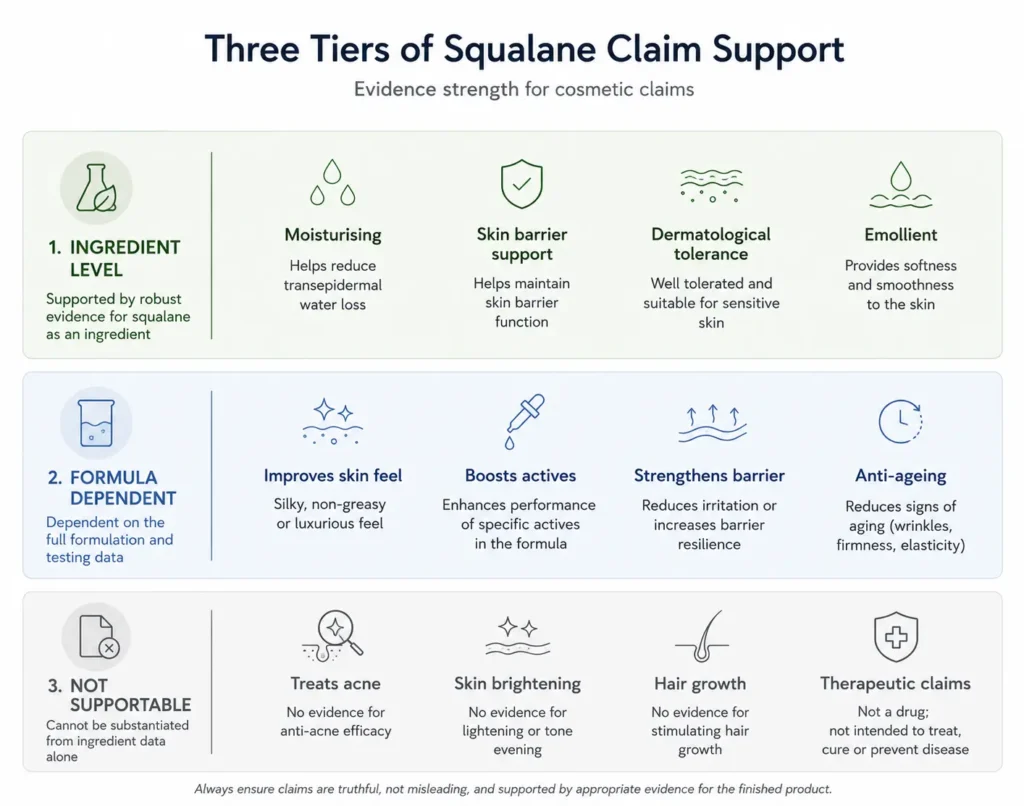
This article sorts them into three groups: what is established at ingredient level, what depends on the finished formula, and what cannot be supported from raw-material data at all. Some of the answers are “not from ingredient data,” which is a useful answer if you are building a claim dossier and an inconvenient one if you are writing marketing copy.
For the material’s identity, specification, and applications, start with What Is Squalane?
A note on the data in this article. Where a study used a finished multi-ingredient product rather than squalane alone, this article says so, because the distinction determines what can be claimed. Where a statement comes from NOYAIN documentation, it is labelled as such.
Quick Answer
Squalane is an oil-soluble emollient and sensory modifier. It softens the skin surface, spreads readily, and lightens the feel of an oil phase that would otherwise be heavy. That much is well characterised. Beyond it, claims need to be checked one at a time.
| Established at ingredient level | Depends on the finished formula | Not supportable from ingredient data |
|---|---|---|
| Emolliency and surface softening | Measured hydration or TEWL outcomes | Anti-wrinkle, firming, elasticity |
| Spreadability, slip, after-feel | Sensory result in a specific product | Anti-inflammatory or anti-allergic effects |
| Oxidative stability | Suitability for a skin-type position | Barrier repair as a therapeutic claim |
| Reviewed safety status for cosmetic use | Non-greasy or lightweight positioning | Acne treatment or prevention |
What an Emollient Actually Does
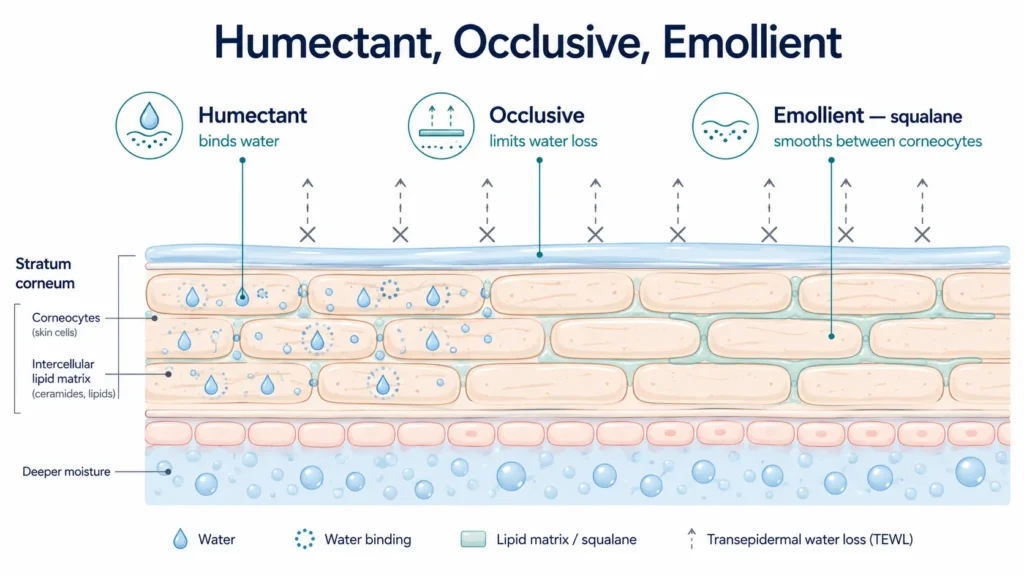
Moisturising ingredients are conventionally grouped in three categories: humectants, which draw and bind water; occlusives, which limit water loss from the surface; and emollients, which smooth and soften the stratum corneum. Squalane belongs to the third group, with some overlap into the second.
The part most consumer-facing writing skips is that emolliency is a surface and sensory function. It is real, it is measurable, and it is a different category of statement from treating a condition. A formulator choosing squalane is choosing how a product will spread, how it will finish, and how heavy the oil phase will feel — not buying a therapeutic mechanism.
That framing matters commercially, because it is where defensible claims live. Squalane is normally classified with moisturizing and emollient raw materials, and the claims that survive scrutiny tend to be the ones phrased at that level.
What Is Well Established
Emolliency, spreadability, and after-feel
This is squalane’s core function and it is properly studied. Instrumental and sensory research on cosmetic emollients, including squalane, has evaluated attributes such as spreading, residue, stickiness, slipperiness, softness, and oiliness, and correlated them with physicochemical properties. For a formulator this is the most directly useful evidence that exists on the material, because it maps onto the decisions actually being made.
Oxidative stability
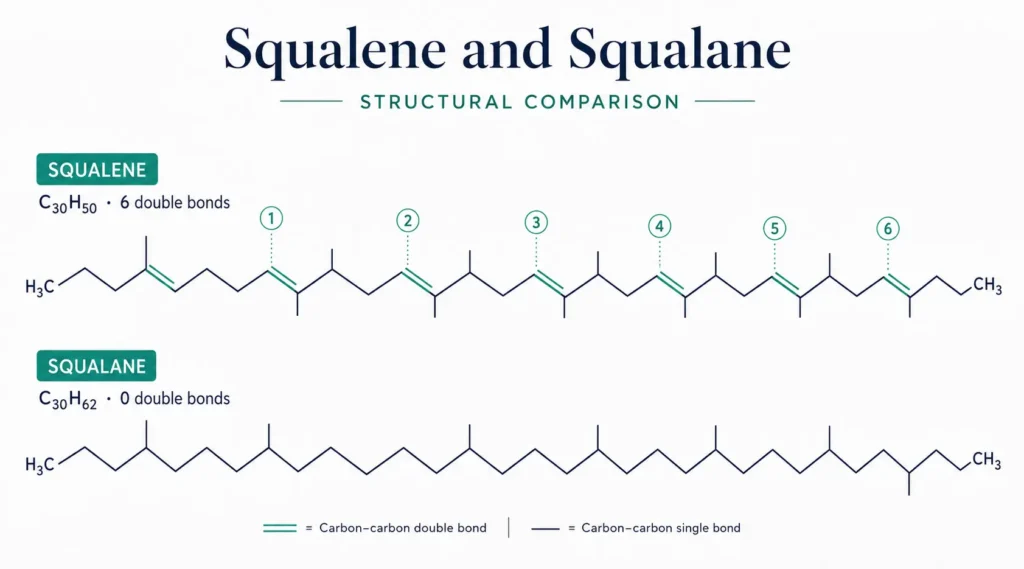
Squalane is fully saturated. Its unsaturated precursor squalene is not, and the difference in oxidation behaviour is chemistry rather than marketing. This is why finished formulations use the hydrogenated material, and it is set out in Squalane vs Squalene.
Reviewed status for cosmetic use
The Cosmetic Ingredient Review has assessed squalane and squalene as used in cosmetics, and CIR documentation reports cosmetic use of squalane across a wide concentration span, from below 0.1% to above 50% depending on product type. That is a statement about established use and safety review, not about efficacy — the two are frequently conflated in ingredient marketing.
Occurrence in human skin lipids
CIR documentation describes squalane as a normal constituent of human sebum, present at up to around 2.6%, and as the most common hydrocarbon in those lipids after squalene.
This is a compositional fact and should be presented as one. Natural occurrence in skin lipids does not, by itself, substantiate any effect on skin. The inference from “your skin already contains this” to “therefore it does the following” is exactly the step this article is written to interrupt.
What Depends on the Finished Formula
Hydration and transepidermal water loss belong here rather than in the section above, and the reason is worth being precise about.
The human data available on squalane-containing products comes from multi-ingredient formulations. One study followed 21 volunteers over 60 with xerosis applying a cream containing squalane together with ceramides and 5% urea to one forearm for 28 days, reporting a mean reduction in TEWL of roughly 1.07 g/m²/h alongside increases in stratum corneum capacitance. Another, cited for effects on skin aesthetics, used a serum containing both bakuchiol and squalane — and the source reporting it acknowledges that the contribution of each cannot be separated.
Those may be sound studies of those products. Neither isolates squalane, and neither can be used to attribute an effect to the ingredient.
What follows is practical rather than discouraging. A brand can run finished-product corneometry or TEWL measurement on its own formulation and substantiate a hydration claim for that product. What it cannot do is import the claim from raw-material literature and expect the dossier to hold. The difference between those two positions is the difference between a claim that survives a retailer’s or regulator’s challenge and one that does not.
The same logic applies to sensory outcome, non-greasy or lightweight positioning, and suitability for a particular skin-type narrative. All are achievable and all are properties of the formula, not of the drum.
What Cannot Be Supported From Ingredient Data
Some claims appear regularly in squalane marketing and cannot be built on raw-material evidence:
- Anti-wrinkle, firming, or skin-elasticity claims
- Anti-inflammatory, anti-allergic, or soothing framed as a therapeutic effect
- Barrier repair, as distinct from a cosmetic moisturisation or barrier-support statement
- Acne treatment or prevention, in either direction
- Any comparative claim against another ingredient without a head-to-head study on the finished products
It is worth being explicit about why in-vitro results do not close this gap. An enzyme-inhibition result on neat material — elastase, hyaluronidase, or anything else — establishes that the material interacts with an enzyme in a tube at the tested concentration. It does not establish an effect on skin, at a cosmetic use level, in a formula, over a period of use. Screening data of that kind is genuinely useful for deciding what to investigate. It is not claim support, and presenting it as clinical validation invites exactly the challenge it is meant to pre-empt.
Several of the claims above sit in drug or functional-cosmetic territory in the EU, Japan, Korea, and the United States, each with its own approval or substantiation pathway. A cosmetic raw material specification does not open any of them.
The Citation Problem on This Topic
Anyone assembling a claim dossier on squalane will meet three recurring problems in the published material available online.
Figures with no traceable source. Specific percentages are attributed to named journals without an author, year, or volume, and then repeated across sites until they look established. Pulling the journal rarely produces the paper.
Citations attached to the wrong compound. Squalane and squalene differ by one letter, and papers about squalene — particularly the work on its oxidation products in acne-prone skin — are cited in support of statements about squalane. These are different molecules answering different questions, as Squalane vs Squalene sets out.
Finished-product results reported as ingredient results. As above: a multi-ingredient cream’s performance becomes “squalane reduces TEWL by” in the retelling.
The practical response is a four-step check on any figure before it enters a dossier. Pull the primary paper. Confirm it studied squalane and not squalene. Confirm the test material was squalane rather than a formulation. Confirm the measured endpoint matches the claim being made. Most circulating figures fail at least one of the four, and it is faster to find that out before a retailer’s compliance team does.
What to Ask a Supplier
A raw material supplier can reasonably be expected to provide identity and specification, a current batch certificate of analysis, source documentation, and safety data — and to be clear about what is and is not efficacy evidence.
Where in-vitro screening data is offered, the method and the test concentration should come with it. Results generated on neat material at 100% concentration are screening data. They can be shared as such, and they should be labelled as such.
The NOYAIN squalane grade and specification covers the material as supplied, including the composition of the non-squalane fraction discussed in Squalane vs Squalene, and the source documentation described in What Is Squalane Made From?
Frequently Asked Questions
What does squalane do for skin?
At the level the evidence supports: it softens and smooths the skin surface, spreads easily, and gives a lighter after-feel than heavier oils. In formulation terms it is an emollient and sensory modifier rather than an active ingredient.
Does squalane hydrate the skin?
Squalane contributes to a formula’s moisturising performance as an emollient, and squalane-containing products have shown measured hydration and TEWL improvements — but in the studies available those products contained other ingredients as well. A hydration claim should be substantiated on the finished product rather than imported from ingredient literature.
Is squalane good for anti-ageing?
Anti-wrinkle, firming, and elasticity claims cannot be supported from raw-material data on squalane. Squalane can legitimately be part of a product positioned around dryness, comfort, and skin softness, which is a different claim in a different regulatory category.
Can a brand claim barrier repair with squalane?
Not on the strength of ingredient data. Cosmetic moisturisation and barrier-support wording is generally workable; “repair” language moves toward a therapeutic claim and needs both a different evidence base and a check against the requirements of each target market.
Is squalane suitable for sensitive-skin positioning?
It is widely used in products positioned that way, and its saturated structure and reviewed safety status support that use. Suitability for a sensitive-skin position is still a finished-product question, established by appropriate testing on the product rather than assumed from the ingredient.
What evidence does a supplier need to provide for a claim?
Suppliers substantiate the material: identity, specification, batch conformity, source, and safety. Claims about what a product does to skin are substantiated by the brand on the finished product. A supplier that offers to provide the second is worth a careful read of the method.
Conclusion
Squalane is a well-characterised emollient with a narrower evidence base than its marketing suggests. For a B2B buyer that is workable rather than disappointing: the claims that hold up are the ones that survive a retailer questionnaire, and knowing which those are before a launch is cheaper than finding out afterwards.
Related Reading
- What Is Squalane? Sources, functions, and raw material selection
- Squalane vs Squalene: what hydrogenation changes
- What Is Squalane Made From? Source routes and how to verify them
- Dimethicone vs Squalane: what squalane can and cannot replace
- All squalane articles and resources
References
- Parente ME, Gámbaro A, Solana G. Study of sensory properties of emollients used in cosmetics and their correlation with physicochemical properties. Journal of Cosmetic Science. 2005;56(3):175–182. PMID:16116522.
- Cosmetic Ingredient Review. Safety assessment of squalane and squalene as used in cosmetics.
- Fiume M, Bergfeld WF, Belsito DV, et al. Squalane and squalene. International Journal of Toxicology. 2023;42(3 Suppl):107S–109S. doi:10.1177/10915818231204276.
- Kim SK, Karadeniz F. Biological importance and applications of squalene and squalane. Advances in Food and Nutrition Research. 2012;65:223–233.
- Squalane, ceramide and 5% urea cream in elderly xerosis — 28-day forearm study. PRIMARY PAPER TO BE LOCATED AND VERIFIED BEFORE PUBLISHING.
- Gholap A, et al. Daily use of a bakuchiol and squalane-containing face serum impacts skin esthetics. CosmoDerma. 2023. VERIFY citation details before publishing.
- National Center for Biotechnology Information. Squalane — PubChem Compound Summary, CID 8089.