Many soothing cosmetic actives look attractive on paper, but formulators often face practical problems such as poor water solubility, precipitation, limited stability, high solvent demand, or discomfort in sensitive skin formulas. This article explains supramolecular technology in practical cosmetic terms, then uses NY HauteCalmin as a case study to show how a supramolecular co-assembled soothing active system can support sensitive skin, redness appearance care, and strong-active comfort formulations.
Key Takeaways
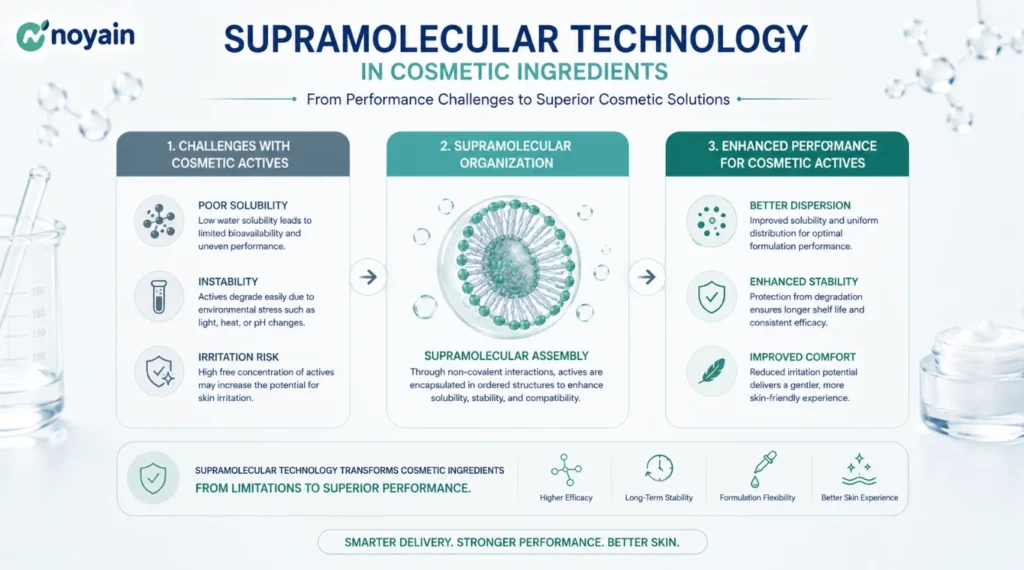
- Supramolecular technology organizes molecules through non-covalent interactions, rather than changing the active ingredient by forming a new covalent molecule.
- In cosmetics, it is mainly used to improve solubility, dispersion, stability, skin delivery, and mildness of difficult active ingredients.
- Cyclodextrin inclusion, host-guest systems, co-assembly, and nanoscale supramolecular structures are common technology directions.
- The value for formulators is practical: fewer precipitation problems, better compatibility, lower irritation risk, and more flexible sensitive skin product design.
- NY HauteCalmin is a useful case study because it applies supramolecular co-assembly to a soothing active system based on Hydroxyphenyl Propamidobenzoic Acid and Ectoin.
Quick Answer: What Is Supramolecular Technology?
Supramolecular technology is the use of organized molecular interactions, such as hydrogen bonding, van der Waals forces, electrostatic attraction, hydrophobic effects, or host-guest inclusion, to build functional structures from existing molecules.
In simple terms, traditional chemistry often asks, “What molecule do we synthesize?” Supramolecular technology asks, “How can existing molecules assemble, interact, and behave better together?”
That distinction matters in cosmetic ingredients. Many effective actives are not easy to formulate. They may crystallize in water, irritate sensitive skin, degrade during storage, or fail to disperse well in a finished product. Supramolecular technology gives formulators another lever: instead of only increasing the concentration or adding more solvents, they can improve how the active is organized in the formula.
How This Relates to NY HauteCalmin
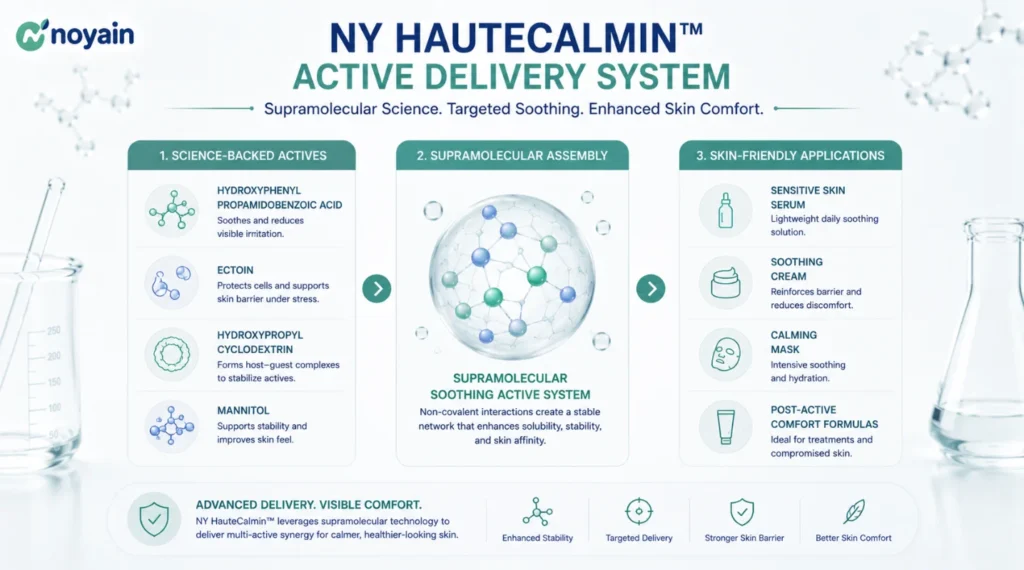
NY HauteCalmin is a supramolecular co-assembled soothing active system. It is built around Hydroxyphenyl Propamidobenzoic Acid and Ectoin, but the key point is not simple blending. The system is designed to improve the formulation usability of HPA, including dispersion, solubility behavior, skin comfort positioning, and sensitive skin application potential.
For buyers who already need specifications, dosage, COA, TDS, SDS/MSDS, or sample support, the NY HauteCalmin product page provides the commercial entry point. The rest of this article explains the technology logic behind that type of active system.
Why Supramolecular Technology Matters for Sensitive Skin Formulations
Supramolecular technology matters for sensitive skin formulations because many ingredient problems are not only chemical identity problems, but also structure, solubility, dispersion, and comfort problems.
Supramolecular chemistry has a strong scientific foundation, including Nobel-recognized work on molecular recognition and organized molecular structures. In cosmetic formulation, however, its value is practical: helping difficult actives become easier to dissolve, stabilize, deliver cosmetically, and use in skin-friendly products.
This is especially relevant for soothing and sensitive skin products. A formulator is not only trying to add a calming ingredient. They are trying to keep the formula clear or uniform, reduce solvent burden, avoid late-stage precipitation, maintain pleasant sensory properties, and support comfort when the formula contains acids, retinoids, brightening agents, or other high-activity components.
How Supramolecular Technology Works in Cosmetic Ingredients
Supramolecular technology works by using weak, reversible interactions to organize active ingredients, carriers, or support molecules into functional assemblies.
These interactions are not weak in the everyday sense. Individually, they are weaker than covalent bonds. Together, they can create stable and useful systems. This is why supramolecular systems can change physical properties without necessarily changing the chemical identity of the active ingredient.
Common mechanisms include:
| Mechanism | What It Means | Cosmetic Formulation Value |
|---|---|---|
| Host-guest inclusion | A host molecule, such as cyclodextrin, holds part of an active molecule inside a cavity | Can improve apparent solubility, odor masking, dispersion, or release profile |
| Co-assembly | Two or more molecules organize into a stable structure through non-covalent interactions | Can improve compatibility, reduce crystallization, and create functional synergy |
| Micellar or nanoscale organization | Molecules form small ordered structures in water or mixed phases | Can improve dispersion and delivery of poorly soluble actives |
| Controlled release | The active is not all freely exposed at once | May reduce direct irritation and support a smoother sensory profile |
| Carrier-assisted delivery | A carrier helps the active disperse in the formula and interact with the skin surface more consistently | Can support better active availability in the finished product |
A recent review on cyclodextrins in cosmetics discusses why host-guest systems are relevant for cosmetic formulation, especially when solubility, stability, or controlled release are important.
{IMG-02 | Before “Traditional Mixing vs Supramolecular Co-Assembly” | Supramolecular co-assembly for soothing actives | Split comparison graphic: HPA + Ectoin simply mixed on the left, co-assembled supramolecular system on the right, showing why co-assembly is not just simple blending. | Self-made infographic}
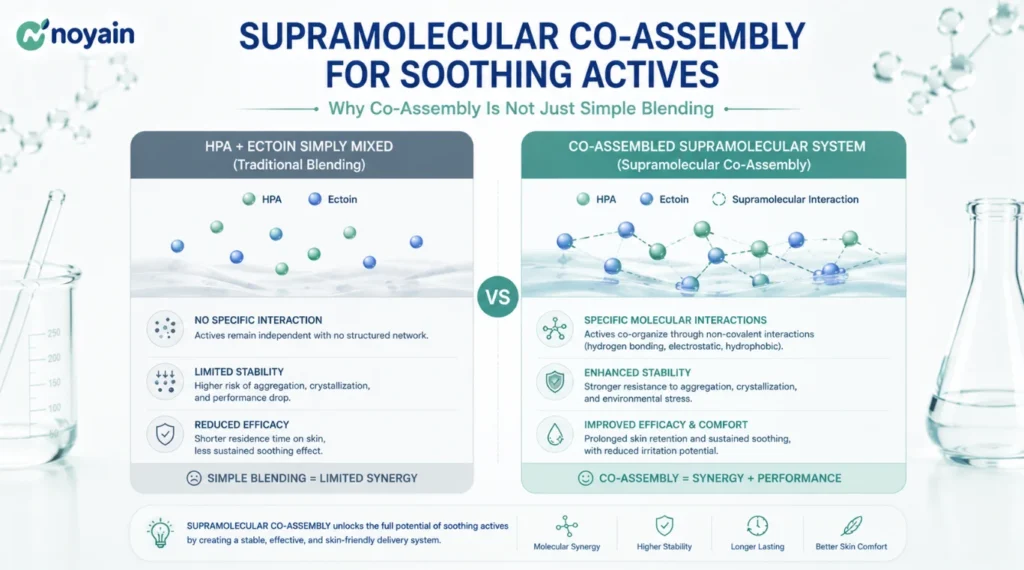
Traditional Mixing vs Supramolecular Co-Assembly
Traditional mixing puts ingredients into the same formula. Supramolecular co-assembly designs how selected molecules interact before or during formulation.
| Dimension | Traditional Ingredient Mixing | Supramolecular Co-Assembly |
|---|---|---|
| Main idea | Combine ingredients in one formula | Organize molecules into functional assemblies |
| Solubility strategy | Add solvent, glycol, surfactant, or adjust pH | Use host-guest inclusion, co-assembly, or carrier systems |
| Stability strategy | Rely on antioxidants, chelators, packaging, pH control | Add molecular-level protection or improved dispersion |
| Irritation strategy | Lower active level or add soothing ingredients | Control active exposure, release, and local concentration |
| Marketing story | Ingredient list focused | Technology and performance focused |
| Limitation | Can be simple but may not solve difficult active behavior | Requires technical validation and raw material documentation |
This comparison does not mean supramolecular systems replace good formulation practice. pH, preservation, packaging, viscosity, sensory profile, and compatibility still matter. Supramolecular technology works best when it is treated as part of a full formulation strategy.
What Problems Can Supramolecular Technology Solve?
Supramolecular technology is most useful when the active ingredient has a clear benefit but poor formulation behavior.
1. Poor Solubility
Poor solubility is one of the most common reasons a promising active becomes difficult to commercialize.
Many cosmetic formats are water-rich: toners, essences, serums, gel creams, sheet mask liquids, and lightweight lotions. If an active has poor water solubility, formulators may see turbidity, sediment, crystal precipitation, or a need for high levels of glycols and solubilizers. Those fixes can work, but they may also affect skin feel, preservation, viscosity, cost, and irritation potential.
Supramolecular systems can increase apparent solubility by changing how the active exists in the formula. This does not mean every active becomes freely soluble in every base. It means the formulator has a more structured way to manage dispersion and precipitation risk.
2. Instability During Storage
Instability is not always dramatic. Sometimes it appears as slow color drift, odor change, crystal growth, pH movement, or a gradual drop in perceived efficacy.
By placing actives in a more organized microenvironment, supramolecular technology may help reduce exposure to stressors such as oxygen, light, water activity, or incompatible formula components. The finished formula still needs stability testing, but the technology can provide a more robust starting point.
3. Irritation and Sensory Discomfort
Sensitive skin formulation is not only about choosing “gentle” ingredients. It is also about controlling how active ingredients are presented to the skin.
For acids, retinoids, brightening actives, and some anti-acne ingredients, discomfort can be linked to high local concentration, fast release, low pH, solvent load, or barrier-compromised skin. A supramolecular system may help reduce the immediate free-active burden and support a more gradual interaction with the skin surface.
This should be expressed carefully. A cosmetic ingredient system can help support skin comfort or reduce the perception of stinging in a finished cosmetic test. It should not be described as treating disease or repairing injured tissue like a drug.
4. Limited Cosmetic Delivery Performance
Delivery in cosmetics should be discussed conservatively. The skin barrier is designed to limit penetration, and cosmetic claims must stay within cosmetic boundaries.
Still, delivery matters. If an active stays crystallized, poorly dispersed, or trapped in the wrong phase, the formula may not deliver the intended performance. Supramolecular organization can help improve the active’s availability in the cosmetic matrix and support more efficient contact with the target skin layers allowed by cosmetic use.
5. Formula Homogenization
Many brands use the same popular actives. The difference between formulas increasingly comes from how ingredients are stabilized, combined, and delivered.
Supramolecular technology gives brands a more technical story than simple ingredient stacking. Instead of saying “we added active A and active B,” a brand can explain how the active system was engineered for solubility, comfort, and formulation usability.
Video: A Short Introduction to Supramolecular Technology
Practical Notes from Bench Formulation
In bench formulation, supramolecular technology is most useful when the base formula keeps failing for practical reasons rather than concept reasons.
For example, a sensitive skin serum may have a strong concept: hydration, redness appearance care, and comfort after exfoliating actives. But the first lab trials may show cloudiness, sticky skin feel from excess glycols, precipitation after two weeks, or a stinging profile that is not acceptable for the target audience.
In those cases, the first question should not be “Which trending active can we add next?” A better question is: “Which part of the active system is causing the formula to fail?”
Useful checks include:
- Does the active fully dissolve at the intended use level?
- Does it stay clear after 4 weeks at room temperature, 40 C, and freeze-thaw conditions?
- Does the active require a solvent level that makes the formula sticky or irritating?
- Does pH adjustment improve solubility but create a new irritation or compatibility problem?
- Does the active interact with polymers, electrolytes, preservatives, or fragrance?
- Does the formula feel comfortable on compromised or sensitive skin panels?
This is where supramolecular technology becomes practical. It can reduce the pressure on the formulator to solve every problem by adding more solvent, more polymer, or more soothing ingredients.
Case Study: NY HauteCalmin as a Supramolecular Soothing Active System
NY HauteCalmin is a useful example of supramolecular technology in a cosmetic raw material, but it should be understood as a case study rather than the whole story.
NY HauteCalmin is positioned as a supramolecular co-assembled soothing active system for sensitive skin formulations. According to supplier materials and the product page, it combines Hydroxyphenyl Propamidobenzoic Acid and Ectoin with support components including Lactobacillus/Soybean Ferment Extract, Hydroxypropyl Cyclodextrin, and Mannitol.
The ingredient logic is easy to understand:
- Hydroxyphenyl Propamidobenzoic Acid is used for soothing and sensitive skin comfort positioning, but it can be difficult to formulate because of solubility limitations.
- Ectoin, listed as Ectoine in PubChem, is widely used in hydration, barrier-support, and environmental stress protection concepts.
- Hydroxypropyl Cyclodextrin can support host-guest or carrier-style formulation strategies.
- A co-assembled system can help connect soothing, hydration, solubility, and delivery into one more usable active platform.
Supplier technical data suggests improved solubility and cosmetic delivery performance versus non-assembled HPA, subject to finished-formula validation. These should be treated as supplier technical data, not as universal guarantees.
NY HauteCalmin Quick Profile
| Item | Information |
|---|---|
| Product type | Supramolecular co-assembled soothing active |
| Key actives | Hydroxyphenyl Propamidobenzoic Acid, Ectoin |
| Support components | Lactobacillus/Soybean Ferment Extract, Hydroxypropyl Cyclodextrin, Mannitol |
| Appearance | White to off-white solid powder |
| Recommended use level | 0.5-5% |
| Processing note | Add in the final stage at or below 45 C |
| Application direction | Sensitive skin formulas, soothing repair concepts, redness appearance care, strong-active comfort formulas |
For a broader ingredient category path, it can also sit within soothing repair ingredients alongside other comfort-focused cosmetic actives.
Traditional HPA Use vs NY HauteCalmin Supramolecular System
| Dimension | Traditional Hydroxyphenyl Propamidobenzoic Acid Formulation Challenge | NY HauteCalmin Technical Direction |
|---|---|---|
| Solubility | May face water-phase solubility, dispersion, or crystallization challenges | Uses supramolecular co-assembly to improve formulation dispersion and application convenience |
| Sensitive skin comfort | High local exposure or solvent-heavy systems may affect comfort | Supports a gentler soothing active system design for sensitive skin positioning |
| Formula compatibility | May require extra solvent, pH adjustment, or system optimization | Better suited for serums, lotions, masks, and sensitive skin formula development |
| Technology story | Single active addition | Ectoin + HPA + supramolecular co-assembly creates a technology-based raw material story |
| Buyer value | Formulator must solve application challenges independently | Supplier provides a more complete active system with documentation and formulation guidance |
This table is important for product evaluation. NY HauteCalmin should not be read as simply “Ectoin plus HPA.” Its value proposition is that a difficult soothing active is presented as a more usable supramolecular active system for sensitive skin product development.
Request Technical Documents for NY HauteCalmin
If you are evaluating NY HauteCalmin for a sensitive skin, redness appearance care, retinol comfort, or acid comfort formulation, the next step is not only to read the product story. It is to request the documents and sample needed for internal screening.
Recommended buyer actions:
| Action | Why It Matters |
|---|---|
| Request COA | Check current batch appearance, microbiology, and quality release information |
| Request TDS | Confirm recommended use level, processing temperature, storage, and application direction |
| Request SDS/MSDS | Support safety handling, logistics, and internal compliance review |
| Ask for a sample and formulation guidance | Run clarity, pH, viscosity, compatibility, sensory, and stability tests in your base formula |
Suggested CTA copy for the page:
- Request COA/TDS/SDS
- Ask for a Sample
- Discuss Your Sensitive Skin Formula
When Should Formulators Consider Supramolecular Active Systems?
Formulators should consider supramolecular active systems when a formula needs both performance and elegance.
Good fit scenarios include:
| Formula Goal | Why Supramolecular Technology May Help |
|---|---|
| Sensitive skin serum | Supports active comfort, hydration, and lower irritation positioning |
| Retinol support formula | May help reduce the discomfort profile when paired with barrier-support systems |
| Acid exfoliation product | Can support soothing and stinging-control concepts around low-pH formulas |
| Redness appearance care | Useful when the formula needs fast comfort and visible skin tone support positioning |
| Water-rich essence or toner | Helps manage poorly soluble actives in lightweight bases |
| Premium technology story | Gives brands a technical basis beyond simple ingredient stacking |
For formulations where Ectoin is already part of the concept, the standalone Ectoin cosmetic ingredient page may also help buyers compare whether they need a single active or a co-assembled active system.
Formulation and Validation Checklist
Supramolecular technology does not remove the need for formula validation. It changes what you should pay attention to.
Use this checklist before scale-up:
| Test Area | What to Check | Why It Matters |
|---|---|---|
| Appearance | Clarity, color, sediment, crystal formation | Confirms dispersion and solubility behavior |
| pH | Initial pH and drift after storage | Affects skin comfort, preservation, and active compatibility |
| Viscosity | 0w, 4w, 8w, 12w viscosity trend | Detects polymer or electrolyte interactions |
| Temperature stability | Room temperature, 40 C or 45 C, freeze-thaw | Screens precipitation and system robustness |
| Packaging | Pump, dropper, airless, sachet, mask pouch | Checks compatibility and water loss risk |
| Sensory | Tack, slip, residue, stinging perception | Confirms consumer experience |
| Compatibility | Retinoids, acids, brighteners, preservatives, fragrance | Prevents conflicts in multi-active formulas |
| Documentation | COA, TDS, SDS, composition, regional status | Supports purchasing, QA, and regulatory review |
This article is based on lab-scale formulation observations, ingredient functionality review, public scientific references, and supplier technical materials. It does not make clinical claims. Final performance should be validated in the finished formulation.
Buyer Notes: What to Ask Before Sourcing a Supramolecular Active
Buyers should evaluate a supramolecular cosmetic active by both technology story and documentation quality.
Before sourcing, request:
- TDS with use level, processing temperature, solubility notes, and storage conditions.
- COA for the current batch.
- SDS or MSDS for safe handling and logistics.
- Composition or INCI breakdown for regulatory screening.
- Stability data or supplier application notes.
- Suggested formula types and incompatible conditions.
- Sample for internal screening.
For NY HauteCalmin specifically, the product page provides a commercial bridge for sample and documentation review: NY HauteCalmin supramolecular co-assembled soothing active. Keep the evaluation technical: run your own clarity, pH, viscosity, compatibility, and sensory testing before making final claims.
FAQ
What is supramolecular technology in cosmetics?
Supramolecular technology in cosmetics uses non-covalent molecular interactions to improve how active ingredients dissolve, disperse, stabilize, release, or interact within a formula. It is often used when a valuable active has poor solubility, instability, or irritation challenges.
Is supramolecular technology the same as encapsulation?
Not exactly. Encapsulation usually means an active is enclosed inside a shell or carrier. Supramolecular technology is broader. It can include host-guest inclusion, co-assembly, nanoscale organization, or carrier-assisted systems. Some encapsulation approaches can be supramolecular, but not all supramolecular systems are classic capsules.
Does supramolecular technology change the active ingredient?
Usually, the goal is to change the active’s physical behavior without changing its basic chemical identity. Supramolecular systems rely on non-covalent interactions, so they can improve properties such as solubility or release profile without necessarily creating a new covalent molecule.
Why is solubility so important for cosmetic actives?
Solubility affects clarity, stability, texture, delivery, and consumer experience. A poorly soluble active may crystallize, settle, make the formula cloudy, require high solvent levels, or show inconsistent performance. Better solubility can make an active easier to use in serums, toners, lotions, creams, and masks.
Can supramolecular technology reduce irritation?
It may help reduce irritation potential in some systems by controlling active exposure, improving dispersion, or supporting gradual release. However, irritation depends on the full formula, use level, pH, skin condition, and product format. Finished-product tolerance testing is still required.
What is NY HauteCalmin used for?
NY HauteCalmin is used as a soothing and hydration-support active system for sensitive skin formulations. It is suitable for serum, cream, lotion, mask, and strong-active comfort concepts where formulators want to address redness appearance, stinging perception, itch-related discomfort, and barrier-support positioning.
Is NY HauteCalmin simply a blend of Ectoin and HPA?
No. NY HauteCalmin should not be positioned as a simple blend of Ectoin and Hydroxyphenyl Propamidobenzoic Acid. It is designed as a supramolecular co-assembled soothing active system, with the purpose of improving HPA’s formulation usability, dispersion, solubility behavior, cosmetic delivery performance, and sensitive skin application potential.
Why use supramolecular technology for Hydroxyphenyl Propamidobenzoic Acid?
Hydroxyphenyl Propamidobenzoic Acid has strong value in soothing and sensitive skin concepts, but it may face solubility, dispersion, and formula compatibility challenges. Supramolecular technology can help turn this difficult active into a more usable cosmetic ingredient system, especially for water-rich serums, lotions, masks, and strong-active comfort formulas.
Can NY HauteCalmin be used with retinol or acids?
Supplier materials position NY HauteCalmin for formulas that need to reduce discomfort from strong actives such as acids and retinoids. In practice, compatibility should be tested in the final formula, especially pH, viscosity, active stability, preservation, sensory profile, and packaging compatibility.
What documents should buyers request for a supramolecular cosmetic active?
At minimum, request COA, TDS, SDS or MSDS, composition or INCI breakdown, recommended use level, storage conditions, and application data. For a technology-based active, also ask for solubility, stability, compatibility, and finished-formula testing guidance.
Conclusion
Supramolecular technology is not just a marketing term. Used properly, it gives cosmetic formulators a practical way to improve ingredient solubility, stability, delivery, comfort, and synergy without relying only on higher active levels or heavier solvent systems.
For educational content, the most important point is the technology logic: molecules can be organized to behave better in a formula. For product development, the next step is validation: test the active system in the actual base, at the intended use level, under realistic stability and sensory conditions.
NY HauteCalmin is one example of this approach in sensitive skin formulation. If your project needs a supramolecular co-assembled soothing active, review NY HauteCalmin or contact the Noyain technical team for COA, TDS, SDS, samples, and formulation discussion.