The INCI name Squalane tells you nothing about where the material came from. Two drums can carry the same name, the same CAS number, and the same appearance while originating from entirely different feedstocks and entirely different amounts of processing.
For a cosmetic brand that has committed to a sourcing position, or an ODM that has to answer a client’s questionnaire, that gap matters. This article walks the four commercial routes, explains what each one implies for supply and purification, and then covers the part almost nobody writes about: how to verify which route your material actually came from.
For the basic identity, functions, and specification parameters, start with What Is Squalane?
A note on the data in this article. Where a statement comes from NOYAIN specifications or product documentation, it is labelled as such. Supplier-level information describes the raw material as supplied and is not a substitute for testing in the intended formula. Third-party sources are listed in the references.
Quick Answer: The Four Commercial Routes
Squalane is always made by hydrogenating squalene. What differs between routes is where the squalene comes from and how much work is required to isolate it.
| Route | Feedstock | Squalene in the feedstock | Status |
|---|---|---|---|
| Shark liver oil | Marine animal | Historically the richest single source | Declining; largely displaced |
| Olive | Olive oil and olive-processing by-products | Around 6.8 wt% reported in olive pomace deodorizer distillate | Widely marketed |
| Soybean | Soybean oil deodorizer distillate | Reported from under 2% to around 6%, depending on the distillate | Industrial scale, under-marketed |
| Sugarcane fermentation | Plant sugars converted by engineered yeast | Not applicable — produced rather than extracted | Growing |
The hydrogenation step itself is the same chemistry in every case, and it is covered in Squalane vs Squalene. What follows is about everything upstream of it.
Route 1: Shark Liver Oil
Shark liver oil was the original commercial source, and for a long time the most efficient one. Squalene occurs there at a far higher concentration than in any plant feedstock, which meant less concentration work to reach a usable squalene fraction.
That advantage no longer determines the market. Biodiversity concerns, scrutiny of marine supply chains, and buyer demand for non-animal sourcing have pushed the category toward plant and fermentation routes, and the shift away from marine sourcing is well documented in the review literature.
For a buyer today the practical point is narrow: the INCI name does not exclude an animal origin. If a sourcing position depends on non-animal supply, that has to be established through documentation, not inferred from the ingredient name.
Route 2: Olive Oil and Olive By-Products
Squalene is a minor component of olive oil, which is why commercial routes do not extract it from the oil itself. They concentrate it from refining and processing by-products, where it is present at a much higher fraction — published work on olive pomace deodorizer distillate reports squalene at around 6.8 wt%.
The olive route carries a distinctive purification burden. Olive-derived squalene arrives with residual waxes, and the documented process removes them by a winterization step before hydrogenation. Where that wax removal is incomplete, wax stays in the finished squalane and can precipitate at low temperature. The mechanism is set out in Squalane vs Squalene.
One positioning note, because it affects how buyers read the market: olive-derived is the most heavily marketed route in the category. That is a marketing fact rather than a quality fact, and it is worth separating the two when comparing offers.
Route 3: Soybean Oil Deodorizer Distillate
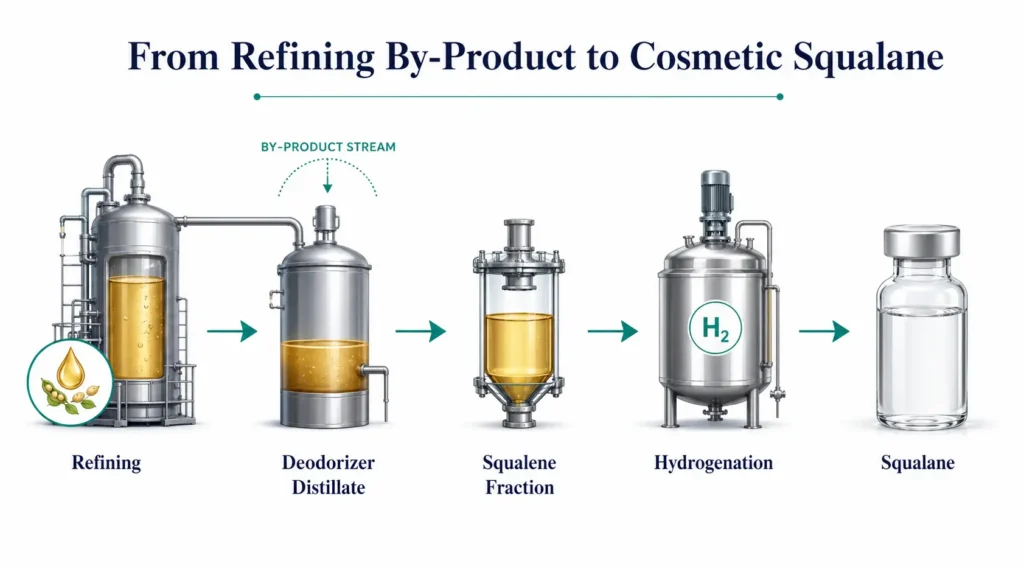
Soybean oil deodorizer distillate, usually abbreviated SODD, is the by-product collected during the deodorisation stage of soybean oil refining. It is produced at very large volume — the literature describes millions of tonnes generated annually and historically discarded as waste — and it contains tocopherols, phytosterols, and squalene.
This is the least-marketed of the four routes and the one with the most published chemistry behind it. Industrial & Engineering Chemistry Research describes SODD as having been proposed as an alternative to marine animals as a natural source of squalene, which is a considerably more useful sentence for a buyer than any sustainability slogan.
Reported squalene content varies with the distillate. Published studies describe figures from under 2% up to around 6%, which is why the concentration steps matter more than the raw feedstock number. The difficulty is not extracting squalene as such; it is separating it cleanly from the tocopherols and sterols it travels with. The recognised problem pairs in the literature are tocopherol–squalene, tocopherol–fatty acid, tocopherol–sterol, and sterol–squalene, and one documented answer is to esterify the distillate before molecular distillation, which has been reported to raise squalene concentration substantially. Studies using column separation on the resulting fraction report squalene recovered at around 96% purity.
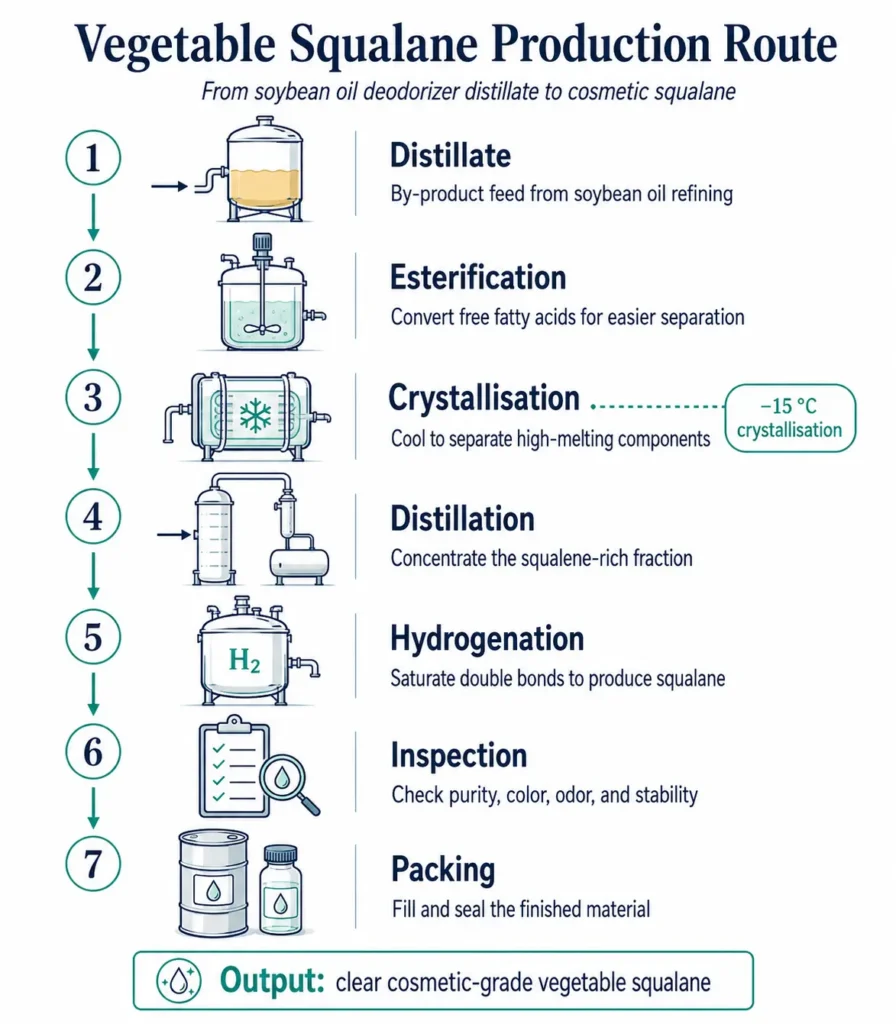
The NOYAIN route, step by step
The production route for the NOYAIN grade is documented in the supplier flow chart, and it follows the same logic as the published approach:
| Step | What it is for |
|---|---|
| Deodorized distillates of soybean oil | The feedstock — a refining by-product, not a dedicated crop |
| Esterification | Prepares the distillate so the squalene fraction separates cleanly from tocopherols and sterols |
| Dynamic crystallisation | Removes components that crystallise out, including wax-forming material |
| Coupled distillation | Concentrates the squalene fraction |
| Hydrogenation | Converts squalene to squalane |
| Coupled distillation | Removes by-products carried through the hydrogenation step |
| Sampling and inspection | Batch release |
| Packing, labelling, storage | Epoxy phenolic steel drums or customised packaging |
The route includes crystallisation at −15 °C with cold filtration. The comparative low-temperature screening data for the grade sits on the squalane grade and specification page rather than here.
Two things follow from this that a buyer can act on. The feedstock is a by-product of an existing refining industry rather than a crop grown for the purpose, which is a materially different supply story from a dedicated agricultural input. And because the route is written down step by step, it can be checked against the published chemistry — which is more than can be said for a source claim consisting of a single sentence.
Route 4: Sugarcane Fermentation
The fermentation route does not extract squalene from a plant lipid at all. Engineered yeast strains convert plant sugars into squalene, which is then hydrogenated in the usual way. Sugarcane is the common sugar source, and the approach is well covered in the microbial-squalene literature.
Its advantages are structural rather than chemical. Production is not tied to a harvest window, output can be scaled by adding capacity rather than acreage, and batch-to-batch consistency is easier to control when the feedstock is a defined sugar stream. The trade-offs the literature notes are process complexity, yield variability, longer production cycles, and by-product handling.
Fermentation-derived grades are sold under branded names and are usually positioned at the premium end. For a buyer the relevant question is the same as for every other route: what the specification says, and what documentation supports the origin claim.
What the Route Actually Changes for a Buyer
| Shark | Olive | Soybean distillate | Fermentation | |
|---|---|---|---|---|
| Supply constraint | Resource-limited | Harvest and season dependent | Refining by-product, large volume | Production capacity dependent |
| Purification burden | Low | High — wax removal required | Moderate — multi-stage separation | Moderate |
| Non-animal origin | No | Yes | Yes | Yes |
| Route documentation typically available | Limited | Varies | Flow chart and source statement | Varies |
Now the part that is easy to lose in source marketing: the finished molecule is the same regardless of route. Squalane is squalane. What actually differs between commercial grades is assay, the identity of the non-squalane fraction, colour and odour control, and process consistency — none of which is determined by the feedstock label on its own.
That is why a source route is a procurement and positioning question rather than a performance question. A well-processed soybean-derived grade and a well-processed olive-derived grade can both be excellent; a poorly processed example of either can carry odour, colour, or cold-haze problems. The composition question — what makes up the percentage that is not squalane — is covered in Squalane vs Squalene.
How to Verify Which Route You Received
Source claims come in three grades of evidence. It is worth knowing which one you have been given.
Level 1 — the source statement. A supplier declaration naming the feedstock. This is necessary and every serious supplier should provide one, but it is an assertion. It tells you what the supplier says, not what can be checked.
Level 2 — the process documentation. A flow chart naming the feedstock and the unit operations in sequence. This is harder to produce without an actual route behind it, and it can be read against published process chemistry. The NOYAIN route corresponds to the documented approach for recovering squalene from soybean oil deodorizer distillate, including esterification ahead of distillation — which means the document can be independently sanity-checked rather than simply believed.
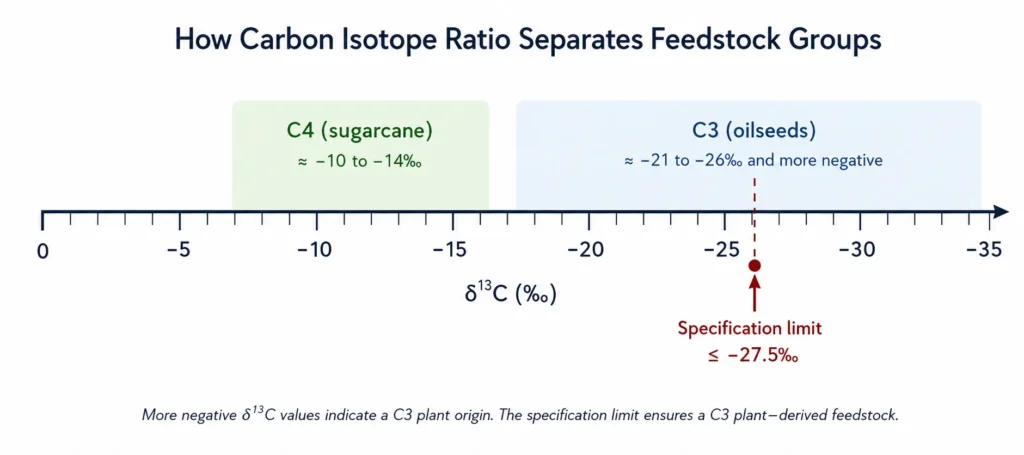
Level 3 — the analytical parameter. Stable carbon isotope ratio analysis, reported as δ13C and measured by isotope ratio mass spectrometry, distinguishes plant groups by their photosynthetic pathway. C4 plants such as sugarcane sit at roughly −10 to −14‰. C3 plants — the oilseeds and broadleaf crops, soybean and olive among them — sit at roughly −21 to −26‰ and more negative. The gap between the two groups is on the order of 20‰, which is very large for isotope work, and compound-specific measurements published in the Journal of Agricultural and Food Chemistry found the δ13C values of sterols and squalene in C3 plant oils to be several to more than sixteen per mil more negative than in C4 and CAM oils.
The NOYAIN specification carries a plant-source parameter measured by 13C-IRMS with a limit of ≤ −27.5‰. What that supports is specific and worth stating precisely: it is consistent with a C3 oilseed feedstock and not with a C4 or sugarcane-fermentation route.
It is equally worth stating what the parameter does not do. Fossil carbon also falls within the C3 range, so a δ13C value cannot by itself separate plant origin from petrochemical origin. Bio-based content is a different measurement entirely: it is a radiocarbon question, addressed by ¹⁴C methods such as ASTM D6866 rather than by stable carbon isotope ratio. If a buyer needs bio-based content documented, that is the test to ask for.
A supplier that can hand over all three levels is describing a route it controls. A supplier that can only offer Level 1 may still be perfectly reliable — but you are trusting the statement rather than checking it, and that is a different risk position to take to a client questionnaire.
Frequently Asked Questions
Is squalane made from sharks?
Some squalane has historically been produced from shark liver oil, and the INCI name alone does not exclude it. Most commercial squalane today comes from olive, soybean, or fermentation routes. If non-animal origin matters for your product, request a written source statement for the specific grade being quoted.
Which route does NOYAIN’s squalane use?
The NOYAIN grade is vegetable squalane derived from soybean oil, produced from deodorized distillates of soybean oil. The supplier flow chart, specification, and source statement are available on request.
Does the source route change how squalane performs in a formula?
Not directly. The finished molecule is the same. What affects formulation behaviour is the assay, the composition of the non-squalane fraction, colour and odour control, and low-temperature behaviour — all of which are consequences of processing rather than of the feedstock category. Compare specifications rather than source labels.
Can a source claim be checked without sending the material to a laboratory?
Partly. A flow chart that names the feedstock and the unit operations can be read against published process chemistry, which is a meaningful check. Confirming the feedstock group analytically requires isotope ratio measurement, which is why some specifications carry that parameter directly.
Why is olive-derived squalane marketed more heavily than soybean-derived?
Largely for narrative reasons. Olive has strong consumer recognition and an established position in skincare storytelling, while soybean oil distillate is a by-product stream with no comparable consumer association. Neither of those facts describes the quality of the resulting material, which is set by the specification.
Does the source route affect price?
It contributes. Feedstock availability, the number of concentration steps required, and the purification burden all differ between routes, and a route with a high wax-removal requirement or a long production cycle carries that cost. Route alone does not determine a quotation, though — assay, volume, packaging, and lead time all matter as much.
Conclusion
The route behind a drum of squalane is a documentation question before it is a marketing one. The ingredient name will not answer it, a source statement asserts it, a flow chart makes it checkable, and an isotope parameter narrows it to a feedstock group.
References
- Chang C-J, Chang Y-F, Lee H-Z, et al. Isolation and purification of fatty acid steryl esters from soybean oil deodorizer distillate. Industrial & Engineering Chemistry Research. 2008. doi:10.1021/ie800346x.
- Separation and purification of squalene from soybean oil deodorizer distillate. Separation and Purification Technology. 2007. doi:10.1016/j.seppur.2007.07.019.
- Integrated utilization strategy for soybean oil deodorizer distillate: synergically synthesizing biodiesel and recovering bioactive compounds. ACS Omega. 2021. doi:10.1021/acsomega.1c00333.
- Weber D, Kexel H, Schmidt HL. Stable carbon isotope ratios of plant products. Journal of Agricultural and Food Chemistry. 1997;45:2942. — VERIFY exact title, volume and pages before publishing.
- Stable carbon isotope ratios (δ13C values) of individual sterols in the oils of C3, C4 and CAM plants. Journal of Agricultural and Food Chemistry. 2024. doi:10.1021/acs.jafc.3c08324.
- From olive pomace to squalane: a green chemistry route using 2-methyltetrahydrofuran. PMC12332605.
- Ciriminna R, Pandarus V, Béland F, Pagliaro M. Solvent-free chemoselective hydrogenation of squalene to squalane. ACS Omega. 2017;2(8):4630–4635. doi:10.1021/acsomega.7b00625.
- Shalu S, Karthikanath PKR, Vaidyanathan VK, et al. Microbial squalene: a sustainable alternative for the cosmetics and pharmaceutical industry — a review. Engineering in Life Sciences. 2024;24(10):e202400003.
- Mendes A, Azevedo-Silva J, Fernandes JC. From sharks to yeasts: squalene in the development of vaccine adjuvants. Pharmaceuticals. 2022;15(3):265.
- National Center for Biotechnology Information. Squalane — PubChem Compound Summary, CID 8089. PubChem.