Alpha-Glucosylrutin (AGR) is a glucosylated derivative of rutin, used in cosmetics mainly as an antioxidant and skin-protecting ingredient. Glucosylation improves the water compatibility of the molecule compared with plain rutin, and that single change is why the material reaches formulations plain rutin cannot. Sunscreens and SPF day-care products are where it shows up most often. Noyain supplies it as NY GLRT Glucosylrutin.
One point should be settled before anything else.
Alpha-Glucosylrutin is not a UV filter, and it does not replace a compliant UVA / UVB sunscreen system.
Whether AGR contributes SPF is the wrong question to open with, and the answer is no. The question worth asking is this:
Why is it added to sunscreen formulations, and how far do the published research and the commercial products actually support it?

Why sunscreen formulations contain antioxidants
Antioxidants are added to sunscreens to address the oxidative side of UV exposure, which the UV filter system reduces but does not eliminate. A sunscreen exists to cut the UV dose reaching the skin, and with it the photodamage that dose causes. Reducing that dose is the whole job of the filter system, and no antioxidant substitutes for it.
Light-related oxidative stress remains a significant part of modern photoprotection research. UV exposure promotes the formation of reactive oxygen species (ROS), so adding an antioxidant on top of a compliant UV filter system has become a common supplementary approach in sunscreen development. Alpha-Glucosylrutin takes that supporting antioxidant role, and nothing beyond it. Establishing SPF is not part of the role. Neither is UVA or UVB protection.
A second reason the material appears in these products has nothing to do with photoprotection at all. AGR is a glucosylated rutin derivative, and the added glucose unit improves water compatibility relative to plain rutin. For emulsions, gels, lightweight sunscreen fluids and other systems carrying a substantial water phase, that physicochemical difference decides whether the ingredient can be used at all.
Worth being precise about what that statement covers. The improved water compatibility describes the properties of Alpha-Glucosylrutin as a molecule. Whether a given commercial Glucosylrutin raw material behaves that way in a specific sunscreen system is a separate question, and the gap between those two claims is where most formulation disappointments live.
What the 2004 human study actually tested
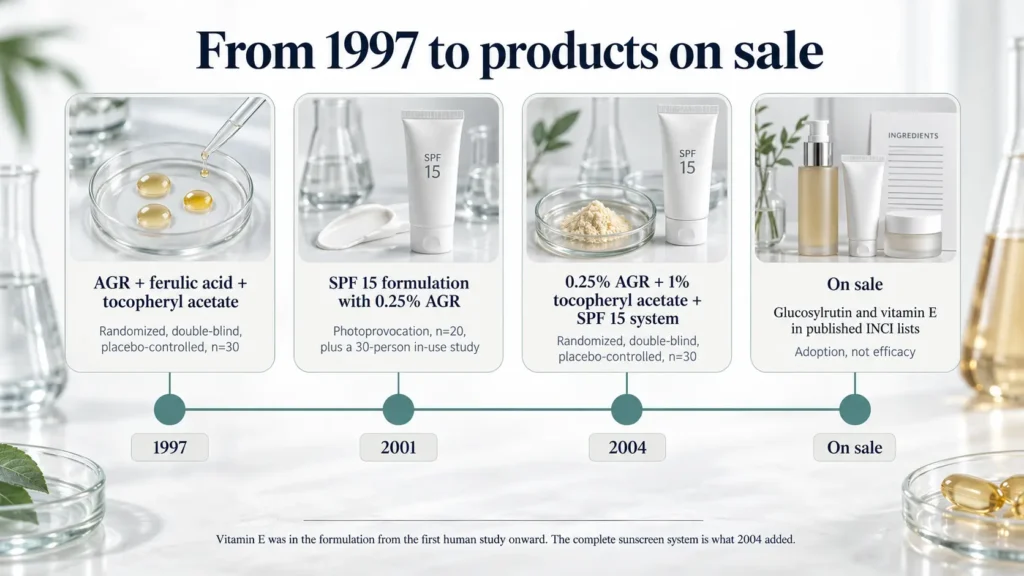
The study tested a complete formulation, not the ingredient on its own, and that distinction governs everything the result can be used for. The 2004 trial was a randomized, double-blind, placebo-controlled study in 30 subjects with a history of polymorphous light eruption (PLE). Several topical treatments were compared using a repeated UVA photoprovocation model, with test areas marked on the upper arms and irradiation repeated daily over four days.
One of the treatments tested was this system:
0.25% Alpha-Glucosylrutin + 1% Tocopheryl Acetate + a broad-spectrum, highly UVA-protective SPF 15 sunscreen system
In that experimental model, 62.1% of the placebo-treated areas and 41.3% of the sunscreen-only areas showed mild to moderate signs of PLE. In the areas treated with the antioxidant sunscreen formulation containing Alpha-Glucosylrutin and Tocopheryl Acetate, only one subject developed clinical signs. The difference between groups was statistically significant (P<0.001).

The comparison worth reading closely is the one between the two control arms. The SPF 15 sunscreen on its own accounted for part of the difference against placebo, and the remaining gap is where the antioxidant components sit. Naming which part of the formulation did which part of the work is narrower than saying the formulation performed better, and considerably more useful to anyone deciding what to put in a brief.
It is not the same statement as this one:
“Alpha-Glucosylrutin improves sun protection.”
What the study tested was a complete AGR + vitamin E derivative + sunscreen system. So what it supports is that combining antioxidants with a complete sunscreen system has a research basis worth building on. The design cannot separate out how much Alpha-Glucosylrutin, Tocopheryl Acetate or the UV filter system each contributed, and it does not demonstrate that adding AGR alone reproduces the result.
Two further limits belong with the numbers.
The 0.25% refers to the Alpha-Glucosylrutin concentration used in the study formulation. It is not a recommended use level for NY GLRT, and it should not be converted directly into a dosing figure for a commercial raw material.
PLE appears here only to describe the study population and the experimental model. Nothing in the study indicates a recommended user group, an indication or product performance for Alpha-Glucosylrutin or for NY GLRT.
Alpha-Glucosylrutin is already in commercial SPF products
Public product INCI lists show Glucosylrutin in established sunscreen and SPF day-care systems, which answers the market-adoption question without any inference. Two Eucerin products give a reasonably clear picture.
| Commercial product | Glucosylrutin | Other listed ingredients of interest | Product type |
|---|---|---|---|
| Eucerin Sun Allergy Protect Gel-Cream SPF 50+ | Yes | Isoquercitrin, Tocopherol, Glycyrrhiza Inflata Root Extract, Glycyrrhetinic Acid, and multiple UV filters | Sunscreen gel-cream |
| Eucerin Anti-Pigment Day SPF 30 | Yes | Isoquercitrin, Tocopherol, Glycyrrhiza Inflata Root Extract, Isobutylamido Thiazolyl Resorcinol, and multiple UV filters | SPF day cream |
Both public formulations share something worth noticing. Glucosylrutin does not appear on its own. In both cases it sits alongside other antioxidant or functional ingredients inside a complete UV filter system, which is the same pattern the human study describes. Alpha-Glucosylrutin is better understood as one component of a combined antioxidant system than as a standalone sunscreen booster. Glucosylrutin and Isoquercitrin are related materials but they are not the same material, and appearing in the same INCI list does not make them interchangeable.
What these commercial cases establish is a fact about formulation practice. They do not show that the overall performance of either finished product comes from Glucosylrutin alone, and they are not a reason for another brand to copy the same formulation, use level or claims.
Which sunscreen products suit Alpha-Glucosylrutin
Sunscreen with an antioxidant position
Sun care with an antioxidant position is the most direct application, and the framing matters as much as the formulation. The UV filters build the UVA / UVB protection system, and Alpha-Glucosylrutin is added to the complete formulation as a supporting antioxidant. For a product that wants an antioxidant or environmental-stress position on top of its baseline SPF, that description is accurate and defensible. Describing AGR as something that strengthens the sunscreen is neither.
SPF day-care products
Alpha-Glucosylrutin is also worth evaluating in SPF day creams, lightweight sunscreen lotions and skincare-sunscreen hybrids. Products in that category have to hold sun protection performance, sensory quality and an active-ingredient position at the same time. A flavonoid antioxidant with better water compatibility than plain rutin has a fairly clear development case in that context.
Why water compatibility matters here
Water compatibility is the practical reason AGR exists as a separate material, because plain rutin has low water solubility and that limits where it can be used in systems with a high water content. Glucosylation improves the property, so compared with plain rutin, AGR is easier to evaluate in water-rich cosmetic systems.
Two levels need to stay separate. One is the molecular properties of Alpha-Glucosylrutin. The other is how a specific commercial raw material behaves in a complete formulation. Good water solubility does not mean an ingredient performs well in every sunscreen system, and the things that go wrong are rarely solubility itself. Colour, clarity, precipitation, long-term stability and compatibility with the other actives and the filter system all have to be observed in the target formulation. A raw material specification sheet is therefore useful for initial screening and cannot stand in for formulation testing.
Working out whether it fits your base? Send us the system you are formulating in and we will point you to the specification that matters for it.
Why Alpha-Glucosylrutin and Vitamin E are often discussed together
They are discussed together because the human study tested them together. In 2004, Alpha-Glucosylrutin was not used alone. The tested formulation carried 1% Tocopheryl Acetate alongside it.
So the direction the existing research points to is how a combined antioxidant system works alongside a sunscreen system. Nothing in that design proves synergy between Alpha-Glucosylrutin and vitamin E in any given formulation. The pairing does have a real human study behind it, and the same pattern of multiple co-existing antioxidants shows up in the commercial products above. The combination logic and how far the evidence stretches are worth a separate article.

What actually needs to be evaluated in a sunscreen formulation
The useful question is not whether Glucosylrutin can be used in sunscreen. The one that matters is this:
“Is this specific raw material suitable in my specific formulation?”
The water compatibility of Alpha-Glucosylrutin gives it a genuine path into water-containing sunscreen systems, and none of that removes the need for formulation validation. Colour, clarity, precipitation, stability and compatibility with other actives all have to be observed at the intended use level in the complete system. Where the target formulation also carries a high electrolyte load, several antioxidants or other actives, those factors belong in the stability observation rather than being assumed away on the basis of a single raw-material property. A material that behaves perfectly in a simple aqueous gel can drop out of a system that looks only slightly more complex.
For the specification, composition and batch data of NY GLRT, work from the product page and the corresponding batch documentation rather than back-calculating from the concentration used in the human study.
Separately, the SPF, UVA protection, photostability and regulatory compliance of the sunscreen itself still have to be established on the finished product, independently of any ingredient-level evidence.
How far the SPF question can be taken
Alpha-Glucosylrutin can be used as a supporting antioxidant alongside a compliant UV filter system, and it is not itself a UVA or UVB filter.
By the same token, neither its antioxidant properties nor the existing research supports a claim that adding Alpha-Glucosylrutin raises SPF. Suppose a specific finished product is properly SPF tested and shows a reproducible change in performance. The corresponding claim then has to rest on that finished product’s own test data and on the regulatory requirements of the target market. No raw material property can carry that claim, and neither can research conducted with a different formulation.
Frequently asked questions
Is Alpha-Glucosylrutin a UV filter?
No. Alpha-Glucosylrutin is used in cosmetics mainly as an antioxidant and skin-protecting ingredient, and it does not replace a compliant UVA / UVB sunscreen system.
Is there human research on Alpha-Glucosylrutin in sun care?
Yes. A 2004 randomized, double-blind, placebo-controlled study evaluated a complete formulation containing 0.25% Alpha-Glucosylrutin, 1% Tocopheryl Acetate and a SPF 15 sunscreen system. The study tested that combined system, so the result cannot be extrapolated into sun-protection performance for Alpha-Glucosylrutin used on its own.
Why is Alpha-Glucosylrutin used in sunscreen formulations?
Two reasons, mainly. The ingredient can be added to a complete sunscreen system as part of a combined antioxidant approach, and its water compatibility is better than that of plain rutin, which makes it easier to evaluate in water-containing sunscreen and SPF day-care systems.
Evaluate Glucosylrutin for your sun-care project
Noyain supplies NY GLRT Glucosylrutin as a cosmetic raw material for formulation development. If you are developing a sunscreen, an SPF day-care product or another antioxidant product, tell us what you are building and we will send a free 2–3 g sample, dispatched within three working days, with the current batch test report. Specifications are on the NY GLRT Glucosylrutin product page.

References
Published research
- Hadshiew IM, Treder-Conrad C, von Bülow R, et al. Polymorphous light eruption (PLE) and a new potent antioxidant and UVA-protective formulation as prophylaxis. Photodermatology, Photoimmunology & Photomedicine. 2004;20(4):200–204. https://doi.org/10.1111/j.1600-0781.2004.00103.x — abstract read 9 September 2026.
- Cidade H, Jesus A, Mota S, et al. Antioxidants in Sunscreens: Which and What For? Antioxidants. 2023;12(1):138. https://doi.org/10.3390/antiox12010138 — general background on the use of antioxidants in sunscreen systems. This review does not cover Alpha-Glucosylrutin.
Commercial product INCI
- Eucerin Sun Allergy Protect Sun Gel-Cream SPF 50+, published ingredient list. https://incidecoder.com/products/eucerin-sun-allergy-protect-sun-gel-cream-spf-50 — read 9 September 2026.
- Eucerin Anti-Pigment Day Cream SPF 30, published ingredient list. https://incidecoder.com/products/eucerin-anti-pigment-day-cream-spf30 — read 9 September 2026.