
Anyone reading up on Alpha-Glucosylrutin (AGR) runs into vitamin E almost at once. Alpha-Glucosylrutin and vitamin E keep appearing together for a simple reason: the human study cited most often for AGR tested the two in the same formulation. Being used together in a study is a different thing from being proven to work together, and plenty of secondhand material blurs that difference deliberately.
This article settles two things:
- Why the pairing holds up in the first place.
- How far the existing research supports it, and which line it cannot be pushed past.
The basic role of AGR in a sunscreen formulation, an antioxidant supporting ingredient rather than a UV filter, is covered in the earlier article on Alpha-Glucosylrutin in sunscreen and is not repeated here.
Where the AGR and vitamin E pairing comes from
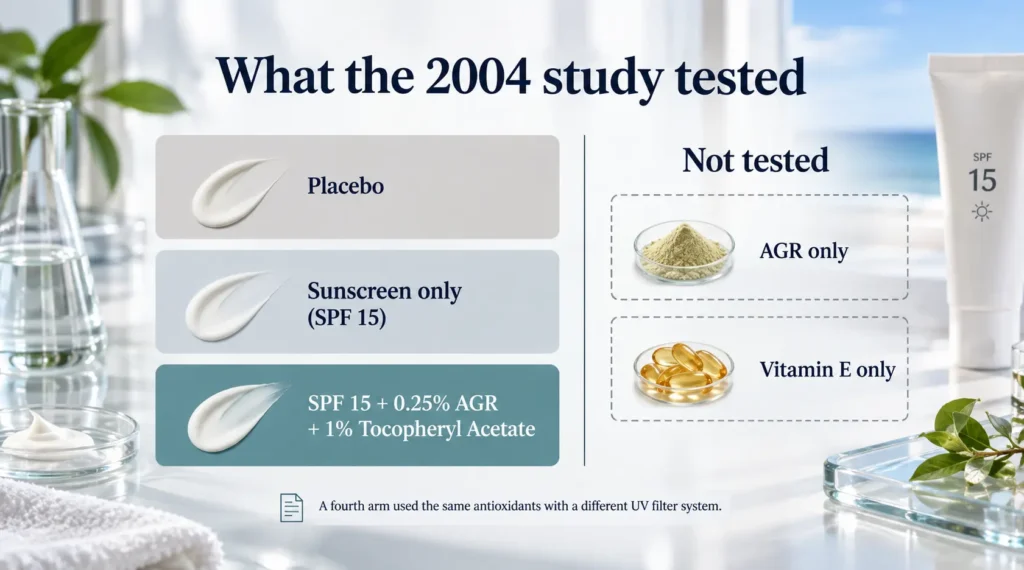
The pairing comes from a randomized, double-blind, placebo-controlled human study published in 2004. The trial enrolled 30 subjects with a history of polymorphous light eruption (PLE) and used a UVA photoprovocation model. Test areas received 60–100 J/cm² of UVA daily for four consecutive days, and the test formulation went on 30 minutes before each exposure. One of the formulations tested was a hydrodispersion gel with this composition:
0.25% Alpha-Glucosylrutin + 1% Tocopheryl Acetate + a broad-spectrum, highly UVA-protective SPF 15 sunscreen system
After four days:
| Group | Areas with mild to moderate signs of PLE |
|---|---|
| Placebo | 62.1% |
| Sunscreen only | 41.3% |
| Sunscreen + AGR + Tocopheryl Acetate | One subject |
The difference between the antioxidant formulation and the controls was statistically significant (P < 0.001). Four treatment groups ran in total, and the fourth used the same AGR and Tocopheryl Acetate concentrations with a different UV filter system; the table shows the three that speak most directly to the ingredient combination discussed here. Numbers like these are why the pairing gets cited again and again. How they are used matters more than the numbers themselves.
What the 2004 study supports, and what it leaves unanswered
The study supports a formulation strategy, and a specific one: adding AGR together with a vitamin E-type antioxidant to a suitable sunscreen system has a basis in human research. What it leaves unanswered is a longer list.
The design cannot show:
- how much of the effect came from AGR and how much from Tocopheryl Acetate
- whether the two act synergistically, with a combined effect greater than the sum of the parts
- whether AGR “regenerates” vitamin E the way some in vitro models suggest
- whether a different formulation would produce the same result
- whether 0.25% plus 1% is the optimal use level
- whether adding either ingredient changes SPF
No AGR-only arm and no vitamin E-only arm existed in the design, so at the level of the data these questions have no answer. None of that is a fault in the study, which was never set up to answer them.
The accurate statement is this:
A human study evaluated a sunscreen formulation containing Glucosylrutin and Tocopheryl Acetate.
The inaccurate one is this:
Glucosylrutin and vitamin E have been clinically proven to act synergistically.
The second sentence claims more than the study design can carry. For a raw-material supplier like us and for formulators like you, drawing that line costs nothing, because good evidence that gets overstated ends up believed by nobody.
Two earlier human studies came before the 2004 trial
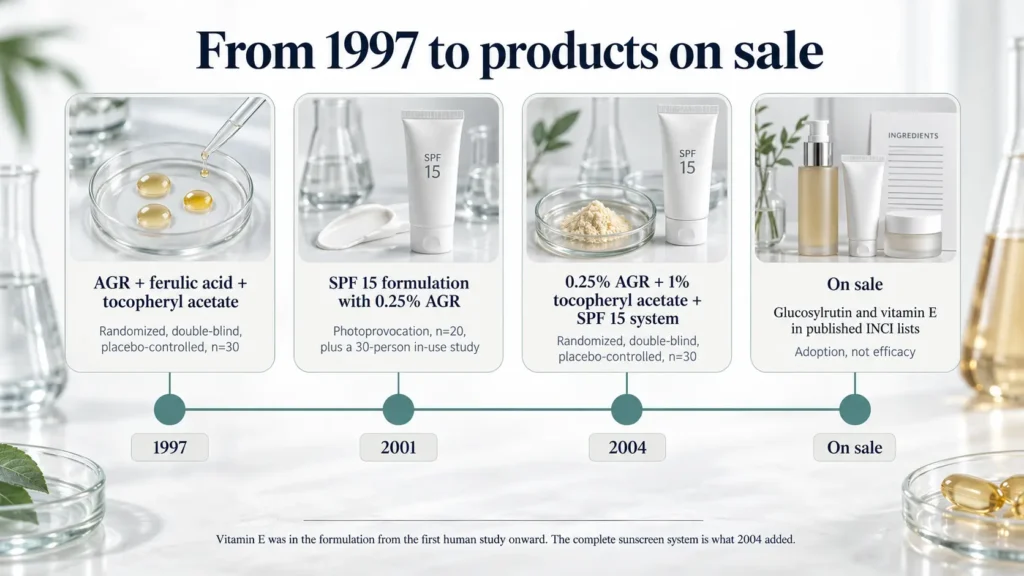
AGR’s human research did not start in 2004, and two controlled studies came first. The earlier of them already carried vitamin E in the formulation. The 1997 study was randomized, double-blind and placebo-controlled, with 30 subjects who had a history of PLE. Three antioxidant formulations and one vehicle-only formulation were applied to the extensor surface of the upper arms twice daily for a week before photoprovocation and through the photoprovocation week that followed. The formulations were combinations of alpha-glucosylrutin, ferulic acid and tocopheryl acetate at different concentrations, and distinct combinations significantly reduced the development and the severity of PLE, along with the itching that came with it.
The 2001 study tested an SPF 15 sunscreen formulation containing 0.25% AGR, a complete sunscreen formulation rather than a single-ingredient test. Twenty subjects each had four test sites: one untreated control, and three treated with the formulation 30 minutes before irradiation, two of which were additionally pre-treated with the AGR-containing base twice daily for three or seven days. A separate in-use study followed 30 people through a holiday, with symptoms recorded in diaries and assessed by a physician after they came back.
Read together, the studies put the evidence in this order:
Combined antioxidants in human research (1997) → an SPF 15 formulation containing AGR (2001) → AGR + Tocopheryl Acetate + a sunscreen system (2004) → Glucosylrutin and vitamin E in products on sale
Vitamin E sat in the same formulation as AGR from the first human study onward, which makes the pairing the main line of this research rather than something added to it later, and what 2004 contributed was the complete sunscreen system. The 1997 work carries the same limit as the 2004 trial, since it also tested combinations and cannot separate what each ingredient contributed.
Tocopherol or tocopheryl acetate: which vitamin E the evidence used
Vitamin E covers more than one ingredient, and treating it as a single one is the easiest mistake to make in any discussion of AGR plus vitamin E.
- Tocopherol is the free form of vitamin E, a fat-soluble antioxidant that is itself easily oxidised.
- Tocopheryl Acetate is the esterified derivative, far more stable in formulation and in storage, and the most common form of vitamin E in cosmetics. It works as a source of vitamin E through bioconversion to free tocopherol, and how far that conversion goes depends on the formulation, on skin penetration and on the experimental conditions, which is why human studies have measured different conversion results. The stability and bioconversion of topical vitamin E have their own reviews in the dermatology literature.
The distinction bears directly on the AGR research, because the 2004 study used Tocopheryl Acetate rather than free Tocopherol. In practice, evidence generated with Tocopheryl Acetate cannot be carried across, number for number, to a formulation built on free Tocopherol. Seen from the other direction, the form of vitamin E your project uses decides how far you are able to cite that literature.
Commercial products already pair Glucosylrutin with vitamin E
Published ingredient lists show Glucosylrutin and a vitamin E ingredient in the same sun-care formulas, so the combination is already in products on sale, which is more than the literature on its own can establish. One caveat comes first: the same brand’s product can carry a different formula in different markets and different versions, since regional regulations and reformulation both change the ingredient list. Each list below was publicly accessible when we checked it, and each carries its source and date. For an actual decision, work from the latest INCI on the official site for your target market and on the product packaging.
1. Sun Allergy Protect Gel-Cream SPF 50+, the best-supported example. The ingredient list on Eucerin’s current official page, identical on the international and UK sites, carries Glucosylrutin together with Tocopherol, alongside Isoquercitrin, Glycyrrhetinic Acid and a full chemical UV filter system.
2. Anti-Pigment Day SPF 30. An official Eucerin page (images-us.eucerin.com, accessible when checked) lists Tocopherol + Glucosylrutin + Isoquercitrin, and the version recorded on INCIDecoder also contains Glucosylrutin. The full ingredient list on Eucerin’s current international page does not carry Glucosylrutin, so two versions exist side by side.
3. Sun Fluid Pigment Control SPF 50+. The version recorded on INCIDecoder lists Glucosylrutin together with both Tocopheryl Acetate and Tocopherol, while the current lists on Eucerin’s international and UK sites carry only Tocopheryl Acetate of the three.
Taken together, the three cases show a clear pattern. Glucosylrutin appears inside a combined system, alongside a complete UV filter system and other antioxidant and soothing ingredients, rather than as a standalone “SPF booster”. The pattern matches how the literature reads. A second thing worth taking from it: copying what sits on another brand’s ingredient list, or the ratio used in a published study, is not a formulation strategy, and those formulas keep changing by market and by version.
Can the 0.25% AGR and 1% tocopheryl acetate ratio be copied?
No. Those concentrations describe the formulation used in one experiment, not a general recommended use level, and the difference matters most once a commercial raw material is involved. “Alpha-Glucosylrutin” in the literature and the commercial raw material you are working with are not necessarily the same thing. Our NY GLRT, for example, is a water-soluble powder with ≥70% monoglucosyl rutin. The remainder of it includes rutin and other components. Converting a literature concentration straight into a use level for a commercial raw material starts from a premise that does not hold.
The approach that works is to start from the specification of the material you actually have and verify the target concentration in your own finished formulation. Specification and batch documentation for NY GLRT are on the product page.
Working out what to dose in your own base? Tell us the system you are formulating in and we will send the NY GLRT specification and the current-batch COA with it.
What to evaluate before formulating AGR with vitamin E
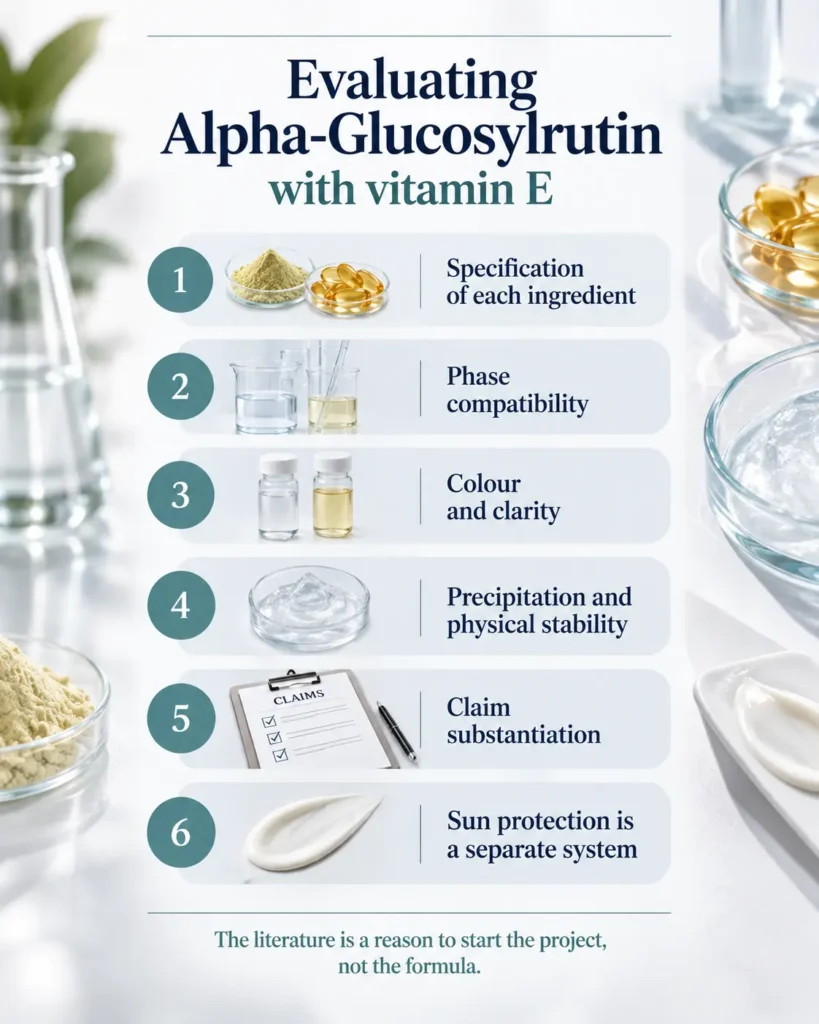
The literature gives you grounds to start a project rather than a formula, so work through these six points during development.
1. The specification of each ingredient. For AGR, look at content, composition, appearance and solubility. For vitamin E, settle the form first, whether Tocopherol, Tocopheryl Acetate or another derivative, because that choice decides which literature you are able to cite.
2. Phase compatibility. AGR goes into the water phase and vitamin E materials into the oil phase, so in an emulsion the two are normally added separately, which gives the combination practical room to work. Whether the pairing improves the overall antioxidant performance of the finished product still has to be verified in the specific formulation.
3. Colour and clarity. Glucosylrutin is not a colourless raw material, and NY GLRT is a light yellow to yellow powder. For a clear serum, a gel or a light-coloured lotion, observe what the target concentration does to the colour of the finished product before anything else.
4. Precipitation and physical stability. Water solubility at raw-material level says nothing about long-term stability inside a formulation. Electrolyte load changes how the material behaves, and so can pH or another active in the system, so watch for precipitation and sedimentation, and for any loss of clarity, under your own test conditions.
5. Claim substantiation. Ingredient-level literature supports the scientific logic behind the development work. A claim made on the finished product needs evidence at finished-product level and has to meet the requirements of the target market.
6. Sun protection is a separate system. Neither AGR nor vitamin E is a UV filter. Where the product carries an SPF or UVA claim, that claim rests on a compliant sunscreen system and on finished-product testing, whether or not these two antioxidants are in the formula. The claim boundaries are set out in the sunscreen article.
Solubility, colour and application screening need a more systematic method than a checklist can carry. The NY GLRT figures to start from are on the product page.
How far the evidence on Alpha-Glucosylrutin and vitamin E goes
Alpha-Glucosylrutin and vitamin E are not a pairing invented by marketing. A formulation strategy with human research behind it sits under the combination, and products on sale use a similar one. The limits of that evidence are just as clear:
- Supported: the technical route of a sunscreen system plus a combined antioxidant system
- Supported: evaluating AGR and a vitamin E-type ingredient together in one formulation
- Not supported: a general synergy conclusion, a fixed ratio, or an SPF gain
Marking those limits works in the ingredient’s favour, since knowing exactly how far the evidence reaches is what lets a formulation decision stand up. So the next step is to treat the literature as the reason to start the project, choose the right commercial specification, and test the combination in your own system, rather than copying the published formula.
Frequently asked questions
Why are Alpha-Glucosylrutin and vitamin E often used together?
The most direct reason is the 2004 human study, in which the tested sunscreen formulation contained both, 0.25% AGR with 1% Tocopheryl Acetate in an SPF 15 system, and performed clearly better than the sunscreen-only control. Brands such as Eucerin also combine them in products on sale, which gives the pairing a precedent in the literature and in the market.
Has synergy between the two been clinically proven?
No. The studies tested complete formulations. The 2004 trial had no AGR-only arm and no vitamin E-only arm, so the contribution of each ingredient cannot be separated, and separating them is what a synergy claim would need.
Do AGR and vitamin E raise SPF?
The existing research does not support that. SPF is determined by the sunscreen system in the finished product and has to be established by testing the finished product.
Are tocopherol and tocopheryl acetate the same thing?
No. Tocopherol is the free form, and Tocopheryl Acetate is a more stable esterified derivative that has to be converted in the skin. The two cannot be swapped when reading the literature, and the 2004 study used the acetate.
Can 0.25% AGR with 1% tocopheryl acetate be used directly?
Those are the concentrations of one published formulation, not a general recommended use level. Commercial raw materials differ in composition, and NY GLRT is a ≥70% monoglucosyl rutin powder, so the starting point is the raw-material specification, and the level gets verified in your own formulation.
Can the pairing be used in a lotion, or only in sunscreen?
Not only in sunscreen. An antioxidant lotion, a day cream or a serum can all be evaluated with this combination. The most direct human evidence comes from a sun-protection setting, so claims need to be narrowed when the pairing moves into anti-ageing or environmental-protection positioning.
Evaluate Glucosylrutin for your antioxidant formulation
Noyain supplies NY GLRT Glucosylrutin, a water-soluble powder with ≥70% monoglucosyl rutin, for cosmetic formulation development. If you are evaluating the AGR and vitamin E combination in a sunscreen, an SPF day-care product, an antioxidant serum or a lotion, tell us what you are building and we will send a free 2–3 g sample, dispatched within three working days, with the current-batch COA and the product specification, so the combination can be verified in your own system. Specifications are on the NY GLRT Glucosylrutin product page.
Related reading: Alpha-Glucosylrutin in Sunscreen: Research, Commercial Use and Formulation Considerations.

References
Published research
- Hadshiew I, Stäb F, Untiedt S, Bohnsack K, Rippke F, Hölzle E. Effects of topically applied antioxidants in experimentally provoked polymorphous light eruption. Dermatology. 1997;195(4):362–368. https://doi.org/10.1159/000245989 — abstract read 11 September 2026.
- Rippke F, Wendt G, Bohnsack K, Dörschner A, Stäb F, Hölzle E, Moll I. Results of photoprovocation and field studies on the efficacy of a novel topically applied antioxidant in polymorphous light eruption. Journal of Dermatological Treatment. 2001;12(1):3–8. https://doi.org/10.1080/095466301750163491 — abstract read 11 September 2026.
- Hadshiew IM, Treder-Conrad C, von Bülow R, Klette E, Mann T, Stäb F, Moll I, Rippke F. Polymorphous light eruption (PLE) and a new potent antioxidant and UVA-protective formulation as prophylaxis. Photodermatology, Photoimmunology & Photomedicine. 2004;20(4):200–204. https://doi.org/10.1111/j.1600-0781.2004.00103.x — abstract read 9 September 2026.
- Thiele JJ, Ekanayake-Mudiyanselage S. Vitamin E in human skin: organ-specific physiology and considerations for its use in dermatology. Molecular Aspects of Medicine. 2007;28(5–6):646–667. https://doi.org/10.1016/j.mam.2007.06.001 — abstract read 11 September 2026.
Commercial product ingredient lists
- Eucerin Sun Allergy Protect Gel-Cream SPF 50+, published ingredient list, international and UK sites. https://int.eucerin.com/products/sun-protection/sun-creme-gel-sun-allergy-protect-spf-50 — read September 2026.
- Eucerin Anti-Pigment Day SPF 30, published ingredient list. https://incidecoder.com/products/eucerin-anti-pigment-day-cream-spf30 — read September 2026. The list on Eucerin’s current international page does not carry Glucosylrutin; go by the latest INCI for your target market.
- Eucerin Sun Fluid Pigment Control SPF 50+, published ingredient list, recorded under the product name Even Pigment Perfector Sun Fluid SPF 50+. https://incidecoder.com/products/eucerin-even-pigment-perfector-sun-fluid-spf-50 — read September 2026. The current lists on Eucerin’s own sites differ, as above.

