
Pro-Xylane in skincare refers to the use of Hydroxypropyl Tetrahydropyrantriol, a xylose-derived active ingredient used in products designed for hydrated, smoother, and firmer-looking skin. Unlike exfoliating acids, it is studied for its effects on structural components of the skin. Today, this established ingredient appears in anti-aging serums, eye creams, and moisturizers across both luxury and mass-market skincare.
What Is Pro-Xylane? Chemistry and R&D Background
Pro-Xylane is associated with the INCI name Hydroxypropyl Tetrahydropyrantriol (CAS No. 439685-79-7). It is a water-soluble C-glycoside derived from D-xylose, a sugar that can be obtained from wood sources such as beechwood.
Its carbon-carbon glycosidic linkage makes it more resistant to certain enzymatic breakdown processes than conventional O-glycosides. However, stability in a finished cosmetic formula still requires testing.
Originally developed through L’Oréal’s research into skin glycobiology, Pro-Xylane became a recognized ingredient in premium anti-aging skincare. The name is associated with L’Oréal’s commercial development of the molecule, while ingredient buyers and formulators identify the raw material using its INCI designation.
How Does Pro-Xylane Benefit the Skin? Mechanisms and Research
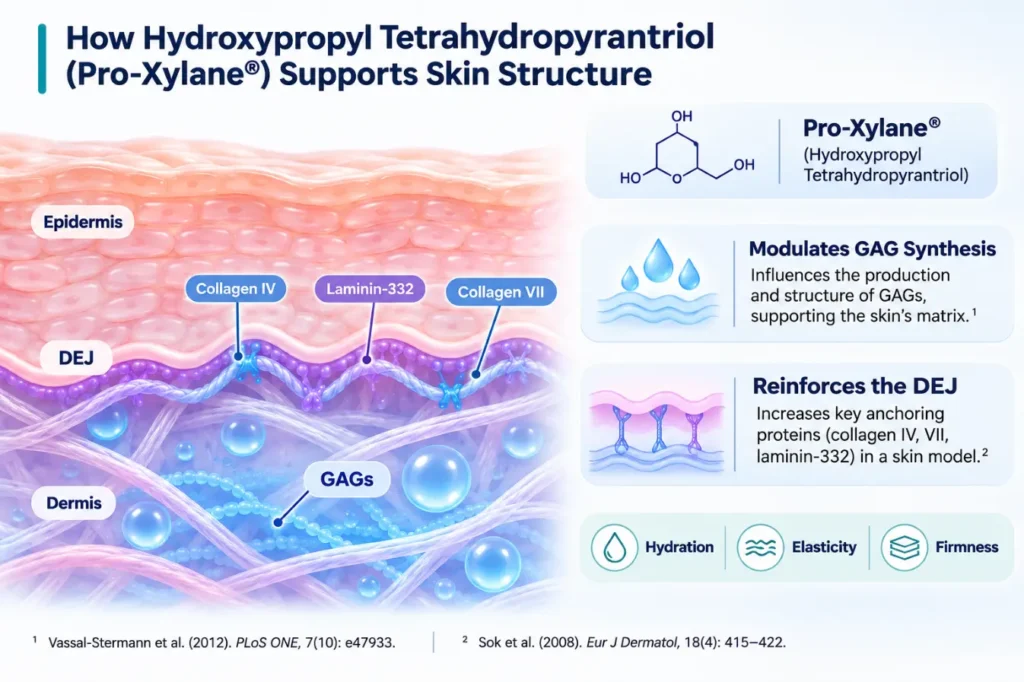
Pro-Xylane research focuses on two important elements of skin structure: glycosaminoglycans (GAGs) within the extracellular matrix and proteins associated with the dermal-epidermal junction (DEJ).
Glycosaminoglycans (GAGs) and Skin Hydration
GAGs, including chondroitin sulfate and dermatan sulfate, are components of the skin’s extracellular matrix that contribute to hydration and structural organization.
In a 2012 study published in PLOS ONE, Vassal-Stermann and colleagues found that a C-xyloside increased GAG chain synthesis and changed their structure and sulfation patterns in a reconstructed dermal tissue model.
These findings help explain the ingredient’s scientific relevance to skin matrix biology, although they do not independently establish improvements in human skin hydration.
Dermal-Epidermal Junction (DEJ) and Skin Firmness
The DEJ connects the epidermis and dermis, helping maintain the skin’s structural integrity. Its architecture changes with age.
A 2008 study by Sok and colleagues investigated a C-xylopyranoside derivative in reconstructed human skin. Researchers observed increased deposition of basement membrane and DEJ-associated proteins, including collagen IV, collagen VII, and laminin-5, as well as increased collagen VII gene expression.
These findings support a potential role in maintaining DEJ structure, but they are preclinical observations rather than direct evidence of wrinkle reduction in people.
What Does the Clinical Evidence Show?
The evidence should be interpreted at two levels:
- Preclinical research: Cell and reconstructed skin studies investigate GAG synthesis, protein expression, and changes in skin structure.
- Finished-product studies: Human studies evaluate complete skincare formulations, where improvements in hydration, elasticity, or wrinkle appearance cannot automatically be attributed to Pro-Xylane alone.
This distinction is important when translating ingredient research into cosmetic product claims.
Where Is Pro-Xylane Used in Today’s Anti-Aging Market?
Pro-Xylane is an established ingredient, but its continued use in international skincare products shows that mature actives can remain commercially relevant.
According to Grand View Research, the global anti-aging products market was valued at USD 55.6 billion in 2025 and is projected to reach USD 107.6 billion by 2033. These figures represent the broader anti-aging products market, not Pro-Xylane ingredient sales.
For brands developing anti-aging products, established ingredients with recognizable consumer positioning and published research can provide a foundation for product differentiation.
Prestige Brand Case Studies
Helena Rubinstein — Re-Plasty Age Recovery Night Cream
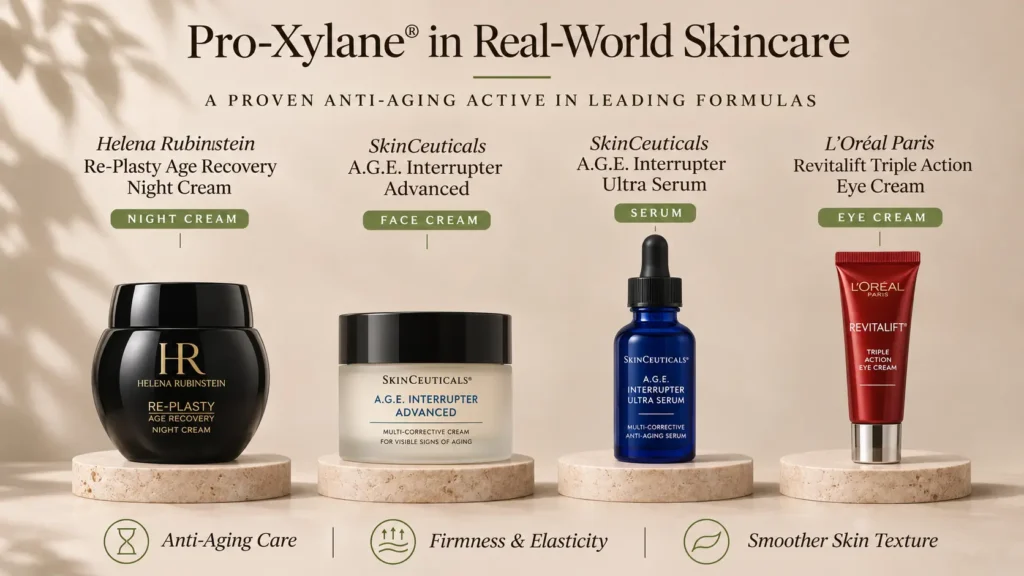
Re-Plasty Age Recovery Night Cream is positioned as a luxury restorative night cream and highlights a 30% Pro-Xylane solution claim.
The brand combines its ingredient story with a rich cream format and premium anti-aging positioning.
SkinCeuticals — A.G.E. Interrupter Advanced
SkinCeuticals A.G.E. Interrupter Advanced features 18% concentrated Proxylane, combined with wild fruit flavonoids and glycyrrhetinic acid.
Its positioning focuses on visible signs of aging, including wrinkles, loss of firmness, and glycation-related skin concerns.
Together, these examples show how a recognizable active can support different product concepts without relying on a single formulation approach.
The Meaning Behind Pro-Xylane Concentration Claims
A percentage printed on skincare packaging does not always represent the percentage of pure active ingredient in the finished product.
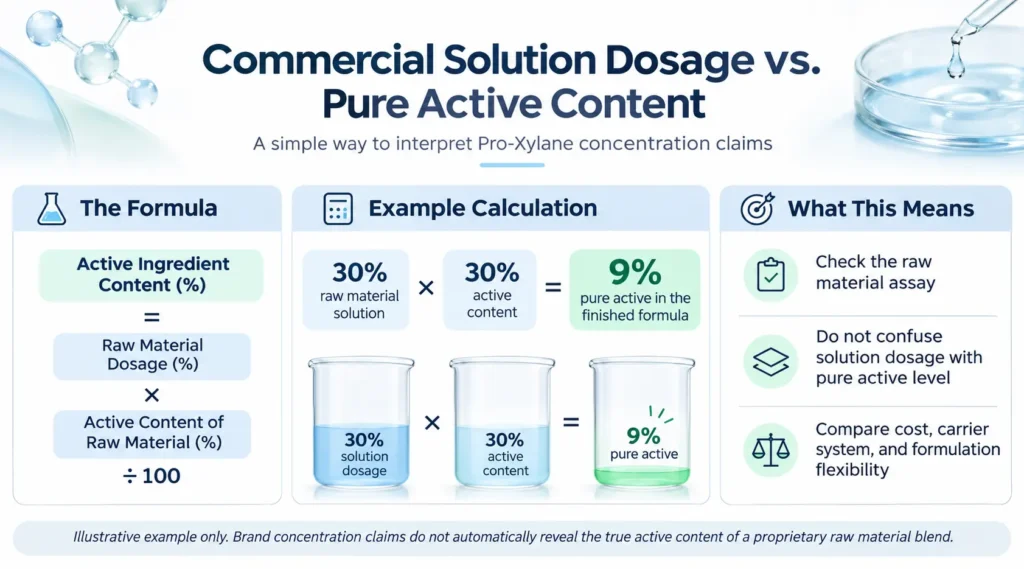
For example, Helena Rubinstein specifies that its 30% claim refers to the amount of a commercial Pro-Xylane solution added to the formula. That solution contains Hydroxypropyl Tetrahydropyrantriol along with other components.
Without knowing the active content of the original raw material, the percentage of pure active ingredient in the finished product cannot be determined from the marketing claim alone.
Formulators can calculate the theoretical active dosage using:
Active Content in Finished Formula (%) = Raw Material Dosage (%) × Active Content of Raw Material (%) ÷ 100
For example, if a commercial liquid raw material contains 30% active ingredient and is added at 30% of a finished formula:
30 × 30 ÷ 100 = 9% pure active ingredient
This is a hypothetical calculation, not a disclosure of the actual formulation used by Helena Rubinstein or SkinCeuticals.
Understanding this distinction helps formulators compare raw material specifications, cost-in-use, carrier systems, and formulation requirements more accurately.
Practical Product Applications
Pro-Xylane-containing ingredients appear in several established skincare formats:
- Anti-Aging Serums: Can be developed with Sodium Hyaluronate, niacinamide, or other humectants for hydration-focused anti-aging concepts.
- Eye Creams: Used in formulas targeting the appearance of dryness-related fine lines and smoother-looking skin around the eyes, subject to finished-product safety testing.
- Firming and Moisturizing Creams: Suitable for water-phase incorporation into emulsions developed for mature, dry, or firmness-concerned skin.
Beyond the two prestige creams discussed above, SkinCeuticals A.G.E. Interrupter Ultra Serum and L’Oréal Paris Revitalift Triple Action Eye Cream provide additional examples of serum and eye-care applications.
Developing your next anti-aging formula?
Explore NOYAIN’s Hydroxypropyl Tetrahydropyrantriol specifications and formulation information.
What Should Brands Look for When Sourcing Pro-Xylane?
When evaluating Hydroxypropyl Tetrahydropyrantriol, buyers should look beyond the headline purity figure.
Purity and actual content are not necessarily the same measurement. The relevant test method and batch-specific content value should be checked before calculating raw material dosage or comparing cost-in-use.
Solid Powder vs. Pre-Diluted Liquid Grades
Commercial grades may differ in concentration, carrier composition, and handling requirements.
| Evaluation Factor | High-Purity Solid Grade | Pre-Diluted Liquid Grade |
|---|---|---|
| Active Content | Verified against batch COA | Depends on solution concentration |
| Solvent Control | Formulator selects solvent system | Carrier system supplied in the blend |
| Formulation Handling | Requires dissolution and processing validation | Generally ready for liquid addition |
| Quality Evaluation | Check purity, content, and solubility | Check active content and carrier compatibility |
Neither form is universally better. The choice depends on the target formula, required active content, manufacturing process, and supplier documentation.
NOYAIN Raw Material Specifications and Support
NOYAIN supplies Hydroxypropyl Tetrahydropyrantriol as a water-soluble solid raw material for anti-aging skincare development.
Our published specifications include:
- Purity: ≥98.0%
- Content: ≥95.0%
- Form: White to off-white solid
- Applications: Serums, eye creams, moisturizers, and anti-aging emulsions
COA, SDS, technical specifications, and sample support are available for ingredient evaluation. Formulators should confirm the final use level, solubility, processing conditions, and finished-product stability before commercial production.
For a broader view of ingredient selection, see our guide to anti-aging ingredients for skincare formulations.
Ready to evaluate Hydroxypropyl Tetrahydropyrantriol for your next skincare project?
Request a sample and technical documentation from NOYAIN to begin your formulation assessment.
