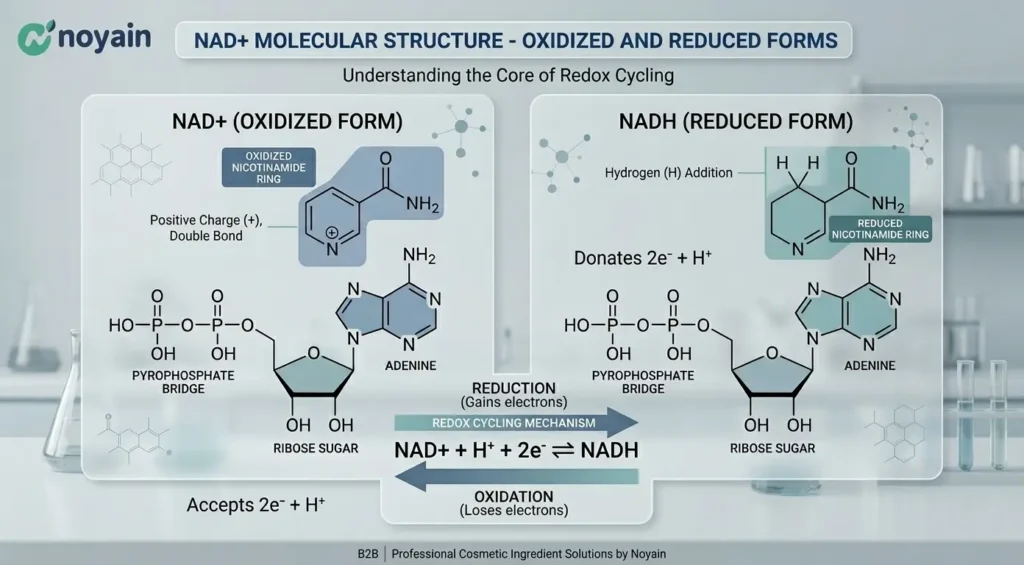
The short answer to NAD+ vs NMN vs niacinamide is that all three sit on the same metabolic route and still behave as three different cosmetic ingredients. Niacinamide is the established active, backed by the most human topical evidence and years of formulation experience. NMN is the NAD+ precursor, a newer ingredient that suits skin longevity concepts while its skin evidence is still building. NAD+ is the coenzyme itself and the most direct way to build a product around NAD+ biology.
Being closer to NAD+ in the pathway does not mean an ingredient works better on skin. What should decide the choice is how mature the evidence is, whether the molecule can be delivered into skin, how stable it stays in your base and next to other actives, and which claim the finished product has to carry.
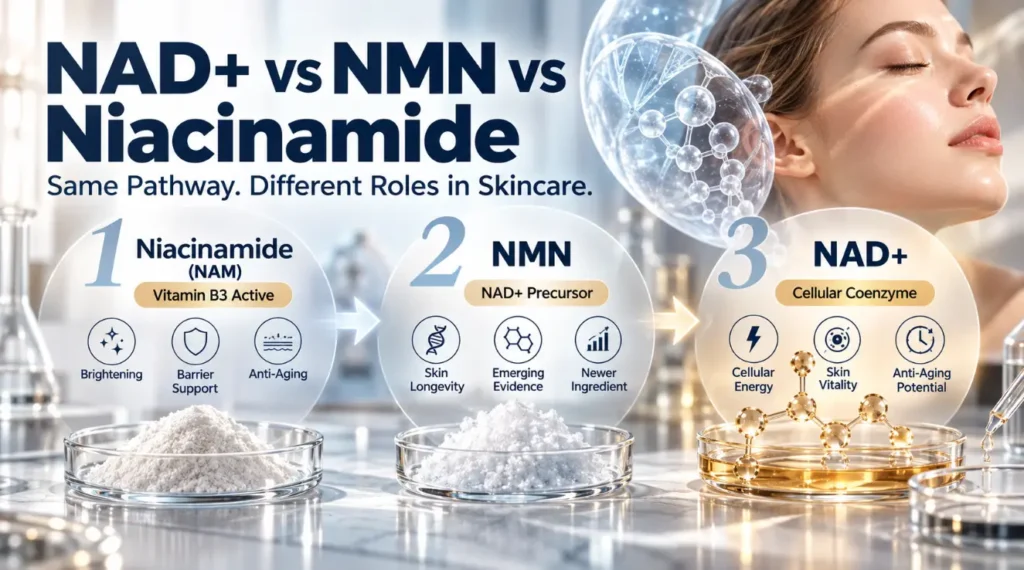
NAD+ vs NMN vs niacinamide at a glance
The three ingredients differ in identity and in how far each sits from NAD+, but the difference that matters most to a formulator is how much topical evidence stands behind each one. In one line: niacinamide wins on maturity, NMN on novelty and a clean precursor story, and NAD+ on letting a brand talk about NAD+ biology directly.
| Niacinamide (NAM) | NMN | NAD+ | |
|---|---|---|---|
| Full name | Niacinamide / Nicotinamide | Nicotinamide Mononucleotide | Nicotinamide Adenine Dinucleotide |
| What it is | A form of vitamin B3 | NAD+ precursor | Cellular coenzyme |
| Relationship to NAD+ | Converted to NMN (NAM → NMN) | Converted to NAD+ (NMN → NAD+) | NAD+ itself |
| Human topical evidence | Relatively extensive | Limited, still building | Limited, still building |
| Formulation experience | Mature | Emerging | Emerging |
| Typical positioning | Brightening, barrier, daily anti-aging | NAD+ precursor, skin longevity | Cellular energy, biotech anti-aging |
| Best fit | Products that need proven performance | NAD+ precursor concepts | Direct NAD+ concepts |
What are niacinamide, NMN and NAD+?
Niacinamide is a vitamin B3 active with a long topical track record, NMN is the immediate precursor of NAD+, and NAD+ is the coenzyme the whole pathway exists to produce.
Niacinamide: the established vitamin B3 active
Niacinamide and nicotinamide are two names for the same molecule, usually shortened to NAM in the literature. NAM is part of the NAD+ salvage pathway, yet its value in skincare goes well beyond being an NAD+ precursor. Its reputation rests on topical studies of barrier function and skin tone, along with a long line of photoaging work, and a 2024 review in Drug Delivery and Translational Research brought its dermal delivery strategies and clinical evidence together in one place (Ong and Goh, 2024). Neither NMN nor NAD+ has a topical research base anywhere near that size. Choose niacinamide when a brand needs proven performance, an ingredient consumers already recognize, and formulation behavior with few surprises.
NMN: the NAD+ precursor
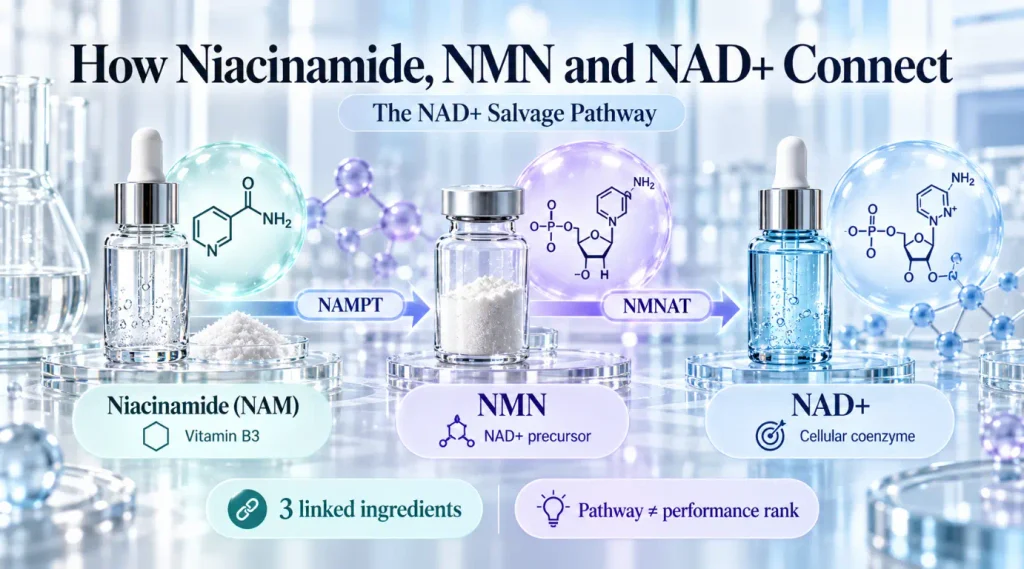
In cells, NMN (nicotinamide mononucleotide) is made from nicotinamide by the enzyme NAMPT and converted into NAD+ by NMNAT, which is why the market calls it an NAD+ precursor. Skin research on NMN has started to move past theory. A 2025 study in the Journal of Cosmetic Dermatology tested NMN, supplied in a yeast-fermented filtrate, on Strat-M, a synthetic skin-mimetic membrane, and on normal human dermal fibroblasts, looking at both permeation and stability (Betsuno et al., 2025). The authors concluded that NMN has potential as a cosmetic ingredient.
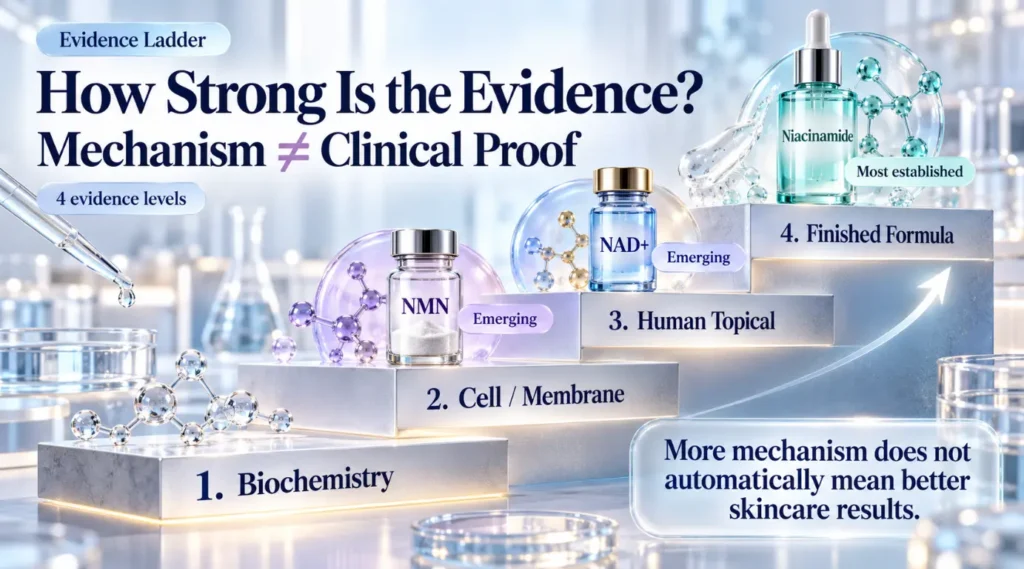
Read that result for what it is: membrane and cell-culture evidence, enough to justify further development and well short of human clinical proof that an NMN skincare product works on skin. The fair description of NMN today is an ingredient with clear biochemistry and a skin evidence base still under construction.
NAD+: the coenzyme itself
NAD+ (nicotinamide adenine dinucleotide) is not a precursor at all. NAD+ is the redox coenzyme at the end of the route and the substrate consumed by NAD+-dependent enzymes such as sirtuins and PARPs. Those roles tie NAD+ to energy metabolism, mitochondrial function and cellular stress responses, which is why NAD+ became one of the most talked-about ideas in skin longevity. For a premium product built around cellular energy or biotech skincare, NAD+ lets the brand put the molecule itself at the center of the story. How NAD+ works in skin, and how to keep it stable in a formula, are covered in our technical guide to NAD+ for skin care.
How niacinamide, NMN and NAD+ connect in the NAD+ pathway
In the salvage pathway, NAMPT converts niacinamide into NMN, and NMNAT converts NMN into NAD+. The pathway shows how the three are related. What it cannot show is which one performs better in a finished product.
Niacinamide (NAM) → NAMPT → NMN → NMNAT → NAD+
Does being closer to NAD+ mean better skincare results?
No. The pathway makes it tempting to rank NAD+ above NMN and NMN above niacinamide, but a cosmetic product is not a pathway diagram. Between the formula and any visible result, an active has to clear a sequence of steps. The active has to stay stable in the formula and release from the base. From there it has to get through the stratum corneum, reach the cells it is meant to act on, remain in its active form once it arrives, and finally produce a change that can be measured. Pathway position says nothing about any of those steps. Being one enzymatic step from NAD+ does not make NMN easier to get into skin, and adding NAD+ itself to a serum does not mean NAD+ reaches the inside of skin cells in useful amounts.
Pathway position is one criterion. Delivery, stability and human evidence count just as much.
Which should you choose: niacinamide, NMN or NAD+?
Default to niacinamide when the product has to deliver an established benefit with the strongest evidence behind it, and move to NMN or NAD+ when the brief is differentiation built on NAD+ biology.
| Product development goal | Evaluate first | Why |
|---|---|---|
| Brightening, barrier or daily anti-aging | Niacinamide | Mature topical evidence and application experience |
| NAD+ precursor concept | NMN | Clear link to NAD+ synthesis |
| Skin longevity or cellular vitality | NMN or NAD+ | New concept with strong differentiation |
| Direct NAD+ or cellular energy positioning | NAD+ | Built directly on NAD+ biology |
| Proven performance plus a new concept | Niacinamide + NMN or NAD+ | Covers both |
| Human topical evidence is the top priority | Niacinamide | The most mature evidence today |
| New-product differentiation is the top priority | NMN or NAD+ | The market is still developing |
The trade-offs
With niacinamide, the trade-off is differentiation. Niacinamide is familiar, well studied and widely used, which also makes it hard to build a distinctive new-product story around the ingredient alone.
With NMN, the gap is human topical evidence. NMN can be converted to NAD+, but that does not mean any topical NMN formula has been shown to raise NAD+ in human skin. Most human research on NMN concerns oral supplementation and whole-body metabolism. A 2026 randomized trial in Nature Metabolism is a good example: 65 healthy adults took one of three oral NAD+ precursors, NMN among them, or a placebo for 14 days, and NAD+ was measured in their blood (Christen et al., 2026). Oral data of that kind cannot stand in as topical efficacy evidence for an NMN serum.
With NAD+, the concept is the most direct and the topical evidence needs the most careful reading. Human topical data remain limited. One 2026 case series in Aesthetic Plastic Surgery followed 36 women with melasma who received microneedling followed immediately by a sterile NAD+ booster, over five sessions (Yi et al., 2026). The study had no control group, and delivery depended on a clinical procedure rather than a leave-on cosmetic, so the results do not carry over to an everyday serum or cream. For both NMN and NAD+, the sensible approach is to treat them as emerging ingredients with a real biological rationale, and to let the finished product prove itself through stability testing and finished-product efficacy testing.
Can you combine niacinamide with NMN or NAD+?
Yes, the combination is worth evaluating, and the logic is easy to follow: niacinamide carries the brightening and barrier benefits consumers already know, while NMN or NAD+ carries the skin longevity story. Paired this way, one formula offers established efficacy and emerging science at once. What the pairing does not give you is a synergy claim. Two ingredients sitting comfortably in the same formula says nothing about whether they work better together, so wording such as synergistic, boosts NAD+ or enhances NAD+ needs data from that specific formula and finished product. Reasoning from the pathway diagram is not enough.
Can be used together ≠ proven synergy.
How strong is the evidence for NAD+ and NMN skincare?
Strong on mechanism, thin on topical proof. Niacinamide has a meaningful body of human topical studies, while the case for NMN and NAD+ rests mostly on biochemistry and laboratory models, plus human data that were not collected on leave-on products.
The most common mistake is treating a mechanism study as if it were an efficacy claim. The table below shows where each fact stops.
| Scientific fact | What it supports | What it does not prove |
|---|---|---|
| Niacinamide takes part in the NAD+ salvage pathway | A clear link to NAD+ metabolism | That all of niacinamide’s effects come from raising NAD+ |
| Niacinamide has a substantial body of human topical studies | Relatively mature evidence for skincare use | That every concentration and every formula performs the same |
| NMN is an NAD+ precursor | A clear link to NAD+ synthesis | That every NMN skincare product raises NAD+ in skin |
| NMN has cell and artificial-membrane data | A research basis for further development | That finished NMN products have mature human anti-aging clinical evidence |
| NAD+ is a central cellular coenzyme | A close connection to energy metabolism and NAD+-dependent enzymes | That topical NAD+ automatically enters cells and acts |
| NAD+ metabolism is linked to aging | A legitimate direction in aging research | That topical NAD+ has been shown to “reverse aging” |
Human NAD+ biology is also more complicated than the usual story suggests. A 2025 review in Nature Metabolism found that an age-related fall in NAD+ has been consistently observed in only a limited number of human studies, and described the published data on NAD+ dynamics in human tissues as sparse (Vinten et al., 2025). A 2026 study in the same journal measured whole-blood NAD+ across seven independent human cohorts and found that levels stayed stable with age (Trętowicz et al., 2026). Neither finding is specific to skin, but together they make the simple “NAD+ falls with age, so top it up” story much harder to defend.
What to check before buying NMN or NAD+ for a formula
Choosing between NMN and NAD+ is only the first decision. Before sampling and purchasing, go through the material and its documents item by item.
| What to check | Why it matters |
|---|---|
| Current-batch COA | Confirms assay and key parameters for the batch you will actually receive |
| Assay or purity method | A “99%” figure means little until you know how it was measured |
| TDS and SDS | Technical parameters and safety information |
| Solubility | Tells you whether the material suits your water phase, serum or emulsion |
| Suggested evaluation range | Sets the range for sampling; it is not a final use level |
| Storage conditions | Stability of NAD+-related materials can’t be taken for granted |
| Regulatory status in the target market | Needs to be confirmed market by market |
| Sample availability | Test in a real formula before you commit to purchasing |
| Finished-formula stability | Tracks changes in assay, color and pH over time |
| Claim support | Keeps marketing language in line with the level of evidence |
NMN and NAD+ specifications from NOYAIN
NOYAIN supplies NMN and NAD+ as cosmetic raw materials, with the specifications below.
| Ingredient | Specification | Suggested Evaluation Range | Positioning |
|---|---|---|---|
| β-Nicotinamide Mononucleotide (NMN) | ≥99.5% (HPLC) | 0.2–2% | NAD+ precursor, skin longevity |
| Nicotinamide Adenine Dinucleotide (NAD+) | ≥98% | 0.01–0.5% | NAD+, cellular skincare |
Treat the suggested evaluation range as a starting point for sampling and stability screening, not as a recommended final dosage. The final use level depends on the formula type and the stability results, and it also has to pass the safety assessment and meet the requirements of the target market. Before a commercial order, evaluate a sample in your own base alongside the current-batch COA and technical documents.
Choose for the product, not for pathway position
The right question is which ingredient fits the product you are building, not which one sits closest to NAD+. Niacinamide is the proven performer: well researched, familiar to consumers and predictable in formulation. NMN is the newer NAD+ precursor, with clear biochemical logic and plenty of room for differentiation. NAD+ is the center of the story and the natural fit for a cellular energy concept, but its effect on skin has to be shown through delivery work and finished-product data. In every case, the product stands or falls on the right ingredient in a sound formula, stability that has been verified, and finished-product evidence that matches what the label claims.
Frequently asked questions
Are NAD+ and NMN the same thing?
No. NMN is a precursor that cells convert into NAD+, while NAD+ is the coenzyme itself. In the salvage pathway, the enzyme NMNAT turns NMN into NAD+.
What is the difference between NMN and niacinamide?
Both feed NAD+ synthesis, but niacinamide sits upstream of NMN and is already an established cosmetic active with mature topical evidence. NMN is one step closer to NAD+, and its human topical evidence is still well behind niacinamide’s.
Are niacinamide and nicotinamide the same ingredient?
Yes. Niacinamide and nicotinamide are two names for the same molecule, commonly abbreviated to NAM in the scientific literature.
Is NAD+ better than NMN for skincare?
Current evidence does not support that conclusion. In any NAD+ vs NMN vs niacinamide comparison, topical performance depends on stability and delivery in the actual base, on the concentration used and on what finished-product testing shows, not on where the ingredient sits in the pathway.
Is NMN more advanced than niacinamide?
Newer is not the same as more effective. NMN brings novelty, niacinamide brings mature evidence and consumer recognition, and the product’s positioning should decide which one belongs in the formula.
Can niacinamide, NMN and NAD+ be used together?
Yes, as a combination to evaluate. Check solubility and pH first, then stability and assay retention over time, and back any synergy claim with evidence from the finished product.
Developing an NAD+ or NMN skincare formula?
Start with a sample and a real formula test, not a bulk order at the suggested evaluation range. Tell us what you are building and we will send a free 2–3 g sample of NMN or NAD+, dispatched within three working days, with the current-batch COA, TDS and SDS. Once testing looks promising, we can go through your formulation requirements and prepare a commercial quotation.
Request an NMN or NAD+ sample and technical documents
References
- Ong RR, Goh CF. Niacinamide: a review on dermal delivery strategies and clinical evidence. Drug Delivery and Translational Research. 2024;14(12):3512–3548. DOI: 10.1007/s13346-024-01593-y. PubMed: 38722460
- Betsuno R, Yamane T, Tsuji H, Nakajima Y, Imai M, Bamba T, Uchiyama S. Permeation of Nicotinamide Mononucleotide (NMN) in an Artificial Membrane as a Cosmetic Skin Permeability Test Model. Journal of Cosmetic Dermatology. 2025;24(5):e70222. DOI: 10.1111/jocd.70222. Full text: PMC12048825
- Christen S, Redeuil K, Goulet L, et al. The differential impact of three different NAD+ boosters on circulatory NAD and microbial metabolism in humans. Nature Metabolism. 2026;8:62–73. DOI: 10.1038/s42255-025-01421-8. PubMed: 41540253
- Yi KH, Wan J, Hwang S. Efficacy and Safety of a Topical Nicotinamide Adenine Dinucleotide Skinbooster for the Treatment of Melasma. Aesthetic Plastic Surgery. 2026;50:4431–4436. DOI: 10.1007/s00266-026-05726-1. PubMed: 41870519. Delivery was microneedling-assisted; the study is not direct evidence for leave-on NAD+ cosmetics.
- Vinten KT, Trętowicz MM, Coskun E, et al. NAD+ precursor supplementation in human ageing: clinical evidence and challenges. Nature Metabolism. 2025;7(10):1974–1990. DOI: 10.1038/s42255-025-01387-7. PubMed: 41083806
- Trętowicz MM, Scantlebery AML, Schomakers BV, et al. Human whole-blood NAD+ levels do not vary with age or lifestyle interventions. Nature Metabolism. 2026;8:1282–1290. DOI: 10.1038/s42255-026-01537-5. PubMed: 42135539