
Cosmetic Active System
DCP (Dimethylmethoxy Chromanyl Palmitate)
A low-dose, oil-soluble brightening active for multi-active tone-care formulas.
We supply DCP for formulators who want to bring a brightening active into the oil phase without relying on a high starting dosage. Its 0.01%-0.1% evaluation range and lipophilic profile make it especially relevant for formulas that combine oil-phase and water-phase brightening strategies.
Oil-Soluble Brightening Active
0.01%-0.1% Evaluation Range
Sample & Current COA Available
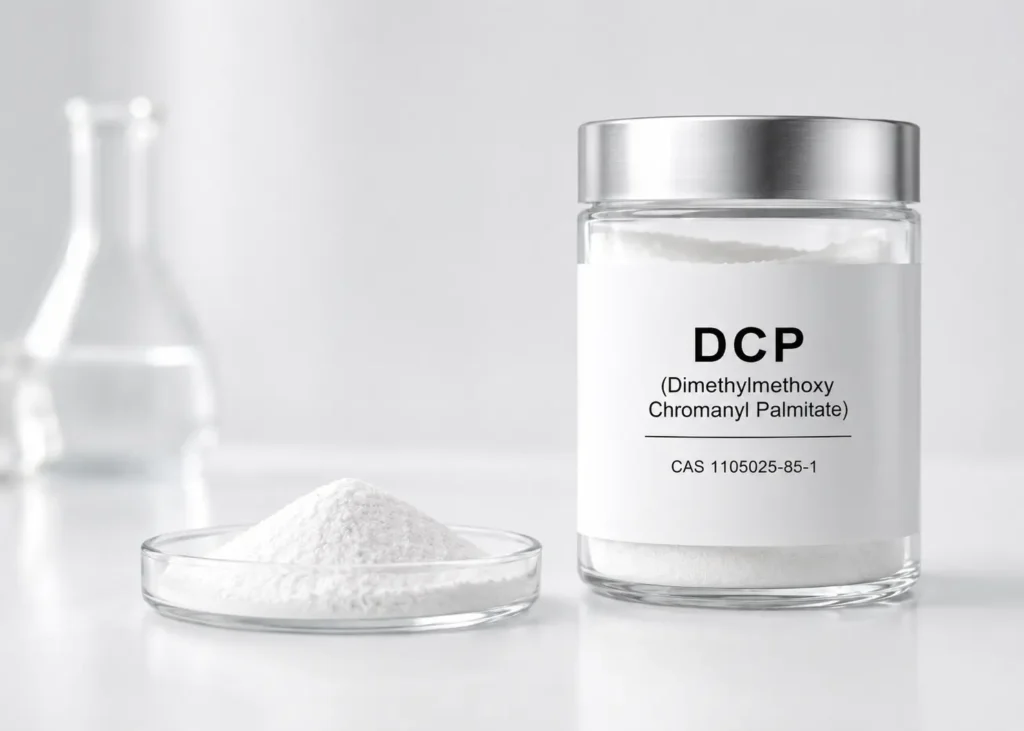
INCI
Dimethylmethoxy Chromanyl Palmitate
CAS
1105025-85-1
Our Supplied Grade
99% grade; reference batch HPLC result 99.56%
Appearance
White to off-white powder
Evaluation Range
0.01%-0.1% in our TDS; confirm the final level in the finished formula
Product Overview
A Modern Oil-Soluble Brightening Active for Multi-Active Formulas
Dimethylmethoxy Chromanyl Palmitate is a lipophilic cosmetic active for brightening and even-tone skincare. Its value is not that it replaces every familiar brightening ingredient. DCP gives formulators a distinct oil-phase route that can complement water-soluble actives in a multi-pathway formula.
With a 0.01%-0.1% evaluation range, published ingredient-level brightening evidence, and use in several finished-product formats, DCP is particularly relevant for premium brightening serums, eye care, targeted dark-spot products, emulsions, and oil-rich or anhydrous concepts.
**Where DCP fits best:** projects seeking a low-use-level brightening active, an oil-phase counterpart to water-soluble actives, or a more differentiated multi-active even-tone story.
Buyer decision path
Why Formulators Choose DCP
01
Start Brightening Evaluation at 0.01%-0.1%
DCP can enter screening at a low use level, giving formulation teams room to assess performance, cost-in-use, and positioning before selecting the final commercial dosage.
02
Bring Brightening into the Oil Phase
Its lipophilic profile opens a different formulation route from water-soluble actives. This is useful in emulsions, oil serums, eye care, and other systems where the oil phase can carry part of the brightening strategy.
03
Build a Multi-Pathway Brightening System
DCP can complement water-phase ingredients rather than compete with them for the same formulation role. That makes it useful when a project needs a broader, multi-active even-tone concept.
04
Support the Concept with Published Evidence
Public in-vitro and human-use data give formulators more than a supplier claim when deciding whether DCP deserves a place in the first screening round.
Formula concepts
Why Source DCP from Us?
We do not ask you to approve DCP based on product-page claims alone. We provide the specification, batch documentation, and sample route needed to evaluate the actual material.
99% Grade Specification
We supply DCP as a white to off-white powder with a 99% grade specification in our TDS, providing a defined starting point for sourcing and formula evaluation.
Reference Batch: 99.56% by HPLC
A supplied reference batch reached **99.56% purity by HPLC**. Commercial approval is always based on the COA and test results for the current available batch.
Review the Current Batch Before Purchase
Request the current COA together with the TDS and SDS/MSDS so your quality and purchasing teams can review identity, assay, specification, and handling information against the same batch opportunity.
Test the Actual Material Before You Commit
We provide samples before bulk purchase. Your team can check whether our DCP dissolves, remains compatible, and performs as intended in the formula you plan to commercialize.
market trend
From Ingredient to Market: DCP Is Already in Premium Skincare
Dimethylmethoxy Chromanyl Palmitate is already found in commercial skincare products from premium and professional brands, particularly in formulas targeting dark spots, uneven skin tone, and brightening.
| Brand / Product | Product Type |
|---|---|
| U Beauty – The RETURN Eye Concentrate | Premium brightening eye care |
| Topicals – Faded Serum | Dark-spot & discoloration serum |
| Joanna Czech – The C+ Serum | Luxury brightening serum |
| Lira Clinical – PRO Lite Serum | Professional pigmentation care |
Its growing use in commercial products shows that DCP has moved beyond ingredient development into real-world premium brightening and discoloration-care formulations.
Brand examples are shown for market reference only and do not imply a supply relationship with us.
Brand examples are shown for market reference only and do not imply a supply relationship with us.
Formulation notes
How to Use DCP in Formulations
The key is not simply adding DCP to the oil phase—it is keeping it fully dissolved through cooling and stability testing.
Formulation performance depends on the complete system, so we recommend sample testing before commercial scale-up.
Get Free SampleFormulation performance depends on the complete system, so we recommend sample testing before commercial scale-up.
Start Within the 0.01%-0.1% Range
Our TDS gives 0.01%-0.1% as the evaluation range. Choose the final level after reviewing formula performance, claim strategy, and cost-in-use.
Pre-Dissolve Before Addition
DCP is an oil-phase active. Pre-dissolve it in a compatible oil or silicone; useful screening media may include C12-15 Alkyl Benzoate, Caprylic/Capric Triglyceride, selected emollient oils, or Dimethicone.
Keep DCP Dissolved During Cooling
Confirm complete dissolution during processing and observe the batch as it cools. A clear hot-phase solution is not enough if crystals appear after the product reaches room temperature.
Check Recrystallization Before Scale-Up
Monitor clarity, color, and crystal formation during low-temperature storage, accelerated testing, and stability cycling. This is a critical checkpoint for selecting the oil phase and process.
Work Within the pH 3.8-8.4 Design Window
Our TDS lists pH 3.8-8.4 as a design window. Validate the chosen use level, process, and packaging in the complete formula.
Use the Oil-Phase Advantage
DCP is well positioned for brightening serums, face creams, eye care, targeted dark-spot products, and anhydrous or oil-rich concepts—especially when the formula already contains water-phase brightening actives.
Technical Specifications
Product Technical Parameters
Parameter | Specification |
|---|---|
Trade Name | DCP |
INCI Name | Dimethylmethoxy Chromanyl Palmitate |
CAS No. | 1105025-85-1 |
Molecular Weight | 446.66 |
Appearance | White to off-white powder |
pH | 3.8-8.4 |
Storage | Keep sealed in a cool, dry, light-protected place; follow current batch documentation |
Recommended Cosmetic Use Level | 0.01%-0.1% Evaluation Range |
Shelf Life | Confirm on the current batch COA before purchase approval |
Document support
Supply Support for DCP Projects
- Identity matching across DCP, Dimethylmethoxy Chromanyl Palmitate, CAS 1105025-85-1, and relevant procurement names.
- Current COA, TDS, and SDS/MSDS for specification, quality, handling, storage, and regulatory review.
- Sample support for evaluating purity, appearance, dissolution, compatibility, stability, and finished-formula performance before bulk purchase.
- Formulation communication covering the 0.01%-0.1% evaluation range, oil-phase incorporation, pre-dissolution, solvent selection, and recrystallization checks.
- Discussion of target application, product format, target market, other active ingredients, and documentation requirements.
- Confirmation of current batch specification, quotation, packaging, MOQ, lead time, batch availability, and shipping documents before commercial order approval.
related products
Other related products
Related Documents
Technical Support Materials
COA Document
Request COATDS (Technical Data Sheet)
Request TDSSDS / MSDS
Request SDS / MSDSFormulation Guide
Get For FreeRelated Topics
Product-related articles
See Where DCP Fits in Your Brightening Formula
Request a sample and current COA for your DCP project. Tell us your product type, target market, optional expected volume, and required documents, and we will confirm availability and quotation details.
Frequently Asked Questions
Questions from Formulators and Buyers
- What is DCP, and where does it fit in a brightening formula?DCP is our abbreviation for Dimethylmethoxy Chromanyl Palmitate, an oil-soluble cosmetic active used in brightening and even-tone products. It is especially relevant when formulators want a low-use-level oil-phase active that can complement water-soluble ingredients in a multi-active serum, cream, eye-care, or targeted tone-care concept.
- Why use an oil-soluble active alongside water-soluble brightening ingredients?An oil-soluble active gives formulators another route for building a multi-phase brightening system. DCP does not need to replace ingredients such as vitamin C derivatives or other familiar actives; it can occupy a distinct oil-phase role when the formula and positioning benefit from more than one brightening strategy.
- What is the recommended use level?Our TDS lists 0.01%-0.1% as the evaluation range. The final level should be selected after testing dissolution, formula stability, desired positioning, and cost-in-use in the complete finished-product system.
- Is DCP water soluble?No. DCP should be handled as an oil-phase active. Pre-dissolve it in a compatible oil or silicone system, then incorporate the solution through a validated process for the intended formulation.
- How should DCP be incorporated?Choose a suitable oil or silicone and confirm complete dissolution before addition. Then monitor the formula during cooling and stability testing for clarity, color change, recrystallization, compatibility, and package interaction. A successful hot-phase solution should remain acceptable after the finished product reaches its storage conditions.
- Can you provide documents and a sample before bulk purchase?Yes. We can provide a DCP sample with the available current batch COA, TDS, and SDS/MSDS for evaluation. This lets your formulation, quality, and purchasing teams review the material and documents before requesting commercial-order approval.
- How do I confirm the current batch specification?When evaluating a Dimethylmethoxy Chromanyl Palmitate supplier, review the current batch COA rather than relying only on a general product-page value. Request the COA and quotation together so your quality and purchasing teams can assess the same available batch.