
Cosmetic Active System
HEPES (Hydroxyethylpiperazine Ethane Sulfonic Acid)
A highly water-soluble zwitterionic ingredient for pH-managed skincare and carefully validated skin-surface renewal concepts.
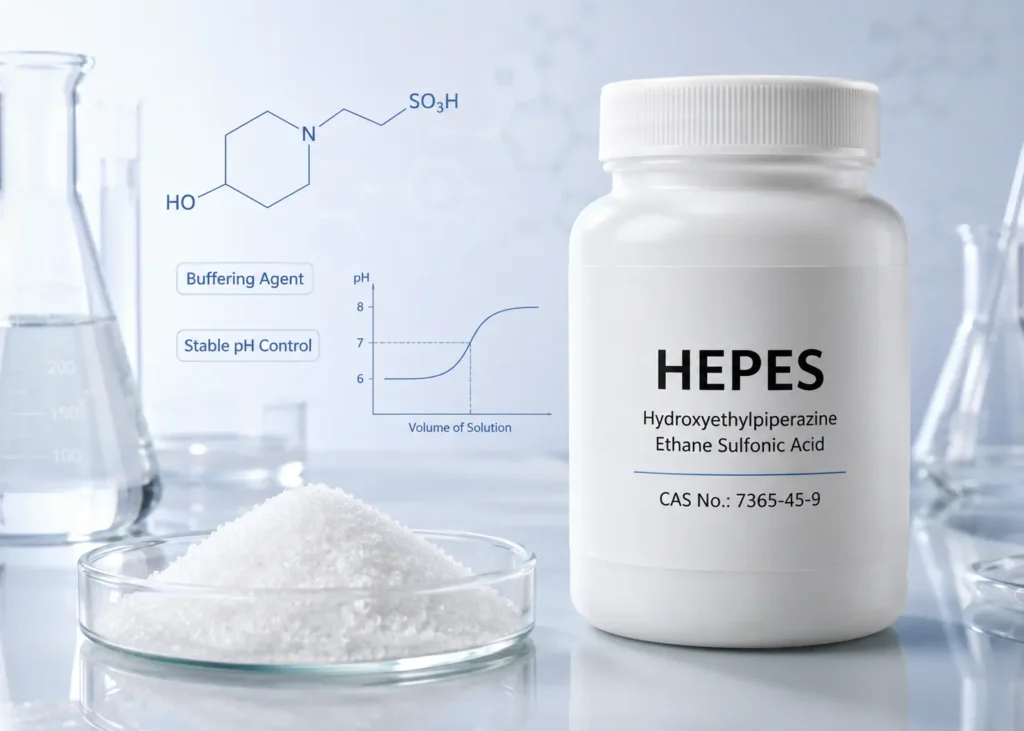
We supply HEPES under the INCI name Hydroxyethylpiperazine Ethane Sulfonic Acid. Our HEPES is a white crystalline powder identified by CAS 7365-45-9, with high water solubility and a defined 1% aqueous-solution pH. It is suitable for formulators developing water-rich skincare systems where buffering performance, pH control strategy, formula clarity, and differentiated renewal positioning need to be evaluated together.
Polysaccharide content: ≥5.0%
Water-soluble; suitable for clear and emulsion systems
ecommended use level: 2-10%
INCI
Hydroxyethylpiperazine Ethane Sulfonic Acid
CAS
7365-45-9
Function
Buffering and pH-management support; formulation-dependent skin-renewal positioning
Appearance
White crystalline powder
Storage
Room temperature under the conditions described in our MSDS
Product Overview
HEPES for pH-Managed and Renewal-Focused Skincare Development
HEPES is the common abbreviated name for Hydroxyethylpiperazine Ethane Sulfonic Acid, a zwitterionic sulfonic-acid compound known for buffering applications. In cosmetic formulation development, it can be evaluated in water-based systems that require a controlled pH strategy, high raw-material water solubility, and a clean white-powder starting form.
Our HEPES MSDS identifies the material as 4-(2-Hydroxyethyl)piperazine-1-ethanesulfonic acid with CAS 7365-45-9, molecular formula C8H18N2O4S, and molecular weight 238.30. The material is reported as soluble in water at 703.6 g/L at 20°C. These properties make it practical to screen in aqueous serums, essences, toners, mask essences, gels, lotions, and emulsion systems.
For renewal-focused development, HEPES may be explored in cosmetic concepts targeting smoother-looking texture, radiance, and more refined-looking skin. We treat this as a formulation and claim-development pathway, not as an automatic raw-material efficacy claim. The final concentration, pH, compatibility, tolerance, stability, and consumer-facing claims should be supported by the finished formula.
01
Confirm the Correct HEPES Identity
Share your required INCI, CAS number, chemical name, purity target, application, and target market. We help verify that the requested material is HEPES free acid rather than a sodium, potassium, or other salt form.
02
Evaluate It in Your Formula
Screen our HEPES in the intended water phase and confirm dissolution, final pH, buffer capacity, clarity, viscosity, preservative performance, active compatibility, and storage stability.
03
Align the Commercial Specification
Before purchase approval, confirm the current batch specification, COA availability, packaging, shelf life, MOQ, lead time, and documentation required for your market and production site.
Buyer decision path
Key Formulation Advantages of HEPES
01
High Water Solubility
Our MSDS reports water solubility of 703.6 g/L at 20°C under OECD Test Guideline 105. This supports efficient aqueous-phase screening and makes HEPES relevant for water-rich formats where raw-material dissolution and visual clarity are important.
02
Buffering Support for pH-Managed Systems
HEPES can support a formulation strategy designed to resist pH drift. It should be treated as a buffer rather than as a substitute for the acid or base used to set the initial formula pH. The complete formula determines actual buffer capacity and long-term pH behavior.
03
Flexible Water-Based Application
The white crystalline powder form and high water solubility make our HEPES practical to evaluate in serums, essences, toners, gels, mask essences, lotions, and creams. Final clarity, texture, electrolyte tolerance, and preservative performance still require prototype testing.
04
Differentiated Renewal Positioning
HEPES is chemically distinct from alpha-hydroxy acids and beta-hydroxy acids. It may be explored in surface-smoothing and radiance-oriented development where a brand wants a different technical story from a conventional acid-only system. This distinction does not by itself establish stronger or milder exfoliation; comparative claims require appropriate finished-product evidence.
Formula concepts
Recommended Applications for HEPES
Serum
pH-Managed Multi-Active Serum
In water-rich serums, HEPES can be evaluated where the development team wants to manage pH drift across a multi-active system. It may be screened with humectants, skin-conditioning ingredients, and compatible actives after checking electrolyte load, clarity, viscosity, preservative efficacy, and active stability.
Essence
Radiance and Texture-Refining Essence
HEPES may be considered in essence concepts designed around smoother-looking texture and radiance. Because our current MSDS is not an efficacy report, the final renewal or exfoliation story should be supported by a suitable finished-formula test rather than by the ingredient name alone.
Toner
Buffered Daily Skincare Toner
In toners, HEPES can support a pH-management strategy while retaining a light, water-rich product format. Confirm final pH, buffer capacity, clarity, skin tolerance, preservative performance, and packaging compatibility throughout stability testing.
Gel or Gel-Cream
Lightweight Renewal Care
HEPES can be screened in aqueous gels and gel-creams for lightweight texture-refining or daily radiance concepts. Electrolyte-sensitive thickeners may respond to the complete buffer system, so viscosity and appearance should be checked before scale-up.
Formulation notes
How to Use HEPES in Formulations
Use our HEPES as a water-soluble buffering ingredient whose final behavior depends on concentration, neutralization, target pH, ionic strength, and the complete active and preservative system.
Get Formulation GuideUse Level
Our current HEPES MSDS does not define a general cosmetic use level. Select the concentration through prototype screening, target-pH design, buffer-capacity measurement, safety assessment, stability testing, and target-market review. Do not convert a concentration from a patent, laboratory buffer, or unrelated finished product into a universal recommendation.
Solubility and Pre-Dissolution
Our MSDS reports 703.6 g/L water solubility at 20°C. For water-based development, prepare an aqueous concentrate or add HEPES gradually to the water phase under effective mixing. Confirm that the material is fully dissolved before making the final pH adjustment.
Addition Phase
HEPES can be introduced through the water phase of compatible systems. Our current source package does not specify a universal processing temperature, so the addition point should be selected after checking heat exposure, active stability, thickener response, and the manufacturing sequence of the complete formula.
pH Setting and Buffer Validation
The pH of a 1% HEPES aqueous solution in our MSDS is 5.0-6.5 at 25°C. This test result is not the same as a recommended finished-product pH or a guaranteed buffering range. Set the initial formula pH with an appropriate acid or base, then measure how well the complete formula resists pH drift during stability testing.
Compatibility Review
Our MSDS identifies strong oxidizing agents as incompatible materials. In cosmetic systems, also evaluate HEPES with acids, bases, high-electrolyte actives, polymers, emulsifiers, preservatives, metal-containing ingredients, fragrances, botanical extracts, and packaging materials before commercial approval.
Stability Check
Monitor pH drift, color, odor, clarity, precipitation, crystallization, viscosity, emulsion stability, preservative efficacy, microbial quality, active retention, and package interaction under accelerated, freeze-thaw, heat/cool-cycle, and real-time storage conditions appropriate to the project.
Technical Specifications
Product Technical Parameters
Parameter | Specification |
|---|---|
Trade Name | HEPES |
INCI Name | Hydroxyethylpiperazine Ethane Sulfonic Acid |
CAS No. | 7365-45-9 |
Molecular Weight | 238.30 |
Appearance | White crystalline powder |
pH | 5.0-6.5 at 1% in water at 25°C |
Storage | Room temperature |
Recommended Cosmetic Use Level | Formula-dependent; confirm through technical and safety evaluation |
Shelf Life | Confirm for the current batch and packaging configuration |
Document support
Supply Support for HEPES Projects
- Identity matching across HEPES, the INCI name, CAS 7365-45-9, standard chemical names, and common procurement synonyms.
- Our current HEPES MSDS for handling, storage, physicochemical, safety, environmental, and transport review.
- Discussion of target application, required purity, target pH, formulation format, test plan, and documentation needs.
- Sample-availability and quotation discussion for laboratory evaluation, pilot development, and commercial sourcing.
- Confirmation of the current commercial specification, batch documentation, packaging, MOQ, lead time, and shipping requirements before order approval.
- Formulation communication covering water-phase addition, pH setting, buffer-capacity testing, electrolyte effects, stability, and claim boundaries.
Supplier value
Formulation and Claim Precautions
Buffer Does Not Mean pH Adjuster
HEPES can help resist pH change, but it does not remove the need to set the initial pH correctly. Define the target pH based on the full formula, ingredient stability, preservative system, skin tolerance, packaging, and market requirements.
Do Not Treat 1% Solution pH as the Finished-Formula Target
The 5.0-6.5 value in our MSDS describes the measured pH of a 1% aqueous HEPES solution at 25°C. It should not be copied into a formulation guide as a universal finished-product pH range.
Validate Renewal and Exfoliation Claims
HEPES appears in published cosmetic formulation and patent contexts related to desquamation and skin-surface renewal. Our current HEPES MSDS does not contain an ingredient-level or finished-formula efficacy study. Claims such as exfoliation, faster renewal, smoother skin, reduced roughness, or improved radiance therefore require suitable formula-level substantiation.
Confirm Cosmetic Use Level
Our current source package does not establish a universal dosage. Select the level through a documented formulation, toxicological, regulatory, stability, and claim review for the intended product and market.
related products
Other related products
Related Documents
Technical Support Materials
COA Document
Request COATDS (Technical Data Sheet)
Request TDSSDS / MSDS
Request SDS / MSDSFormulation Guide
Get For FreeRelated Topics
Product-related articles
Evaluating HEPES for Your Next Skincare Formula?
Tell us your target application, pH, required purity, test quantity, destination market, and document needs. We can help confirm the correct HEPES identity, discuss sample availability, align the commercial specification, and prepare a quotation for your project.
Frequently Asked Questions
Questions from Formulators and Buyers
- What is HEPES in cosmetic formulations?HEPES is the abbreviation for Hydroxyethylpiperazine Ethane Sulfonic Acid. It is a zwitterionic, water-soluble compound known for buffering applications. In cosmetic R&D, it may be evaluated in pH-managed water-based formulas and in carefully substantiated skin-surface renewal, texture-refining, or radiance concepts.
- What is the INCI name of HEPES?The INCI name used for HEPES is Hydroxyethylpiperazine Ethane Sulfonic Acid. We use this name as the primary cosmetic ingredient identity on the product page, while HEPES and the longer chemical names are retained for technical and procurement searches. Final ingredient labelling should be reviewed for the destination market.
- Do the different HEPES names refer to the same ingredient?HEPES, 4-(2-Hydroxyethyl)-1-piperazineethanesulfonic acid, N-2-Hydroxyethylpiperazine-N’-2-ethanesulfonic acid, and 2-[4-(2-Hydroxyethyl)-1-piperazinyl]ethanesulfonic acid refer to the same free-acid chemical identity associated with CAS 7365-45-9. HEPES salts and prepared solutions can be different commercial materials and should be checked separately.
- Is HEPES water soluble?Yes. Our HEPES MSDS reports water solubility of 703.6 g/L at 20°C under OECD Test Guideline 105. Formulators should still confirm dissolution speed, clarity, ionic effects, and long-term precipitation behavior in the complete formula.
- What is the pH of HEPES?Our MSDS reports pH 5.0-6.5 for a 1% aqueous solution at 25°C. This value describes that specific raw-material test solution. It is not a universal recommended formula pH and should not be confused with the buffer’s effective operating behavior in a complete cosmetic system.
- Is HEPES an exfoliating ingredient?HEPES has appeared in published cosmetic formulation and patent contexts related to desquamation and skin-surface renewal. We do not treat that fact alone as proof of exfoliating performance for our raw material or for every finished formula. If the product will claim exfoliation, smoother texture, renewed skin, or improved radiance, validate the chosen concentration and finished formula with suitable safety and efficacy testing.
- How should HEPES be added to a formula?For compatible water-based systems, pre-dissolve HEPES or add it gradually to the water phase under effective mixing. Confirm full dissolution before final pH adjustment. Then test buffer capacity, pH drift, clarity, viscosity, preservative efficacy, active retention, and packaging compatibility in the final formula.