Three grades, two variables, and one comparison most buyers get backwards.
Quick answer: which Hydrolyzed Sponge grade should you evaluate first?
Start with the 99% standard needle, because it sits at the midpoint of both variables and tells you the most about how your formula will behave before you commit to a direction.
The three commercial grades are:
| Grade | Purity | Spicule length | Positioned for |
|---|---|---|---|
| Hydrolyzed Sponge 99 (Long Needle) | 99% | 350–450 µm | Professional treatments |
| Hydrolyzed Sponge 99 (Standard Needle) | 99% | 200–280 µm | Home care and functional skincare |
| Hydrolyzed Sponge 97 (Standard Needle) | 97% | 200–280 µm | Entry-level formulations |
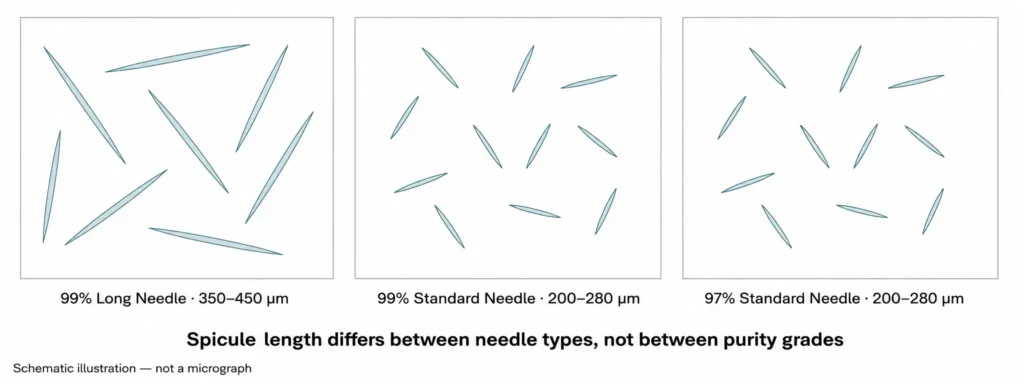
Read that table twice. Purity and spicule length are independent variables, and the 97% and 99% standard needles are the same length.
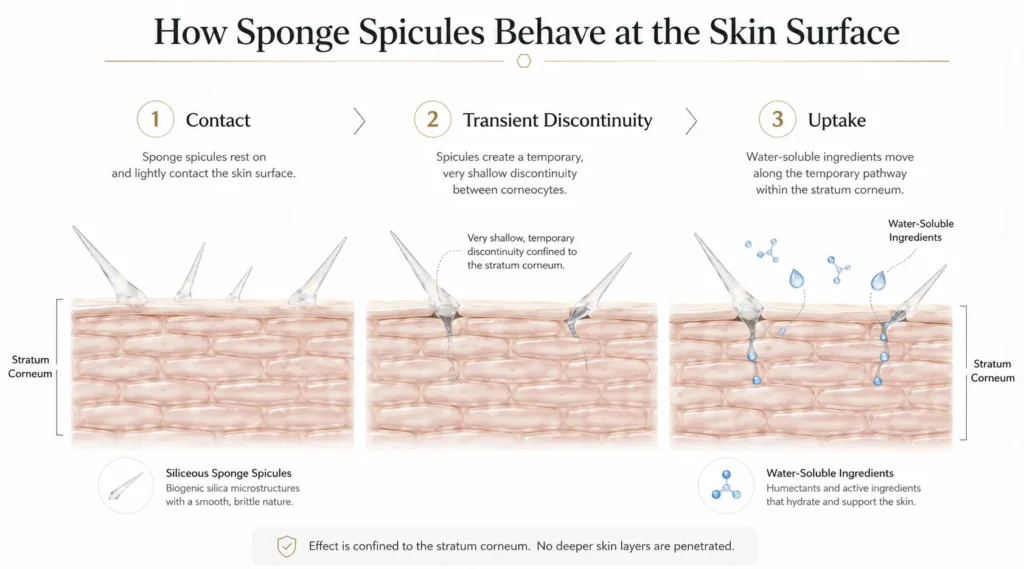
This article is about choosing between the three. If you need the background first — what the ingredient is, how the spicules behave at the skin surface, and what the published research does and does not support — start with our guide to what Hydrolyzed Sponge is and come back.
Why “97%” does not mean “a shorter needle”
It means less spicule and more silicate, at exactly the same length as the 99% standard grade.
This is the single most common misreading we see in enquiries. A buyer sees three grades, assumes they are three points on one scale of intensity, and asks for “the gentlest one” expecting the 97%. But intensity at the skin surface is driven by length, dose and massage technique — not by the purity figure. The 97% standard needle and the 99% standard needle carry the same 200–280 µm spicules. Swapping one for the other to reduce tingling will not reduce tingling.
What changes is what fills the remaining percentage points, and that is a formulation question rather than a sensory one.
What the missing percentage points actually are
They are silicate — specifically calcium silicate and sodium silicate, both itemised on the composition sheet as sponge-derived. Not water, and not contamination.
| Grade | What the composition sheet declares |
|---|---|
| 99% grades | Hydrolyzed Sponge, with the small balance described in the technical data sheet as water |
| 97% grade | Hydrolyzed Sponge, plus calcium silicate and sodium silicate, both listed with a stated percentage and an origin of “Sponge” |
Ask for the composition sheet and you will see the two silicate lines written out. That is a more useful piece of information than the purity figure itself, because it tells you what you are actually formulating with and what your regulatory team will have to declare.
Two consequences follow, and neither is obvious from a purity number alone:
Sodium silicate is alkaline. Its share of the raw material is small, and the raw material is itself typically dosed below 2%, so the contribution to a finished formula is minor — but it is not zero, and it is worth checking against pH-sensitive actives during compatibility screening rather than after. Read the exact figure off the composition sheet for the batch you are quoting.
Your ingredient list may need to change. If your regulatory team builds the INCI declaration from the supplier composition sheet, the 97% grade brings two additional entries with it. The 99% grade, as declared, does not. For brands filing in markets where the full quantitative composition is submitted, this is the difference that matters more than the purity figure itself.
The loss-on-ignition figure confirms the silicate story
Loss on ignition is the specification line that quietly corroborates the composition sheet, and it differs between the two grades by exactly the margin you would expect.
| Specification line | 99% grades | 97% grade |
|---|---|---|
| Sponge spicule content | 99% | 97% |
| Loss on ignition (800 °C, 30 min, GB 25576-2020) | NMT 10% | NMT 12% |
| Loss on drying (80 °C, 30 min, GB/T 6284) | NMT 3% | NMT 3% |
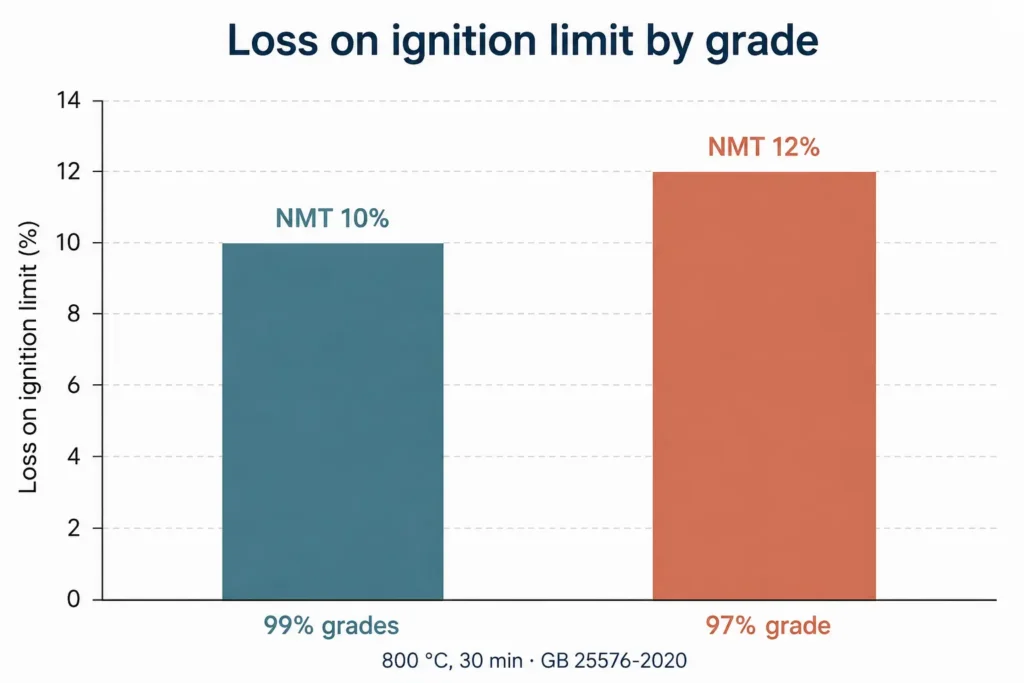
Loss on ignition measures what burns off at 800 °C, leaving the inorganic residue behind. The lower-purity grade carries a two-point wider allowance — consistent with a material whose declared balance is silicate rather than water. The composition sheet and the ignition limit were produced independently, and they point the same way.
Practical use: if a supplier quotes you a purity figure but the loss-on-ignition limit is unchanged from their higher grade, the two numbers are not telling the same story. Ask which one was measured on the batch you are buying.
How purity is actually measured
By hydrofluoric acid volatile weight difference subtraction — a method worth knowing because it determines what the number does and does not cover.
Both technical documents name this method for the spicule content line. Hydrofluoric acid volatilises silica; what remains after treatment, subtracted from the starting weight, gives the siliceous spicule fraction. The figure is therefore a mass fraction of siliceous material, not a count of intact spicules and not a measure of spicule geometry.
That distinction has a direct consequence: a batch can meet a 99% specification while containing a higher proportion of broken or fragmentary spicules than another 99% batch. Purity constrains composition. It does not constrain shape.
If spicule integrity matters to your product — and for a delivery-oriented format it usually does — the purity figure is not the line to check. Ask for microscopy on the batch, and ask whether the images are batch-specific or reused across grades.
Neither the COA nor the TDS carries a spicule length field
This is the gap that catches most first-time buyers: length is the primary axis of difference between the long and standard needles, and it does not appear on the standard quality documents at all.
We checked the full document set for both grades. The certificate of analysis, technical data sheet, specification sheet and composition sheet cover:
- Spicule content, appearance, colour, odour
- Particle size by mesh
- Loss on drying, loss on ignition, pH
- Arsenic, lead, cadmium, mercury
- Total plate count, yeasts and moulds, Staphylococcus aureus, E. coli, Salmonella
- Storage and shelf life
None of them state spicule length. Length comes from a separate measurement report, and that report is what you should ask for by name.
Mesh size is not spicule length
The particle-size line reads 95% pass 100–180 mesh on the technical data sheet, and it is identical for both purity grades. A mesh screen sorts by the smallest cross-section a particle can pass through, which for a needle is governed by diameter, not length. Reference spicule diameters sit around 15–16 µm for both needle types, so both pass the same screen.
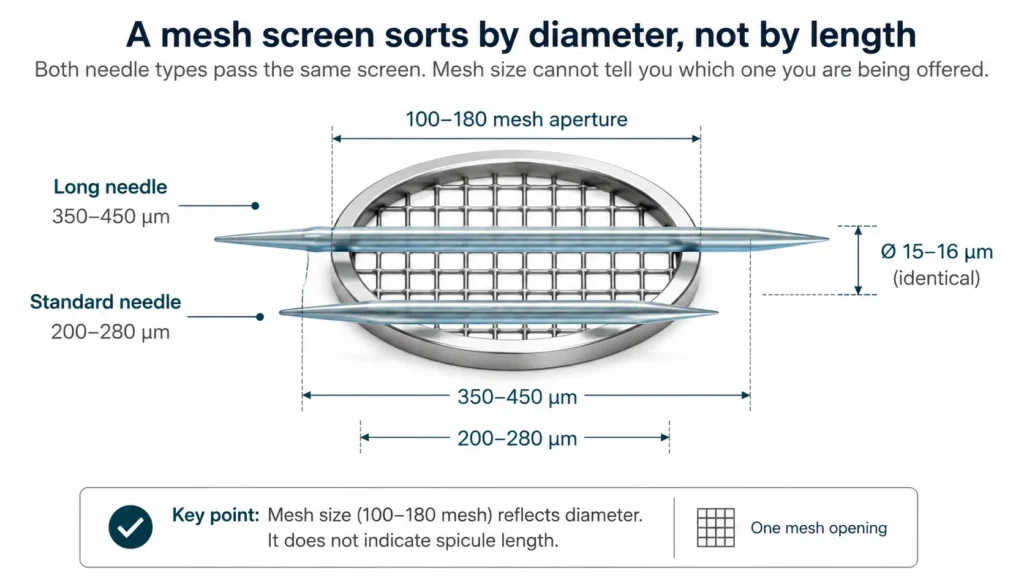
A supplier who answers a length question with a mesh figure has answered a different question.
What is identical across all three grades
Almost everything, which is why the differences that do exist deserve attention.
| Specification | All grades |
|---|---|
| INCI name | Hydrolyzed Sponge |
| CAS number | Not applicable |
| Raw material source | Freshwater sponge |
| Appearance | Uniform fine powder, no obvious visible impurities |
| Colour | White |
| Odour | Characteristic |
| Particle size | 95% pass 100–180 mesh |
| Loss on drying | NMT 3% (80 °C, 30 min) |
| pH, 1% solution | 6.0–8.0 |
| Arsenic / Lead / Cadmium / Mercury | NMT 2 / 10 / 5 / 1 ppm |
| Total plate count | NMT 1,000 cfu/g |
| Yeasts and moulds | NMT 100 cfu/g |
| S. aureus / E. coli / Salmonella | Negative |
| Storage | Low relative humidity, dark |
| Shelf life | Three years |
Three lines differ across the range: spicule content, loss on ignition, and spicule length. Everything else is the same material with the same handling requirements.
Why that is useful to know: if you have already qualified one grade, switching to another within the range does not reset your microbiological, heavy-metal or stability work. It changes your composition declaration and your sensory profile. Scope your re-testing accordingly instead of repeating the whole qualification.
Reading the pH figure without tripping over it
Two different pH ranges appear across the documents, and they are not a contradiction — they are two different test conditions.
| Document | Stated range | Test condition |
|---|---|---|
| Technical data sheet / specification sheet | 6.0–8.0 | 1% solution |
| Certificate of analysis | 5.0–10.0 | 10% solution |
The certificate applies a wider allowance at ten times the concentration. Both are real; they answer different questions. For formulation work at typical use levels, the 1% figure is the relevant one. For incoming-goods inspection, use whichever condition your own QC method specifies, and tell your supplier which one you are testing against before the first shipment rather than after a disagreement.
You will also find a 7.5 ± 1.5 range circulating in older marketing material for this ingredient family. It matches neither test condition on the current documents. Do not build a specification around it.
A grade selection matrix
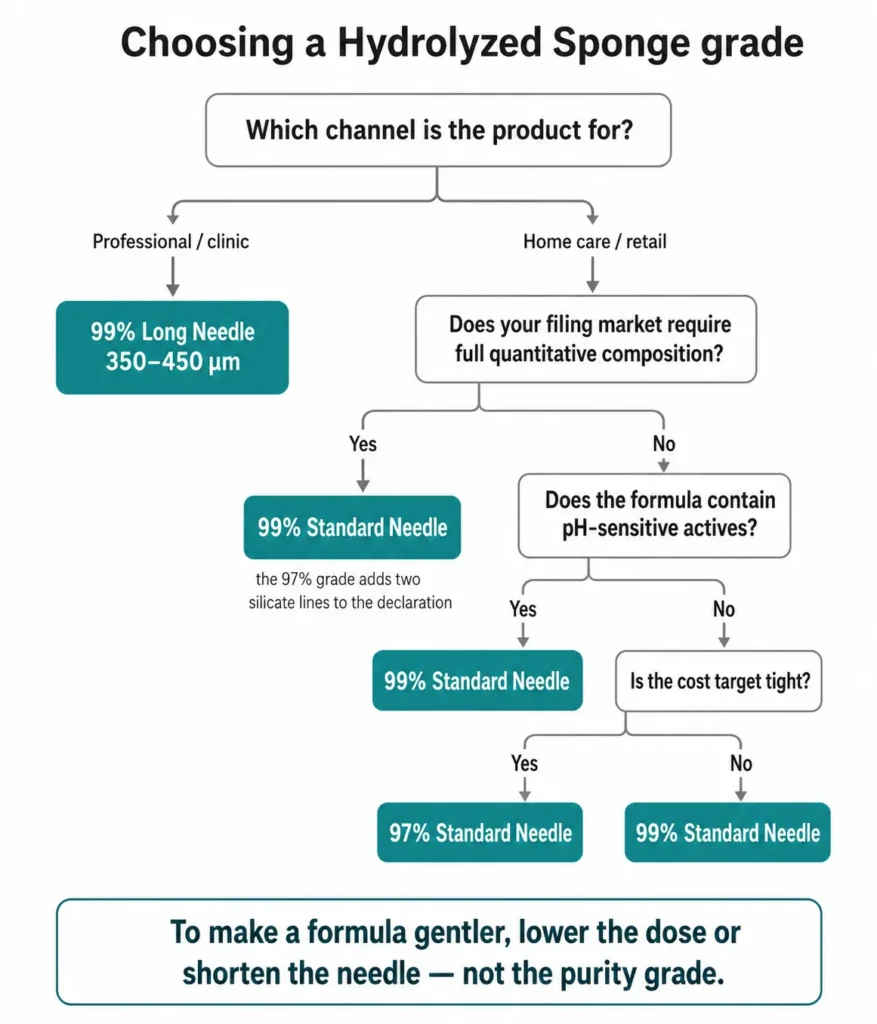
Match the grade to the constraint that is hardest to change later — usually the regulatory filing or the channel, not the sensory target.
| If your product is | And you need | Evaluate |
|---|---|---|
| A professional or clinic-channel treatment | Maximum sensory signal, tolerant users, supervised application | 99% long needle |
| A home-use serum, ampoule or mask | Balanced sensation, repeatable consumer experience | 99% standard needle |
| A first spicule SKU with a tight cost target | Proof of concept before committing volume | 97% standard needle |
| Filed in a market requiring full quantitative composition | The shortest ingredient declaration | 99% grade, either length |
| Built around pH-sensitive actives | Minimum silicate load | 99% grade, either length |
| Positioned for lower irritation | A gentler experience | 99% or 97% standard needle — then reduce dose, not purity |
The last row is the one worth pinning up. Reducing intensity is a dose and length decision. Purity is not a lever for it.
Documents to request before approving a grade
Ask for these by name. A supplier who can produce all seven has a document system; one who produces four has a sales sheet.
- Certificate of analysis for the batch being offered — not a specimen, not last year’s. Check that the manufacturing date, batch number and report date are internally consistent.
- Technical data sheet with the purity test method named.
- Specification sheet for the specific grade.
- Composition sheet listing every declared component and its percentage. This is where the silicates appear or do not.
- Spicule length measurement report — a separate document, because the quality documents do not carry it.
- Batch-specific microscopy, with confirmation that the images are not shared across grades.
- Origin statement naming the species and the harvest environment.
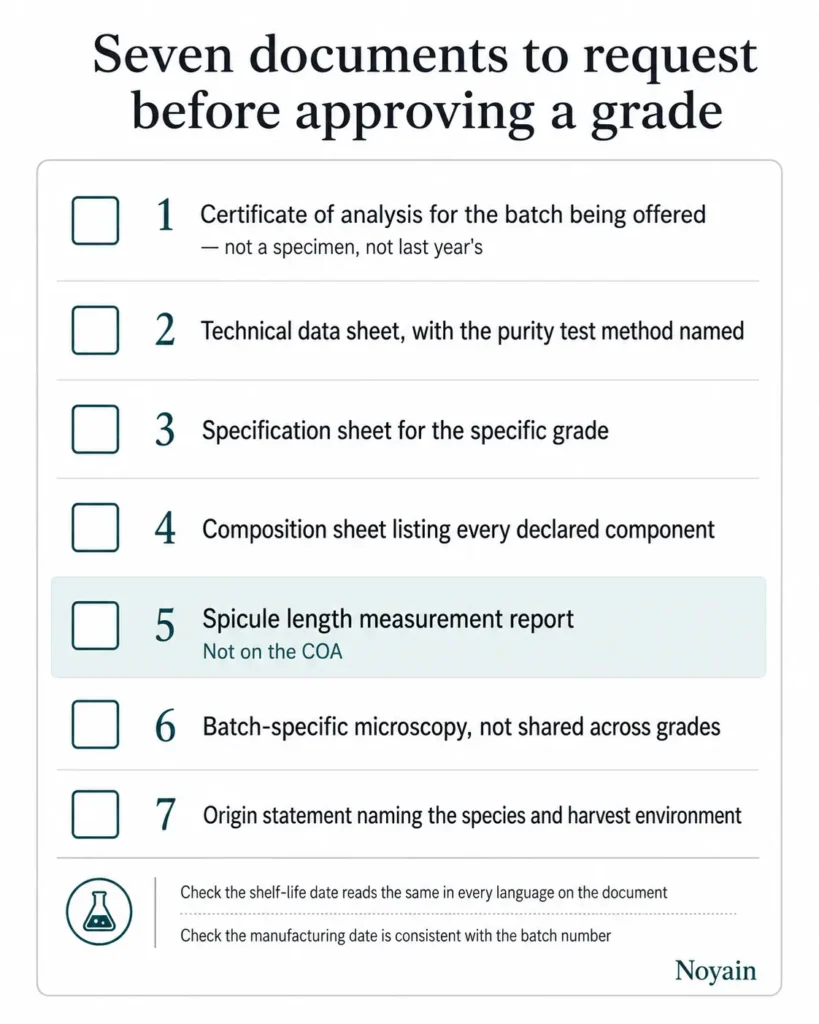
Two checks on the certificate itself are worth doing before anything else. Confirm the shelf-life date is stated identically in every language on the document, and confirm the manufacturing date is consistent with the batch number. Both are quick, and both occasionally surface problems that a specification review will not.
Once you have shortlisted a grade, the next question is whether your serum,cream or mask can keep it uniformly distributed from filling through to the last dose. Format-by-format suspension, packaging and scale-up considerations
are in our Hydrolyzed Sponge formulation guide.
Where every figure in this article comes from
Every specification above is read directly from the manufacturer’s current document set, and we name the document behind each one.
That set is the certificate of analysis, technical data sheet, specification sheet and composition sheet, plus three documents that sit outside the standard pack: the spicule length and diameter measurement report, the origin statement, and the process flow chart.
Two habits are worth stating because they are the reason the numbers above differ from what you will read on a marketing page:
Where a figure appears on one document and not another, we say which. Spicule length is the clearest case — it is on the measurement report and on none of the four quality documents.
Where two documents use different test conditions, we give both. The pH figures are the example: 6.0–8.0 at 1% solution on the technical data sheet, 5.0–10.0 at 10% solution on the certificate. Quoting only the tighter range would read better and would tell you less.
The origin statement documents the species as Spongilla fragilis or Spongilla lacustris, both freshwater sponges in the family Spongillidae, class Demospongiae, phylum Porifera. GBIF catalogues Spongilla lacustris as the common freshwater sponge, described by Linnaeus in 1759. Confirm the species against the batch you are buying rather than taking it from a general statement — standard practice with any wild-sourced material, and we request batch confirmation alongside your sample as a matter of course.
Tell us the product concept and we will tell you which grade we would quote and why, assemble the document set your target market’s filing actually asks for, and coordinate grade-matched samples so your own screening settles the question.
Current grades, specifications and document availability are listed on the Hydrolyzed Sponge product page. Tell us the format, the channel and the market you are filing in, and we will tell you which of the three we would quote and send the matching certificate of analysis with the sample.
Frequently asked questions
Is the 97% grade gentler on skin than the 99% grade?
No. The 97% and 99% standard needles carry the same 200–280 µm spicules, so the sensory experience is driven by the same geometry. Intensity at the skin surface is governed by spicule length, use level and massage technique, not by the purity figure. To make a formula gentler, lower the dose or move from the long needle to the standard needle. Changing purity grade will not change how the product feels.
What makes up the balance in the lower-purity grade?
Calcium silicate and sodium silicate, both itemised on the composition sheet with a stated percentage and an origin of “Sponge”. It is not water and not contamination. The 99% grades declare Hydrolyzed Sponge with the balance described in the technical data sheet as water, so they carry no additional silicate lines. Request the composition sheet for whichever grade you are quoting and read the itemisation directly.
Does a higher purity grade mean better-formed spicules?
Not necessarily. Purity is measured by hydrofluoric acid volatile weight difference subtraction, which gives a mass fraction of siliceous material. It does not describe spicule geometry or the proportion of intact versus broken spicules. Ask for batch-specific microscopy if spicule integrity matters to your format.
Why does the certificate of analysis show a different pH range from the technical data sheet?
Different test concentrations, not a discrepancy. The technical data sheet specifies 6.0–8.0 measured on a 1% solution; the certificate of analysis specifies 5.0–10.0 measured on a 10% solution. Both figures are valid for the condition each one states. For formulation work at typical use levels the 1% figure is the relevant one. Agree with your supplier which condition your incoming inspection will use before the first shipment, so a difference in method does not become a dispute over conformity.
Can I find spicule length on the COA?
No. We checked all four standard documents — certificate of analysis, technical data sheet, specification sheet and composition sheet — and none of them carries a spicule length field. They cover spicule content, appearance, mesh size, loss on drying, loss on ignition, pH, heavy metals and microbiology, but not length. Length is documented in a separate measurement report. Request it by name, and ask whether the measurement is batch-specific or a general reference figure.
Is the mesh size on the specification the same as spicule length?
No, and the two are easy to confuse. Particle size reads 95% pass 100–180 mesh and is identical across the purity grades. A mesh screen sorts by the smallest cross-section a particle can pass through, which for a needle-shaped particle is set by its diameter — around 15–16 µm for both needle types — not by its length. A long needle and a standard needle therefore pass the same screen, and a mesh figure cannot tell you which one you are being offered.
Do I need to repeat my full qualification if I switch grades?
Usually not all of it. Appearance, mesh, loss on drying, pH, heavy metals, microbiology, storage and shelf life are specified identically across the range. What changes is spicule content, loss on ignition, spicule length and your composition declaration. Scope re-testing to those.
Which grade should a first-time buyer sample?
Request grade-matched samples of the 99% standard needle and the 97% standard needle together, and screen them side by side in the same base formula. Both carry the same 200–280 µm spicules, so the only variable between them is the silicate load. That isolates the purity question in your own formula rather than in a specification table, and it tells you whether the cost difference is worth anything for your product.
References
External sources
- GBIF Secretariat. Spongilla lacustris (Linnaeus, 1759). GBIF Backbone Taxonomy, taxon 2244988. https://www.gbif.org/species/2244988 — accessed 6 August 2026.
- World Porifera Database. Spongilla lacustris (Linnaeus, 1759), AphiaID 167235. https://www.marinespecies.org/porifera/porifera.php?p=taxdetails&id=167235
Test standards named on the technical documents
- GB 25576-2020, National Food Safety Standard — Food Additive: Silicon Dioxide. Named by the technical data sheet as the loss-on-ignition method. Issued by China’s National Health Commission and State Administration for Market Regulation, 2020.
- GB/T 6284-2006, Chemical products for industrial use — General method for determination of water content — Loss of mass on drying method. Named by the technical data sheet as the loss-on-drying method.