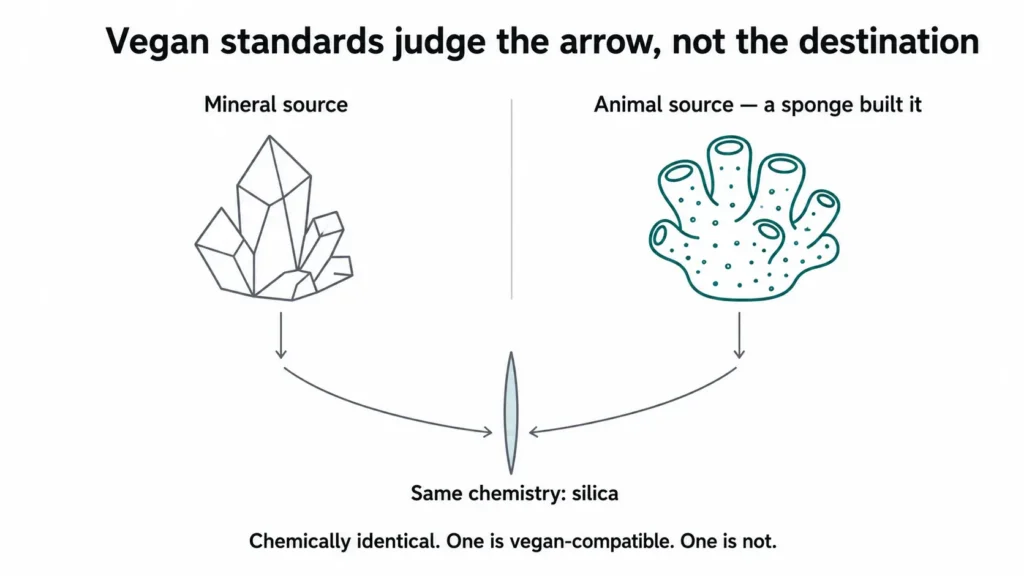
Two dates are circulating for the same deadline. Both of them are correct.
Quick answer: what Indonesia’s halal certification for cosmetics requires
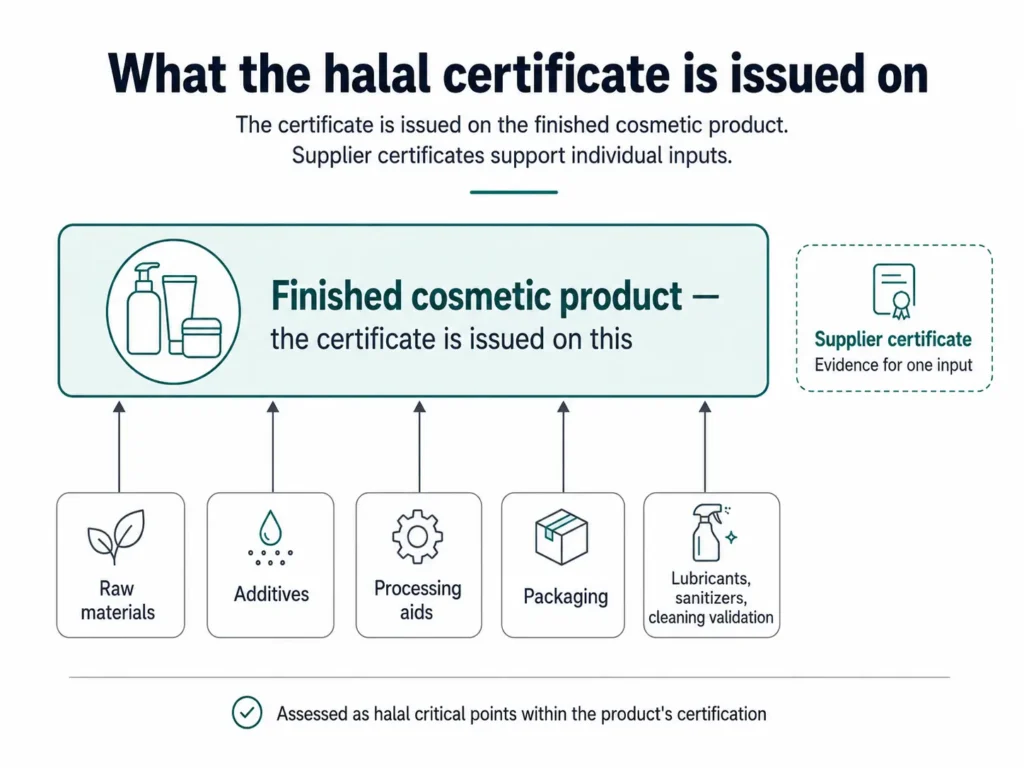
Cosmetics placed on the Indonesian market must hold BPJPH halal certification once the staging period for the category closes on 17 October 2026, and certification is granted on the product after its supply chain has been examined — which puts your ingredient list inside the file rather than beside it.
The framework runs through Act No. 33/2014 on Halal Product Assurance, Government Regulation No. 42/2024 and Ministry of Religious Affairs Decree No. 748/2021. BPJPH (Badan Penyelenggara Jaminan Produk Halal) administers it, an accredited halal inspection body (Lembaga Pemeriksa Halal, LPH) such as LPPOM MUI carries out the examination, and the halal determination is issued on that basis.
This article covers the date, what is actually in scope, the seven halal critical points the inspection works through, the difference between a supplier declaration and a certificate, and what a certified raw material does and does not do for your own filing.
The two dates you will see, and which one to plan against
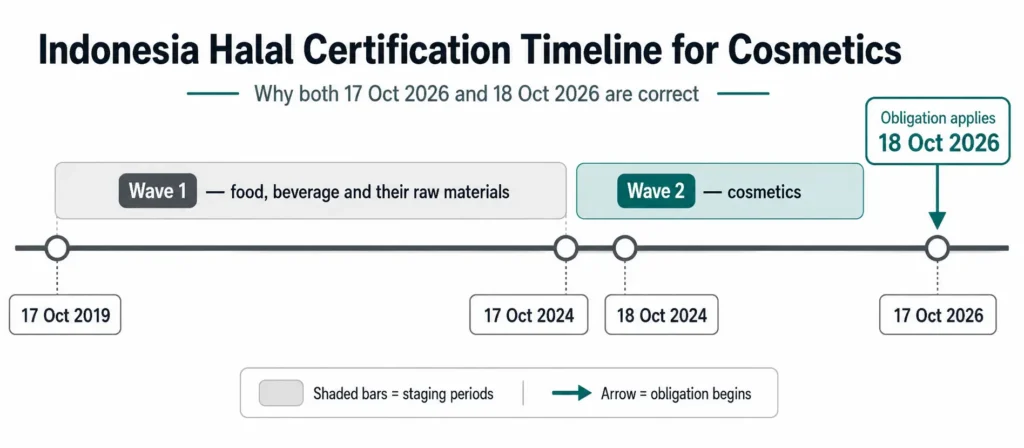
17 October 2026 is the last day of the staging period and 18 October 2026 is the first day the obligation applies, so the two dates in circulation are describing the same line from opposite sides.
| Wave | Categories | Staging period runs to | Obligation applies from |
|---|---|---|---|
| First | Food and beverage, their raw materials, additives and processing aids, plus slaughter products and services (medium and large businesses) | 17 October 2024 | 18 October 2024 |
| Second | Cosmetics, among other categories in this wave | 17 October 2026 | 18 October 2026 |
The first wave is why this reading is safe rather than an inference. BPJPH describes that staging period as running sejak 17 Oktober 2019 hingga 17 Oktober 2024, and the obligation itself as Terhitung mulai 18 Oktober 2024, kewajiban bersertifikat halal secara resmi diberlakukan — counted from 18 October 2024. For cosmetics BPJPH uses the matching formulation: Produk Kosmetik wajib bersertifikat halal setelah 17 Oktober 2026 — required after 17 October 2026.
Plan against 18 October 2026. If a colleague’s timeline says 17 October, it is not wrong either — it is the last day on which an uncertified product is still lawfully on the shelf.
What happens after the date. BPJPH’s own publication on the first wave describes the consequences as peringatan tertulis atau penarikan produk dari peredaran — written warning, or withdrawal of the product from circulation. A figure of up to IDR 2 billion for serious violations appears in trade coverage of the cosmetics wave; it is not in the BPJPH publications listed at the end of this article, so treat it as trade reporting rather than a penalty schedule you can quote to your board.
What is in scope, and the one question the public sources do not settle
The obligation attaches to the product placed on the Indonesian market, and every material inside it has to be accounted for — but no public source we read states plainly whether an imported raw material needs a certificate of its own or is assessed inside the finished product’s file.
Here is what the Indonesian bodies actually publish. LPPOM MUI frames the requirement around products: produk yang masuk, beredar dan diperdagangkan di wilayah Indonesia wajib bersertifikat halal BPJPH — products entering, circulating and traded in Indonesian territory. LPPOM also publishes under the heading that raw materials for cosmetics, traditional medicine and health supplements fall within the 2026 wave, and tells industry to self-assess the supply chain so that setiap bahan baku yang digunakan telah tersertifikasi — every raw material used has been certified. BPOM, which keeps its own safety and notification remit alongside BPJPH’s halal remit, names the material classes that draw attention: collagen, glycerin, gelatin, certain alcohols and animal-derived materials.
International trade coverage compresses all of this into “raw materials are also covered”. That is the right instinct and it skips the mechanism.
For a purchasing decision the gap matters less than it looks, because the two readings converge on the same work:
- Under either reading, every material in the formula needs traceable halal evidence in your file.
- Where they differ is whose certificate it has to be — yours, obtained on the finished product, or your supplier’s, obtained on the input.
- A supplier certificate satisfies both readings. That is why buyers are collecting them now instead of waiting for the mechanism to be clarified.
For your own filing the version that counts is the one your halal inspection body gives you in writing. Ask the LPH handling your file how raw materials are treated, and ask before you build the supplier list rather than after.
The seven halal critical points, and the three nobody prepares for
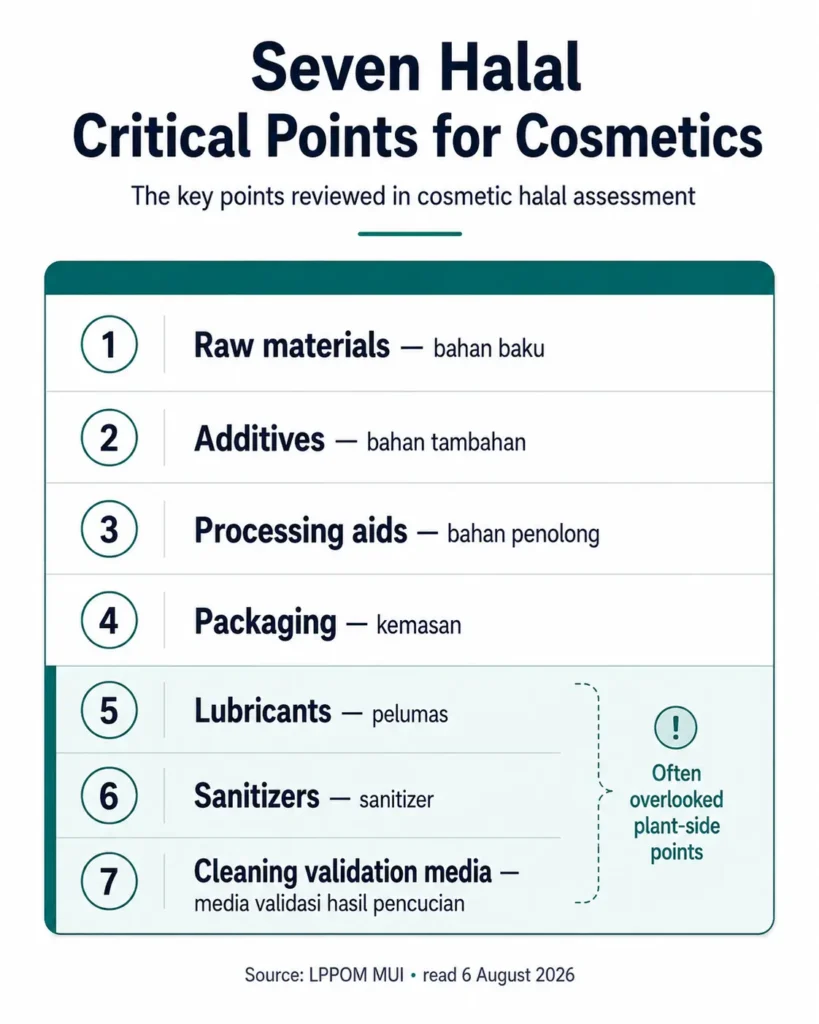
LPPOM MUI lists seven halal critical points for cosmetics, and three of them sit outside the formula entirely: line lubricants, sanitizers, and the media used to validate cleaning.
The seven, as published:
- Raw materials — bahan baku
- Additives — bahan tambahan
- Processing aids — bahan penolong
- Packaging — kemasan
- Lubricants — pelumas
- Sanitizers — sanitizer
- Cleaning validation media — media validasi hasil pencucian
Points one to four are what a product developer expects, and points three and four already catch people out: a processing aid does not appear on the INCI list, and packaging is usually a different supplier’s problem until it is suddenly yours.
Points five to seven are the ones that arrive as a surprise, because they are properties of the plant rather than of the product. The lubricant on a filling line, the sanitizer used between batches, and whatever medium is used to demonstrate that a vessel was cleaned are all examined. If you manufacture through a contract manufacturer, none of those three are in the specification you signed off, and all three are questions you can put to them today: which lubricant grade is used on product-contact equipment, what the sanitizer is composed of, and how cleaning validation is performed.
That is three emails, and it is far cheaper than discovering the answer during an audit.
Water-resistant formulations and ablution
A water-resistant or long-wear formulation carries a halal consideration that has nothing to do with its ingredient list: it must not prevent water from reaching the skin in a way that would invalidate ablution.
LPPOM MUI states it directly — for cosmetics made anti-air (water resistant) atau waterproof, care is needed so that use of the product does not stop water reaching parts of the body, yang dapat mengakibatkan berwudhu menjadi tidak sah, which could render wudu invalid.
This reaches waterproof sunscreen, long-wear foundation, transfer-resistant colour and film-forming primers — the whole long-wear segment, in other words, which is also where a brand’s development budget tends to go. It is a design constraint rather than a document, so it does not show up on any checklist your regulatory team is working from, and it is the point most likely to be found late. If a long-wear product is in your Indonesian plan, raise it with your LPH early and get their position in writing before the formula is locked.
Declaration or certificate: which one your file can use
A certificate names the issuing body, a certificate number, a validity period and an annex of covered products; a declaration has none of those, because it is the supplier’s own statement about itself.
Four checks separate them, and they take about a minute:
| Check | On a certificate | On a declaration |
|---|---|---|
| Issuing body | Named, and accredited — BPJPH, or a body BPJPH recognises | The supplier |
| Reference number | Present and verifiable | Absent |
| Validity period | Stated, with an expiry | Absent, or “current” |
| Scope | An annex listing the specific products covered | Usually the company, or a product family |
A declaration is not worthless. It is a supplier telling you what they believe about their own material, and for an internal screening step that is often enough. It is simply not certification, and a regulatory reviewer will read it as what it is. The same distinction applies to origin and animal-derived material generally — we cover it for one material in detail in our article on animal-origin materials and halal documentation.
Reviewing supplier documents this week? The four checks above work on any halal document, from any supplier. If you want the pair to compare against, ask us for a certificate and its annex alongside a declaration for the same material — seeing them side by side takes less time than reading about the difference.
What a certified raw material does for your file, and what it does not
It gives you documented halal evidence for one input; your finished product still needs its own certification, and no quantity of certified inputs produces one automatically.
Your product’s certification also examines the formula as a whole, the process, the facility it is made in, and the packaging — the seven critical points above, in other words, most of which sit downstream of any raw material you buy. A certified input removes one line of questioning and shortens the evidence-gathering. It does not shorten the certification. Any supplier implying otherwise is worth one clarifying question.
BPJPH is not JAKIM, and a certificate is not a passport
Two limits travel with every halal certificate: it covers only the products listed in its annex, and recognition between national schemes is not automatic.
The annex limit is the one that bites in practice. Certification is granted per product, so a plant that has been audited is not a plant whose whole catalogue is certified, and a grade variant of a certified material is frequently not on the annex. Read the annex, not the certificate’s cover page, and read it for the exact grade you intend to buy.
Scheme recognition is the second. An Indonesian certificate does not automatically satisfy Malaysia, where using the halal mark on a cosmetic requires certification by JAKIM or a body JAKIM recognises. Recognition arrangements exist between some schemes and change over time. Confirm what your target market accepts with that market’s authority rather than assuming a certificate travels.
Where the rest of the Muslim-majority markets actually stand
Indonesia is the only market that turns halal certification for cosmetics into a condition of market access; everywhere else it is a trust or a channel asset, and copy that treats all Muslim-majority markets as one is either alarming buyers who do not need certification or under-selling the one place it is compulsory.
Status as of August 2026:
| Market | Requirement for cosmetics | Reference | What it means commercially |
|---|---|---|---|
| Indonesia | Mandatory once the staging period closes 17 October 2026 | Act No. 33/2014; Government Regulation No. 42/2024; Ministry of Religious Affairs Decree No. 748/2021; administered by BPJPH | Regulatory market access. Highest priority |
| Malaysia | Voluntary to sell; certification required to carry the mark | JAKIM for the halal mark; NPRA for cosmetic notification | Consumer and customer trust |
| Brunei | Voluntary for cosmetics | Mandatory regime is food-related; confirm the current position with the local authority | Consumer trust |
| UAE | Generally voluntary | Confirm per product with the importer | Muslim retail channels, pharmacies, brand procurement |
| Saudi Arabia and other Gulf states | No blanket mandate for all cosmetics | Confirm per item with the local importer; the explicit mandatory regime centres on meat and poultry | Channel and procurement advantage — animal-origin materials matter most here |
| Singapore, Türkiye, Pakistan, Bangladesh | Generally no blanket mandate | Requirement comes from the retailer, brand or distributor rather than from law | Channel-driven |
Regulatory status changes, so re-check this against the authority in your target market before a filing. And note that the commercial requirement is wider than the legal one: ODM houses, brands and distributors serving Muslim markets routinely ask for halal raw-material documentation even where their own country does not require it.
What we learned putting a certification through
The part that takes the work is not the paperwork — it is getting a certifying body onto a production site and having the plant produce what the body asks for on the day.
BPJPH carried out an on-site audit at our manufacturing partner’s facility, with a scope covering Hydrolyzed Sponge, Copper Tripeptide-1, Tranexamic Acid and VCIP. We assembled the scope list, arranged for the partner to produce what BPJPH asked for, and hosted the audit on site. Anyone can forward a supplier’s declaration; getting a certifying body through someone else’s plant door is a different exercise, and it is the reason the four materials above are backed by a certificate rather than a statement.
Three things it taught that are useful to you before you start your own:
- The scope list written at the beginning becomes the annex at the end. A grade that is not on the list when the audit is arranged will not be on the annex when the certificate is issued. This is the single most expensive thing to get wrong, because correcting it means going back.
- The questions were not confined to the formula. They tracked the critical points above, including the plant-side ones. Turning up with a clean ingredient dossier and no answer on cleaning validation is a slow day.
- Certification is per product, always. An audited plant is not a certified catalogue. We say this about our own certificate for the same reason we say it about everyone else’s.
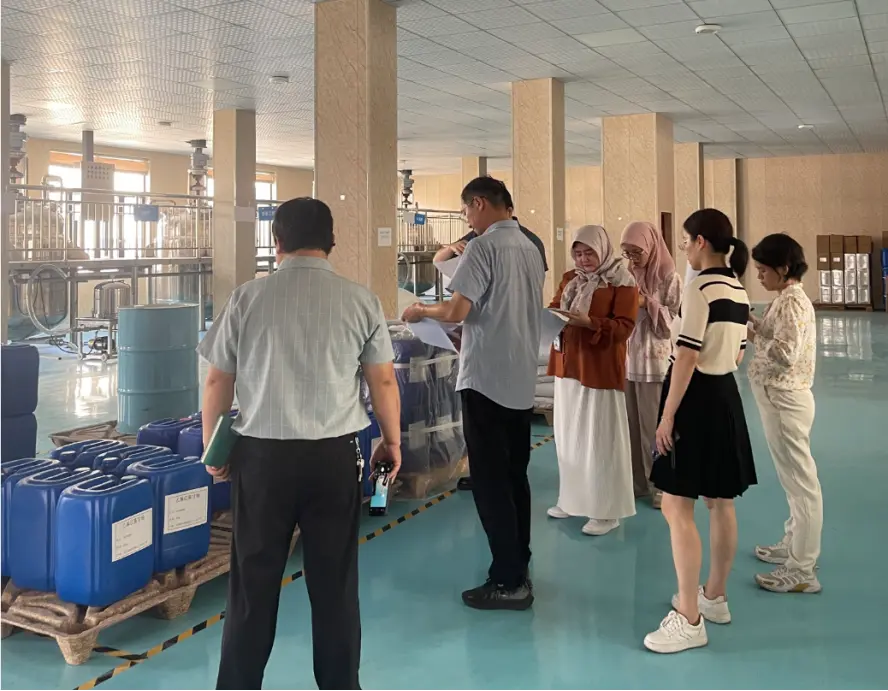
Specifications and documentation for the material in that scope are on the Hydrolyzed Sponge product page, and how to read a grade specification covers what the annex grade names actually refer to.
Supplier questions for your halal file
Ordered by what fails most often rather than by logical sequence, because the first three are where files come apart.
- Is this a certificate or a declaration? They are different documents and only one of them is certification. Ask for the word, not the reassurance.
- Which body issued it, and is that body BPJPH or one BPJPH recognises? Recognition between schemes is not automatic, and a certificate from an unrecognised body is a certificate you cannot use in this filing.
- Is the exact grade I am quoting listed on the annex? Annexes are per product. A grade variant of a certified material is often absent, and the cover page will not tell you.
- What is the certificate number and the validity period? A document with no number and no expiry cannot be checked by anyone, which is the same as not having it.
- If certification is under application, at what stage and with which body? “In progress” is not a status a reviewer can file. A stage and a body can at least be tracked.
- What is the material’s origin, and for animal or aquatic materials, what species, documented per batch? Origin is where a halal file fails first, and a general statement about a material is not a statement about the lot you are buying.
- Can you supply an origin or composition statement covering every component, not only the main one? The minor components — carriers, stabilisers, residual solvents — are where the surprises live.
- Which processing aids and carriers are used that do not appear on the INCI list? Processing aids are a named critical point, and by definition they are not on the label you were reading.
Where to verify each point yourself
Every point in this article traces to a body that publishes its own position, and for a filing that is the version that counts.
| Question | Where the answer is authoritative |
|---|---|
| The commencement date and the staging waves | BPJPH’s own publications |
| Whether your product category sits in this wave | BPJPH, and Ministry of Religious Affairs Decree No. 748/2021 |
| How raw materials are assessed inside your file | The halal inspection body (LPH) handling your certification, for example LPPOM MUI |
| Safety, quality and notification alongside halal | BPOM, which keeps that remit separately from BPJPH’s |
| Whether your Indonesian route accepts a given certificate | Your Indonesian importer or distributor |
| Whether another market recognises a scheme | That market’s authority — JAKIM for Malaysia, and so on |
Take the commencement date from BPJPH’s own publication before you build a timeline on it. That applies to every secondary source, this article included; the links below are the ones we read, with the date we read them, so you can check the reading rather than trust it.
What to do with this before October
Two things are worth acting on now. Get the mechanism for raw materials in writing from the body handling your certification, because it decides whether you are collecting supplier certificates or building the evidence yourself. And put the three plant-side critical points — lubricants, sanitizers, cleaning validation — to your contract manufacturer this week, because they are the ones nobody has an answer ready for and they are not yours to fix quickly.
Noyain supplies cosmetic raw materials from Guangzhou with lot-specific documentation, and holds BPJPH halal certification for part of the active ingredient range, with applications filed for more. Tell us the market you are filing in and what you are building, and we will send a free 2–3 g sample of the grade that fits, dispatched within three working days, together with the certificate and its annex so you can check that grade is listed.
Frequently asked questions
When exactly does the Indonesian requirement for cosmetics start?
The staging period closes on 17 October 2026 and the obligation applies from 18 October 2026. Both dates circulate in trade coverage because they describe the same line from opposite sides. BPJPH used the identical structure for the first wave, which ran to 17 October 2024 with the obligation counted from 18 October 2024. Plan against 18 October 2026, and confirm against BPJPH before committing a timeline.
Does my raw material need its own halal certificate?
The obligation attaches to the product placed on the Indonesian market, and every material in it must be accounted for in that certification. Whether an imported raw material needs a certificate of its own, or is assessed as an input to your file, is not stated plainly in the public sources — so ask the halal inspection body handling your certification. Either way, a supplier certificate settles the question for that material.
Is a supplier’s halal declaration enough for my Indonesian file?
A declaration is the supplier’s own statement and carries no issuing body, number, validity period or annex. It is usable for internal screening and a reviewer will read it as what it is. For a filing, ask whether a certificate exists, which body issued it, and whether your specific grade appears on its annex.
Does a BPJPH certificate work in Malaysia?
Not automatically. Malaysia allows uncertified cosmetics to be sold, but using the halal mark requires certification by JAKIM or a body JAKIM recognises. Recognition arrangements between schemes exist and change, so confirm the current position with JAKIM rather than assuming an Indonesian certificate carries across.
If my supplier’s material is certified, is my product certified?
No. A certified input gives you documented evidence for one line of your formula. Your finished product’s certification also examines the formula as a whole, the process, the facility and the packaging. A certified raw material shortens the evidence-gathering, not the certification.
Do production lubricants and sanitizers really matter?
Yes — lubricants, sanitizers and cleaning validation media are three of the seven halal critical points LPPOM MUI publishes for cosmetics. They are properties of the plant rather than the product, so they usually sit outside the specification a brand signed off with its contract manufacturer, which is why they are the most common late discovery.
Are imported cosmetics treated differently from locally made ones?
The requirement is framed around products entering, circulating and traded in Indonesian territory, so imports are in scope alongside domestic production. The practical difference is procedural rather than substantive: an importer works through a certification route for foreign products, and the recognition status of any foreign certificate you are relying on has to be confirmed. Your Indonesian importer is the right party to confirm the route.
References
Official publications, read 6 August 2026
- BPJPH — Produk Kosmetik Wajib Bersertifikat Halal pada Oktober 2026
- BPJPH — Masa Penahapan Usai, Kewajiban Sertifikasi Halal Berlaku mulai 18 Oktober 2024
- LPPOM MUI — Miliki Sejumlah Titik Kritis Halal, Kosmetik Wajib Halal 2026
- LPPOM MUI — Bahan Baku Kosmetik, Obat Tradisional, dan Suplemen Wajib Halal 2026: Industri Diminta Bersiap
- BPOM, Direktorat Standardisasi Obat Tradisional, Suplemen Kesehatan dan Kosmetik — Kewajiban Halal Kosmetik Oktober 2026: Regulasi BPJPH dan BPOM Semakin Terintegrasi
Trade coverage
- in-cosmetics group — Indonesia’s mandatory Halal cosmetics regulations 2026. Source of the IDR 2 billion figure discussed above, which does not appear in the official publications listed here.
Regulations
- Act No. 33 of 2014 of the Republic of Indonesia, on Halal Product Assurance (Undang-Undang Nomor 33 Tahun 2014 tentang Jaminan Produk Halal).
- Government Regulation of the Republic of Indonesia No. 42 of 2024, on the implementation of halal product assurance (Peraturan Pemerintah Nomor 42 Tahun 2024).
- Ministry of Religious Affairs of the Republic of Indonesia, Decree No. 748 of 2021, on categories of products subject to mandatory halal certification (Keputusan Menteri Agama Nomor 748 Tahun 2021).