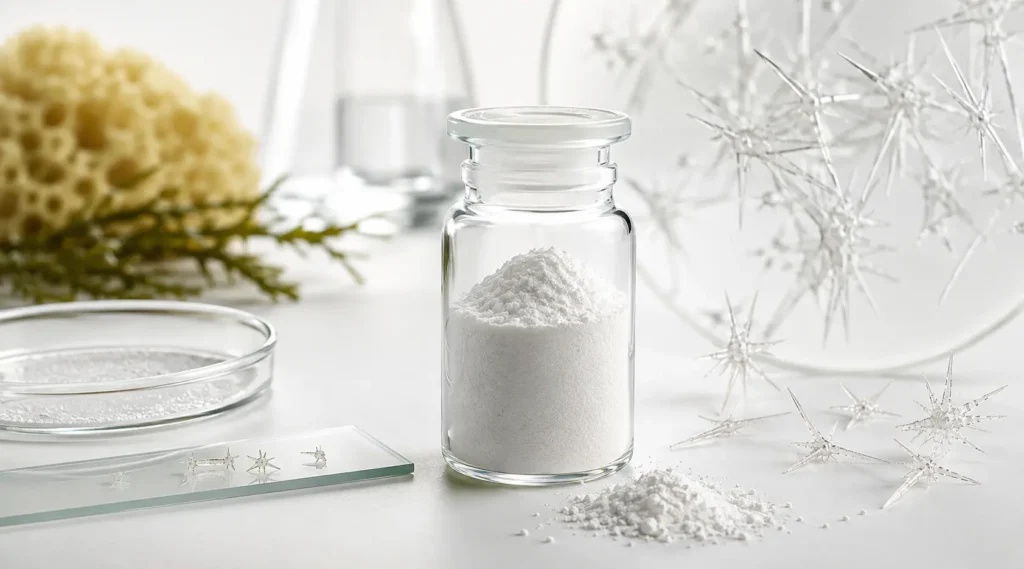
Hydrolyzed Sponge is a cosmetic raw material made from purified microscopic structures called sponge spicules. It is supplied as a fine powder and added to serums, gels, creams, masks and scalp formulas.
The name causes more confusion than almost anything else in this category. Hydrolyzed Sponge is not hydrolyzed collagen, not a soluble protein extract, and not the same thing as device-based microneedling. Quotations arrive carrying three different names for what may or may not be the same material.
This guide covers what the material is, how it behaves on skin, what the published studies can and cannot support, how to compare grades, and what to check before a sample becomes an order.
Hydrolyzed Sponge at a glance
| Item | Practical answer |
|---|---|
| INCI name | Hydrolyzed Sponge |
| Typical source | Purified spicules from freshwater sponge |
| Physical form | Fine powder containing rigid microscopic spicules |
| Main structure | Biogenic silica, in a silica–chitin composite skeleton |
| Solubility | Insoluble; it must be dispersed and suspended |
| CosIng function | Skin Conditioning — abrasive and exfoliant are not listed7 |
| Common formats | Gel serums, ampoules, creams, masks and scalp formulas |
| Not the same as | Hydrolyzed Sponge Extract, protein hydrolysates, microneedling devices |
Hydrolyzed Sponge is an insoluble spicule powder. The formulation job is to suspend it evenly, not to dissolve it.
What Hydrolyzed Sponge actually is
It is the cleaned mineral skeleton of a freshwater sponge, ground and graded by length.
Freshwater sponges build a supporting skeleton from microscopic needles called spicules. In Spongilla species those spicules are mainly biogenic silica, and the dried skeleton is best described as a silica–chitin biocomposite — a structure that has been characterised by thermogravimetric analysis and 1H NMR spectroscopy.4
Purification reduces the organic fraction; what remains is cleaned, dried and graded. The finished ingredient is supplied as a white or off-white powder.
High-purity grades are essentially purified siliceous spicules. How much organic material remains depends on the source and the purification process — which is why colour, loss on ignition and the stated test method are all worth checking, and why on a well-controlled material they tend to agree with each other.
One correction worth making early
A number of supplier datasheets describe this ingredient as a composite of silica and calcium carbonate. That is wrong, and it is checkable.
Calcareous spicules belong to the sponge class Calcarea. Spongilla is a demosponge — class Demospongiae — and demosponge spicules are siliceous. A document listing calcium carbonate as a component has either been copied from an unrelated source or is describing a different organism. It is a quick way to judge how carefully a supplier’s technical documents were assembled.
Similar names do not always mean the same ingredient
| Name | What buyers should know |
|---|---|
| Hydrolyzed Sponge | The listed INCI for the spicule-based cosmetic ingredient7 |
| Hydrolyzed Sponge Extract | A separate INCI entry with different assigned functions7 |
| Spongilla Lacustris Spicule Extract | Usually a supplier or trade description; confirm the declared INCI |
| Hydrolyzed collagen or protein | A different ingredient category with a different mechanism |
If the word extract appears anywhere on a quotation or specification, confirm the exact INCI before artwork or regulatory documents are approved. The two entries are not interchangeable, and the difference surfaces at label review rather than at sampling — which is the expensive place to find it.
Hydrolyzed Sponge has no widely assigned ingredient-specific CAS number. When a supplier lists a silica or quartz CAS number, ask what that number is intended to describe.
“Hydrolyzed” does not mean a protein hydrolysate
The word describes processing applied to the sponge, not the presence of hydrolysed protein.
The finished powder is not equivalent to hydrolyzed collagen, hydrolyzed keratin or a peptide solution. Buyers arriving from those ingredients are looking at a different category entirely: those are soluble, functional molecules, and this is an insoluble mineral solid.
A spicule powder behaves nothing like a soluble protein:
- it does not dissolve in the water phase;
- it needs suspension stability across shelf life;
- its length distribution changes product design;
- its skin feel depends on the whole formula and the way it is applied.
How sponge spicules behave at the skin surface
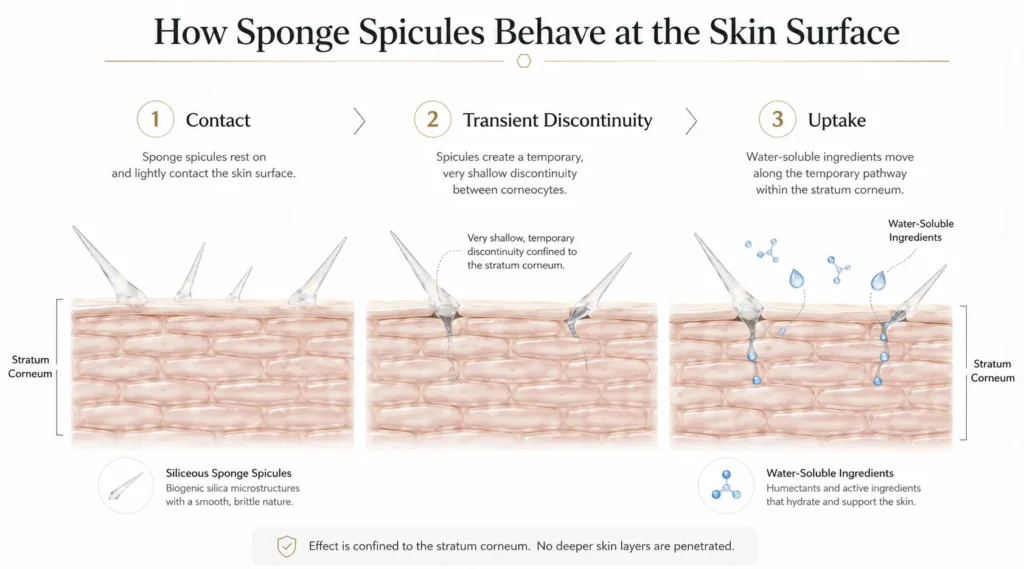
Spicules work by making brief mechanical contact with the outer skin during application — there is no fixed depth, and no chemistry involved.
1. Contact
During application and massage, rigid spicules contact the outer skin surface. Some lie flat; others engage the upper stratum corneum.
2. Temporary pathways
With rubbing or massage, some spicules become partially embedded between corneocytes. This creates small, temporary discontinuities in the outer barrier.
Unlike a device, there is no fixed needle depth. Behaviour depends on:
- spicule length and diameter;
- the length distribution of the grade;
- dose in the formula;
- base viscosity and rheology;
- massage pressure and application time.
3. Uptake of co-formulated ingredients
Water-soluble ingredients in the same formula may move along the temporary pathways formed around the spicules.
The discontinuities are transient and occur within the stratum corneum. How far spicules and co-formulated ingredients distribute beyond that depends on grade, dose, formula, application method and study model, and is not established by a supplier specification.
This description is written for formulators. What a finished product may claim is set by the regulations of the market it ships to, and is the responsibility of the brand owner.
Is Hydrolyzed Sponge the same as microneedling?
No — and settling this early matters, because it changes how the finished product is regulated.
| Point | Hydrolyzed Sponge | Microneedle roller or device | Dissolving microneedle patch |
|---|---|---|---|
| What it is | Cosmetic raw material dispersed in a formula | Manufactured mechanical device | Manufactured patch with shaped microstructures |
| How it is used | Applied as part of a serum, gel, cream or mask | Rolled or pressed onto skin | Applied to a fixed area |
| Depth control | Not mechanically fixed; depends on grade, dose, formula and use | Mainly determined by device design and operation | Determined by patch design |
| Main formulation issue | Suspension, sensory level and stability | Device handling and hygiene | Patch material, payload and dissolution |
| Regulatory position | Evaluated as a cosmetic ingredient and finished formula | Depends on device and market classification | Depends on product design and market classification |
Hydrolyzed Sponge should not be marketed as “microneedling in a bottle.” The phrase is easy to understand, and that is exactly why the comparison keeps coming up — but it sets expectations about depth and performance that the material cannot meet, and it invites a regulatory reading nobody wants.
What published research can and cannot tell us
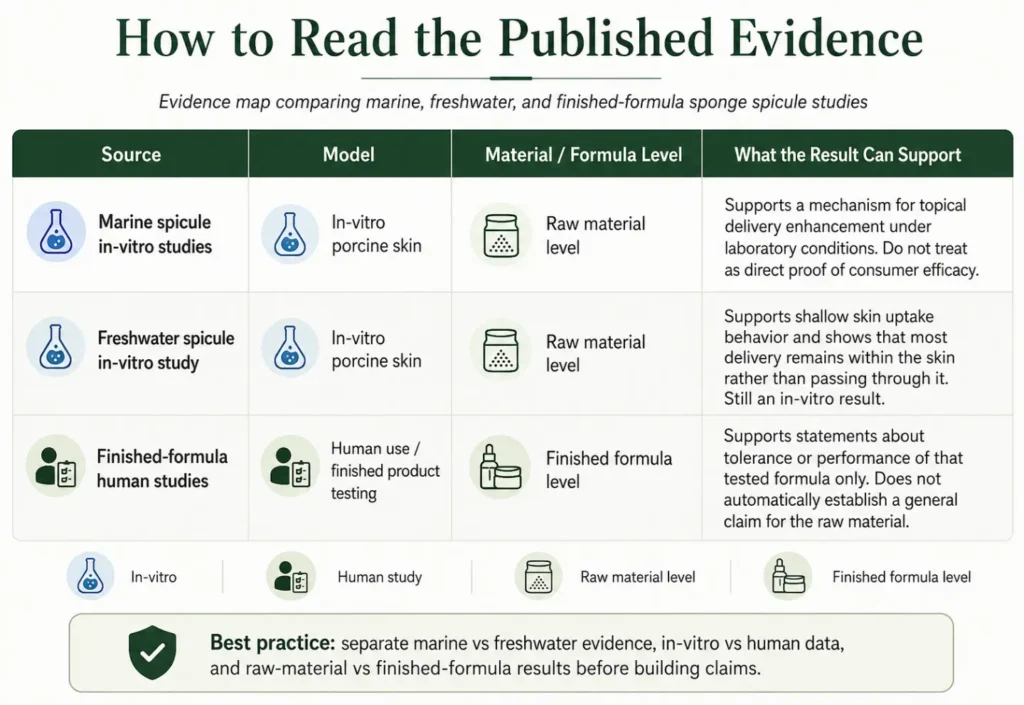
Most published spicule research was not run on freshwater commercial grades, which changes what any of it supports.
Some studies use marine spicules, some use freshwater spicules, some use manufactured spicules that are not sponge-derived at all, and some test a complete finished formula rather than the raw material.
| Evidence type | What was tested | What it can support | Main limitation |
|---|---|---|---|
| Marine spicule, in vitro | Marine spicules on laboratory skin models | A delivery-enhancement mechanism under specific test conditions | Does not describe freshwater commercial grades or consumer results |
| Freshwater spicule, in vitro | Freshwater spicules on porcine skin | Skin uptake, and the split between material retained in skin and material passing through | Still a laboratory model |
| Finished-formula human studies | A complete cream or gel used on people | Statements about the exact formula tested | Does not establish a claim for the raw material |
| Non-sponge micro-spicule studies | Manufactured spicules of other materials | The general concept of spicule-assisted delivery | Not evidence about sponge-derived ingredients at all |
Marine spicule studies
A 2017 study using marine Haliclona spicules — silicious oxeas roughly 120 µm long and 7 µm in diameter — reported a 10 kDa fluorescent dextran penetrating porcine skin in vitro at 33.09 ± 7.16 times the control level, with spicules retained in skin for at least 72 hours. The same work reported that the skin disruption was self-limiting and recovered over time.1
A 2021 study across several spicule-based systems found that delivery behaviour tracked aspect ratio — the relationship between spicule length and diameter — rather than length alone.5 That finding is worth carrying into grade selection: a longer spicule is not automatically a stronger one.
Both explain the mechanism. Neither proves that a given freshwater grade will reproduce the result.
Freshwater spicule study
A 2022 freshwater-spicule study reported 73.4% dermal absorption and 2.2% percutaneous penetration in a porcine-skin model.6
In plain terms: most of the measured delivery stayed within the skin in that test, and a much smaller fraction passed through it. Those numbers belong to that study design and should not be reused as a performance claim for any grade or finished product.
The length-versus-irritation trade-off
One study is worth reading closely, because it measured both sides of the same decision.
A 2019 sponge-microspicule cream study prepared spicules at roughly 176 µm long and 12 µm wide, then compared them against deliberately shortened, broken spicules. The full-length version gave the higher permeation of a 66 kDa model protein — a 2.26-fold enhancement — but caused skin irritation. The broken-spicule version reached 1.94-fold, not significantly different, and that was the version taken forward into the human phase.3
This is published evidence that length drives delivery and irritation together, and that the highest-performing option in vitro is not automatically the one that survives use testing. It is the clearest argument available for why grade selection has to be settled in a finished formula rather than argued from a specification sheet.
A note on non-sponge “micro-spicule” studies
Some frequently cited human studies do not involve sponge material. A 2017 split-face study on periocular wrinkles used hollow pyramidal micro-spicules made from hyaluronic acid, not sponge spicules.2 It is legitimate evidence about the spicule concept, and no evidence at all about Hydrolyzed Sponge. When a supplier cites “clinical studies on spicules,” check what the spicules were made of.
Read the original studies
- Marine sponge spicules and delivery of hydrophilic biomacromolecules — PubMed
- Spicule-based delivery of therapeutic peptides — Pharmaceutics, open access
- Natural spicules as a dermal delivery system — Journal of Cosmetic Dermatology
- Sponge microspicule cream for protein and growth-factor delivery — J-STAGE, full text
- Micro-spicule EGF cream and periocular wrinkles — PMC, full text
- Silica–chitin biocomposite of Spongilla lacustris origin — Applied Physics A
How to read a Hydrolyzed Sponge grade
Purity, length and colour describe three different things, and treating the purity percentage as the whole answer is the most common sourcing mistake with this material.
1. Purity: ask how it was measured
A figure like 97% or 99% means nothing without its method.
- What test method was used, and is it printed on the TDS?
- Is the result tested per batch, or only stated as a general specification?
- Are loss on ignition, particle size and heavy metals controlled as well?
A documented method beats a higher number with no explanation behind it. Two suppliers quoting 99% by different methods are not quoting the same thing.
2. Colour: use it as a quick screen, not a grade
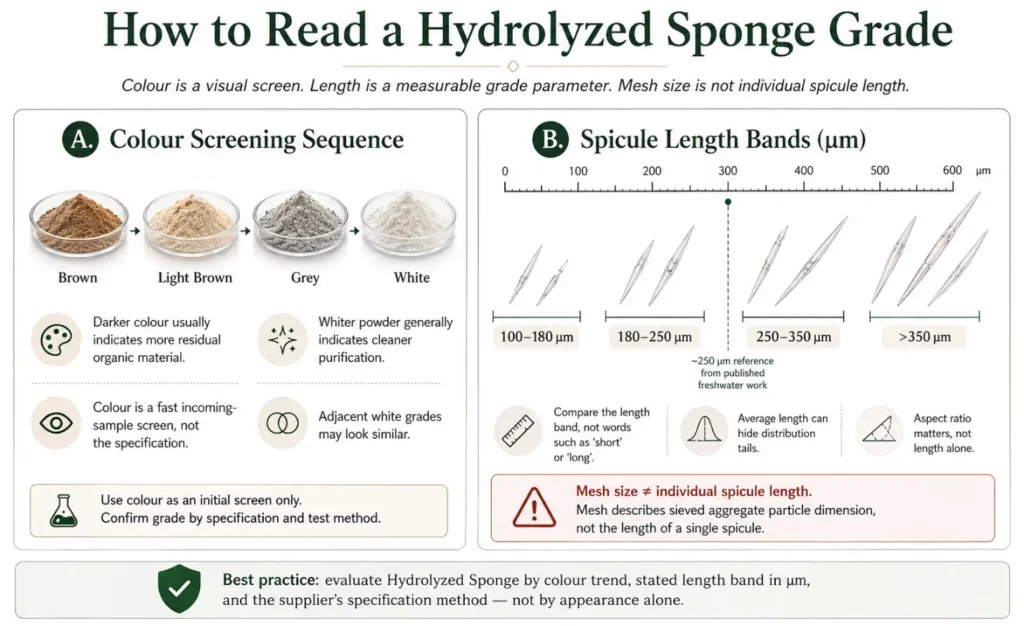
Commercial samples appear brown, light brown, grey, off-white or white. Darker powder generally means more residual organic material, pigment or sediment; whiter powder generally means more complete purification.
But colour cannot confirm a grade. Two high-purity samples both look white, so colour cannot separate a 97% from a 99%, and a white appearance on its own does not prove how the material was processed. Use it on incoming samples, then confirm from specifications and test data.
3. Length: compare micrometres, not marketing names
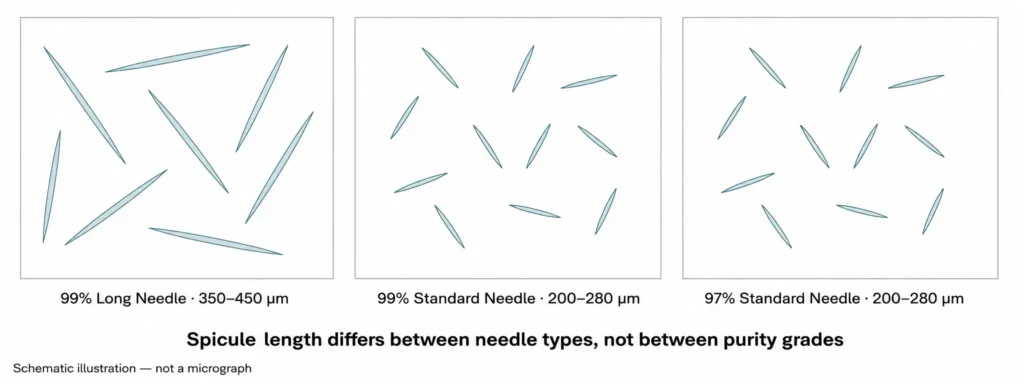
There is no universal definition of “short,” “standard” or “long.” One supplier’s long grade can overlap another supplier’s standard grade, which makes the words useless for comparison and the numbers essential.
Ask for:
- the minimum and maximum length, as a band;
- a microscope image with a scale bar;
- the average length, if available;
- width, or the aspect ratio;
- confirmation that the image belongs to the quoted grade.
An average hides the tails of the distribution, and the tails are what tolerance testing finds. On the image: if a supplier uses one photograph across several grades, that tells you something about how separately those grades are actually produced.
4. Mesh size is not spicule length
Mesh describes what passes through a sieve. It says nothing directly about the length of an individual spicule. A specification reading “100–180 mesh” must not be read as “100–180 µm spicule length” — these are different measurements and cannot be converted into each other.
5. Grade alone does not determine skin feel
Dose is the main driver of tingling, but not the only one. Finished sensory also shifts with:
- length distribution;
- aspect ratio;
- broken or fractured spicules;
- base viscosity;
- application amount;
- massage time and pressure.
Which is why two formulas built on the same nominal grade can feel different — and why sensory has to be settled in the finished base rather than argued from a datasheet.
Comparing grades? Review the Hydrolyzed Sponge product page, or request current grade specifications, microscope images and batch documents before choosing a sample.
Formulating with an insoluble spicule powder
The goal is not dissolution — it is even distribution, held in place from filling through to last use.
Step 1: Pre-wet the powder
Wet the powder into glycerin or a compatible glycol before it goes near the main batch. This gives a smooth slurry and avoids the dry clumps and floating powder that follow from tipping it straight into a water phase.
Step 2: Add during cool-down
Add the pre-dispersed slurry once the gel or emulsion structure has formed and the temperature has dropped. Avoid reheating afterwards.
Step 3: Mix gently
Mix enough to distribute evenly, and no more. Strong shear can fracture spicules and change the length distribution the grade was selected for. This is also why Step 1 matters: since homogenisation cannot be used to break up agglomerates, they have to be prevented at the wetting stage.
Step 4: Build enough suspension structure
A watery base lets spicules settle. A structured gel or emulsion with adequate viscosity and yield stress holds them. The practical test is whether the formula can keep particles in place while the product stands still.
Check:
- appearance immediately after filling;
- sedimentation during stability testing;
- uniformity at the top and bottom of the pack;
- redispersibility after storage;
- compatibility with pumps, valves and filling equipment.
Which rheology modifiers actually deliver yield stress rather than viscosity alone, and how that differs by format, is covered in our formulation guide.
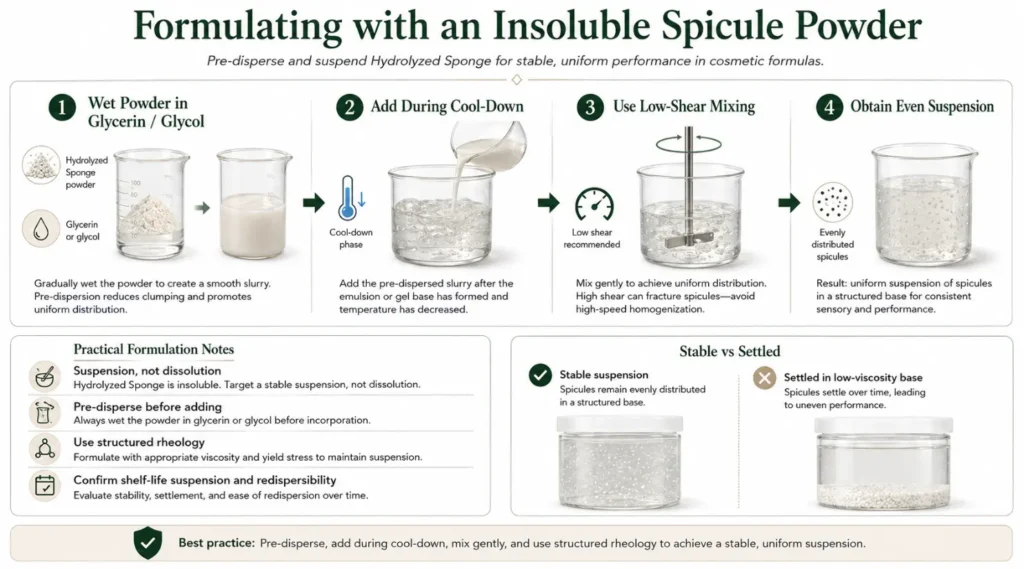
Stable suspension versus settling
| Stable system | Unstable low-viscosity system |
|---|---|
| Spicules stay evenly distributed | Spicules collect at the bottom |
| Each use is consistent | First and last doses differ |
| Visually uniform | Visible sediment |
| Sensory can be defined | Sensory drifts through the pack |
Pairing with other ingredients
Water-soluble ingredients are the logical partners, since they can move along the temporary pathways formed around the spicules. Soothing and moisturising ingredients belong in the same formula for post-use comfort. Every combination still needs compatibility, stability and tolerance testing in the finished formula.
Tingling, tolerance and use instructions
Tingling is expected with spicule formulas — it is neither a defect nor proof that the product works.
The sensory level comes from the whole system: grade, dose, base, application amount and massage. As the 2019 cream study showed, the same material at full length and in shortened form produced measurably different irritation outcomes at similar delivery levels.3
A finished product needs:
- tolerance testing on the actual formula;
- clear application instructions;
- clear use frequency;
- patch-test guidance where appropriate;
- warnings against use on broken, sunburned or actively irritated skin.
What our finished-gel test can support
A supplier study evaluated a gel containing 1% Hydrolyzed Sponge on 30 volunteers over 14 days, with no adverse skin reactions recorded during assessment.
That study tested one finished gel, at one concentration, in one panel, without a control group. It offers supporting tolerance information for the formula that was tested. It does not establish a use level or an efficacy claim for the raw material.
There is no general use range to start from. The only concentration with test data behind it is the 1% finished gel above. Adjust from there based on:
- grade;
- product format;
- base rheology;
- target sensory;
- intended use frequency;
- finished-formula tolerance results.
Where Hydrolyzed Sponge fits best
Hydrolyzed Sponge works best in formats that can hold an insoluble particulate in place while still supporting the intended application method. A structured gel serum, an ampoule, an O/W cream, a rinse-off massage mask and a two-step system each present a different rheology and packaging problem, and a thin toner-style essence is the weakest starting point.
Which format to choose, why a thick base can still settle, and what to test before scale-up are covered format by format in our Hydrolyzed Sponge formulation guide.
What to ask a supplier before ordering
Four groups of questions separate a documented material from a repackaged one.
Product identity
- What is the exact INCI?
- Is the source freshwater or marine?
- Which sponge genus?
- Is an animal-origin declaration available?
Grade information
- What is the length band in µm?
- Is there a microscope image with a scale bar, for this grade?
- What is the purity figure, and by what method?
- Does the powder colour agree with the stated grade?
Quality documents
- Is the COA issued against the lot number actually supplied?
- Are loss on ignition, particle size and heavy-metal limits available?
- Are TDS, SDS and origin documents available?
- Is Halal status a third-party certificate or a supplier declaration?
Formulation support
- Is a sample available for suspension and sensory testing?
- Can the supplier recommend a starting grade by product format?
- Has pump, valve and filling compatibility been evaluated?
- Are specifications and images unique to each grade?
A supplier should be able to explain a grade in plain language and then produce the document that backs the explanation. The order matters: an explanation with no document behind it, and a document nobody can explain, are both warning signs.
Frequently asked questions
Does Hydrolyzed Sponge dissolve in water?
No. It is an insoluble solid. It must be pre-dispersed and kept suspended in the finished formula.
Is Hydrolyzed Sponge vegan?
No. Sponges are animals, so sponge-derived material is animal-origin and should not be marketed as vegan.
Does Hydrolyzed Sponge have a CAS number?
No ingredient-specific CAS number is widely assigned to this INCI. Ask for clarification if a supplier lists a silica or quartz CAS number.
Why are some powders brown, grey or white?
Colour reflects how much residual organic material, pigment or sediment remains after processing. It works as a quick visual check but cannot confirm a purity grade.
What is loss on ignition, and why does it appear on the specification?
It measures the weight lost when a sample is heated, which for this material largely corresponds to the residual organic fraction. It acts as a cross-check on the purity figure: on a well-controlled material, the two agree.
Does marine or freshwater source matter?
Yes. Source affects dimensions, aspect ratio, supply chain, and how the published research should be read. Marine study results should not be applied to freshwater commercial grades.
What is the best Hydrolyzed Sponge grade?
There is no single best grade. It depends on product format, target sensory, application method, use frequency and the suspension system available.
References
- Zhang S, Ou H, Liu C, Zhang Y, Mitragotri S, Wang D, Chen M. Skin Delivery of Hydrophilic Biomacromolecules Using Marine Sponge Spicules. Molecular Pharmaceutics. 2017;14(9):3188–3200. doi:10.1021/acs.molpharmaceut.7b00468
- Ha JM, Lim CA, Han K, Ha JC, Lee HE, Lee Y, Seo YJ, Kim CD, Lee JH, Im M. The Effect of Micro-Spicule Containing Epidermal Growth Factor on Periocular Wrinkles. Annals of Dermatology. 2017;29(2):187–193. doi:10.5021/ad.2017.29.2.187 (Micro-spicules in this study were hyaluronic-acid based, not sponge-derived.)
- Tansathien K, Suriyaaumporn P, Charoenputtakhun P, Ngawhirunpat T, Opanasopit P, Rangsimawong W. Development of Sponge Microspicule Cream as a Transdermal Delivery System for Protein and Growth Factors from Deer Antler Velvet Extract. Biological and Pharmaceutical Bulletin. 2019;42(7):1207–1215. doi:10.1248/bpb.b19-00158
- Krupska T, Wysokowski M, Petrenko I, Khrunyk Y, Nowacki K, Ehrlich H, Turov VV. 1H NMR Spectroscopy Study of Structural Water in Rehydrated Biocomposite of Spongilla lacustris Freshwater Demosponge Origin. Applied Physics A. 2020;126(8):667. doi:10.1007/s00339-020-03844-4
- Zhang C, Zhang K, Zhang J, Ou H, Duan J, Zhang S, Wang D, Mitragotri S, Chen M. Enhanced Skin Delivery of Therapeutic Peptides Using Spicule-Based Topical Delivery Systems. Pharmaceutics. 2021;13(12):2119. doi:10.3390/pharmaceutics13122119
- Kim TG, Lee Y, Kim MS, Lim J. A Novel Dermal Delivery System Using Natural Spicules for Cosmetics and Therapeutics. Journal of Cosmetic Dermatology. 2022;21(10):4754–4764. doi:10.1111/jocd.14771
- European Commission. CosIng — Cosmetic Ingredient Database. Entries: Hydrolyzed Sponge; Hydrolyzed Sponge Extract.
Noyain supplies Hydrolyzed Sponge grades with samples and lot-specific documentation. Review the Hydrolyzed Sponge product page to compare specifications, request current batch documents, or discuss sample selection.