A brand sends a brief: can squalane replace the dimethicone in this formula?
The honest answer has three parts, and only one of them is about squalane. What does the current EU regulation actually restrict. What is the dimethicone doing in that particular formula. And which of those jobs a hydrocarbon emollient can take over.
This article works through all three. It does not conclude that one material is better than the other, because for most of the jobs involved that question has no answer — they are different materials doing overlapping but not identical work.
A note on the data in this article. Regulatory statements are referenced to the regulation or the agency publishing it. Where a statement comes from NOYAIN specifications, it is labelled as such. Nothing here is a claim about the safety of any material relative to another.
Quick Answer
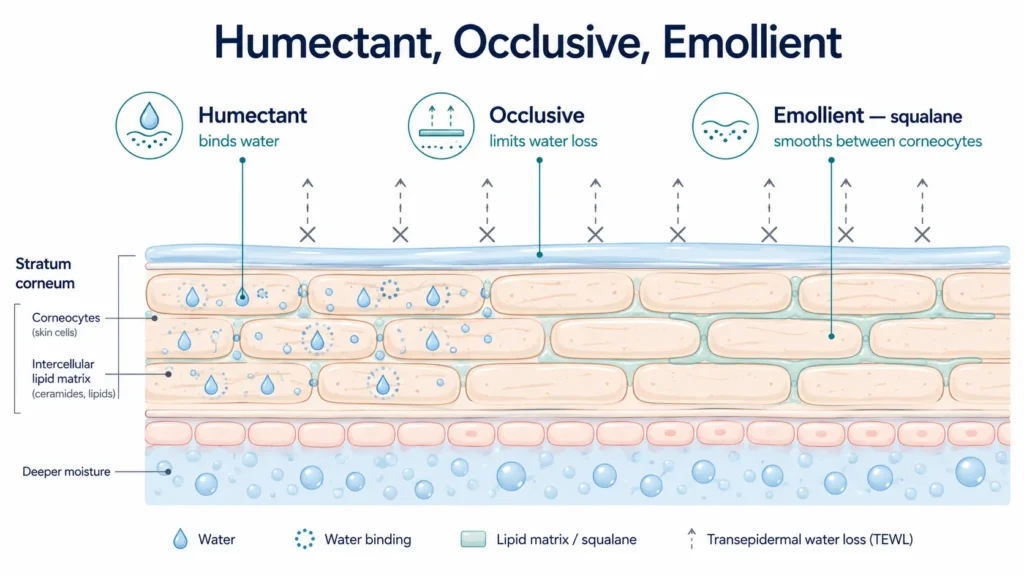
Dimethicone is a linear polydimethylsiloxane, supplied in a wide range of viscosity grades, and it works as an emollient, film former and skin-conditioning agent. Squalane is a saturated hydrocarbon emollient. They overlap on skin feel and slip. They diverge on film formation, water repellency, and regulatory status.
| Dimethicone | Squalane | |
|---|---|---|
| INCI name | Dimethicone | Squalane |
| CAS number | 9006-65-9 | 111-01-3 |
| Chemistry | Linear polydimethylsiloxane | Saturated C30 hydrocarbon |
| Supplied as | Viscosity grades, roughly 5 to 1,000,000 cSt | One grade, defined by assay |
| Forms a hydrophobic film | Yes | No |
| US OTC skin-protectant active | Yes, 1–30% under 21 CFR 347.10 | No |
The last row is the one most comparison articles leave out, and it is the one that settles certain briefs before the discussion starts.
What the 2026 EU Rules Actually Restrict
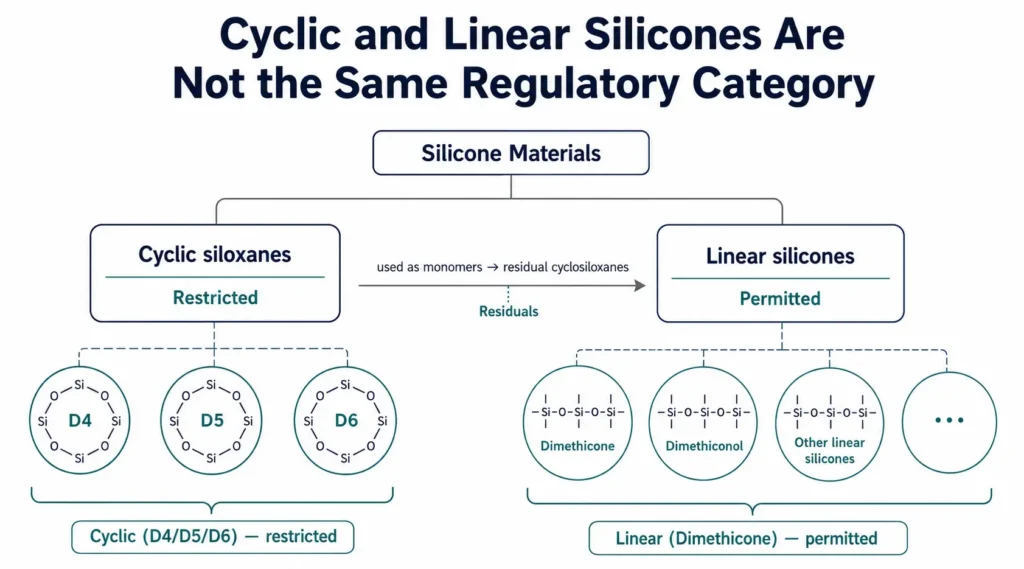
The short version, because a great deal of confusing material has been published on this: the restriction is on cyclic siloxanes. Dimethicone is linear, and it is not one of the restricted substances.
The three substances covered are octamethylcyclotetrasiloxane (D4), decamethylcyclopentasiloxane (D5) and dodecamethylcyclohexasiloxane (D6). They are cyclosiloxanes — silicon and oxygen atoms repeating in a closed ring — and the European Chemicals Agency classifies them as very persistent and very bioaccumulative, which is what drove the restriction. ECHA’s cyclosiloxanes topic page sets out the background.
Commission Regulation (EU) 2024/1328, which amends Annex XVII of REACH, sets the operative dates:
| Date | What applies |
|---|---|
| 31 January 2020 | D4 and D5 already restricted in rinse-off cosmetic products |
| 1 January 2022 | D4 prohibited in cosmetics under Annex II of the Cosmetics Regulation |
| 6 June 2026 | D4, D5 and D6 not placed on the EU market as substances, constituents, or in mixtures at 0.1% or more by weight; rinse-off cosmetics covered |
| 6 June 2027 | By derogation, the same restriction extends to leave-on cosmetic products |
Two things follow that matter commercially. The rinse-off deadline has already passed. And leave-on products — creams, serums, facial oils, the formats where emollient and skin-feel silicones do most of their work — have until June 2027, which is less than a year.
The question to actually ask your silicone supplier
Here is the part that gets missed. Cyclosiloxanes are used as monomers in silicone polymer production, and that use is derogated in the regulation. But the 0.1% threshold applies to mixtures containing these substances, which means residual D4, D5 or D6 carried through into a linear silicone grade is within scope.
So for a brand currently using dimethicone, the useful question is not “is dimethicone banned?” It is “what is the residual cyclosiloxane content of the grade I am buying, and can my supplier document it?”
That is an enforcement question as much as a compliance one. ECHA’s Enforcement Forum ran a pilot project checking cosmetic products for restricted substances including D4 and D5, and found restricted cyclosiloxanes in around 3% of the products inspected, with withdrawals following.
One boundary, stated plainly: none of this makes dimethicone unsafe or non-compliant. The Cosmetic Ingredient Review has assessed the methicone and dimethicone polymer group and concluded safety as used in cosmetics, and dimethicone remains permitted in the EU. This article is not a case against silicones, and a supplier that presents it as one is selling you a narrative rather than answering your brief.
What Dimethicone Is Doing in the Formula
Substitution cannot be discussed until the jobs are named. In a typical formula, dimethicone may be doing several of the following at once:
- Forming a thin hydrophobic film on skin or hair
- Providing slip and reducing drag during application
- Delivering water repellency and wash resistance
- Reducing soaping and whitening in an emulsion
- Lowering friction and improving gloss on hair
- Acting as a carrier phase for other materials
- Serving as an OTC skin-protectant active in a US drug-monograph product
Viscosity grade changes the answer substantially. A 5 cSt fluid and a 100,000 cSt fluid are not doing the same job, so “replacing the dimethicone” is not one question — it is as many questions as there are grades in the formula.
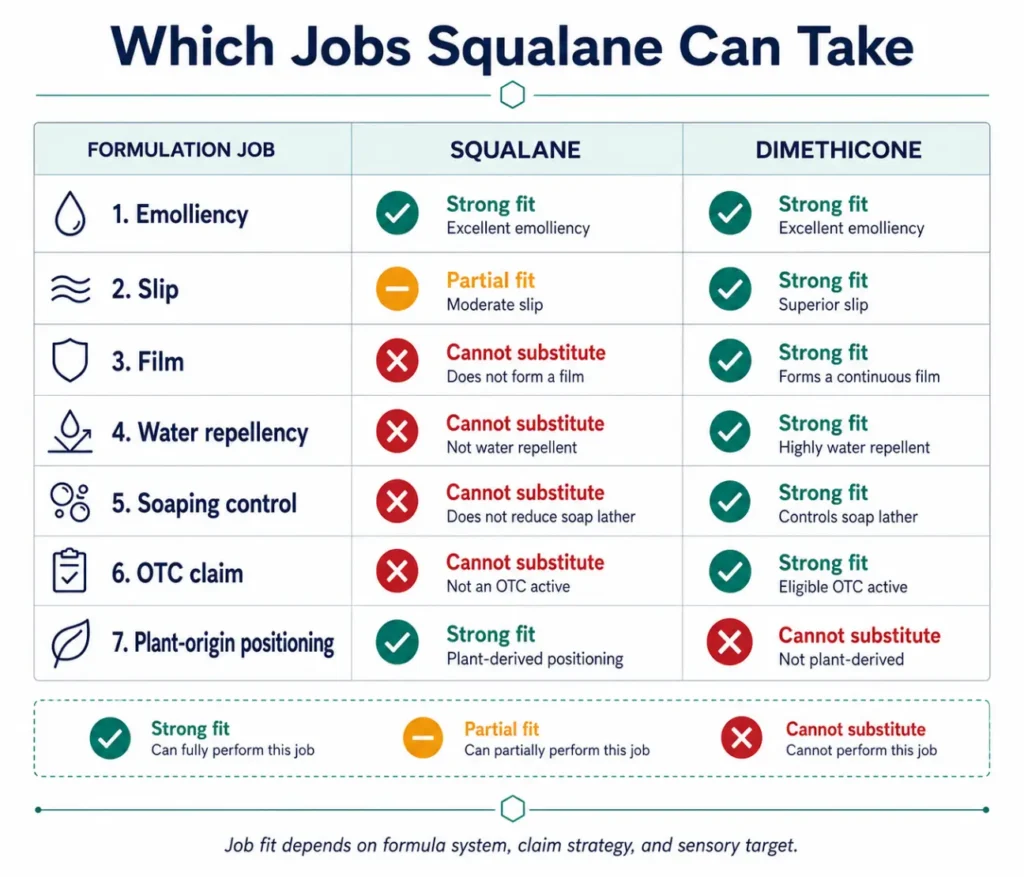
Which Jobs Squalane Can Take
| Job in the formula | Can squalane take it? |
|---|---|
| Emolliency and skin softness | Yes |
| Slip and spreadability | Partly — different character, not identical |
| Lightening a heavy oil phase | Yes |
| Hydrophobic film on skin | No |
| Water repellency and wash resistance | No |
| Reducing soaping in an emulsion | No |
| US OTC skin-protectant claim | No |
| Non-silicone, plant-origin positioning | Yes |
Squalane is a good answer to the emolliency and sensory half of the brief. It contributes softness and spreadability and can lighten an oil phase that would otherwise feel heavy, which is why it appears in facial oils, serums, creams and colour cosmetics. The NOYAIN squalane grade and specification covers the material as supplied, and its composition — including what the non-squalane fraction consists of — is discussed in Squalane vs Squalene.
It is not an answer to the structural half. Squalane does not form the hydrophobic film that gives a silicone its water repellency and wash resistance, and it does not control soaping in an emulsion. Nor does it carry US skin-protectant monograph status.
In practice, then, reducing silicone content is rarely a single swap. It is usually a rebuild of the oil phase, in which squalane covers emolliency and sensory lightness while esters, waxes, or non-silicone film formers cover what the silicone was doing structurally — and the emulsifier system often needs revisiting as well. Anyone offering a one-for-one replacement is quietly proposing a reformulation project they will not be doing.
Source Narrative and Product Positioning
Silicone-free positioning is a marketing decision, not a technical conclusion. Both materials are permitted in the EU, both have been formally reviewed, and neither position is more scientifically correct than the other. Brands take the silicone-free route for consumer-facing reasons, and that is a legitimate commercial choice as long as it is not dressed up as a safety argument.
What a plant-origin story can legitimately be built on is documentation: a source statement, a production route, and where available an analytical origin parameter. How that gets verified rather than asserted is covered in What Is Squalane Made From?
What it should not be built on is an environmental comparison between the two materials. That comparison requires test data on both, under the same protocol, that most suppliers on either side do not hold — and a claim of that kind will be checked by exactly the technically capable buyer this decision matters to.
Frequently Asked Questions
Are silicones banned in the EU in 2026?
No. Three specific cyclic siloxanes — D4, D5 and D6 — are restricted to below 0.1% by weight. The restriction has applied to substances, mixtures and rinse-off cosmetics since 6 June 2026 and extends to leave-on cosmetic products from 6 June 2027. Linear silicones, including dimethicone, are not among the restricted substances.
Is dimethicone a cyclosiloxane?
No. Dimethicone is a linear polydimethylsiloxane. D4, D5 and D6 are cyclic — closed rings of alternating silicon and oxygen. The distinction is the whole basis of the restriction, and it is the point most widely misreported.
Can squalane replace dimethicone one-for-one?
Not reliably. It can take the emolliency, spreadability and oil-phase-lightening roles. It cannot form a hydrophobic film, deliver wash resistance, or control soaping. Treat a silicone reduction as an oil-phase rebuild requiring fresh stability and sensory testing, not as a raw-material substitution.
Which dimethicone viscosity grade is closest to squalane in feel?
Low-viscosity fluids are the nearest comparison, since both are light and spread readily, but the character differs — a silicone’s slip is not a hydrocarbon’s slip, and panel testing will pick that up. High-viscosity grades are not comparable at all; their function is film and cushion, which squalane does not provide.
Does removing dimethicone change emulsion stability?
It can. Beyond the sensory question, dimethicone influences how an emulsion behaves during processing and on application, including soaping. Any oil-phase change of this size needs the full stability programme repeated rather than a spot check.
Can squalane carry a US skin-protectant claim?
No. Dimethicone is listed as an OTC skin-protectant active ingredient at 1–30% under 21 CFR 347.10. Squalane has no equivalent monograph status, so a product relying on that claim cannot substitute squalane for the active.
Conclusion
Two separate questions are usually asked as one. The regulatory question is about residual cyclosiloxane content in the grades you already buy. The reformulation question is about which of the jobs your dimethicone is doing can be taken over by something else, and by what. Squalane answers part of the second question and none of the first.
Related Reading
- What Is Squalane? Sources, functions, and raw material selection
- Squalane vs Squalene: what hydrogenation changes
- What Is Squalane Made From? Source routes and how to verify them
- Moisturizing and emollient cosmetic ingredients
- All squalane articles and resources
References
- European Commission. Commission Regulation (EU) 2024/1328 of 16 May 2024 amending Annex XVII to Regulation (EC) No 1907/2006 (REACH) as regards D4, D5 and D6. Official Journal of the European Union.
- European Chemicals Agency. Cyclosiloxanes — hot topics.
- Regulation (EC) No 1223/2009 on cosmetic products, Annex II (prohibited substances) — entry for octamethylcyclotetrasiloxane.
- US Food and Drug Administration. 21 CFR 347.10 — Skin protectant active ingredients. Electronic Code of Federal Regulations.
- Cosmetic Ingredient Review. Safety assessment of methicone and dimethicone polymers as used in cosmetics. Final amended report.
- National Center for Biotechnology Information. Squalane — PubChem Compound Summary, CID 8089.