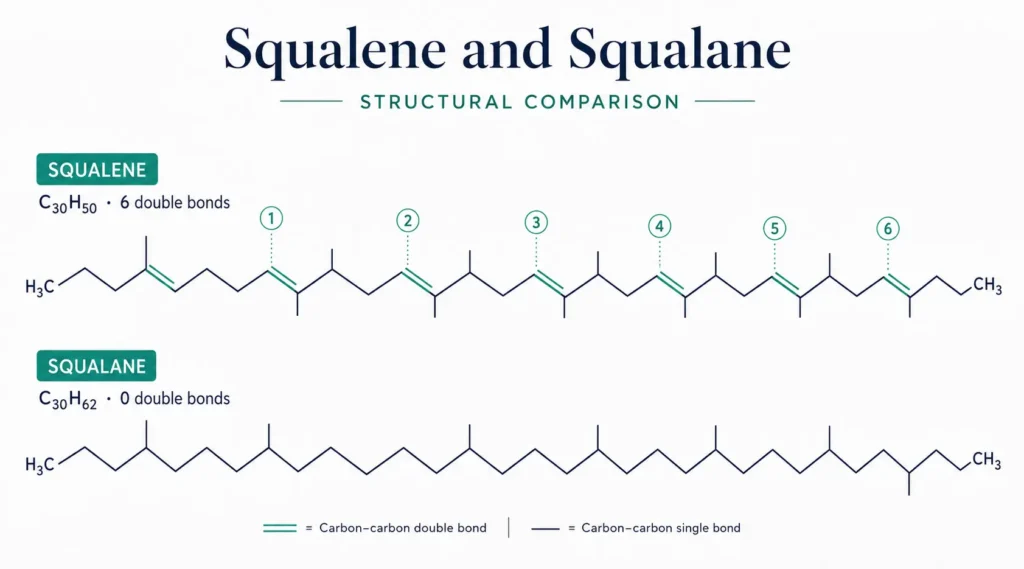
A quotation for squalene and a quotation for squalane differ by one letter. The materials differ by six carbon–carbon double bonds, two CAS numbers, and two customs classifications.
That matters commercially before it matters chemically. An unusually cheap offer described as “squalene” is not a discounted squalane — it is a different substance, with a different stability profile, different handling requirements, and different documentation. Substituting one for the other is a reformulation, not a cost saving.
This article covers the three checks that separate the two on a quotation, what a commercial squalane grade actually contains besides squalane, and why the cosmetic industry hydrogenates in the first place.
For basic identity, cosmetic functions, and grade-selection criteria, start with What Is Squalane?
A note on the data in this article. Where a statement comes from NOYAIN supplier documentation or from the manufacturing partner’s product information, it is labeled as such. Supplier-level information describes the raw material as supplied and is not a substitute for testing in the intended formula. Third-party sources are listed in the references.
Quick Answer: The Difference in One Paragraph
Squalene is the unsaturated precursor. Squalane is what remains after squalene’s six carbon–carbon double bonds have been hydrogenated. Removing those double bonds removes the sites where atmospheric oxygen attacks the molecule, which is why squalane, not squalene, is the material normally supplied for finished cosmetic formulations.
| Property | Squalene | Squalane |
|---|---|---|
| INCI name | Squalene | Squalane |
| CAS number | 111-02-4 | 111-01-3 |
| EC number | 203-826-1 | 203-825-6 |
| Molecular formula | C30H50 | C30H62 |
| Molecular weight | 410.7 | 422.8 |
| C=C double bonds | 6 | 0 |
Two INCI names and two CAS numbers is the practical point. On a specification, a label, or a customs declaration, these are two different substances. Identity can be confirmed through the PubChem record for squalane and the PubChem record for squalene, and squalane is listed by the European Chemicals Agency under substance information for CAS 111-01-3.
Three Checks Before You Accept a Quotation
Three checks are specific to the squalane-versus-squalene question. Each takes under a minute and each has ended a sourcing problem before it started.
1. Confirm the INCI name and CAS number on the offer itself
Squalane is 111-01-3; squalene is 111-02-4. The confusion runs in both directions — some suppliers write “squalene” when they mean squalane, and some price sheets carry both without distinguishing them. Get the CAS number in writing before sampling, not after.
2. Ask for the composition, not only the assay
A minimum of 92% squalane tells you about the main component. It does not tell you what the other 6–8% is. Ask, and note whether the answer is specific or evasive.
3. Compare the storage and shelf-life terms
The grade NOYAIN supplies is specified for sealed storage at room temperature in a ventilated, dry environment, with a 24-month shelf life. Squalene grades generally require tighter handling and usually an antioxidant system. If a supplier offers both and quotes identical storage terms for each, that is worth a question — it suggests the specification was copied rather than issued per material.
Broader grade-selection criteria — appearance, odor, acid and iodine values, low-temperature clarity, batch documents — are covered in What Is Squalane?
What a Commercial Squalane Actually Contains
If squalane is hydrogenated squalene, a reasonable next question is what makes up the rest of a commercial grade. Most suppliers do not answer it.
The manufacturing partner behind the grade NOYAIN supplies publishes the composition of its vegetable squalane as follows.
| Component | Content |
|---|---|
| Squalane | 92–94% |
| Cyclosqualane | 2–5% |
| Iso-squalane | 0–1% |
| Other alkanes | 0–2% |
The ranges describe typical values for each component rather than a fixed mass balance.
Two things are worth drawing out of that table.
Every component listed is a saturated hydrocarbon. Cyclosqualane, iso-squalane, and the residual alkane fraction are all products of the same hydrogenation and purification route. The portion of the material that is not squalane is not leftover squalene.
Composition and feedstock are separate questions. A grade can be produced entirely from plant feedstock and still contain 92–94% squalane, because “plant-derived” describes where the carbon came from while assay describes what is in the drum. That distinction, and why “100% plant-derived” must never be rewritten as “100% pure squalane,” is set out in What Is Squalane?
For buyers, the useful part is not the specific percentages. It is that the question has an answer. A supplier that can describe its non-squalane fraction is describing a route it has visibility into; a supplier that can only quote a minimum assay may be reselling without that visibility.
Need the numbers on paper?
Review the squalane grade and specification, or request the current COA, SDS, and source statement for your own evaluation.
Why the Industry Hydrogenates
What hydrogenation changes
Hydrogenation converts C30H50 into C30H62. Six double bonds become zero, and a reactive polyunsaturated hydrocarbon becomes a saturated branched alkane that is comparatively inert.
That inertness is the entire commercial point. It is also why squalane sits alongside other stable oil-phase materials in a formulator’s moisturizing and emollient ingredient shortlist rather than being treated as a delicate ingredient that needs protecting.
Reaching complete saturation is not a single mild step. Industrial practice is typically a two-stage process, with the second stage at higher hydrogen pressure and temperature, precisely because the last of the unsaturation is the hardest to remove. Published work on catalytic routes describes conventional industrial conditions as considerably harsher than laboratory alternatives, and continues to look for milder catalytic systems — which tells you something about how much process effort sits behind an ordinary drum of squalane.
Why squalene itself is not used directly
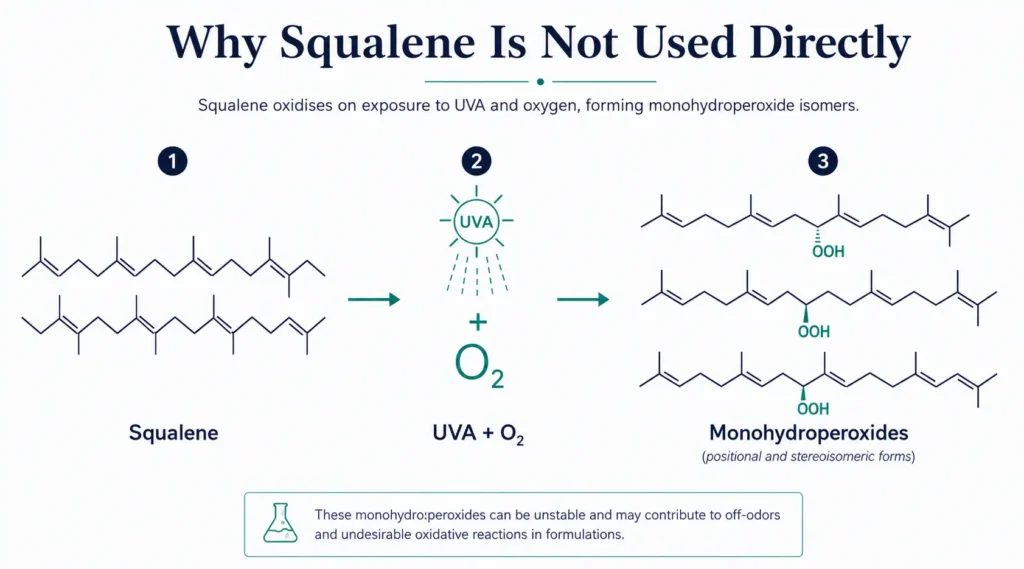
Squalene is a major lipid in human sebum, so on a “skin-identical” argument alone it would seem to be the more attractive raw material. The reason the industry does not use it is not the molecule itself. It is what the molecule turns into.
On exposure to UVA, squalene forms a set of monohydroperoxide isomers, and it is the oxidized material that causes problems. In a rabbit-ear model, Chiba and colleagues reported that the comedogenic response to squalene monohydroperoxide exceeded that of cosmetic ingredients already recognized as comedogenic, while squalene itself and the corresponding reduced hydroxide produced weaker responses. The Cosmetic Ingredient Review’s safety assessment documentation for squalane and squalene records the same finding. Later work in the International Journal of Cosmetic Science describes squalene oxides, in contrast to pure squalene, as potent comedogenic compounds, and a 2023 study in Pharmaceuticals reports the peroxide form present in the stratum corneum of acne-prone skin.
Read together, these give the formulation argument its shape. The risk in an unsaturated hydrocarbon is not how it behaves on day one. It is what a proportion of it becomes over a shelf life that includes warehouse heat, clear packaging, retail lighting, and shipping through warm climates. At a low use level in a well-protected formula that risk can be managed. At a meaningful percentage of the oil phase, it becomes a formulation liability that hydrogenation removes at source.
Two boundaries are worth stating plainly, because this is where copy in this category tends to overreach. First, none of the above is a claim that squalane treats or prevents acne. Second, it is not a claim that a squalane-containing formula is non-comedogenic — that is a finished-product question, addressed in Is Squalane Comedogenic? The literature explains why the industry hydrogenates. It does not substantiate a benefit claim for any finished product, and responsibility for finished-product claims rests with the brand owner.
The feedstock decides how much purification the route needs
Different squalene feedstocks arrive with different companions, and those companions determine the purification burden.
Olive-derived squalene is the clearest example. Because it carries residual waxes, the published route requires a winterization step to precipitate those waxes out before hydrogenation, followed by the two-stage hydrogenation itself. If that wax removal is incomplete, the waxes stay in the finished squalane.
This is the mechanism behind a problem buyers occasionally see in practice: some vegetable-derived squalane grades develop haze or wax-like precipitation when they get cold. It is not the squalane crystallizing. It is residual wax carried through from the feedstock.
The grade NOYAIN supplies is produced by its manufacturing partner from deodorized distillates of soybean oil, and that route includes crystallization at −15 °C with cold filtration. Comparative low-temperature screening data sits on the squalane grade and specification page rather than here.
One qualification matters here and is easy to lose: whether a specific grade hazes depends on that producer’s process control, not on the feedstock category as a whole. Well-controlled olive-derived grades exist, and a soybean route is not automatically clearer than an olive route. Screen the actual material under the temperature conditions your supply chain will see. Source routes are compared in What Is Squalane Made From?
Where Squalene Is Still the Right Material
Squalane is the correct choice for cosmetic formulations, but squalene is not an inferior version of it. It is a different material with its own uses.
Squalene remains the relevant molecule as a component of vaccine adjuvant systems, where its properties are the point rather than a problem to be engineered away. It is used in nutraceutical and supplement applications, and it is studied extensively as a biological lipid in its own right. And it is, necessarily, the feedstock from which every kilogram of squalane is made — which is why fermentation and plant-oil squalene supply chains matter to squalane buyers even though they never purchase squalene themselves.
The practical reading for a cosmetic buyer is narrower than “squalene is unstable.” It is that the property making squalene valuable in some applications is the same property that makes it unsuitable as a bulk emollient in a product with a two-year shelf life.
Frequently Asked Questions
Is “squalene oil” on a product label a mistake?
Usually it is a spelling error for squalane, since squalane is what almost all finished skincare actually contains. But it is not safe to assume. The INCI name and CAS number on the supplier documentation determine which material is in the product, not the marketing copy.
Can squalene be substituted for squalane in an existing formula?
Not as a like-for-like swap. Even setting aside the different stability profile, the substitution changes the oil phase enough to require re-testing for stability, sensory performance, and packaging compatibility. Treat it as a reformulation, not a raw-material substitution.
Does squalane oxidize at all?
Squalane is far more stable than squalene, but “more stable” is not “inert under all conditions.” It should still be stored sealed, at room temperature, in a ventilated dry environment, and evaluated in the finished formula and packaging rather than assumed to be indefinitely robust.
Is olive-derived squalane more prone to cold haze?
Olive-derived squalene carries residual waxes that must be removed by winterization before hydrogenation, and incomplete removal leaves wax in the finished material, which can precipitate at low temperature. Whether a specific grade hazes depends on that producer’s process control rather than on the feedstock category alone, so screen the actual material under the temperature conditions your supply chain will see.
Which one should appear on my finished-product ingredient list?
Whichever the supplier documentation for the material you actually bought specifies. If the COA says CAS 111-01-3, the INCI name is Squalane. Copying the label wording from a competitor product is not a substitute for reading your own COA.
Conclusion
Squalane and squalene are related materials with different commercial roles: one is the feedstock, the other is what cosmetic formulations are built with. Confirming which one an offer covers is a documentation check that takes a minute and prevents a genuinely expensive mistake.
Evaluating squalane for a new project?
View the squalane grade and specification · Request a sample and the current document set
Related Reading
- What Is Squalane? Sources, cosmetic functions, and raw material selection
- What Is Squalane Made From? Source routes and how to verify them
- Squalane Benefits in Skincare: What the ingredient does in a formula
- Is Squalane Comedogenic? What formulators and brands should know
- Dimethicone vs Squalane: What squalane can and cannot replace
- All squalane articles and resources
References
- National Center for Biotechnology Information. Squalane — PubChem Compound Summary, CID 8089. PubChem.
- National Center for Biotechnology Information. Squalene — PubChem Compound Summary, CID 638072. PubChem.
- Chiba K, Yoshizawa K, Makino I, et al. Comedogenicity of squalene monohydroperoxide in the skin after topical application. Journal of Toxicological Sciences. 2000;25(2):77–83. PMID:10845185.
- Pham DM, Boussouira B, Moyal D, Nguyen QL. Oxidization of squalene, a human skin lipid: a new and reliable marker of environmental pollution studies. International Journal of Cosmetic Science. 2015;37(4):357–365. doi:10.1111/ics.12208.
- Condrò G, Sciortino R, Perugini P. Squalene peroxidation and biophysical parameters in acne-prone skin: a pilot in vivo study. Pharmaceuticals. 2023;16(12):1704. doi:10.3390/ph16121704.
- Ciriminna R, Pandarus V, Béland F, Pagliaro M. Solvent-free chemoselective hydrogenation of squalene to squalane. ACS Omega. 2017;2(8):4630–4635. doi:10.1021/acsomega.7b00625.
- From olive pomace to squalane: a green chemistry route using 2-methyltetrahydrofuran. PMC12332605.
- Mendes A, Azevedo-Silva J, Fernandes JC. From Sharks to Yeasts: Squalene in the Development of Vaccine Adjuvants. Pharmaceuticals. 2022;15(3):265. doi:10.3390/ph15030265.
- Cosmetic Ingredient Review. Safety assessment of squalane and squalene as used in cosmetics.
- European Chemicals Agency. Substance information: 2,6,10,15,19,23-hexamethyltetracosane (squalane), CAS 111-01-3.