
Cosmetic Active System
Carnosine
A water-soluble dipeptide active for anti-glycation, antioxidant, and anti-aging skincare concepts.
Carnosine is a cosmetic raw material used in skincare formulations targeting glycation-related visible aging, oxidative stress, dullness, sallow tone, and firmness appearance. It is suitable for anti-aging serums, firming creams, eye care, brightening anti-aging essences, masks, and OEM/ODM product development.
Anti-glycation peptide positioning
Water-soluble active for serum systems
Suitable for anti-aging and antioxidant skincare
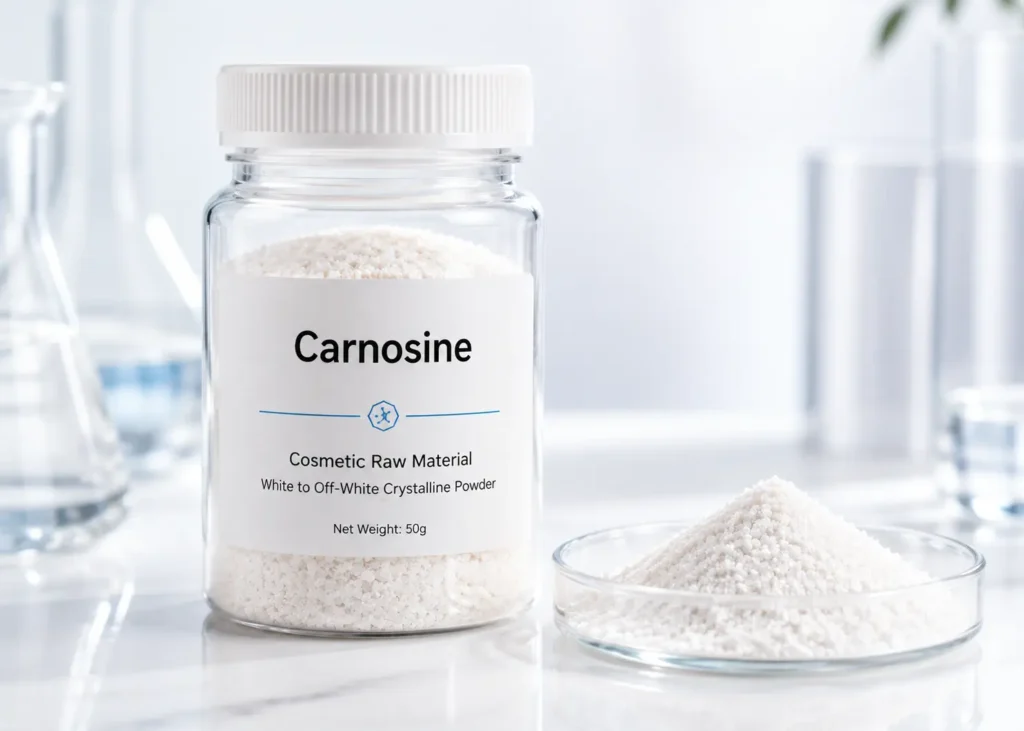
INCI
Carnosine
CAS
305-84-0
Function
Anti-glycation support, antioxidant support, anti-aging skin conditioning
Recommended Dosage
0.1% - 1%
Shelf Life
24 Months
Product Overview
Carnosine for Anti-Glycation and Antioxidant Skincare
Carnosine is a naturally occurring dipeptide, also known as L-Carnosine or beta-Alanyl-L-histidine, used as a cosmetic active ingredient for anti-glycation, antioxidant, and anti-aging skin-conditioning concepts. For skincare brands, formulators, manufacturers, and distributors, it helps build product stories around skin quality, dullness care, smoother-looking texture, and firmness appearance.
In formulation development, Carnosine is especially suitable for water-rich leave-on products where anti-glycation positioning, antioxidant care, and mild daily-use anti-aging value are important. It can be used in serums, essences, creams, eye care, ampoules, and mask essences when formulators need a peptide active that is different from conventional signal-peptide or renewal-focused systems.
For sourcing and commercial evaluation, buyers should confirm INCI name, CAS number, assay, purity, appearance, pH, solubility, recommended use level, COA, TDS, MSDS, MOQ, lead time, packaging, and target-market document needs before sample testing or bulk order approval.
01
Match Your Required Spec
Tell us your target assay, purity requirement, pH range, packaging need, application scenario, and claim direction. We help you confirm whether our Carnosine specification matches your formulation or sourcing project.
02
Test It in Your Formula
We support sample evaluation for anti-aging serums, firming creams, eye care, brightening essences, ampoules, and mask systems. Use level, compatibility, processing temperature, and stability should be verified in your final formula.
03
Prepare for Commercial Order
For bulk purchasing, we help confirm COA, TDS, MSDS, specification, MOQ, lead time, packaging, shipping documents, and batch consistency before commercial approval.
Function + Formulation Value
Key Benefits of Carnosine
01
Anti-Glycation Story
Carnosine supports skincare concepts focused on glycation-related visible aging, including dullness, yellowish tone, reduced bounce appearance, and firmness loss positioning.
02
Antioxidant Support
Supplier leaflet data reports intracellular ROS scavenging and mitochondrial oxidative-stress support, helping brands build antioxidant and environmental-stress skincare concepts.
03
Firmness Appearance
By supporting anti-glycation positioning, Carnosine helps connect the formula story to collagen appearance protection, skin resilience, and smoother-looking texture.
04
Brightening Support
Carnosine can be used in brightening anti-aging formulas targeting sallow, tired-looking, and uneven-looking skin tone when paired with compatible tone-care actives.
Market Applications
Recommended Applications for Carnosine
Serum
Anti-Glycation Carnosine Serum
In anti-aging serum formulas, Carnosine can be used as a featured water-soluble peptide active to support anti-glycation positioning, antioxidant care, dullness improvement, and smoother-looking skin. It can be combined with niacinamide, sodium hyaluronate, betaine, glycerin, panthenol, or compatible non-copper peptides.
Cream
Firming & Resilience Face Cream
In emulsion systems, Carnosine helps brands create a firmness appearance and skin-quality story for mature-skin or early-aging product lines. It can be paired with ceramides, squalane, panthenol, glycerin, tocopherol, and barrier-support ingredients, with final compatibility confirmed in the finished cream.
Eye Care
Carnosine Eye Serum or Eye Cream
In eye-area products, Carnosine can support concepts around dullness, fatigue appearance, early visible aging, and fine-line appearance care. Formulators should verify use level, pH, preservative compatibility, and eye-area safety in the finished product system.
Essence
Brightening Anti-Aging Essence
In brightening anti-aging essences, Carnosine can add anti-glycation and antioxidant value to formulas targeting sallow tone and uneven-looking skin. It can be developed with niacinamide, 3-O-Ethyl Ascorbic Acid, humectants, panthenol, and soothing agents after compatibility testing.
Ampoule
Multi-Active Peptide Ampoule
In ampoule products, Carnosine helps add a small dipeptide mechanism to non-copper peptide and antioxidant systems. It is suitable for concentrated skin-quality concepts using humectants, Acetyl Hexapeptide-8, sodium hyaluronate, betaine, and barrier-support ingredients.
Mask Essence
Intensive Skin-Quality Mask
In sheet mask essence systems, Carnosine can support hydration, antioxidant care, and post-use smoother-looking skin. It works well in water-rich formulas with glycerin, betaine, panthenol, sodium hyaluronate, allantoin, and mild soothing ingredients.
Formulation Guide
How to Use Carnosine in Formulations
Use Carnosine as a water-soluble peptide active for anti-aging, anti-glycation, antioxidant, and skin-conditioning formulas. Final dosage, compatibility, processing conditions, stability, and claim direction should be verified in the finished product system.
Get Formulation GuideUse Level
The recommended reference range is 0.1% - 1.0%. Final dosage should be selected according to the product format, active system, target claim direction, safety assessment, stability performance, and local market requirements.
Solubility
Carnosine is freely soluble in water and suitable for aqueous serums, essences, gels, lotions, creams, masks, and eye care products. It is not soluble in vegetable oils or DMSO according to the supplied product data.
Addition Phase
Supplier TDS recommends adding Carnosine at the final stage below 45 degC. Avoid unnecessary high-temperature exposure and confirm assay retention, pH, color, odor, and clarity during prototype and stability testing.
Compatible Actives
Carnosine can be developed with niacinamide, 3-O-Ethyl Ascorbic Acid, tocopherol, ferulic acid, sodium hyaluronate, glycerin, betaine, panthenol, allantoin, ceramides, and compatible non-copper peptides.
Stability Check
Monitor pH drift, color, odor, clarity, viscosity, assay retention, preservative compatibility, microbial quality, and packaging interaction. Pay extra attention to formulas containing acids, high electrolytes, metal ions, oxidizing substances, or complex botanical blends.
Packaging Suggestion
Store raw Carnosine in a light-protected, sealed container at room temperature. For finished antioxidant and peptide products, consider airless, opaque, or light-protective packaging where appropriate.
Technical Specifications
Product Technical Parameters
Parameter | Specification |
|---|---|
INCI Name | Carnosine |
Appearance | White to off-white crystalline solid or powder |
Purity | ≥99.0% |
Recommended Dosage | 0.1% - 1% |
Solubility | Freely soluble in water; insoluble in vegetable oils and DMSO |
pH Stability | 7.5 - 8.5 in 0.1% solution |
Function | Anti-glycation support, antioxidant support, anti-aging skin conditioning |
Application | Creams, serums, facial oils, eye care, masks, and emulsions |
Storage Condition | Store in a light-protected, sealed container at room temperature; keep away from heat, humidity, oxidizers, and food-grade chemicals |
Shelf Life | 24 months under recommended storage conditions |
Why Choose NOYAIN®
Supply Support for Carnosine Projects
- Batch-specific COA support for appearance, identification, purity, assay, pH, residue on ignition, loss on drying, heavy metals, and microbial limits.
- TDS, SPEC, composition statement, flowchart, and MSDS available for formulation, handling, storage, and sourcing workflows.
- Sample support for anti-aging serums, firming creams, eye care, essences, ampoules, masks, and OEM/ODM evaluation.
- Technical communication for INCI name, CAS number, assay, purity, use level, pH range, addition phase, incompatibilities, and stability testing.
- Formulation discussion for anti-glycation, antioxidant, brightening anti-aging, and non-copper peptide skincare concepts.
- Quotation, MOQ, lead-time, packaging, shipping document, and batch-consistency support for pilot batches and commercial procurement planning.
Kind Tips
Formulation Precautions
Cool-Down Addition
Add Carnosine during the final stage below 45 degC where possible. If higher-temperature processing is required, confirm assay retention and appearance in the finished formula.
pH Range Control
Supplier information recommends a formula pH range of 4.0 - 8.0. Check pH drift during accelerated and real-time stability testing before finalizing claims or packaging.
Incompatibility Review
Avoid chelating agents, oxidizing substances, p-hydroxyacetophenone, and Copper Peptide (Copper Tripeptide-1) unless the complete formula has passed compatibility and stability validation.
Finished Formula Validation
Confirm color, odor, clarity, viscosity, preservative compatibility, microbial quality, assay retention, and packaging interaction in the final product rather than relying only on raw-material data.
related products
Other related products
Related Documents
Technical Support Materials
COA Document
Request COATDS (Technical Data Sheet)
Request TDSSDS / MSDS
Request SDS / MSDSFormulation Guide
Get For FreeRelated Topics
Product-related articles
Ready to Source Carnosine for Anti-Glycation Skincare?
Contact us to request Carnosine samples, quotation, COA, TDS, MSDS, and formulation support for your serum, cream, eye care, mask, or OEM/ODM anti-aging project.
Frequently Asked Questions
Questions from Formulators and Buyers
- Why do formulators use Carnosine in skincare products?
Formulators use Carnosine mainly for anti-glycation, antioxidant, and anti-aging skincare concepts. It is suitable for products targeting dull-looking skin, sallow tone, loss of firmness appearance, fine-line appearance, and overall skin-quality improvement. For brands developing advanced anti-aging formulas, Carnosine can help strengthen the product story beyond basic hydration or general antioxidant positioning.
- What types of skincare products is Carnosine suitable for?
Carnosine is suitable for serums, essences, firming creams, eye care products, anti-aging lotions, brightening anti-aging formulas, ampoules, gels, and mask essences. It is especially useful in leave-on products where anti-glycation, antioxidant care, and skin-quality improvement are part of the product positioning.
- What is the recommended use level of Carnosine?
The common reference use level is 0.1%–1.0%. The final dosage should be confirmed based on the formula type, target claim, active ingredient system, pH, stability, safety assessment, and local cosmetic regulations. For new product development, we recommend starting with small-batch formulation testing before confirming the final use level for commercial production.
- Is Carnosine easy to formulate?
Yes. Carnosine is water soluble, which makes it suitable for many aqueous skincare systems such as serums, essences, gels, lotions, creams, and masks. It can usually be added into the water phase or final stage of formulation, depending on the complete formula system. Formulators should still verify solubility, clarity, pH, color, odor, preservative compatibility, and stability in the final product.
- Can Carnosine be used with Niacinamide or Vitamin C derivatives?
Yes. Carnosine can usually be developed with niacinamide, vitamin C derivatives, humectants, antioxidants, soothing agents, barrier-support ingredients, and compatible non-copper peptides. However, the complete formula should still be tested for pH drift, color change, odor change, precipitation, and active retention, especially in multi-active anti-aging systems.
- Are there any ingredients that need special attention when using Carnosine?
Formulas containing Copper Peptide Copper Tripeptide-1 , strong chelating systems, oxidizing ingredients, or p-hydroxyacetophenone should be carefully evaluated before final approval. These combinations are not automatically impossible, but they require compatibility testing in the complete formulation. We recommend checking color stability, pH stability, clarity, and assay retention before scale-up.