
Yes—Quaternium-73 demonstrates measurable antimicrobial activity against acne-associated bacteria at parts-per-million concentrations, allowing formulators to target blemish-prone skin at just 0.001% to 0.005%. In in vitro laboratory testing, this yellow crystalline compound inhibits Cutibacterium acnes (C. acnes) at a minimum inhibitory concentration (MIC) as low as 0.00002%, supported by decades of established use in Japanese skincare. Unlike conventional exfoliating acids, Quaternium-73 targets acne-associated bacteria through antimicrobial activity rather than exfoliation. This makes it a complementary option for developing low-dose, multi-active blemish-care formulas, leaving ample room in the base formula for soothing, hydrating, and sebum-balancing ingredients.
What Is Quaternium-73?
Quaternium-73—widely known in the cosmetic industry by the trade name Pionin—is a cationic antimicrobial active engineered for high-potency, low-dose blemish care. Where salicylic acid or benzoyl peroxide address clogged pores through exfoliation or oxidation, Quaternium-73 focuses specifically on controlling acne-related microbial proliferation.
| Property | Specification / Details |
| INCI Name | Quaternium-73 |
| Common / Trade Name | Pionin (Kankohso No. 201 in Japan) |
| CAS Number | 15763-48-1 |
| Appearance | Fine yellow crystalline powder |
| Ionic Nature | Cationic (positively charged) |
| Primary Function | Targeted antimicrobial support |
| Typical Use Level | 0.001% – 0.005% |
Quaternium-73 has a long history of use in Japan. Listed as Kankohso No. 201 in the Japanese cosmetic ingredient standards established in 1967, it also has regulatory precedent as an active ingredient in Japanese quasi-drug products intended to prevent acne, as outlined in NAGASE’s official PIONIN™ product documentation. While regulatory classifications differ outside Japan, this multi-decade track record gives global formulators a well-characterized benchmark for low-dose antimicrobial skincare.
How It Targets Acne-Related Bacteria
Blemish development is driven by four overlapping factors: excess sebum production, follicular hyperkeratinization, localized inflammation, and microbial imbalance involving Cutibacterium acnes (formerly Propionibacterium acnes).
Quaternium-73 addresses the microbial pathway through charge interaction. Because the molecule carries a positive (cationic) charge, it is electrostatically attracted to negatively charged bacterial cell envelopes. Upon contact, it disrupts cell membrane integrity and interferes with normal metabolic survival, inhibiting bacterial growth at trace concentrations.
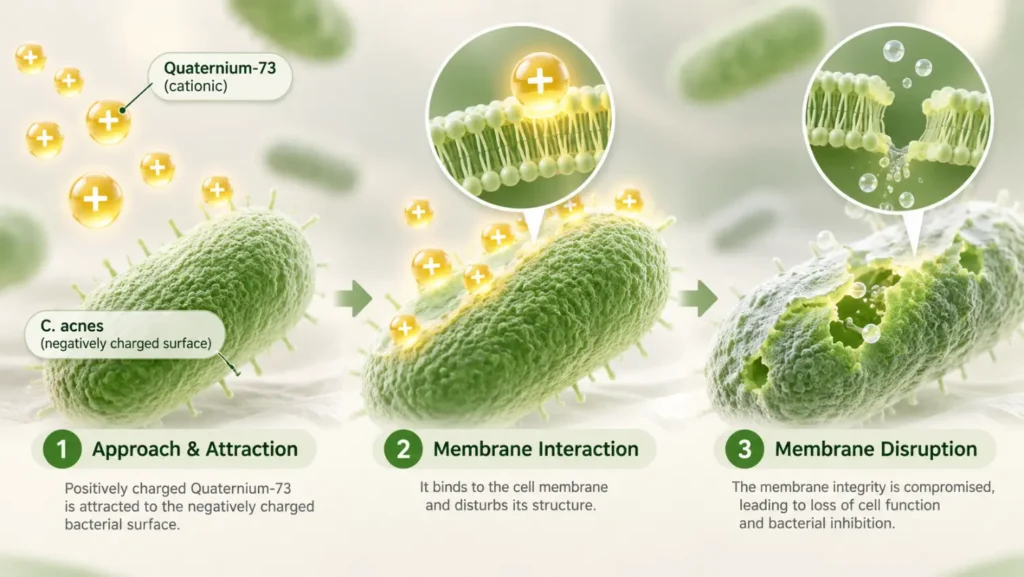
In standard in vitro microbiological assays, Quaternium-73 exhibits an MIC against C. acnes as low as 0.00002% (0.2 ppm). To put that figure in perspective, a typical commercial starting dose of 0.002% is 100 times higher than the baseline laboratory inhibition threshold—helping account for real-world formulation variables such as surfactant binding, rinse-off contact time, and skin surface sebum. Because its mechanism does not depend on desquamation or acidic pH, it offers a distinct functional pathway compared to traditional keratolytic acids.
What Does the Research Actually Show?
When evaluating Quaternium-73 for commercial product development, R&D teams should distinguish between standalone in vitro microbiological data, multi-active human studies, and emerging delivery-system research.
Human Study on Dissolving Microneedle Patches (2022)
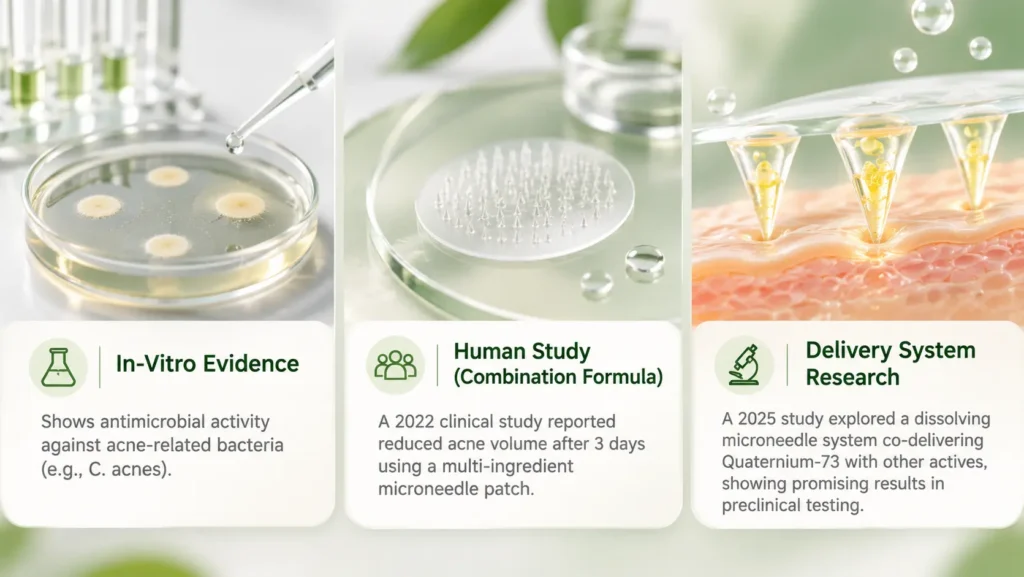
A 2022 clinical study published in the Journal of Cosmetic Dermatology evaluated dissolving anti-acne microneedle patches containing Quaternium-73 alongside complementary anti-blemish actives across 30 subjects with visible facial acne. Over the 28-day study period, investigators recorded:
- 12.34% reduction in acne lesion volume after 3 days
- Additional 10.01% reduction in acne volume after 7 days
- 5.88% decrease in measured skin melanin index at Day 28
- Zero adverse skin reactions reported throughout the trial
Because the tested patch combined multiple active ingredients within a physical microneedle delivery matrix, the 12.34% Day-3 reduction reflects the performance of the complete patch system rather than Quaternium-73 acting alone in a conventional emulsion or serum.
Preclinical Combination Delivery Research (2025)
More recently, a 2025 study in Microsystems & Nanoengineering investigated a dual-phase dissolving microneedle system engineered to co-deliver PIONIN, salicylic acid, and dipotassium glycyrrhizinate. The researchers demonstrated that pairing a poorly water-soluble antimicrobial with water-soluble soothing and keratolytic agents in a structured delivery carrier achieved strong antibacterial activity against acne-associated bacteria and favorable preclinical anti-acne outcomes.
Summary of Supporting Evidence
| Evidence Type | Key Finding | Practical Scope for Formulators |
| In Vitro MIC Testing | Inhibits C. acnes at concentrations as low as 0.00002% | Establishes baseline antimicrobial potency at trace doses |
| Japanese Regulatory History | Listed in Japan’s 1967 cosmetic ingredient standards (Kankohso No. 201) with quasi-drug precedent | Demonstrates long-term commercial use in regulated anti-acne formulas |
| 2022 Human Patch Study | 12.34% acne volume reduction at Day 3 in a 30-subject trial | Validates multi-active combination patches; does not isolate single-ingredient efficacy |
| 2025 Delivery Research | Co-delivery of Pionin, salicylic acid, and dipotassium glycyrrhizinate | Demonstrates the feasibility of delivering Quaternium-73 alongside complementary actives in an advanced microneedle system |
If you are mapping out bench trials or reviewing technical specifications for an upcoming blemish-care project, explore the full grade details on our NOYAIN Quaternium-73 product page.
Where Quaternium-73 Fits in Skincare Formulations
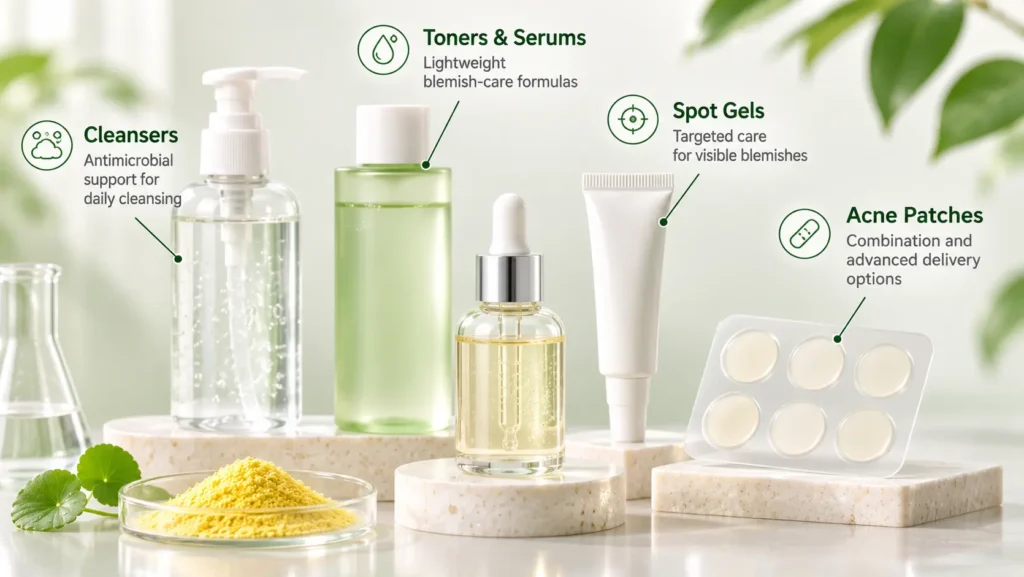
For product developers, Quaternium-73 is rarely positioned as a standalone active. Instead, it serves as a low-dose antimicrobial component that complements daily acne-prone and oily-skin formulas without adding sensory heaviness.
| Product Format | Formulation Role & Positioning |
| Lightweight Serums & Toners | Daily antimicrobial maintenance in fast-absorbing, non-comedogenic bases |
| Targeted Spot Gels | Concentrated localized blemish care paired with soothing or keratolytic actives |
| Facial Cleansers | Antimicrobial support in rinse-off gels and foams using compatible surfactant systems |
| Hydrocolloid & Microneedle Patches | High-value targeted blemish patches combining physical protection with active delivery |
| Oil-Control Gel-Creams | Lightweight moisturizers designed for oily and blemish-prone skin |
Formulation Guidelines: Dosage, Solubility, and Compatibility
Working at parts-per-million levels keeps raw material cost-in-use efficient, but Quaternium-73 requires deliberate processing to ensure uniform dispersion and long-term stability.
Recommended Use Level and Premixing
For commercial formulation development with NOYAIN Quaternium-73, we recommend a starting dosage range of 0.001% to 0.005%, adjusted according to target-market regulations and finished-product safety testing.
Because Quaternium-73 has poor solubility in water, adding the crystalline powder directly into the main aqueous phase often leads to incomplete dissolution or recrystallization. Instead, pre-dissolve the powder in a suitable solvent carrier—such as Butylene Glycol, Propylene Glycol, 1,2-Pentanediol, or Ethanol—with gentle stirring before incorporating the premix into your batch.
Critical Stability and Charge Checks
- Cationic–Anionic Compatibility: Because Quaternium-73 is cationic, certain anionic ingredients—such as specific anionic surfactants or anionic rheology modifiers—may present compatibility challenges depending on concentration and formulation structure. Overall compatibility depends on the complete formulation, so bench testing is recommended to confirm solubility, clarity, and stability.
- Light and Color Stability: Quaternium-73 is naturally yellow. Even at 0.001–0.005%, prolonged UV exposure can trigger slight color shift or potency loss—validate stability under accelerated light exposure and specify UV-filtering or opaque packaging where needed.
- Preservation System Integrity: Do not rely on 0.001–0.005% Quaternium-73 to replace a broad-spectrum preservative system; always verify microbiological protection via standard Preservative Efficacy Testing (PET).
Compatible Actives for Multi-Mechanism Formulas
Modern acne-care formulas often combine multiple mechanisms to address blemish-prone skin. Depending on your formulation goals, Quaternium-73 can be evaluated as a potential pairing alongside:
- Niacinamide: Shares a compatible near-neutral pH window (pH 5.5–7.0), offering a direction that pairs antimicrobial support with sebum regulation and barrier care.
- Salicylic Acid: Combines pore-clearing exfoliation with antimicrobial support. For water-dominant formulas where free salicylic acid poses solubility challenges, formulators can also evaluate NA40, NOYAIN’s salicylic acid–methyl-cyclodextrin complex.
- Allantoin and Panthenol: Non-ionic soothing and hydrating ingredients such as Allantoin can help support skin comfort alongside antimicrobial care.
- Zinc PCA: Incorporating Zinc PCA offers a complementary direction for oily-skin and sebum-control positioning.
Each combination should be verified through bench stability and compatibility testing in the target base.
Safety Profile and Global Regulatory Context
Quaternium-73 is used at low concentrations in skincare formulations. Its safety should be assessed within the finished product, taking into account the intended use level, exposure, and complete formula. According to the EWG Skin Deep ingredient profile for Quaternium-73, the compound receives low hazard scores across key categories such as allergies and immunotoxicity, while noting that publicly indexed data remain limited.
From a compliance standpoint, brand owners must align product claims with regional frameworks. While Quaternium-73 has established quasi-drug precedent in Japan, cosmetic products marketed in the United States, European Union, or ASEAN markets cannot make drug-level acne-treatment claims based solely on Japanese regulatory history. Brands should verify local ingredient inventories, concentration limits, and finished-product toxicological safety assessments prior to commercial launch.
Evaluating Quaternium-73 for Commercial Production
Because Quaternium-73 is dosed at fractions of a percent, batch-to-batch purity and consistency play an important role in dissolution and formulation reliability. Before selecting a raw material supplier, R&D and procurement teams should review HPLC assay specifications, batch Certificate of Analysis (COA) data, solubility guidance, and available technical documentation.
NOYAIN supplies high-purity Quaternium-73 (≥99.0% by HPLC) for skincare brands, R&D formulators, OEM/ODM manufacturers, and ingredient distributors. Our team can provide available technical documentation and sample support to help you evaluate the ingredient in your own formulations.
Final Thoughts
Yes. Quaternium-73 demonstrates that powerful antimicrobial activity doesn’t require a high ingredient concentration. Backed by trace-level in vitro activity against C. acnes, decades of established Japanese skincare applications, and versatile compatibility across gels, serums, cleansers, and patches, it gives formulators a focused tool for flexible blemish-care product development. Starting with high-purity NOYAIN Quaternium-73 (≥99% HPLC) and verifying solubility and stability in your finished formula allows brands to turn a micro-dose active into a technically sound acne-care solution.
