
Piroctone olamine is an antifungal ingredient widely used in shampoos to help control dandruff, support scalp microbiome balance, and improve scalp comfort. Unlike insoluble anti-dandruff agents such as zinc pyrithione (ZPT), piroctone olamine (INCI: Piroctone Olamine; CAS: 68890-66-4) can be solubilized in compatible surfactant systems, making it particularly useful for developing clear shampoos and modern scalp-care formulations.
With zinc pyrithione prohibited in EU cosmetics since March 2022, piroctone olamine has become an important option for brands developing anti-flake and scalp-balancing products.
But how effective is piroctone olamine in shampoo, and what should formulators consider when selecting its concentration and incorporating it into a formula?
This guide examines clinical evidence, real shampoo brands, US and EU regulatory differences, and practical formulation considerations for R&D teams and OEM/ODM manufacturers.
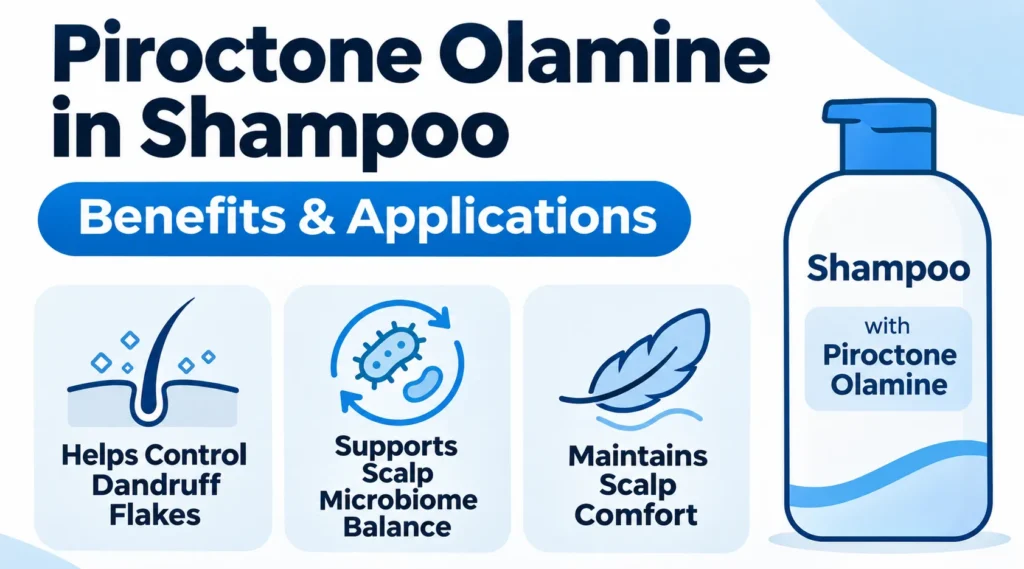
How Piroctone Olamine Works on the Scalp
Dandruff is closely associated with an imbalance in the scalp microbiome, particularly the proliferation of Malassezia yeasts.
These microorganisms metabolize components of scalp sebum, releasing fatty acids that can contribute to irritation, itching, and excessive skin flaking in susceptible individuals.
Piroctone olamine helps address these conditions through three properties:
1. Antifungal Activity Against Malassezia
Piroctone olamine can interfere with fungal metabolism, including processes involving iron availability. This helps control Malassezia proliferation, one of the factors associated with dandruff formation.
2. Support for Scalp Microbiome Balance
Research indicates that effective treatment with piroctone olamine shampoo can shift the scalp microbiome toward a composition more commonly observed in individuals without dandruff.
In a 2024 study, these changes were accompanied by improvements in visible flaking and reductions in microbial pathways associated with oxidative stress.
3. Formulation Flexibility
Unlike particulate zinc pyrithione, piroctone olamine can dissolve in suitable surfactant systems. This provides opportunities for transparent shampoo formulations without relying on an insoluble active suspension.
However, solubility depends on the surfactant system, pH, and other formulation components. Finished products still require compatibility and stability testing.
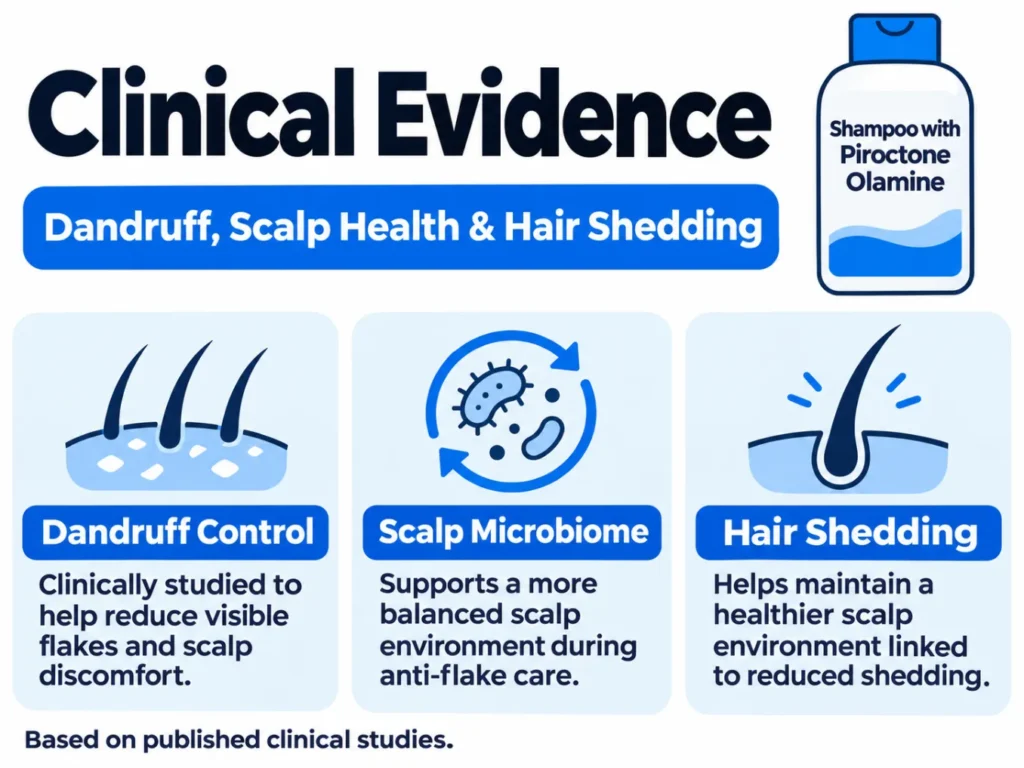
Clinical Evidence: What Studies Show for Dandruff, Hair Shedding & Hair Quality
Clinical studies provide useful evidence for the application of piroctone olamine in scalp-care shampoos. However, it is important to distinguish the effects of the ingredient itself from the performance of complete shampoo formulations.
Dandruff Control and Scalp Microbiome Balance
A 2024 study by Hu et al., published in the International Journal of Cosmetic Science, investigated scalp microbial composition and the effects of a shampoo containing 0.5% piroctone olamine.
The research included an initial scalp microbiome assessment involving 94 subjects, followed by a three-week comparison involving 100 individuals with dandruff.
The researchers observed:
- Reduced relative abundance of certain Malassezia species and Staphylococcus capitis.
- Increased relative abundance of Cutibacterium acnes.
- Improvements in clinical scalp flaking scores compared with a control shampoo.
- Reduced abundance of microbial genes associated with oxidative stress and certain metabolic pathways.
These findings suggest that piroctone olamine shampoo can help restore a more balanced scalp microbiome while improving visible dandruff symptoms.
The study demonstrates associations between treatment, microbial changes, and dandruff improvement; it does not establish that every microbiome change was caused directly by the active ingredient.
Can Piroctone Olamine Shampoo Help Reduce Hair Shedding?
The relationship between piroctone olamine shampoo and hair loss has also attracted research interest.
In a six-month study involving 150 men with dandruff-associated hair shedding, Piérard-Franchimont et al. (2002) compared three shampoos containing:
- 1% Piroctone Olamine
- 1% Ketoconazole
- 1% Zinc Pyrithione
Participants used their assigned shampoo two to three times per week.
The results showed:
| Clinical Parameter | 1% Piroctone Olamine | 1% Ketoconazole | 1% Zinc Pyrithione |
|---|---|---|---|
| Change in hair shedding | −16.5% | −17.3% | −10.1% |
| Change in anagen hair proportion | +7.9% | +4.9% | +6.8% |
| Change in mean hair shaft diameter | +7.7% | +5.4% | −2.2% |
Source: Piérard-Franchimont et al. (2002), International Journal of Cosmetic Science. Results were observed in the studied participants after six months of use.
These results suggest that controlling dandruff and improving scalp conditions may contribute to reduced hair shedding.
An important distinction: Overall hair density did not change during the study, and there was no neutral-shampoo control group. The results therefore should not be interpreted as proof that piroctone olamine treats androgenetic alopecia or promotes new hair growth.
Wet Combability and Post-Rinse Performance
A 2011 study by Schmidt-Rose et al. compared a shampoo containing 0.5% piroctone olamine + 0.45% climbazole with a shampoo containing 1% zinc pyrithione.
The piroctone olamine/climbazole formulation demonstrated:
- Comparable anti-dandruff effectiveness to the zinc pyrithione shampoo.
- Greater antifungal substantivity in the experimental model.
- Improved wet-hair combability.
- Positive scalp-itch feedback from 90% of participants after four weeks.
These findings are relevant to formulators developing shampoos that combine dandruff control with desirable hair-conditioning properties.
However, the results apply to the tested combination of piroctone olamine and climbazole, not to piroctone olamine alone.
Real-World Shampoo Applications & US vs. EU Regulatory Landscape
Piroctone olamine is already used in commercial shampoo formulations across different product categories, from mass-market anti-dandruff products to sensitive-scalp and premium hair-care ranges.
For international brands and contract manufacturers, understanding the regulatory differences between major markets is equally important.
US FDA Rules vs. EU Cosmetic Regulations
Piroctone olamine can be incorporated into cosmetic shampoos, but the permitted product claims and regulatory requirements depend on the destination market.
| Regulatory Dimension | European Union | United States |
|---|---|---|
| Regulatory framework | EU Cosmetics Regulation (EC) No 1223/2009 | FDA cosmetic requirements and OTC drug regulations |
| Piroctone Olamine | Listed in Annex V, Entry 35, as a permitted cosmetic preservative | Not listed as an active ingredient in FDA OTC Dandruff Monograph M032 |
| Concentration reference | Up to 1.0% in rinse-off cosmetics and 0.5% in other cosmetics under Annex V/35 | No Piroctone Olamine active concentration established under M032; applicable product safety requirements still apply |
| Zinc Pyrithione | Prohibited in EU cosmetic products since March 1, 2022 | Listed as an OTC anti-dandruff active under M032, subject to specified conditions |
| Ketoconazole | Generally regulated through the medicinal-product framework for medicinal uses | Not listed in M032; certain OTC shampoos are marketed through approved drug applications |
| Product claims | Cosmetic anti-dandruff claims may be used where appropriate and substantiated | Claims to treat or control dandruff can trigger drug regulation; cosmetic-only products must avoid unapproved drug claims |
Sources: EU Cosmetics Regulation (EC) No 1223/2009, Commission Regulation (EU) 2021/1902, and FDA OTC Monograph M032.
The distinction matters when developing international product lines. A formulation positioned as an anti-dandruff cosmetic in Europe may require a different regulatory strategy if marketed with therapeutic dandruff claims in the United States.
The EU limits above refer to the ingredient’s Annex V entry and should not be interpreted as universal permitted concentrations for every market or product claim.
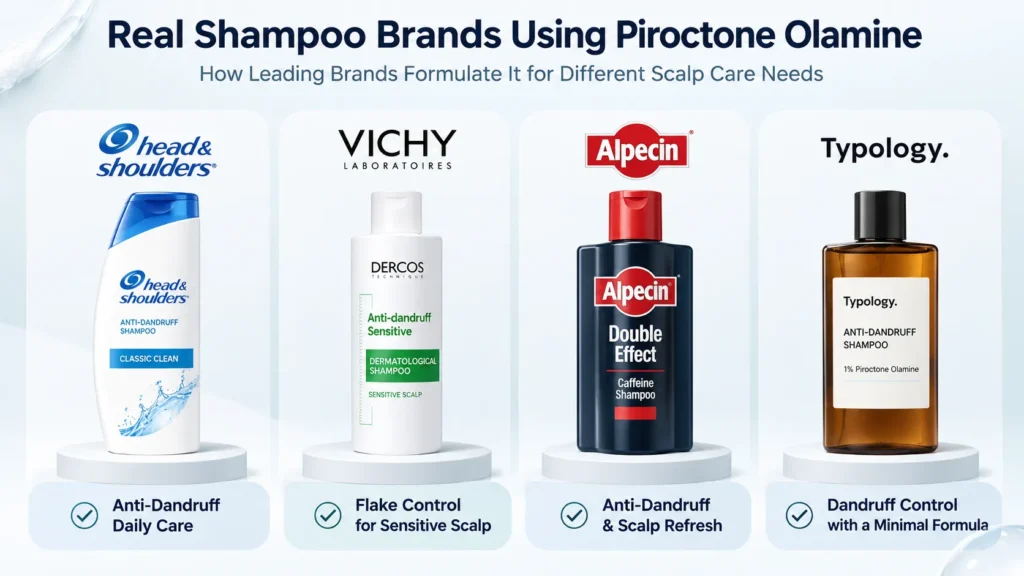
Four Commercial Shampoo Brands Using Piroctone Olamine
The following commercial products demonstrate how brands incorporate piroctone olamine into different shampoo concepts.
1. Head & Shoulders Classic Clean Shampoo — UK Market
Head & Shoulders uses piroctone olamine in its UK Classic Clean formula alongside conventional cleansing surfactants, including Sodium Laureth Sulfate, Sodium Lauryl Sulfate, and Cocamidopropyl Betaine.
The formula also contains conditioning ingredients such as Dimethiconol and Guar Hydroxypropyltrimonium Chloride.
Formulation takeaway: Piroctone olamine can be incorporated into established, high-foaming shampoo systems designed for mainstream dandruff-control products.
2. Vichy Dercos Anti-Dandruff Sensitive Shampoo — UK Market
Vichy’s sensitive-scalp formula combines Piroctone Olamine with Salicylic Acid and Bisabolol.
Its sulfate-free cleansing system includes Sodium Methyl Cocoyl Taurate, Laureth-5 Carboxylic Acid, and Cocamidopropyl Betaine.
Formulation takeaway: Combining piroctone olamine with exfoliating and soothing ingredients offers an approach for developing sensitive-scalp anti-flake shampoos.
3. Alpecin Double Effect Caffeine Shampoo — UK Market
Alpecin combines Piroctone Olamine and Salicylic Acid with Caffeine, Zinc PCA, Niacinamide, and Panthenol.
The product is positioned around dandruff care and hair-root vitality.
Formulation takeaway: Piroctone olamine can be part of multifunctional scalp-care concepts that combine anti-flake ingredients with conditioning and hair-care actives.
4. Typology Anti-Dandruff Shampoo — European Market
Typology presents a minimalist scalp-care concept using 1% Piroctone Olamine alongside Jujube (Ziziphus Joazeiro) extract.
The shampoo is positioned as a sulfate-free treatment for dandruff-prone scalps.
Formulation takeaway: Piroctone olamine can support simplified, sulfate-free product concepts aimed at consumers seeking scalp care with a shorter, carefully selected ingredient list.
Note: Product formulations may vary by region, production date, or SKU. The examples above refer to the identified market versions and publicly disclosed ingredient information.
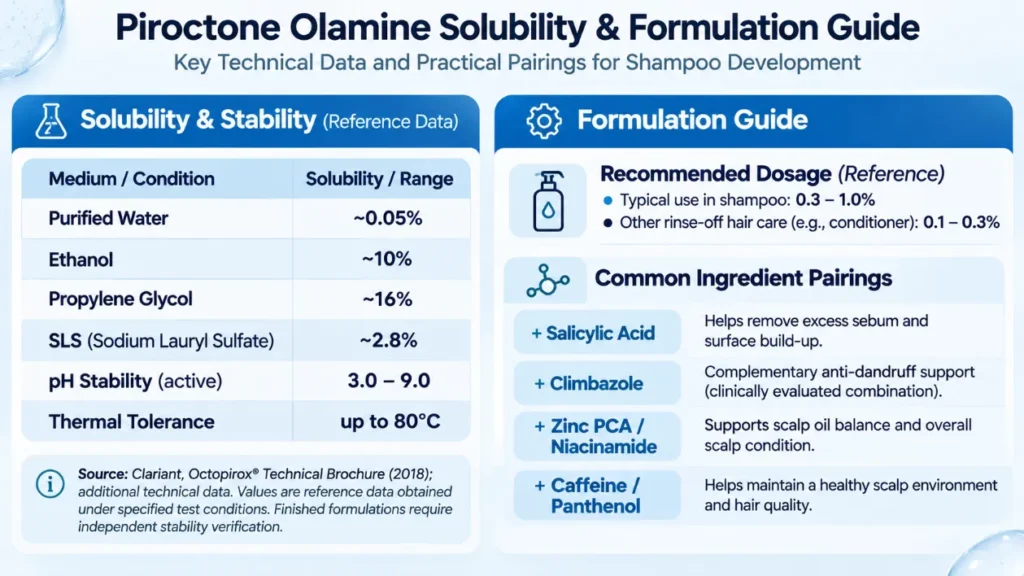
Formulation Guide: Dosage, Solubility, Stability & Ingredient Pairings
Developing a stable piroctone olamine shampoo formulation requires more than selecting an active concentration.
The final result depends on the surfactant system, solubility, pH, processing conditions, and compatibility with other ingredients.
Recommended Piroctone Olamine Dosage
Different sources provide different concentration ranges because they serve different purposes.
The following table distinguishes supplier recommendations, research concentrations, and regulatory limits.
| Reference Category | Piroctone Olamine Level | Application Context |
|---|---|---|
| NOYAIN Product Guidance | Refer to current product TDS | Grade-specific formulation recommendations and specifications |
| Clariant — Hair Shampoo | 0.3–1.0% | Typical supplier reference range |
| Clariant — Hair Tonic | 0.05–0.1% | Typical supplier reference range |
| Clariant — Hair Conditioner | 0.1–0.3% | Typical supplier reference range |
| Published Clinical Studies | Commonly 0.5% or 1.0% | Concentrations used in selected shampoo studies |
| EU Annex V/35 Limit | 1.0% rinse-off; 0.5% other products | Regulatory maximum under the listed preservative entry |
Sources: Clariant Octopirox® Technical Brochure, EU Cosmetics Regulation, and the clinical studies listed in References.
These values are not interchangeable. Supplier recommendations are useful formulation starting points, clinical concentrations describe specific tested formulas, and regulatory limits define applicable legal ceilings.
For NOYAIN’s Piroctone Olamine (≥99.0% HPLC purity), formulators should refer to the current product specifications and TDS when planning laboratory trials.
Solubility, Surfactant Compatibility & Sulfate-Free Systems
Piroctone olamine has limited solubility in pure water, but substantially better solubility in certain glycols, alcohols, and surfactant systems.
Its solubility also depends on pH and temperature.
Piroctone Olamine Solubility & Stability Reference
| Medium / Condition | Reported Reference Value | Formulation Consideration |
|---|---|---|
| Purified Water | Approximately 0.05% | Limited solubility; additional solubilization may be required |
| Ethanol | Approximately 10% | Useful reference solvent for certain liquid scalp-care formulations |
| 1,2-Propylene Glycol | Approximately 16% | Historical solubility reference; actual results depend on temperature and test conditions |
| 15% Sodium Lauryl Sulfate (SLS/SDS) solution | Approximately 2.8% at pH 7 and room temperature | Historical surfactant-solubility result; not transferable directly to every shampoo base |
| Formulation pH Range | pH 3–9 | Clariant reference for chemical stability/formulation compatibility |
| Typical Shampoo Target pH | Approximately 5.0–6.5 | Common development target, subject to the selected surfactant system |
| Processing Temperature | Up to 80°C under normal processing conditions | Avoid prolonged heating; verify suitability for the complete formula |
Sources: Clariant Octopirox® Technical Brochure; EP2099410A2, which cites historical Clariant solvent and surfactant-solubility data.
Important: These are reference values obtained under particular test conditions, not universal solubility limits or NOYAIN batch-specific measurements. Finished formulas require independent verification.
For sulfate-free shampoos, possible surfactant systems include:
- Sodium Methyl Cocoyl Taurate
- Sodium Lauroyl Sarcosinate
- Disodium Laureth Sulfosuccinate
- Alkyl Polyglucosides
The compatibility of piroctone olamine with these systems depends on the surfactant blend, active concentration, electrolyte content, pH, and co-solvents.
A glycol or suitable surfactant premix may assist incorporation, but clarity and long-term stability must be confirmed in the finished formulation.
Formulators should evaluate precipitation, viscosity changes, color stability, and freeze-thaw performance before scale-up.
Preventing Shampoo Yellowing: Iron Complexation & Light Stability
Transparent piroctone olamine shampoos may develop yellow coloration during storage or accelerated stability testing.
Two important factors should be considered.
1. Trace Iron Complexation
Piroctone olamine can form colored complexes with iron ions.
Trace metals may originate from process water, raw materials, manufacturing equipment, or other formulation components.
Clariant technical literature identifies this interaction as a potential cause of visible yellowing.
2. Light Exposure
Piroctone olamine is sensitive to ultraviolet light under certain conditions. Strong or prolonged exposure may affect active stability.
For formulators, practical precautions include:
- Using process water with controlled metal content.
- Monitoring potential metal contamination from raw materials and equipment.
- Comparing light-exposed and light-protected stability samples.
- Evaluating opaque or UV-protective packaging where appropriate.
Chelating agents or antioxidants should not be assumed to prevent discoloration without experimental verification.
Shampoo Formulation Concepts & Ingredient Pairings
Piroctone olamine can be combined with other cosmetic ingredients to create differentiated scalp-care concepts.
However, combinations supported by clinical studies should be distinguished from general formulation-development ideas.
| Product Concept | Ingredient Combination | Formulation Purpose | Key Considerations |
|---|---|---|---|
| Dual-Antifungal Scalp Care | Piroctone Olamine + Climbazole | Complementary antifungal activity and post-wash performance | Evaluated in published research; verify applicable regulatory limits |
| Exfoliating Anti-Flake Shampoo | Piroctone Olamine + Salicylic Acid | Combines antifungal action with removal of adherent scalp flakes | Clinically studied combination; check pH and solubility |
| Oily Scalp & Barrier Care | Piroctone Olamine + Zinc PCA + Niacinamide | Supports an oil-control and scalp-care product concept | Evaluate electrolyte effects, viscosity, and compatibility |
| Scalp Vitality Shampoo | Piroctone Olamine + Caffeine + Panthenol | Combines scalp hygiene with hair-care and conditioning positioning | Validate product claims and sensory performance |
Sources: Schmidt-Rose et al. (2011) for the piroctone olamine/climbazole combination; Lodén & Wessman (2000) for piroctone olamine/salicylic acid. Other combinations are formulation concepts requiring independent testing.
The appropriate pairing depends on the intended product positioning, target market, surfactant architecture, and claims strategy.
Developing a Piroctone Olamine Shampoo?
Explore NOYAIN’s high-purity Piroctone Olamine (≥99.0% HPLC) and request technical documents or a sample for formulation evaluation.
Frequently Asked Questions About Piroctone Olamine Shampoo
Can Piroctone Olamine shampoo be used daily?
Piroctone olamine can be formulated into shampoos intended for regular use. However, suitability for daily use depends on the finished formula, ingredient concentration, cleansing system, and product safety assessment.
A mild, well-designed shampoo may be suitable for frequent use, but this should be supported by appropriate finished-product evaluation.
How does Piroctone Olamine compare with Ketoconazole in shampoo?
Both ingredients have antifungal applications, but their formulation characteristics and regulatory positioning differ.
Ketoconazole is commonly used in medicinal anti-dandruff shampoos, while piroctone olamine is widely used in cosmetic scalp-care products in markets where such applications are permitted.
The appropriate choice depends on the intended claims, regulatory requirements, and desired product performance.
Why can Piroctone Olamine shampoos turn yellow?
Yellowing may occur because of interactions between piroctone olamine and trace metal ions, particularly iron.
Exposure to strong UV light can also affect ingredient stability.
Formulators should investigate process water, raw materials, equipment, packaging, and storage conditions rather than assuming a single cause.
Can Piroctone Olamine be used in sulfate-free shampoos?
Yes. Piroctone olamine can be incorporated into suitable sulfate-free surfactant systems.
Commercial examples, including Vichy Dercos Sensitive Shampoo, demonstrate this application.
However, solubility and clarity depend on the specific surfactant blend and processing conditions. Laboratory compatibility and stability testing remain necessary.
Is Piroctone Olamine used in anti-dandruff shampoos in the USA?
Piroctone olamine is not listed as an active ingredient under the FDA’s OTC Dandruff Monograph M032.
Therefore, a product cannot rely on piroctone olamine alone to qualify for anti-dandruff drug claims under that monograph. Drug claims outside an applicable OTC monograph require an appropriate FDA approval pathway.
In the United States, piroctone olamine may be used in cosmetic scalp-care shampoos with claims consistent with their regulatory classification and substantiation.
Source Piroctone Olamine for Your Next Shampoo Project
Contact NOYAIN for samples, technical documents, or a bulk quotation.
References
- Piérard-Franchimont, C., et al. (2002). Nudging hair shedding by antidandruff shampoos: A comparison of 1% ketoconazole, 1% piroctone olamine and 1% zinc pyrithione formulations. International Journal of Cosmetic Science, 24(5), 249–256. Read Study
- Schmidt-Rose, T., et al. (2011). Efficacy of a piroctone olamine/climbazol shampoo in comparison with a zinc pyrithione shampoo in subjects with moderate to severe dandruff. International Journal of Cosmetic Science, 33(3), 276–282. Read Study
- Hu, P., et al. (2024). Scalp microbiome composition changes and pathway evaluations due to effective treatment with Piroctone Olamine shampoo. International Journal of Cosmetic Science, 46(3), 333–347. Read Study
- Lodén, M., & Wessman, C. (2000). The antidandruff efficacy of a shampoo containing piroctone olamine and salicylic acid in comparison to that of a zinc pyrithione shampoo. International Journal of Cosmetic Science, 22(4), 285–289. Read Study
- Clariant. Taking Anti-Dandruff Shampoos to the Next Level — Octopirox® Technical Brochure. View Technical Reference
- European Patent Office. EP2099410A2: Compositions Comprising Macromolecular Assemblies of Lipid and Surfactant. Historical solubility data citing Clariant technical literature. View Patent
- U.S. Food and Drug Administration. OTC Monograph M032: Drug Products for the Control of Dandruff, Seborrheic Dermatitis, and Psoriasis. View FDA Document
- European Parliament and Council. Regulation (EC) No 1223/2009 on Cosmetic Products. View Regulation
- European Commission. Commission Regulation (EU) 2021/1902, amending restrictions on certain substances in cosmetic products, including Zinc Pyrithione. View Regulation
