
PDRN Quality Guide
How to Develop a PDRN Skincare Product That Actually Stands Out
A practical product-development framework covering visual differentiation, product format, sensory experience, ingredient pairing, claims, and manufacturing feasibility. Built for beauty brands, OEM/ODM manufacturers, product managers, and formulation teams turning PDRN from a trending ingredient into a distinctive, consumer-perceivable, production-ready product.
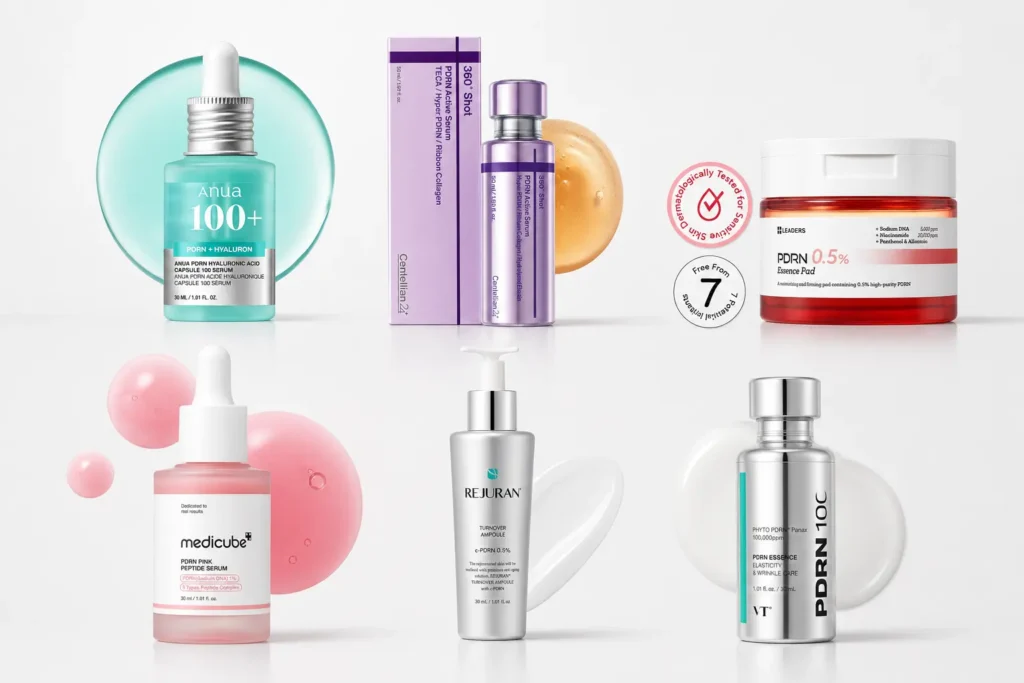
A PDRN product will not succeed simply because it contains PDRN.
Open any beauty marketplace, walk through a trade show, or scroll through a few TikToks and the pattern is familiar: clear dropper bottles, gel textures, PDRN + hyaluronic acid, and repair or anti-aging positioning. The formulas often look similar, the visual language is converging, and consumers have little reason to trust one product over another when they all look the same.
The market does not need more PDRN products. It needs PDRN products that look different at first glance, feel different on first use, and give the brand a clear story to tell.
What determines whether a PDRN product can compete is not the ingredient alone, but six connected decisions: visual hook → format innovation → immediate sensory feedback → a PDRN + X story consumers can understand → substantiated claims → stable manufacturing and commercial scale-up.
6-Step Development Logic
From concept idea to a product that can actually launch
Instead of showing the six stages as a thin horizontal timeline, this layout turns them into clearer decision cards. Each step answers one key question in the development process.
01
Why will consumers notice it?
Build a product look that catches attention on shelf, in short-form video, and on product detail pages.
02
Why will consumers want to try it?
Choose a format that creates a stronger experience than just another standard PDRN serum.
03
Does it deliver in the first 10 seconds?
Engineer the texture, absorption, finish, and comfort so the first use immediately feels convincing.
04
Why will consumers believe the story?
Pair PDRN with supporting actives that make sense for a real consumer need and a clear product position.
05
What does the brand want to claim?
Define market-facing claims early, then align the formula and test plan to support them responsibly.
06
Can it be manufactured consistently?
Validate raw material quality, formulation stability, packaging fit, and scale-up readiness before launch.
Module 01
Design the Visual Hook Before You Finalize the Formula
Many teams follow the same sequence: define the benefit direction, build the formula, then hand it to design and ask for packaging. For a PDRN product, that sequence can work against you.
Consumers see the product before they understand the ingredient story. On TikTok, Instagram, e-commerce product pages, short-form video, and trade-show displays, the product itself has to work as content. If the formula has no memorable visual identity and the packaging has no story, even a strong formulation can disappear in the feed.
- Signature appearance: soft pink tones, a milky dewy look, or a translucent water-gel texture can turn the formula itself into a recognizable brand asset
- Bi-phase / oil beads / microcapsules / burst beads: the shake, burst, and mix moment can become short-form content in its own right
- Packaging as part of the story: ampoules, single-dose packs, airless pumps, dual-chamber systems, or freeze-dried powder + activator can shape the first impression of professionalism and value
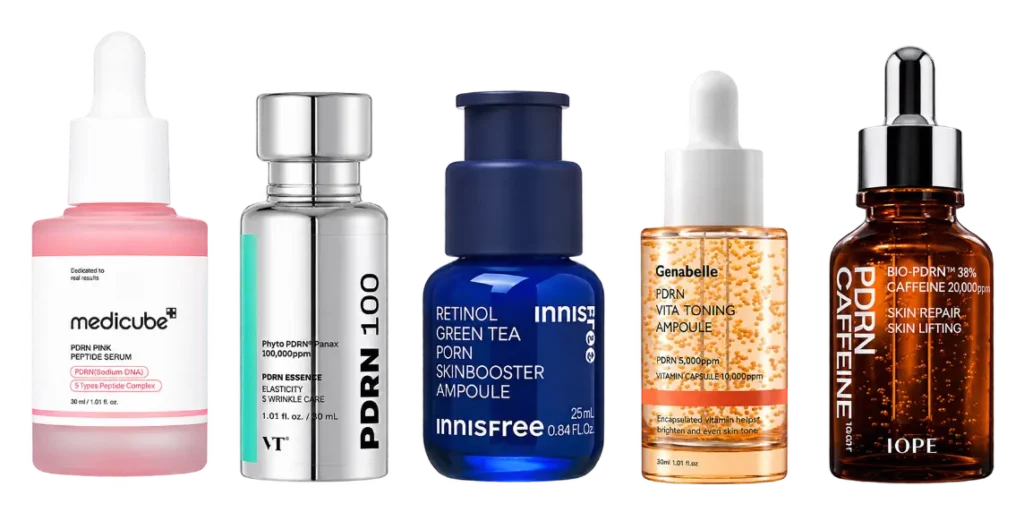
Even for the same product, the visual impression it brings to users can vary greatly.
Important: Avoid unsupported medical implications. Do not casually use terms such as “sterile,” “medical grade,” “injectable grade,” “aesthetic-medicine equivalent,” or “skin-booster equivalent” unless they are properly substantiated and legally appropriate.
Module 02
Make the Product Format Part of the Value Proposition
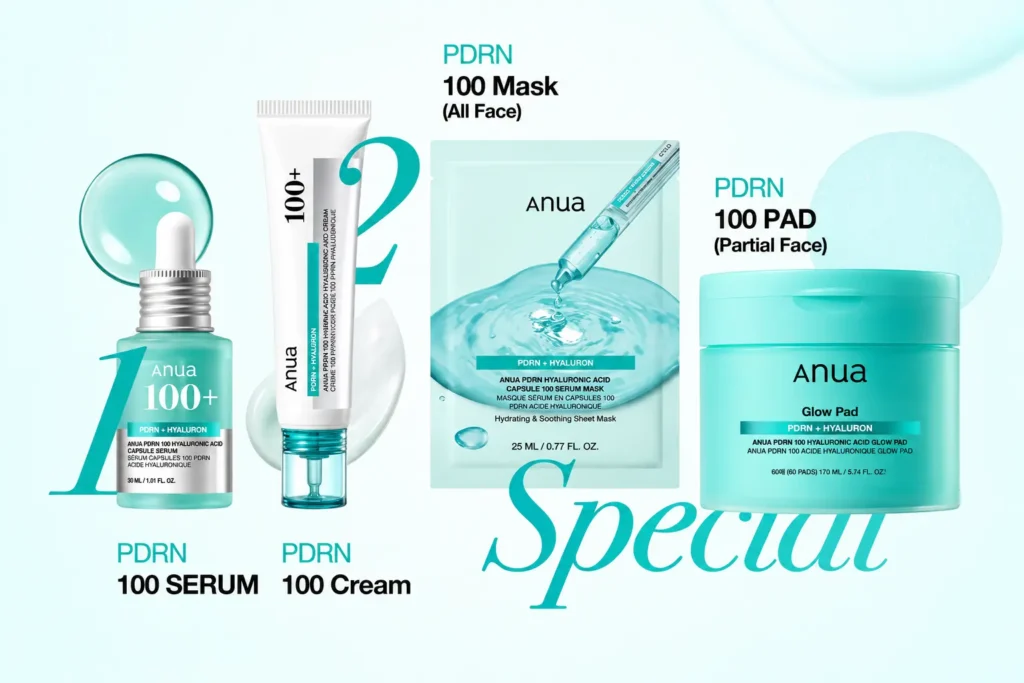
PDRN can be developed into a complete product line.
Format innovation is not only formulation innovation; it is marketing innovation.
The market is not short of standard PDRN serums. Format innovation can move a product away from direct price comparison and give it a clearer reason to exist. Consumers are no longer choosing “another PDRN serum”; they are choosing a distinct PDRN experience.
- Freeze-dried powder + activator/diluent: a fresh-mix concept creates ritual and visual differentiation. When sensitive components benefit from separation, freeze-dried or compartmentalized formats can also create additional formulation options
- Dissolving patches / microstructured patches: an innovation route that should remain within cosmetic product positioning; avoid claims such as “solves transdermal delivery” or “reaches the dermis”
- Device-compatible concepts: PDRN device gels, LED-paired serums, or gels designed for home beauty devices can create a clear “device + skincare” usage scenario
- Transforming textures: gel-to-water, cream-to-water, or capsule-to-serum transformations make the physical experience part of the product memory
For more technical guidance on developing different PDRN product formats, see our PDRN serum, cream, mask, toner and ampoule formulation guide.
Module 03
Design the First 10 Seconds of Sensory Feedback
Strong long-term efficacy cannot compensate for a poor first-use experience. Before consumers can evaluate longer-term results, they notice tackiness, heaviness, absorption speed, pilling, makeup compatibility, immediate glow, and overall comfort.
Sensory performance is part of product trust. If the first 10 seconds feel wrong, consumers may never give the product enough time to demonstrate longer-term benefits.
- Break the “high active load = high tack” assumption: use humectant balance, polymer-load optimization, and rheology tuning to deliver a high-performance feel without excessive tack
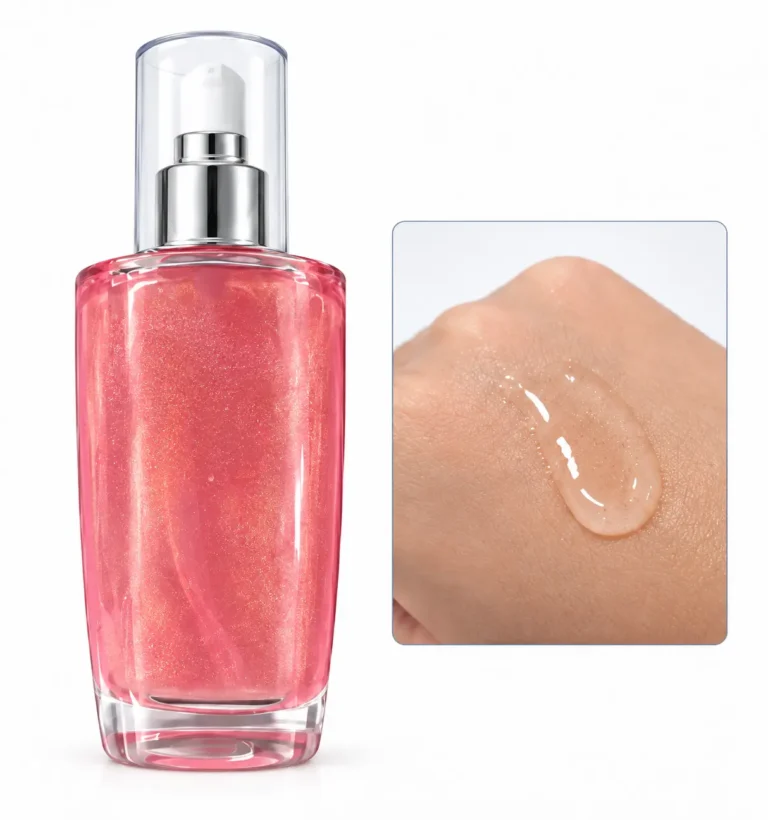
- Texture transformation: gel → watery, cream → silky, microcapsule → serum; the physical transition creates an immediate sense that the product is different
- Immediate finish: glass-skin finish, hydrated glow, or a soft reflective finish can make the first-use difference visible
Module 04
Build a PDRN + X Story Consumers Understand Instantly
A successful PDRN formula does not need a long ingredient list. It needs a combination consumers can understand in seconds.
Once the PDRN source and grade are defined, build the supporting active system around one clear consumer need.For evidence-led premium and K-beauty-inspired concepts, salmon-derived Sodium DNA remains one of the most established routes.If the PDRN source has not yet been decided, compare the different PDRN source routes before locking the product concept.
Once the PDRN source and grade are defined, build the supporting active system around one clear consumer need.For evidence-led premium and K-beauty-inspired concepts, salmon-derived Sodium DNA remains one of the most established routes.If the PDRN source has not yet been decided, compare the different PDRN source routes before locking the product concept.
01
PDRN + Barrier Support
- Pairing: PDRN + Panthenol + Ceramides / Ectoin
- Consumer need: Dryness, tightness, and a compromised-feeling skin barrier
- Product direction: Soothing serums, recovery creams, and barrier-support formulas for dry or sensitive-feeling skin
02
PDRN + Anti-Aging
- Pairing: PDRN + Peptides + Niacinamide
- Consumer need: Fine lines, loss of elasticity, and dull-looking skin
- Product direction: Premium serums, ampoules, eye-care products, and intensive anti-aging treatments
03
PDRN + Retinoid Routine
- Pairing: PDRN + Panthenol / Ectoin / Hyaluronic Acid
- Consumer need: Dryness and tightness associated with high-activity skincare routines
- Product direction: Hydrating and comfort-focused companion products designed to fit into retinoid skincare routines
One Formula, One Clear Story
Do not try to make one PDRN product solve every skin concern.
Choose one primary consumer problem, build the supporting ingredient system around it, and make that story visible in the product name, packaging, texture, claims, and campaign content.
The easier the concept is to understand, the easier it is to market.
Module 05
Design the Claim First, Then Build the Test Plan Backward
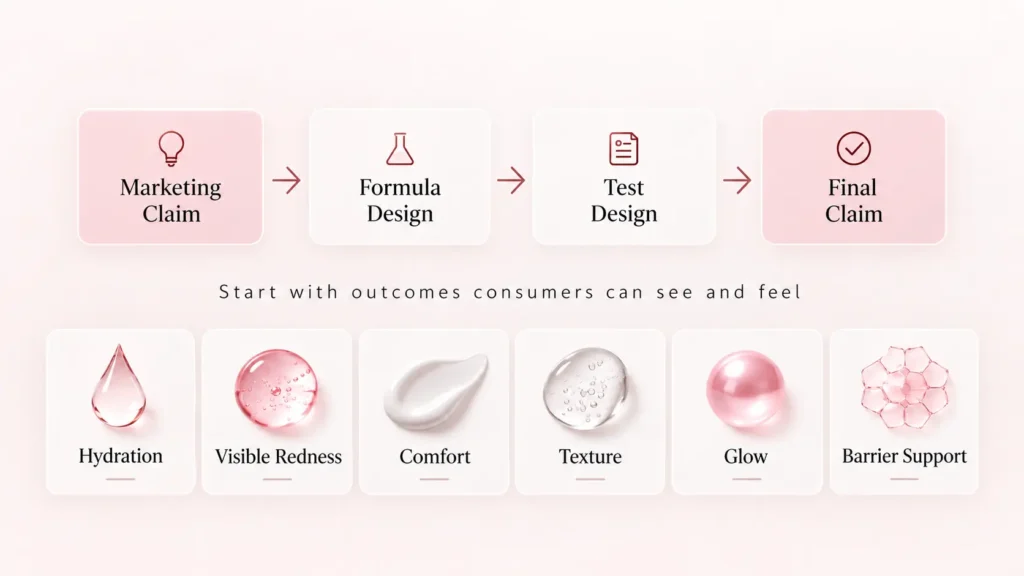
Example: “Visible improvement in redness in 15 minutes” can be used as a development target, but it should only become a formal marketing claim after appropriate finished-product testing supports it. Do not invent percentages or time-to-result figures.
This is one of the most common sequencing mistakes. Teams finish the formula first and only then ask, “What can we claim?” The result is often a list of broad phrases such as “cell regeneration,” “dermal remodeling,” “deep repair,” or “DNA repair.” These claims can be difficult for consumers to perceive, weak at differentiating the product, and more challenging from a compliance perspective.
A better sequence is: Marketing Claim → Formula Design → Test Design → Final Claim
Start with outcomes that are observable, perceivable, and testable:
- Hydration — Does the skin feel more hydrated?
- Visible Redness — Does the skin look calmer?
- Comfort — Are feelings of tightness and dryness reduced?
- Texture — Does the skin feel smoother to the touch?
- Glow — Does the skin look more radiant?
- Barrier Support — Does the skin feel more comfortable and resilient?
Module 06
Turn the Marketing Concept into a Product That Can Actually Be Manufactured
A concept can look excellent on a slide, but if the raw material is unstable, batches are inconsistent, dissolution is poor, the formula precipitates, color drifts, microbiological control is weak, packaging is incompatible, or scale-up fails, it is not a commercial product. It is only a slide-deck concept.
01
Raw Material Consistency
Can the PDRN deliver the same quality from batch to batch?
Focus on identity, molecular characteristics, purity, microbiological control, and supporting documentation.
For a step-by-step raw-material assessment, use our PDRN Quality Guide to review assay, molecular characteristics, hyperchromicity, impurity control, and batch consistency.
02
Formula Compatibility
Can the ingredient work reliably in the actual formula and process?
Confirm dissolution, pH and temperature compatibility, preservation, and physical stability before the concept is locked.
03
Scale-Up Reality
Will the product still perform when you move from lab sample to commercial production?
Pilot batches should confirm stability, packaging compatibility, microbiological safety, and manufacturing repeatability.
Core Takeaway
Do not finalize the marketing story first and solve the technical problems later.
The strongest PDRN concepts are developed with positioning, formulation, and manufacturing feasibility moving together from the beginning.
Ready to evaluate the raw material itself? Review our Sodium DNA (PDRN) product specification and commercial supply information.
Compare Before You Decide
Have a PDRN Product Idea? Validate Whether It Can Actually Be Manufactured.
You may already have the concept—a serum, ampoule, cream, mask, dual-chamber pack, freeze-dried format, or device-compatible gel. The next step is not immediate production. It is to confirm that the concept is feasible at the raw-material, formulation, and manufacturing levels.
Frequently Asked Questions
Common PDRN Product Development Questions
- Does a PDRN product have to be a serum?
No. Serums are currently the most common format, which also makes them one of the most crowded. Creams, lotions, masks, ampoules, eye products, and device-compatible gels can all create useful differentiation. The format should match your target channel, consumer habits, and product story—not simply what other brands are already doing.
- How can a PDRN product avoid looking like everything else?
Work backward from the visual hook. Before finalizing the formula, ask what a consumer will notice in the first half-second of a TikTok or product-page scroll. If the answer is “another clear dropper bottle,” reconsider the concept. Distinctive formats, texture transformation, and packaging ritual can help move the product away from direct price comparison.
- Should you decide on the product format or the ingredient pairing first?
They should be developed in parallel, but a practical sequence helps: first define what you want consumers to perceive—sensory feel, visual impact, or usage ritual. Then confirm that the format can deliver that experience, and finally verify that the ingredient-pairing logic can remain stable in the chosen system. Reversing the sequence often produces either a technically sound formula consumers do not notice or an attractive concept that cannot be formulated reliably.
- Does a higher PDRN use level automatically mean a better product?
No. Use level has to be balanced against the formula system, stability, sensory performance, cost, and claim strategy. In some systems, an unnecessarily high PDRN level may create viscosity issues, compatibility problems, or an unsustainable cost structure. What matters is that the ingredient is present at an appropriate level in a stable, workable formulation—not simply that the number is higher.
- Which ingredients can be paired with PDRN in a product concept?
Common, easy-to-understand directions include barrier support with panthenol, ceramides, or ectoin; anti-aging support with peptides or niacinamide; hydration systems using combinations of hyaluronic acid; and routine-support concepts designed around retinoid use. Every pairing should follow a clear consumer need → solution logic → product positioning pathway rather than simply stacking popular actives.
- When should stability testing begin?
As early as practical. Preliminary compatibility work and short-term stability observation can begin during proof of concept. Formal accelerated and real-time stability programs should start once the formula is substantially defined—not after packaging design and the marketing plan are already complete.