Some spicule products tell the consumer to shake the bottle. That instruction is a formulation decision, not a usage tip.
Quick comparison: which format to choose
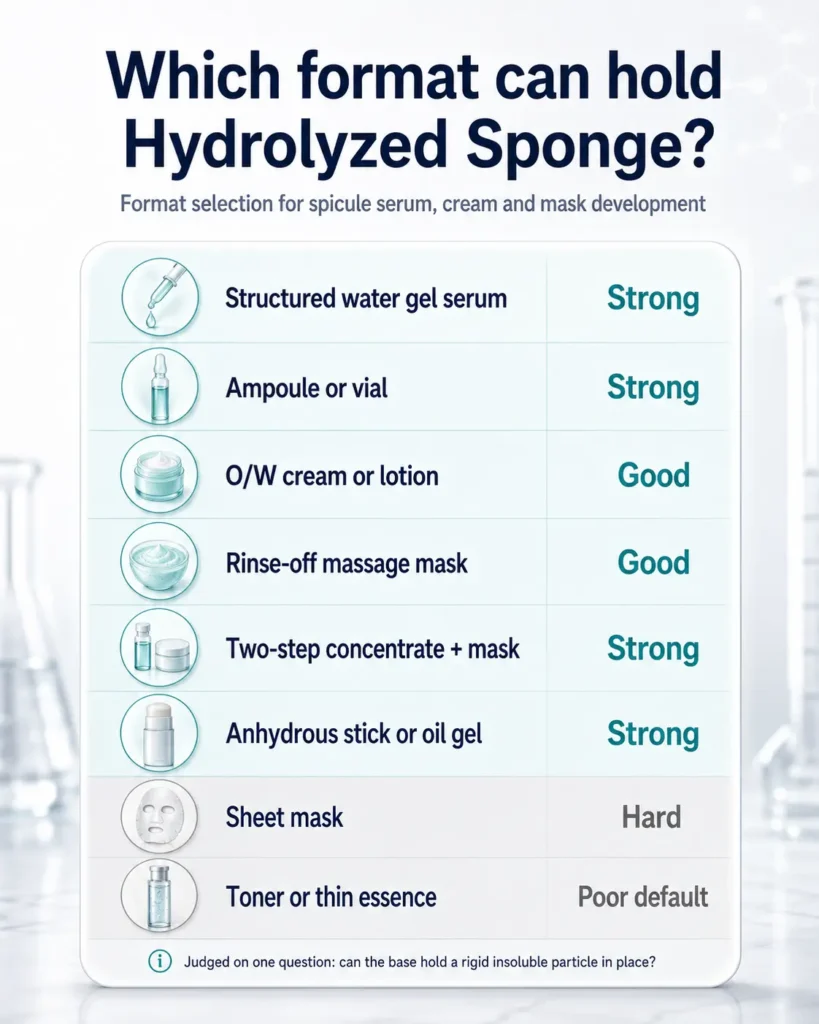
Build a rinse-off massage mask or a structured water gel serum first, because both can be given real suspension structure; a thin toner-style essence is the weakest starting point, and a sheet mask is possible but needs two engineering answers rather than one.
Hydrolyzed Sponge is not a soluble active. It is a rigid, insoluble particulate, and the format’s first job is mechanical — hold it evenly in place from filling through to the last dose. That constraint decides more than dose, sensory or cost does.
| Format | Suitability | Main challenge |
|---|---|---|
| Structured water gel serum | Strong | Suspension — yield stress, not viscosity |
| Ampoule or vial | Strong | Dose uniformity per unit, more than shelf settling |
| O/W cream or lotion | Good | Distribution at cool-down, and sensory on rub-out |
| Rinse-off massage mask | Good, and the easiest first build | Massage protocol and rinse instruction |
| Sheet mask | Possible, but the hardest | Suspension and transfer from the nonwoven |
| Toner or thin essence | Poor default | Sedimentation, with no massage step to recover it |
| Two-step: concentrate + mask | Strong alternative | Packaging cost and one extra consumer step |
| Anhydrous stick, balm or oil gel | Strong and underused | Sensory on an oil-continuous base |
Why the format decides more than the dose
Because none of this material goes into solution, so every format has to answer the same mechanical question before it answers anything else.
The two standard grades measure 200–280 µm long and 15–16 µm across; the long-needle grade measures 350–450 µm at the same diameter. Those are rods with an aspect ratio somewhere between about 13 and 30, not spheres — and as rigid insoluble particulates they settle in any base that is not structured enough to hold them.
Nothing about that changes with the format. What changes is whether the base can be given the structure to resist it, and whether the application step helps or works against you. Both are decisions you can make on paper before the first trial batch.
Why a thick serum can still settle
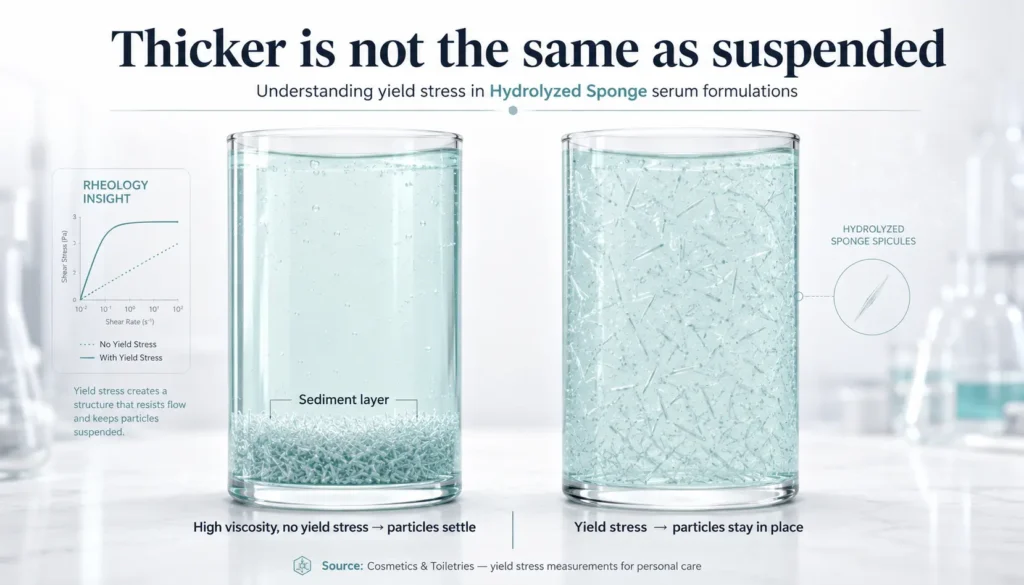
Because thickness and suspension are different properties: viscosity slows a particle down, and yield stress is what actually stops it.
Cosmetics & Toiletries puts it directly: “increased viscosity only causes longer settling times, it does not impart true suspension.” Yield stress is the threshold below which a material behaves as a solid rather than a liquid, and it is the variable to design against. The same article gives a worked example — 1.7 Pa of yield stress suspended jojoba ester beads of 250–400 µm at a specific gravity of 0.907.
That number is a good demonstration and a poor target. Those beads were spheres, and they creamed upwards. Spicules are rods, and they settle downwards. Different shape, opposite direction, different drag — the yield stress that held one tells you nothing reliable about the other. Measure the yield stress of your own base, then test settling on the finished formula in the finished pack. No supplier can hand you a number that replaces that step, and any who offers one is guessing.
Which rheology modifiers deliver yield stress rather than viscosity alone is the practical question, and the trade literature splits them cleanly. Clays — magnesium aluminum silicate, bentonite, hectorite — give “high yield value and good suspension properties” and are the standard choice in masks. Associative and modified-acrylate polymers build a network that holds at rest and breaks under shear, described as suited to “suspending actives, preventing sedimentation, and resisting sag”. Xanthan gum is credited with “good suspending properties”. Cellulose derivatives are the cautionary case: HEC and HPMC are “straightforward viscosity builders” that “lack the suspension performance of anionic systems with a defined yield stress” — so a base thickened with HEC alone can feel exactly right and still settle.
Published thickening levels are a starting point, not a suspension specification: carbomer around 0.1–0.5%, xanthan typically 1–2%. Those figures come from general rheology guidance rather than from any spicule formulation, so treat them as where to begin. Depending on particle loading and the rest of the system, you may need to work towards the upper end of a range or combine modifiers — and the finished formula still has to be measured and tested.
What “shake before use” tells you
It tells you the yield stress does not hold the particles, and that the remedy was moved to the consumer.
Some commercial spicule formulas say so openly. One brand instructs: “Always shake before use. Spicules can settle at the bottom of the bottle — you need them evenly suspended in the formula.” That is honest, and it is a legitimate choice. It also has costs that land after launch rather than before it:
- The first dose and the last dose are not the same product, whatever the label says.
- The consumer who forgets gets a weak application, then a heavy one.
- Sediment visible through the pack reads as instability to a retailer’s QA reviewer, whether or not it is.
Whether you accept those costs is a positioning decision. What is worth avoiding is accepting them by default, because the base felt thick enough and nobody measured.
Serum and ampoule
Both work, and the difference between them is which failure you have to design out.
A structured water gel serum is the category’s natural format, and a neutralised carbomer or modified-acrylate network can carry real yield stress at a pourable viscosity. Add the pre-wetted spicules once the gel structure has formed and mix gently — the checks that matter are in the test list below.
An ampoule or vial uses the same chemistry, but the fill volume changes what matters. A single vial is a single dose, so consistency between units outranks shelf settling: check fill uniformity across a production run, sampling early, middle and late. A suspension that holds in a lab batch can stratify in a hopper.
Cream and lotion
An O/W emulsion is the most forgiving leave-on route, because the base is already a structured system and much of the suspension work is done before you add anything.
Two things to watch. Cool-down addition is the safer starting approach, because it puts the spicules into a structure that has already formed; if your process needs heating or high shear afterwards, re-check spicule integrity, distribution and finished rheology rather than assuming they survived it. Then check sensory on rub-out: an emulsion carries more drag than a gel, and that drag combined with a rigid particulate can read as pilling or roughness rather than as the intended texture. That is a formulation outcome, not a grade problem, and it is cheaper to find early.
Mask formats: rinse-off, sheet mask and two-step
A rinse-off massage mask is the easiest mask route, a sheet mask is the hardest and has been done anyway, and a two-step system avoids the problem by keeping the spicules out of the essence entirely.
Rinse-off massage mask. High viscosity, clay-type suspension, short contact, and the product is removed. It is the most forgiving format on this material and the sensible first build. Define the massage protocol and the rinse instruction, and test tolerance on the finished mask.
Sheet mask. The difficulty is real and it is double — the essence has to be thin enough to saturate the nonwoven and release from it, which limits how much yield stress you can build, and the fabric then sits between the particles and the skin. It is not impossible, and the market shows how it was solved. DARLING’s TINGLE TREAT sheet mask carries Hydrolyzed Sponge alongside Carbomer and Ammonium Acryloyldimethyltaurate/VP Copolymer, with Cetearyl Olivate, Sorbitan Olivate and Glyceryl Stearate in the same list — that is a structured emulsion-type essence rather than a thin one — and the instruction is to gently massage the mask into your skin during wear. Two answers in one product: build the yield stress into an emulsion essence, and make transfer active rather than passive.
If a sheet mask is on your plan, those are the two levers. What does not work is a conventional low-viscosity essence with no massage step.
Two-step: concentrate plus mask. Put the spicules in a small structured concentrate applied first, then follow with a sheet or hydrogel mask carrying everything else. Sarah Chapman’s Spicule Collagen Infusion Mask is built this way, with the spicules in the concentrate at a disclosed 3,000 ppm. The suspension problem shrinks to a few millilitres of a base you fully control, and neither step has to do two incompatible jobs.
Developing a spicule serum, cream or mask? Tell us the format, the target market and the sensory level you are aiming at, and we will recommend a grade — and put a sample in the post.
Formats that reduce the suspension problem instead of solving it
Two routes make the question much smaller, and both are underused in this category.
Anhydrous systems. A stick, a balm or an oil gel can be structured with waxes, fatty alcohols or an oil-phase rheology modifier such as fumed silica to give high resistance to particle movement at rest — which is a different and often easier problem than suspending in water. It is not automatic: an unstructured oil is no better than an unstructured gel, so the structure still has to be built and verified. The trade-off is sensory, because an oil-continuous base changes how a rigid particulate feels on rub-out.
Powder kept dry until use. A two-part kit or a capsule cannot settle, because there is nothing for the powder to settle in. It also lets you dose precisely, which a suspended system never quite guarantees, and it removes shelf-life questions about the suspension itself. The costs are packaging and asking the consumer to do one more thing.
For a brand that wants a spicule product without inheriting a rheology project, changing the format is faster than changing the thickener.
Filling and packaging
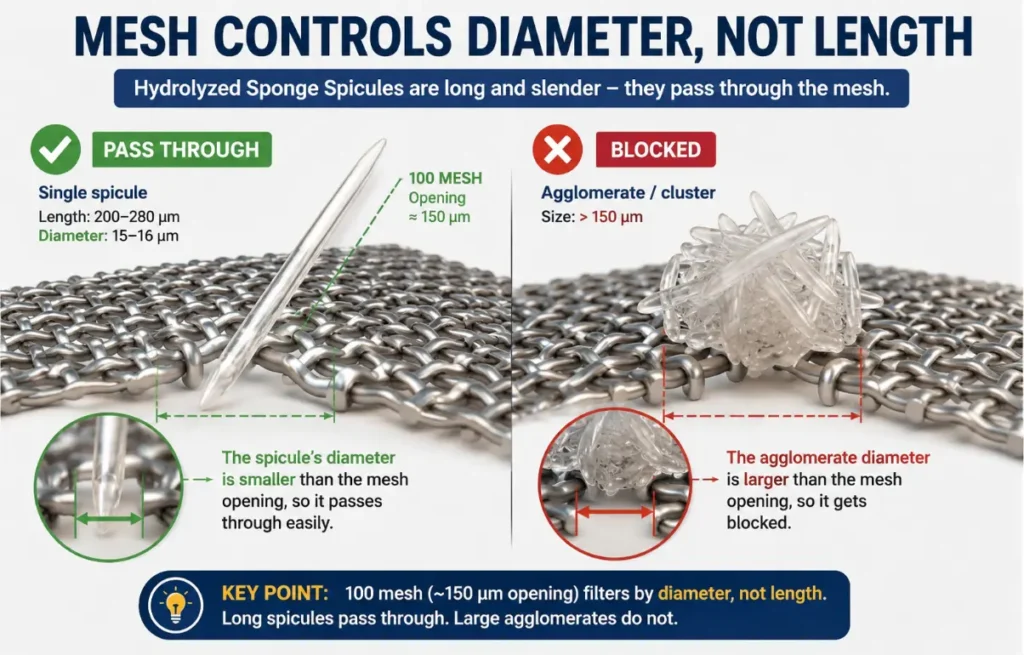
The risk on a filling line is not the length of an individual spicule — it is agglomerates, and they form during dispersion rather than during filling.
The geometry is less alarming than it looks. These grades are specified as 95% passing 100–180 mesh, and a 100-mesh aperture is roughly 150 µm, shorter than the needles themselves. They pass because a rod goes through lengthwise. Mesh constrains the diameter, not the length — 15–16 µm here — which is why a mesh figure can never be read as a length specification, and why a 200–280 µm needle travels through a pump orifice or a dropper without difficulty.
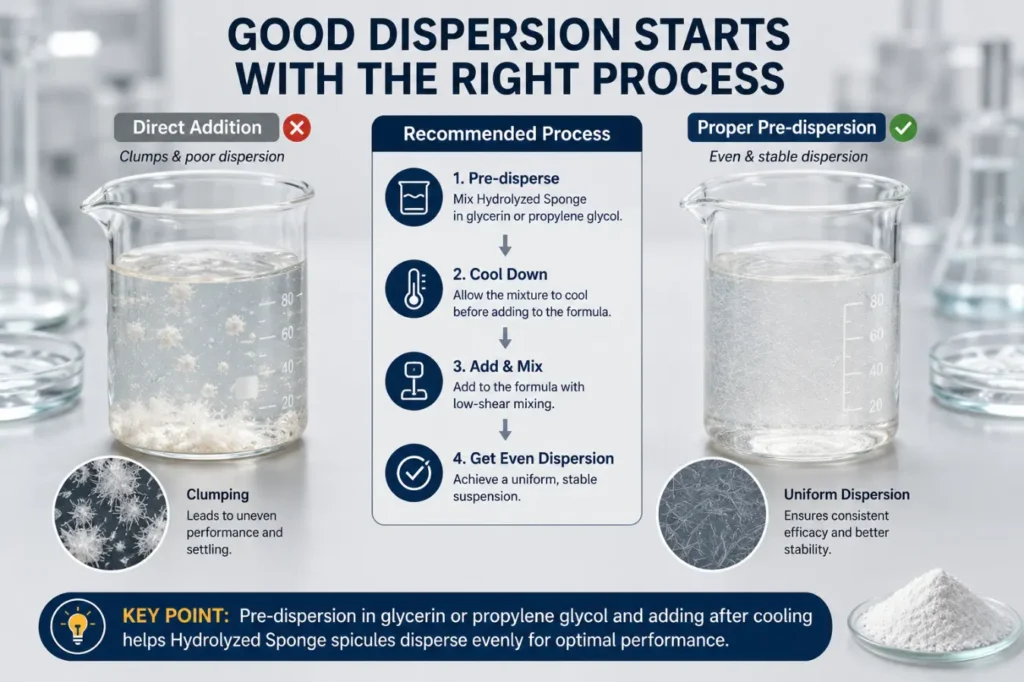
A clump of poorly wetted powder is a different object. It behaves as one large particle, it blocks small orifices, and it cannot be broken up later: homogenisation would fracture the spicules and destroy the length distribution the grade was chosen for. That is why pre-wetting into glycerin or a compatible glycol is not an optional refinement.
Three checks belong on a production line rather than a bench:
- Fill uniformity across a full run, sampling early, middle and late.
- Wear on elastomer seals and piston fillers, within a run and between runs. This is a hard mineral particle in contact with moving parts.
- The pack’s own behaviour. A clear dropper bottle displays sediment to the customer; a jar hides it but invites contamination.
An airless system is worth deciding on deliberately rather than by habit. If your formula needs shaking to redisperse, an airless pump removes the user’s ability to do it — so validate redispersion in the actual pack before committing. This is a combination to test, not a rule: one published spicule-essence study filled its formulation into sterile air-tight airless containers. That study examined an encapsulated system and its outcomes do not read across to this raw material; it is cited here only for the packaging choice.
Choosing the grade
Match the grade to how the product is applied and how long it stays on, not to how strong you want the product to feel.
| Format and use pattern | Grade |
|---|---|
| Rinse-off mask, professional treatment under a defined protocol | Hydrolyzed Sponge 99 (Long Needle), 350–450 µm |
| Daily home-care serum, ampoule or cream | Hydrolyzed Sponge 99 (Standard Needle), 200–280 µm |
| Cost-led or entry-level home care | Hydrolyzed Sponge 97 (Standard Needle), 200–280 µm |
The two Standard grades share an identical length band. Buyers regularly assume 97% means a shorter or milder needle; it does not — the needle is the same, and what differs is purity and the document set. To make a product gentler, change the dose, the base or the application instruction, not the purity figure. The full grade-by-grade comparison is in which grade to quote.
How much to use
Treat 0.1–2.0% as a supplier reference range — a formulation starting range, not an evidence-based efficacy or safety concentration — and start in the lower half for any leave-on format.
Three public levels are worth knowing, and read together they make the point of this whole article: the level tracks the format.
| Disclosed level | Format it sits in |
|---|---|
| 3,000 ppm (0.3%) | A spicule concentrate in a two-step mask system, applied then followed by a mask |
| 1% | A finished gel, assessed on 30 volunteers over 14 days with no adverse skin reactions recorded |
| 3.5% | A marketed two-phase serum, where the spicule layer is a separate phase the user shakes to combine |
The 1% figure is ours and it has one study behind it — one gel, one concentration, one panel, no control arm — so it supports a statement about that gel rather than a use level for the raw material. The 0.3% and 3.5% figures are other companies’ disclosures on their own products; the 3.5% material is a branded spicule complex rather than a like-for-like grade, so read it as a format signal, not a target.
The pattern is the useful part. A two-phase system that is shaken before every use can carry several times what a leave-on gel can, because the sensory ceiling and the suspension problem are both handled differently. So start in the lower half of the range for a leave-on serum or cream used daily and unsupervised, the upper half for a rinse-off mask that is massaged and removed, and let a professional treatment be set by its protocol. Dispersion quality matters as much as the number — a poorly wetted 0.5% behaves worse than a well-dispersed 1%, and the four-step dispersion process is where that is decided.
What to test before you scale up
Test the finished formula in the finished pack, because suspension is a property of the whole system and a beaker sample will pass tests the filled bottle fails.
A screening sequence we would suggest, ordered to catch problems earliest:
- Yield stress of the base, before the spicules go in. This is the design variable, and measuring it once tells you more than three trial batches.
- Settling in the actual pack, upright and inverted, at ambient and after temperature cycling.
- Top-versus-bottom uniformity on a filled unit, quantified rather than eyeballed.
- Redispersibility after storage — and if the formula needs redispersing, revisit the pack choice before shipping it.
- Tolerance on the finished formula, with application instructions and use frequency defined, plus patch-test guidance where appropriate.
Fill uniformity across a production run belongs on this list too; it is covered under filling above rather than repeated here.
Before you request a sample
Four things decide which grade anyone should quote you, and three of them are about your product rather than about the material.
- What format are you developing, and is it leave-on or rinse-off? This sets the grade before anything else does, because contact time and supervision are what the length band has to match.
- What suspension system does your base already use? A carbomer or acrylate gel, a clay-thickened mask and a cellulose-thickened base are three different starting positions, and the third one needs work before spicules go anywhere near it.
- What packaging and sensory target are you working to? A clear dropper, an airless pump and a sachet impose different constraints, and the sensory ceiling is what usually caps the dose.
- Is there a reference formula for that format, and whose formula is it? A reference formula from a manufacturer’s technical documentation is useful; one with no stated origin is not. Ask which rheology modifier class it uses and at what level, not just its target viscosity.
For purity, needle length band, mesh, and how to read a COA or TDS, the grade guide covers it in detail — those questions belong to grade selection rather than to format selection.
So: what to build first
If you have not made a spicule product before, build the rinse-off massage mask. It is the most forgiving base to suspend in, the contact time is short, the product is removed, and it lets you learn the sensory range on this material before committing it to a leave-on hero. Then move to a structured gel serum with the yield stress designed rather than discovered. A sheet mask is achievable, but plan for a structured emulsion essence and an in-wear massage step from the start rather than as a rescue. And if you want a spicule product without a rheology project attached, look at a two-step kit or an anhydrous format.
Noyain supplies Hydrolyzed Sponge in three grades from stock in Guangzhou, with lot-specific documentation. Tell us what you are building and we will send a free 2–3 g sample of the grade that fits, dispatched within three working days, with the current COA and TDS. Specifications are on the Hydrolyzed Sponge product page.
Frequently asked questions
Can I put Hydrolyzed Sponge in a sheet mask?
Yes, but it is the hardest format and it needs two things at once. The essence has to be structured enough to hold the particles while still saturating and releasing from the nonwoven, which in practice means an emulsion-type essence rather than a thin one, and the mask needs an in-wear massage step so transfer is active rather than passive. Marketed sheet masks containing Hydrolyzed Sponge do exactly that. A conventional low-viscosity essence with no massage step does not work.
Why do spicules settle even in a thick gel?
Because thickness and suspension are different properties. Viscosity slows settling; yield stress is what stops it, and a base can be thick without much of one. Cellulose thickeners such as HEC are the classic case — they build viscosity through chain entanglement but lack the defined yield stress that holds a dense particle. Measure yield stress on the base and treat viscosity as a sensory decision.
Which grade should I use in a serum?
For a daily home-care serum, Hydrolyzed Sponge 99 (Standard Needle) at 200–280 µm is the sensible default. The long-needle grade at 350–450 µm suits rinse-off and professional formats where contact time is controlled and the product is removed. The 97% Standard grade shares the same 200–280 µm band as the 99% Standard, so choose between those two on purity and documentation rather than on needle length.
How do I add Hydrolyzed Sponge to a formula?
Pre-wet the powder into glycerin or a compatible glycol before it goes near the batch, add the slurry once the gel or emulsion structure has formed and the temperature has dropped, and mix only enough to distribute it. Strong shear fractures spicules and changes the length distribution the grade was chosen for, and agglomerates cannot be homogenised out later — which is why the wetting step is where the outcome is decided. The full sequence is in our guide to Hydrolyzed Sponge.
References
Rheology and suspension
- Cosmetics & Toiletries — Yield Stress Measurements for Personal Care, Part I: Definitions and Basics. Source of the statement that viscosity alone does not impart suspension, and of the 1.7 Pa jojoba-bead example.
- Safic-Alcan — Rheology Modifiers in Cosmetics: Types, Uses and Selection Guide. Source of the clay, associative-polymer and cellulose-derivative characterisations.
- Safic-Alcan — Natural Carbomer Alternatives: Xanthan, Sclerotium Gum. Source of the xanthan suspension note and the published thickening levels.
Marketed formats, read 10 August 2026
- DARLING — TINGLE TREAT sheet mask. A structured emulsion-type sheet mask essence containing Hydrolyzed Sponge, with an in-wear massage instruction; source of the ingredient list quoted above.
- Sarah Chapman — Spicule Collagen Infusion Mask. A two-step concentrate-plus-mask system; source of the disclosed 3,000 ppm spicule level.
- Ecoori — Spicule 2 Phase Serum. A marketed two-phase serum listing its branded spicule complex at 3.5%; a different material from the grades discussed here, cited as a format signal only.
- Boldpurity — What Are Spicules. Source of the “always shake before use” instruction.
- Nano-Encapsulated Spicule System, PMC12564063. Cited only for its packaging choice — the formulation was filled into sterile air-tight airless containers. It studied an encapsulated system, and its outcomes do not read across to this raw material.
Standards referenced on the grade specifications
- GB 25576-2020, National food safety standard — Food additive silicon dioxide (loss on ignition method used for these grades).
- GB/T 6284-2006, Chemical products for industrial use — General method for determination of water content — Loss of mass on drying method.