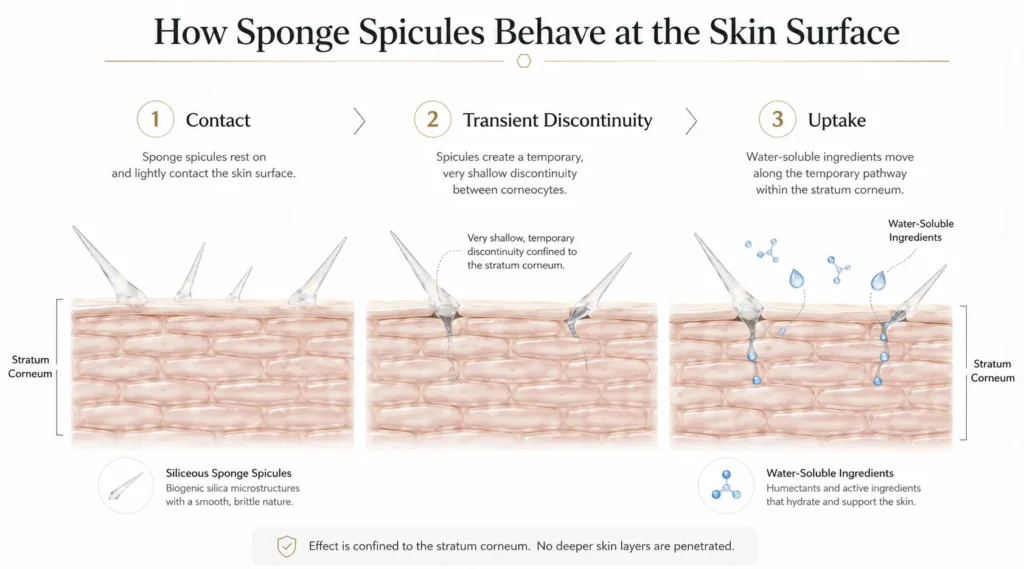
A sponge is an animal. The confusing part is that its spicules are made of glass.
Quick answer: is Hydrolyzed Sponge vegan?
No. Sponges are animals, so Hydrolyzed Sponge is an animal-derived material and a formula containing it should not carry a vegan claim.
That is the short version, and it is not the useful part. The useful part is why this question keeps getting answered wrongly — including by suppliers — and what you can put on a label instead.
This article covers origin, claims and certification. For what the material is and how the spicules behave at the skin surface, start with our guide to what Hydrolyzed Sponge is.
Why sponges are animals, not plants
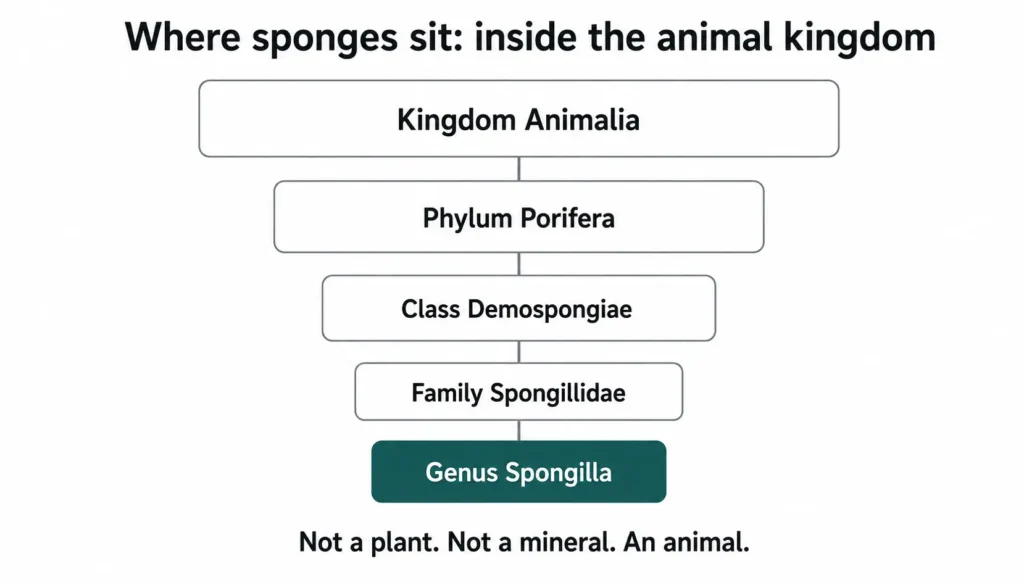
Because they belong to the phylum Porifera, which sits inside the animal kingdom alongside every other animal.
They have no leaves, no roots and no chlorophyll. They filter water for food. The absence of a nervous system and the fact that they do not move as adults makes them read as plant-like, and that is where the intuition goes wrong.
The material we supply is documented as Spongilla fragilis or Spongilla lacustris, both freshwater sponges in the family Spongillidae, class Demospongiae, phylum Porifera. GBIF catalogues Spongilla lacustris as the common freshwater sponge, described by Linnaeus in 1759.
Confirm the species against the batch you are buying rather than taking it from a general statement — good practice with any biologically sourced material, and we request batch confirmation alongside your sample as a matter of course.
The silica confusion, and why chemistry is not the test
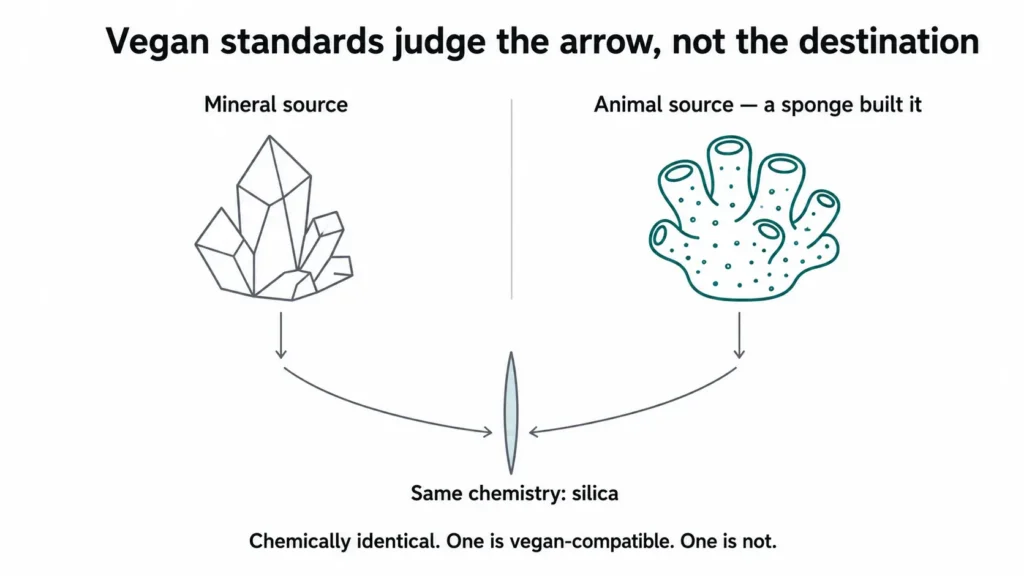
Spicules are made of biogenic silica — chemically the same family of material as mineral silica — and that fact does not make the ingredient non-animal.
This is where most of the wrong answers come from. A formulator reads the specification, sees an inorganic profile throughout, and reasons that a silica needle cannot be an animal product. The reasoning is chemically sensible and completely beside the point.
Vegan standards judge origin, not composition. They ask what the material came from, not what it is made of. Biogenic silica is silica that an animal built. Beeswax is a useful comparison: chemically it is esters and hydrocarbons, nothing exotic, and it is still an animal product because a bee made it.
Three consequences follow, and they explain the pattern of when this goes wrong:
Suppliers mislabel it in good faith. Reasoning from the chemistry gets you to “mineral”, and “mineral” gets you to “vegan”. You will see spicule powder described as vegan on supplier pages. It is wrong, but it is not usually dishonest.
Your R&D team cannot catch it from the specification. Nothing on a COA or TDS for this material says “animal”. The identity is in the origin statement and the INCI name, not in the technical parameters.
So it surfaces late. Not at formulation, not at sampling, but at regulatory filing or a retailer’s ingredient audit — after the formula is locked and the packaging is designed. We have had buyers come back to us after a vegan claim was challenged downstream, which is a slower and more expensive place to find out.
What the composition sheet actually declares
Every line on it carries an origin of “Sponge” — including the components that are not spicules.
The 97% grade’s composition sheet lists Hydrolyzed Sponge plus calcium silicate and sodium silicate, and the origin column reads Sponge for all three. The 99% grades declare Hydrolyzed Sponge with the small balance described in the technical data sheet as water.
That matters for one specific argument a brand sometimes tries: that the non-spicule fraction is mineral filler and therefore neutral. On the document that would support such an argument, it is not neutral. There is no line in the declaration that sits outside the animal origin.
If your regulatory team builds the ingredient declaration from the supplier composition sheet, ask for that sheet by name and read the origin column, not just the component names.
Vegan is not the same as cruelty-free — and these sponges are cultivated
Vegan is a composition question; cruelty-free is an animal-testing question. A material can satisfy one and fail the other, in either direction.
Hydrolyzed Sponge fails the vegan test on composition. Cruelty-free is a separate assessment about testing policy, and the two claims should never be traded off against each other on a pack.
There is a third question buyers with sourcing policies ask before either of those: is the material wild-collected or cultivated? These sponges are cultivated. That is worth knowing because a cultivated source gives you a traceable supply chain in a way wild collection does not — batch identity, harvest records and species consistency all become answerable questions rather than estimates.
Cultivation is a fact about the supply chain, not a certification. Terms like “sustainably sourced” and “responsibly harvested” belong to schemes that audit against a standard, so they need that scheme named. Cultivated is what the material is; anything beyond it needs a certificate.
Which claims hold up
| Claim | Verdict | Why |
|---|---|---|
| Vegan · plant-based · plant-derived | 🔴 No | Sponges are animals. Composition, not chemistry, is the test |
| Vegetarian | 🔴 No | Same reason |
| Mineral-derived · mineral origin | 🔴 No | The silica is biogenic. Chemically similar, biologically not |
| Marine-derived | 🔴 No | These are freshwater sponges |
| Cultivated source | 🟢 Yes | Factual and documented |
| Freshwater-sourced | 🟢 Yes | Origin statement |
| Animal-derived, non-mammalian, non-vertebrate | 🟢 Yes | Accurate and often exactly what a buyer’s compliance team needs |
| Cruelty-free | 🟡 Separate assessment | An animal-testing question, not a composition question |
| Halal | 🟢 Yes, with the scheme named | See below — this grade is within a BPJPH-certified scope |
| Kosher | 🔴 No | No certification held. Aquatic species rules differ from Halal’s, and sponges have neither fins nor scales |
Declaration or certificate: the difference decides what you can claim
A certificate names its issuing body, its certificate number and its expiry. A declaration names none of those, because it is the manufacturer stating its own position.
Both documents exist in this market and they are not interchangeable. A self-declaration is a supplier telling you what it believes about its own process. A certificate is a third party saying it went and checked. A buyer’s compliance team treats them very differently, and a supplier who answers “do you have Halal certification?” by sending a declaration has answered a different question.
Four things to look for on any supplier’s Halal document, in this order:
- Who issued it — the manufacturer itself, or a named certifying body
- Is there a certificate number — a declaration will not have one
- What is the expiry date — and is it still current
- Is the issuing body recognised in your market — this one is skipped most often, and it is the one that stops a shipment
Indonesia makes this mandatory from 18 October 2026
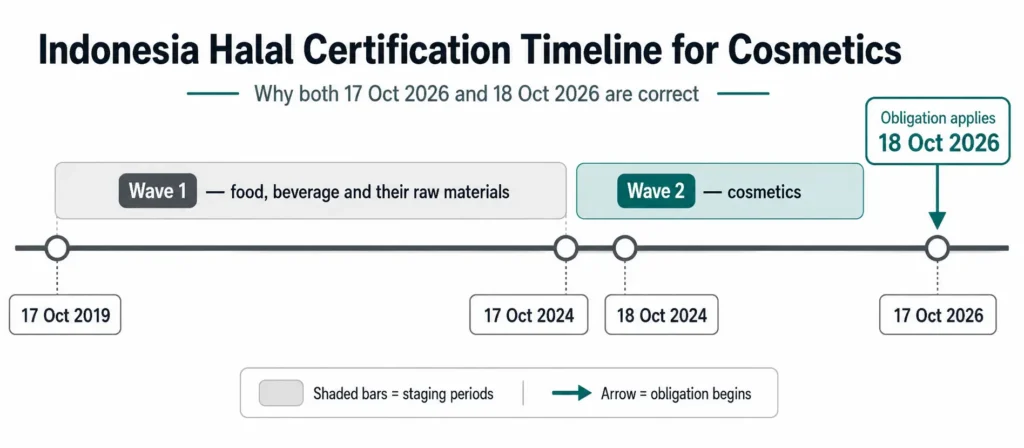
Indonesia is the only market that turns halal certification for cosmetics into a condition of market access, and a cosmetic placed on that market must hold BPJPH certification from 18 October 2026 — 17 October is the last day of the staging period, which is why both dates circulate.
The obligation attaches to the finished product, and every material in it has to be evidenced as halal within that certification. The framework runs through Act No. 33/2014 on Halal Product Assurance, Government Regulation No. 42/2024 and Ministry of Religious Affairs Decree No. 748/2021, administered by BPJPH.
The two dates, the seven halal critical points the inspection works through, and the declaration-versus-certificate checks are covered in full in our guide to Indonesia’s halal requirement for cosmetics.
Everywhere else the picture is different, and copy that treats all Muslim-majority markets as one is either alarming buyers who do not need certification or under-selling the one place it is compulsory:
| Market | Requirement for cosmetics | What it means for you |
|---|---|---|
| Indonesia | Mandatory from 18 October 2026 | Regulatory market access. The obligation is on the finished product; every raw material must be evidenced within it |
| Malaysia | Voluntary | Selling is possible uncertified, but using the Halal mark requires JAKIM or a JAKIM-recognised body |
| Brunei | Voluntary for cosmetics | Mandatory for food-related business only |
| UAE | Generally voluntary | Helps with Muslim retail channels, pharmacies and brand procurement |
| Saudi Arabia and Gulf states | No blanket mandate | Animal-origin materials and products carrying a Halal claim may still be asked for origin or Halal documents. Confirm per item with the importer |
| Singapore, Türkiye, Pakistan, Bangladesh | Generally no blanket mandate | Requirements come from retailers, brands and distributors rather than from law |
Status changes. This table reads as of August 2026 and should be re-checked against the authority in your target market before a filing.
What a certified raw material does and does not do for your finished product
It supports your finished-product certification. It does not grant it.
This is the misunderstanding most likely to surface after a purchase order. A certified ingredient means one input to your formula has been assessed. Your formula as a whole, your manufacturing site and your finished product each need their own assessment under the scheme that applies to you.
Two further limits worth writing into your own supplier questionnaire:
A certificate covers only the products listed in its annex. A supplier who says “we are Halal certified” is describing a company. Ask which materials are on the annex, and check that the grade you are buying is one of them.
BPJPH is not automatically equivalent to JAKIM or to any other national scheme. Recognition between schemes is not universal. If you are filing in Malaysia, confirm what Malaysia accepts rather than assuming an Indonesian certificate travels.
Where this material stands
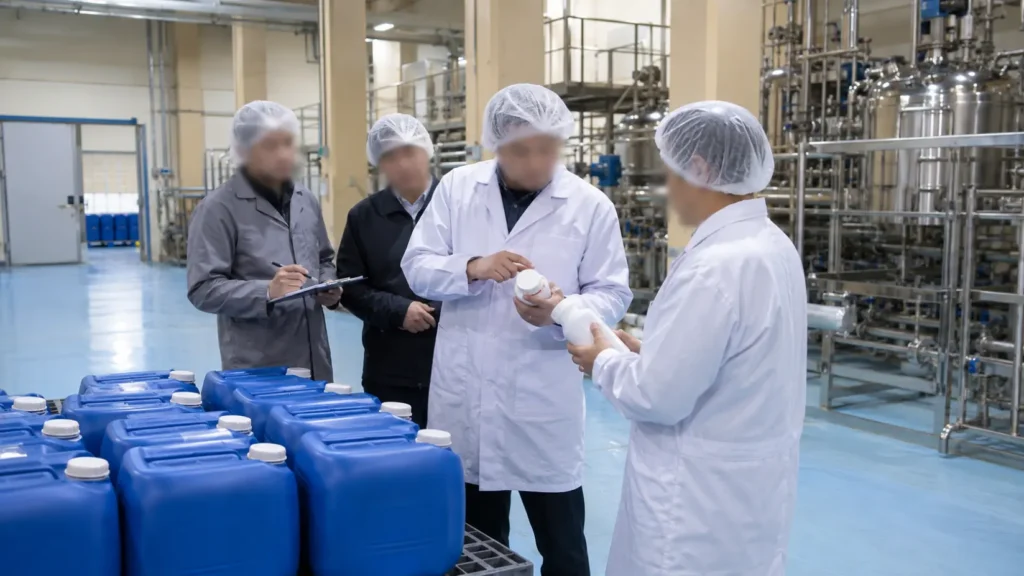
This grade sits within a BPJPH-certified scope, and the certification came from putting a certifying body inside the plant that makes it.
That plant belongs to the manufacturing partner we buy this material from, which is exactly why getting a certifier through its doors was work rather than paperwork. We assembled the scope list, arranged for the partner to produce what BPJPH asked for, and hosted the audit on site. BPJPH auditors came to the facility, worked through the production areas and the documentation, and the audited scope covered Hydrolyzed Sponge alongside Copper Tripeptide-1, Tranexamic Acid and VCIP.
Anyone can forward a supplier’s declaration. Getting a certifying body into someone else’s plant is a different exercise, and it is the reason the four checks in the section above are specific rather than general.
So, plainly: this material is animal-derived and cannot carry a vegan claim. It is cultivated, freshwater-sourced, species-documented, and within a BPJPH-certified scope. For a brand serving Muslim-majority markets — particularly Indonesia from 18 October 2026 — that combination is usually more useful than a vegan claim would have been, because a vegan claim was never available and Halal market access is.
If your brand must be vegan
Then this is not your material, and it is better to know that now than after a retailer audit.
Plant-derived and synthetic spicule alternatives are sold, and a brand with a hard vegan commitment should evaluate them. Three things to check before assuming they are equivalent:
The evidence base is different. Most published spicule research uses sponge-derived material — marine or freshwater. A study on sponge spicules does not transfer to a plant-derived or synthetic needle, and a supplier citing sponge literature for a non-sponge product has made exactly the error this article is about.
Geometry consistency is different. A biologically formed spicule has a length and diameter distribution set by the organism. A manufactured needle has whatever distribution its process produces. Neither is automatically better, but they are not comparable without seeing measurement data for the specific material.
Sensory behaviour follows geometry. If you are switching to hit a vegan claim, expect to re-screen dose and skin feel rather than dropping the alternative into an existing formula.
Where animal origin is acceptable, the sponge-derived material is the one with the longer research record and, in this case, the certified Halal scope.
Documents to request
Ask for these four by name. A supplier who produces all four has a document system; one who produces the first only has a sales sheet.
- Origin statement — naming the species and whether the source is wild-collected or cultivated. This is the document that establishes animal origin, and the one to read first for any vegan question
- Composition sheet — every declared component with its percentage and its origin column. This is where the non-spicule fraction shows its origin
- Halal document, and check which kind it is — certificate or declaration. If certificate: issuing body, certificate number, expiry, and the annex listing which materials are covered
- Batch confirmation of species — because the origin statement names more than one possible species
If you are filing in Indonesia, ask additionally whether the certificate’s issuing body is BPJPH or a body BPJPH recognises, and whether the specific grade you are quoting appears on the annex.
Grades, specifications and document availability are listed on the Hydrolyzed Sponge product page. Tell us the market you are filing in, and we will send the origin statement, the composition sheet and the certificate annex with your sample.
Frequently asked questions
Is Hydrolyzed Sponge vegan?
No. Sponges are animals in the phylum Porifera, so Hydrolyzed Sponge is animal-derived and a formula containing it should not carry a vegan claim. This holds regardless of how the material is processed — hydrolysis and purification do not change what it came from. If a vegan claim is a fixed requirement for your product, evaluate plant-derived or synthetic spicule alternatives instead.
Spicules are silica — does that make them mineral rather than animal?
No. The silica is biogenic, meaning an animal built it. Vegan and vegetarian standards assess what a material came from, not what it is chemically made of. Beeswax is the same situation: unremarkable chemistry, animal origin, not vegan. Reasoning from the specification’s inorganic profile to “mineral” is the single most common way this question gets answered wrongly.
Is Hydrolyzed Sponge cruelty-free?
That is a separate question. Cruelty-free concerns animal testing; vegan concerns composition. Hydrolyzed Sponge fails the vegan test on composition, and its cruelty-free position depends on testing policy rather than on origin. Assess the two independently, and do not let one be presented as covering the other on a pack.
Are the sponges wild-collected or farmed?
Cultivated. That gives a more traceable supply chain than wild collection — batch identity, harvest records and species consistency become answerable rather than estimated. Cultivation is a supply-chain fact, not a certification: claims such as “sustainably sourced” belong to schemes that audit against a standard and need that scheme named.
Is Hydrolyzed Sponge Halal certified?
This grade sits within a BPJPH-certified scope, following an on-site audit at the manufacturing partner’s facility that also covered Copper Tripeptide-1, Tranexamic Acid and VCIP. Ask for the certificate and its annex so your regulatory team can confirm the grade you are quoting is listed. Note that a certificate and a manufacturer self-declaration are different documents, and only the first carries an issuing body, a number and an expiry.
Does Indonesia’s requirement apply to raw materials as well as finished cosmetics?
The obligation attaches to the cosmetic placed on the Indonesian market, and every material in it has to be evidenced as halal within that certification — so your ingredient list becomes part of your compliance position rather than a separate matter. Whether an imported raw material needs a BPJPH certificate of its own is not stated plainly in the public sources, so confirm the mechanism with the halal inspection body handling your file. A supplier certificate settles the question for that material either way.
Does a certified raw material mean my finished product is certified?
No. It supports your finished-product certification without granting it. Your formula, your manufacturing site and your finished product each need their own assessment under the scheme that applies to you. A certified ingredient means one input has been assessed — which is what removes it as an obstacle, not what completes your file.
Can I use Hydrolyzed Sponge in a product labelled “clean” or “naturally derived”?
Possibly, but check the definition you are working to. “Clean” has no single standard, and “naturally derived” definitions differ on whether animal-derived materials qualify and on how much processing is allowed. Hydrolyzed Sponge is biologically sourced and processed by hydrolysis and purification. Get the specific definition your retailer or certifier uses in writing before designing a pack around either word.
What documents prove the origin?
The origin statement is the primary document: it names the species and the source environment. The composition sheet supports it by showing the origin column for every declared component. Both are available on request. For a claim your compliance team will have to defend, also request batch confirmation of species, since the origin statement names more than one possibility.
References
External sources
- GBIF Secretariat. Spongilla lacustris (Linnaeus, 1759). GBIF Backbone Taxonomy, taxon 2244988. https://www.gbif.org/species/2244988 — accessed 6 August 2026.
- World Porifera Database. Spongilla lacustris (Linnaeus, 1759), AphiaID 167235. https://www.marinespecies.org/porifera/porifera.php?p=taxdetails&id=167235
Regulations and schemes cited
- Act No. 33 of 2014 of the Republic of Indonesia, on Halal Product Assurance.
- Government Regulation of the Republic of Indonesia No. 42 of 2024, implementing halal product assurance.
- Ministry of Religious Affairs of the Republic of Indonesia, Decree No. 748 of 2021, on categories of goods subject to mandatory halal certification.
- Badan Penyelenggara Jaminan Produk Halal (BPJPH) — Indonesian halal certification authority.
- Jabatan Kemajuan Islam Malaysia (JAKIM) — Malaysian halal certification authority.