This article is based on nucleic-acid spectroscopy principles, ingredient functionality review, and supplier quality-control interpretation. It does not make clinical treatment claims. Finished-product performance must be validated in the final formulation.
Not all DNA is PDRN. For formulators and ingredient buyers, the key question is not only how much DNA is present, but whether the DNA retains meaningful double-stranded structure.
Quick Answer
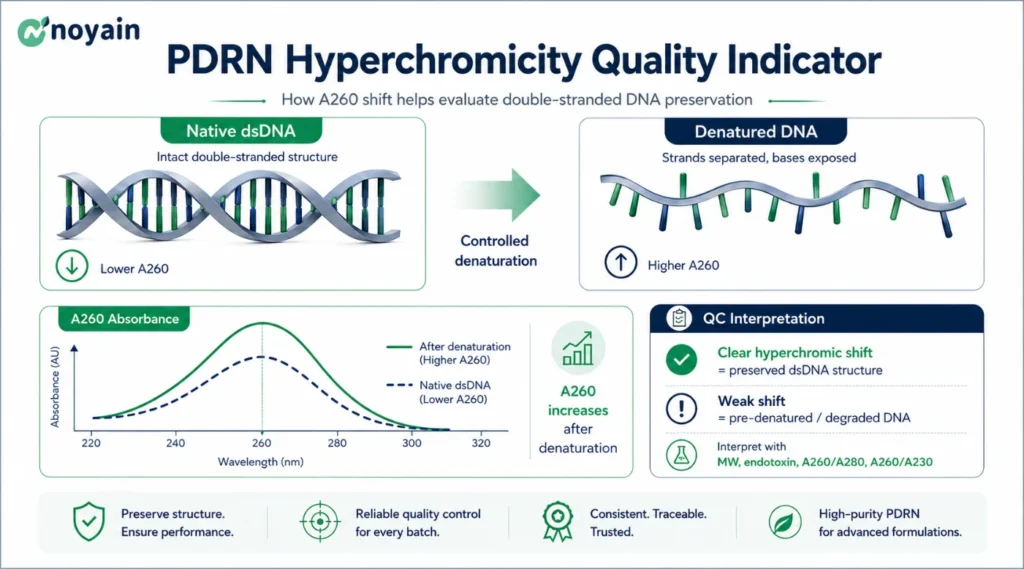
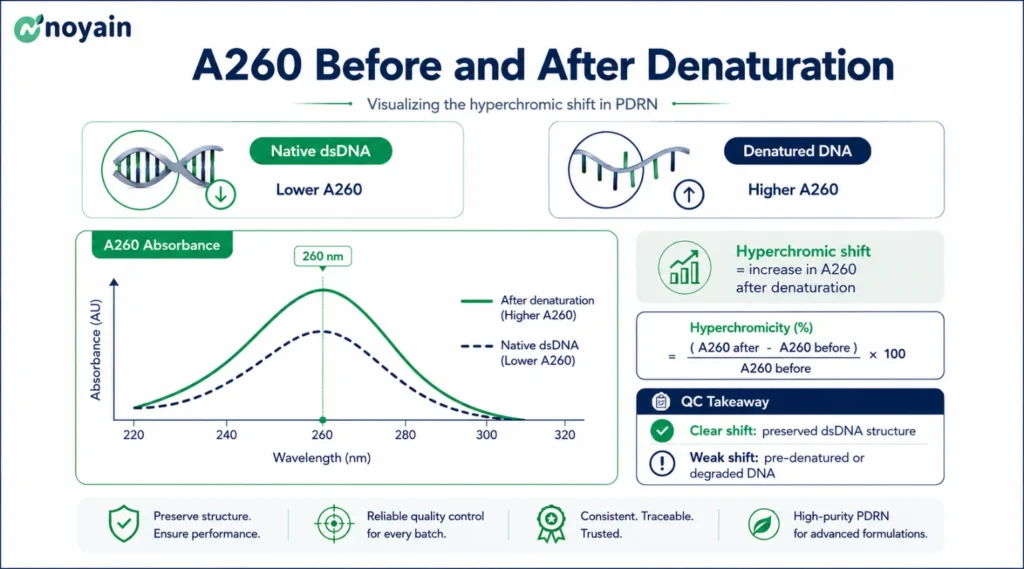
Hyperchromicity is the increase in UV absorbance around 260 nm when double-stranded DNA is denatured.
For PDRN, it is useful because it shows whether Sodium DNA still retains meaningful double-stranded structure.
At a glance:
| Question | Short answer |
|---|---|
| What is it? | A UV absorbance shift linked to DNA denaturation |
| How is it measured? | By comparing A260 before and after controlled denaturation |
| Why does it matter? | It reflects preserved double-stranded base stacking |
| What can it not prove? | Finished-formula efficacy, purity by itself, or safety by itself |
In practical terms, hyperchromicity helps connect a UV spectroscopy signal with a larger sourcing question: is the material simply DNA-containing, or does it retain the structured double-stranded characteristics expected from PDRN-grade Sodium DNA?
For the broader ingredient foundation, see our PDRN Complete Guide.
Key Takeaways
- Hyperchromicity is a structure-sensitive UV spectroscopy parameter, not just another purity percentage.
- It is based on the difference between native DNA absorbance and denatured DNA absorbance at around 260 nm.
- Stronger hyperchromic behavior generally indicates better preservation of double-stranded DNA base stacking before denaturation.
- It should be interpreted together with assay, molecular-weight distribution, A260/A280, A260/A230, endotoxin, residual solvent, and microbiological data.
Why It Matters for PDRN
PDRN quality is not only about total DNA amount. It is also about whether the DNA retains a structured double-stranded form.
A material can contain DNA fragments and still fail to preserve the double-stranded structure that matters for high-specification Sodium DNA sourcing.
This is why Noyain evaluates PDRN quality not only by total DNA content, but also by structural indicators, active double-stranded DNA content, endotoxin control, and batch consistency.
Why A260 Alone Is Not Enough for PDRN Quality Control
A260 absorbance is a concentration signal, while hyperchromicity is a structural signal.
Most nucleic acids absorb UV light strongly around 260 nm. That makes A260 useful for estimating DNA concentration, but it does not tell the whole quality story. Free nucleotides, degraded DNA fragments, single-stranded DNA, and double-stranded DNA can all contribute to absorbance.
This creates a common procurement problem:
| Claim on COA | What it may tell you | What it may not tell you |
|---|---|---|
| DNA assay | Approximate nucleic-acid amount | Whether the DNA retains PDRN-grade structural characteristics |
| A260 value | UV-absorbing nucleic-acid concentration | Structural integrity and impurity profile |
| A260/A280 ratio | Protein or phenol-related purity clue | Whether DNA is double-stranded |
| A260/A230 ratio | Salt, solvent, carbohydrate, or reagent contamination clue | Whether the material has preserved PDRN architecture |
| Hyperchromicity | Whether native DNA base stacking is still present | It still needs to be read with MW, endotoxin, and purity data |
For a buyer, this means a high “DNA content” number is not automatically a high-quality PDRN number.
How DNA Hyperchromicity Works at A260
Hyperchromicity is evaluated by comparing DNA absorbance before and after controlled denaturation.
A simplified calculation is:
Hyperchromicity (%) =
[(A260 after denaturation - A260 before denaturation) / A260 before denaturation] x 100
The principle is straightforward. In intact double-stranded DNA, bases are stacked inside the helix. This base stacking suppresses UV absorbance. When heat, pH, or denaturing conditions separate the strands, the bases become more exposed and absorb more light at 260 nm.
The result is a measurable absorbance increase.
Important interpretation
Hyperchromicity is not the same thing as “active double-stranded DNA content.” Hyperchromicity is the optical response. Active double-stranded DNA content is a product-quality result derived from validated analytical methods. They are related, but they should not be used as interchangeable terms.
What Hyperchromicity Can and Cannot Tell You
Hyperchromicity helps evaluate DNA structure, but it is not a complete quality or efficacy claim by itself.
| Hyperchromicity can help indicate | Hyperchromicity cannot directly prove |
|---|---|
| Whether DNA base stacking is preserved | Finished-product efficacy |
| Whether DNA has meaningful double-stranded structure | Skin repair or anti-aging performance |
| Whether extraction may have damaged DNA structure | Exact active dsDNA content by itself |
| Batch-to-batch structural consistency | Complete purity or safety profile |
What Hyperchromicity Tells You About PDRN Quality
Hyperchromicity helps answer one of the most important questions in PDRN sourcing: was the DNA structure preserved during extraction and purification?
For cosmetic formulators and procurement teams, the parameter is most useful in four ways.
1. It Indicates Double-Stranded Structure Preservation
High-specification PDRN should retain meaningful double-stranded DNA architecture before final controlled fragmentation or processing.
If extraction exposes DNA to harsh acids, high temperatures, strong alkali, phenol-chloroform systems, aggressive shear, or long degradation windows, the double helix can partially denature or fragment. Once that happens, the material may still absorb at 260 nm, but the hyperchromic response becomes less meaningful because the structure has already been damaged.
2. It Helps Distinguish Structured DNA From Degraded Nucleotide Material
Two materials can show similar DNA assay values while behaving differently in formulation and quality testing.
| Material type | Likely hyperchromic behavior | Procurement meaning |
|---|---|---|
| Preserved double-stranded PDRN | Clear A260 increase after denaturation | Better structural integrity |
| Partially denatured DNA | Moderate or inconsistent increase | Extraction damage may have occurred |
| Highly degraded/free nucleotide material | Weak structural signal | “DNA content” may overstate active PDRN quality |
| Impurity-rich extract | Unstable or hard-to-interpret signal | Requires deeper purity review |
3. It Supports Batch-to-Batch Consistency
Hyperchromicity is also useful as a consistency check. If the same grade shows large shifts in hyperchromic behavior between lots, the extraction process, denaturation state, molecular-weight distribution, or impurity load may not be stable.
For high-specification PDRN supply, the goal is not only one good COA. The goal is repeatable structure and purity lot after lot.
4. It Strengthens the Supplier Evaluation Conversation
Hyperchromicity gives formulators a more technical question to ask suppliers:
Does your PDRN specification only report total DNA,
or does it also evaluate preserved double-stranded structure?
That question quickly separates basic nucleic-acid materials from PDRN suppliers with real quality-control depth.
Advanced Solvent-Free Extraction Technology
Noyain’s PDRN is produced using a proprietary inorganic salt extraction process developed through internal technical development and process optimization.
Unlike conventional phenol-chloroform or harsh chemical extraction systems, this process eliminates toxic organic solvents while achieving up to 95% DNA recovery. The process is designed to keep conditions below the DNA double-helix melting point, helping preserve native double-stranded DNA architecture.
This non-denaturing process helps preserve the native double-stranded DNA structure, resulting in 47.7% active double-stranded DNA content, compared with lower structured dsDNA levels often seen in conventionally processed DNA materials. The 47.7% active double-stranded DNA content refers to the measured structured dsDNA fraction under Noyain’s internal validated QC method, not the hyperchromicity percentage itself.
The result is a PDRN material with:
| Quality dimension | Conventional risk | Noyain PDRN advantage |
|---|---|---|
| Extraction chemistry | Organic solvent residues, phenol/chloroform concern | Proprietary inorganic salt extraction, no toxic organic solvents |
| DNA recovery | Lower yield or higher structural damage | Up to 95% DNA recovery |
| Double-stranded preservation | Heat, acid, alkali, or shear may denature DNA | Non-denaturing process below DNA melting conditions |
| Active double-stranded DNA content | Lower structured dsDNA levels may occur when DNA is conventionally processed or insufficiently preserved | 47.7% active double-stranded DNA content under internal validated QC |
| Endotoxin control | Variable, supplier-dependent | ≤0.01 EU/mL |
| Cosmetic positioning | Standard active | Quality-controlled cosmetic active with stringent low-endotoxin QC benchmark |
This is the core quality difference: the process is not only designed to extract DNA; it is designed to preserve the form of DNA that matters.
Why Solvent-Free Extraction Matters
Solvent-free extraction matters because residual extraction chemistry can affect both safety perception and analytical confidence.
Traditional nucleic-acid extraction methods may use phenol, chloroform, strong acid, strong alkali, or enzyme-intensive routes. These approaches can be effective for laboratory isolation, but they create problems for high-specification cosmetic ingredient supply:
- residual solvent or reagent concerns;
- higher purification burden;
- potential protein or enzyme-related impurity risk;
- structural stress on DNA;
- less convincing clean-beauty and quality-positioning story.
For a cosmetic brand, the sourcing story becomes much cleaner when the PDRN supplier can explain:
- how DNA is extracted;
- why toxic organic solvents are avoided;
- how double-stranded structure is preserved;
- how endotoxin is controlled;
- how each batch is documented.
This is especially important for PDRN because the ingredient often sits in advanced, post-procedure, anti-aging, and K-beauty-inspired product concepts where trust is part of the product value.
What A Good PDRN Specification Should Include
Hyperchromicity is useful, but it should never be the only decision point.
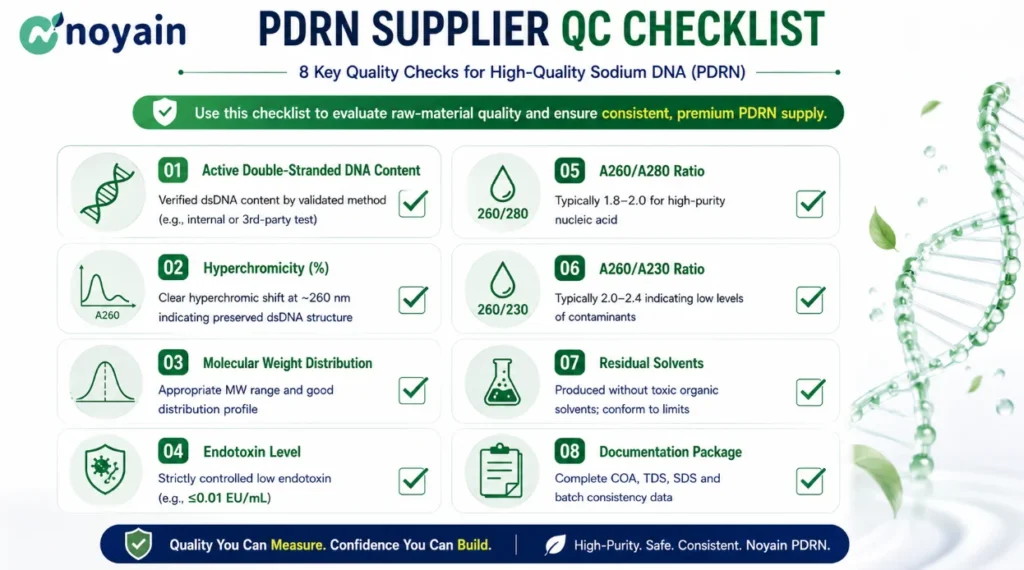
When evaluating PDRN for cosmetic formulations, request a specification package that covers:
| Parameter | Why it matters |
|---|---|
| INCI name | Confirms cosmetic labeling as Sodium DNA |
| Assay / active content | Confirms nucleic-acid active level |
| Active double-stranded DNA content | Indicates preserved structured DNA fraction |
| Hyperchromicity or equivalent structural indicator | Supports double-stranded structure evaluation |
| Molecular-weight distribution | Determines topical suitability, consistency, and supplier control |
| A260/A280 ratio | Helps screen protein or phenol-related impurities |
| A260/A230 ratio | Helps screen salts, carbohydrates, organic contaminants, or extraction residues |
| Endotoxin | Essential for low-endotoxin active positioning |
| Microbial limits | Required for cosmetic ingredient quality |
| Heavy metals | Required for regulatory and safety review |
| Residual solvents | Especially important if supplier uses conventional extraction |
| COA, TDS, SDS | Core procurement documentation |
| BSE/TSE statement | Important for animal-derived DNA sourcing |
| Batch-to-batch trend data | Confirms quality consistency beyond a single lot |
How to Interpret Hyperchromicity as a PDRN Quality Indicator
Hyperchromicity is powerful, but it has limits.
Use it as a quality signal, not as a standalone performance claim. It does not prove that a finished serum will reduce wrinkles, improve barrier recovery, or outperform another formula. It tells you whether the raw material has preserved structural characteristics that are expected from well-produced DNA material.
The practical interpretation looks like this:
Good hyperchromicity signal
  +
Defined molecular-weight distribution
  +
High active double-stranded DNA content
  +
Low endotoxin
  +
Clean solvent/residue profile
  =
Stronger PDRN raw-material quality story
If one of those elements is missing, ask for the data before building a high-specification claim around the ingredient.
Formulation Implications
Hyperchromicity is a raw-material QC parameter, but it has formulation implications.
PDRN is a polyanionic molecule because of its phosphate backbone. Even if the raw material is high quality, the finished formula can still fail if the system is not compatible.
Once PDRN enters a finished formula, stability must still be confirmed through formula-specific testing, including pH stability, heat stability, preservative compatibility, and accelerated stability testing.
For PDRN formulas, screen these variables:
| Factor | Practical recommendation |
|---|---|
| pH | Keep final formula around pH 5.0-7.0 unless supplier data supports a different range |
| Temperature | Add PDRN during cool-down, generally below 40°C |
| Shear | Avoid prolonged high shear after PDRN addition |
| Cationic ingredients | Avoid cationic surfactants and high-cationic polymer systems |
| Metal ions | Be careful with high levels of Zn2+, Cu2+, Ca2+, and Mg2+ |
| Preservatives | Validate compatibility; avoid strongly cationic preservative systems |
| Packaging | Prefer opaque, airless, low-contamination packaging for advanced cosmetic formulas |
For delivery and topical-vs-injection differences, see our PDRN Injection vs Topical guide.
Questions to Ask Your PDRN Supplier
Use these questions before approving a PDRN raw material for an advanced cosmetic formula:
- Do you test hyperchromicity or another structural indicator?
- Can you provide active double-stranded DNA content data?
- What is the molecular-weight distribution?
- What extraction method is used, and are toxic organic solvents avoided?
- Can you provide endotoxin, residual solvent, COA, TDS, SDS, and batch consistency data?
Supplier Red Flags
Be cautious if a supplier only talks about “high DNA content” but cannot provide structural or safety data.
Red flags include:
- no active double-stranded DNA content data;
- no molecular-weight distribution;
- no endotoxin specification;
- no residual solvent statement;
- no A260/A280 or A260/A230 interpretation;
- no batch-to-batch trend record;
- no clear source traceability;
- no COA, TDS, or SDS;
- vague statements such as “salmon DNA powder” without PDRN-grade specification.
For high-specification cosmetic development, the phrase “DNA ingredient” is not enough. The material should be characterized as PDRN-grade Sodium DNA with defined structure, purity, safety, and consistency.
Technical Support for PDRN Screening
Noyain supplies cosmetic-grade PDRN (Sodium DNA) produced through advanced solvent-free inorganic salt extraction. Our technical team can support PDRN screening for serums, ampoules, creams, masks, and post-procedure cosmetic concepts.
Available documentation may include COA, TDS, SDS, source declaration, endotoxin specification, molecular-weight profile, active double-stranded DNA content, and formulation guidance.
For sample requests or technical discussion, visit our Sodium DNA product page or contact our team.
FAQ
What is DNA hyperchromicity in PDRN quality control?
DNA hyperchromicity in PDRN quality control refers to the increase in A260 absorbance after controlled DNA denaturation. It helps indicate whether the Sodium DNA material retained meaningful double-stranded base stacking before denaturation.
Is hyperchromicity the same as PDRN purity?
No. Hyperchromicity is a structural indicator based on UV absorbance change after DNA denaturation. Purity requires a broader dataset, including assay, A260/A280, A260/A230, residual solvents, proteins, salts, endotoxin, microbial limits, and heavy metals.
Does higher hyperchromicity always mean better PDRN?
Not by itself. A stronger hyperchromic response can indicate better preservation of double-stranded DNA structure, but it must be interpreted with molecular-weight distribution, active double-stranded DNA content, impurity profile, and batch consistency.
Why does denatured DNA absorb more UV light?
When DNA is double-stranded, the bases are stacked inside the helix and absorb less UV light. When the strands separate during denaturation, the bases become more exposed, increasing absorbance around 260 nm.
Why is double-stranded DNA content important in PDRN?
Double-stranded DNA content helps indicate whether the extraction process preserved native DNA architecture instead of producing mostly degraded, denatured, or low-structure nucleotide material. It is an important quality signal for high-specification PDRN sourcing.
What makes Noyain’s PDRN different?
Noyain’s PDRN uses a proprietary inorganic salt extraction process that avoids toxic organic solvents, achieves up to 95% DNA recovery, helps preserve native double-stranded DNA structure, reaches 47.7% active double-stranded DNA content under internal validated QC, and controls endotoxin at ≤0.01 EU/mL.
References
- Promega. Why Does Denatured DNA Absorb More Ultraviolet Light Than Double-Stranded DNA?
- Thermo Fisher Scientific. Interpretation of Nucleic Acid 260/280 Ratios
- Squadrito F., Bitto A., Irrera N., Pizzino G., Pallio G., Minutoli L., Altavilla D. Pharmacological Activity and Clinical Use of PDRN. Frontiers in Pharmacology, 2017. DOI: 10.3389/fphar.2017.00224.
- Baek J. et al. Polydeoxyribonucleotides as Emerging Therapeutics for Skin Regeneration and Repair. Applied Sciences, 2025.
- Internal technical summary: Noyain PDRN inorganic salt extraction process, active double-stranded DNA content, and endotoxin QC specification.