
- Add during the cool-down phase when possible, preferably below 40 °C.
- Avoid strong alkaline systems and unnecessary prolonged heating.
- Validate color, odor, pH drift, assay retention, and package compatibility during stability testing.
- Use airless, opaque, or UV-protective packaging for premium vitamin C positioning.
- Confirm compatibility when combining with strong acids, high electrolyte systems, botanical extracts, and metal ions.
- Final use level and claims should be supported by safety assessment and target-market compliance review.
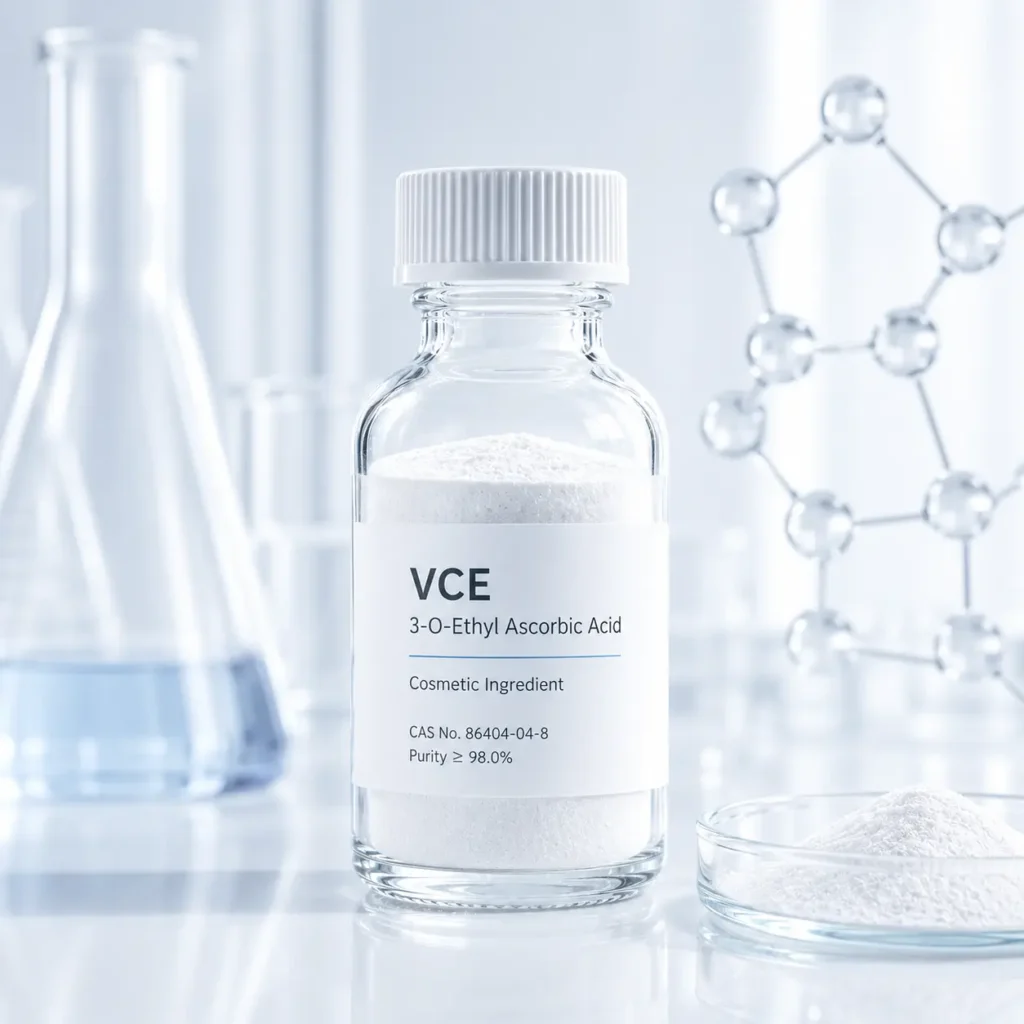
Cosmetic Active System
3-o-Ethyl Ascorbic Acid
VCE (3-o-Ethyl Ascorbic Acid) is a stable vitamin C derivative for brightening, antioxidant, and anti-aging skincare formulations. It helps improve visible skin radiance, reduce the look of dullness, and support even-looking skin tone while offering better formulation stability than traditional L-Ascorbic Acid. It is widely used in serums, essences, creams, lotions, toners, masks, and premium vitamin C skincare lines.
INCI
3-O-Ethyl Ascorbic Acid
CAS
86404-04-8
Function
Brightening, antioxidant, even-tone care, anti-aging support, vitamin C derivative positioning
Shelf Life
24-36 months
Product Overview
A Formulation-Friendly Vitamin C Derivative for Modern Brightening Skincare
Vitamin C remains one of the most recognized active concepts in global skincare, but pure L-Ascorbic Acid can be difficult to formulate due to oxidation, color change, low-pH requirements, and consumer tolerance challenges. VCE solves these practical formulation problems by offering a more stable vitamin C derivative for daily-use brightening and antioxidant products.
3-O-Ethyl Ascorbic Acid is an etherified derivative of ascorbic acid. This structural modification improves stability and makes it easier to use in mild cosmetic systems while maintaining the strong marketing value of vitamin C. For formulators, it enables cleaner serum aesthetics, improved product shelf appeal, and more flexible pH design compared with traditional low-pH vitamin C formulas.
For skincare brands, VCE supports high-demand consumer claims such as radiance, glow, antioxidant care, uneven tone improvement, and dark spot appearance reduction. It is especially suitable for premium brightening serums, urban antioxidant products, anti-aging vitamin C lines, and sensitive-skin-friendly glow formulas.
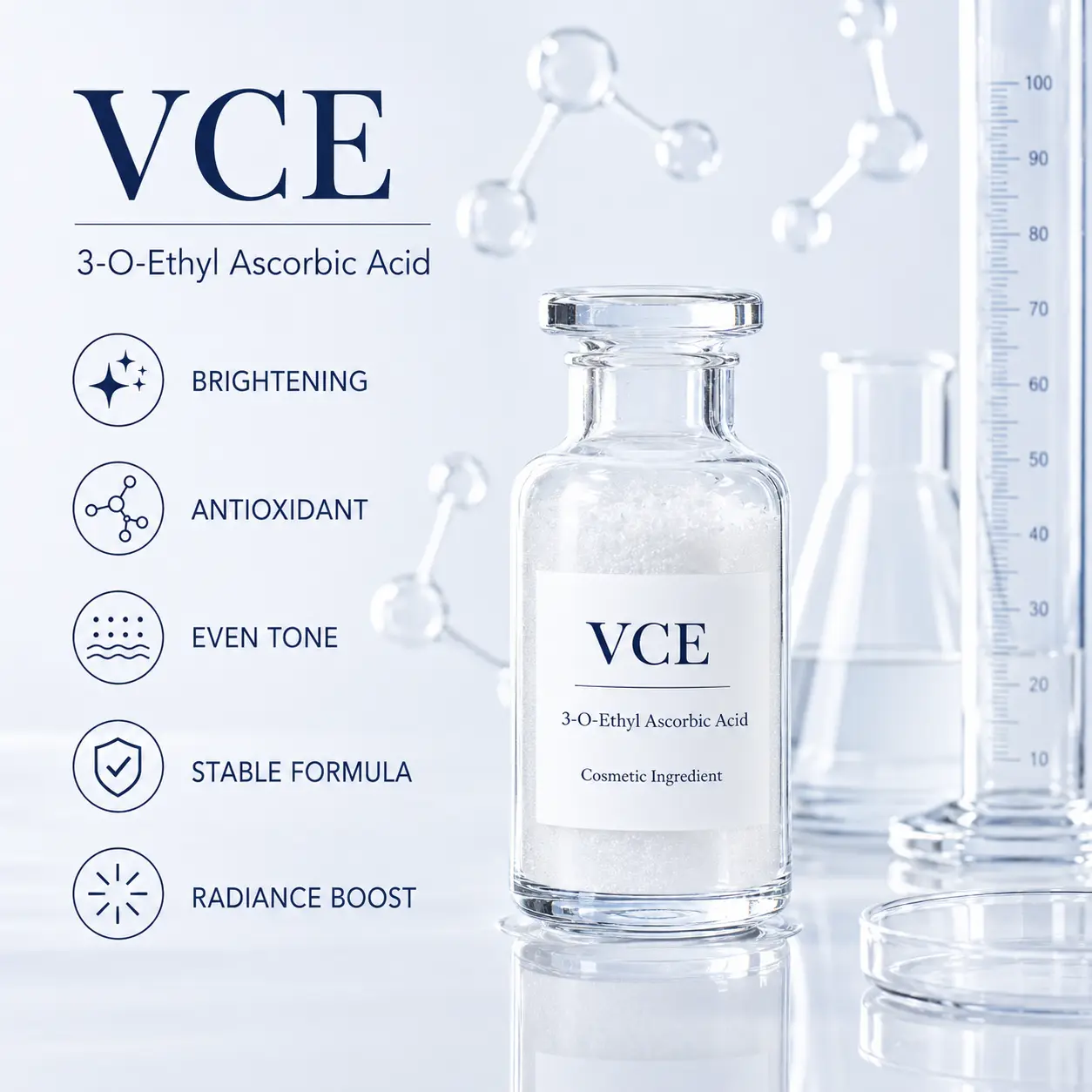
Skincare principles
How VCE Supports Brightening Skincare
Radiance and Dullness Care
VCE helps restore a brighter-looking complexion by supporting formulations that target dull, tired, and uneven-looking skin. It is ideal for glow serums and daily radiance products where consumers expect visible clarity and luminosity without the harsh sensory profile often associated with very acidic vitamin C formulas.
Uneven Tone and Dark Spot Appearance
3-O-Ethyl Ascorbic Acid is commonly used in skincare products targeting uneven-looking tone and dark spot appearance. Scientific literature reports that this ingredient is associated with anti-melanogenic activity and tyrosinase-related pathways, making it a valuable component in cosmetic brightening systems.
Antioxidant Protection
Environmental stress, UV exposure, pollution, and daily oxidation can contribute to dullness and premature signs of skin aging. VCE provides antioxidant positioning for formulas designed to help protect the skin from oxidative stress and support a healthier, more resilient appearance.
Anti-Aging Brightening
Brightening and anti-aging are strongly connected in modern skincare. VCE helps brands develop products positioned for photoaging, dullness, fine-line appearance, and loss of radiance. It can be used as the hero active in a vitamin C serum or as part of a multi-active anti-aging complex.
Suitable for the following applications
Recommended Applications
Brightening Serum
The primary application platform. VCE at 1.0-3.0% in a lightweight serum can be positioned for glow, dullness reduction, antioxidant care, and even-looking skin tone.

Dark Spot Care Essence
A targeted brightening product format where VCE can be combined with niacinamide, alpha-arbutin, tranexamic acid, or glutathione for multi-pathway tone care.
Radiance Toner
Water-based toner or essence format using VCE at moderate levels with humectants and soothing ingredients for daily complexion refinement.
Vitamin C Cream
O/W emulsion or gel cream positioned for brightening and anti-aging. Suitable for daily skincare lines where pure ascorbic acid may be too unstable or irritating.
Product's own advantages
Why Formulators Choose VCE
Stable Vitamin C Positioning
Compared with free L-Ascorbic Acid, VCE is more formulation-friendly and better suited for products that require improved color, odor, and shelf stability.
Mild pH Formulation Flexibility
VCE can be used in mild acidic to near-neutral systems, making it easier to design consumer-friendly products with better skin tolerance.
Strong Consumer Recognition
Vitamin C is a globally recognized skincare concept. VCE lets brands leverage this recognition while reducing common formulation challenges.
Broad Application Range
Suitable for water-based serums, gel essences, emulsions, creams, lotions, toners, sheet masks, and multi-step brightening routines.
Multi-Claim Value
Supports brightening, radiance, antioxidant, even-tone, anti-aging, and urban skincare positioning in one active.
Synergy with Other Brightening Actives
Works well in multi-active tone-care formulas with niacinamide, alpha-arbutin, tranexamic acid, glutathione, ferulic acid, and soothing ingredients.
Technical Specifications
Product Technical Parameters
Parameter | Specification |
|---|---|
Brand Name | NOYAIN® VCE |
INCI Name | 3-O-Ethyl Ascorbic Acid |
Appearance | White to almost white crystalline powder |
Purity | 98.0% |
Recommended Dosage | 0.5% - 3.0% typical cosmetic use |
Solubility | Soluble in water; compatible with selected polyol systems |
pH Stability | 5.0-6.5 |
Application | Serums, Creams, Lotions, Masks, Ampoules, Repair Treatments |
Storage Condition | Brightening serums, dark spot care, radiance toners, anti-aging creams, sheet masks, vitamin C skincare lines |
Shelf Life | 24-36 months |
why choose us
Our high-quality 3-O-Ethyl Ascorbic Acid
Water-soluble profile
Easy to incorporate into water-phase systems, serums, toners, and gel essences.
Better stability than pure L-Ascorbic Acid
Reduces common issues such as rapid browning and oxidation in many cosmetic systems.
Mild sensory positioning
Allows brands to create vitamin C products without the aggressive low-pH feel of some traditional formulas.
Transparent serum compatibility
Suitable for clear or translucent serum aesthetics after compatibility validation.
Flexible marketing concept
Can support brightening, glow, antioxidant, even-tone, vitamin C derivative, and anti-aging claims.
Works in multi-active systems
Can be paired with humectants, antioxidants, tone-care actives, soothing agents, and barrier-support ingredients.
Kind tips
Formulation Precautions
related products
Other related products
Related Documents
Technical Support Materials
COA Document
Get For FreeTDS (Technical Data Sheet)
Get For FreeMSDS (Material Safety Data Sheet)
Get For FreeFormulation Guide
Get For FreeRelated Topics
Product-related articles
Frequently Asked Questions
- What is VCE in cosmetic formulations?
VCE refers to 3-O-Ethyl Ascorbic Acid, also known as Ethyl Ascorbic Acid or Vitamin C Ethyl Ether. It is a stable vitamin C derivative widely used in skincare formulations for brightening, antioxidant care, radiance improvement, and anti-aging product concepts.
Compared with traditional vitamin C, VCE is easier to formulate because it offers better stability and broader pH compatibility, making it suitable for modern serums, creams, essences, masks, and daily brightening skincare products.
- What are the key benefits of 3-O-Ethyl Ascorbic Acid?
The main cosmetic value of 3-O-Ethyl Ascorbic Acid is to help improve the appearance of dull, uneven, and tired-looking skin. It is commonly used in formulations designed for:
- Brighter-looking skin
- Improved radiance and glow
- More even-looking skin tone
- Antioxidant protection
- Anti-aging and photoaging care concepts
- Dark spot appearance reduction support
For brands developing brightening or vitamin C skincare lines, VCE is a practical active ingredient because it combines marketing recognition with formulation flexibility.
- How is VCE different from L-Ascorbic Acid?
L-Ascorbic Acid is the pure form of vitamin C, but it is known to be sensitive to light, oxygen, heat, and pH conditions. It often requires a low-pH formulation system, which may not be suitable for every product type or skin-positioning concept.
VCE, or 3-O-Ethyl Ascorbic Acid, is an ethylated vitamin C derivative with improved stability and better pH flexibility. This makes it easier to use in mild, elegant, and consumer-friendly skincare formulas while still supporting vitamin C-related brightening and antioxidant claims.
- What is the recommended use level of VCE?
A typical cosmetic use level for VCE is 0.5% to 3.0%. Lower levels may be used for daily radiance or sensitive-skin-oriented products, while higher levels may be considered for intensive brightening serums or premium vitamin C formulations.
The final dosage should always be confirmed through formula stability testing, compatibility testing, safety assessment, and skin tolerance evaluation.
- Can VCE be used with niacinamide?
Yes. VCE and niacinamide are commonly used together in brightening and tone-evening skincare formulas. This combination is especially suitable for products targeting dullness, uneven-looking tone, dark spot appearance, and overall skin radiance.
Niacinamide can also support barrier care and improve the overall skin feel of a brightening formula, making the VCE + niacinamide combination suitable for serums, essences, creams, and daily-use skincare products.
- Is VCE suitable for sensitive skin formulations?
VCE can be used in sensitive-skin-oriented brightening products when the formula is designed carefully. For this type of product, formulators often use a moderate VCE level and combine it with soothing or barrier-supporting ingredients such as:
- Panthenol
- Allantoin
- Bisabolol
- Beta-glucan
- Centella asiatica extract
- Ceramides
- Hyaluronic acid
However, suitability for sensitive skin depends on the complete formula, not only on VCE itself. Final product tolerance testing is recommended.
- Who should consider using VCE in a skincare formula?
VCE is a strong choice for brands, formulators, and private-label manufacturers developing:
- Vitamin C brightening products
- Anti-dullness skincare
- Even-tone skincare lines
- Dark spot appearance care products
- Antioxidant serums
- Premium radiance formulas
- Gentle vitamin C alternatives to low-pH L-Ascorbic Acid products
It is especially valuable when the goal is to create a stable, elegant, and consumer-friendly vitamin C skincare formula.