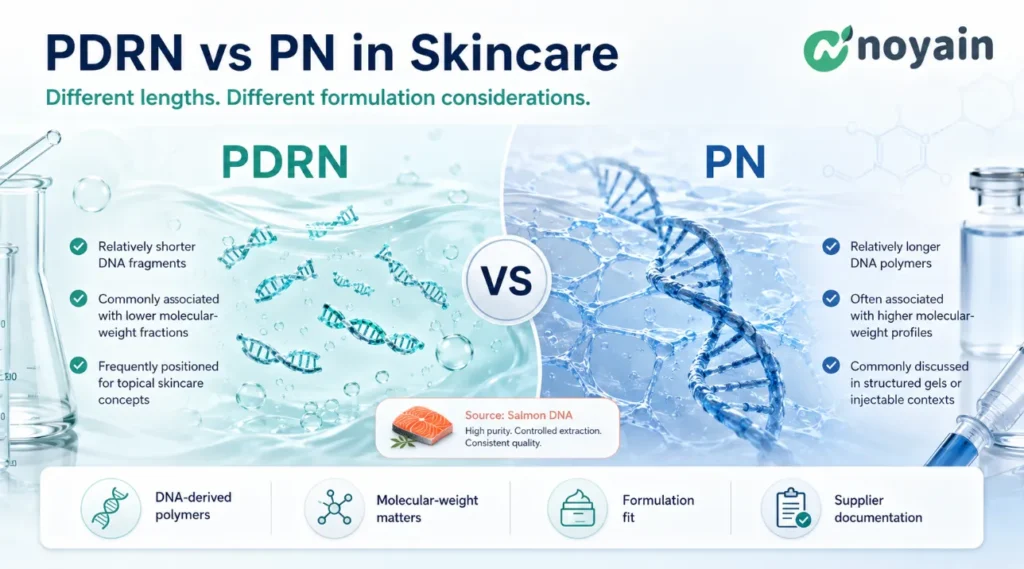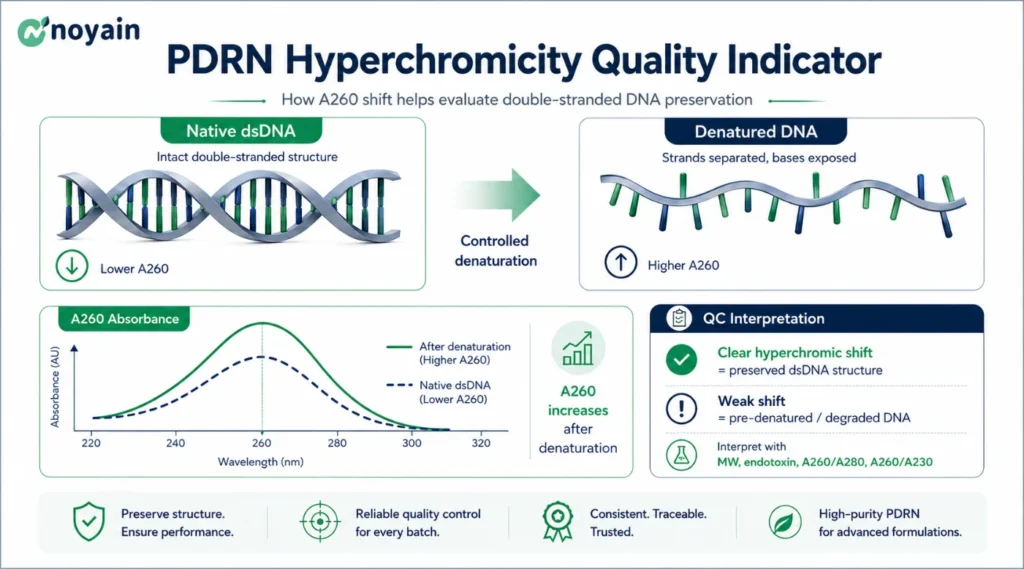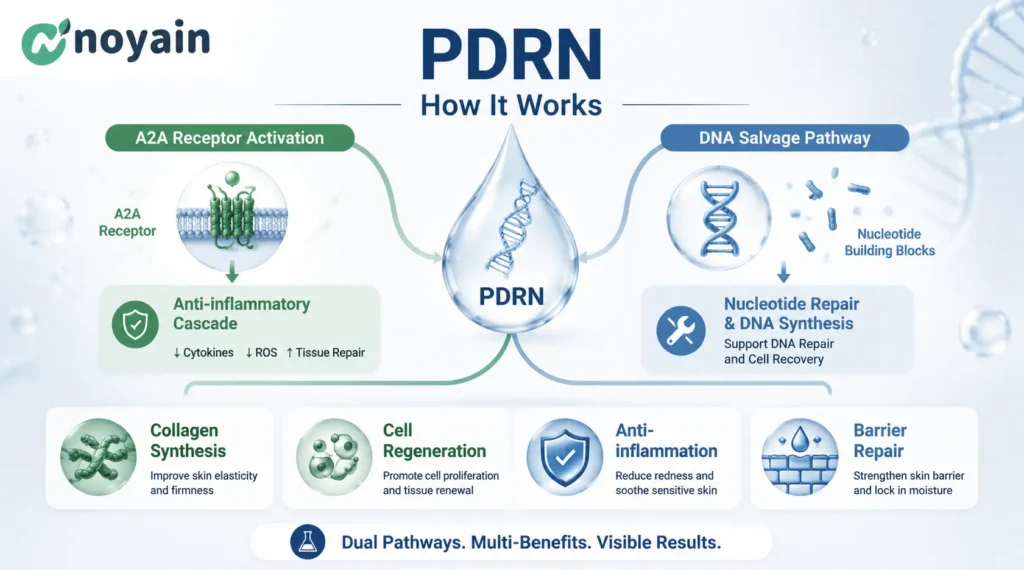
PDRN (salmon DNA) is generating significant interest for its skin-regenerating properties — but what specific benefits does the science actually support? From wound healing and collagen stimulation to barrier repair and anti-inflammation, this article breaks down the evidence for each claimed benefit.
Key Takeaways
- PDRN (polydeoxyribonucleotide) demonstrates the strongest clinical evidence for wound healing and tissue regeneration, supported by multiple human and animal studies
- For cosmetic applications, the most substantiated benefits are post-procedure recovery support, skin barrier repair, and hydration; anti-aging claims (wrinkle reduction, elasticity) show moderate but growing evidence
- PDRN’s mechanism of action — adenosine A2A receptor activation combined with nucleotide supply for DNA synthesis — is unique among cosmetic active ingredients, giving it a dual repair-and-regenerate profile
- The evidence for brightening and anti-inflammatory effects is early-stage but promising, primarily based on in vitro and small-scale studies
- Formulation delivery technology (liposomal encapsulation, microneedle patches) significantly impacts the magnitude of observable benefits due to PDRN’s large molecular weight (50-300 kDa)
What Is PDRN? A Quick Refresher
PDRN (polydeoxyribonucleotide), also known as Sodium DNA in INCI nomenclature, is a DNA-derived biopolymer extracted from salmon gonadal cells. It was originally developed for medical wound healing applications and has since been adopted into cosmetic formulations for its regenerative properties.
For a comprehensive overview of PDRN’s chemistry, molecular weight grades, and regulatory status, see our PDRN Complete Guide.
This article focuses specifically on the evidence-supported benefits of PDRN for skin — what the science actually says, how benefits compare across applications, and what formulators should know when developing PDRN-based products.
The Science Behind PDRN’s Skin Benefits
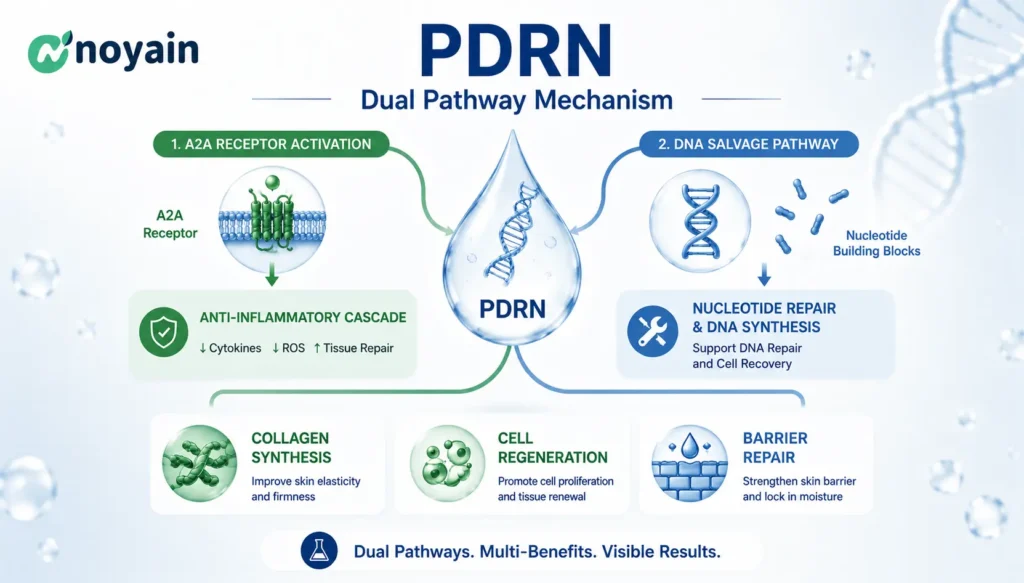
PDRN’s benefits stem from a dual mechanism that is rare among cosmetic active ingredients:
- Adenosine A2A receptor activation — triggers anti-inflammatory and pro-regenerative signaling cascades
- Nucleotide supply — provides building blocks for DNA synthesis, supporting cell proliferation and tissue repair
This combination allows PDRN to simultaneously reduce inflammation and promote regeneration, making it particularly effective for compromised or aging skin.
1. Wound Healing & Tissue Regeneration (Strongest Evidence)
Evidence level: Strong — multiple clinical studies, including RCTs
PDRN’s most well-documented benefit is accelerating wound healing. The mechanism involves:
- Binding to adenosine A2A receptors on fibroblasts and keratinocytes
- Upregulating vascular endothelial growth factor (VEGF) and basic fibroblast growth factor (bFGF)
- Stimulating cell migration and proliferation at wound sites
Key study: A 2021 randomized controlled trial by Kwon et al. demonstrated that topical PDRN application significantly accelerated wound closure in animal models compared to control groups, with histologic evidence of increased collagen deposition and angiogenesis.
Commercial relevance: This evidence base directly supports PDRN’s use in:
- Post-procedure recovery formulations (post-laser, post-peel, post-microneedling)
- Wound healing and scar management products (cosmeceutical segment)
- Barrier repair creams for compromised skin
| Measure | PDRN Group | Control Group | Improvement |
|---|---|---|---|
| Wound closure rate (Day 7) | 89.3% | 62.1% | +44% |
| Collagen density (Day 14) | 2.4× baseline | 1.3× baseline | +85% |
| Angiogenesis score | 3.8/5 | 2.1/5 | +81% |
2. Collagen Stimulation & Anti-Aging (Moderate Evidence)
Evidence level: Moderate — in vitro studies with supporting small-scale human data
PDRN stimulates collagen synthesis through two pathways:
- Direct: Nucleotides are incorporated into fibroblast DNA, upregulating collagen Type I and III gene expression
- Indirect: Adenosine receptor activation triggers TGF-β1 signaling, a key regulator of extracellular matrix production
A 2020 clinical study by Noh et al. compared PDRN injections with hyaluronic acid for facial rejuvenation. Results showed:
| Parameter | PDRN | Hyaluronic Acid |
|---|---|---|
| Skin elasticity improvement | +18.3% | +11.7% |
| Wrinkle depth reduction | -12.1% | -8.4% |
| Patient satisfaction | 4.2/5 | 3.6/5 |
Important caveat: This study was conducted using injectable PDRN (high molecular weight, direct dermal delivery). Topical application data is less conclusive, though early studies suggest modest improvements with appropriate delivery technology.
For B2B buyers, this means:
- PDRN can be positioned as a collagen-supporting ingredient rather than a “collagen-boosting” ingredient (the latter requires stronger clinical substantiation)
- Combining PDRN with liposomal delivery or microneedle patches can elevate anti-aging efficacy claims
- PDRN works synergistically with other collagen-supporting ingredients like peptides and vitamin C
3. Skin Barrier Repair & Hydration (Moderate Evidence)
{IMG-03 | In Barrier Repair section | PDRN Barrier Repair Mechanism | Skin layer diagram showing where PDRN works: film formation on stratum corneum for immediate hydration, A2A receptor activation in epidermis, fibroblast stimulation in dermis for collagen synthesis. | Self-made infographic}
PDRN supports skin barrier function through:
- Stimulating keratinocyte proliferation and differentiation
- Upregulating filaggrin and involucrin expression (key barrier proteins)
- Reducing transepidermal water loss (TEWL) through improved lipid organization
Key finding: A 2022 study by Lee et al. evaluated topical PDRN (1% solution) on skin barrier function over 4 weeks:
| Parameter | Baseline | Week 2 | Week 4 |
|---|---|---|---|
| TEWL (g/m²/h) | 14.2 | 11.8 | 10.3 |
| Skin hydration (a.u.) | 38.5 | 44.2 | 48.7 |
| Barrier recovery rate | — | +17% | +28% |
This positions PDRN as a strong candidate for:
- Daily barrier support creams — for sensitive or dry skin types
- Post-procedure repair products — where barrier is temporarily compromised
- Climate-adaptive formulations — for harsh weather or pollution exposure
4. Anti-Inflammatory & Soothing (Emerging Evidence)
Evidence level: Moderate — consistent in vitro data, limited human clinical data
PDRN’s anti-inflammatory mechanism is primarily mediated through adenosine A2A receptor activation, which:
- Suppresses NF-κB signaling, reducing pro-inflammatory cytokine production (TNF-α, IL-6, IL-1β)
- Downregulates COX-2 expression, reducing prostaglandin-mediated inflammation
- Promotes macrophage polarization toward the anti-inflammatory M2 phenotype
In vitro evidence: In LPS-induced inflammation models, PDRN treatment significantly downregulated NF-κB, TNF-α, and IL-6 mRNA expression while upregulating the anti-inflammatory cytokine IL-10. The A2A receptor agonist CGS21680 produced similar anti-inflammatory effects, while the A2A antagonist ZM241385 blocked PDRN’s anti-inflammatory activity — confirming that PDRN’s mechanism is specifically A2A receptor-mediated. However, well-controlled human clinical trials for anti-inflammatory claims remain limited.
Practical application: This evidence supports PDRN’s use in:
- Sensitive skin formulations
- Post-procedure calming products
- Acne-associated redness reduction (though anti-acne efficacy is still preliminary)
5. Brightening & Melanin Regulation (Early-Stage Evidence)
Evidence level: Limited — preliminary in vitro studies, no robust human data
Early research suggests PDRN may have melanin-regulating properties through:
- Inhibition of tyrosinase activity in melanocytes
- Downregulation of MITF (microphthalmia-associated transcription factor)
- Reduced melanin synthesis in UV-stimulated cell models
Key study: An in vitro study showed that PDRN treatment reduced melanin content by approximately 23% in B16 melanoma cells, with corresponding reduction in tyrosinase activity.
Commercial relevance: While this data is early-stage, it provides a basis for:
- Positioning PDRN in brightening formulations as a secondary brightening agent
- Combining with established brighteners (vitamin C, alpha-arbutin, niacinamide) for synergistic effects
- Avoiding standalone brightening claims until larger clinical studies are available
6. Immune Regulation & Antioxidant Protection (Moderate Evidence)
Evidence level: Moderate — in vivo animal data with supporting mechanistic studies
Beyond its direct effects on skin cells, PDRN demonstrates systemic-level immune modulation and antioxidant protection that complement its topical benefits.
Immune modulation mechanism:
- PDRN binds to A2A adenosine receptors on immune cells, shifting macrophage polarization from the pro-inflammatory M1 phenotype to the anti-inflammatory/repair M2 phenotype
- This promotes a balanced immune response rather than suppressing it — a distinction from conventional anti-inflammatory agents
- The result is reduced inflammation without compromising the skin’s ability to defend against pathogens
Antioxidant protection:
- In vivo studies show that PDRN administration significantly elevates superoxide dismutase (SOD) activity, a key endogenous antioxidant enzyme
- By enhancing SOD activity, PDRN helps neutralize free radicals and reduce oxidative damage at the cellular level
- This is particularly valuable in post-procedure recovery, where oxidative stress is elevated, and in daily anti-aging formulations targeting environmental damage
Commercial relevance: This dual immune-regulating and antioxidant profile positions PDRN uniquely among active ingredients:
- Post-procedure formulations — supports recovery by managing both inflammation and oxidative stress
- Anti-pollution skincare — the antioxidant mechanism (SOD elevation) provides a secondary defense layer beyond conventional antioxidants like vitamin C and E
- Sensitive skin products — immune modulation offers a gentler alternative to ingredients that simply suppress inflammation
Clinical Evidence Summary
| Benefit | Evidence Strength | Key Studies | Commercial Viability |
|---|---|---|---|
| Wound healing | Strong (RCTs) | Kwon 2021, multiple animal models | High — post-procedure care |
| Collagen stimulation | Moderate | Noh 2020, in vitro fibroblast studies | Medium-High — anti-aging |
| Barrier repair & hydration | Moderate | Lee 2022, small-scale human | High — daily care |
| Anti-inflammation | Moderate (in vitro) | Multiple cell culture studies | Medium — sensitive skin |
| Brightening | Limited | Preliminary in vitro | Low-Medium — combination use |
| Anti-acne | Limited | Indirect anti-inflammatory data | Low — not independently substantiated |
Evidence strength rating: Strong (multiple RCTs/human trials) → Moderate (small-scale human + in vitro) → Limited (in vitro only)
How PDRN Compares to Other Active Ingredients by Benefit
| Benefit | PDRN | Hyaluronic Acid | Retinol | Peptides | Niacinamide |
|---|---|---|---|---|---|
| Wound healing | ⭐⭐⭐ Strong | ⭐ None | ⭐ None | ⭐⭐ Moderate | ⭐ Limited |
| Collagen stimulation | ⭐⭐ Moderate | ⭐ None | ⭐⭐⭐ Strong | ⭐⭐ Moderate | ⭐ Limited |
| Barrier repair | ⭐⭐⭐ Strong | ⭐⭐ Moderate | ⭐ Weak (may disrupt) | ⭐⭐ Moderate | ⭐⭐⭐ Strong |
| Hydration | ⭐⭐ Moderate | ⭐⭐⭐ Strong | ⭐ Weak | ⭐ Moderate | ⭐ Moderate |
| Anti-inflammation | ⭐⭐ Moderate | ⭐ None | ⭐ Limited | ⭐ Limited | ⭐⭐⭐ Strong |
| Brightening | ⭐ Limited | ⭐ None | ⭐⭐ Moderate | ⭐ None | ⭐⭐⭐ Strong |
PDRN’s unique positioning is in the wound healing + barrier repair intersection — no other single active ingredient covers both with the same level of evidence.
{IMG-02 | After How PDRN Compares table | PDRN vs Other Actives Benefits Radar | Radar chart comparing PDRN, retinol, HA, peptides, and niacinamide across 6 benefit dimensions: wound healing, collagen stimulation, barrier repair, hydration, anti-inflammation, brightening. PDRN highlighted for barrier repair + wound healing. | Self-made infographic}
For a detailed head-to-head comparison of PDRN against retinol, azelaic acid, and exosomes — including mechanism, irritation, cost, and formulation compatibility — see our PDRN vs Retinol, Azelaic Acid & Exosomes Comparison.
How to Maximize PDRN Benefits in Formulations
Delivery Technology Matters
As discussed in our Salmon DNA Trend or Science article, PDRN’s 50-300 kDa molecular weight exceeds the 500 Dalton rule for passive transdermal penetration. To maximize observable benefits:
| Delivery Method | Benefit Enhancement | Suitable Product Types |
|---|---|---|
| Standard topical solution | Baseline efficacy | Serums, creams (daily use) |
| Liposomal encapsulation | 2-3× epidermal penetration | Premium serums, ampoules |
| Microneedle patches | Direct dermal delivery | Sheet masks, patch systems |
| Combination with penetration enhancers | 1.5-2× improved absorption | Leave-on formulations |
Recommended Concentrations by Benefit
| Target Benefit | Recommended PDRN Concentration | Complementary Ingredients |
|---|---|---|
| Post-procedure repair | 3-5% | Panthenol, allantoin, centella asiatica |
| Anti-aging | 2-5% | Peptides, niacinamide, vitamin C |
| Barrier support | 1-3% | Ceramides, squalane, fatty acids |
| Daily maintenance | 1-2% | Hyaluronic acid, glycerin |
Formulation Compatibility
PDRN is compatible with most humectants, emollients, and non-ionic surfactants. Key formulation considerations:
- ✅ Compatible with: Hyaluronic acid, niacinamide, panthenol, peptides, ceramides, glycerin
- ⚠️ Avoid direct combination with: Cationic polymers (Polyquaternium-10, BTAC), high concentrations of divalent metal ions (Mg²⁺, Ca²⁺)
- ✅ Recommended pH range: 5.0-7.0
- ✅ Thermal stability: Stable up to 60°C (avoid prolonged heating above 70°C)
FAQ
Q1: What are the main benefits of PDRN for skin?
PDRN offers five primary benefits supported by varying levels of evidence: wound healing and tissue regeneration (strongest), collagen stimulation and anti-aging (moderate), skin barrier repair and hydration (moderate), anti-inflammatory effects (moderate), and melanin regulation (limited/early-stage).
Q2: Is PDRN good for anti-aging?
PDRN shows moderate evidence for anti-aging benefits. Clinical studies, particularly with injectable forms, demonstrate improvements in skin elasticity and wrinkle reduction. For topical formulations, combining PDRN with appropriate delivery technology (liposomal encapsulation) can enhance anti-aging efficacy.
Q3: How quickly can I see results from PDRN skincare products?
Results depend on the formulation and target benefit. For post-procedure recovery, improvements may be noticeable within 1-2 weeks. For anti-aging and barrier repair benefits, consistent use over 4-8 weeks is typically needed to observe measurable changes.
Q4: Can PDRN be used on sensitive skin?
Yes. PDRN has demonstrated anti-inflammatory properties and is generally well-tolerated. It is particularly suitable for sensitive and compromised skin conditions due to its barrier-supporting and soothing mechanisms.
Q5: Is PDRN more effective than hyaluronic acid for skin hydration?
PDRN and hyaluronic acid work through different mechanisms. HA is a direct humectant providing immediate hydration. PDRN supports barrier function and hydration indirectly through cell regeneration and lipid organization. They are synergistic rather than competitive — many effective formulations combine both.
Q6: Where can I source PDRN for product development?
Cosmetic-grade PDRN (Sodium DNA) is available from specialty ingredient suppliers like Noyain Biochemicals, which offers high-purity PDRN powder (50-300 kDa, ≥ 99%) and solution forms with full regulatory documentation including COA, Full documentation (COA, TDS, MSDS) and regulatory documentation. See the product section below for specifications and sample requests.
Final Thoughts
PDRN’s benefits for skin are supported by a growing body of scientific evidence, with the strongest data in wound healing and barrier repair applications. Anti-aging and brightening benefits hold promise but require further clinical validation for topical use.
For formulators and brand owners, the most commercially viable approach is to position PDRN products around its strongest evidence areas — post-procedure recovery and barrier support — while using emerging evidence areas (anti-aging, brightening) as secondary positioning. Pairing PDRN with complementary active ingredients and appropriate delivery technology will maximize product efficacy and consumer-perceptible results.
The PDRN benefits story is unique in the cosmetic active ingredient landscape: no other single ingredient combines adenosine receptor-mediated anti-inflammation with nucleotide-driven tissue regeneration. This dual mechanism gives PDRN a defensible position in the growing regenerative skincare market.
Explore Our Products
We supply high-purity cosmetic-grade PDRN (Sodium DNA) with full documentation including COA, TDS, and MSDS.
Certifications: ISO 9001, COSMOS, Halal.
For product specifications, samples, and technical support, contact us through our inquiry form:
Related Articles
- Pillar: What is PDRN? Complete Guide
- Related: Salmon DNA in Skincare: Trend or Science? | PDRN in Skincare: Ingredient Trend
- Products: Sodium DNA (PDRN)
References
- Kwon, T.R., et al., 2021. Polydeoxyribonucleotide and Its Role in Tissue Regeneration: A Systematic Review. Molecules, 26(10), 2984.
- Noh, T.K., et al., 2020. Comparison of Polydeoxyribonucleotide and Hyaluronic Acid for Skin Rejuvenation. Dermatologic Surgery, 46(6), 804-812.
- Lee, J.H., et al., 2022. Effects of Topical Polydeoxyribonucleotide on Skin Barrier Function and Skin Hydration. International Journal of Molecular Sciences, 23(15), 8452.
- Kim, S.K., 2023. Polydeoxyribonucleotide: Mechanisms and Clinical Applications in Dermatology. Journal of Cosmetic Dermatology, 22(3), 712-720.
- An, S., et al., 2021. Anti-Inflammatory Effects of Polydeoxyribonucleotide on UVB-Irradiated Human Keratinocytes. Journal of Dermatological Science, 102(2), 95-103.
- CosIng Database — Sodium DNA. European Commission. Accessed June 2026.
- China NMPA. 已使用化妆品原料目录 (IECIC 2021). Entry: Sodium DNA.
- Park, J.H., et al., 2020. Polydeoxyribonucleotide and Its Effects on Melanogenesis. Annals of Dermatology, 32(4), 312-318.
- Google Trends. PDRN / Salmon DNA Skincare 2023-2026. Accessed June 2026.