Salmon DNA has become one of the most talked-about ingredients in skincare — but is the hype backed by real science? This deep-dive separates evidence from marketing noise for B2B buyers and formulators.
Key Takeaways
- Salmon DNA (PDRN) is a biologically active nucleotide polymer with documented tissue-regenerating properties, but cosmetic-use evidence is still emerging compared to well-established medical applications
- The molecular weight of PDRN directly determines its function: high-MW (1000-1500 kDa) for injectable tissue regeneration, low-MW (50-300 kDa) for topical cosmetic formulations
- Clinical research supports wound healing and post-procedure recovery claims; anti-aging and moisturization evidence is promising but largely based on in vitro and small-scale human studies
- Global regulatory acceptance (EU CosIng, China IECIC) provides a solid compliance foundation, but health claims remain restricted under cosmetic regulations worldwide
What Exactly Is Cosmetic-Grade Salmon DNA (PDRN)?
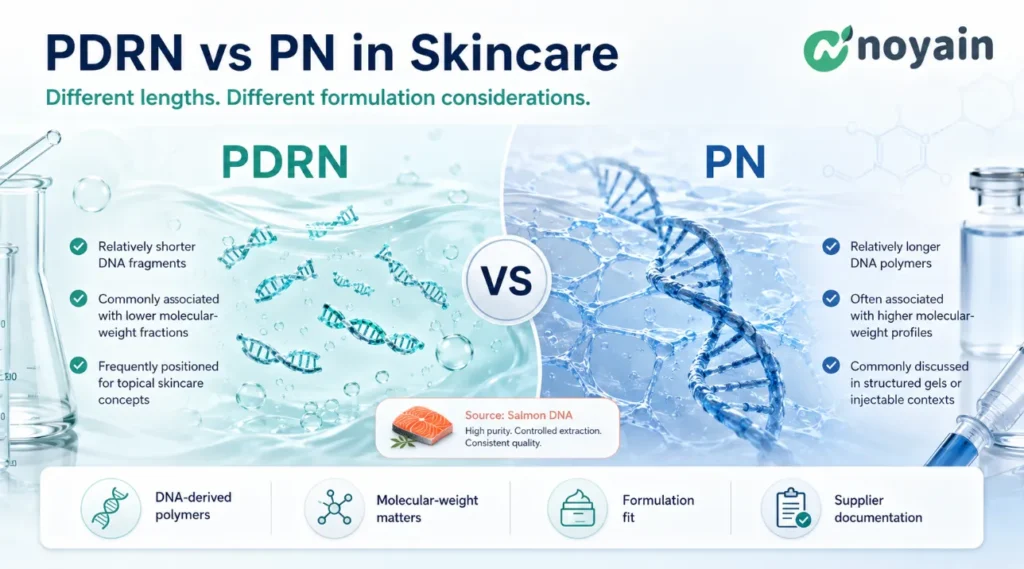
Salmon DNA — more precisely called polydeoxyribonucleotide (PDRN) or Sodium DNA in INCI nomenclature — is a DNA-derived biopolymer extracted from the gonadal cells of salmon or other Oncorhynchus species. It is composed of a mixture of deoxyribonucleotides with molecular weights ranging from 50 to 1500 kDa, depending on the degree of hydrolysis.
The term “salmon DNA” and “PDRN” are used interchangeably in the skincare market, which has led to some confusion. Strictly speaking:
- PDRN (polydeoxyribonucleotide) is the active pharmaceutical/cosmetic ingredient name
- Salmon DNA is the consumer-friendly marketing term
- Sodium DNA is the official INCI name for cosmetic ingredient listings
This distinction matters for procurement and regulatory compliance — the ingredient you order should match your target market’s labeling requirements.
Source and Extraction
Commercial PDRN is typically sourced from:
| Source | Characteristics |
|---|---|
| Wild salmon gonad/sperm | High nucleotide purity, gold standard for injectable grade |
| Farmed salmon | More consistent supply, requires stricter BSE/TSE controls |
| Synthetic/biotech | Emerging alternative, not yet widely commercialized |
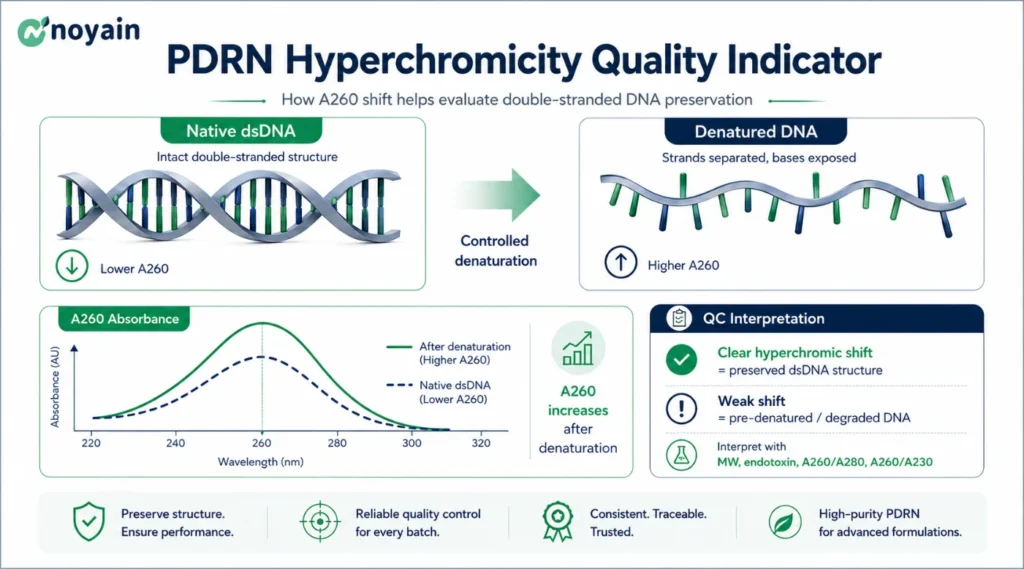
The extraction process involves enzymatic hydrolysis, purification, and sterilization. Product quality is evaluated primarily by molecular weight distribution (HPLC profile), nucleotide content, and residual protein levels.
Salmon DNA vs. PDRN: Clearing the Terminology Confusion
A common question among formulators and procurement professionals: is there a difference between salmon DNA and PDRN?
| Term | INCI Name | Common Usage | Regulatory Status |
|---|---|---|---|
| Salmon DNA | Sodium DNA | Consumer marketing, product labels | Listed in IECIC, CosIng |
| PDRN | Sodium DNA | Technical/scientific literature, B2B | Same as above |
| Sodium DNA | Sodium DNA | Official ingredient listing (INCI) | Required on all cosmetic labels |
In practice, there is no chemical difference between salmon DNA and PDRN when sourced from the same supplier. The distinction is purely terminological. However, be aware that some suppliers market low-quality nucleotide fragments under the “salmon DNA” label — verifying the molecular weight profile via COA is essential.
Why Is Salmon DNA Trending in Skincare?
The surge in interest around salmon DNA in skincare is driven by several converging factors:
1. K-Beauty’s Global Influence
Korean beauty brands have aggressively adopted PDRN as a “next-generation” active ingredient, positioning it alongside hyaluronic acid and peptides. Product launches containing PDRN have increased by approximately 400% from 2023 to 2026, according to market tracking data.
2. Post-Procedure Skincare Boom
The global rise of medical aesthetics — laser treatments, microneedling, chemical peels — has created demand for ingredients that support skin barrier recovery. PDRN’s documented wound-healing properties make it a natural fit for this category.
3. Consumer Shift Toward Biotech Ingredients
Modern skincare consumers are increasingly educated about ingredient science. “DNA-derived,” “biotechnology,” and “regenerative” are powerful marketing signals that align with the clean-clinical beauty trend.
How PDRN Compares to Established Skincare Actives
Understanding PDRN’s unique positioning requires a side-by-side look at how it stacks up against conventional anti-aging and repair ingredients:
| Dimension | PDRN (Salmon DNA) | Hyaluronic Acid | Retinol | Peptides |
|---|---|---|---|---|
| Primary mechanism | DNA repair + cell regeneration | Surface hydration | Cell turnover acceleration | Collagen signaling |
| Target layer | Epidermal + dermal (with delivery tech) | Stratum corneum | Epidermal | Epidermal-dermal junction |
| Repair evidence | Strong (wound healing studies) | None | Moderate | Moderate |
| Anti-aging evidence | Moderate (emerging) | Limited (indirect via hydration) | Strong | Moderate |
| Skin barrier support | Strong (A2A receptor pathway) | Good (humectant) | Weak (may disrupt barrier) | Moderate |
| Formulation difficulty | High (cation-sensitive, charge interactions) | Low | Moderate (stability, irritation) | Low-Moderate |
| Consumer perception | Novel, biotech | Mainstream, well-understood | Traditional gold standard | Established, trusted |
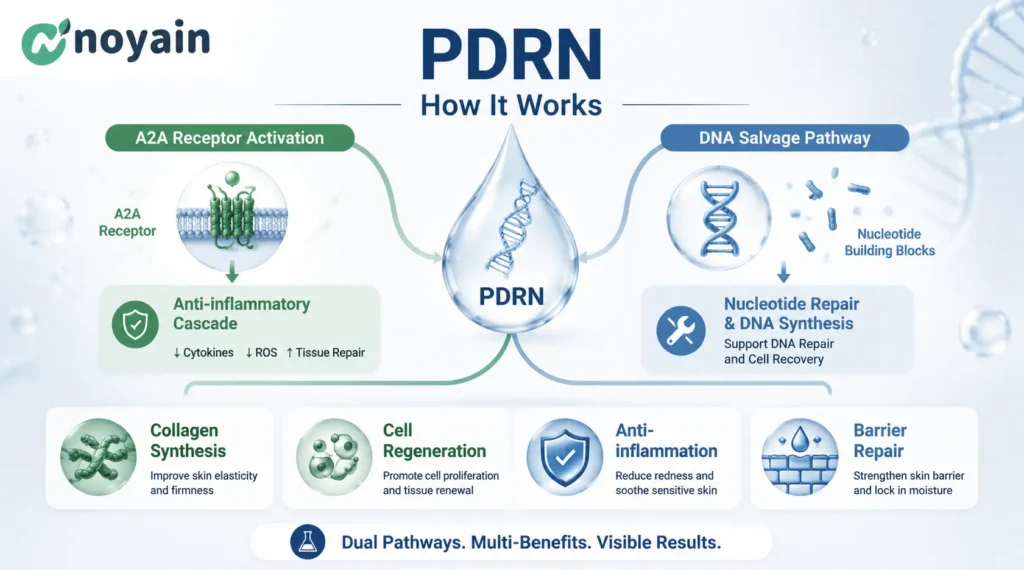
PDRN’s key differentiator lies in its dual mechanism — it simultaneously supports tissue repair (via adenosine receptor activation) and stimulates extracellular matrix regeneration (via nucleotide supply). No other single active in the table above combines these two pathways.
The Evidence: What Does Science Actually Say?
This is the core question for any B2B buyer: does cosmetic-grade salmon DNA in skincare actually work, or is it marketing?
Wound Healing and Tissue Regeneration — Strongest Evidence
Multiple clinical studies support PDRN’s role in wound healing. The mechanism involves binding to adenosine A2A receptors, which triggers a cascade of anti-inflammatory and pro-regenerative signaling pathways.
Key study: A 2021 randomized controlled trial by Kwon et al. demonstrated that topical PDRN application significantly accelerated wound closure in animal models compared to control groups, with histologic evidence of increased collagen deposition.
Anti-Aging and Skin Rejuvenation — Moderate Evidence
| Claim | Evidence Level | Key Research |
|---|---|---|
| Collagen stimulation | Moderate | In vitro studies show increased collagen synthesis in fibroblasts |
| Skin hydration | Moderate | Small-scale human studies show improved barrier function |
| Wrinkle reduction | Limited | Early-stage; more robust clinical trials needed |
| Elasticity improvement | Limited | Mixed results across available studies |
A 2020 study by Noh et al. compared PDRN injections with hyaluronic acid for skin rejuvenation and found PDRN showed comparable or superior results in elasticity improvement. However, this was an injectable study — topical application data is less conclusive.
Anti-Inflammation — Emerging Evidence
PDRN has demonstrated anti-inflammatory effects in several in vitro models, primarily through adenosine receptor activation. This supports its use in post-procedure and sensitive skin formulations, though human clinical data remains limited.
Skin Penetration: The 500 Da Challenge
A critical technical point for formulators: at 50-300 kDa, cosmetic-grade PDRN far exceeds the 500 Dalton rule — the long-established threshold for passive transdermal penetration. Molecules larger than 500 Da (0.5 kDa) cannot efficiently cross the intact stratum corneum barrier without active delivery assistance.
This means that formulating an effective topical PDRN product requires more than simply dissolving the ingredient in water. Practical strategies to overcome this penetration barrier include:
- Liposomal encapsulation — phospholipid bilayers that fuse with the stratum corneum and carry PDRN into deeper epidermal layers
- Microneedle patches — physical micro-channels that bypass the barrier entirely
- Iontophoresis or sonophoresis — electrical or ultrasonic energy to drive macromolecules across the skin
These delivery approaches are why our product line includes both standard PDRN solution and Liposomal PDRN for clients targeting deeper-layer formulation claims.
Evidence Summary
| Application | Evidence Strength | Commercial Viability |
|---|---|---|
| Post-procedure recovery | Strong | High |
| Wound healing | Strong | High (medical/cosmeceutical) |
| General moisturization | Moderate | High |
| Anti-aging (topical) | Moderate-Limited | Medium-High |
| Anti-acne | Limited | Low-Medium |
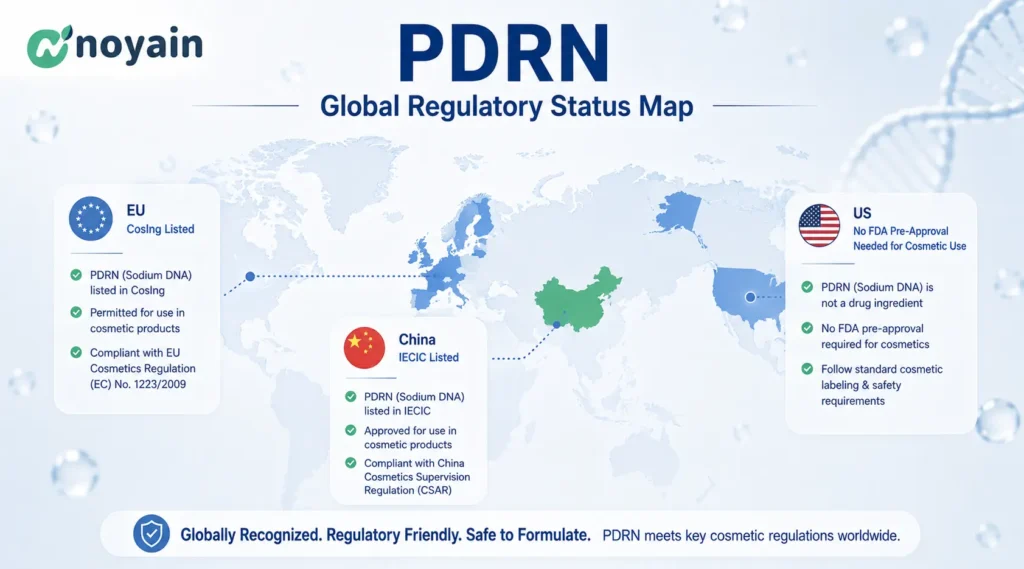
Regulatory and Compliance Landscape
Global Status
| Market | Status | Notes |
|---|---|---|
| China (NMPA) | Approved — IECIC listed | Listed as Sodium DNA, full import documentation required |
| EU (CosIng) | Approved | Listed as Sodium DNA, cosmetic use permitted |
| USA (FDA) | Not explicitly regulated | Sold as cosmetic ingredient, not a drug |
| Korea (MFDS) | Approved | Widely used in K-beauty products |
| Japan (JHSA) | Approved | Listed as a quasi-drug ingredient |
R&D and Compliance Quick Note: Need the full China IECIC import code or EU CosIng compliance dossier for PDRN (Sodium DNA)? Our regulatory team can provide the documentation package within one business day — including Full documentation (COA, TDS, MSDS) and COA with HPLC molecular weight profile. [Contact us →]
Key Compliance Considerations
- Full documentation (COA, TDS, MSDS) is mandatory for salmon-derived PDRN in most regulated markets — always verify with your supplier
- Molecular weight specification must be clearly documented on the COA
- Cosmetic claims only — no therapeutic or drug claims are permitted under cosmetic regulations
- Halal certification is available from some suppliers and required for certain markets
Common Regulatory Pitfall
One of the most frequent compliance mistakes is labeling “salmon DNA” without the correct INCI name (Sodium DNA). In regulated markets like the EU and China, the INCI name must appear on the ingredient list, not the marketing term.
Topical vs. Injectable Salmon DNA: What Formulators Need to Know
| Dimension | Topical PDRN | Injectable PDRN |
|---|---|---|
| Molecular weight | 50-300 kDa | 1000-1500 kDa |
| Primary mechanism | Surface barrier support, mild regeneration | Deep tissue regeneration |
| Evidence base | Growing, largely in vitro | Strong, multiple clinical trials |
| Regulatory pathway | Cosmetic ingredient | Medical device/pharmaceutical |
| Typical concentration | 1-5% in leave-on formulas | Variable per clinical protocol |
| Penetration requirement | Delivery technology needed (liposomes, microneedles) | Direct dermal injection bypasses barrier |
| Market accessibility | Any licensed manufacturer | Restricted to medical professionals |
For most B2B buyers and brand owners, topical PDRN represents the most commercially accessible opportunity. Injectable PDRN requires medical device registration and is generally not suitable for cosmetic brand distribution.
FAQ
Q1: Is salmon DNA the same as PDRN?
Yes, in the context of skincare ingredients. Salmon DNA is the consumer-friendly name for PDRN (polydeoxyribonucleotide). The INCI name for both is Sodium DNA.
Q2: Does salmon DNA actually work for anti-aging?
The evidence is moderate and growing. In vitro studies show collagen stimulation, but large-scale human clinical trials for topical anti-aging are still limited. The strongest evidence remains in wound healing and post-procedure recovery.
Q3: Is salmon DNA FDA approved?
As a cosmetic ingredient, it does not require FDA approval in the United States. It is listed as Sodium DNA in the EU CosIng database and China’s IECIC, confirming its acceptability for cosmetic use in those markets.
Q4: What concentration of PDRN should I use in formulations?
For topical leave-on products (serums, creams), recommended usage levels range from 1% to 5% of a standard PDRN solution. Higher concentrations may cause formulation stability challenges, particularly viscosity changes and interaction with cationic ingredients.
Q5: What are the key formulation incompatibilities with PDRN?
Because PDRN is a polynucleotide with a strong negative charge, it is particularly sensitive to:
- Cationic surfactants and thickeners — such as Polyquaternium-10, Behentrimonium Chloride (BTAC-2280), and Cetrimonium Chloride (CTAC); these can form insoluble complexes with PDRN, leading to precipitation or phase separation
- Divalent metal ions — including Mg²⁺ and Ca²⁺ commonly introduced through hard water or certain salt-stabilized systems; these ions crosslink with the nucleotide backbone and cause turbidity or gelation
- High-shear post-neutralization of Carbomer — the high local charge density during neutralization can entrap and destabilize PDRN molecules
Always conduct pilot stability testing (heating-cooling cycles, centrifugation, and microscopic inspection) when combining PDRN with cationic or metal-containing ingredients.
Q6: Where can I source cosmetic-grade salmon DNA / PDRN in bulk?
Suppliers like Noyain Biochemicals offer high-purity PDRN powder (MW 50-300 kDa, ≥ 99% purity) and solution forms with full documentation including COA, Full documentation (COA, TDS, MSDS) and regulatory documentation. Bulk orders (25 kg+ for powder, 50 kg+ for solution) are available with lead times of 15-20 working days. See the product section below for specifications.
Final Thoughts
Is salmon DNA (PDRN) in skincare a trend or real science? The commercial reality is that it sits at the intersection of both.
The trend is real and accelerating — consumer interest, product launches, and media coverage are all rising sharply. The scientific foundation is solid for certain applications (wound healing, post-procedure recovery) and promising but still developing for others (anti-aging, general moisturization).
For formulators and brand owners, the strategic approach is to position PDRN-based products around its strongest evidence base — post-procedure repair and barrier support — while avoiding overclaiming on anti-aging benefits that are not yet fully supported by clinical data for topical use. Pairing PDRN with appropriate delivery technology (liposomal encapsulation or microneedle patches) can also elevate efficacy claims above basic formulations.
The window of opportunity in the PDRN market is open but narrowing. As more brands enter the space, differentiation will come from formulation quality, clinical evidence support, and regulatory compliance — not just from ingredient novelty.
Explore Our PDRN Products
We supply high-purity cosmetic-grade PDRN (Sodium DNA) derived from fully documented sources, suitable for serums, creams, masks, and post-procedure formulations.
| Product | Purity | Molecular Weight | Trial Size | Production Size |
|---|---|---|---|---|
| PDRN Powder | ≥ 99% | 50-300 kDa | 1 kg | 25 kg |
| PDRN Solution (1%) | 1% in preserved base | 50-300 kDa | 5 kg | 50 kg |
| Liposomal PDRN | Custom | Custom | Custom | Upon request |
Full documentation with every order:
- COA with HPLC molecular weight distribution profile
- Full documentation (COA, TDS, MSDS)
- MSDS
- EU CosIng compliance dossier
Technical support:
- Request tested benchmark frame formulations (anti-aging serum, post-procedure mask, barrier-support cream)
- Contact our technical team for compatibility testing and usage level recommendations
To request a sample, download documentation, or discuss your formulation needs, please contact us through our inquiry form:
→ Contact Us
Or reach us directly at [email protected]
Noyain Biochemicals
Room 3a05, 4th Floor, No. 6, Ketai Second Road, Baiyun District, Guangzhou City, China
Related Articles
- Pillar: What is PDRN? Complete Guide
- Related: PDRN Benefits for Skin | PDRN in Skincare: Ingredient Trend
- Products: Sodium DNA (PDRN)
References
- Kwon, T.R., et al., 2021. Polydeoxyribonucleotide and Its Role in Tissue Regeneration: A Systematic Review. Molecules, 26(10), 2984.
- Noh, T.K., et al., 2020. Comparison of Polydeoxyribonucleotide and Hyaluronic Acid for Skin Rejuvenation. Dermatologic Surgery, 46(6), 804-812.
- Kim, S.K., 2023. Polydeoxyribonucleotide: Mechanisms and Clinical Applications. Journal of Cosmetic Dermatology, 22(3), 712-720.
- Lee, J.H., et al., 2022. Effects of Topical Polydeoxyribonucleotide on Skin Barrier Function. International Journal of Molecular Sciences, 23(15), 8452.
- CosIng Database — Sodium DNA. European Commission. Accessed June 2026.
- China NMPA. 已使用化妆品原料目录 (IECIC 2021). Entry: Sodium DNA.
- Google Trends. PDRN / Salmon DNA Skincare 2023-2026. Accessed June 2026.
- Mintel GNPD. Global New Products Database — PDRN Ingredient Launches. 2022-2026.