Pentylene glycol is one of the most versatile ingredients in modern skincare formulation — but what exactly is it, and when should you use it over other glycols? This guide covers everything formulators need to know.
Key Takeaways
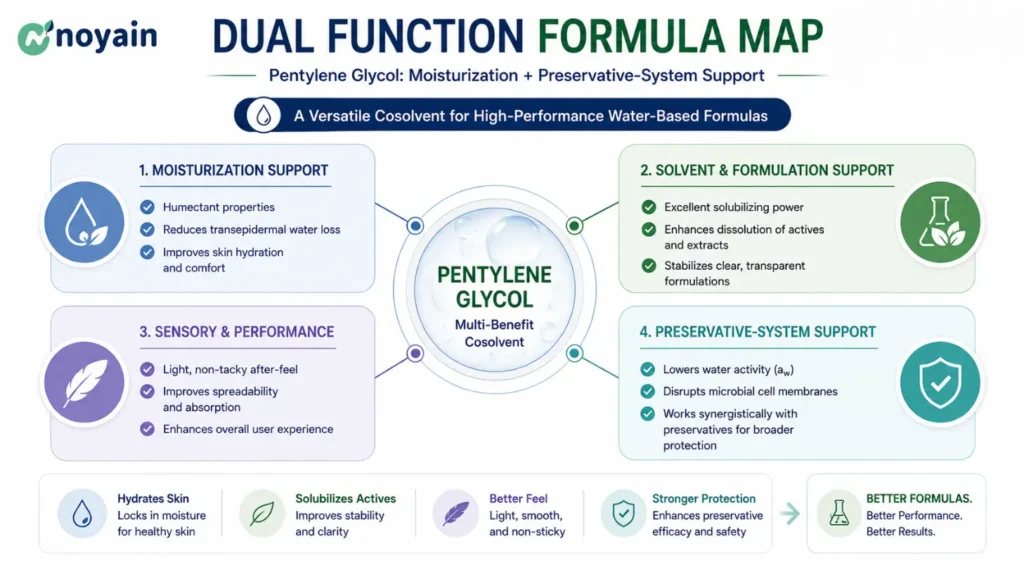
- Pentylene glycol (C5H12O2) is a 1,2-pentanediol that serves four key functions: humectant, antimicrobial preservative booster, solvent, and texture enhancer
- Its antimicrobial mechanism is cell membrane disruption (not water activity reduction)—as an amphiphilic diol, it penetrates and lyses microbial cell membranes at low concentrations of 3-5%
If you are developing a preservative system, we recommend considering pentylene glycol as your primary booster. You will benefit from the same cell membrane-disrupting mechanism as traditional preservatives, but with a much milder skin compatibility profile — a trade-off your customers will notice and appreciate.
- Naturally-derived versions are upcycled from sugarcane and corn by-products, making them COSMOS and ISO 16128 compliant
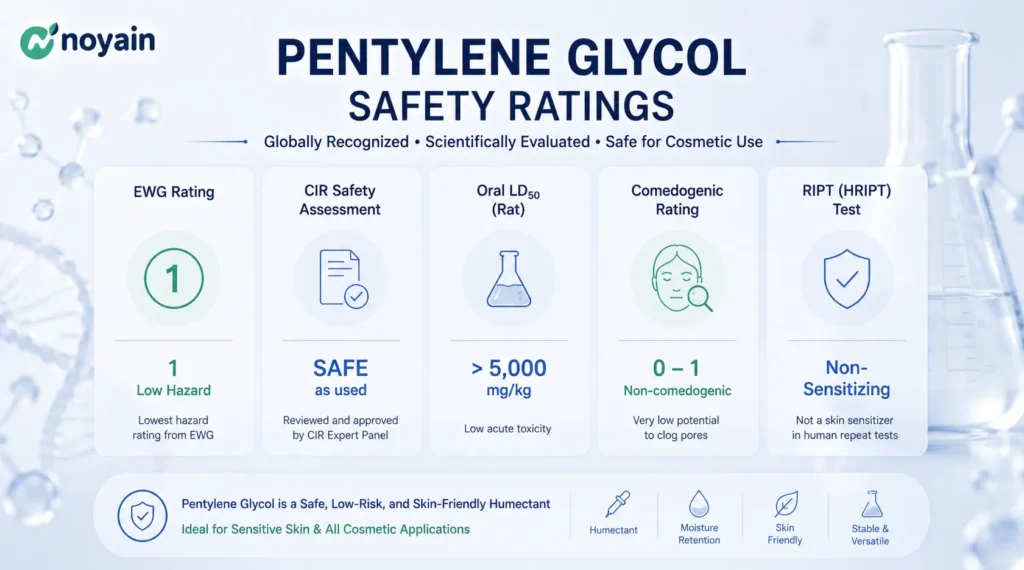
- The Cosmetic Ingredient Review (CIR) expert panel considers it safe for use in cosmetics at concentrations up to 5%
- It enhances sunscreen water resistance by preventing UV filter recrystallization and promoting uniform film formation—a unique advantage for SPF formulations
What is Pentylene Glycol?
Pentylene glycol (INCI: Pentylene Glycol, also known as 1,2-pentanediol) is a 5-carbon diol with the molecular formula C5H12O2. It is a clear, colorless, slightly viscous liquid.
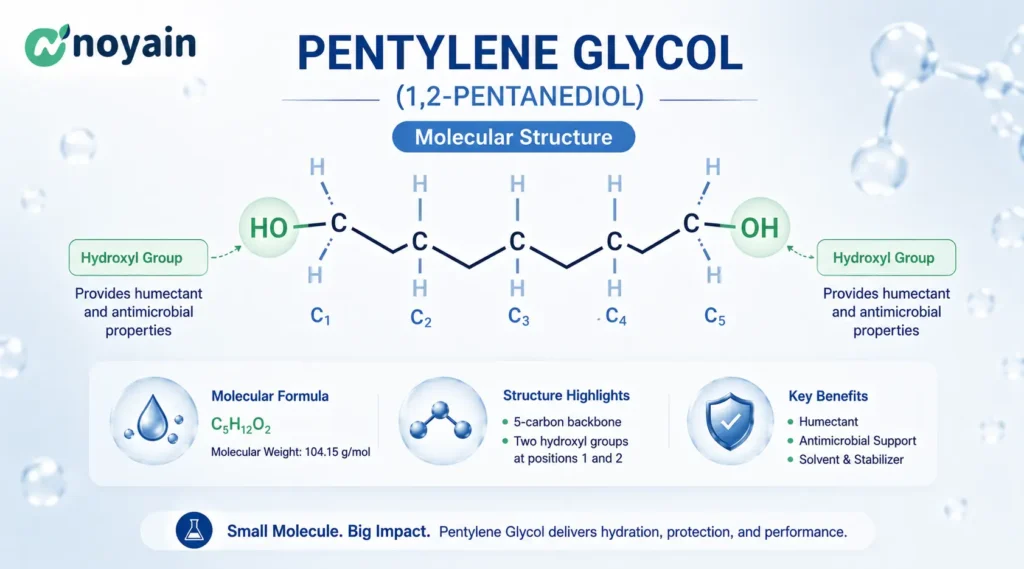
In cosmetic formulations, pentylene glycol serves four primary functions:
Think of pentylene glycol as a multi-tool for formulators — it does several jobs at once, and does most of them well. Unlike single-function ingredients that only moisturize or only preserve, this small molecule earns its place in a formula by contributing to hydration, preservation, texture, and stability simultaneously.
1. Hydration (Humectant) — Attracts and binds water to the skin, making it an effective moisturizer that leaves a light, non-greasy feel.
2. Antimicrobial (Preservative Booster) — Helps preserve products by inhibiting the growth of bacteria and fungi. At concentrations of 3-5%, it allows formulators to reduce or replace traditional preservatives.
3. Solvent & Penetration Booster — Dissolves hard-to-mix ingredients and helps active ingredients penetrate deeper into the skin.
4. Texture Enhancer — Improves the overall feel of lotions and creams, and enhances the water resistance of sunscreens.
Origin: Natural vs. Synthetic
Pentylene glycol can be produced through two pathways:
| Origin | Source | Certification Compatibility |
|---|---|---|
| Naturally-derived | Upcycled from renewable resources (sugarcane, corn by-products) | COSMOS, Ecocert, Natrue, ISO 16128 |
| Synthetic | Petroleum-based | Conventional cosmetics |
Many premium cosmetic brands now use naturally-derived pentylene glycol made from upcycled sugarcane and corn by-products—a more sustainable choice that reduces waste and supports the circular economy.
Quick Specs:
| Parameter | Information |
|---|---|
| INCI Name | Pentylene Glycol |
| CAS Number | 5343-92-0 |
| Molecular Formula | C5H12O2 |
| Appearance | Clear, colorless liquid |
| Odor | Low-odor grade (proprietary multi-stage vacuum distilled) |
| Solubility | Water-soluble, alcohol-soluble |
| Recommended dosage | 1-5% (optimal: 3-4%) |
| CIR-approved max | Up to 5% |
| Preservative booster threshold | ≥ 3% |
| Bio-based content | 100% (upcycled sugarcane/corn) |
| COSMOS compliance | ✅ Yes (naturally-derived) |
| IECIC (China) | ✅ Listed |
Why Use Pentylene Glycol in Formulations?
Here are five reasons to formulate with pentylene glycol:
{IMG-02 | Before Benefits section | Pentylene Glycol vs Other Glycols | Comparison infographic showing pentylene glycol vs propylene glycol vs butylene glycol vs glycerin across: function, humectancy, preservative boost, skin feel, COSMOS status, recommended usage. | Self-made infographic}
1. It’s a True Multifunctional Ingredient
Unlike single-function ingredients, pentylene glycol delivers hydration, preservation boosting, solvent capability, and texture enhancement in one molecule. This simplifies INCI lists, reduces inventory complexity, and lowers formulation costs.
2. It Enables Natural Preservative Systems
As consumer demand for “clean” and “natural” cosmetics accelerates, pentylene glycol has become the go-to alternative for formulators looking to reduce parabens, phenoxyethanol, and other synthetic preservatives. At 3-5%, it provides broad-spectrum antimicrobial activity against bacteria, yeast, and mold.
3. It Boosts Sunscreen Performance
Pentylene glycol enhances the water resistance of sunscreens—a unique functional benefit that makes it especially valuable in SPF formulations. By acting as an efficient polar solvent for crystalline UV filters (such as avobenzone and octocrylene), it prevents filter recrystallization and promotes a uniform, gap-free hydrophobic film on the stratum corneum, directly boosting SPF efficiency and water resistance. This allows formulators to achieve improved protection without increasing wax or polymer levels.
4. It’s Naturally Derived and Sustainable
Naturally-derived pentylene glycol is produced by upcycling by-products of sugarcane and corn processing—not from petroleum. This makes it suitable for COSMOS, Ecocert, and Natrue-certified formulations, and aligns with the growing demand for sustainable, bio-based, and waste-reducing ingredients.
5. It’s Clinically Safe and Well-Tolerated
The Cosmetic Ingredient Review (CIR) expert panel has evaluated pentylene glycol and considers it safe for use in cosmetics at concentrations up to 5%. It is generally well-tolerated by most skin types, including sensitive skin, though individuals with highly sensitive skin may experience mild irritation at higher concentrations.
Pentylene Glycol in Skincare: Key Functions
Hydration (Humectant)
Pentylene glycol attracts and binds water molecules to the skin, providing effective moisturization without the sticky, tacky feel associated with glycerin at high concentrations. At 2-5%, it delivers noticeable hydration improvement in leave-on products.
Antimicrobial & Preservative Boosting
Mechanism of Action:
Unlike the common misconception that pentylene glycol works solely by reducing water activity (aw), its true antimicrobial mechanism at cosmetic-use concentrations (3-5%) is fundamentally different:
As an amphiphilic diol, pentylene glycol disrupts the cytoplasmic membrane of microorganisms, increasing cell permeability and causing cell lysis. Its medium-length carbon chain (C5) provides sufficient hydrophobicity to insert into and destabilize the lipid bilayer of bacterial and fungal cell membranes. Additionally, it lowers the surface tension of the formulation, allowing co-preservatives to penetrate microbial cells more efficiently—a synergistic rather than merely additive effect.
If you are developing a preservative system, we recommend considering pentylene glycol as your primary booster. You will benefit from the same cell membrane-disrupting mechanism as traditional preservatives, but with a much milder skin compatibility profile — a trade-off your customers will notice and appreciate.
(Note: Reducing water activity to the critical threshold of aw 0.85 requires 30-40% polyol concentrations, far beyond typical pentylene glycol usage levels.)
Synergistic Preservative Systems
For formulators targeting “preservative-free” claims or reducing phenoxyethanol usage, here are three proven synergistic systems tested for 2026 clean beauty standards:
| System | Composition | Application |
|---|---|---|
| Low-sensitivity, preservative-free | 3.0% Pentylene Glycol + 0.5% Caprylyl Glycol | Broad-spectrum antibacterial + antifungal; ideal for sensitive skin lines |
| High-efficiency, broad-spectrum | 3.5% Pentylene Glycol + 0.3% p-Anisic Acid (pH 5.0-5.5) | Clean beauty; self-adjusting pH; excellent mold control |
| Cost-effective preservation | 2.0% Pentylene Glycol + 0.3% Phenoxyethanol + 0.1% Ethylhexylglycerin | Reduces phenoxyethanol by 40% while maintaining broad-spectrum protection |
Solvent & Penetration Booster
Pentylene glycol acts as an effective co-solvent, helping to dissolve hard-to-mix ingredients into a uniform formulation. It also temporarily disrupts the lipid bilayer of the stratum corneum, allowing active ingredients (vitamins, peptides, botanical extracts) to penetrate more deeply—making it particularly valuable in anti-aging and treatment serums.
💡 Professional Tip
For clean beauty “preservative-free” claims, the 3.0% Pentylene Glycol + 0.5% Caprylyl Glycol system offers the strongest synergy—caprylyl glycol broadens the antimicrobial spectrum while pentylene glycol provides primary membrane disruption. Both are COSMOS-compliant and IECIC-listed.
Texture Enhancement & Sunscreen Water Resistance
Pentylene glycol improves the overall sensory profile of lotions and creams, contributing to a light, silky, non-tacky finish. In sunscreen formulations, it enhances water resistance through two mechanisms:
- Prevents UV filter recrystallization: As an efficient polar solvent for crystalline UV filters (avobenzone, octocrylene), it keeps them solubilized in the formulation over time
- Promotes uniform film formation: It helps form a continuous, gap-free hydrophobic film on the stratum corneum, directly boosting SPF durability and water resistance without additional polymers
Formulation Guide: Compatibility and Processing
{IMG-03 | Before Formulation section | Pentylene Glycol Formulation Guide | Infographic showing recommended usage levels (1-3% humectant, 3-5% preservative booster), pH range 4-8, and key compatibility notes with thickeners and actives. | Self-made infographic}
Thickener Compatibility
| Thickener | Compatibility | Process Notes |
|---|---|---|
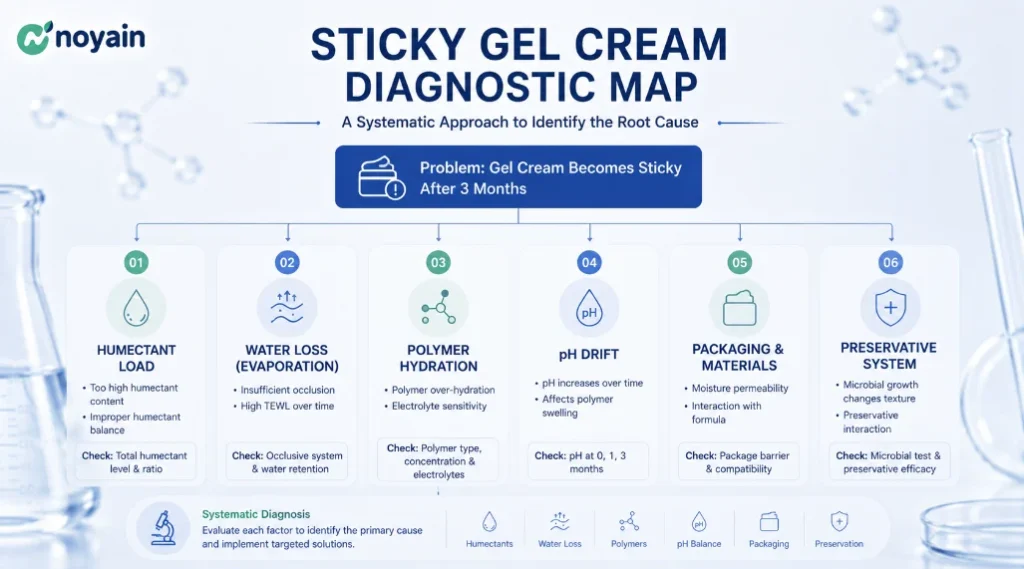
| Carbomer | ✅ Good | ⚠️ High dosages (≥ 4%) may cause slight viscosity decrease in polymer gels. Remedy: Increase Carbomer level by 0.1-0.2%, or shift a portion of pentylene glycol to the post-emulsification phase under slow cooling. |
| Xanthan gum | ✅ Excellent | Cold-process compatible; add to water phase |
| Sodium hyaluronate | ✅ Excellent | Synergistic hydration benefits; sequence-independent |
| HEC (Hydroxyethylcellulose) | ✅ Excellent | No interaction concerns; add to water phase |
Compatibility with Active Ingredients
| Category | Compatibility | Notes |
|---|---|---|
| Vitamins (C, B3, B5) | ✅ Excellent | Stable across formulation pH range |
| Retinoids | ✅ Excellent | No degradation interaction |
| AHAs / BHAs | ✅ Excellent | Compatible at formulation pH |
| Peptides | ✅ Excellent | No charge interaction concerns |
| Cationic ingredients | ✅ Excellent | No flocculation risk (unlike polyanionic ingredients) |
| Sunscreen filters | ✅ Excellent | Prevents recrystallization; enhances water resistance |
✅ Key Processing Advantage: Unlike PDRN, hyaluronic acid, and other polyanionic active ingredients, pentylene glycol has no charge interactions, no metal ion sensitivity, and no special dissolution requirements. It is one of the easiest multifunctional ingredients to formulate with.
Processing Protocol
| Step | Parameter | Recommendation |
|---|---|---|
| Addition phase | Water phase or oil phase | Either phase; also suitable for post-emulsion addition |
| Temperature | Up to 80°C | Heat-stable; can be added during main heating phase |
| pH range | 3-9 | Stable across entire cosmetic pH range |
| Shear sensitivity | None | Can be mixed at high speed without degradation |
Global Regulatory Status (2026)
| Market | Status | Notes |
|---|---|---|
| United States | CIR-approved up to 5% | Cosmetic use permitted; no monograph restrictions |
| European Union | Listed in CosIng | COSMOS-compliant (naturally-derived version) |
| China | ✅ Listed in IECIC | Full compliance for import cosmetics registration |
| Korea | Approved cosmetic ingredient | Widely used in K-beauty formulations |
| Japan | Cosmetic ingredient status | No restrictions |
✅ Our supply: Naturally-derived pentylene glycol sourced from upcycled sugarcane by-products. Full documentation for China IECIC filing, EU CosIng compliance, COSMOS certification, and ISO 16128 natural origin compliance available with each shipment.
FAQ
Q1: What is pentylene glycol and how is it used in skincare?
A: Pentylene glycol (1,2-pentanediol) is a multifunctional cosmetic ingredient that acts as a humectant, preservative booster, solvent, and texture enhancer. It is used in serums, creams, lotions, sunscreens, and cleansers at concentrations of 1-5%.
Q2: What is the recommended concentration of pentylene glycol in formulations?
A: For humectancy: 1-3%. For preservative boosting: 3-5%. The CIR expert panel has approved it as safe at up to 5%—the optimal range for most leave-on products is 3-4%.
Q3: Is pentylene glycol safe for all skin types?
A: Yes, the CIR expert panel considers pentylene glycol safe for cosmetic use at concentrations up to 5%. It is well-tolerated by most skin types including sensitive skin, though individuals with highly sensitive skin may experience mild irritation at higher concentrations.
Q4: Can pentylene glycol replace preservatives entirely?
A: At 3-5%, pentylene glycol can significantly reduce the need for traditional preservatives, but it works best in combination with a secondary preservative booster for complete broad-spectrum protection. See the Synergistic Preservative Systems section above for recommended combinations.
Q5: Is pentylene glycol natural or synthetic?
A: Both versions exist. Our pentylene glycol is naturally-derived by upcycling sugarcane and corn by-products, making it COSMOS and ISO 16128 compliant. Synthetic versions are also available but are less suitable for natural-certified formulations.
Q6: Does pentylene glycol improve sunscreen performance?
A: Yes. Pentylene glycol acts as an efficient polar solvent for crystalline UV filters (avobenzone, octocrylene), preventing their recrystallization and promoting a uniform, gap-free hydrophobic film on the skin. This directly boosts both SPF efficiency and water resistance.
Q7: How does your bio-based pentylene glycol address the “characteristic odor” issue in fragrance-free formulations?
A: Traditional or low-purity pentylene glycol often carries a chemical, petrochemical, or burnt odor that can ruin fragrance-free products. Our upcycled green pentylene glycol undergoes a proprietary multi-stage vacuum distillation process, resulting in a high-purity (≥ 99.5%), low-odor grade that seamlessly fits sensitive skin and fragrance-free profiles without altering the sensory baseline.
Q8: How does pentylene glycol compare to propylene glycol?
A: Pentylene glycol is naturally-derived (propylene glycol is typically petroleum-derived), has stronger preservative-boosting properties, provides a lighter skin feel, and offers the additional benefit of enhancing sunscreen water resistance. Pentylene glycol is the preferred choice for natural and “clean” formulations.
Q9: Does pentylene glycol affect the viscosity of Carbomer gels?
A: At high concentrations (≥ 4%), pentylene glycol may cause a slight decrease in Carbomer gel viscosity due to its mild surfactant-like properties. Remedy: Increase Carbomer level by 0.1-0.2%, or add a portion of pentylene glycol post-emulsification under slow cooling.
Q10: Where can I buy pentylene glycol for cosmetic formulations?
A: We supply naturally-derived pentylene glycol from upcycled sugarcane sources with full documentation. See the section below for samples and technical support.
Explore Our Products
We supply high-purity pentylene glycol (99.5%+) with full documentation including COA, TDS, and MSDS. Naturally-derived, COSMOS-compliant version available.
Certifications: ISO 9001, COSMOS, Halal.
For product specifications, samples, and technical support, contact us through our inquiry form:
→ Contact Us
Or reach us directly at [email protected]
Noyain Biochemicals
Room 3a05, 4th Floor, No. 6, Ketai Second Road, Baiyun District, Guangzhou City, China
References
- Cosmetic Ingredient Review (CIR). Safety Assessment of Pentylene Glycol. 2020.
- CosIng Database – Pentylene Glycol. European Commission. Accessed 2026.
- ISO 16128 – Natural and Organic Cosmetic Ingredients.
- China NMPA. IECIC 2021. Entry: Pentylene Glycol.
- Kabara, J.J. Cosmetics and Toiletries. Antimicrobial Mechanisms of Glycols. 2010.