Article Intro: A sticky gel cream after storage is usually not a single-ingredient problem. This article shows how to diagnose humectant imbalance, polymer/rheology changes, and packaging-related water loss before deciding whether pentylene glycol is worth screening as part of a lower-tack formulation strategy.
Quick Answer
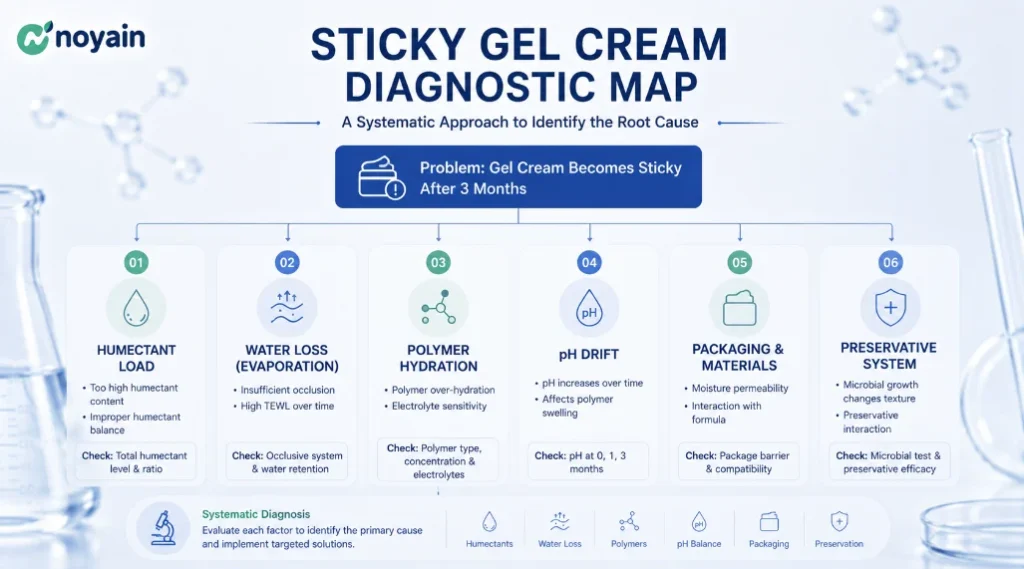
To reduce stickiness in gel cream formulations, start by confirming why the product became tacky. Most aged gel creams become sticky because of humectant imbalance, polymer/rheology changes, packaging-related water loss, or a combination of these factors.
Pentylene glycol is worth screening when the formula is structurally stable but feels tacky because the humectant balance is too glycerin-heavy, propylene glycol-heavy, or slow to dry down. It should be tested as a partial replacement tool, not as a universal anti-stickiness ingredient.
A practical first matrix is to keep the base formula constant, reduce glycerin by 1-3%, add 1-3% pentylene glycol, and compare fresh, room-temperature aged, heat-aged, and packaged samples side by side.
Problem Definition: Sticky Gel Cream After Storage
The typical complaint is simple:
“The gel cream felt elegant when the lab sample was approved, but after 8-12 weeks in the jar it feels sticky and takes longer to absorb.”
That problem should be treated as formulation troubleshooting, not as a generic ingredient education topic. The goal is not to ask whether pentylene glycol is good in skincare. The goal is to decide whether it helps this specific gel cream maintain a cleaner dry-down after storage.
For a broader ingredient background, see our full guide to what pentylene glycol is and how it works in skincare. The rest of this article focuses on sticky gel cream troubleshooting.
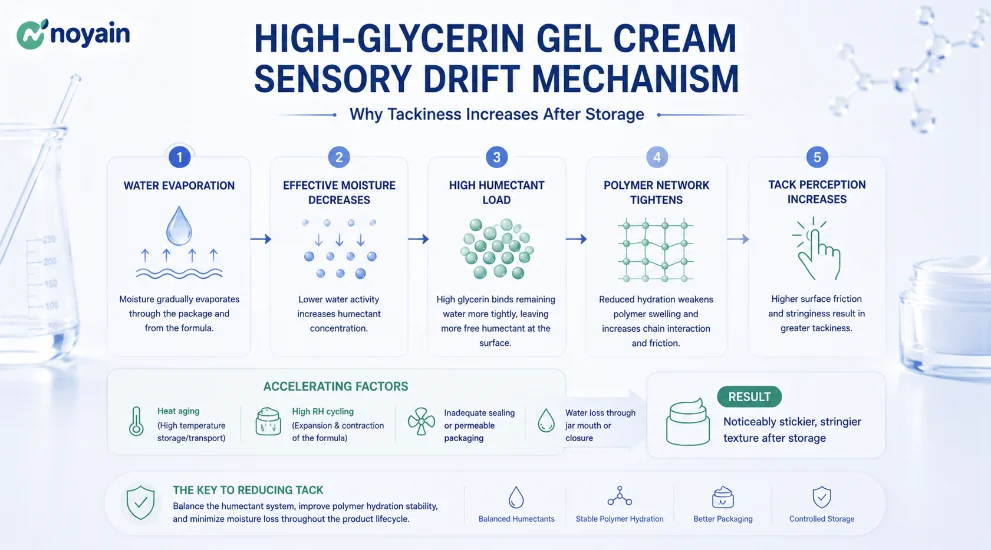
Why High-Glycerin Formulas Become Sticky After Storage
Glycerin is one of the most effective and economical humectants used in gel creams. However, a high-glycerin system does not always maintain the same sensory profile throughout storage.
Several mechanisms may contribute to increased tack:
- Water evaporation concentrates the humectant phase.
- Polymer networks become tighter after aging.
- High total humectant loads slow dry-down.
- Elevated temperatures increase sensory drift.
- Packaging-related moisture loss changes the water-to-humectant ratio.
As a result, a gel cream that feels elegant during laboratory evaluation may become noticeably stickier after 8-12 weeks.
This does not mean glycerin should be removed. In many cases, optimizing the humectant balance provides a better solution than simply lowering moisturization.
Gel Cream Sensory Drift Diagnostic System (GSD System)
The GSD System is Noyain’s working framework for diagnosing gel creams that feel elegant when fresh but become sticky, draggy, or slow to dry after storage.
Noyain’s Gel Cream Sensory Drift Framework classifies tack problems into three common causes:
- Humectant imbalance
- Polymer/rheology changes
- Packaging-related water loss
Internally, these are tracked as GSD-H, GSD-P, and GSD-PK. For clarity, the rest of this article uses the plain-language cause names.
Humectant Imbalance
This is the first layer to check when the formula looks stable but feels tacky during rub-out.
Common signals:
- High glycerin level
- Heavy total humectant load
- Slow dry-down after application
- Tacky film after 2-5 minutes
- Better feel when glycerin is reduced in a quick bench trial
In humectant-driven tack, pentylene glycol may help because it can support hydration while reducing reliance on a high-tack humectant profile.
Polymer/Rheology Changes
This cause matters when the product feels draggy, elastic, stringy, or thicker after aging.
Common signals:
- Viscosity increase after storage
- Stringing during application
- Gum-heavy texture
- Over-neutralized carbomer or acrylates system
- pH drift affecting polymer swelling
Pentylene glycol may improve rub-out slightly, but it will not correct an overbuilt or unstable rheology system. Fix the polymer architecture first.
Packaging-Related Water Loss
This cause matters when the same formula feels different after being stored in final packaging.
Common signals:
- Weight loss in jar or tube stability samples
- More tack in headspace-heavy packs
- Stronger tack after 40 C or 45 C aging
- Humectant and polymer concentration effects without visible separation
If water loss is the main driver, changing the glycol ratio may reduce tack perception, but packaging selection and fill/closure validation still need to be solved.
Decision Logic: When Pentylene Glycol Should Be Screened
The decision should come from the input conditions, not from ingredient theory alone.
| Input Condition | What It Suggests | Screening Decision |
|---|---|---|
| Formula looks stable but feels tacky after aging | Humectant balance may be too heavy | Screen partial glycerin replacement with pentylene glycol |
| Formula gets thicker, stringy, or elastic | Polymer/rheology changes are likely involved | Retune polymer before judging glycol change |
| Formula loses weight in packaging | Water loss is concentrating the water phase | Fix packaging and retest the humectant ratio |
| Formula uses propylene glycol and the brief asks for lower tack | Glycol selection is part of the problem | Compare PG reduction with pentylene glycol substitution |
| Formula has odor, haze, or preservation concerns | Solubilization or preservative system may be shifting | Validate compatibility and preservative efficacy before scale-up |
| Formula separates or shows droplet movement | Structural stability is not solved | Do not treat pentylene glycol as the primary fix |
If tack is mainly caused by humectant imbalance, pentylene glycol is worth testing early. If tack is mainly caused by polymer/rheology changes or packaging-related water loss, solve that cause first and then revisit the humectant system.
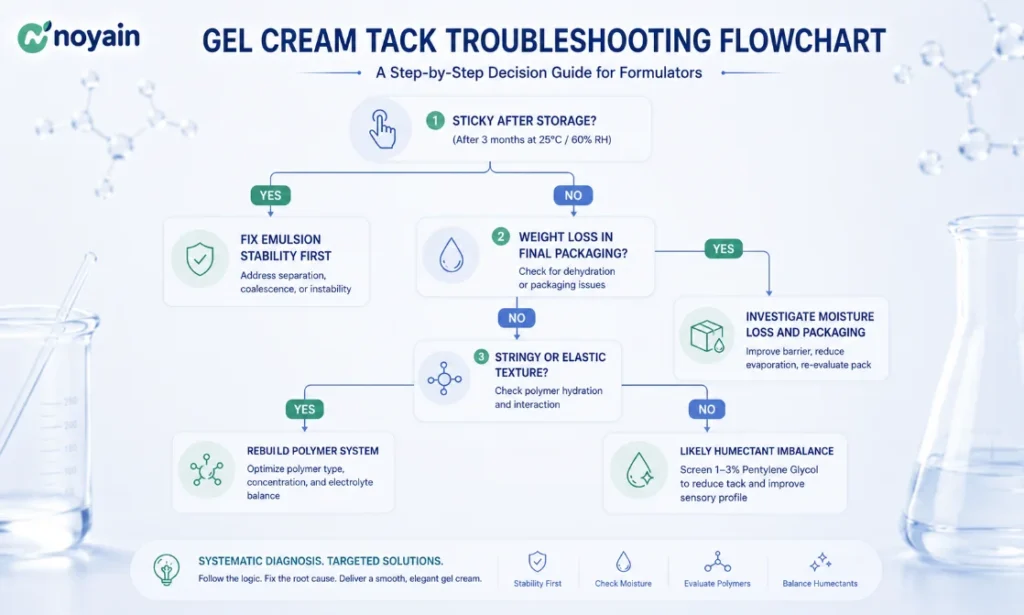
Use the flowchart as a fast screening route. It moves from visible instability to packaging water loss to polymer texture, then only reaches pentylene glycol screening when humectant imbalance is the most likely cause.
Where Pentylene Glycol Fits in the Formula
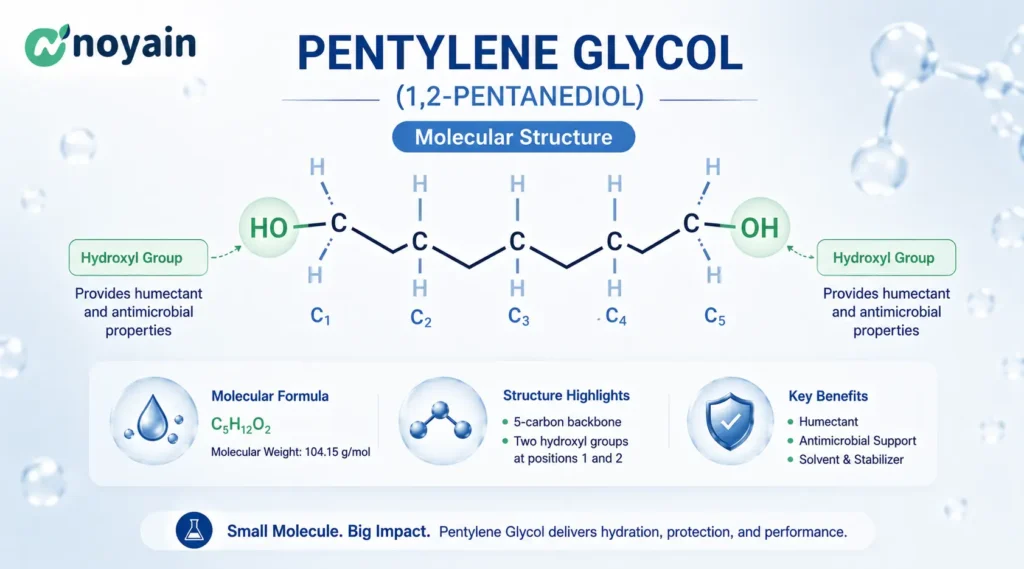
Pentylene glycol, also known as 1,2-pentanediol, is a five-carbon diol. PubChem lists 1,2-Pentanediol with the molecular formula C5H12O2, and the FDA GSRS record for Pentylene Glycol can help regulatory teams confirm substance identity.
In gel cream troubleshooting, its formulation value is practical:
- It can reduce the syrupy feel of a glycerin-heavy water phase.
- It can improve spread and dry-down in lightweight gel creams.
- It can support humectancy without making glycerin do all the work.
- It can contribute to preservative-system robustness in some systems.
- It can help create a cleaner sensory profile for leave-on facial formats.
The Cosmetic Ingredient Review assessment of alkane diols lists cosmetic functions for alkane diols such as solvent, humectant, skin-conditioning, and viscosity-related uses. That does not mean pentylene glycol automatically fixes tack, but it explains why formulators often evaluate it in water-rich systems.
Pentylene Glycol vs Glycerin for Gel Cream Sensory Performance
Both glycerin and pentylene glycol contribute to moisturization, but they create different sensory profiles.
| Attribute | Glycerin | Pentylene Glycol |
|---|---|---|
| Humectancy | High | Moderate |
| Tackiness | Higher | Lower |
| Dry-down speed | Slower | Faster |
| Spreadability | Moderate | Better |
| Skin feel | Syrupy | Cleaner |
| Preservation support | Limited | Can contribute in some systems |
| Typical role | Primary humectant | Co-humectant and multifunctional solvent |
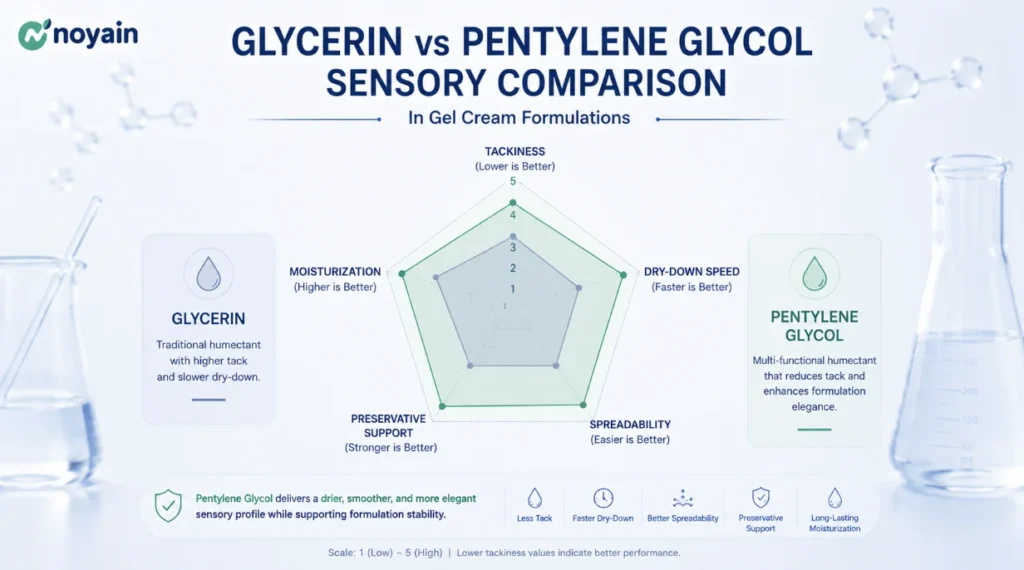
In most gel cream systems, formulators do not replace glycerin completely. Instead, pentylene glycol is often evaluated as a co-humectant to improve sensory performance while maintaining hydration.
Formulation Strategy: Partial Replacement, Not Full Removal
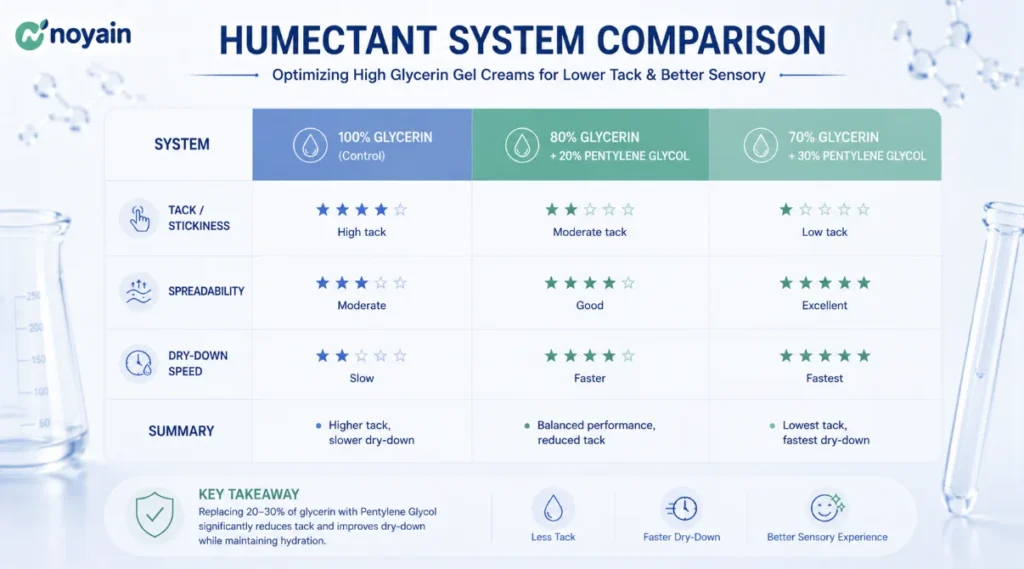
The safest formulation move is usually not to remove glycerin completely. Glycerin is effective, familiar, and cost-efficient. The better question is:
What ratio gives enough hydration with less tack and better dry-down after storage?
Start with a controlled matrix rather than a full reformulation.
| Prototype | Glycerin Change | Pentylene Glycol Level | Purpose |
|---|---|---|---|
| A – Current control | Existing level | Existing level or 0% | Confirm the complaint under the same aging conditions |
| B – Lower glycerin | Reduce by 1% | 0% | Check whether tack is mainly glycerin-driven |
| C – Balanced system | Reduce by 1-2% | 1-2% | Test lower tack while preserving hydration feel |
| D – Stronger correction | Reduce by 2-3% | 2-3% | Evaluate dry-down, tack, and preservation-support potential |
| E – Polymer retune | Best humectant ratio | Same as best prototype | Adjust viscosity only after the sensory direction is clear |
The point of this matrix is isolation. Keep the polymer, oil phase, active ingredients, fragrance, pH target, and preservative system as constant as possible during the first screen.
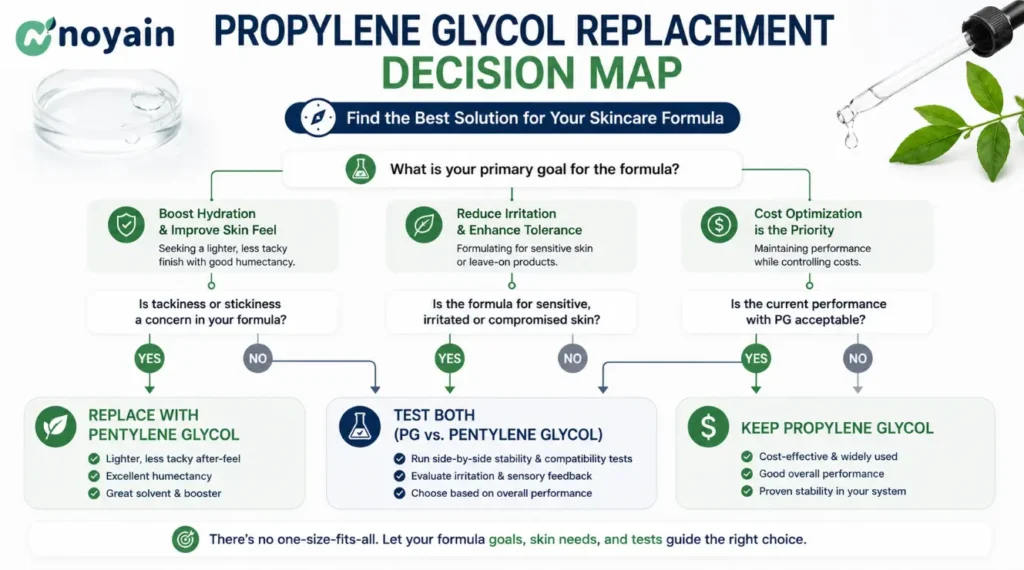
If the current formula uses propylene glycol, use the same logic but compare it against a PG reduction route. The propylene glycol replacement decision guide is useful when the reformulation brief includes lower tack, cleaner positioning, or reduced dependence on PG.
Example Starting Chassis
This is not a universal formula. It is a practical screening frame for a lightweight leave-on gel cream.
- Deionized water: q.s. to 100%
- Glycerin: 3-7%
- Pentylene glycol: 0-3%
- Niacinamide: 2%
- Panthenol: 0.5%
- Carbomer or acrylates polymer: 0.20-0.35%
- Neutralizer: q.s. to target pH
- Light emollients: 3-5%
- Emulsifier or polymeric emulsifier: as required
- Preservative system: as required
- Fragrance: optional, low level
- pH target: 5.5-6.2 unless the active system requires another range
Add pentylene glycol to the water phase or premix it with glycerin and water-soluble powders when needed. Hydrate the polymer fully before final pH adjustment, then record viscosity after 24-hour equilibration.
Internal Bench Screening Example
The following observations are based on internal laboratory screening using a lightweight gel cream chassis.
Conditions:
- Total humectants: approximately 8%
- Carbomer-based gel cream
- pH 5.8
- Same preservative system
- 45 C accelerated aging
- Controlled changes only to the glycerin/pentylene glycol ratio
These observations are formulation lab-scale observations only. They are not clinical claims, regulatory conclusions, or universal performance guarantees.
Directional observations from this type of screen:
| Screening Item | High-Glycerin Control | Balanced Glycerin + Pentylene Glycol Prototype | Interpretation |
|---|---|---|---|
| Initial rub-out | Hydrating but slightly draggy | Smoother slip | Humectant balance influenced early sensory feel |
| Dry-down after 3 minutes | Noticeable tack | Lower tack | Pentylene glycol helped reduce tack perception in this chassis |
| After 45 C heat aging | Tack increased | Tack increased less | Sensory drift was smaller but still required validation |
| Viscosity drift | Moderate increase | Lower increase | Polymer retuning may still be needed |
| Preservative support | Standard | Directionally stronger | Final formula still requires preservative efficacy testing |
The useful lesson is not that one ingredient removes stickiness. The useful lesson is that a balanced humectant system can be easier to tune than a formula built around one high-load humectant.
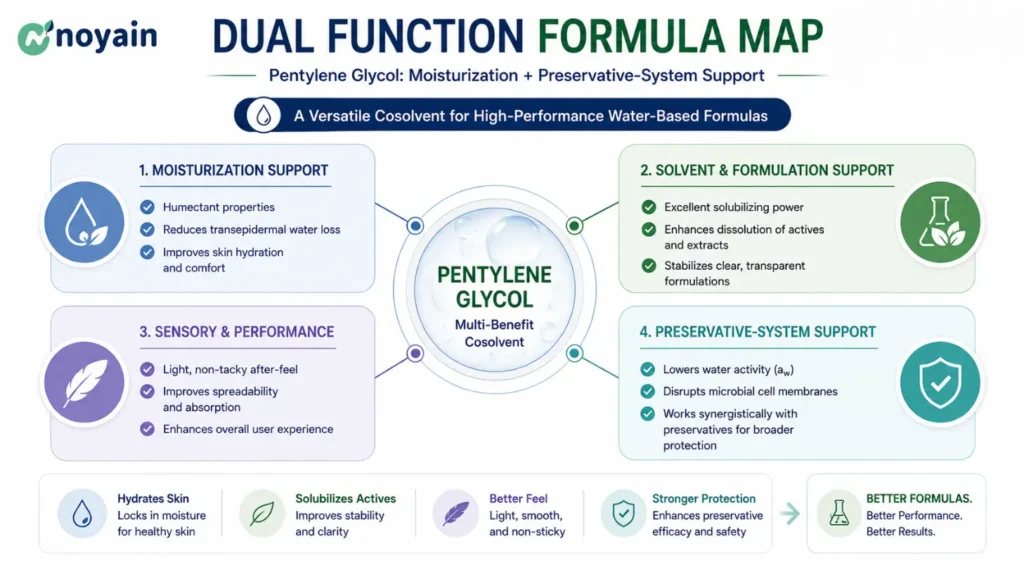
For projects where both hydration and preservation support matter, the pentylene glycol moisturization and preservation guide gives more context on the dual-function formulation logic.
Stability Validation Before Scale-Up
Do not judge the matrix at day one. A gel cream that feels elegant after 24 hours may drift after storage.
Use a validation plan that covers sensory, physical stability, packaging, and preservation:
| Test Area | What to Measure | Why It Matters |
|---|---|---|
| Sensory review | Tack, drag, dry-down, residue after 2-5 minutes | Confirms whether the lower-tack target is real |
| pH tracking | Initial, 4 weeks, 8 weeks, 12 weeks | pH drift can change thickener behavior and preservative performance |
| Viscosity tracking | Initial and aged samples | Separates humectant tack from polymer tightening |
| Heat aging | 40 C / 45 C comparison | Shows whether tack increases under stress |
| Freeze-thaw | 3-5 cycles where relevant | Screens emulsion and polymer robustness |
| Centrifuge | Early physical weakness | Helps identify hidden instability |
| Packaging weight loss | Final pack and alternative packs | Confirms whether water loss is concentrating the system |
| Preservation | Challenge or regional preservative efficacy method | Confirms the final system, not just ingredient logic |
If antimicrobial performance is part of the reformulation goal, use a recognized preservative efficacy framework. USP <51> Antimicrobial Effectiveness Testing is one reference QA teams may use, while cosmetic companies may also apply ISO or regional methods depending on target markets.
Troubleshooting Table
| What You See | Likely Cause | What to Try First |
|---|---|---|
| Sticky but visually stable | Humectant imbalance | Reduce glycerin by 1-2% and screen 1-2% pentylene glycol |
| Sticky and slow to dry | High total humectant load | Lower total humectant load and reduce film former drag |
| Thick, elastic, or stringy | Polymer network changes | Reduce gum load or retune carbomer/acrylates neutralization |
| Sticky only after heat aging | Water loss or humectant concentration | Compare weight loss, pH, and viscosity against room-temperature samples |
| Sticky after active addition | Polymer-active interaction | Recheck electrolyte load, pH, and polymer compatibility |
| Haze or odor develops | Solubilization or preservative interaction | Rework fragrance, solubilizer, glycol ratio, and cool-down process |
| Sensory improves but preservation fails | Preservative system | Treat pentylene glycol as support only and run full efficacy testing |
| Tack improves but moisture feel drops | Humectant correction went too far | Restore part of glycerin or add betaine/panthenol at controlled levels |
First identify the likely cause, then choose the correction. This keeps the troubleshooting process readable for formulation, QA, and purchasing teams.
Compatibility Notes
Pentylene glycol is generally straightforward to screen in water-rich gel creams, but the full formula still controls the result.
- Glycerin: Avoid one-to-one replacement assumptions. Partial replacement is usually the more useful first test.
- Hyaluronic acid and natural gums: High molecular weight HA, xanthan gum, and sclerotium gum can increase drag or stringiness. Keep them under review when tack is already a concern.
- Carbomer and acrylates polymers: Any humectant change may shift perceived viscosity or gel break. Recheck neutralization and viscosity after equilibration.
- Niacinamide and panthenol: These are commonly screened in water-based systems, but panthenol can add drag in already tacky formulas.
- Fragrance and solubilizer systems: Glycol changes can affect clarity, rub-out, and odor stability, especially in low-oil gel creams.
- Packaging: Jar packaging may allow more moisture exchange than airless systems. Compare final packaging formats before scale-up.
Regulatory teams can use the European Commission CosIng database to verify cosmetic ingredient naming and function categories, but finished-formula testing remains necessary.
When Pentylene Glycol Is the Right Fix
Pentylene glycol is a strong screening candidate when:
- The gel cream is a leave-on facial gel cream, serum cream, sleeping mask, water cream, or gel lotion.
- The product feels sticky after storage but shows no major separation.
- The humectant system is glycerin-heavy or PG-heavy.
- The target is lower tack without a dry, stripped after-feel.
- The formula needs better dry-down consistency after aging.
- Preservative-system support is also part of the design brief.
It is not the first fix when:
- Phase separation is already visible.
- The polymer network is clearly unstable.
- Packaging water loss is severe.
- pH drift is outside the intended range.
- The formula has unresolved odor, haze, or microbial risk.
- The product needs a complete rheology redesign.
If you are comparing glycol choices, the pentylene glycol vs propylene glycol comparison can help separate sensory, positioning, and cost considerations.
Sample Screening and Technical Support
Once a prototype shows lower tack and acceptable stability, the next step is not a full commercial purchase. The next step is usually a controlled sample screen with documentation support.
For a formulation project, a supplier should be able to provide:
- A small cosmetic-grade Pentylene Glycol sample for bench comparison
- COA, TDS, and SDS/MSDS for early qualification review
- INCI and CAS confirmation
- Basic technical support for humectant screening and ratio adjustment
Detailed commercial qualification details should live on a separate sourcing or supplier qualification page. Keeping those details outside this technical article helps preserve the formulation troubleshooting intent.
Practical Recommendation
If your gel cream becomes sticky after 8-12 weeks, use this sequence:
- Confirm whether the product lost water in final packaging.
- Measure pH and viscosity drift.
- Compare fresh, room-temperature aged, and heat-aged samples.
- Classify the issue as humectant imbalance, polymer/rheology change, or packaging-related water loss.
- If humectant imbalance is likely, run a partial replacement matrix with 1-3% pentylene glycol.
- Retune polymer level only after the best humectant ratio is identified.
- Confirm preservation, packaging, odor, color, pH, viscosity, and sensory behavior before scale-up.
The winning direction is usually not “less hydration.” It is a more balanced hydration system: enough glycerin to perform, enough pentylene glycol to reduce tack, and enough stability testing to prove the formula still behaves after storage.
Need Help Screening a Lower-Tack Gel Cream?
Noyain supplies cosmetic-grade pentylene glycol for skincare formulation projects where hydration, skin feel, preservative-system support, and batch consistency need to be balanced.
Available support includes laboratory samples, COA, TDS, SDS/MSDS, INCI and CAS documentation, and formulation support for gel creams, serums, toners, essences, and mask liquids.
To request a sample, documentation, or technical discussion, use the inquiry form:
FAQ
Why does a gel cream become sticky after storage?
Most sticky gel creams become tacky because of humectant imbalance, polymer network change, packaging-related water loss, or a combination of these factors. Measure pH, viscosity, sensory drift, and packaging weight loss before changing the formula.
Can pentylene glycol reduce tack in gel cream formulations?
Yes, it can help when tack is mainly caused by a heavy glycerin or glycol system. It works best as part of a balanced humectant system, not as a cure for structural instability.
What percentage of pentylene glycol should I test?
For early gel cream screening, 1-3% is a practical range. Test it with controlled glycerin reduction and confirm the final level through sensory review, stability, packaging, preservation, and cost evaluation.
How can I reduce tack without reducing hydration?
Use partial humectant rebalancing instead of simply lowering the total humectant system. Keep enough glycerin for hydration, then screen 1-3% pentylene glycol to improve dry-down and reduce tack perception.
Should pentylene glycol fully replace glycerin?
Usually no. Partial replacement is often more useful because glycerin still supports hydration performance. The goal is to reduce excess tack while keeping moisturization feel.
Does pentylene glycol fix polymer stringiness?
Not reliably. If the formula is stringy, elastic, or over-thickened, adjust the polymer system first. Pentylene glycol may improve rub-out, but it will not repair a poor rheology design.
Does packaging affect gel cream stickiness?
Yes. Water loss through packaging can concentrate humectants and polymers, making the same formula feel stickier after storage. Always compare final packaging during stability testing.
Can pentylene glycol support preservation?
It may support preservative-system robustness in some formulas, but it should not replace preservative efficacy testing. Finished products still need validation using the appropriate test method for the target market.
What should buyers ask before sourcing pentylene glycol?
For early screening, ask for COA, TDS, SDS/MSDS, INCI and CAS confirmation, sample availability, and batch consistency information. Detailed purchasing questions should be handled on a dedicated supplier qualification page.
References
- Cosmetic Ingredient Review. 2017. Safety Assessment of Alkane Diols as Used in Cosmetics.
- National Center for Biotechnology Information. PubChem. 1,2-Pentanediol, CID 93000.
- FDA Global Substance Registration System. Pentylene Glycol.
- European Commission. CosIng Cosmetic Ingredient Database.
- United States Pharmacopeia. USP <51> Antimicrobial Effectiveness Testing.