
Quick Answer: Sodium hyaluronate is the sodium salt of hyaluronic acid, and both ingredients share the same core polysaccharide structure. Converting hyaluronic acid into its sodium salt does not automatically make the polymer smaller or allow it to penetrate deeper into the skin. In skincare, molecular weight, concentration, and overall formulation matter more than whether the ingredient is labeled as hyaluronic acid or sodium hyaluronate.
Sodium Hyaluronate vs Hyaluronic Acid: Comparison Table
The table below compares the verified chemical, regulatory, and formulation properties of both ingredients without assuming unverified differences in polymer chain length.
| Parameter | Hyaluronic Acid | Sodium Hyaluronate |
|---|---|---|
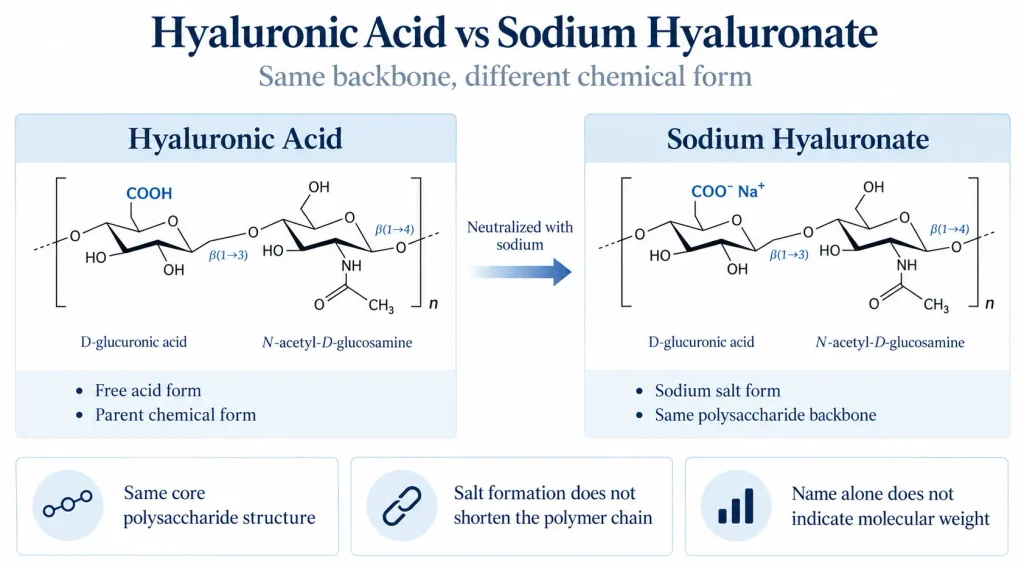
| Chemical Form & Relationship | Free acid form of the glycosaminoglycan polysaccharide composed of repeating disaccharide units of D-glucuronic acid and N-acetyl-D-glucosamine | Direct sodium salt derivative of hyaluronic acid sharing the same repeating disaccharide backbone (carboxyl groups neutralized with sodium ions) |
| Molecular Weight | Not fixed by name; available across a wide range of polymer chain lengths depending on manufacturing specifications | Not fixed by name; spans a broad range (e.g., 80.2 to 4,010 kDa in Food Chemicals Codex specifications, plus specialized grades) |
| Skin Hydration Role | Functions as a hydrophilic humectant and skin-conditioning agent that binds water | Functions as a hydrophilic humectant and skin-conditioning agent that binds water |
| Formulation & Penetration Basis | Selected by molecular weight grade, viscosity target, and vehicle; stratum corneum permeability cannot be judged by the free acid name alone | Widely used in aqueous formulations across multiple molecular weight grades; hydration time, viscosity, and skin penetration depend on grade specifications and formulation conditions |
| INCI Name | Hyaluronic Acid | Sodium Hyaluronate |
What Is the Difference Between the Two?
Hyaluronic acid—often called hyaluronan in scientific literature—is a linear polysaccharide (long-chain sugar polymer) naturally present in the human dermis and epidermis, where it helps maintain tissue hydration and viscoelasticity. However, the physiological roles of endogenous hyaluronan inside living tissue should not be equated directly with topically applied skincare, which acts on or within the upper layers of the skin depending on polymer size and formulation vehicle.
Chemically, converting hyaluronic acid into sodium hyaluronate replaces the hydrogen ion on each acidic carboxyl group (–COOH) with a sodium ion to form a carboxylate salt (–COO⁻ Na⁺). When either form is dissolved in a water-based cosmetic product formulated around skin-compatible pH levels, both dissociate into the same hyaluronate polyanion.
This explains why many retail products labeled as a “hyaluronic acid serum” on the front of the box list Sodium Hyaluronate on the back-label ingredient declaration. “Hyaluronic acid” is the universally recognized consumer term for the category. In product development, Sodium Hyaluronate is widely supplied as a water-soluble cosmetic raw material and is commonly used in aqueous formulations; however, hydration time, viscosity, and processing behavior vary with molecular weight, particle characteristics, concentration, and formulation conditions. When Sodium Hyaluronate is used as a cosmetic ingredient, its appropriate ingredient declaration should follow the applicable INCI nomenclature and the labeling requirements of the target market.
Why Molecular Weight Matters More Than the Name
A widespread misconception in consumer skincare is that Sodium Hyaluronate always has a smaller molecular size than Hyaluronic Acid simply because it is a salt. From a polymer chemistry standpoint, salt neutralization does not cleave glycosidic bonds or shorten the polymer chain. Likewise, chemical database entries showing a formula weight around 379 to 401 Daltons (or ~779 to 800 Daltons for a dimer) only represent a single repeating structural unit—not a commercial cosmetic polymer made of hundreds or thousands of linked units. According to Food Chemicals Codex (FCC) specifications evaluated in the CIR Safety Assessment of Hyaluronates, commercial Sodium Hyaluronate can range from 80.2 kDa to 4,010 kDa, meaning the INCI name alone tells you nothing about chain length.
When evaluating sodium hyaluronate molecular weight for formulation, polymer chain length is the primary factor governing viscosity, film formation, and stratum corneum interaction:
- Viscosity and Surface Film Formation: High-molecular-weight grades (such as polymers above 1,000 kDa) build substantial viscosity in water even at low concentrations (0.1% to 0.5%). On the skin, these large polymers remain primarily on the stratum corneum, forming a hydrating film on the skin surface that may support surface moisture retention and provide a smooth, cushioned slip. Lower-molecular-weight grades contribute much less thickening, allowing formulators to incorporate higher active concentrations into lightweight, fluid serums or mists.
- Stratum Corneum Penetration Evidence: In a 2016 ex vivo study on excised human skin using Raman micro-imaging, researchers compared three hyaluronic acid grades: high molecular weight (1,000–1,400 kDa), medium molecular weight (100–300 kDa), and low molecular weight (20–50 kDa). The 1,000–1,400 kDa grade remained mainly on the skin surface, whereas grades in the 20–300 kDa range passed through the stratum corneum, with the 20–50 kDa grade showing the greatest permeation.
- Clinical Efficacy Across Molecular Weights: In a 2011 randomized, split-face clinical study involving 76 female subjects (aged 30–60 years) over 60 days, researchers tested five cream formulations containing 0.1% hyaluronic acid at 50, 130, 300, 800, and 2,000 kDa. All five 0.1% formulations significantly improved skin hydration and overall elasticity compared to placebo. However, only the 50 kDa and 130 kDa cream formulations produced statistically significant reductions in wrinkle depth after 60 days, which the authors linked to the greater penetration capacity of lower-molecular-weight chains.
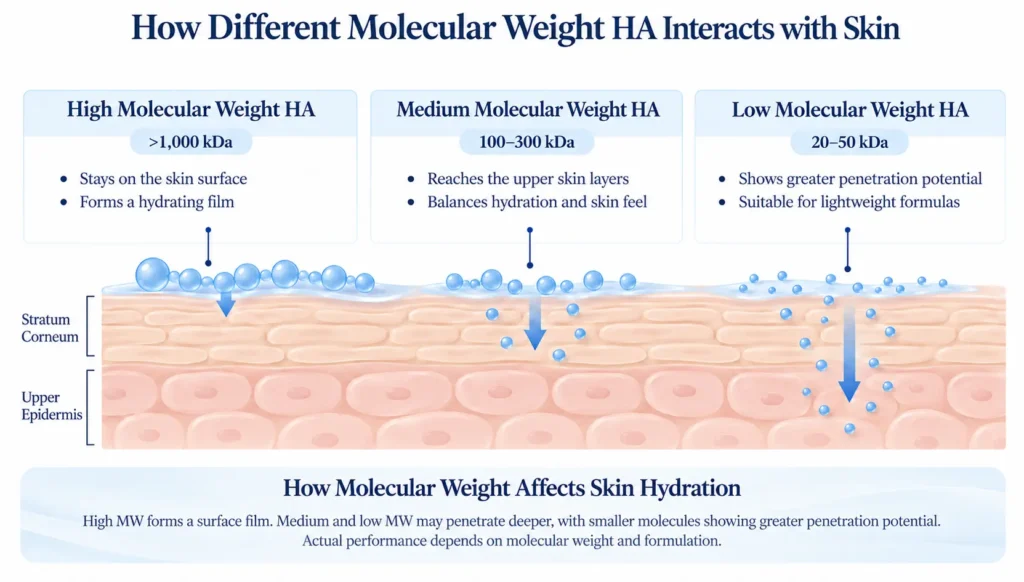
Two scientific boundaries apply when interpreting these studies. First, there is no universal regulatory cutoff defining “high,” “medium,” or “low” molecular weight; the kilodalton brackets in these studies reflect specific experimental test materials, and individual raw material suppliers define their own grade ranges. Second, ex vivo skin permeation and clinical results from a specific 0.1% cream vehicle do not automatically guarantee identical performance in every finished product.
Which Is Better for Your Skin?
When comparing sodium hyaluronate vs hyaluronic acid for skin, neither ingredient is automatically better based on its name alone. At comparable molecular weights and concentrations, both ingredients can serve similar humectant functions. The hydration performance of a finished product depends on the complete formulation and should be evaluated through appropriate testing.
For everyday skincare users and product developers, choosing the right product comes down to how the formula is constructed:
- Complete Moisturization Architecture: Hyaluronates bind water effectively, but pairing them with small-molecule humectants (like glycerin or panthenol) alongside emollients and occlusives (such as squalane, ceramides, or shea butter) helps attract water and reinforce the skin barrier against evaporation.
- Matching Product Vehicle to Skin Type: Rather than assigning
Hyaluronic Acidto dry skin andSodium Hyaluronateto oily skin, match the polymer grade and base texture to skin needs:- Dry Skin: Benefits from high-molecular-weight grades paired with lipid-rich creams or lotions that form a protective surface film and soften dry patches.
- Oily or Combination Skin: Typically prefers oil-free gels, toners, or fluid serums built with lower-viscosity grades (or moderate levels of high-molecular-weight grades) that hydrate without feeling heavy.
- Sensitive Skin: Should focus on gentle, fragrance-free vehicles formulated at skin-compatible pH levels.
- Multi-Molecular Weight Blending: Combining multiple molecular weight grades—or blending
Sodium Hyaluronatewith hydrolyzed or crosslinked derivatives—is a practical formulation strategy to balance surface slip with lightweight hydration, though final efficacy always depends on testing the complete formula.
How to Choose Sodium Hyaluronate for Formulation
When evaluating hyaluronic acid vs sodium hyaluronate for formulation and B2B procurement, relying on an INCI name alone can result in batch-to-batch viscosity shifts or inaccurate cost-in-use comparisons. Formulators and ingredient buyers should verify the following technical parameters:
- INCI, CAS, and Source Declaration: Confirm the exact INCI (
Sodium Hyaluronatevs.Hyaluronic Acid), CAS number, and manufacturing origin (modern cosmetic grades are predominantly produced via microbial fermentation rather than animal extraction). - Molecular Weight Range and Analytical Method: Request the target molecular weight bracket (in kDa or MDa) and confirm whether the supplier measures it via Size Exclusion Chromatography with Multi-Angle Laser Light Scattering (SEC-MALLS / GPC) or intrinsic viscosity calculations.
- Assay / Content and Loss on Drying (LOD): Check the minimum hyaluronate content specification (e.g., ≥92.0% or ≥95.0%), whether it is reported on a dried or as-is basis, and the maximum moisture limit.
- Viscosity and Solution Clarity: Because aqueous hyaluronate solutions are shear-thinning, always verify viscosity alongside concentration (e.g., 0.1%, 0.5%, or 1.0%), temperature, viscometer spindle, and RPM. Checking solution transmittance (clarity) at a defined wavelength also helps ensure clean appearance in transparent serums.
- Hydration, pH, and Formulation Compatibility: High-molecular-weight powders require proper dispersion (such as pre-wetting with glycerin or propanediol, or steady agitation into vortexing water) to prevent unhydrated gel lumps. Formulators should verify the recommended operating pH window and electrolyte or cationic compatibility against the supplier’s Technical Data Sheet (TDS).
- Microbiological Limits, COA, and Storage: Review total aerobic microbial count, yeast/mold limits, heavy metals, protein residue, and storage requirements (such as temperature and light protection) on the Certificate of Analysis (COA), TDS, and Safety Data Sheet (SDS).
Raw Material Input vs. Active Concentration: Hypothetical Dilution Math
In procurement and formulation cost-in-use analysis, always distinguish between a neat powder and a pre-dissolved liquid stock solution:
Hypothetical Calculation Example:
Suppose a formulator uses a liquid raw material solution containing 1% Sodium Hyaluronate, with the remainder consisting of water and any required preservative system. Adding 1.0% of this diluted solution into a finished lotion delivers a theoretical active concentration of:Active concentration = 1.0% × 1.0% = 0.01% Sodium Hyaluronate
(Note: This hypothetical example illustrates dilution math and does not represent a specific product parameter or recommended usage level.)
Evaluating a Commercial Sodium Hyaluronate Grade: NOYAIN SHA-H1
For skincare formulators and ingredient buyers, selecting Sodium Hyaluronate goes beyond comparing INCI names. Actual batch specifications help determine whether an ingredient is suitable for a particular formulation.
NOYAIN supplies SHA-H1 Sodium Hyaluronate (CAS 9067-32-7), a water-soluble powder for cosmetic applications including hydrating serums, gels, and moisturizers.
Our published reference batch (Lot NY-20260103) reports:
- Sodium Hyaluronate Content: 94.53%, against a specification of ≥92.0%.
- Molecular Weight: 1.204 MDa (1,204 kDa), as reported for the reference batch.
- Solution Transmittance: 99.5%, measured in a 0.5% aqueous solution at 25°C and 550 nm.
- Recommended Storage: 2–10°C in a tightly sealed, light-resistant container.
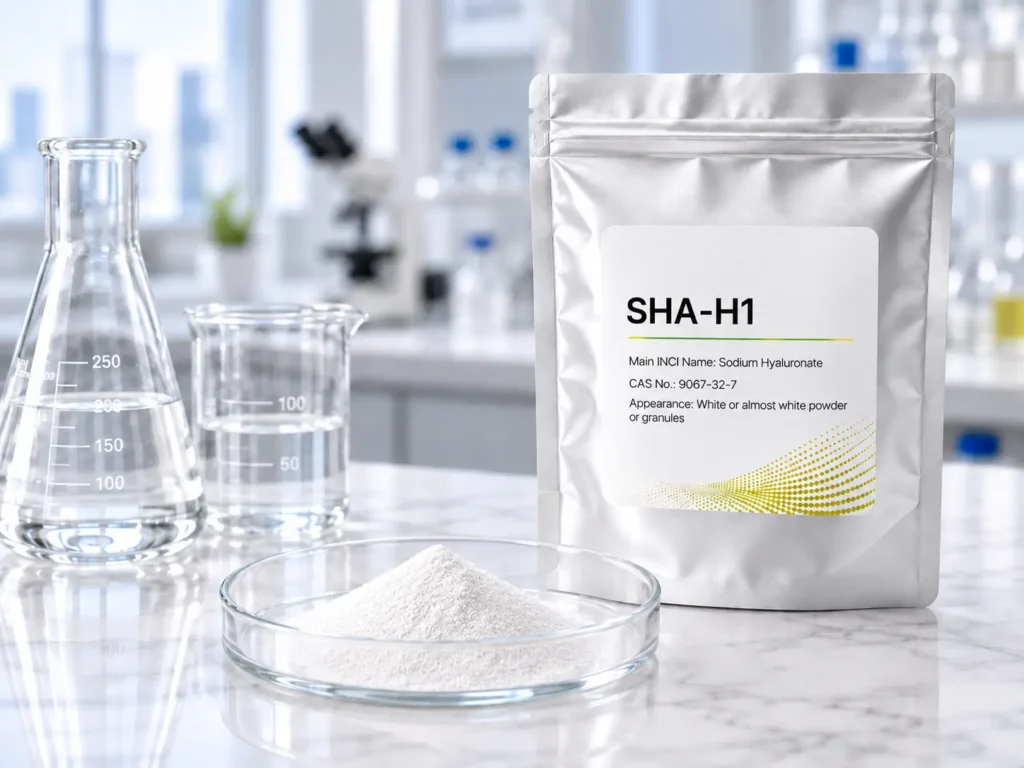
These values describe the reference batch rather than guaranteed results for every production lot. Buyers should review the latest available COA and confirm compatibility through formulation testing.
Explore NOYAIN SHA-H1 Specifications
Other HA Forms: Hydrolyzed and Crosslinked
Beyond standard Hyaluronic Acid and Sodium Hyaluronate, cosmetic formulations frequently incorporate cleaved or crosslinked derivatives to adjust viscosity and sensory feel. These INCI names reflect distinct chemical modifications rather than a simple “large, medium, small” size ranking.
| INCI Name | Structural Modification | Key Formulation & Sensory Characteristics |
|---|---|---|
| Hydrolyzed Hyaluronic Acid | Hyaluronic acid enzymatically or chemically cleaved into shorter polysaccharide chains | Dissolves readily with potentially lower viscosity, depending on concentration and formulation; suited for high-fluidity toners, mists, and lightweight serums |
| Hydrolyzed Sodium Hyaluronate | The sodium salt of hydrolyzed hyaluronic acid consisting of cleaved, lower-molecular-weight hyaluronate chains | Provides similar low-viscosity behavior in water-based systems while allowing higher humectant loading with potentially lower viscosity, depending on concentration and formulation |
| Sodium Hyaluronate Crosspolymer | A crosslinked derivative of sodium hyaluronate in which polymer chains form a three-dimensional network | Its swelling behavior, viscosity, and sensory properties depend on the crosslinking chemistry and the specific commercial grade |
Frequently Asked Questions (FAQ)
Is Sodium Hyaluronate always low molecular weight?
No. Converting hyaluronic acid into its sodium salt only neutralizes the carboxyl groups with sodium ions and does not shorten the polymer chain. Commercial Sodium Hyaluronate is produced across a broad spectrum, from grades below 50 kDa to high-molecular-weight grades such as 1,204 kDa or up to 4,010 kDa.
Why do “Hyaluronic Acid” serums list Sodium Hyaluronate on the INCI label?
“Hyaluronic acid” is the standard consumer and marketing name for the entire category. When Sodium Hyaluronate is the raw material used in manufacturing, its ingredient declaration on the product label follows the applicable INCI nomenclature and the regulatory labeling rules of the target market.
Does a lower molecular weight or higher concentration always perform better?
No. Lower-molecular-weight grades (such as 20–300 kDa) show greater stratum corneum penetration in experimental testing, whereas higher-molecular-weight grades (above 1,000 kDa) excel at building viscosity and forming a hydrating film on the skin surface. Excessively high concentrations of high-molecular-weight grades can cause pilling or tackiness if not balanced with appropriate emollients.
How can raw material buyers verify the molecular weight of a grade?
Because the INCI name does not indicate polymer chain length, buyers must review the supplier’s Technical Data Sheet (TDS) and batch Certificate of Analysis (COA)—such as checking the reported kDa/MDa value, assay, and transmittance on a reference lot like NOYAIN SHA-H1—and verify the analytical method used.
Conclusion & Next Steps
Understanding the difference between Sodium Hyaluronate and Hyaluronic Acid starts with separating chemical form from polymer chain length: both share the same polysaccharide backbone, while molecular weight, purity, and formulation design govern how the ingredient performs in production and on the skin.
If you are developing or sourcing for a skincare formulation, you can review our NOYAIN SHA-H1 Sodium Hyaluronate specifications to check reference batch data. To request the latest COA, TDS, SDS, or evaluation samples, contact our team with your target dosage form (such as serum, gel, or cream), target market requirements, and preferred molecular weight range.
References & Further Reading
- Cosmetic Ingredient Review (CIR). Safety Assessment of Hyaluronates as Used in Cosmetics. Final Report. July 7, 2023. Available at: https://www.cir-safety.org/sites/default/files/FR_Hyaluronates_062023.pdf
- Papakonstantinou E, Roth M, Karakiulakis G. Hyaluronic acid: A key molecule in skin aging. Dermato-Endocrinology. 2012;4(3):253–258. doi:10.4161/derm.21923. Available at: https://pmc.ncbi.nlm.nih.gov/articles/PMC3583886/
- Essendoubi M, Gobinet C, Reynaud R, Angiboust JF, Manfait M, Piot O. Human skin penetration of hyaluronic acid of different molecular weights as probed by Raman spectroscopy. Skin Research and Technology. 2016;22(1):55–62. doi:10.1111/srt.12228. PMID: 25877232. Available at: https://doi.org/10.1111/srt.12228
- Pavicic T, Gauglitz GG, Lersch P, Schwach-Abdellaoui K, Malle B, Korting HC, Farwick M. Efficacy of cream-based novel formulations of hyaluronic acid of different molecular weights in anti-wrinkle treatment. Journal of Drugs in Dermatology. 2011;10(9):990–1000. PMID: 22052267. Available at: https://pubmed.ncbi.nlm.nih.gov/22052267/
- United States Pharmacopeial Convention (USP). Sodium Hyaluronate Monograph. Food Chemicals Codex (FCC). Available at: https://doi.usp.org/USPFCC/FCC_F104240_09_01.html
- Cosmetic Ingredient Review (CIR). Safety Assessment of Sodium Hyaluronate Crosspolymers as Used in Cosmetics. Scientific Literature Review for Public Comment, March 26, 2026. Available at: CIR report (PDF)
