Article intro: Replacing propylene glycol is not a moral decision and it is not a simple “safe vs unsafe” question. For formulators, the better question is whether propylene glycol still fits the product brief. This guide explains when I would keep it, when I would replace it with pentylene glycol, and how to run a practical side-by-side replacement test before scale-up.
Quick Answer: Should I Replace Propylene Glycol?
Yes – if your formula is a leave-on skincare product and you need:
- Lower tackiness
- Better sensory feel
- Preservative-system support
- Clean beauty positioning
No – if cost control, existing validation, or rinse-off performance are the main priorities.
For most premium serums, toners, and essences, pentylene glycol is the first alternative I would test. For a deeper technical comparison, see our full Pentylene Glycol vs Propylene Glycol guide. This article focuses on the replacement decision and the practical test plan.
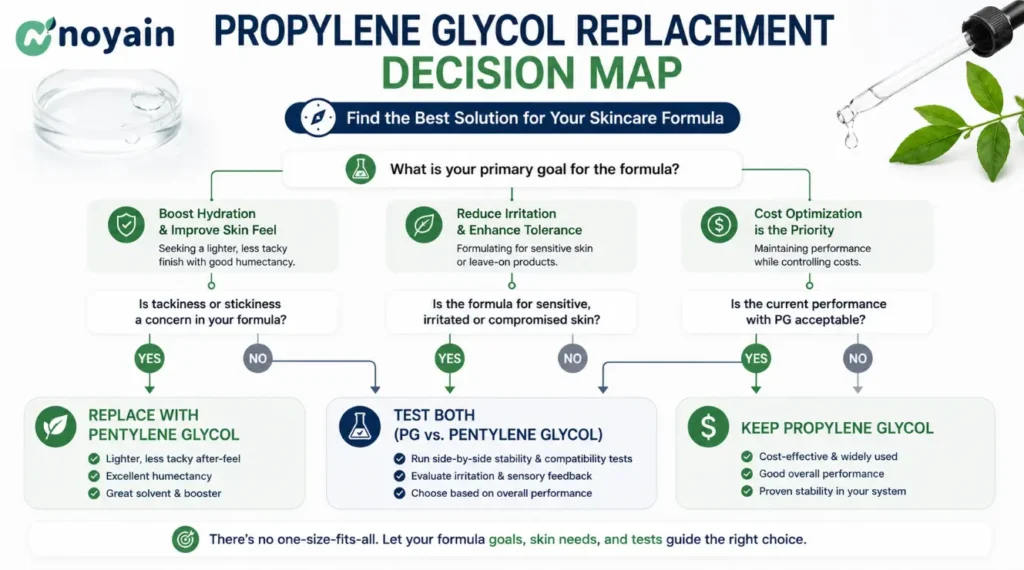
Propylene Glycol Replacement Decision Tree
Use this quick decision tree before you start reformulating:
| Decision Point | If Yes | If No |
|---|---|---|
| Is it a leave-on skincare formula? | Continue evaluating replacement value | Keep propylene glycol unless there is a clear claim, irritation, or retailer issue |
| Is there a sensitive-skin claim? | Test pentylene glycol | Continue |
| Is it a clean beauty or premium-positioned product? | Test pentylene glycol as a clean beauty glycol alternative | Continue |
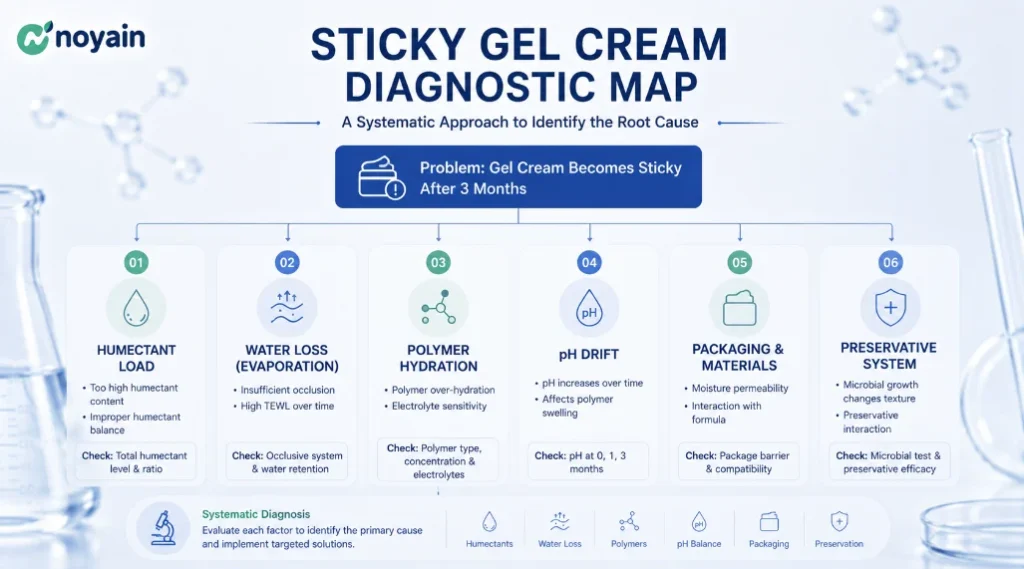
| Is it a high-glycerin or sticky system? | Test pentylene glycol for lower tackiness | Continue |
| Is it a serum, toner, essence, mask liquid, or gel-cream? | Test pentylene glycol early | Continue |
| Is preservation difficult or preservative reduction desired? | Test pentylene glycol, then run challenge testing | PG may remain acceptable |
| Is cost the dominant priority? | Try a partial replacement first | Full replacement may be reasonable |
The fastest route is usually not a full reformulation. It is a controlled A/B test: keep the whole formula unchanged and replace propylene glycol with pentylene glycol at the same percentage.
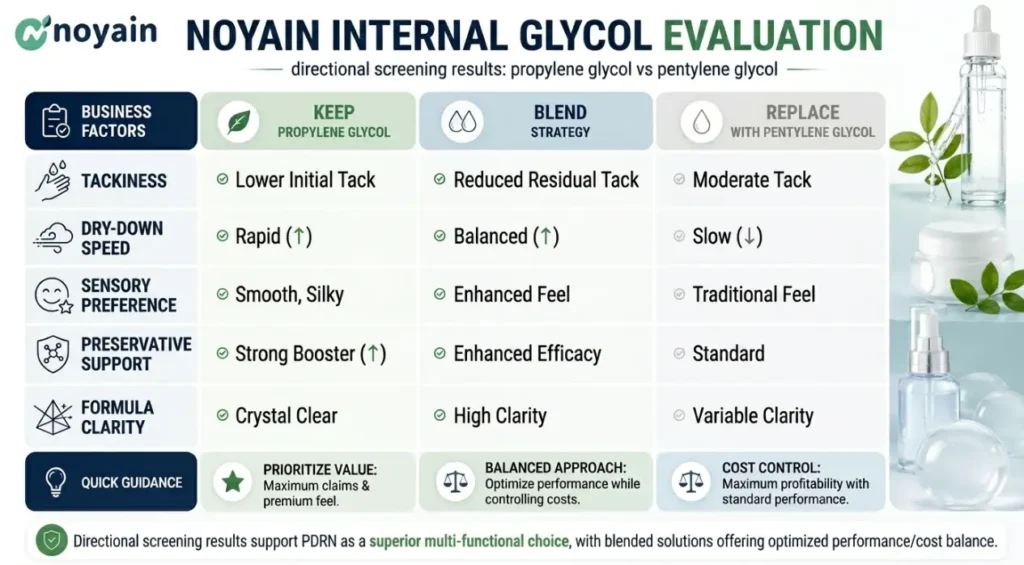
Noyain Internal Glycol Evaluation
Most online articles compare propylene glycol and pentylene glycol from public ingredient databases. In formulation work, the more useful question is what changes when both ingredients are tested in the same base formula.
The table below summarizes directional results from Noyain internal formulation screening using a lightweight water-based hydrating serum chassis. The results are not a regulatory safety assessment or a clinical study. They are first-party formulation observations used to guide replacement testing.
| Evaluation Item | Propylene Glycol | Pentylene Glycol | Noyain Formulation Note |
|---|---|---|---|
| Tackiness score | 7/10 | 4/10 | Pentylene glycol reduced the sticky after-feel in the high-humectant base |
| Dry-down speed | Moderate | Faster | The pentylene glycol prototype felt drier and smoother after 2-3 minutes |
| Internal sensory preference trend | Moderate | Stronger | Internal panel directionally preferred the pentylene glycol version for facial leave-on use |
| Preservative support | Moderate | Strong | Pentylene glycol gave better support to the preservative system in screening |
| Formula clarity | Similar | Similar | No meaningful clarity loss was observed in the test serum |
Internal laboratory evaluation results from Noyain formulation testing. Use these directional findings as a replacement-screening reference, not as a universal performance guarantee. Finished formulas still require stability, compatibility, and preservative challenge testing.
The Real Decision Is Formula Fit
Propylene glycol has been used for a long time because it is inexpensive, available, easy to process, and useful as a solvent. It does not deserve the simple label of “bad” or “unsafe.” Major cosmetic safety assessments and regulatory frameworks allow propylene glycol in cosmetic use when the finished product is properly formulated and tested.
The reason formulators are looking for alternatives is more practical:
- Some facial leave-on products feel warmer, tackier, or less premium with propylene glycol.
- Clean beauty teams may prefer ingredients with a lower consumer-database concern profile.
- Brand owners may want a more modern ingredient story.
- Preservation teams may want a glycol that contributes more to the preservative system.
- Procurement teams may need natural-origin or certification documentation.
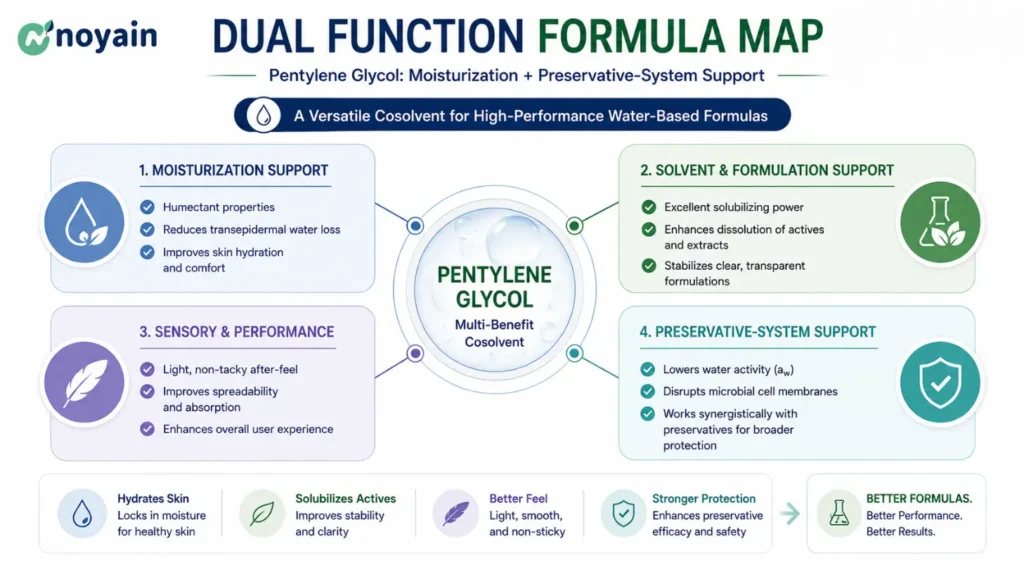
That is where pentylene glycol becomes useful. It gives the formulator more than a one-for-one solvent replacement. It can also improve dry-down, support preservation, and simplify the ingredient deck.
Are Pentylene Glycol and Propylene Glycol the Same?
No. They are related glycols, but they are not the same ingredient.
| Comparison Point | Propylene Glycol | Pentylene Glycol |
|---|---|---|
| INCI Name | Propylene Glycol | Pentylene Glycol |
| Chemical Name | 1,2-Propanediol | 1,2-Pentanediol |
| CAS Number | 57-55-6 | 5343-92-0 |
| Carbon Chain | C3 | C5 |
| Typical Role | Humectant, solvent | Humectant, solvent, texture enhancer, preservative booster |
| Skin Feel | Functional, can be slightly tacky or warm | Smoother, lower tack, more premium dry-down |
| Clean Beauty Perception | More questioned by some consumers | Often easier to position in clean or sensitive-skin formulas |
| Natural-Origin Options | Limited, depends on supplier | Available from bio-based routes depending on supplier |
| Cost | Lower | Higher |
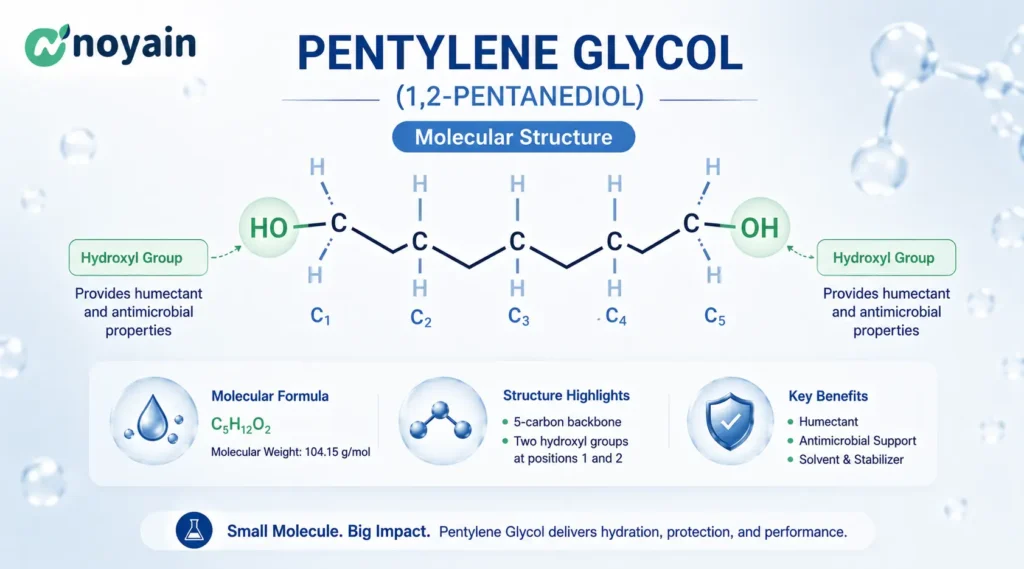
The structural difference matters. Pentylene glycol has a longer carbon chain, which gives it a more balanced hydrophilic-lipophilic character than propylene glycol. In practical formulation work, that can mean better sensory feel and stronger support for preservation systems.
Using 1,2-Pentanediol in Cosmetic Formulation
If you need the basic ingredient definition first, start with What Is Pentylene Glycol?. In replacement work, the practical point is that formulators may know the ingredient by its INCI name, Pentylene Glycol, while technical documents may refer to it as 1,2-pentanediol.
In practical 1,2-pentanediol formulation work, the ingredient is commonly evaluated as:
- A humectant in water-based leave-on products
- A solvent for selected actives, extracts, and fragrance components
- A preservative booster in water-rich systems
- A sensory modifier for lower tackiness and smoother dry-down
- A clean beauty glycol alternative when propylene glycol no longer fits the brand brief
The most important point is that 1,2-pentanediol is not just a label swap. It can change the sensory profile, preservative strategy, and sourcing story of the final product.
Where I Most Often See Pentylene Glycol Used
The highest adoption rates are usually found in formulas where sensory feel, mildness perception, and preservation support matter at the same time.
I most often see pentylene glycol used in:
- Korean skincare formulations
- Sensitive-skin serums
- Clean beauty brands
- Premium anti-aging products
- Fragrance-free formulations
- Microbiome-friendly skincare concepts
- Lightweight toners, essences, and mask liquids
- High-glycerin formulas that need lower tackiness
These are also the formats where a cosmetic-grade Pentylene Glycol specification matters most. Odor, assay, origin documentation, and preservative-system fit can decide whether the replacement still works after scale-up.
Propylene Glycol Alternative Comparison
When buyers search for a propylene glycol alternative, Google and procurement teams are usually comparing several options, not only pentylene glycol. This is how I would frame the decision:
| Alternative | Sensory Feel | Clean Beauty Fit | Preservative Support | Relative Cost | Best Use Case |
|---|---|---|---|---|---|
| Pentylene Glycol / 1,2-Pentanediol | Excellent | Excellent, with the right documentation | Excellent | High | Premium leave-on formulas, low-tack serums, preservation support |
| Propanediol | Good | Excellent | Moderate | Medium | Natural-positioned humectant and solvent systems |
| Butylene Glycol | Good | Moderate | Low | Medium | General humectancy and solvent support |
| Glycerin | Moderate to sticky | Excellent | None | Low | Low-cost hydration, especially when tackiness can be managed |
If I need only a natural-positioned humectant, propanediol may be enough. If I need preservative support and lower tackiness, pentylene glycol is usually my first choice.
Why These Situations Justify Replacement
1. The Formula Feels Sticky, Warm, or Too Basic
Core decision: Replace or partially replace PG when the product brief demands a lighter, smoother, less tacky skin feel.
This is the most common reason I would test a replacement. Propylene glycol may work technically, but in a premium serum or gel-cream it can make the formula feel ordinary. If the product brief says “lightweight,” “non-sticky,” “K-beauty texture,” or “fast-absorbing,” pentylene glycol is worth testing early.
In high-glycerin systems, pentylene glycol is especially useful. It can help reduce tackiness while still contributing to the total humectant system. I usually test it at 2-4% in water-based serums and compare the feel at 30 seconds, 3 minutes, and 10 minutes after application.
2. The Brand Wants a Clean Beauty Glycol Alternative
Core decision: Replace PG when the brand needs a cleaner, easier-to-explain glycol story for retailers, consumers, or sensitive-skin positioning.
Consumer-facing databases often rate propylene glycol and pentylene glycol differently, which is why brand teams may ask for a safety-facing explanation. For the ingredient-specific discussion, see our Pentylene Glycol Safety Review. That does not mean propylene glycol is automatically unsafe. EWG and similar databases are not regulatory authorities. Still, these scores can influence brand communication, retailer requirements, and consumer perception.
If the product brief includes sensitive skin, clean beauty, minimalist INCI, or premium positioning, pentylene glycol is easier to defend in a customer-facing ingredient story. A bio-based Pentylene Glycol grade can also support natural-positioned formulas when the right documentation is available.
3. You Want Preservative-System Support
Core decision: Test pentylene glycol when your preservation system needs extra support, especially in water-rich leave-on formulas.
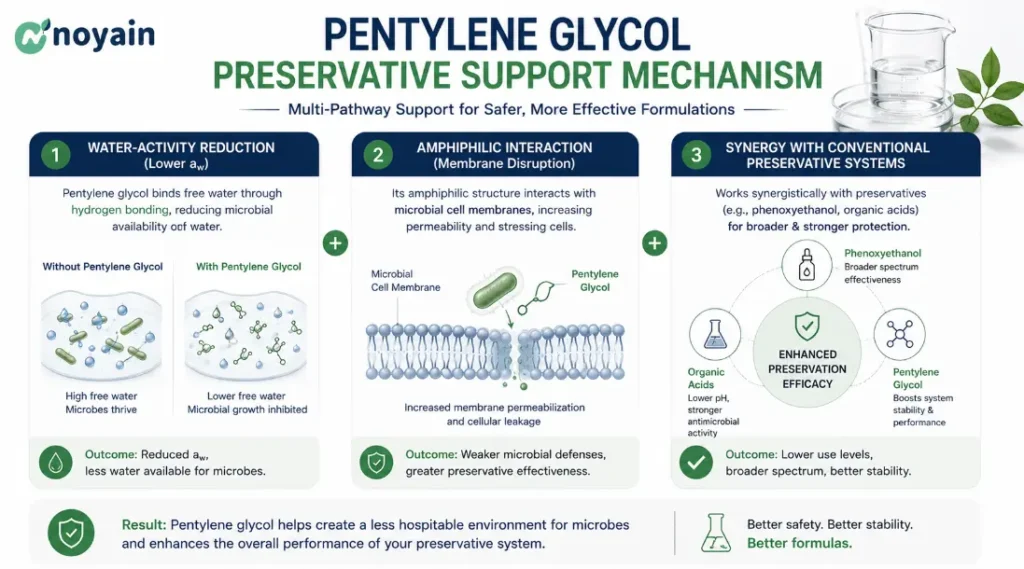
Propylene glycol can help solubilize ingredients, but it is not usually chosen for preservative boosting. Pentylene glycol is different. It can help reduce water activity and support the performance of conventional preservatives.
This matters in:
- Toners and essences with high water content
- Sheet mask liquids
- Lightweight serums
- Gel-creams
- Low-preservative or phenoxyethanol-reduced systems
- Formulas with botanical extracts that increase microbial risk
Pentylene glycol should not be treated as a complete preservative replacement. It is a booster, not a free pass. After replacing propylene glycol, run a preservative efficacy test such as USP <51>, EP 5.1.3, or an equivalent challenge test used by your lab.
4. You Need a More Premium Leave-On Product
Core decision: Replace PG when sensory quality and brand positioning matter more than the lowest possible raw material cost.
For a body wash, budget lotion, or mass-market rinse-off product, raw material cost may matter more than skin feel. For a leave-on facial serum, the calculation changes. A glycol that improves slip, dry-down, and preservation support can be worth the higher cost because it improves the product experience.
I would prioritize pentylene glycol in:
- Facial serums
- Toners and essences
- Sheet mask liquids
- Eye gels
- Sensitive-skin moisturizers
- Clean beauty leave-on products
- Lightweight anti-aging formulas
- Acne-prone skin formulas where low tack and non-greasy feel are important
When I Would Keep Propylene Glycol
Replacing propylene glycol is not always the smartest move. I would keep it, or at least keep it in the test matrix, in the following situations.
1. The Formula Is Highly Cost-Sensitive
Pentylene glycol normally costs more than propylene glycol. If the product is a high-volume, low-margin SKU and the current formula already passes stability, compatibility, preservation, and sensory requirements, replacement may not create enough value.
2. The Formula Is Rinse-Off
For shampoos, body washes, hand washes, and other rinse-off formats, the sensory benefit of pentylene glycol may be less noticeable. If propylene glycol is only supporting solubility or processing, it may remain the more efficient choice.
3. Propylene Glycol Is Solving a Specific Solubility Problem
Do not assume every active or fragrance component will behave identically after the switch. Pentylene glycol has strong solvent utility, but the solvent environment changes. If the formula depends on propylene glycol to dissolve a difficult active, fragrance component, dye, or botanical extract, run a solubility check before replacing it.
4. The Product Has Already Passed Expensive Validation
If the formula has completed stability, compatibility, safety, preservation, packaging, and regulatory review, a glycol change is not a small administrative edit. It can trigger new testing. In that case, I would replace propylene glycol only if there is a clear commercial reason.
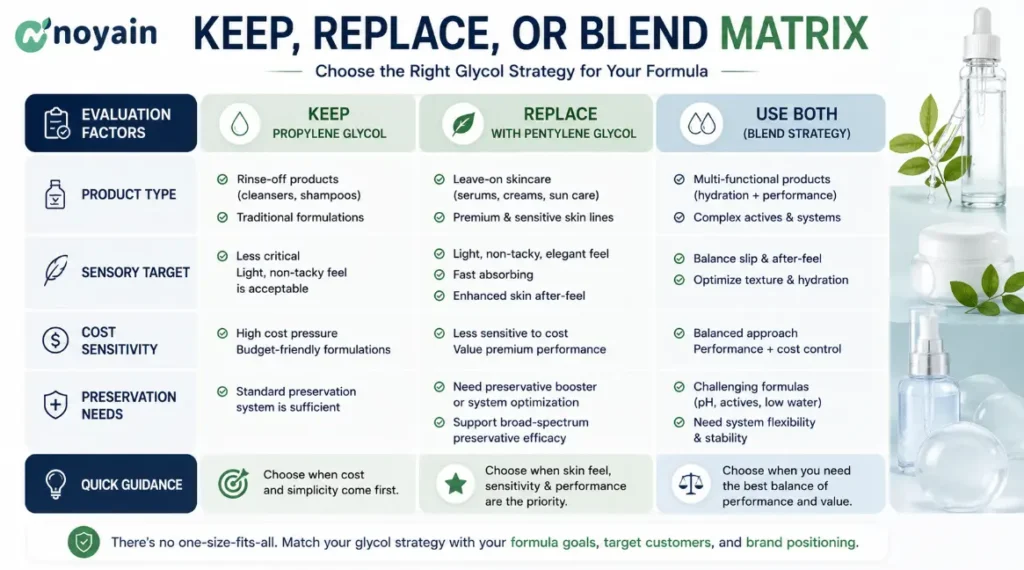
Keep, Replace, or Blend?
| Formula Situation | Best Move | Why |
|---|---|---|
| Budget rinse-off product | Keep propylene glycol | Cost and processing usually matter more than premium after-feel |
| Premium facial serum | Replace with pentylene glycol | Better skin feel and stronger clean-positioning value |
| High-glycerin toner | Replace or blend | Pentylene glycol can reduce tackiness while supporting humectancy |
| Phenoxyethanol-reduced system | Test pentylene glycol | It can support the preservative system, but must be challenge tested |
| Active solubility depends on PG | Test before replacing | Solvent behavior may change |
| Clean beauty formula | Replace with pentylene glycol | Better fit for modern positioning, especially with bio-based documentation |
| Very cost-sensitive lotion | Blend or keep PG | A partial replacement may improve feel without too much cost increase |
A Practical Replacement Test
If you are trying to answer “should I replace propylene glycol in my formula?”, do not start with a full reformulation. Start with a controlled A/B test.
Step 1: Make a 1:1 Replacement Prototype
Replace propylene glycol with pentylene glycol at the same percentage.
Example:
- Original: 3.0% Propylene Glycol
- Prototype: 3.0% Pentylene Glycol
Keep everything else the same. This gives you a clean comparison.
Step 2: Check Appearance and Processing
During batching, record:
- Clarity
- Mixing time
- Foaming
- Heating requirement
- Any odor shift
- Any viscosity change during neutralization or cooling
Pentylene glycol is water-miscible and easy to incorporate, but it can change viscosity, odor impression, or active solubility depending on the system.
Step 3: Run a Simple Sensory Panel
Use a small internal panel before investing in larger tests. Compare:
- Slip during application
- Tackiness at 30 seconds
- Tackiness at 3 minutes
- Dry-down smoothness
- Warmth or stinging perception
- Residue
- Overall preference
In facial leave-on formulas, this step often answers the business question faster than a long ingredient debate.
Step 4: Check pH, Viscosity, and Stability
Run the basic technical checks:
- pH at initial, 24 hours, and after accelerated storage
- Viscosity at initial and after temperature cycling
- Centrifuge stability if relevant
- Freeze-thaw stability if relevant
- Color and odor stability
- Packaging compatibility
Step 5: Confirm Preservation
If the formula contains water, do not skip preservation testing. Pentylene glycol can support preservation, but every final formula still needs validation. If you reduce the primary preservative after adding pentylene glycol, challenge testing becomes even more important.
Practical Formulator Notes
These are the checks I would keep on the bench worksheet when replacing propylene glycol:
- Start replacement at a 1:1 ratio before changing anything else.
- Monitor viscosity after 24 hours, not only immediately after batching.
- Evaluate sensory after 3 minutes, not just during first application.
- Re-check preservative efficacy if the formula contains water.
- Verify active solubility before pilot scale.
- Watch odor in fragrance-free formulas.
- Confirm pH after the glycol change, especially in acid toners and gel systems.
- Do not reduce the preservative package until the pentylene glycol version passes challenge testing.
For most serum, toner, and essence projects, this short checklist prevents unnecessary reformulation loops.
Pentylene Glycol Compatibility Guide
Pentylene glycol is generally easy to test in water-based skincare systems, but compatibility still depends on the full formula.
Commonly compatible with:
- Niacinamide
- Panthenol
- Hyaluronic acid
- Ceramides
- Peptides
- Botanical extracts
- Glycerin, betaine, and other humectants
Evaluate carefully with:
- High electrolyte systems
- Difficult fragrance solubilization systems
- Certain polymer thickener combinations
- Very low-pH exfoliating formulas
- Formulas with heavy botanical extract load
For formulators, this section matters because replacement success is rarely about one glycol alone. It depends on pH, solubility, polymer behavior, preservative system, and the sensory target of the finished formula.
What I Observed During a Real Replacement Project
In one lightweight hydrating serum project, we replaced 3% propylene glycol with 3% pentylene glycol while keeping the rest of the formula unchanged. The formula was a water-based serum with glycerin, betaine, panthenol, sodium hyaluronate, a polymeric thickener, and a conventional preservative system.
The most noticeable differences appeared during sensory evaluation:
- Lower tackiness after 2-3 minutes
- Faster dry-down
- Less warm feeling during application
- Smoother rub-out in the high-humectant base
- Slightly lower viscosity after 24 hours, still within the acceptable range
The preservative challenge test still passed without changing the preservative package. Raw material cost increased, but the internal panel preferred the pentylene glycol version because it felt more premium and less sticky.
That is why I rarely judge this replacement only from a cost sheet. If the formula is a facial leave-on product, the sensory improvement can be commercially meaningful.
Example A/B Test Formula: Lightweight Hydrating Serum
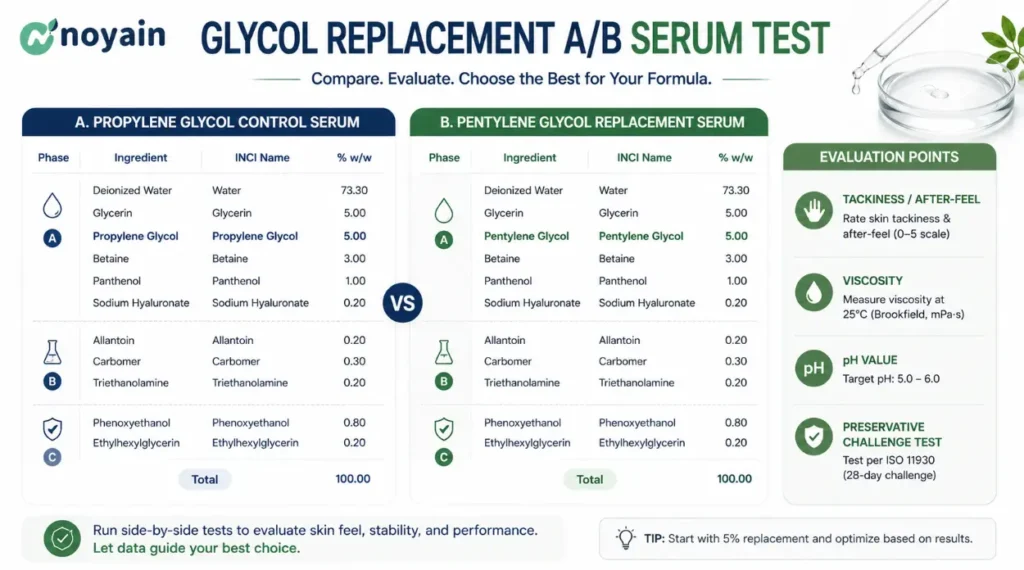
Use this as a simple test chassis when comparing propylene glycol and pentylene glycol.
| Phase / Ingredient | Control A | Prototype B | Function |
|---|---|---|---|
| Aqua / Water | q.s. to 100% | q.s. to 100% | Solvent |
| Glycerin | 4.0% | 4.0% | Humectant |
| Propylene Glycol | 3.0% | – | Traditional glycol humectant / solvent |
| Pentylene Glycol | – | 3.0% | 1,2-pentanediol formulation test ingredient; humectant, sensory modifier, preservative booster |
| Betaine | 2.0% | 2.0% | Humectant and osmolyte |
| Panthenol | 1.0% | 1.0% | Skin conditioning support |
| Sodium Hyaluronate | 0.10% | 0.10% | Hydration and viscosity contribution |
| Hydroxyethylcellulose or Acrylates Copolymer | q.s. | q.s. | Texture and viscosity control |
| Preservative System | q.s. | q.s. | Microbial protection; validate by challenge test |
| pH Adjuster | q.s. to pH 5.5-6.0 | q.s. to pH 5.5-6.0 | pH control |
What I would evaluate:
- Does Prototype B feel less tacky at 3 minutes?
- Does it spread more evenly?
- Does the formula remain clear?
- Does viscosity shift after 24 hours?
- Does the preservative system still pass challenge testing?
- Does the higher ingredient cost create enough sensory or positioning value?
If the sensory improvement is obvious and preservation remains strong, pentylene glycol is usually worth moving into the next development round.
What Percentage of Pentylene Glycol Should You Use?
For most leave-on skincare formulas, I would start in this range:
| Goal | Typical Starting Range |
|---|---|
| Sensory improvement | 2-3% |
| Humectant support | 2-5% |
| Preservative-system support | 3-5% |
| Solvent support | Depends on active and solubility target |
| Partial PG replacement | Replace 25-50% of the PG phase first |
| Full PG replacement | 1:1 replacement as a first prototype |
The right level depends on the whole formula. A toner with a light preservative system may need a different level than a rich emulsion or an active serum. If your goal is preservative boosting, confirm with PET or challenge testing rather than relying on a fixed percentage.
Can You Use Both Propylene Glycol and Pentylene Glycol?
Yes. A blend can be useful when the formula needs cost control but still benefits from pentylene glycol.
For example, if the original formula uses 4% propylene glycol, you might test:
- 4.0% Propylene Glycol
- 2.0% Propylene Glycol + 2.0% Pentylene Glycol
- 4.0% Pentylene Glycol
This gives you a cost, sensory, and preservation comparison. Sometimes the blend gives enough improvement without the full cost increase. In other cases, the full pentylene glycol replacement wins clearly on skin feel.
Cost and Sourcing Considerations
Pentylene glycol is usually more expensive than propylene glycol, so buyers will ask a fair question: what does the extra cost buy?
The answer should be specific:
- Better sensory profile in leave-on formulas
- Lower tackiness in high-humectant systems
- Preservative-system support
- Cleaner ingredient perception
- Natural-origin or bio-based sourcing options, depending on grade
- More premium positioning for sensitive-skin or clean beauty products
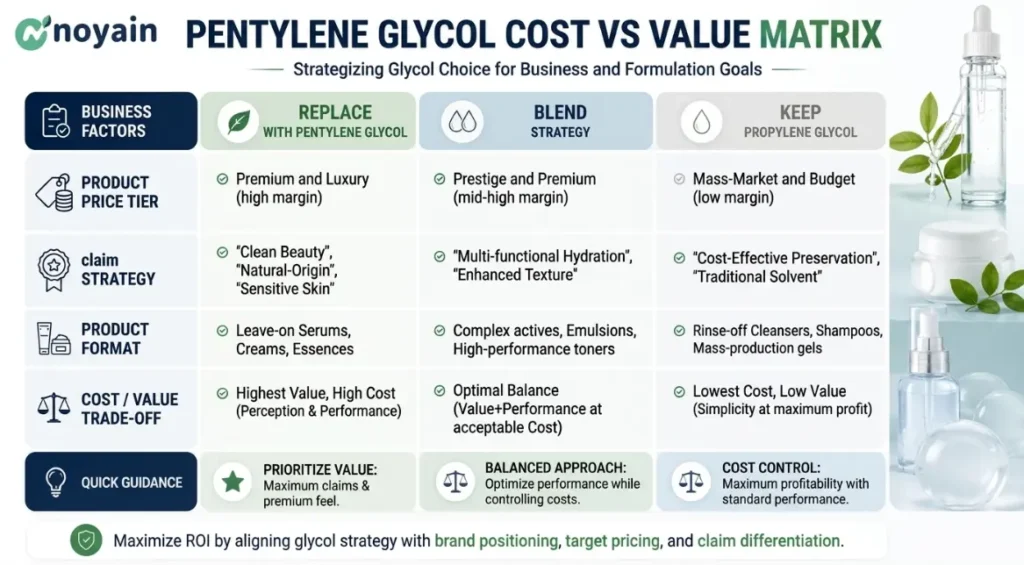
Cost vs Value Analysis
The cost question should be tied to product positioning. A higher raw material cost is easier to justify when the formula sells sensory quality, clean beauty positioning, or sensitive-skin compatibility.
| Product Scenario | Recommended Move | Why |
|---|---|---|
| Premium facial serum (> USD 20 retail) | Replace PG | Skin feel and label perception can justify the upgrade |
| Premium anti-aging serum | Replace PG | Sensory quality and preservation support matter more than lowest cost |
| Clean beauty product | Replace PG | Pentylene glycol fits the claim story better when documentation supports it |
| Fragrance-free sensitive-skin toner | Replace or blend | Lower tackiness and lower odor pressure can be valuable |
| Affordable daily lotion | Blend | Partial replacement can improve feel without a full cost increase |
| Rinse-off shampoo or body wash | Keep PG | Sensory upgrade is usually less noticeable after rinsing |
| Commodity high-volume SKU | Keep PG | Cost and supply stability may be the stronger priority |
If a formula sells at a premium price point, I usually evaluate pentylene glycol early. If the formula competes mainly on price, I test a blend before recommending full replacement.
Buyer Questions Before Approving a Glycol Replacement
Before a purchasing team approves a glycol replacement project, they usually ask questions beyond formulation performance:
- How much will the formula cost increase?
- Will supplier documentation change?
- Is the material available globally?
- Does the supplier provide backup inventory or stable lead time?
- Will validation need to be repeated?
- Will the replacement affect existing customer claims, such as dermatologically tested, sensitive skin, clean beauty, or natural origin?
- Can the supplier provide COA, TDS, SDS/MSDS, origin statement, and certification documents?
- Is the material suitable for the target market’s claim language?
- Can the supplier support lab samples before pilot production?
For B2B projects, these questions are not secondary. A technically good replacement can still fail if procurement, regulatory, or supply-chain teams cannot approve it smoothly.
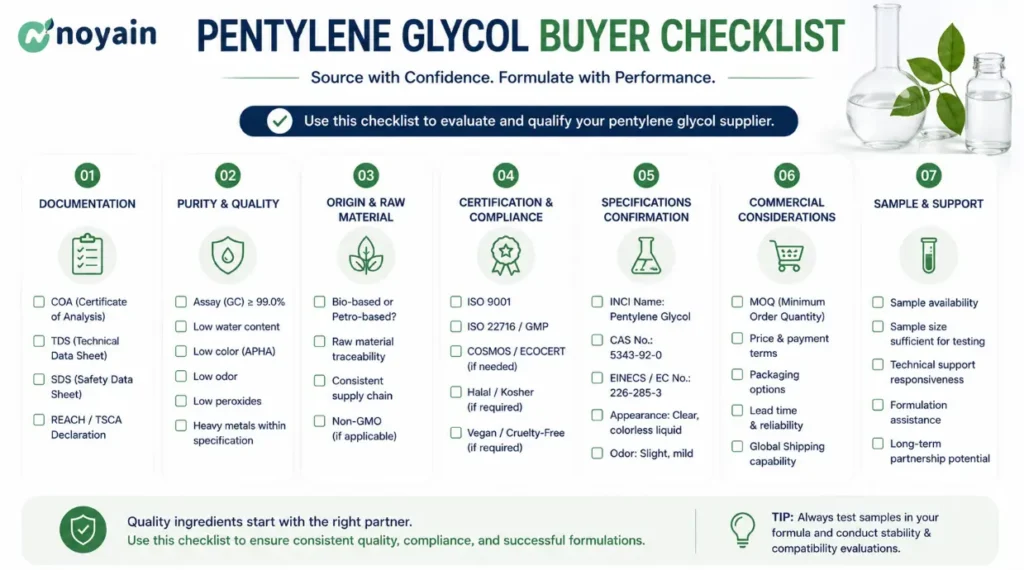
When sourcing Pentylene Glycol, ask for:
- INCI: Pentylene Glycol
- CAS: 5343-92-0
- Purity or assay specification
- Appearance, odor, and color limits
- COA for each batch
- TDS and MSDS/SDS
- Origin statement if natural-positioned claims are needed
- COSMOS-compatible, Halal, Vegan, Non-GMO, or other certification documents when required
- Allergen statement
- MOQ and lead time
- Sample policy
- Batch-to-batch consistency data
A low price is not very useful if the material creates odor drift, document gaps, or delayed approval during scale-up.
Common Sourcing Problems With Pentylene Glycol
When evaluating suppliers, I usually verify more than price and lead time. Pentylene glycol is often used in premium leave-on products, so small quality differences can become visible in the final formula.
Common sourcing problems include:
- Odor inconsistency: A faint odor shift may be obvious in fragrance-free serums, toners, and mask liquids.
- Color drift: Even slight yellowing can be an issue in clear gel or essence formats.
- Assay variation: Low or inconsistent purity may affect sensory feel, preservation support, and buyer confidence.
- Incomplete origin documentation: This is a problem when the formula needs natural-origin, bio-based, or clean beauty positioning.
- Certification gaps: COSMOS-compatible, Halal, Vegan, Non-GMO, or allergen statements should be checked before claims are approved.
- Unstable lead time: A good lab sample is not enough if the supplier cannot support pilot and commercial batches.
- Batch-to-batch COA differences: Review multiple COAs when possible, not only one sample document.
For B2B buyers, the safest approach is to request a small lab sample first, then verify odor, color, assay, documentation, and formulation performance before discussing larger-volume procurement.
Common Replacement Mistakes
Mistake 1: Treating Pentylene Glycol as a Standalone Preservative
Pentylene glycol can support preservation, but it should not be used as the only preservation strategy in a water-containing formula unless testing proves the system is adequate. Use it as part of a preservative system.
Mistake 2: Replacing PG After Final Validation
If the formula is already close to launch, changing glycols can create more work than expected. Build the replacement test early in development.
Mistake 3: Ignoring Solubility
If propylene glycol is holding an active, fragrance, colorant, or botanical component in solution, test solubility before making the switch.
Mistake 4: Looking Only at Raw Material Cost
Pentylene glycol costs more, but it may reduce tackiness, improve consumer preference, support preservation, and strengthen the product story. Evaluate total formula value, not just ingredient price per kilogram.
Mistake 5: Making a Safety Claim Based Only on EWG
EWG can be useful for understanding consumer perception, but it is not a regulatory safety assessment. In technical documentation, separate regulatory status, scientific safety assessment, and consumer-facing perception.
Decision Checklist
Use this checklist before replacing propylene glycol:
| Question | If Yes | Action |
|---|---|---|
| Is the formula a facial leave-on product? | Pentylene glycol may add value | Run 1:1 A/B test |
| Is tackiness a complaint? | Pentylene glycol is worth testing | Evaluate sensory at 30 sec / 3 min / 10 min |
| Is the brand clean-positioned? | Pentylene glycol may fit better | Request origin and certification documents |
| Is PG solving an active solubility issue? | Replacement may not be simple | Run solubility screening |
| Is cost the main driver? | PG may still be best | Test partial replacement |
| Is preservation difficult? | Pentylene glycol may help | Run challenge testing |
| Has the formula already passed validation? | Change may trigger retesting | Replace only with a clear business reason |
If You Only Remember Five Things
- Pentylene glycol is not the same as propylene glycol.
- Start replacement with a 1:1 A/B test before changing the rest of the formula.
- Pentylene glycol often reduces tackiness in high-humectant leave-on formulas.
- Pentylene glycol can support preservation, but the finished formula still needs challenge testing.
- Cost increases must be justified by sensory improvement, claim value, or buyer approval needs.
This is the short version I would give to a product manager who needs the decision without the full technical discussion.
FAQ
Can pentylene glycol replace propylene glycol in serum?
Yes, it can often be tested as a 1:1 replacement in water-based serums. In high-glycerin serums, pentylene glycol may reduce tackiness and improve dry-down. Check viscosity, clarity, active solubility, skin feel, and preservative efficacy before approval.
Can pentylene glycol replace propylene glycol 1:1?
In many water-based skincare formulas, yes. Start with a direct 1:1 prototype, then adjust based on sensory feel, viscosity, solubility, stability, and preservation results.
Is pentylene glycol safer than propylene glycol?
Both ingredients can be used safely in properly formulated cosmetics. Pentylene glycol may be easier to position for sensitive-skin and clean beauty formulas because of consumer perception and skin-feel advantages, but safety should be evaluated from the finished formula, not the INCI name alone.
What percentage of pentylene glycol equals 5% propylene glycol?
Start with 5% pentylene glycol as the first A/B prototype. After sensory, stability, solubility, and preservation testing, you may reduce the level or use a partial replacement depending on cost and performance.
Does pentylene glycol improve preservative efficacy?
It can support preservative efficacy by helping reduce water activity and improving the overall preservation environment, especially in water-rich formulas. It should still be validated with preservative challenge testing.
Can I reduce phenoxyethanol if I add pentylene glycol?
Possibly, but not automatically. Pentylene glycol can support preservative efficacy, yet any reduction in phenoxyethanol or another preservative must be confirmed by preservative challenge testing.
Does pentylene glycol work with niacinamide, peptides, and hyaluronic acid?
Yes, it is commonly compatible with niacinamide, peptides, panthenol, and hyaluronic acid in water-based skincare systems. Still check pH, clarity, viscosity, odor, and preservative efficacy in the final formula.
What documents should I request when buying pentylene glycol?
Request COA, TDS, SDS/MSDS, INCI confirmation, CAS confirmation, origin statement, allergen statement, and certification documents such as COSMOS-compatible, Halal, Vegan, or Non-GMO if your market requires them.
The Bottom Line
I would replace propylene glycol when the formula needs better skin feel, cleaner positioning, sensitive-skin compatibility, or preservative-system support. I would keep propylene glycol when cost, validation history, or a specific solubility role matters more.
The best approach is simple: do not decide from the INCI list alone. Make an A/B prototype, test sensory feel, confirm stability, verify preservation, and compare the cost against the value the replacement creates.
If your formula is a modern leave-on serum, toner, essence, mask liquid, or gel-cream, pentylene glycol should be in the first replacement test.
Ready to Compare PG and Pentylene Glycol in Your Formula?
Request a free laboratory sample and run your own A/B test.
Available support includes:
- 50g / 100g samples
- COA, TDS, SDS/MSDS
- Regulatory documentation
- Formulation support
- MOQ and lead-time consultation
Most sample requests receive a response within 12 hours.
Or reach us directly at [email protected]
Noyain Biochemicals
Room 3a05, 4th Floor, No. 6, Ketai Second Road, Baiyun District, Guangzhou City, China
References
- Johnson, W. Jr., Bergfeld, W. F., Belsito, D. V., et al. 2012. “Safety Assessment of 1,2-Glycols as Used in Cosmetics.” International Journal of Toxicology, 31(5 Suppl):147S-168S.
- Fiume, M. M., Bergfeld, W. F., Belsito, D. V., et al. 2012. “Safety Assessment of Propylene Glycol, Tripropylene Glycol, and PPGs as Used in Cosmetics.” International Journal of Toxicology, 31(5 Suppl):245S-260S.
- PubChem. “1,2-Pentanediol.” National Center for Biotechnology Information.
- PubChem. “Propylene Glycol.” National Center for Biotechnology Information.
- European Commission. CosIng cosmetic ingredient database.
- European Chemicals Agency (ECHA). Substance information database.
- United States Pharmacopeia. USP <51> Antimicrobial Effectiveness Testing.