
Bisabolol
Advanced Soothing Solution for Sensitive and Compromised Skin Formulations
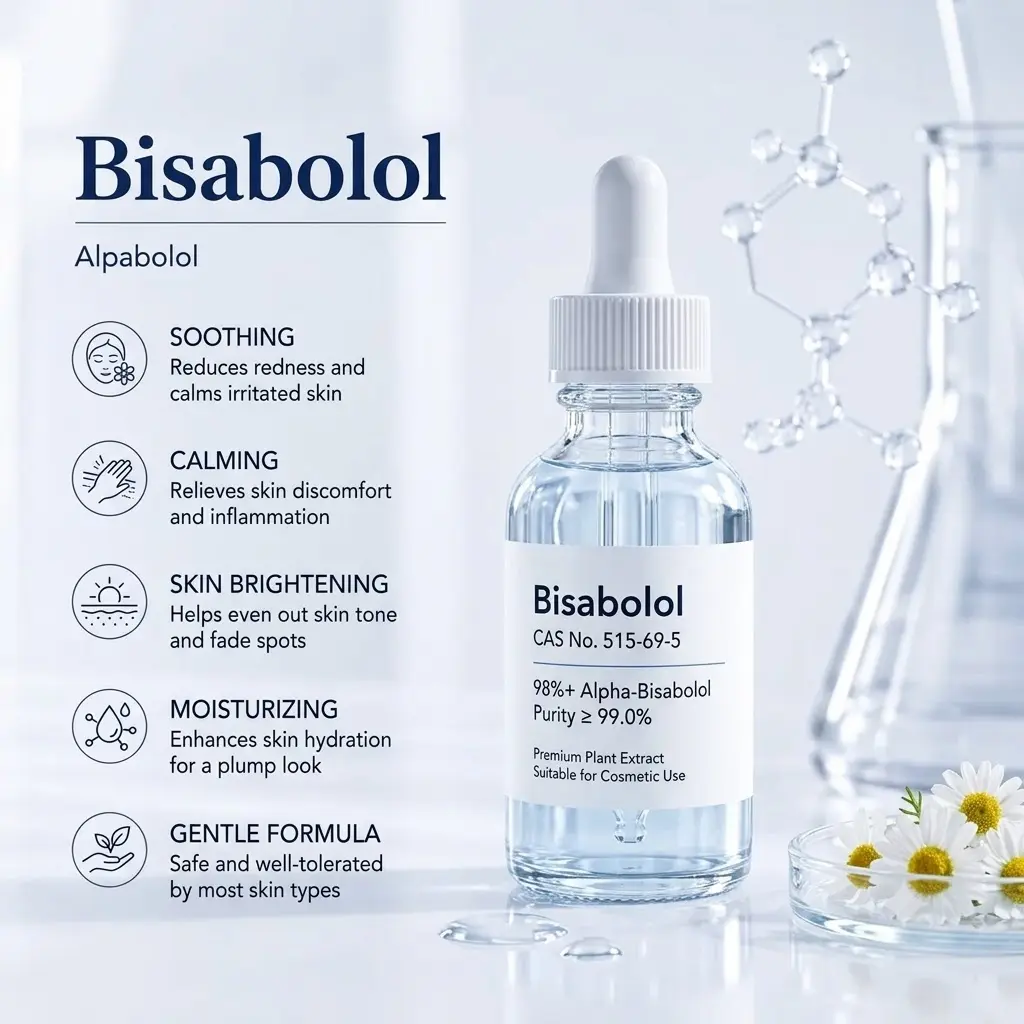
Soothing Mechanism
Recommended Applications
Sensitive Skin Serum
Post-Procedure Care
After-Sun Care
Soothing Mask
Why Formulators Choose Bisabolol
Our high-quality Bisabolol ingredients
Product Technical Parameters
Parameter | Specification |
|---|---|
INCI Name | Sodium DNA |
Appearance | Liquids and powders |
Purity | 99% |
Recommended Dosage | 0.05% – 2.0% |
Solubility | Fully soluble in water, alcohol, and glycols |
pH Stability | 4.5 – 8.0 |
Application | Serums, Creams, Lotions, Masks, Ampoules, Repair Treatments |
Shelf Life | 24 Months |
Other related products
Technical Support Materials
Product-related articles
Frequently Asked Questions
- What is the difference between Bisabolol and (-)-Alpha-Bisabolol?
Bisabolol is the INCI name used on cosmetic ingredient lists. Alpha-bisabolol has several stereoisomeric forms.
NOYAIN Bisabolol is specified as the (-)-α-bisabolol form, also known as Levomenol. Buyers should confirm the active form and CAS number through the product specification and current batch documentation.
- What is the CAS number of NOYAIN Bisabolol?
The specified CAS number for this (-)-α-bisabolol grade is 23089-26-1.
The CAS number should be checked together with the INCI name, chemical identity, active form and supplier specification because other commercial Bisabolol materials may use different identity records.
- How is NOYAIN Bisabolol produced?
It is produced through a biosynthetic route involving Saccharomyces cerevisiae fermentation and enzymatic catalysis.
The current technical dossier specifies a single (-)-α-bisabolol active form, purity above 98% and 98% bio-based carbon.
- What is the recommended dosage of Bisabolol?
The current recommended use range is 0.01%–1.0%.
Supplier-provided human-use testing evaluated 0.1% and 0.2% in a base-oil system. The final level should be selected according to the product format, target positioning, total formula, safety assessment and stability results.
- Is Bisabolol soluble in water?
Bisabolol is a lipophilic, oil-compatible ingredient and should not be described as fully water-soluble.
For emulsions, it can generally be pre-mixed into the oil phase or a compatible emollient. Clear water-based systems may require an appropriate solubilizer and formulation testing.
- Does Farnesol below 0.5% mean the product is allergen-free?
No. Farnesol below 0.5% is a raw-material specification and does not establish that the raw material or finished product is allergen-free or hypoallergenic.
The actual batch result, ingredient use level, other sources of Farnesol and applicable target-market regulations must be considered.