Pentylene glycol is one of the most searched cosmetic ingredients on safety databases — but is the concern warranted? This comprehensive safety review examines EWG data, CIR assessment, available toxicological profiles, and common safety concerns to give formulators and procurement professionals the complete safety picture.
Key Takeaways
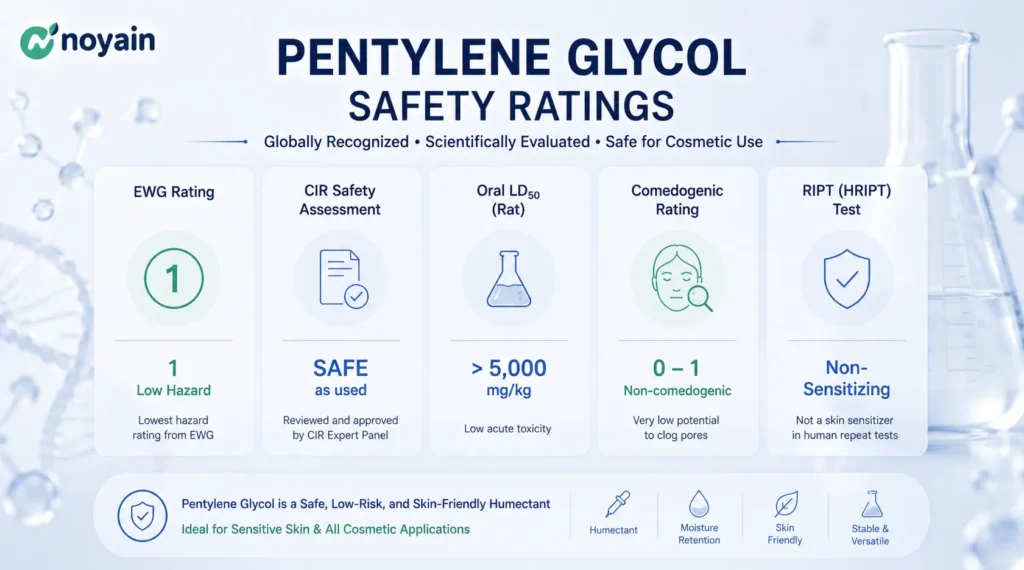
- EWG Rating: 1 (Low Hazard) — among the safest cosmetic ingredient scores
- CIR Assessment: Evaluated by the Cosmetic Ingredient Review panel and determined safe as used in cosmetic formulations
- Comedogenicity: Rated 0–1 (non-comedogenic, will not clog pores)
- Acute Toxicity: LD50 > 5,000 mg/kg (practically non-toxic)
- Pregnancy Safety: Current assessments have not identified reproductive or developmental concerns at cosmetic use levels
- Not a PEG, not a drying alcohol, not an endocrine disruptor
Why Safety Data Matters for Formulators and Buyers
In the era of ingredient transparency and “clean beauty,” safety data is no longer optional — it is the first filter in formulation decisions. Every year, millions of consumers search ingredient safety databases before purchasing. For B2B ingredient suppliers, providing clear, third-party-validated safety data is essential for building trust with brand owners and formulators.
Pentylene glycol has accumulated a strong safety dossier over decades of use. This article aggregates all major safety evaluations into one reference document.
1. EWG Skin Deep: Rating 1 (Low Hazard)
The Environmental Working Group (EWG) Skin Deep database is one of the most consulted resources for ingredient safety. Pentylene glycol receives an EWG score of 1 out of 10, where 1 is the safest and 10 is the highest hazard.
| EWG Score | Meaning | Pentylene Glycol |
|---|---|---|
| 1 | Low Hazard | ✅ |
| 2–3 | Moderate | — |
| 4–6 | Moderate-High | — |
| 7–10 | High Hazard | — |
Score Breakdown (EWG Skin Deep):
| Safety Parameter | Score | Assessment |
|---|---|---|
| Cancer | 0/2 | No evidence of carcinogenicity |
| Developmental & Reproductive Toxicity | 0/2 | No evidence of toxicity |
| Allergies & Immunotoxicity | 0/2 | Low concern |
| Use Restrictions | 0/1 | No known restrictions |
This places pentylene glycol in the safest category of cosmetic ingredients — comparable to glycerin and water in terms of hazard rating.
Keyword context: The highest-volume safety keyword, “pentylene glycol danger” (search volume 40), suggests consumers actively want reassurance about this ingredient. This article directly addresses that concern with available evidence.
2. CIR (Cosmetic Ingredient Review) Assessment
The Cosmetic Ingredient Review (CIR) panel is an independent scientific body that evaluates the safety of cosmetic ingredients. Their assessment of 1,2-glycols, which includes pentylene glycol, concluded that these ingredients are safe as used in cosmetic formulations when formulated to be non-irritating.
Key CIR Findings:
| Parameter | Finding |
|---|---|
| Panel conclusion | Safe as used in cosmetic formulations |
| Common use levels reviewed | 1–5% |
| Irritation potential | Minimal to none at reviewed concentrations |
| Sensitization potential | No significant sensitization observed |
| Phototoxicity | No phototoxic potential |
| Genotoxicity | Negative in standard assays |
Note: The CIR panel evaluated safety across the range of concentrations in current use rather than establishing a single maximum safe limit. Common cosmetic use levels for pentylene glycol typically range from 1–5%, depending on the desired function (humectant, solvent, or preservative booster).
The CIR safety assessment is a key reference for regulatory bodies worldwide and provides authoritative support for pentylene glycol’s safety profile in cosmetics.
3. RIPT (Repeat Insult Patch Test) Data
The Human Repeat Insult Patch Test (RIPT) is the gold standard for determining skin sensitization potential. Available data from multiple RIPT studies indicates that pentylene glycol has a favorable dermal safety profile at typical cosmetic use concentrations.
What RIPT Evaluates:
| Phase | Duration | Purpose |
|---|---|---|
| Induction | 3 weeks | Repeated exposure to assess irritation and sensitization |
| Rest | 2 weeks | No exposure |
| Challenge | Re-application | Verify whether sensitization has occurred |
Available Evidence:
Multiple RIPT studies conducted at typical cosmetic use levels have reported no evidence of sensitization for pentylene glycol. Published and supplier-provided data consistently show:
- Irritation potential: Low — cumulative irritation scores remain minimal across independent studies
- Sensitization rate: No evidence of delayed contact hypersensitivity in study populations
- Concentration range evaluated: Studies typically cover the 1–5% range corresponding to common cosmetic use levels
Conclusion: The available RIPT evidence supports pentylene glycol’s safety profile for topical application at typical cosmetic concentrations. Formulators should always conduct their own stability and safety testing within their specific formulation context.
4. Comedogenicity Rating: 0–1 (Non-Comedogenic)
Comedogenicity measures an ingredient’s tendency to clog pores and cause acne. The standard comedogenic scale runs from 0 (will not clog pores) to 5 (highly likely to clog pores).
| Rating | Meaning | Pentylene Glycol |
|---|---|---|
| 0 | Non-comedogenic | ✅ Primary rating |
| 1 | Low likelihood | ✅ Upper range |
| 2 | Slight likelihood | — |
| 3 | Moderate likelihood | — |
| 4 | Fairly high likelihood | — |
| 5 | High likelihood | — |
Pentylene glycol is consistently rated 0–1, meaning it has virtually no potential to block pores or cause breakouts. This makes it a preferred humectant for acne-prone and oily skin formulations, and a safe alternative to higher-comedogenicity ingredients.
5. Acute Toxicity Profile
Acute toxicity is measured by the LD50 (Lethal Dose, 50%) — the dose required to cause mortality in 50% of test subjects. Higher LD50 values indicate lower toxicity.
| Route | LD50 | Classification |
|---|---|---|
| Oral (rat) | > 5,000 mg/kg | Practically non-toxic |
| Dermal (rabbit) | > 2,000 mg/kg | Low toxicity |
| Inhalation (rat, 4h) | > 5.0 mg/L | Low toxicity |
For context:
- Table salt (NaCl) oral LD50: ~3,000 mg/kg
- Caffeine oral LD50: ~200 mg/kg
- Pentylene glycol oral LD50: > 5,000 mg/kg
Pentylene glycol has a safety margin that exceeds many common food ingredients. At typical cosmetic use concentrations of 1–5%, the exposure is orders of magnitude below any toxic threshold.
6. Potential Side Effects of Pentylene Glycol
While pentylene glycol has a strong safety profile, no cosmetic ingredient is entirely without the potential for reactions in every individual. Understanding the documented side effect profile allows formulators and procurement professionals to make informed decisions.
| Potential Effect | Context | Frequency |
|---|---|---|
| Mild irritation | Very sensitive or damaged skin barrier; concentrations above typical use ranges | Rare |
| Temporary stinging | Open skin, compromised barrier, or very high concentrations | Rare |
| Eye irritation | Direct contact with undiluted ingredient; rinse-off formulations at use levels are generally non-irritating | Uncommon |
| Allergic contact dermatitis | As with any cosmetic ingredient, individual sensitivity is possible | Extremely uncommon |
Documented side effects are rare and generally mild. The available evidence from RIPT data, CIR assessments, and post-market surveillance indicates that pentylene glycol has a very low adverse event profile when used at typical cosmetic concentrations (1–5%).
Keyword alignment: This section directly addresses search queries around “pentylene glycol side effects,” “pentylene glycol irritation,” and “pentylene glycol allergy” by providing a clear, balanced overview of the documented safety profile.
7. Safety During Pregnancy
Pregnancy safety is one of the most commonly searched concerns for cosmetic ingredients. The available data for pentylene glycol is reassuring:
| Concern | Assessment |
|---|---|
| Reproductive toxicity | Current assessments have not identified reproductive concerns at cosmetic use levels |
| Teratogenicity | Not classified as a teratogen by major regulatory bodies |
| Transdermal absorption | Minimal at typical use concentrations |
| Systemic exposure | Well below safety thresholds at cosmetic use levels |
Bottom line: Pentylene glycol is not classified as a reproductive or developmental toxicant by major regulatory bodies including ECHA and the CIR panel. As with any cosmetic ingredient during pregnancy, individual formulations should be reviewed by a healthcare provider if concerns arise.
8. Is Pentylene Glycol Safer Than Propylene Glycol?
One of the most common questions from formulators is how pentylene glycol compares to propylene glycol in terms of safety. This comparison directly addresses high-intent search queries and helps buyers make informed decisions.
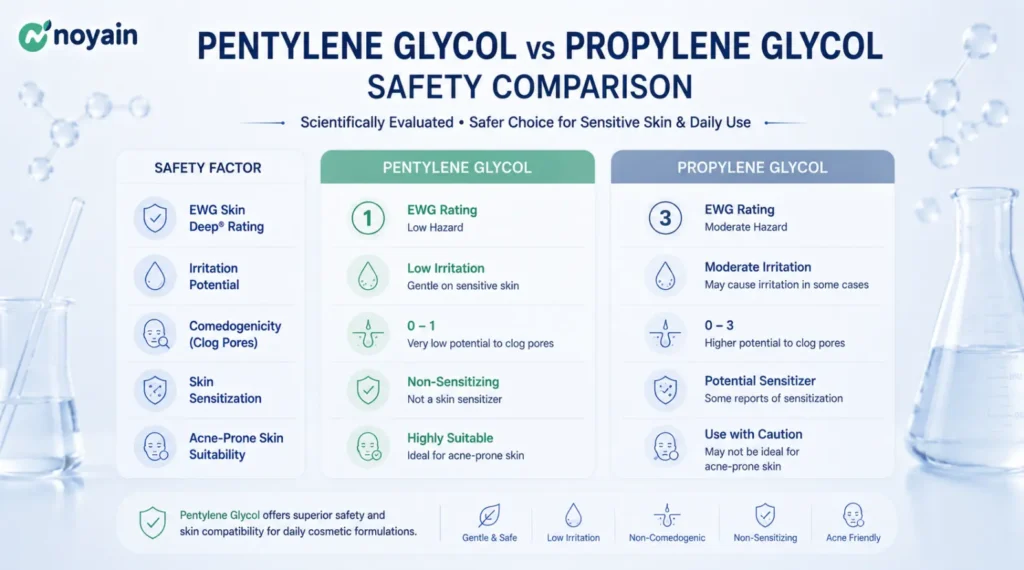
| Safety Parameter | Pentylene Glycol | Propylene Glycol |
|---|---|---|
| EWG Score | 1 (Low Hazard) | 3 (Moderate Hazard) |
| Skin Irritation Potential | Lower — documented as minimal at use levels | Higher — known irritant in some populations |
| Comedogenic Rating | 0–1 (non-comedogenic) | 0–3 (variable by individual) |
| Sensitization Rate | Extremely low | Low to moderate in some populations |
| Drying Effect | None — acts as humectant | Can be drying at high concentrations |
| Acne Suitability | Better — non-comedogenic, non-irritating | Moderate — may trigger breakouts in some users |
| Natural Origin Availability | Yes (sugarcane fermentation) | Limited (primarily petrochemical) |
| Common Use Level | 1–5% | 1–50% |
Key Takeaway: Pentylene glycol offers a superior safety profile compared to propylene glycol, particularly for sensitive skin and acne-prone formulations. This is why many formulators are transitioning from propylene glycol to pentylene glycol in clean beauty and sensitive skin products.
For a detailed comparison covering molecular structure, humectancy, cost, and formulation guidance, see our full guide: Pentylene Glycol vs Propylene Glycol →
9. Common Safety Concerns — Debunked
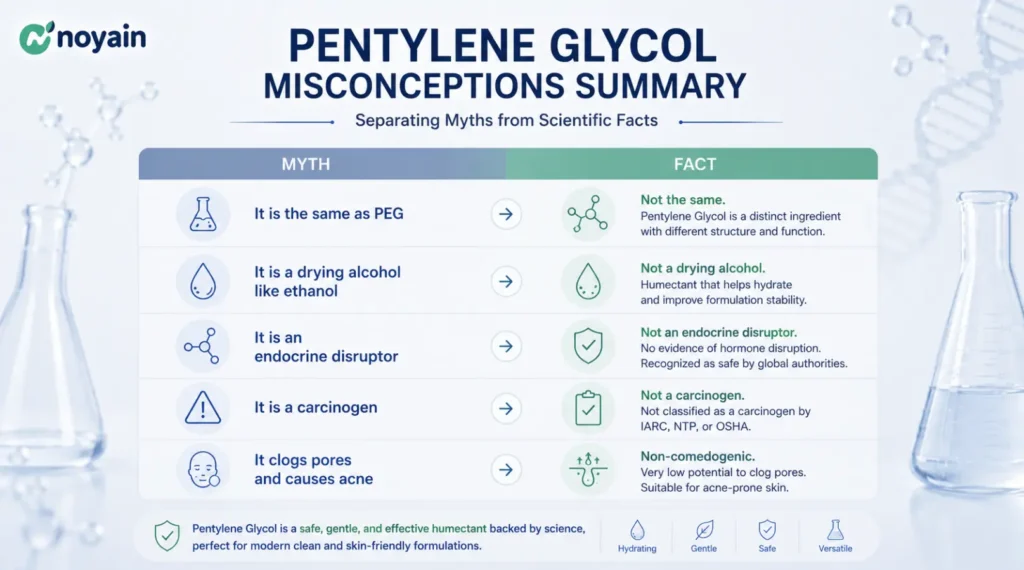
“Is pentylene glycol a PEG?”
No. PEGs (polyethylene glycols) are polymers of ethylene oxide with the repeating structure (O-CH₂-CH₂)n. Pentylene glycol is a simple, fixed-molecule diol (C₅H₁₂O₂). It is PEG-free by definition and does not contain ethoxylated chains. This makes it suitable for PEG-free and clean beauty formulations.
“Is pentylene glycol an alcohol?”
Chemically, yes — pentylene glycol contains two hydroxyl (OH) groups, classifying it as a diol or glycol. But in the cosmetic context, “alcohol” generally refers to simple alcohols like ethanol and SD alcohol, which are known for their drying and irritating effects. Pentylene glycol does not share those properties. It is a moisturizing humectant, not a drying solvent.
“Is pentylene glycol an endocrine disruptor?”
No. Pentylene glycol has no known affinity for estrogen, androgen, or thyroid receptors. It is not listed in the EU’s endocrine disruptor priority list or the EDC database.
“Does pentylene glycol cause cancer?”
No. Pentylene glycol is not classified as a carcinogen by IARC, NTP, or California Prop 65. It is negative in standard genotoxicity assays.
“Is pentylene glycol drying?”
No, the opposite is true. Pentylene glycol is a humectant — it attracts and retains moisture in the skin. It improves the sensory profile of formulations by reducing the sticky or tacky feeling associated with other humectants like glycerin.
10. What Safety Documents Should Buyers Request?
For procurement professionals evaluating pentylene glycol suppliers, the following documentation provides a complete safety and compliance picture:
| Document | Purpose | What It Verifies |
|---|---|---|
| COA (Certificate of Analysis) | Batch conformance to specifications | Purity, identity, residual solvents, heavy metals per batch |
| TDS (Technical Data Sheet) | Physical and chemical properties | Appearance, solubility, pH, density, flash point |
| SDS / MSDS (Safety Data Sheet) | Hazard communication | Handling, storage, transport, emergency measures |
| Allergen Statement | Regulatory compliance | Declaration of EU-listed fragrance allergens (typically: none) |
| Heavy Metal Test Report | Brand compliance | Arsenic, cadmium, mercury, lead (typically: below detectable limits) |
| Halal / Vegan Certificate | Market access | Certification body, scope, validity |
| Non-GMO Declaration | Brand positioning | GM-free manufacturing process |
Our Pentylene Glycol product page provides all of the above technical documentation upon request: Request Documentation →
11. Regulatory Status Worldwide
| Authority | Status | Reference |
|---|---|---|
| FDA (USA) | No specific cosmetic restrictions currently apply to pentylene glycol; permitted for use in various consumer applications | 21 CFR |
| CIR (USA) | Safe as used in cosmetic formulations when formulated to be non-irritating | Final Assessment 2022 (CIR Website ↗) |
| EU CosIng | Listed as an authorized cosmetic ingredient | CosIng Database ↗ |
| REACH (EU) | Registered — CAS 5343-92-0 | ECHA Dossier ↗ |
| China NMPA | Listed in IECIC (Inventory of Existing Cosmetic Ingredients in China) | IECIC 2021 |
| Korea KFDA | Approved for cosmetic use | MFDS Cosmetic Ingredient List |
| EWG | Score 1 (Low Hazard) | Skin Deep Database ↗ |
Regulatory References:
- ECHA substance record for 1,2-Pentanediol (CAS 5343-92-0): https://echa.europa.eu/substance-information/-/substanceinfo/100.023.945
- EU CosIng ingredient listing: https://ec.europa.eu/growth/tools-databases/cosing/
- CIR Safety Assessment of 1,2-Glycols: Published in International Journal of Toxicology, 2022
FAQ
Is pentylene glycol safe for sensitive skin?
Yes. Available clinical data indicates a low irritation and low sensitization profile when used at typical cosmetic concentrations (1–5%). Pentylene glycol is widely used in formulations designed for sensitive, reactive, and rosacea-prone skin.
Can pentylene glycol cause acne?
No. Pentylene glycol has a comedogenic rating of 0–1 and is generally considered non-comedogenic. It is unlikely to clog pores or trigger breakouts and is frequently used in acne-friendly formulations.
Is pentylene glycol safe during pregnancy?
Current toxicological assessments, including CIR and ECHA reviews, have not identified reproductive or developmental concerns at cosmetic use levels. Pentylene glycol is not classified as a reproductive toxicant by any major regulatory body.
Is pentylene glycol a PEG?
No. Pentylene glycol is a simple diol and is chemically unrelated to polyethylene glycols (PEGs). It is completely PEG-free and suitable for PEG-free formulation claims.
What concentration of pentylene glycol is typically used in cosmetics?
Most cosmetic formulations use between 1–5% pentylene glycol, depending on the desired function:
- 1–3% — Humectant and skin conditioning
- 3–5% — Preservative boosting and multifunctional performance
Does pentylene glycol have side effects?
Documented side effects are rare and generally mild. Most reports involve mild, transient irritation in individuals with extremely sensitive or compromised skin barriers. Allergic contact dermatitis is extremely uncommon. The CIR panel did not identify significant safety concerns at typical use levels.
Looking for Cosmetic-Grade Pentylene Glycol?
Our cosmetic-grade pentylene glycol is supplied with complete technical documentation:
- COA (Certificate of Analysis) per batch
- TDS (Technical Data Sheet) with full specifications
- SDS / MSDS (Safety Data Sheet)
- Regulatory support documentation (REACH, CosIng, IECIC)
- Global export experience — consistent quality across markets
Request Technical Documentation or Formulation Support →
References
- Cosmetic Ingredient Review (CIR). “Safety Assessment of 1,2-Glycols as Used in Cosmetics.” International Journal of Toxicology. 2022. https://www.cir-safety.org/
- EWG Skin Deep Database. “Pentylene Glycol.” Accessed 2026. https://www.ewg.org/skindeep/
- European Chemicals Agency (ECHA). “1,2-Pentanediol — Substance Information.” CAS 5343-92-0. https://echa.europa.eu/substance-information/-/substanceinfo/100.023.945
- EU CosIng Database. “Pentylene Glycol.” https://ec.europa.eu/growth/tools-databases/cosing/
- U.S. Food and Drug Administration. Cosmetic Ingredient Regulations. 21 CFR.
- China NMPA. Inventory of Existing Cosmetic Ingredients in China (IECIC). 2021.
- Johnson, W. et al. “Safety Assessment of 1,2-Glycols.” International Journal of Toxicology. 2022.
This safety review is provided for informational purposes. For specific regulatory or formulation questions, consult with your quality and compliance team. Our team can assist with technical documentation, compliance verification, and formulation support.