Article Intro: At Noyain, we frequently evaluate pentylene glycol in water-based serum, toner, essence, and sheet-mask systems where hydration, sensory feel, and preservative support need to be optimized simultaneously. This article summarizes both formulation principles and observations from our internal screening work.
Quick Answer
Yes, one ingredient can help with both moisturization and preservation support, but it cannot replace formulation testing.
At Noyain, this question appears most often in water-based serums, toners, essences, and sheet mask liquids where the same formula needs lighter hydration, lower tack, and better preservative-system support. The recommendations below combine general formulation principles with observations from internal screening work.
Many formulators search for a pentylene glycol preservative solution when trying to improve both hydration and microbial robustness in the same formula. The more accurate framing is preservative-support strategy: pentylene glycol can help the system perform better, but the finished product still needs a validated preservative design.
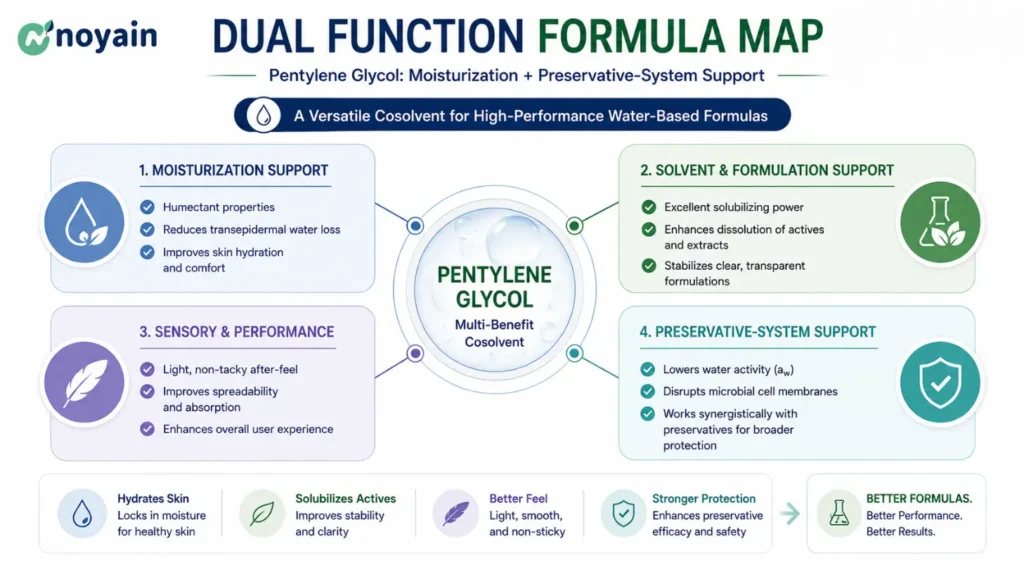
Pentylene glycol is useful because it works as a humectant, solvent, skin-conditioning agent, texture modifier, and preservative booster. In practical skincare formulation, that means it can help the formula feel more hydrated while also supporting the preservative system by reducing available water and improving the environment in which traditional preservatives work.
The important nuance is this: pentylene glycol is usually a preservative booster, not a stand-alone preservative strategy. In practice, it is best used to make a preservation system more efficient, not to remove challenge testing or skip a proper antimicrobial preservative system.
Key Takeaways
- Pentylene glycol is a multifunctional skincare ingredient used for humectancy, solvent support, sensory improvement, and preservative-system support.
- It can support both moisturization and preservation strategies, but it should not be treated as a stand-alone preservative.
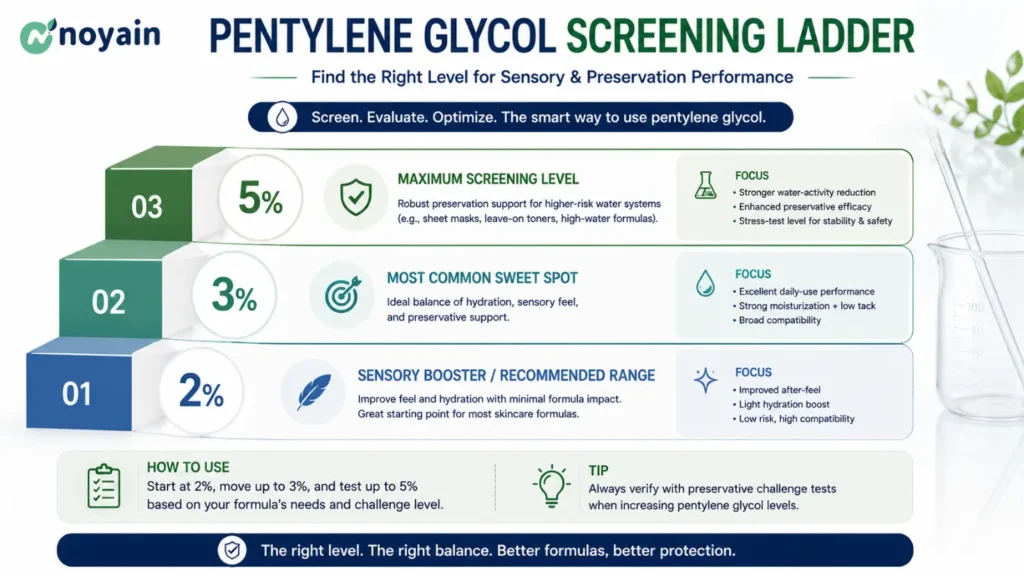
- At Noyain, our most common screening levels are 2% for sensory optimization, 3% as the primary screening point, and 5% as the upper evaluation point for higher-risk water systems.
- Most leave-on serum, toner, and essence projects start around 3% before moving higher.
- Challenge testing remains essential because the result depends on the full formula, packaging, pH, water activity, and preservative system.
One mistake we repeatedly see is treating pentylene glycol as a preservative replacement rather than a preservative-support ingredient. In our experience, formulas perform best when pentylene glycol is evaluated as part of a complete hurdle strategy rather than as a substitute for challenge testing.
Where This Question Comes From
The question usually appears in one of three projects:
- A serum feels hydrating but sticky, and the brand wants a cleaner dry-down.
- A toner or essence needs a milder preservative system for sensitive-skin positioning.
- A brand wants to simplify the ingredient deck without losing formula performance.
In each case, the team is not only looking for “more moisture.” They are looking for a multifunctional ingredient that can reduce the number of compromises in the formula.
That is where pentylene glycol becomes interesting. It is not just another glycol sitting in the humectant bucket. Its five-carbon 1,2-diol structure gives it a balance of water affinity and amphiphilic character that can influence hydration feel, solubility, microbial robustness, and sensory profile. For chemical identity checks, PubChem lists the same substance as 1,2-Pentanediol.
What Pentylene Glycol Actually Does in a Formula
Pentylene glycol has several overlapping functions. For this article, the two most important are humectancy and preservation support.
| Function | What It Means in Practice | Why Formulators Care |
|---|---|---|
| Humectant | Helps bind water and reduce moisture loss from the formula and skin surface | Supports hydration claims and improves after-feel |
| Preservative booster | Helps reduce water activity and supports antimicrobial performance when paired with preservatives | May allow a more balanced preservative system |
| Solvent | Helps dissolve fragrance components, extracts, and some actives | Improves clarity and processing flexibility |
| Skin-conditioning agent | Improves slip and rub-out in water-based formulas | Helps reduce the sticky feel of glycerin-rich systems |
| Texture modifier | Can make the formula feel smoother and less heavy | Useful in serums, toners, essences, and gel-creams |
This multifunctionality is why pentylene glycol often earns its place in a formula even when the raw material cost is higher than propylene glycol or glycerin.
The Moisturization Side: Why It Feels Different from Glycerin
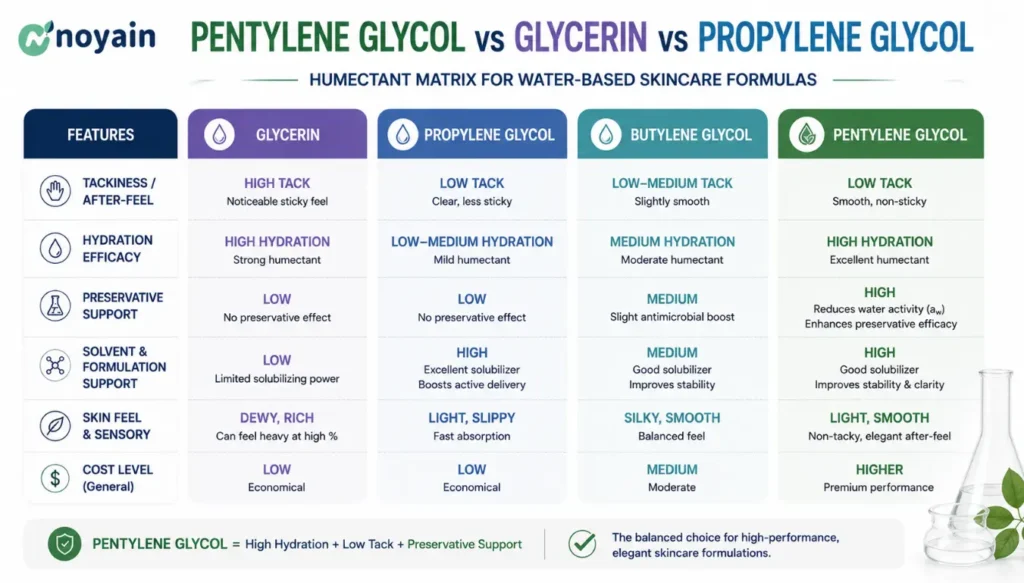
Glycerin is still one of the most efficient and cost-effective humectants in skincare. Pentylene glycol should not be treated as a simple glycerin replacement. The better use is often glycerin balancing.
In a serum or toner, glycerin gives strong water-binding performance, but it can also create tack, drag, and a slow dry-down when used at higher levels. Pentylene glycol can help soften that sensory profile.
From a bench formulation point of view, the benefit is not only “more hydration.” It is a better balance between hydration and elegance:
| Formula Goal | Glycerin Alone | Glycerin + Pentylene Glycol |
|---|---|---|
| Hydration perception | Strong, sometimes heavy | Strong but lighter-feeling |
| Tackiness | Can increase at higher levels | Usually reduced in dry-down |
| Spreadability | Can feel syrupy | Smoother and more fluid |
| Serum clarity | Usually good | Usually good when properly formulated |
| Premium skin feel | Depends on level and chassis | Easier to achieve in leave-on formulas |
For lightweight serums, a split humectant system often works better than pushing glycerin too high. A typical starting point might be glycerin at 2-4% plus pentylene glycol at 2-4%, then adjusting based on tackiness, preservative challenge results, and cost target.
The Preservation Side: Booster, Not Magic Shield
Pentylene glycol can support preservation, but it should be described carefully.
It does not mean the finished product is automatically protected. It does not mean you can skip preservative challenge testing. It does not mean the ingredient should be marketed as the only antimicrobial control in a high-risk water-based product.
What it can do is help create a less favorable environment for microbial growth and improve the performance of a properly selected preservative system.
The support usually comes from three mechanisms:
- Water activity reduction: The vicinal hydroxyl groups in 1,2-diols form hydrogen bonds with free water and bulk water in the formula. Microorganisms need available water, not just total water, so reducing water activity can make the system less hospitable.
- Solvent and distribution support: Pentylene glycol can help some preservative components distribute more evenly in the water phase or mixed phase.
- Membrane interaction support: The C5 chain gives pentylene glycol more amphiphilic character than shorter glycols, which may support antimicrobial performance in combination systems.
For formulators evaluating a pentylene glycol preservative booster strategy, this is one reason the search phrase “pentylene glycol preservative” appears so frequently. The technical correction matters: pentylene glycol is best positioned as a booster or hurdle ingredient, not as a registered stand-alone preservative system.
How to Use It in a Preservative System
For a typical water-based leave-on product, Pentylene Glycol (INCI), also described in chemistry contexts as 1,2-pentanediol, should be treated as part of the preservation strategy, not as the whole strategy. These 1,2-pentanediol formulation adjustments should be screened against the full preservative system, not judged as isolated ingredient swaps.
| Product Type | Starting Level | Main Reason to Use It | Validation Needed |
|---|---|---|---|
| Hydrating serum | 2-4% | Humectancy, lower tack, preservative support | Stability, challenge test, viscosity drift |
| Toner or essence | 2-3% | Clarity, hydration, mild preservative support | Challenge test, fragrance compatibility |
| Sheet mask liquid | 3-5% | Hydration, microbial robustness, feel | Challenge test, packaging compatibility |
| Gel-cream | 2-4% | Better dry-down and system support | Emulsion stability, viscosity, challenge test |
| Mild cleanser | 1-3% | Solvent support and preservation help | Foam, clarity, preservation |
At Noyain, the usual screening ladder is 2%, 3%, and 5%, adjusted by product type. The goal is to find the lowest level that improves both the sensory profile and the preservation margin without pushing cost or skin feel too far.
If you are ready to screen this multifunctional ingredient in your next chassis, you can request technical specifications, sample options, and standard packaging sizes directly on our Pentylene Glycol Product Page.
Should You Use Pentylene Glycol?
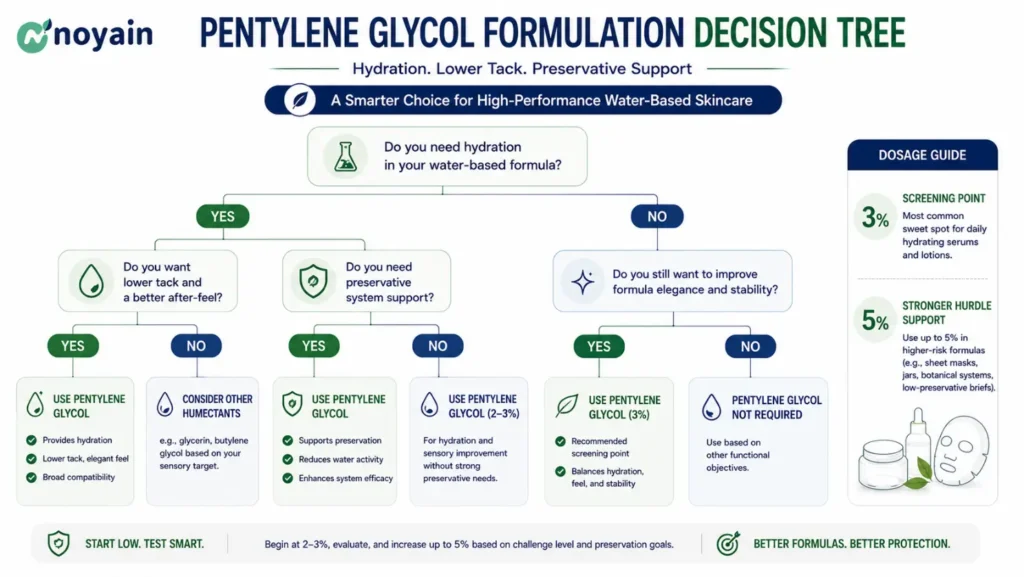
Use this decision tree before building the test matrix:
Do you need better hydration in a water-based formula?
  |
  +-- No -> Pentylene glycol may not be the first priority.
  |
  +-- Yes
       |
       +-- Do you also need lower tack or faster dry-down?
              |
              +-- Yes -> Screen pentylene glycol at 2-3%.
              |
              +-- No -> Compare with glycerin, propanediol, or butylene glycol.
       |
       +-- Do you need preservative-system support?
              |
              +-- Yes -> Start at 3% with the full preservative system.
              |
              +-- Higher-risk water system?
                    |
                    +-- Sheet mask / jar / botanical load / low-preservative brief -> Screen 5% as the upper test point.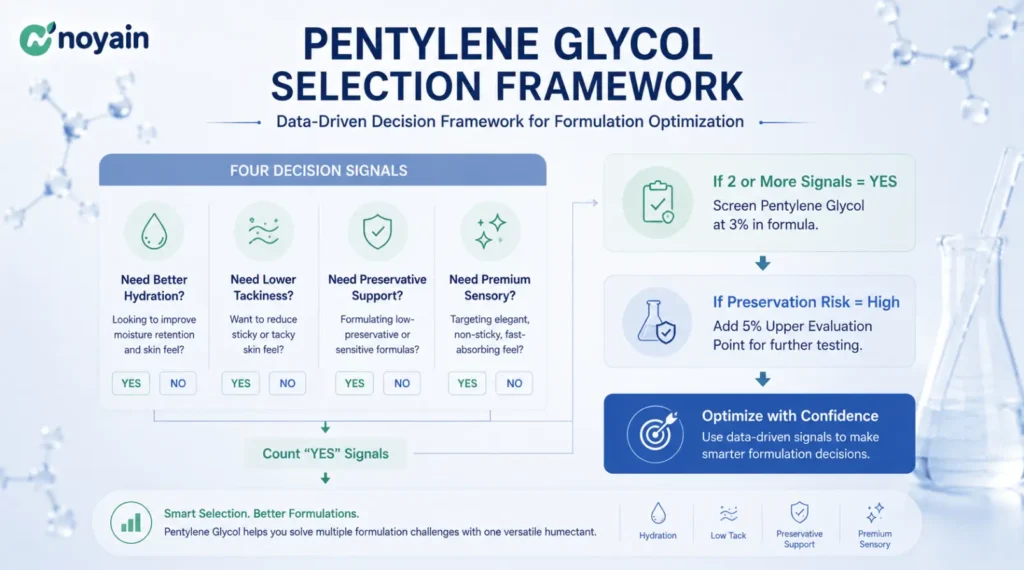
Example: Lightweight Hydrating Serum Test System
Below is a simple test chassis for evaluating whether pentylene glycol improves both moisturization feel and preservative-system support.
Lightweight Hydrating Serum Test System

Deionized Water ..................... q.s. to 100%
Glycerin ............................ 3.00%
Pentylene Glycol .................... 3.00%
Niacinamide ......................... 4.00%
Panthenol ........................... 0.50%
Sodium Hyaluronate .................. 0.10%
Carbomer or Acrylates/C10-30 Polymer  0.15-0.25%
Neutralizer ......................... q.s.
Preservative System ................. supplier-recommended level
pH Target ........................... 5.5-6.2
This is not a finished commercial formula. It is a screening system.
The test should compare at least three versions:
| Version | Change | What to Observe |
|---|---|---|
| A | Glycerin only | Baseline tack, viscosity, preservation result |
| B | Glycerin + 3% pentylene glycol | Dry-down, clarity, preservative support |
| C | Glycerin + propylene glycol | Cost-efficient alternative benchmark |
The evaluation should track rub-out, dry-down after 3 minutes, tackiness after 10 minutes, viscosity after heat aging, microbial challenge results, and odor shift after accelerated stability.
What Surprised Me During Screening
One observation that surprised us was that increasing pentylene glycol from 3% to 5% did not always produce a proportional improvement in preservative-system support.
In several niacinamide serum prototypes, the sensory gain between 3% and 5% was marginal, while raw material cost increased noticeably. The 5% version did not always feel worse, but it rarely felt twice as useful as the 3% version. Once the formula already had good clarity, acceptable rub-out, and a reasonable preservative system, the extra 2% sometimes added more cost than practical decision value.
As a result, 3% often became the practical optimization point unless the formula contained:
- High botanical or extract load
- Sheet mask liquid or ampoule format
- Low-preservative positioning
- High consumer contamination risk
- Jar packaging or repeated finger contact
- A preservative system that needed more hurdle support
This is the kind of decision that does not show up in ingredient database summaries. A supplier can say “use 1-5%,” but the formulator still needs to decide where the performance curve starts to flatten.
Noyain Internal Formulation Observation
In internal water-based serum screening, pentylene glycol tends to show its value most clearly when the base formula already contains glycerin, niacinamide, panthenol, or other water-soluble actives.
Our directional observation is:
- 2% pentylene glycol improves slip but may not give enough preservation support in difficult systems.
- 3% is often the practical sweet spot for leave-on serums and toners because it can improve dry-down and give useful hurdle support without making cost or sensory feel harder to defend.
- 5% can provide stronger preservation support in higher-risk systems, but the return may flatten in simple serum chassis, so cost, sensory feel, and claim strategy should be checked.
- The biggest sensory improvement appears when pentylene glycol is used to balance glycerin rather than replace all humectants.
These are formulation observations, not universal performance claims. Final formulas still require preservative efficacy testing, stability testing, packaging compatibility checks, and regional compliance review.
Compatibility Notes
Pentylene glycol is generally easy to use, but it still affects the formula system. Do not add it as a last-minute “booster” without checking the full chassis.
| Factor | What to Check | Practical Recommendation |
|---|---|---|
| pH | Finished pH and preservative pH window | Keep the preservative system inside its effective range |
| Polymer thickener | Viscosity, neutralization, clarity | Check viscosity after adding glycols because some polymers respond differently |
| Electrolytes | Salt load from actives and extracts | Monitor gel thinning in electrolyte-sensitive systems |
| Fragrance or essential oil | Clarity, odor, solubilization | Run freeze-thaw and heat stability before launch |
| Preservatives | Challenge test result, phase distribution | Treat pentylene glycol as support, not a replacement for validation |
| Packaging | Extractables risk, headspace, pump compatibility | Test in final packaging, especially for mask liquids and toners |
If your formula uses organic acids, phenoxyethanol blends, caprylyl glycol, ethylhexylglycerin, or low-pH systems, pentylene glycol may help, but the result depends on pH, water phase composition, and total formula load.
Processing Notes
Pentylene glycol is generally heat-stable and easy to incorporate. Unlike some volatile texturizers or fragrance-like sensory modifiers, it can usually be added in either of two places:
- Water phase before heating
- Post-emulsification cool-down phase below 40°C, often alongside preservatives or heat-sensitive materials
For most serum systems, I prefer adding it to the water phase early during development. This simplifies processing, improves batch-to-batch consistency, and makes it easier to evaluate viscosity, clarity, and polymer hydration under repeatable conditions.
However, the final addition point should still be validated. If the formula contains fragrance, botanical extracts, solubilizers, organic acids, or a delicate preservative blend, compare early addition against cool-down addition and check:
- Clarity after 24 hours and after heat aging
- Viscosity drift after freeze-thaw
- Odor shift after accelerated stability
- pH movement after neutralization
- Preservative challenge performance
The optimal addition point should always be confirmed through stability, viscosity, and preservative testing in the finished formula.
Why Not Just Use Caprylyl Glycol?
Caprylyl glycol is often selected when the formulator wants stronger antimicrobial support from a higher-carbon glycol. It can be very useful in preservation systems, especially when paired with phenoxyethanol or other preservative components.
Pentylene glycol is different. It is usually the better candidate when the formula needs a balance between:
- Humectancy
- Preservation support
- Solvent performance
- Sensory feel
- Cost defensibility
- Clean beauty or sensitive-skin positioning
In practice, caprylyl glycol and pentylene glycol are frequently used together rather than treated as direct substitutes. Caprylyl glycol may carry more of the antimicrobial-support role, while pentylene glycol helps improve hydration feel, water-phase handling, and formula elegance.
| Ingredient | Best Strength | Watchpoint |
|---|---|---|
| Pentylene Glycol | Hydration + sensory + preservative support balance | May not be strong enough alone in high-risk formulas |
| Caprylyl Glycol | Stronger preservative boosting in many systems | Can be harder to solubilize and may affect skin feel |
| Ethylhexylglycerin | Preservative boosting and deodorant-style support | Can be system-dependent and sometimes sensitization-sensitive |
| Propanediol | Natural-positioned humectant and solvent | Weaker preservative boost than pentylene/caprylyl glycol systems |
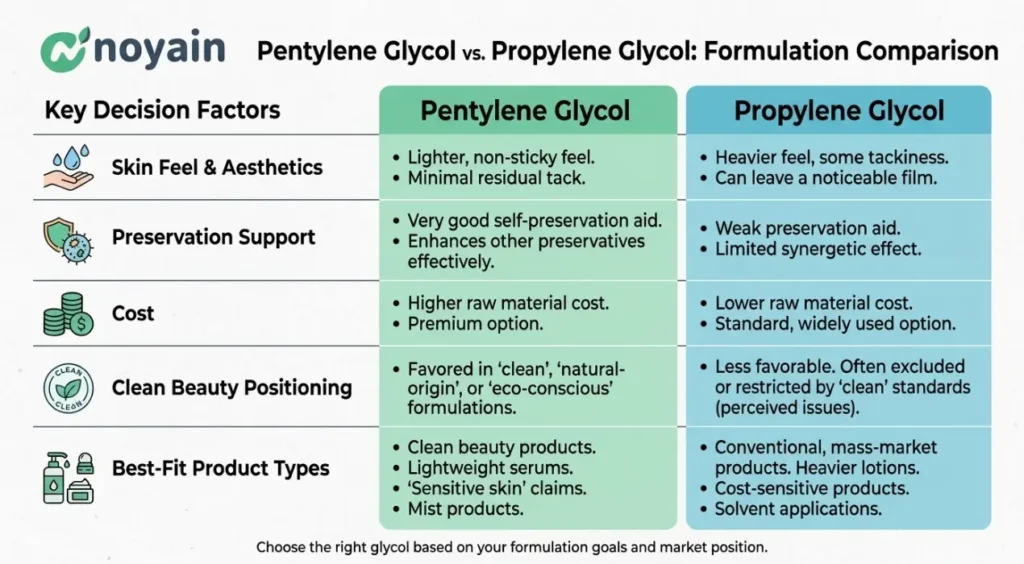
| Propylene Glycol | Low-cost humectant and solvent | Less attractive for clean beauty and premium skin feel |
For a high-risk water system, the decision is usually not “pentylene glycol vs caprylyl glycol.” The better question is whether the formula needs a layered hurdle strategy.
Common Preservation Combinations
Pentylene glycol is most useful when it is designed into a preservation system rather than added as an afterthought. The table below summarizes common combinations and the practical watchpoints.
| Combination | Typical Use Case | Advantages | Watchpoints |
|---|---|---|---|
| Pentylene glycol + phenoxyethanol | Serums, toners, essences, gel-creams | Familiar global system, better distribution support, good fit for many leave-on products | Check brand restrictions on phenoxyethanol and confirm final challenge test |
| Pentylene glycol + ethylhexylglycerin | Sensitive-skin or preservative-optimized formulas | Good booster pairing, can support lower overall preservative burden | Sensitization perception and system dependence should be reviewed |
| Pentylene glycol + caprylyl glycol | Higher-risk water systems, sheet masks, jar products | Layered glycol hurdle support and broader sensory/preservation balance | Caprylyl glycol solubilization and skin feel need close checking |
| Pentylene glycol + organic acid systems | Low-pH toners, AHA/BHA products, acidic essences | Useful when pH supports organic acid preservatives | pH control is critical; neutralization can reduce efficacy |
| Pentylene glycol + chelator + conventional preservative | Extract-rich formulas or formulas with metal-ion risk | Helps preservation robustness in complex systems | Confirm compatibility with actives, fragrance, and packaging |
From screening work, the most common mistake is choosing the booster before defining the microbial risk. A simple water-based serum and a sheet mask liquid do not need the same level of hurdle design.
When Pentylene Glycol Is a Good Fit
Pentylene glycol is a strong candidate when the formula brief includes several of these requirements:
- Leave-on skincare format
- Light, non-sticky texture
- Hydration claim
- Sensitive-skin or clean beauty positioning
- Phenoxyethanol-reduced or preservative-optimized system
- High water phase
- Glycerin tackiness problem
- Need for solvent support without a heavy skin feel
The strongest fit is usually in serums, toners, essences, ampoules, sheet mask liquids, gel-creams, and lightweight lotions.
Need samples, COA, TDS, or formulation support?
View the Pentylene Glycol Product Page to request technical documents, sample options, standard packaging sizes, and formulation guidance.
When It May Not Be the Best First Choice
Pentylene glycol is useful, but it is not always the first answer.
It deserves more caution when:
- The formula is extremely cost-sensitive.
- The product is rinse-off and sensory improvement is less valuable.
- The formula already passed preservation and stability with a lower-cost glycol.
- The brand does not need clean beauty or sensitive-skin positioning.
- The target market requires a very specific natural certification route and documentation is not yet confirmed.
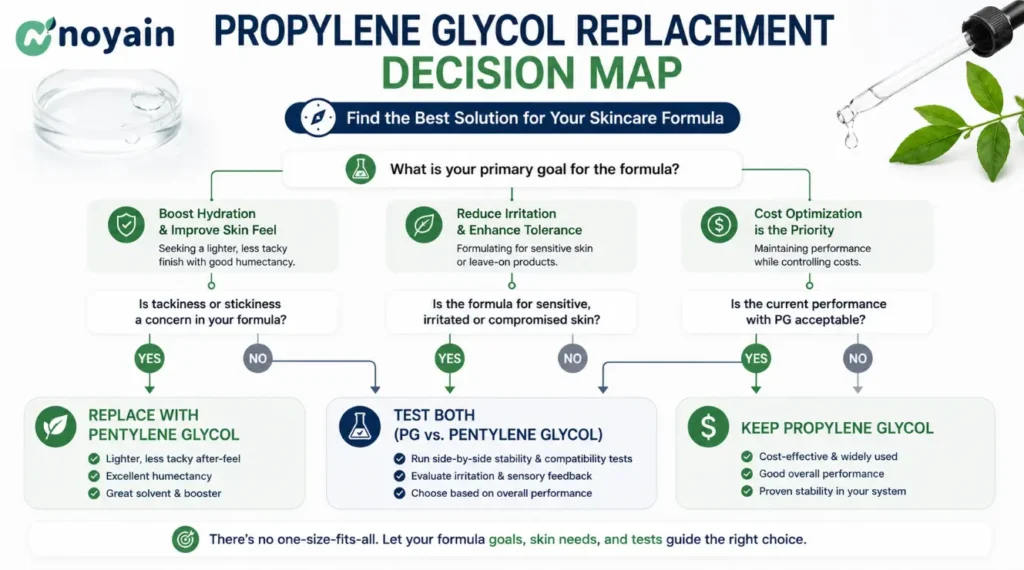
In these cases, propylene glycol, butylene glycol, glycerin, propanediol, or a traditional preservative system may still be the better commercial choice.
For a replacement-focused comparison, read Should I Replace Propylene Glycol in My Formula?.
Preservation Testing: What You Still Need to Run
The most common mistake is assuming that a preservative booster removes the need for formal testing. It does not.
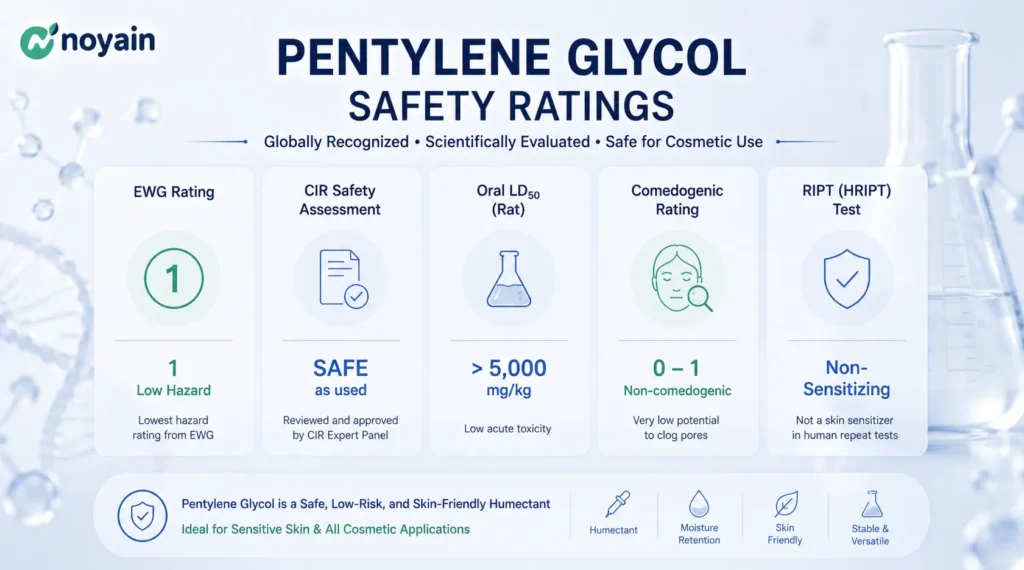
The Cosmetic Ingredient Review safety assessment of alkane diols is useful background for ingredient safety context, but it does not replace preservative efficacy testing in the finished formula.
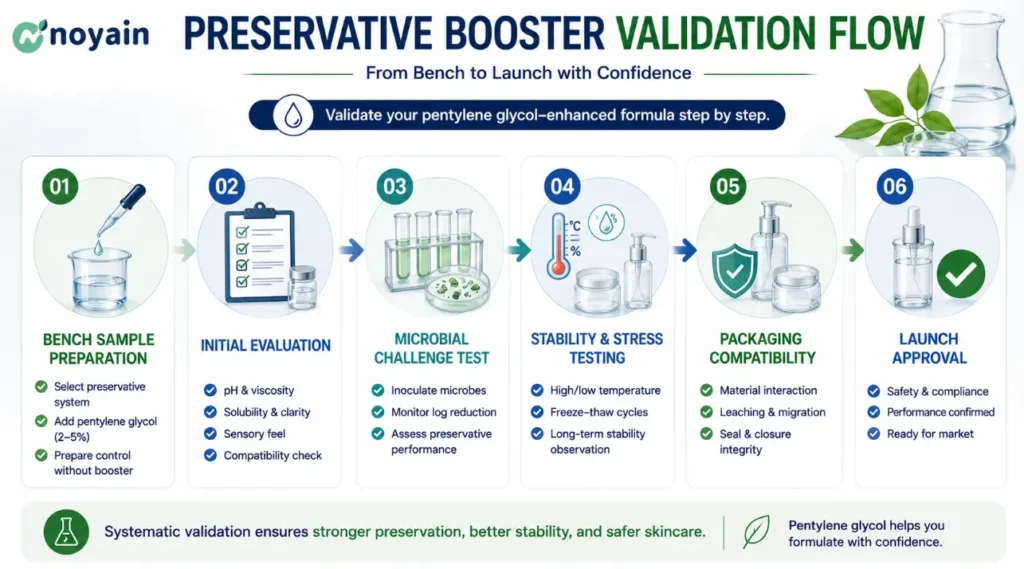
Before launch, run:
| Test | Why It Matters |
|---|---|
| Preservative efficacy test / challenge test | Confirms the finished product can control microbial contamination |
| Accelerated stability | Checks viscosity, odor, color, pH, clarity, and separation |
| Freeze-thaw | Screens for clarity, crystallization, and emulsion stress |
| Packaging compatibility | Confirms the formula behaves in the final container |
| Use simulation | Helps assess contamination risk from consumer handling |
| Regional compliance review | Confirms claims and ingredient use are acceptable for the target market |
If the formula is a sheet mask, jar cream, baby product, eye-area product, or low-preservative concept, be more conservative. These products have higher risk profiles and need stronger validation.
Buyer & Sourcing Guide
Why Buyers Choose It
Many purchasing teams initially compare pentylene glycol against propylene glycol only on cost per kilogram. On that narrow metric, pentylene glycol usually looks more expensive.
But cosmetic ingredient buying is not only a raw-material price exercise. In some projects, formulators may be able to:
- Reduce glycerin loading while keeping a hydrated skin feel
- Improve dry-down without adding another sensory modifier
- Support a more efficient preservative system
- Reduce the number of separate functional ingredients
- Support premium, sensitive-skin, clean beauty, or natural-origin positioning
- Make the ingredient deck easier for a brand team to explain
That does not mean pentylene glycol always lowers total formula cost. Sometimes it does not. But in premium leave-on skincare, the overall formulation value may outweigh the higher raw material price.
This is especially relevant for brands selling serums, essences, sheet masks, ampoules, and gel-creams where texture, claims, and buyer confidence matter as much as the cost of one line item.
What Specifications Matter
Not all pentylene glycol grades behave identically in leave-on skincare, even when the INCI name is the same. From a supplier and formulation-support perspective, the specification sheet matters because small differences in impurity profile can influence odor stability, color stability, and buyer confidence. For identity and registry confirmation, buyers can cross-check the FDA GSRS Pentylene Glycol substance record.
When sourcing material, formulators and buyers should verify:
- Assay / purity
- Water content
- Color, often reported as APHA or Hazen color
- Odor profile
- Residual impurities
- Heavy metals or relevant impurity limits, where applicable
- Manufacturing route
- Bio-based content, if natural-origin positioning is relevant
- Batch-to-batch consistency
- Packaging and storage conditions
Small odor differences can become more noticeable in minimalist leave-on products, especially toners, essences, and fragrance-free serums. This is why a lab sample should be evaluated not only in water, but in the real formula chassis after heat aging and final packaging contact.
When to Request Samples
Requesting a laboratory sample is worthwhile when:
- You are reformulating away from propylene glycol
- You are trying to reduce glycerin tack
- You are optimizing a preservative system
- You are developing a premium serum, toner, essence, ampoule, or sheet mask liquid
- You need a multifunctional ingredient to simplify the formula
- You need to compare synthetic vs bio-based sourcing options
- You need to confirm odor stability in a fragrance-free leave-on product
For these projects, ask for the sample together with COA, TDS, SDS/MSDS, recommended use level, packaging information, and available certification documents. You can request these through the Pentylene Glycol Product Page.
What to Ask Suppliers
Because pentylene glycol is often used for both performance and claim support, buyers should not evaluate it only by price.
Ask for:
- INCI name: Pentylene Glycol
- Chemical name: 1,2-Pentanediol
- CAS number: 5343-92-0
- Purity or assay
- COA, TDS, and SDS/MSDS
- Odor and color specification
- Water content and impurity profile
- Origin: synthetic or bio-based
- Certification options: COSMOS-compatible, vegan, halal, or other claims if needed
- Recommended use level and processing guidance
- Packaging size, MOQ, lead time, and shelf life
For sample requests, COA/TDS/MSDS, and technical formulation support, contact us through the Pentylene Glycol Product Page or Contact Us.
Formulation Troubleshooting
| Problem | Possible Cause | What to Try |
|---|---|---|
| Formula still feels sticky | Glycerin level too high or polymer drag | Reduce glycerin, test 2-4% pentylene glycol, adjust polymer |
| Challenge test fails | Booster level too low or preservative system not suited to pH | Rework preservative system, check pH, test 3-5% pentylene glycol |
| Viscosity drops | Glycol affects polymer hydration or electrolyte load is high | Adjust thickener, hydration order, or neutralization |
| Odor changes during stability | Fragrance, extract, or preservative interaction | Run blank controls and heat-aging comparison |
| Formula becomes hazy | Solubilization or phase balance issue | Check fragrance load, surfactant/solubilizer, and cooling process |
| Cost is too high | Full replacement may not be needed | Try partial replacement or lower level with stronger preservative support |
The practical answer is rarely “use more.” The better answer is usually to build a small screening matrix and let sensory, stability, and challenge data decide.
Practical Recommendation
If your formula is a modern leave-on skincare product, pentylene glycol is one of the first multifunctional ingredients worth testing for improving both moisturization and preservation support.
Use it when you need:
- A lighter humectant system
- Better dry-down than glycerin-heavy formulas
- Support for a preservative system
- Cleaner label positioning
- A smoother formulation story for sensitive-skin or premium skincare
Start at 2-3% for sensory and humectancy support. Move toward 3-5% when preservation support is part of the goal. Then confirm the final decision with stability, challenge testing, and packaging evaluation.
That is the right way to think about pentylene glycol: not as a shortcut, but as a formulation tool that can help one ingredient do more than one job.
FAQ
Is pentylene glycol a preservative?
Pentylene glycol is usually used as a preservative booster rather than a stand-alone preservative. It can support preservation by reducing available water and improving preservative-system performance, but finished formulas still need proper preservative efficacy testing.
What percentage of pentylene glycol should I use?
For skincare formulas, a common screening range is 1-5%. For humectancy and sensory improvement, 2-3% is a practical starting point. For stronger preservative-system support, formulators often screen 3-5%, depending on the product type and preservative system.
Can pentylene glycol replace phenoxyethanol?
Not directly. Pentylene glycol may help reduce preservative load in some systems, but it should not be treated as a direct replacement for phenoxyethanol without challenge testing. The answer depends on pH, packaging, water activity, product type, and the full preservative system.
Does pentylene glycol lower water activity?
Pentylene glycol can help lower water activity by binding part of the free water in a formula through hydrogen bonding. The degree of reduction depends on concentration, total humectant system, electrolyte load, and the rest of the formula. If water activity is a critical control point, measure it directly rather than assuming the effect from use level alone.
Is pentylene glycol a hurdle technology ingredient?
It can be used as part of a hurdle strategy in cosmetic preservation. In this context, “hurdle” means the formula uses multiple barriers, such as lower water activity, suitable pH, preservative chemistry, packaging control, and good manufacturing practice. Pentylene glycol may support one or more of those hurdles, but it does not replace full preservative validation.
Can pentylene glycol improve preservative efficacy?
Yes, pentylene glycol can improve preservative efficacy in some systems by reducing available water and supporting preservative distribution. The result is formula-dependent, so the only reliable answer comes from side-by-side challenge testing in the finished product.
Pentylene glycol vs caprylyl glycol: which is better for preservation?
Caprylyl glycol is often stronger as an antimicrobial-support ingredient, while pentylene glycol usually gives a better balance of humectancy, skin feel, solubility, and preservation support. Many formulas use them together instead of choosing only one.
Can pentylene glycol be used in preservative-free formulations?
It can support low-preservative or self-preserving concepts, but the phrase “preservative-free” needs caution. A water-based skincare product still needs microbial protection. If a brand wants a preservative-free claim, the full formula, packaging, manufacturing controls, and challenge test results must support that claim.
Is pentylene glycol natural?
Pentylene glycol may be produced through synthetic or bio-based manufacturing routes depending on the supplier. Always verify origin, certifications, bio-based content, and supporting documentation directly with the supplier if natural-origin positioning is important for the project.
What is the difference between pentylene glycol and 1,2-pentanediol?
They refer to the same chemical substance. Pentylene glycol is the cosmetic industry name and INCI name, while 1,2-pentanediol is the systematic chemical name commonly used in technical documents, chemistry references, SDS files, and supplier specifications.